ISSN 0104-6632 Printed in Brazil
www.abeq.org.br/bjche
Vol. 27, No. 03, pp. 441 - 450, July - September, 2010
Brazilian Journal
of Chemical
Engineering
AN ALGEBRAIC APPROACH FOR
SIMULTANEOUS SOLUTION OF PROCESS AND
MOLECULAR DESIGN PROBLEMS
S. Bommareddy, N. G. Chemmangattuvalappil, C. C. Solvason and M. R. Eden
*Department of Chemical Engineering, Auburn University, AL, 36849, USA. E-mail: [email protected]
(Submitted: December 11, 2009 ; Revised: July 28, 2010 ; Accepted: July 30, 2010)
Abstract - The property integration framework has allowed for simultaneous representation of processes and products from a properties perspective and thereby established a link between molecular and process design problems. The simultaneous approach involves solving two reverse problems. The first reverse problem identifies the property targets corresponding to the desired process performance. The second reverse problem is the reverse of a property prediction problem, which identifies the molecular structures that match the targets identified in the first problem. Group Contribution Methods (GCM) are used to form molecular property operators that will be used to track properties. Earlier contributions in this area have worked to include higher order estimation of GCM for solving the molecular design problem. In this work, the accuracy of the property prediction is further enhanced by improving the techniques to enumerate higher order groups. Incorporation of these higher order enumeration techniques increases the efficiency of property prediction and thus the application range of the group contribution methods in molecular design problems. Successful tracking of properties is the key in applying the reverse problem formulation for integrated process and product design problems. An algebraic technique has been developed for solving process and molecular design problems simultaneously. Since both process and molecular property operators target the same optimum process performance, the set of inequality expressions can be solved simultaneously to identify the molecules that meet the desired process performance. Since this approach is based on an algebraic algorithm, any number of properties can be tracked simultaneously.
Keywords: Property Operators; Reverse Problem Formulation; Molecular Design.
INTRODUCTION
Molecular design is an important activity that helps in obtaining the best performance from a process. Numerous contributions have been made in the field of Computer-Aided Molecular Design (CAMD). Many of these methods include the use of Group Contribution Methods (GCM) which utilize tables comprised of various molecular fragments/groups and their contribution towards a property of the molecule. Higher order groups are also given in these tables to better explain the change in the contribution of a group towards a property due to its neighboring groups. Employing systematic algebraic techniques to design molecules based on GCM decreases the permutations of groups that need to be checked if they have a valid
442 S. Bommareddy, N. G. Chemmangattuvalappil, C. C. Solvason and M. R. Eden
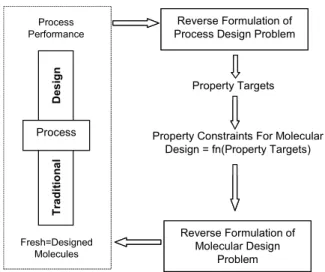
Incorporating higher order groups at a later stage in the algorithm may also lead to a situation where some potential combinations are omitted without being considered in further stages of the algorithm. There is a definite need for solving process and molecular design problems together, as the solution space is limited if these problems are solved separately. For example, the properties of fresh material added to a process depend on existing recycle streams within the process. Solving the process design problems alone would require committing to specific raw materials well in advance to secure a solution. Hence, when process and product design problems are solved together, it will be possible to design molecules that meet the desired process performance. The identification of optimal molecule(s) corresponding to optimum process performance is a challenging issue. Molecular design subject to process constraints through Property Integration and Group Contribution Methods is one possible solution to overcome this limitation. The concept of reverse problem formulation (RPF) has helped formulate integrated process-product design problems without leading to complex MINLP formulations by insightful decoupling of the constitutive equations from the process model (Eden et al., 2003a). RPF enables design of novel molecules and solution of process design problems without commitment to specific components during the solution step (see Figure 1). Techniques have been developed by Eden et al. (2003a, 2003b) for the identification of property targets corresponding to the optimum process performance using a visual approach. An algebraic approach based on a two-stage generate and test methodology would be an efficient extension to these methods, particularly for large problems that normally are prone to combinatorial explosion.
Property Constraints For Molecular Design = fn(Property Targets)
Process Performance
Fresh=Designed Molecules
Reverse Formulation of Process Design Problem
Property Targets
Reverse Formulation of Molecular Design
Problem
T
ra
d
it
io
n
a
l
D
e
s
ig
n
Process Property Constraints For Molecular Design = fn(Property Targets)
Process Performance
Fresh=Designed Molecules
Reverse Formulation of Process Design Problem
Property Targets
Reverse Formulation of Molecular Design
Problem
T
ra
d
it
io
n
a
l
D
e
s
ig
n
Process
Figure 1: Simultaneous Solution using Reverse Problem Formulation
PROPERTY INTEGRATION
Processes and molecules can be represented by their properties through the Property Integration framework (Shelley and El-Halwagi, 2000; Eden et al, 2003a; Eljack et al., 2007). The key point lies in targeting the optimal property ranges of the desired molecules for a given process performance. These property ranges serve as the input to the molecular design problem which returns the possible molecules. To enable this simultaneous solution approach, Group Contribution Methods (Marrero and Gani, 2001) that assist in predicting the properties of molecules based on their structural characteristics were incorporated into the Property Integration framework.
Process Property Operators
Properties form the basis of the performance of many process units and so they should be considered as design variables for a given process/product performance. As properties are not generally conserved, a function is tailored for an original property to find its conserved surrogate (Shelley and El-Halwagi, 2000). These functions, called the Process Property Operators, are often non-linear, but they are tailored to add the property contributions from different streams linearly to obtain the conserved property surrogates corresponding to the properties of the product stream:
sources
N
j j i j ji
i
(P ) x (P )
φ =
∑
φ (1)where φj(Pji) is the property operator of the jth property Pji of stream i, xi is the fractional contribution and Nsources is the total number of streams. For instance, density does not exhibit a linear mixing rule; however, the reciprocal value of density follows a linear mixing rule. Hence, the Property Operator for density would be its inverse:
1 2 3
1 1 1 1
= + +
ρ ρ ρ ρ (2)
Group Contribution Method for Property Estimation
An Algebraic Approach for Simultaneous Solution of Process and Molecular Design Problems 443
f f s s t t
f s t
f (Y)=
∑
N C +∑
N C +∑
N C (3)Nf, Ns and Nt are the number of first, second and third order groups and Cf, Cs and Ct are their respective property contributions. The property function is complex, but property contributions from each molecular group are forced to obey simple linear additive rules. Higher order groups in the group contribution tables helps in describing the molecules better because they account for proximity effects.
Molecular Property Operators
The operator expressions for molecular fragments differ from that of process streams. However, since they represent the same properties, it is possible to relate them. Inclusion of GCM for molecular design introduces molecular property operators. The molecular property operators are tailored in such a way that the right-hand side of the equations is always in the form of a summation of the number of each group (ng) multiplied by the contribution to property j from group g, (Pjg). The molecular property operator φjM is given by (Eljack et al., 2007):
g
N M
j j,m g j,g
g 1
(P ) n P
=
φ =
∑
(4)SIMULTANEOUS PROCESS AND MOLECULAR DESIGN
Traditionally process and molecular design problems have been solved separately with little or no feedback between each other. Since both design problems aim at satisfying a given process performance, they can be connected from a property perspective to bridge the gap between process and molecular design problems. Visualization approaches have been developed (Eljack et al., 2007; Kazantzi et al., 2007), but, due to their inability to handle more than three properties efficiently in these componentless design problems, an algebraic approach is needed. Also, scaling down data to fit into a graphical representation may prevent it from capturing data at the right level of detail (Qin et al., 2004). An algebraic molecular design approach using higher order groups has been developed (Chemmangattuvalappil et al., 2009), but its application range could be improved if
the accuracy of the property prediction is enhanced by better techniques for enumerating higher order groups. The technique incorporated in this work aims at reducing the number of combinations of groups that should be checked for forming a molecule with the required properties. This new method is significantly less computationally intensive compared to the previous geometric methods of molecular design. The number of permutations of first order groups can be decreased by introducing higher order groups before permuting the first order groups for each possible combination of them. Since the higher order groups are introduced at the design level itself and not in the screening level, we can be sure that the probability of missing a potential molecule is minimized compared to other methods. Since the possibility of non-existence of each higher order group is considered while generating the combinations, structural isomers can be generated to some extent.
General Problem Statement
The problem is to identify molecules that meet a given process performance and environmental restrictions defined in terms of properties.
Process Design Model
The process design problem aims at finding the admissible property ranges in its conservative surrogate form [φlowerjf ,φupperjf ] and feed flowrate Ff that meets the given process performance without committing to any components.
Process performance may be given by the upper and lower limits of different properties. Consider a process sink which processes a mixture of sources i, such that {i = 1,2,3....Nsources}. Each source entering the sink has a flow rate Fi and property Pji. For a sink with a permissible flowrate F, the performance can be defined by:
lower upper
j j j
P ≤ ≤P P (5)
Since the properties may not be conserved, they are reformulated in terms of their conserved surrogates by the application of the property operators:
lower upper
j (P )j j(P )j j (P )j
φ ≤ φ ≤ φ (6)
444 S. Bommareddy, N. G. Chemmangattuvalappil, C. C. Solvason and M. R. Eden
sources
N
j j i ji ji f jf jf
i
(P ) x (P ) x (P )
φ =
∑
φ + φ (7)Hence, the property operator value for the fresh feed stream is calculated as,
sources
N
jf jf j j i ji ji
f i
1
(P ) (P ) x (P )
x
⎡ ⎤
φ = ⎢φ − φ ⎥
⎢ ⎥
⎣
∑
⎦(8)
where,
i i
F x
F
= (9)
and the feed flowrate to the sink is given by:
sources
N
f i
i
F = −F
∑
F (10)It is evident that, for each property, there will be two inequality expressions: one for the minimum value and the other for the maximum value for a given sink (Qin et al., 2004). Solving the model to find the upper and lower property limits of the fresh feed into the sink would provide the input to the molecular design problem.
Molecular Design Model
When designing molecules to serve a specific purpose, some constraints are needed. The methodology developed employs a generate and test technique where all combinations are generated at two levels: first order combinations and higher order group combinations; these are gradually cut down by efficiently applying the constraints in a definite order. This methodology basically prevents the problem from being addressed as an MINLP problem. The constraints include structural and some specific properties depending on the process requirements. The structural constraints that are to be imposed are:
1. The Free Bond Number of the final molecule is zero to ensure that the number of bonds attached to each group is equal to its valance and hence eliminate the possibility of any free bonds left in the molecule.
The mathematical expression for the Free Bond Number (FBN), which is the number of free bonds in each acyclic molecular string, is (Eljack et al., 2007):
g g
N N
g g g r
g 1 g 1
FBN n FBN 2 n 1 2N
= =
⎛ ⎞
⎜ ⎟
= − − −
⎜ ⎟
⎝ ⎠
∑
∑
(11)where FBNg is the free bond number associated with group g, and Nr is the number of rings found in the structure.
2. The following expressions have been developed to ensure the existence of a meaningful molecule:
ng≥ 0 (acyclic) ng≥3 (ring) (12) Specific constraints are imposed to ensure that the molecule will result in the desired process performance, i.e., physical property constraints, environmental constraints and the constraints from the process model need to be specified. Environmental and process constraints are tracked using molecular property operators. The output of the process model can be written as:
lower upper
jf (P )jf jf(P )jf jf (P )jf
φ ≤ φ ≤ φ (13)
Molecular property operators are expressed as a function of the above conserved property surrogates of non-conserved properties to obtain the input range of process constraints for molecular design problem:
M
j (Pj,m) f ( jf(P ))jf
φ = φ (14)
Hence,
M,lower M,upper
j,m j j,m j,m
j (P ) (P ) j (P )
φ ≤ φ ≤ φ (15)
Along with this input of process constraints, similar constraints for physical, environmental properties and preselected groups are combined with the structural constraints shown below:
(
)
( )
f max g g
N ≤ N , n ≥ 0 acyclic , n ≥ 3 ring (16)
The number of first order groups that could possibly be present in the designed candidate molecules is maximized. The reason behind maximizing the number of these groups is to ensure that no potential molecule is left out of the search space.
An Algebraic Approach for Simultaneous Solution of Process and Molecular Design Problems 445
fs
N M
j j,mf f j,f
f 1
(P ) n P
=
φ =
∑
(17)
Enumeration of Higher Order Groups
In order to increase the accuracy of property based molecular design techniques, the effects of higher order molecular groups need to be considered while designing molecules. Higher order groups give a better description of molecules and differentiation of structural isomers is possible using such groups. Different combinations of first order groups are generated and for each combination whose FBN is zero, the following methodology is used to find the maximum number of higher order groups in each. If cyclic molecules are included during the generation of combinations of first order groups, a maximum number of constituent groups must be imposed (since the efficiency of GCM is not great for high molecular weight molecules). The following rules should be considered for the generation of molecules:
Rule 1
Higher order groups can only be formed from complete molecular fragments. For instance, to form the higher order group CH (CH3) CH (CH3), there must be two CH and two (CH3) groups. It is not possible to consider a CH (CH3) group as half of a higher order group.
Rule 2
If any of the higher order groups completely overlap some other higher order group, only the larger group must be chosen in order to prevent redundant description of the same molecular fragment.
So, if (k : n) is the set of first order groups that are the building blocks of one higher order group, h, then (nk : nn) is the number of those first order groups present in the molecule, η is the number of occurrences of one particular first order group in a selected higher order group, and nh is the number of possible higher order groups from those first order groups, then:
k n
h
k n
n n
n =Min⎛⎜ : ⎞⎟
η η
⎝ ⎠ (18)
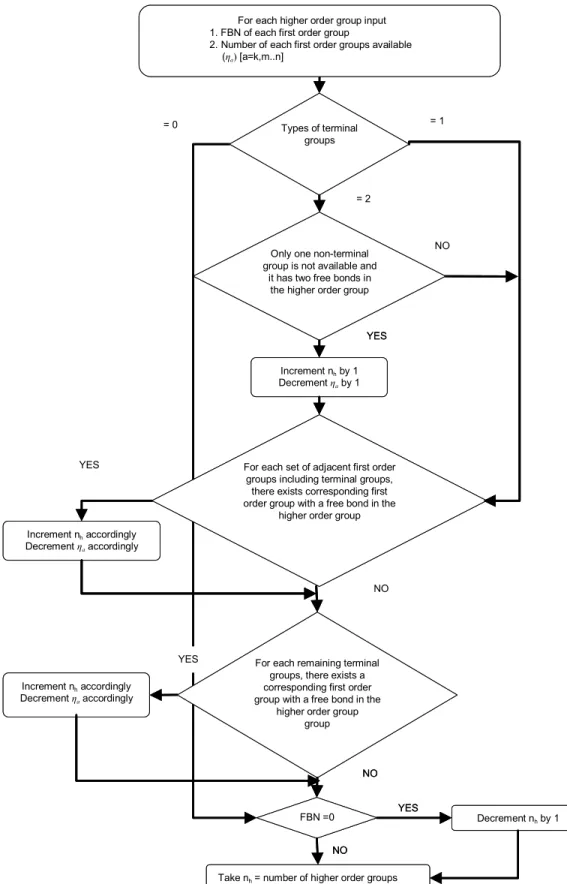
nh must be rounded down to the nearest integer number according to Rule 1. Moreover, two higher order groups of the same kind can even share first order groups just like higher order groups of different kind. For instance, 2 OH and 1 CH group can form 2CHOH groups. Hence the possibility of sharing of available first order groups participating in the given higher order group is considered. To account for these additions to the count of higher order groups by sharing of groups, the methodology in Figure 2 is used if nh≥ 0. Higher order groups can be found by the algebraic equations given by Eq. (18) but, due to above mentioned reasons, a step by step method has to be used to ensure that no higher order groups are wrongly omitted.
Example: Higher order group considered:
CH3-CH-CH-CH3
Number of CH3 groups: 4 Number of CH groups: 3
Initiallynh=Int Min⎡⎣
( )
23:24 ⎤⎦=1Free bonds on CH3=0, CH=2, CH=2, CH3=0
Remaining CH3 groups =2, CH groups = 1
Addition of 1 CH and 1 CH3 groups to a CH group with one of its free bonds leads to formation of one more CH3-CH-CH-CH3 group. Addition of a CH3 group to a CH group is not allowed since (CH3)2CH is another higher order group. Since no remaining first order groups lead to formation of higher order groups, the maximum number of higher order group CH3-CH-CH-CH3 for a given first order combination with 4 CH3 and 3 CH groups is taken to be 3. This is one kind of scenario that can be considered by using the methodology in Figure 2.
If φMj (Pj,mh)is the property contribution from the higher order groups, it is calculated as:
h
N M
j j,mh h j,h
h 1
(P ) n P
=
φ =
∑
(19)The property for molecule i can now be estimated as (Chemmangattuvalappil et al., 2009):
M M M
j (Pj,m) j (Pj,mf) j (Pj,mh)
446 S. Bommareddy, N. G. Chemmangattuvalappil, C. C. Solvason and M. R. Eden
Types of terminal groups
For each higher order group input 1. FBN of each first order group
2. Number of each first order groups available (ηa)[a=k,m..n]
Only one non-terminal group is not available and
it has two free bonds in the higher order group
Increment nhby 1
Decrementηaby 1
For each set of adjacent first order groups including terminal groups, there exists corresponding first order group with a free bond in the
higher order group
For each remaining terminal groups, there exists a corresponding first order group with a free bond in the
higher order group group
FBN =0
Take nh= number of higher order groups
= 0 = 1
= 2
NO
YES
NO
NO Increment nhaccordingly
Decrementηaaccordingly
Increment nhaccordingly
Decrementηaaccordingly
Decrement nhby 1
YES
YES
YES
NO Types of terminal
groups
For each higher order group input 1. FBN of each first order group
2. Number of each first order groups available (ηa)[a=k,m..n]
Only one non-terminal group is not available and
it has two free bonds in the higher order group
Increment nhby 1
Decrementηaby 1
For each set of adjacent first order groups including terminal groups, there exists corresponding first order group with a free bond in the
higher order group
For each remaining terminal groups, there exists a corresponding first order group with a free bond in the
higher order group group
FBN =0
Take nh= number of higher order groups
= 0 = 1
= 2
NO
YES
NO
NO Increment nhaccordingly
Decrementηaaccordingly
Increment nhaccordingly
Decrementηaaccordingly
Decrement nhby 1
YES
YES
YES
NO
An Algebraic Approach for Simultaneous Solution of Process and Molecular Design Problems 447
Since all the combinations of all first order groups, whose maximum occurrence is taken as the limit, are considered, no potential molecule is left out. Introduction of the higher order groups prior to this stage in the molecular design model would lead to a non-linear model and does not increase the accuracy of the model significantly. So, finding the maximum of these higher order groups from different combinations of first order groups that obey the structural constraints would serve the purpose of finding potential molecules for a given process performance. Hence, all possible combinations of the numbers [0, ng] and [0, nh] are generated subject to
the following constraint:
FBN = 0 with the inclusion of the possibility of the number of rings in the case of cyclic molecules.
The above method of generation enables the identification of structural isomers to some extent as the possibility of nonexistence of each higher order group is considered. The possible molecules are screened out by checking if the combination of all the groups satisfies all structural, property and process constraints. Rule 2 indicates that a higher order group is not completely overlapped by any other higher order group. Hence, after screening out the molecules based on the above constraints, an extra condition of whether any second order group is completely overlapped by another is checked before the final screening.
STEPWISE PROCEDURE FOR ALGEBRAICALLY SOLVING A MOLECULAR DESIGN PROBLEM
1. Transform the required property range of the process sink into sets of Maxima and Minima of their respective surrogates using the Process Property Operators.
2. Solve the reverse formulated process model to find the range of fresh feed properties into the sink and these may serve as the initial input to the molecular design problem.
3. Transform the required property range into sets of Maxima and Minima using the molecular property operators and their corresponding functions in GCM.
4. Select the first order groups to form the candidate molecules based on the nature of the final product.
5. Using the contributions of each molecular fragment, find the maximum number of each first order group by solving the molecular design model.
6. Enumerate all possible combinations of first order groups whose FBN is zero.
7. Evaluate all the possible numbers of higher order groups and generate all the combinations of first and higher order groups using the methodology represented by the flowsheet in Figure 2.
8. Screen out the molecules based on the structural and specific constraints while also considering Rule 2 of the higher order enumeration technique.
CASE STUDY
448 S. Bommareddy, N. G. Chemmangattuvalappil, C. C. Solvason and M. R. Eden
The process property targets and flow rate data for all streams (S1, S2 and S3) and the sink are summarized in Table 1.
Table 1: Property data for gas purification
Pj
Property Bounds
on Sink S1 S2 S3
Vc 529-610 754 730 790
Hv 100-115 113 125 70
Hfus 20-24 15 15 20
Flowrate 300 50 70 30
These selected process properties combine linearly and hence the property operator of each is the property itself. The Process Property Operators of the above properties are given by:
1 1 2 2 3 3
c f c,f S c,S S c,S S c,S
V =x V +x V +x V +x V (21)
1 1 2 2 3 3
v f v,f S v,S S v,S S v,S
H =x H +x H +x H +x H (22)
1 1
2 2 3 3
fus f fus,f S fus,S
S fus,S S fus,S
H x H x H
x H x H
= + +
+ (23)
i i
F x
F
= , i ∈ (f, S1, S2, S3) (24)
Given the values above, the property range of critical volume (Vc), heat of vaporization (Hv) and heat of fusion (Hfus) are found. These are utilized as the process property constraints in the molecular model. The results of the process model are given in Table 2.
Table 2: Property surrogates of Feed
Pj Lower Limit Upper Limit
Vc 307.98 469.98
Hv 90.008 120.008
Hfus 24.00 32.00
The property operators for the molecular target properties and the functions that link them to the process property operators are given below:
g
N
M b
b g bg b0
b0 g 1
T
T exp n T , t 222.543
t =
⎛ ⎞
= ⎜ ⎟= =
⎝ ⎠
∑
(25)g
N
M m
m g mg m0
m0 g 1
T
T exp n T , t 147.45
t =
⎛ ⎞
= ⎜ ⎟= =
⎝ ⎠
∑
(26)g
N
M M
c g cg c c
g 1
V n V , V V 7.95
=
=
∑
= − (27)g
N
M M
v g vg v v
g 1
H n H , H H 11.733
=
=
∑
= − (28)g
N
M M
fus g fusg fus fus
g 1
H n H , H H 2.806
=
=
∑
= + (29)g
N
ow ow0 g owg
g 1
ow0
log K K n log K ,
K 0.097
=
− =
=
∑
(30)
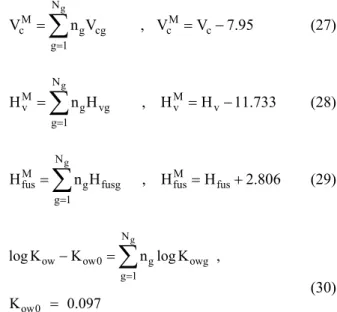
The property operator values on the process side of the problem are calculated using the equations on the right side of every equation above and these values are tailored using the equations to the left to be used by the molecular design model.
Additional physical and environmental property constraints are imposed on the feed. Table 4 gives the property target inputs to the molecular design model.
Table 4: Molecular Property Operator values
Pj Lower Limit Upper Limit
M m
T 9.375
M b
T 13.16
M c
V 300.03 462.03
M v
H 78.275 108.275
M fus
H 26.806 34.806
ow
log K 4
Now, the following first order groups have been considered for molecular design:
CH3, CH2, CH, CH3O, CH2O, CHO, CH2NH2, CHNH2, CH2NH, CHNH and C
An Algebraic Approach for Simultaneous Solution of Process and Molecular Design Problems 449
maximizing these groups is to ensure that no potential molecule is left out. The variations in the property values caused by inclusion of the higher order groups will be considered in the later stages. To insure water solubility and to reduce vapor pressure, the molecule must have two or more –OH groups. To limit the extent of corrosion, only one amino group is allowed to be in the amine (N in the amino group either connects to H or C). Finally, to limit detrimental effects of direct exposure to the solvent, tertiary amines are ruled out in this case study.
The maximum values are as follows:
CH3 – 3, CH2 – 4, CH – 4, CH3O – 3, CH2O – 4, CHO – 3, CH2NH2 – 1,
CHNH2 – 1, CH2NH – 1, CHNH – 1 and C – 2 The possible higher order groups from the above first order groups are found and the maximum number of each higher order groups using the methodology explained by Figure 2 of each combination of first order groups whose FBN is zero is found. Their contribution to the molecular property operator values are found using Eq. (19). All possible combinations of both first and higher order groups are generated.
The above method of generation enables the identification of isomers as the possibility of nonexistence of each higher order groups is considered. The possible molecules are screened out by checking if the combination of all the groups satisfies all structural, property and process constraints. After screening out the molecules based on the above constraints, an extra condition of whether any second order group is completely overlapped by another is checked before the final screening. The final list of candidate molecular structures that should be investigated further is given in Table 5 below.
Table 5: Candidate molecular structures
S. No Molecule
1 OH-CH(OCH3)-CH(CH2NH2)-OH
2 (OH)2-CH-CH(OCH3)-CH2NH2
3 (OH)2(CH2NH2)C-CH2-OCH3
4 OH-CH2-O-CH2-CH(OH)-CH2NH2
5 (OH)2CH-CH2-OCH2-CH2NH2
6 OH-NH-CH2-CH(CH(OCH3)(CH3))-CH2-OH
7 OH-NH-CH2-CH(OH)-CH(CH3)-CH2-O-CH3
8 OH-CH(CH2NH2)-CH2-CH2-O-CH(OH)-CH3
9 (OH)2(CH3)C-CH2NH-CH2-OCH2-CH3
The generated molecular structures have properties consistent with the property limits of the sink; however hemiacetals, carbinolamines and germinal diols are often unstable and as such would need to be further tested for their applicability.
The objective of this case study was to illustrate the generation of molecules that satisfy certain property ranges and since the second step of the simultaneous design considers the elimination of each possible higher order group, success in detection of isomers is reached to some extent. The same methodology can be used to generate cyclic molecules by including the constraint on the number of rings in each combination of groups.
CONCLUSIONS
In this work, an algebraic method has been developed that solves process and molecular design problems simultaneously to find molecules that would meet the needs of the process. Higher order group contribution has been included in the molecular design model. Enhanced enumeration techniques of higher order groups increase the application range and reliability of the molecular design step. The incorporation of these techniques into the solution method at the design level ensures that no potential molecule is omitted. The solution method is efficient, but the accuracy of the property prediction will depend only on the accuracy of the property models used. Here, an algebraic approach has been followed which decreases the combinatorial size of the problem significantly and also ensures that any number of properties can be tracked.
NOMENCLATURE
FBN Free bond number
FBNg Free bond number associated with group g
F Allowable flow rate into the sink Fi Flow rate into source i
GCM Group Contribution Method Hfus eat of fusion
hfus0 Adjustment parameter used in the estimation of heat of fusion
Hv Standard heat of vaporization at 298 K hv0 Adjustment parameter used in the
estimation of heat of vaporization Kow Octanol/water partition coefficient Nf Total number of first order molecular
450 S. Bommareddy, N. G. Chemmangattuvalappil, C. C. Solvason and M. R. Eden
Nh Total number of higher order molecular groups
Nr Total number of rings in a molecule Nsources Total number of sources into the sink nf Number of functional groups in the
main chain ng Molecular group
Pj,g Contribution of property j from group g Pj,m Property j of molecule m
Pji Property j of stream i Tb Boiling point
tb0 Adjustment parameter used in the estimation of boiling temperature Tm Melting point
tm0 Adjustment parameter used in the estimation of melting temperature xi Fractional contribution
Vc Critical volume
vc0 Adjustment parameter used in the estimation of critical volume k,m…n first order groups
Greek Symbols
M j
φ Molecular property operator of the jth property
j
φ Process property operator of the jth property
ηk , ηm …. ηn Number of occurrences of first order groups
REFERENCES
Chemmangattuvalappil, N. G., Solvason. C. C., Eljack. F. T., Eden. M. R., A Novel Algorithm for Molecular Synthesis Using Enhanced Property Operators. Computers & Chemical Engineering, 33, (3), 636-643 (2009).
Eden, M. R., Jørgensen, S. B., Gani, R., El-Halwagi, M. M., Reverse Problem Formulation based Techniques for Process and Product Design. Computer Aided Chemical Engineering 15A, 451-456 (2003a).
Eden, M. R., Jørgensen, S. B., Gani, R., El-Halwagi, M.M., Property Cluster Based Visual Technique for Synthesis and Design of Formulations.
Computer Aided Chemical Engineering 15B, 1175-1180 (2003b).
Eljack, F. T., Eden, M. R., Kazantzi, V., El-Halwagi, M. M., Simultaneous Process and Molecular Design - A Property Based Approach. AIChE Journal, 53, (5), 1232-1239 (2007). Harper, P. M., Gani, R., Kolar, P., Ishikawa, T.,
Computer-aided Molecular Design with Combined Molecular Modelling and Group Contribution. Fluid Phase Equilibria, 158-160, 337-347 (1999).
Harper, P. M., Gani, R., A step and Multi-level approach for Computer aided Molecular Design. Computers & Chemical Engineering, 24 (2-7), 677-683 (2000).
Kazantzi, V., Qin, X., El-Halwagi, M. M., Eljack, F. T., Eden, M. R., Simultaneous Process and Molecular Design through Property Clustering Techniques. Industrial & Engineering Chemistry 46(10), 3400-3409 (2007).
Marcoulaki, E. C., Kokossis, A. C., Molecular design synthesis using stochastic optimization as a tool for scoping and screening. Computers & Chemical Engineering, 22, (1), S11-S18 (1998). Marrero, J., Gani, R., Group Contribution Based
Estimation of Pure Component Properties. Fluid Phase Equilibria, 183-184, 183-208 (2001). Qin, X., Gabriel, F., Harell, D., El-Halwagi, M. M.,
Algebraic Techniques for Property Integration via Componentless Design. Ind. Eng. Chem. Res., 43, 3792-3798 (2004).
Shelley, M. D., El-Halwagi, M. M., Component-less Design of Recovery and Allocation systems: A Functionality–based Clustering Approach. Computers & Chemical Engineering, 24, 2081-2091 (2000).
Affens, W. A., Flammability properties by hydrocarbons fuels. J. Chem Eng. Data, 11, 197-202 (1966).
Konemann, H., Quantitative Structure-Activity relationships in fish toxic studies. 1. Relationship for 50 industrial chemicals. Toxicology 19, 209-221 (1981).