http://dx.doi.org/10.1590/0104-1428.1621
S
C
I
E
N
T
I
F
I
C
-T
E
C
H
N
I
C
A
L
Polímeros, 25(3), 277-288, 2015 277
Analysis of equations of state for polymers
Erlí José Padilha Júnior
1, Rafael de Pelegrini Soares
1and Nilo Sérgio Medeiros Cardozo
1* 1Departamento de Engenharia Química – DEQUI, Universidade do Rio Grande do Sul – UFRGS,
Porto Alegre, RS, Brazil
*[email protected]Abstract
In the literature there are several studies comparing the accuracy of various models in describing the PvT behavior of polymers. However, most of these studies do not provide information about the quality of the estimated parameters or the sensitivity of the prediction of thermodynamic properties to the parameters of the equations. Furthermore, there are few studies exploring the prediction of thermal expansion and compression coeficients. Based on these observations, the objective of this study is to deepen the analysis of Tait, HH (Hartmann-Haque), MCM (modiied cell model) and SHT (simpliied hole theory) equations of state in predicting the PvT behavior of polymers, for both molten and solid states. The results showed that all equations of state provide an adequate description of the PvT behavior in the molten state, with low standard deviations in the estimation of parameters, adequate sensitivity of their parameters and plausible prediction of speciic volume, thermal expansion and isothermal compression coeficients. In the solid state the Tait equation exhibited similar performance to the molten state, while HH showed satisfactory results for amorphous polymers and dificulty in adjusting the PvT curve for semicrystalline polymers.
Keywords: equation of state, PvT behavior, polymer.
1. Introduction
The study of the thermodynamic behavior of polymers is essential to analyze the physical transformations that occur during processing, e.g. injection molding or extrusion, and to predict the properties of the final products. Polymers in melt state or in solution can be represented correctly by an equation of state (EoS) because these can be considered equilibrium states for polymers. Conversely, the solid state is at least one quasi-equilibrium state, because the properties depend on the conditions of solidification, as the cooling rate and pressure, which difficults their description by means of EoS[1].
Numerous equations of state have been developed to describe the PvT (pressure-volume-temperature) behavior of polymers. In literature, there are several studies comparing the fitting accuracy of various models for PvT data of polymers[1-7]. These studies are focused mainly in the analysis of the fitting accuracy of the specific volume in the molten state, employing usually the method of least squares[2,3,6,8-20] for the parameter estimation step. They showed that the theoretical equations based on cell-and-hole models and the Tait and the Hartmann-Haque (HH) empirical equations are those which provide more accurate fitting of the experimental data.
On the other hand, little information is available in the literature on at least two important aspects that are essential for the use of the referred equations in process simulation: quality of the estimated parameters as a function of the model employed and fitting accuracy of the models for thermal expansion and isothermal compression coefficients.
The isobaric thermal expansion coefficient (β) and isothermal compressibility (κ) are defined by:
1 P T ∂ν
β= ν ∂ (1)
1 T P ∂ν
κ=− ν ∂
(2)
where the negative sign indicates the volume decrease with pressure increase[21].
These coefficients are important for the simulation of polymer processing operations, because they are present in the governing equation of energy conservation. However, to the best of our knowledge, the only studies on their prediction from EoS are those of Utracki[22,23], in which the prediction of thermal expansivity and compressibility by hole models is analyzed.
Based on these observations, the objective of this study is to deepen the analysis of Tait, HH, MCM (modified cell model) and SHT (simplified hole theory) equations of state in prediction of PvT behavior of polymers, in both molten and solid physical states. The EoS were analyzed with respect to: (i) quality in the estimation of its parameters by the method of least squares, (ii) sensitivity of their predictions to each of its parameters, (iii) quality of the prediction of the specific volume, and (iv) quality of the prediction of isobaric thermal expansion coefficient and isothermal compressibility.
2. Equations of State Analyzed
2.1 Tait equation of state
Padilha, E. J., Jr., Soares, R. P., & Cardozo, N. S. M.
Polímeros , 25(3), 277-288, 2015 278
(i.e., a volume-pressure relationship). Tait equation can be written as[3]:
(
,)
o( )
1 1( )
P t(
,)
v T P v T Cln v T P
B T
= − + +
(3)
where for polymers in the molten state, i.e., above the liquid-solid transition temperature:
(
)
1 2 5
o m m
v =b +b T−b (4a)
( )
3mexp 4m(
5)
B T =b −b T−b (4b)
(
,)
0t T P
ν = (4c)
and for polymers in solid state, i.e., below the liquid-solid transition temperature
(
)
1 2 5
o s s
v =b +b T−b (5a)
( )
3sexp 4s(
5)
B T =b −b T−b (5b)
(
,)
7{
8(
5) ( )
9}
t T P b exp b T b b P
ν = − − (5c)
The liquid-solid transition temperature, which is the glass transition temperature for amorphous polymers and the melting or crystallization temperature for semicrystalline polymers, can be calculated by
( )
5 6t
T P =b +b P (6)
In these equations, v is the specific volume of the polymeric material; the coefficient C is a constant equal to 0.0894; vo is the specific volume at zero pressure; νt is the specific volume corresponding to crystalline phase;
B is the sensitivity to pressure of material; b1 at b9 are parameters of model, obtained by fitting of PvT diagram. The parameters b1m to b4m and b1s to b4s describe the
dependence on pressure and temperature in the molten and the solid state, respectively; b5 and b6 are parameters that describe the change of transition temperature with pressure;
7
b to b9are particular parameters of semicrystalline polymers that describe the form of the state transition[24].
2.2 HH equation of state
Hartmann and Haque[10] developed an empirical equation of state combining the thermal pressure function of Pastine and Warfield, the zero-pressure isobar presented by Somcynsky and Simha, and the empirical dependence of volume with the thermal pressure. HH EoS describes the PvT behavior of polymers in the molten and solid states. It is given by:
5 3/ 2
Pv =T −lnv (7)
where the dimensionless variables P, v and T for molten polymers are defined as:
0 0 0
; ;
m m m
P v T
P v T
B v T
= = =
(8)
and for solid polymers as:
0 0 0
; ;
s s s
P v T
P v T
B v T
= = =
(9)
where B0, v0 and T0 are the characteristic parameters. 0
T and v0 are defined as temperature and specific volume, respectively, extrapolated to zero pressure, while B0 is identified as the isothermal bulk modulus extrapolated to zero temperature and pressure.
2.3 MCM equation of state
The modified cell model equation of state was developed by Dee and Walsh[2], starting from the formalism presented by Prigogine et al.[25]. In the cell model, the compressibility and thermal expansion of the structure are explained only by changes in the cell volume. Dee and Walsh[2] introduced a numerical factor that scales the hard-core cell volume in the free volume term, disconnecting the theory from the specific geometry. This factor, q, was found to be constant for numerous polymers and equal to about 1.07. MCM EoS can be written as:
1/3
1/3 2 4
2 1.2045 1.011
–
– 0.8909
Pv v
T v q T v v
= −
(10)
The reduced parameters P, v and T are defined as:
* ; * ; *
P v T
P v T
P v T
= = = (11)
where P*, v* and T* are characteristic parameters. 2.4 SHT equation of state
The hole theory introduces empty cells in the cell model[26], based on the concept that the thermal expansion of liquid is mainly due to holes (h), i.e., the empty cells, while volume changes of the cells are also allowed. Zhong et al.[27] simplified the hole theory through the use of an exponential function to the fraction of occupied cells. SHT EoS is derived as:
( )
( )
( ) ( )
1/3
1/3 2 2
2 1.1394 –1 .5317 – 0.9165
yv
Pv y
T yv y T yv yv
= +
(12)
where P, v and T are reduced parameters defined by Equation 11, y is the fraction of occupied cells, being defined by:
0.52/
1 T
y= −e− (13)
3. Methodology
The experimental PvT data used in this work were taken from the literature[7,21,28-32] as shown in Table 1. For each polymer, the available data were subdivided in two sets: one used for parameter estimation (DATA1) and other for validation (DATA2). The construction of these subsets was based on random selection of points.
Analysis of equations of state for polymers
P
olímeros, 25(3), 277-288, 2015
279
Table 1. Relevant information about the experimental PvT data useda.
Polymer Amorphous Semicrystalline
PS PC PMMA PCHMA PnBMA PoMS iPP LPE PEO PA6 PLA PBS-B
Reference 28 29 30 30 30 31 29 32 7 21 32 32
Pressure range (MPa) 0.1-200 0.1-200 0.1-180 0.1-180 0.1-180 0.1-180 0.1-200 0.1-200 0.1-200 0.1-190 0.1-200 0.1-200
Temperature range (K) 280-468 313-603 353-423 357-453 285-355 302-470 313-573 313-493 313-493 364-586 313-493 313-493
Initial temperature of analysis (K)
468 313 353 357 285 302 313 313 313 364 313 313
Initial pressure of analysis (MPa)
0.1 0.1 0.1 0.1 0.1 0.1 0.1 0.1 0.1 0.1 0.1 0.1
Number of experimental points in solid state used for parameter estimation
33 26 36 30 29 25 28 41 27 35 56 16
Number of experimental points in molten state used for parameter estimation
28 30 20 26 22 26 25 29 43 17 21 20
Number of experimental points in solid state used for the analysis of the prediction accuracy
33 24 - 30 - - 28 - - 35 - 15
Number of experimental points in molten state used for the analysis of the prediction accuracy
28 32 - 26 - - 24 - - 17 - 19
Experimental data variance
(σ2exp)
0.0003 0.001 0.0004 0.0004 0.0004 0.0004 0.001 0.002 0.002 0.0003 0.002 0.002
Padilha, E. J., Jr., Soares, R. P., & Cardozo, N. S. M.
Polímeros , 25(3), 277-288, 2015 280
coefficients, taking as basis of comparison their theoretically expected behavior. The estimation of parameters was conducted by the least squares method, using the lsqnonlin function already implemented in MatLab software, with the following objective function (FObj):
(
)
2 1ˆ n
i i i
FObj v v
=
=∑ − (14)
where
(
vˆi−vi)
is the residual between predicted (vˆi) and experimental (vi) values and nis the number of pointsconsidered.
The parameters of the equations of state were estimated simultaneously, as suggested by Hartmann and Haque[10]. For the Tait EoS, firstly, b5 and b6 were estimated from data of transition temperature at different pressures. The melt parameters (b1m, b2m, b3m and b4m) and solid parameters (b1s, b2s, b3s, b4s, b7, b8 and b9) were estimated separately from data corresponding to the respective states[33]. Likewise, for HH EoS, the experimental data were divided into two states: molten and solid state. The parameters of the MCM and SHT EoS were estimated only with molten state data.
The quality of the estimated parameters for each model was analyzed in terms of their covariance matrix (Vα), evaluated using a routine developed in MatLab, according the following expression[34]:
( )
1 2 T 1T
y
Vα=Hα−GασGα Hα− (15)
where σ2y is the experimental data variance, Hα is the
Hessian matrix of FObj, and Gα is the matrix that represents the derivative of the gradient of FObj with relation to the experimental values vi.
The normalized parameter sensitivity matrix was used to evaluate the sensitivity of the predictions of the considered EoS to parameter variations. The coefficients of this matrix are given by:
* ˆ ˆ j i ij j i a v S a v ∂ =
∂ (16)
where aj is the parameter of the equation analyzed. These coefficients were calculated using a MatLab function, according to the following central-difference approximation:
(
) (
)
*
2
i j i j j
ij
i
v h v h
S
h v
α + − α − α
=
(17)
with h equal to 10-4. In this way, the parameter sensitivity of the specific volume predictions was analyzed in a wide temperature range, at different pressures, for polycarbonate and linear polyethylene.
To appraise the fit and prediction quality of each model, the mean relative deviation (MRD) and the regression coefficient (R2) were calculated:
1
0 ˆ
1 0 n i i
i i
v v
MRD
n = v
−
= ∑ (18)
(
)
(
)
2 1 2 2 1 ˆ 1 n i i i n i i i v v R v v = = − ∑ = − − ∑ (19)where vi is the arithmetic mean of experimental specific volumes.
Additionally, F-tests were performed to assess the suitability of the considered models. The value of F0 used in the comparison with the critical value of F (Fc=F distribution value corresponding to 95% confidence) was defined as the ratio between the model ( 2
eos
σ ) and the experimental (σ2exp) variances, according to the following expression:
(
)
22
0 2 2
ˆ n i i i eos exp exp v v n np F − ∑ σ − = = σ σ (20)
where np is the number of estimated parameters. The experimental variances are shown in Table 1.
4. Results and Discussion
4.1 Fitting and prediction of specific volume
As mentioned previously, the comparison of the EoS under analysis with relation to the fitting of specific volume data has already been extensively studied by other authors[2,3,6,8-20]. Therefore, in the present work, the analysis corresponding to the fitting stage will be focused only in the quality of the estimated parameters, aspect for which there is little information available in the literature.
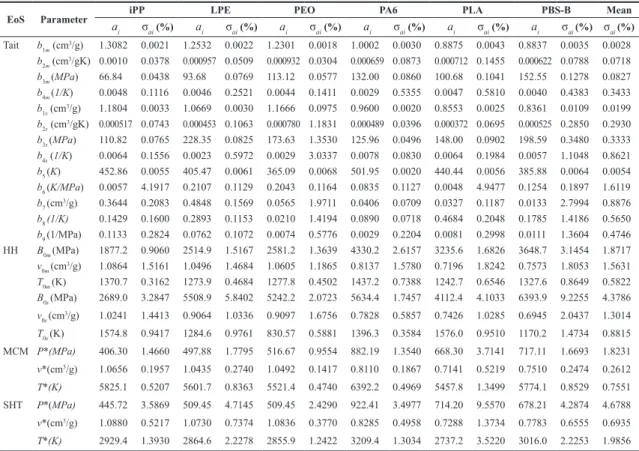
The values of parameters estimated from data set DATA1 and their respective standard deviations are presented in Tables 2 and 3, for the amorphous and semicrystalline polymers, respectively. The low values of the standard deviations indicate that the fitting were adequate. The parameters of equations of state showed a higher standard deviation for semicrystalline polymers, in both physical states. The fitting of Tait and HH EoS were better in molten state, both to amorphous and semicrystalline polymers. In general, Tait equation exhibited the lowest values of standard deviations (below 2%) except for the parameter b6 in the cases of the polymers iPP and PLA, for which the linear dependence between transition temperature and pressure described by Equation 6 is not obeyed. For all equations of state, the greatest deviations were found for the parameters related to pressure, what can be explained by the wide range of pressure analyzed.
Analysis of equations of state for polymers
Polímeros, 25(3), 277-288, 2015 281
Table 2. Estimated parameters (ai) and percentage standard deviation (σai) for amorphous polymers.
EoS Parameter
PS PC PMMA PCHMA PnBMA PoMS Mean
ai σai (%) ai σai (%) ai σai (%) ai σai (%) ai σai (%) ai σai (%) σai (%)
Tait b1m(cm3/g) 0.9767 0.0015 0.8590 0.0025 0.8603 0.0024 0.9318 0.0017 0.9469 0.0014 1.0046 0.0013 0.0018
b2m(cm3/gK) 0.000506 0.0461 0.000553 0.0392 0.000511 0.1042 0.000596 0.0477 0.000628 0.0532 0.000547 0.0492 0.0566
b3m (MPa) 154.65 0.0672 151.39 0.1062 277.56 0.1512 161.98 0.0629 192.89 0.0998 184.57 0.0882 0.0959
b4m (1/K) 0.0030 0.2749 0.0034 0.2218 0.0075 0.6696 0.0052 0.1845 0.0047 0.4290 0.0062 0.2388 0.3364
b1s (cm
3/g) 0.9748 0.0015 0.8575 0.0035 0.8625 0.0007 0.9303 0.0014 0.9479 0.0011 1.0045 0.0018 0.0017
b2s (cm
3/gK) 0.000213 0.1116 0.000192 0.2435 0.000275 0.1665 0.000248 0.1118 0.000376 0.3084 0.000232 0.0996 0.1736
b3s (MPa) 275.87 0.0645 249.21 0.1005 257.75 0.0303 255.61 0.0486 223.53 0.0373 276.20 0.0649 0.0577
b4s (1/K) 0.0018 0.6080 0.0021 0.7384 0.0045 0.3877 0.0038 0.3082 0.0036 0.8858 0.00067 1.2603 0.6981
b5 (K) 370.86 0.0026 417.06 0.0059 375.30 0.0034 383.84 0.0030 296.66 0.0039 401.21 0.0028 0.0036
b6 (K/MPa) 0.3924 0.0211 0.2687 0.0885 0.3485 0.0692 0.2665 0.0441 0.2225 0.0528 0.3361 0.0350 0.0518
HH B0m (MPa) 2953.3 1.3157 3470.2 2.6453 5238.2 5.0184 3115.0 1.3573 3654.1 2.5917 3154.5 2.1292 2.5096
v0m (cm3/g) 0.8753 0.6226 0.7413 1.3425 0.7570 0.7592 0.8192 0.7058 0.8431 0.6388 0.8917 0.6503 0.7865
T0m (K) 1602.1 0.2884 1471.8 0.6255 1464.9 0.7126 1471.8 0.3327 1256.7 0.4040 1631.2 0.3724 0.4559
B0s (MPa) 4278.5 3.6067 3858.2 7.8331 3867.7 3.2444 4172.8 3.7264 3499.0 3.3230 4251.8 4.6353 4.3948
v0s (cm3/g) 0.9218 0.5102 0.8107 1.4375 0.8158 0.5568 0.8785 0.6056 0.8891 0.7577 0.9399 0.6413 0.7515
T0s (K) 2552.0 0.4872 2914.7 1.3898 2592.6 0.4136 2656.6 0.5196 1863.6 0.4846 2453.5 0.7396 0.6724
MCM P*(MPa) 532.04 0.4534 707.66 0.9018 1017.5 2.1312 594.83 0.8393 656.45 0.6733 616.17 0.9196 0.9864
v*(cm3/g) 0.8690 0.0822 0.7357 0.1447 0.7463 0.2813 0.8101 0.1353 0.8392 0.1177 0.8745 0.1612 0.1537
T*(K) 6933.9 0.3985 6441.5 0.5280 6178.8 1.1607 6298.7 0.5389 5427.0 0.5621 6704.6 0.6911 0.6466
SHT P*(MPa) 420.57 1.0068 675.78 2.1852 887.13 6.4028 518.74 2.1551 506.85 1.3689 577.23 4.3201 2.9065
v*(cm3/g) 0.9242 0.1769 0.7620 0.3835 0.7798 0.8736 0.8491 0.3381 0.8937 0.2329 0.9032 0.7175 0.4538
T*(K) 4009.2 0.8431 3353.9 1.3560 3311.9 3.4399 3425.4 1.3222 3168.3 1.1022 3429.9 2.7175 1.7968
Table 3. Estimated parameters (ai) and percentage standard deviation (σai ) for semicrystalline polymers.
EoS Parameter iPP LPE PEO PA6 PLA PBS-B Mean
ai σai (%) ai σai (%) ai σai (%) ai σai (%) ai σai (%) ai σai (%) σ
ai (%)
Tait b1m (cm
3/g) 1.3082 0.0021 1.2532 0.0022 1.2301 0.0018 1.0002 0.0030 0.8875 0.0043 0.8837 0.0035 0.0028
b2m (cm3/gK) 0.0010 0.0378 0.000957 0.0509 0.000932 0.0304 0.000659 0.0873 0.000712 0.1455 0.000622 0.0788 0.0718 b3m (MPa) 66.84 0.0438 93.68 0.0769 113.12 0.0577 132.00 0.0860 100.68 0.1041 152.55 0.1278 0.0827
b4m (1/K) 0.0048 0.1116 0.0046 0.2521 0.0044 0.1411 0.0029 0.5355 0.0047 0.5810 0.0040 0.4383 0.3433 b1s (cm
3/g) 1.1804 0.0033 1.0669 0.0030 1.1666 0.0975 0.9600 0.0020 0.8553 0.0025 0.8361 0.0109 0.0199
b2s (cm3/gK) 0.000517 0.0743 0.000453 0.1063 0.000780 1.1831 0.000489 0.0396 0.000372 0.0695 0.000525 0.2850 0.2930 b3s (MPa) 110.82 0.0765 228.35 0.0825 173.63 1.3530 125.96 0.0496 148.00 0.0902 198.59 0.3480 0.3333
b4s (1/K) 0.0064 0.1556 0.0023 0.5972 0.0029 3.0337 0.0078 0.0830 0.0064 0.1984 0.0057 1.1048 0.8621
b5 (K) 452.86 0.0055 405.47 0.0061 365.09 0.0068 501.95 0.0020 440.44 0.0056 385.88 0.0064 0.0054 b6 (K/MPa) 0.0057 4.1917 0.2107 0.1129 0.2043 0.1164 0.0835 0.1127 0.0048 4.9477 0.1254 0.1897 1.6119 b7 (cm3/g) 0.3644 0.2083 0.4848 0.1569 0.0565 1.9711 0.0406 0.0709 0.0327 0.1187 0.0133 2.7994 0.8876 b8 (1/K) 0.1429 0.1600 0.2893 0.1153 0.0210 1.4194 0.0890 0.0718 0.4684 0.2048 0.1785 1.4186 0.5650
b9 (1/MPa) 0.1133 0.2824 0.0762 0.1072 0.0074 0.5776 0.0029 0.2204 0.0081 0.2998 0.0111 1.3604 0.4746 HH B0m (MPa) 1877.2 0.9060 2514.9 1.5167 2581.2 1.3639 4330.2 2.6157 3235.6 1.6826 3648.7 3.1454 1.8717
v0m (cm
3/g) 1.0864 1.5161 1.0496 1.4684 1.0605 1.1865 0.8137 1.5780 0.7196 1.8242 0.7573 1.8053 1.5631
T0m (K) 1370.7 0.3162 1273.9 0.4684 1277.8 0.4502 1437.2 0.7388 1242.7 0.6546 1327.6 0.8649 0.5822
B0s (MPa) 2689.0 3.2847 5508.9 5.8402 5242.2 2.0723 5634.4 1.7457 4112.4 4.1033 6393.9 9.2255 4.3786
v0s (cm3/g) 1.0241 1.4413 0.9064 1.0336 0.9097 1.6756 0.7828 0.5857 0.7426 1.0285 0.6945 2.0437 1.3014
T0s (K) 1574.8 0.9417 1284.6 0.9761 830.57 0.5881 1396.3 0.3584 1576.0 0.9510 1170.2 1.4734 0.8815
MCM P*(MPa) 406.30 1.4660 497.88 1.7795 516.67 0.9554 882.19 1.3540 668.30 3.7141 717.11 1.6693 1.8231
v*(cm3/g) 1.0656 0.1957 1.0435 0.2740 1.0492 0.1417 0.8110 0.1867 0.7141 0.5219 0.7510 0.2474 0.2612
T*(K) 5825.1 0.5207 5601.7 0.8363 5521.4 0.4740 6392.2 0.4969 5457.8 1.3499 5774.1 0.8529 0.7551
SHT P*(MPa) 445.72 3.5869 509.45 4.7145 509.45 2.4290 922.41 3.4977 714.20 9.5570 678.21 4.2874 4.6788
v*(cm3/g) 1.0880 0.5217 1.0730 0.7374 1.0836 0.3770 0.8285 0.4958 0.7288 1.3734 0.7783 0.6555 0.6935
Padilha, E. J., Jr
., Soar
es, R. P
., & Car
dozo, N. S. M.
P
olímeros , 25(3), 277-288, 2015
282
Table 4. Statistical results in specific volume prediction by EoS.
Polymer
Molten Solid
EoS
Fc
a
EoS
Fc
b
Tait HH MCM SHT Tait HH
MRD
(%) R
2 F
0
MRD
(%) R
2 F
0
MRD
(%) R
2 F
0
MRD
(%) R
2 F
0
MRD
(%) R
2 F
0
MRD
(%) R
2 F
0
PS 0.0394 0.9997 8.38×10⁻⁴ 0.0581 0.9992 1.81×10⁻⁹ 0.0323 0.9997 6.38×10⁻⁴ 0.0520 0.9995 0.0013 1.4792 0.0201 0.9998 1.78×10⁻⁴ 0.0294 0.9994 4.22×10⁻⁴ 1.4393
PC 0.0723 0.9994 4.84×10⁻⁴ 0.1077 0.9990 7.27×10⁻⁴ 0.1333 0.9976 0.0018 0.1141 0.9988 9.08×10⁻⁴ 1.4465 0.0557 0.9982 1.97×10⁻⁴ 0.1395 0.9877 0.0012 1.5200 PCHMA 0.0364 0.9998 6.11×10⁻⁴ 0.1136 0.9984 4.03×10⁻⁹ 0.0808 0.9992 0.0020 0.0612 0.9995 0.0014 1.4984 0.0639 0.9976 0.0020 0.1085 0.9937 0.0049 1.4620 IPP 0.1028 0.9996 0.0017 0.1600 0.9988 0.0043 0.1320 0.9991 0.0031 0.1478 0.9990 0.0035 1.5200 0.4300 0.9249 0.0933 0.9429 0.8659 0.1532 1.4792 PA6 0.1070 0.9978 0.0129 0.1010 0.9980 0.0101 0.0804 0.9992 0.0040 0.1059 0.9987 0.0067 1.6253 0.1964 0.9920 0.0297 0.6487 0.9316 0.2388 1.4259 PBS-B 0.0444 0.9998 1.66×10⁻⁴ 0.0583 0.9996 2.48×10⁻⁴ 0.0612 0.9995 2.75×10⁻⁴ 0.0733 0.9994 3.40×10⁻⁴ 1.5891 0.0890 0.9978 5.40×10⁻⁴ 0.1741 0.9899 0.0021 1.6689
Amorphous Mean - - - 0.0466 0.9985 - 0.0925 0.9936 -
-Semicrystalline Mean
- - - 0.2385 0.9716 - 0.5886 0.9291 -
-Mean 0.0671 0.9994 - 0.0998 0.9988 - 0.0867 0.9991 - 0.0924 0.9992 - - -
Analysis of equations of state for polymers
Polímeros, 25(3), 277-288, 2015 283
polymers in solid state, where a higher difference between Tait and HH equations occurred.
Figure 1 shows the residual plots for each equation of state. It is possible to observed that the predominately random nature of the errors distributions for both molten and solid state data, with the predictions of the HH EoS
for molten iPP as only relevant exception. These results support the statement of good suitability of the EoS tested.
As example of the general behavior described in the previous paragraph, Figure 2 shows the variation of MRD with the temperature for an amorphous polymer, PC, and with the pressure and temperature for a semicrystalline one, iPP. It can be seen that the HH EoS presented a high relative
Padilha, E. J., Jr., Soares, R. P., & Cardozo, N. S. M.
Polímeros , 25(3), 277-288, 2015 284
deviation in solid state, especially at low pressures near the transition temperature (Figures 2c and 2d).
4.2 Sensitivity analysis
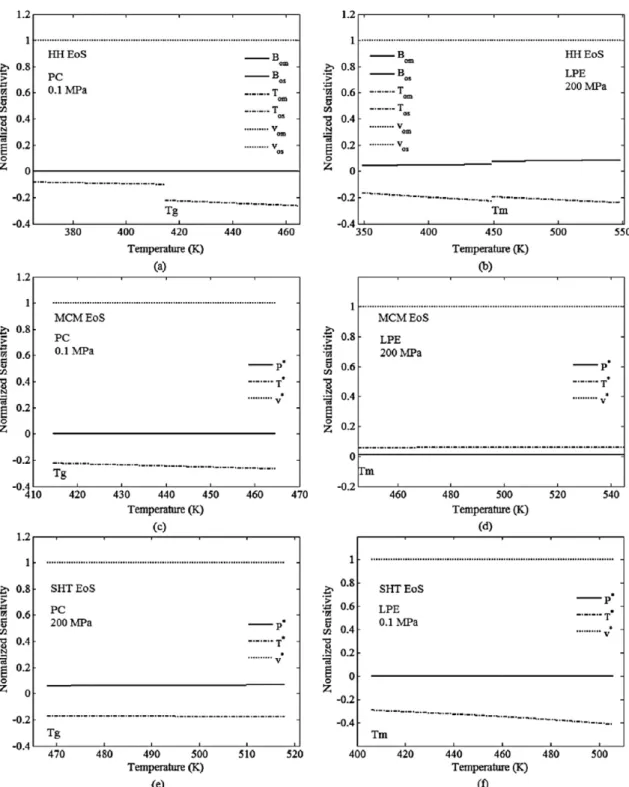
The sensitivity of the prediction of specific volume with relation to each parameter of HH, MCM and SHT EoS is shown in Figure 3. The sensitivity of parameters showed similar behavior for all these EoS, both to amorphous and semicrystalline polymers. Besides the highest sensitivity corresponds to the volume related parameters, the sensitivity to each parameter was nearly constant in the whole ranges of pressure and temperature analyzed.
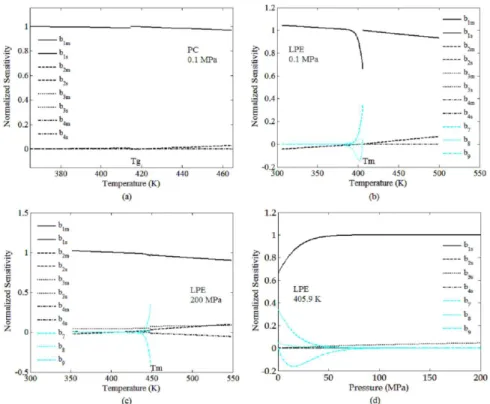
For the Tait EoS, the behavior of the sensitivity to the parameters was somewhat different, as shown in Figure 4. The sensitivity to the parameters b1 and b2 varied continuous and complementarily with the increase of the temperature (Figures 4b and 4c), with increase of the sensitivity to
1
b
and decrease of the sensitivity to b2. Moreover, it is perceived that there was an abrupt change in the sensitivity of the parameters of Tait EoS near the transition temperature of linear polyethylene in the solid state. The sensitivities of parameters b1s and of term vt (b7, b8 and b9) of Tait equation were modified near the transition region. It is
found that there is a correlation between the sensitivities to the parameters b1s and b7, both related to the specific volume. All parameters of the vt term (b7, b8 and b9) reveal sensitivity close to the transition regions, stating that they are within linked in modeling this region. Thus, this transition region has fundamental importance for the estimation of the parameters of the Tait EoS.
4.3 Isobaric thermal expansion and isothermal compression coefficients prediction analysis
Figure 5 shows the isobaric thermal expansivity calculated from the PC, PoMS, iPP and PLA by equations of state. It is observed that all the EoS predict similar values of this coefficient and are in qualitative agreement with the theory in the sense that the thermal expansion coefficient of a polymer melt is always greater than that of the corresponding amorphous and semicrystalline solid[35,36]. However, Tait EoS, unlike the other equations, predicts a reduction of this coefficient with the increase of the temperature, contrarily to theoretical expectations[35], revealing a limitation of the model. Moreover, in the case of semicrystalline polymers, Tait equation of state presented an abrupt increase in thermal expansion coefficient in the
Analysis of equations of state for polymers
Polímeros, 25(3), 277-288, 2015 285
Figure 3. Normalized sensitivity of specific volume relative to the parameters of: (a) HH EoS to PC in 0.1 MPa, (b) HH EoS to LPE in 200 MPa, (c) MCM EoS to PC in 0.1 MPa, (d) MCM EoS to LPE in 200 MPa, (e) SHT EoS to PC in 200 MPa and (f) SHT EoS to LPE in 0.1 MPa.
crystalline transition region. This occurs because Tait EoS describes satisfactorily sudden change in specific volume due to destruction/growth of crystallites, which does not happen with the HH equation. The theoretical equations of state, MCM and SHT displayed the same curve shape.
Figure 6 shows the isothermal compressibility predicted from the PC, PoMS, iPP and PLA by equations of state.
Padilha, E. J., Jr., Soares, R. P., & Cardozo, N. S. M.
Polímeros , 25(3), 277-288, 2015 286
Figure 4. Normalized sensitivity of specific volume of polymers relative to parameters of Tait equation of state: (a) PC in 0.1 MPa, (b) LPE in 0.1 MPa, (c) LPE in 200 MPa and (d) LPE in 405.9 K.
Analysis of equations of state for polymers
Polímeros, 25(3), 277-288, 2015 287
Figure 6. Isothermal compressibility predicted by EoS: (a) PC, (b) PoMS, (c) iPP and (d) PLA.
5. Conclusions
The Tait, HH, MCM and SHT equations of state were evaluated in prediction the PvT behavior of polymers, for both molten and solid physical states.
In the analysis of the PvT behavior of melt polymers, all equations of state studied showed adequate fitting of specific volume data, with light advantage of the Tait equation. No significant differences among them were observed in terms of quality of the estimated parameters, sensitivity of the predictions to the parameters, and of prediction of the thermal expansion and compression coefficients. Then, all EoS studied are appropriate in modeling the molten state.
In the analysis of the PvT behavior of solid polymers, Tait and HH equations exhibited differences in sensitivity analysis and specific volume prediction, justified mainly because HH EoS does not describe correctly the crystalline transition. The parameter estimation in both equations was adequate, with low values of standard deviations. Thus, the Tait equation of state is the most appropriate for modeling solid polymers, except for the prediction of the isobaric thermal expansion coefficient, property for which the values predicted with this equation are not in qualitative agreement with theoretical expectations.
Based on these results, the Tait equation of state can be indicated as the most appropriate for modeling the PvT behavior during processing of polymers.
6. References
1. Zoller, P. (1989). PVT relationships and equations of state of polymers. In J. Brandrup & E. H. Immergut (Eds.), Polymer handbook (pp. 475-483). New York: John Wiley & Sons. 2. Dee, G. T., & Walsh, D. J. (1988). A modified cell model
equation of state for polymer liquids. Macromolecules, 21(3), 815-817. http://dx.doi.org/10.1021/ma00181a044.
3. Rodgers, P. A. (1993). Pressure–volume–temperature relationships for polymeric liquids: A review of equations of state and their characteristic parameters for 56 polymers. Journal of Applied Polymer Science, 48(6), 1061-1080. http://dx.doi.org/10.1002/ app.1993.070480613.
4. Sy-Siong-Kiao, R. (1995). Models for the prediction of the pressure-volume-temperature relationship and the diffusion coefficient in polymer melts (Doctoral thesis). Purdue University, West Lafayette.
5. Wang, W., Liu, X., Zhong, C., Twu, C. H., & Coon, J. E. (1997). Simplified hole theory equation of state for liquid polymers and solvents and their solutions. Industrial & Engineering Chemistry Research, 36(6), 2390-2398. http:// dx.doi.org/10.1021/ie9604132.
6. Chiew, Y. C., Ting, S. K. H., & Leong, K. K. (2000). A perturbed Lennard–Jones chain equation of state for polymer liquids. Fluid Phase Equilibria, 168(1), 19-29. http://dx.doi. org/10.1016/S0378-3812(99)00329-5.
Padilha, E. J., Jr., Soares, R. P., & Cardozo, N. S. M.
Polímeros , 25(3), 277-288, 2015 288
8. Sanchez, I. C., & Lacombe, R. H. (1976). An elementary molecular theory of classical fluids. Pure fluids. Journal of Physical Chemistry, 80(21), 2352-2362. http://dx.doi. org/10.1021/j100562a008.
9. Sanchez, I. C., & Lacombe, R. H. (1978). Statistical thermodynamics of polymer solutions. Macromolecules, 11(6), 1145-1156. http://dx.doi.org/10.1021/ma60066a017. 10. Hartmann, B., & Haque, M. A. (1985). Equation of state for
polymer solids. Journal of Applied Physics, 58(8), 2831-2836. http://dx.doi.org/10.1063/1.335881.
11. Ougizawa, T., Dee, G. T., & Walsh, D. J. (1989). PVT properties and equations of state of polystyrene: molecular weight dependence of the characteristic parameters in equation-of-state theories. Polymer, 30(9), 1675-1679. http://dx.doi. org/10.1016/0032-3861(89)90329-7.
12. Huang, S. H., & Radosz, M. (1990). Equation of state for small, large, polydisperse, and associating molecules. Industrial & Engineering Chemistry Research, 29(11), 2284-2294. http:// dx.doi.org/10.1021/ie00107a014.
13. Ougizawa, T., Dee, G. T., & Walsh, D. J. (1991). Pressure-volume-temperature properties and equations of state in polymer blends: characteristic parameters in polystyrene/ poly(vinyl methyl ether) mixtures. Macromolecules, 24(13), 3834-3837. http://dx.doi.org/10.1021/ma00013a015. 14. Song, Y., Lambert, S. M., & Prausnitz, J. M. (1994). A perturbed
hard-sphere-chain equation of state for normal fluids and polymers. Industrial & Engineering Chemistry Research,
33(4), 1047-1057. http://dx.doi.org/10.1021/ie00028a037. 15. Sanchez, I. C., & Cho, J. (1995). A universal equation of state
for polymer liquids. Polymer, 36(15), 2929-2939. http://dx.doi. org/10.1016/0032-3861(95)94342-Q.
16. Jeon, K. S., Char, K., Walsh, D. J., & Kim, E. (2000). Thermodynamics of mixing estimated by equation-of-state parameters in miscible blends of polystyrene and tetramethylbisphenol-A polycarbonate. Polymer, 41(8), 2839-2845. http://dx.doi.org/10.1016/S0032-3861(99)00350-X. 17. Gross, J., & Sadowski, G. (2001). Perturbed-chain SAFT: an
equation of state based on a perturbation theory for chain molecules. Industrial & Engineering Chemistry Research,
40(4), 1244-1260. http://dx.doi.org/10.1021/ie0003887. 18. Broza, G., Castaño, V. M., Martinez-Barrera, G., Menard, K.
P., & Simões, K. P. (2005). P–V–T properties of a polymer liquid crystal subjected to pre-drawing at several temperatures.
Physica B: Condensed Matter, 357(3–4), 500-506. http:// dx.doi.org/10.1016/j.physb.2004.12.018.
19. Wang, M., Takishima, S., Sato, Y., & Masuoka, H. (2006). Modification of Simha–Somcynsky equation of state for small and large molecules. Fluid Phase Equilibria, 242(1), 10-18. http://dx.doi.org/10.1016/j.fluid.2006.01.003.
20. Simha, R., & Utracki, L. A. (2010). PVT properties of linear and dendritic polymers. Journal of Polymer Science: Part B, Polymer Physics, 48(3), 322-332. http://dx.doi.org/10.1002/ polb.21893.
21. Winterbone, D. E. (1997). Advanced thermodynamics for engineers. London: Arnold.
22. Utracki, L. A. (2009). Compressibility and thermal expansion coefficients of nanocomposites with amorphous and crystalline polymer matrix. European Polymer Journal, 45(7), 1891-1903. http://dx.doi.org/10.1016/j.eurpolymj.2009.04.009.
23. Utracki, L. A. (2010). PVT of amorphous and crystalline polymers and their nanocomposites. Polymer Degradation & Stability, 95(3), 411-421. http://dx.doi.org/10.1016/j. polymdegradstab.2009.07.020.
24. Chang, R. Y., Chen, C. H., & Su, K. S. (1996). Modifying the tait equation with cooling-rate effects to predict the pressure– volume–temperature behaviors of amorphous polymers: modeling and experiments. Polymer Engineering and Science,
36(13), 1789-1795. http://dx.doi.org/10.1002/pen.10574. 25. Prigogine, I., Trappeniers, N., & Mathot, V. (1953). Statistical
thermodynamics of r-MERS and r-MER solutions. Discussions of the Faraday Society, 15, 93-107. http://dx.doi.org/10.1039/ df9531500093.
26. Simha, R., & Somcynsky, T. (1969). On the statistical thermodynamics of spherical and chain molecule fluids.
Macromolecules, 2(4), 342-350. http://dx.doi.org/10.1021/ ma60010a005.
27. Zhong, C., Wang, W., & Lu, H. (1993). Simplified hole theory equation of state for polymer liquids. Fluid Phase Equilibria,
86(1), 137-146. http://dx.doi.org/10.1016/0378-3812(93)87172-W. 28. Utracki, L. A. (2007). Pressure–volume–temperature of molten
and glassy polymers. Journal of Polymer Science: Part B, Polymer Physics, 45(3), 270-285. http://dx.doi.org/10.1002/ polb.21031.
29. Sato, Y., Yoshiteru, Y., Takishima, S., & Masuoka, H. (1997). Precise measurement of the PVT of polypropylene and polycarbonate up to 330°C and 200 MPa. Journal of Applied Polymer Science, 66(1), 141-150. http://dx.doi.org/10.1002/ (SICI)1097-4628(19971003)66:1<141::AID-APP17>3.0.CO;2-4. 30. Olabisi, O., & Simha, R. (1975). Pressure-volume-temperature
studies of amorphous and crystallizable polymers. I. Experimental.
Macromolecules, 8(2), 206-210. http://dx.doi.org/10.1021/ ma60044a022.
31. Quach, A., & Simha, R. (1971). Pressure-volume-temperature properties and transitions of amorphous polymers; polystyrene and poly (orthomethylstyrene). Journal of Applied Physics,
42(12), 4592-4606. http://dx.doi.org/10.1063/1.1659828. 32. Sato, Y., Inohara, K., Takishima, S., Masuoka, H., Imaizumi,
M., Yamamoto, H., & Takasugi, M. (2000). Pressure-volume-temperature behavior of polylactide, poly(butylene succinate), and poly(butylene succinate-co-adipate). Polymer Engineering and Science, 40(12), 2602-2609. http://dx.doi.org/10.1002/ pen.11390.
33. Wang, J., Xie, P., Yang, W., & Ding, Y. (2010). Online pressure– volume–temperature measurements of polypropylene using a testing mold to simulate the injection-molding process. Journal of Applied Polymer Science, 118(1), 200-208. http://dx.doi. org/10.1002/app.32070.
34. Himmelblau, D. M. (1970). Process analysis by statistical. New York: John Wiley & Sons.
35. van Krevelen, D. W., & te Nijenhuis, K. (2009). Properties of polymers. Amsterdam: Elsevier Science.
36. van der Vegt, A. K. (2002). From polymers to plastics. Delft: DUP Blue Print.