Abstract
This study focuses on the viscosity calculation of molten slags using computa-tional thermodynamics. Different slag systems and their measured viscosities from different references were used and compared with those obtained through FactSage software. To calculate the viscosity of each slag the Viscosity module available in Fact-Sage 6.4 was used. In order to perform the evaluation of computational thermody-namics in viscosity calculation, six different slag systems were presented, all of which were formed of calcium-silicate melts. In total, 162 slags, in temperatures ranges from 1423 K (1150 ºC) to 2089 K (1816 °C) were presented for all slag systems. The software showed a tendency to produce viscosity values lower than those found in the literature measured by an experimental method. The relative deviation between the measured and calculated viscosity values is in the range of 13.31 to 37.53% for evaluated sys-tems. Considering all references and systems, the average deviation between measured and calculated viscosities is 23.61%, which, according to literature, is an acceptable value. The CaO-SiO2-Al2O3 and CaO-SiO2-FeO systems showed the best agreement between the experimental method and the method calculated through FactSage 6.4 with a very good fitting between viscosity values.
Keywords: Viscosity, slags, computational thermodynamics, FactSage 6.4.
Vinicius Cardoso da Rocha
Doutorando
Universidade Federal do Rio Grande do Sul - UFRGS Programa de Pós-Graduação em Engenharia de Minas, Metalúrgica e de Materiais
Porto Alegre – Rio Grande do Sul – Brasil [email protected]
Miguel Lahr da Silva
Mestrando
Universidade Federal do Rio Grande do Sul - UFRGS Programa de Pós-Graduação em Engenharia de Minas, Metalúrgica e de Materiais
Porto Alegre – Rio Grande do Sul – Brasil [email protected]
Wagner Viana Bielefeldt
Professor Adjunto
Universidade Federal do Rio Grande do Sul - UFRGS Departamento de Metalurgia
Coordenador da Área de Aciaria do Laboratório de Siderurgia da UFRGS
Porto Alegre – Rio Grande do Sul – Brasil [email protected]
Antônio Cezar Faria Vilela
Professor-Titular
Universidade Federal do Rio Grande do Sul - UFRGS Departamento de Metalurgia e de Pós-Graduação em Engenharia de Minas, Metalúrgica e Materiais - PPGE3M Coordenador do Laboratório de Siderurgia
Porto Alegre – Rio Grande do Sul – Brasil [email protected]
Assessment of
viscosity calculation for
calcium-silicate based slags
using computational thermodynamics
http://dx.doi.org/10.1590/0370-44672017710029
Metallurgy and materials
Metalurgia e materiais
Viscosity is a physical property that is related to the structural properties of molten slags (Jung et al., 2014) and the viscous behavior of slags is very important during steelmaking operation processes. Slag viscosity can effect parameters such as the rate of desulphurization and heat transfer (Pengcheng and Xiaojun, 2016). Oxide based slags have very complex structures (including those with fluoride, sulfide or phosphide presence) and the viscosity of these slags can vary in a wide
range of values (Costa e Silva, 2012). More accurate data on slag viscos-ity is required to optimize the operation process, for example, of a blast furnace (Chen et al., 2014). Unfortunately, slag viscosity studies are highly problematic and time-consuming. Viscosity measure-ments are difficult, expensive and often carry considerable errors, according to Mills, Chapman, Fox and Sridhar (Mills et al., 2001). As cited in Jung (2010), these authors (Mills et al., 2001) promoted the
“Round Robin Project” which showed that viscosity values for the same sample when measured by various groups in the world can differ by 20 to 50%. The reasons for this difference may be attrib-uted to some error sources, which include incorrect equipment calibration, volatil-ization and interaction with atmosphere, as reported by Jung (2010). Vargas et al. (2001) suggested that the difficulties as-sociated with viscosity measurement of molten oxides are related to:
i. Wide viscosity range;
ii. Low heat conducting properties of the liquid;
iii. Presence of bubbles in the liquid; iv. High temperature during the experiments;
v. Deviation in temperature measure-ment and chemical composition of the melt. Under the conditions listed, Jung (2010) mentioned the rotational technique as most suitable for viscosity measure-ment among other methods. However, besides the experimental techniques, computational thermodynamics can also be applied in predicting viscosity of multi-component systems within different chemical compositions and temperatures, due to the wide change in slag viscosities noticed by the dependence of these two parameters (Xu et al., 2016).
Accurate thermodynamic databases, which have been widely used in the last
years, form the basis for developing the viscosity calculations (Jung, 2010). Thus, there is a continuous development of models for viscosity prediction, considering combi-nations of various oxides and temperature extrapolations that are difficult to achieve experimentally (Xu et al., 2014). Introduced by Pelton and Blander (1986), the modi-fied quasi-chemical model (MQM), for example, describes phases of liquid slag in the FactSage thermodynamic software. In the software viscosity module, it is possible to calculate the viscosity of liquids from the MQM (FactSage Modules, 2016). It is reported that even multi-component slag systems have been successfully modeled through MQM (Suzuki and Jak, 2013).
Recently, Bale el al. (2016) published a summary of the developments in the FactSage software during the last six years with revised and updated databases that were added in the software. Academic
and industrial collaboration are essen-tial to the improvement of the FactSage software and its development is ongoing. Regarding this fact, the objective of this study was to evaluate the viscosity calcu-lation accuracy through FactSage 6.4, by comparing the viscosity values with those obtained experimentally from literature for six calcium-silicate melt systems. A large amount of viscosity data is available in lit-erature, obtained by applying experimental techniques with the use of a viscometer. In this perspective, the grouping of a number of slags of various different systems is the key feature of this article, including the main systems used in steel production over wide ranges of chemical compositions and temperatures. From comparison with the experimental results of viscosity, it is pos-sible to identify the acceptable situation for application of the software, considering the possible experimental errors.
2. Methodology
In order to verify the accuracy of the FactSage software for the viscos-ity calculation, six different slag systems were presented: CaO-SiO2-Al2O3-MgO (CSAM), CaO-SiO2-Al2O3-K2O (CSAK),
CaO-SiO2-Al2O3-MgO-CaF2 (CSAMF), CaO-SiO2-MgO (CSM), CaO-SiO2-Al2O3 (CSA) and CaO-SiO2-FeO (CSFeO). All presented systems featuring 162 slags in total, in temperatures ranging from
1423 K (1150 ºC) to 2089 K (1816 °C). Table 1 shows more detailed informa-tion about the experiments in viscosity measurement from the literature adopted in this work.
References Viscometer Calibration Temperature measure-ment Crucible/Spindle Atmosphere
Pengchen and Xiaojun, 2016 Rotating cylinder method Castor oil Pt-6% Rh/Pt-30% Rh Mo/Mo Ar
Shankar et al., 2007 Rotating cylinder method Silicone oil standards with viscosities of 0.975 to
4.85 Pa.s at 298 ± 1 K Optical pyrometry Mo/Mo Ar
Tang et al.,2011 Rotating cylinder method Silicone oil standards at298 ± 1 K Pt-6% Rh/Pt-30% Rh Mo/Mo Ar
Machin et al.,1952; Machin
and Yee, 1948 Oscillating cylinder-type
-Leeds and Northrup type K potentiometer
and Pt-Pt-10% Rh Platinum/-
-Zhang and Chou, 2012 Rotating cylinder method - Pt-6% Rh/Pt-30% Rh Mo/Mo Ar
Wu et al., 2011 Rotating cylinder method - Pt-6% Rh/Pt-30% Rh Mo/Mo Ar
Ji et al., 1997 Rotating cylinder method Mineral oil standards and a reference slag Pt-10% Rh/Pt (Armco iron)Iron/Iron Ar
Chen and Zhao, 2015 Rotating cylinder method - B-type Mo/Mo Ar
Schumacher et al., 2015 Rotating cylinder method 49.7, 97, and 488 mPa.sViscosity standards of B-type and R-type Graphite/Mo Ar
Urbain et al., 1982 Rotating cup method and isothermal
deformation method - Optical pyrometry Mo/- Vacuum or Ar
Table 1
In the CSAM slag system, the apparatus for viscosity measurement adopted by Pengcheng and Xiaojung (2016), Shankar et al. (2007) and Tang et al. (2011) were made by the rotating cylinder method at 1723 K (1450 °C) to 1823 K (1550 °C). This measurement method was also applied in other studies (Ji et al., 1997; Wu et al., 2011; Zhang and Chou, 2012; Chen and Zhao, 2015) in the CSAK, CSAMF and CAFeO slag systems. In the Zhang and Chou (2012) study, the temperature range was 1713 K (1440 ºC) to 1813 K (1540 ºC) and in the Wu et al. (2011) study, the tem-perature range was 1697 K (1424 ºC) to
1905 K (1632 ºC). Lastly, in the CAFeO system (Ji et al., 1997; Chen and Zhao, 2015) a range of 1423 K (1150 °C) to 1773 K (1500 °C) was used.
Using the same method in the viscosity measurement, Schumacher et al. (2015) studied the CSM slag system. The authors (Schumacher et al., 2015) used a Deltech DT-31 Vertical Tube Laboratory Furnace equipped with a pneumatically actuated elevator. The experimental apparatus is also described in Park et al. (2002). According to Schumacher et al. (2015) there are few studies focused in the CSM systems. The experiments were conducted in a
tem-perature range from 1723 K (1500 ºC) to 1973 K (1700 ºC).
In the CSA slag system, Santhy et al. (2005) studying the effect of oxygen and silicon ratio on slag viscosities, showed data on chemical composition and viscosities taken from literature (Chopra and Taneja, 1964) for a fixed temperature of 1773 K (1500 °C). Also, in the same temperature, Machin and Yee (1948) did some experimental measurements in viscosities for the CSA system. Moreover, Urbain et al. (1982) measured this system in an evaluated temperature range of 1611 K (1338 °C) to 2089 K (1816 °C).
Systems References
CaO-SiO2-Al2O3-MgO (70 slags) (Pengchen and Xiaojun, 2016) (Shankar et al., 2007) (Tang et al.,2011) (Machin et al.,1952)
CaO-SiO2-Al2O3-K2O (13 slags) (Zhang and Chou, 2012)
CaO-SiO2-Al2O3-MgO-CaF2 (9 slags) (Wu et al., 2011)
CaO-SiO2-FeO (18 slags) (Ji et al., 1997) (Chen and Zhao, 2015)
CaO-SiO2-MgO (4 slags) (Schumacher et al., 2015)
CaO-SiO2-Al2O3 (48 slags) (Chopra and Taneja, 1964) (Machin and Yee, 1948) (Urbain et al., 1982)
Table 2
Systems adopted in viscosity calculations and their references.
As seen, all systems are formed of calcium-silicate melts. The viscosity cal-culations were performed through the Viscosity module, available in version 6.4 of FactSage. The software provides a viscosity calculation module based on a structural viscosity model with an
optimized database applicable for the slag containing Al2O3-B2O3 -CaO-MgO-FeO -Fe2O3MnO NiO PbO ZnO -Na2O-K2O-TiO2-Ti2O3-SiO2-F (Jung et al., 2014). The viscosity database from FactSage applied in this study was Melts, valid for liquid and
super-cooled slags with moderate viscosity values (when ln (viscosity, Pa.s) < 15)
(FactSage Modules, 2010). Table 3 shows the chemical composition range for each system adopted in the viscosity calculations considering all references listed in Table 2.
Sy
st
ems Chemical composition range (% wt.) Temp. range [K (ºC)] Exp. viscosity range (Pa.s)
CaO SiO2 Al2O3 MgO CaF2 K2O FeO
CSAM 5 – 55 30 – 65 0 – 40 0 – 30 1723 (1450) – 1823 (1550) 0.17 – 3.87
CSAK 35.1 – 39 54.9 – 61 0 – 10 0 – 5 1713 (1440) – 1813 (1540) 1.09 – 4.53
CSAMF
43 – 60 7.5 – 22 25 5 – 10 0 – 4.9 1697 (1424) –1905 (1632) 0.04 – 1.66
CSF
eO 5.5 – 45.6 23.1 – 50.1 11 – 70 1423 (1150) –1773 (1500) 0.02 – 0.54
CSM 51 – 55 43 – 46.8 1.5 – 6 1723 (1500) –1973 (1700) 0.11 – 0.33
CSA 14 – 55 15.1 – 65 0 – 40 1611 (1338) –2089 (1816) 0.12 – 5.39
Table 3
It can be seen that the systems cover a wide range in chemical composition. Thus, in order to compare the results of viscosities, the same slag composition was
used during calculations in FactSage. A performance analysis of each slag system on viscosity (η) calculations through Fact-Sage was evaluated by the mean deviation
between measured and calculated viscos-ity (Equation 1) with n values (Davenport et al., 2002; Zhang et al., 2012; Pengcheng and Xiaojun, 2016).
Δ
=
1
n
|
η
measuredη
-
η
calculated|
measured
x 100
x
(1)In the Equation 1, n denotes the total number of slags for each system in particular, as quantified in Table 2.
3. Results and discussion
All systems and their viscosities will be presented in the following sections. The comparison between experimental and calculated viscosities is illustrated
in Figures 1 to 6. In all the comparative analyses shown below, between viscosities of the slag systems, the possibility of errors and uncertainties in the experimental data
will be taken into account in up to 30% as proposed in the Suzuki and Jak (2013) study and the Round Robin Project from Mills et al. (2001).
3.1 Viscosity of the CaO-SiO
2-Al
2O
3-MgO system
The quaternary slags in the CSAM system play a very important role in the steelmaking process, in view of the oxides commonly em-ployed (Song et al., 2011). Therefore,
studies (Machin et al., 1952; Shan-kar et al., 2007; Tang et al., 2011; Pengcheng and Xiaojun, 2016) have been conducted on the viscosity measurement of CSAM slag systems.
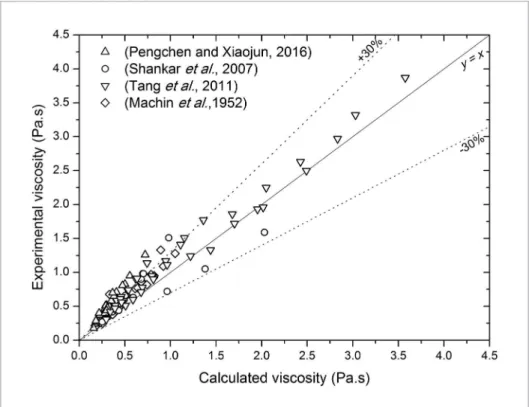
Figure 1 shows the comparison be-tween the viscosity values found in the references previously cited and those calculated by FactSage 6.4 for the CSAM system.
Figure 1
Calculated and measured viscosity com-parison for CaO-SiO2-Al2O3-MgO system.
The experimental viscosity values show a strong trend, higher than those calculated through FactSage, as illus-trated in Figure 1. For the CSAM system, it is noted that above approximately 0.5 Pa.s the values between experimental and calculated viscosities are quite
similar practically for all references. As viscosity increases, Figure 1 indicates a non-linear behavior in the ratio between the values. Muller and Erwee (2011) studying blast furnace slags in the CSAM system also reported that the overall correlation between the predicted and
measured viscosity values is better at lower viscosities (higher temperatures), but deteriorates at higher viscosities. However, data from Tang et al. (2011) fit well with the estimated values through FactSage along the established viscosity range (0~4 Pa.s).
3.2 Viscosity of CaO-SiO
2-Al
2O
3-K
2O system
Alkali oxide has importance in iron-making and steeliron-making processes. In a blast furnace, for example, the content of
alkali oxide has significant influence on the viscosity of slag, which is very important in the ironmaking operation (Zhang and Chou,
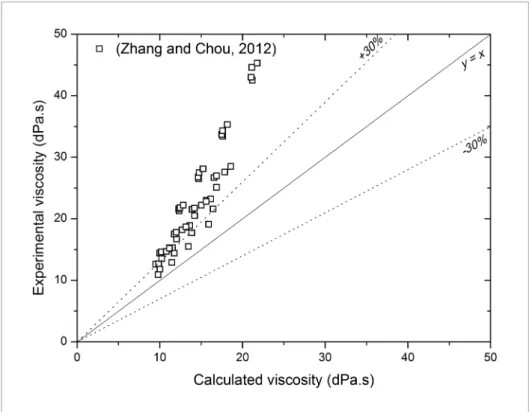
Figure 2 Calculated and measured viscosity com-parison for CaO-SiO2-Al2O3-K2O system.
The values measured for viscosity are higher than those calculated through FactSage, as shown in Figure 2. Although there is a reasonable correlation for values
lower than 10 dPa.s, a strong deviation
as the viscosity increases is noted, which shows experimental viscosity values to be 30% higher than the FactSage values.
Therefore, as experimental viscosity increases, the calculation method loses accuracy and the difference between vis-cosities becomes higher.
3.3 Viscosity of the CaO-SiO
2-Al
2O
3-MgO-CaF
2system
The main application of the CSAMF system is in the steelmaking process, during secondary refining.
Studying different slags, the authors (Wu et al., 2011) evaluated the effect of CaF2 in the slag viscosity. Figure 3
shows the experimental and calculated values for the viscosity of slags in the CSAMF system.
Figure 3 Calculated and measured
viscosity comparison for the CaO-SiO2-Al2O3-MgO-CaF2 system.
Analyzing Figure 3, it is noted that a very good fitting between experimental and calculated viscosities up to 0.075 Pa.s exist.
In this region, the majority of values of Figure 3 lay on the y = x line. As viscosity in-creases from 0.075 Pa.s, there is a dispersion
of the viscosity values, especially around 0.10 Pa.s, where experimental viscosities are
4 times higher than the calculated values. According to Jung et al. (2014) for oxide
slags with an addition of CaF2 there is a discrepancy between experimental data in
the literature on CaF2 viscosity and this fact can affect the comparison analysis.
3.4 Viscosity of the CaO-SiO
2-MgO system
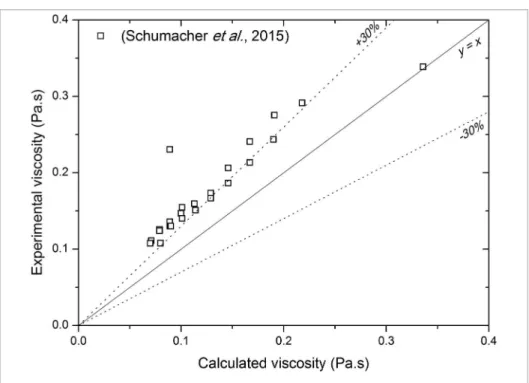
Figure 4 shows the results for viscosities in the CSM system.
Figure 4
Calculated and measured viscosity
comparison for the CaO-SiO2-MgO system.
Figure 4 indicates that the dif-ference between experimental and calculated viscosities is not high. It is possible to observe that as measured
viscosity values increase, the calculated viscosities also increase, practically keeping a constant slope with experi-mental viscosity values around 30%
higher than the calculated values. For viscosity values lower than 0.1 Pa.s, the
data from viscosities seem to approach the line y = x.
3.5 Viscosity of the CaO-SiO
2-Al
2O
3system
A basic system for secondary steel-making operations is the CSA slag system (Jung et al., 2014). The change in the
com-positions of these systems has an impact on heat capacity, density and viscosity (Lis et al., 2012). Figure 5 shows the
com-parison between measured and calculated viscosities for this system.
Figure 5
It is possible to observe that data from literature (Chopra and Taneja, 1964; Urbain et al., 1982) are near the y = x line, especially for values below 2.5 Pa.s, as
shown in Figure 5. The values shown in Figure 5 indicate a very well fitted relation-ship of the reference (Chopra and Taneja, 1964; Urbain et al., 1982) data with
the calculated viscosity values through FactSage. However, for Machin and Yee (1948), the viscosities seem to be similar only for values below 0.5 Pa.s.
3.6 Viscosity of the CaO-SiO
2-FeO system
According to Davenport et al. (2002), the system of SiO2-FeO is presented in cop-per smelting slags as a main component. On the other hand, in secondary
steelmak-ing processes, with CaO-based slags, there is employment of SiO2 and even FenO in the slag composition (Ji et al., 1997). In view of the metallurgical applications, the viscosity
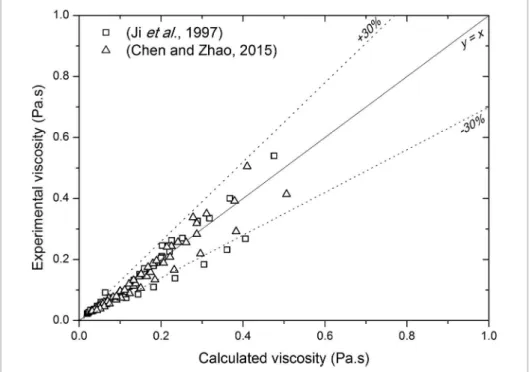
study of CaO-SiO2-FeO is very important. The comparison between experimental and calculated viscosities for the CaO-SiO2 -FeO system is shown in Figure 6.
Figure 6 Calculated and measured viscosity
comparison for the CaO-SiO2-FeO system.
Figure 6 announces a good agreement between experimental and calculated viscosity values. The viscos-ity data from Chen and Zhao (2015) seem to show a better fit than the Ji
et al. (1997) data along the viscosity range (0~0.6 Pa.s) in Figure 6. A few
values of the measured viscosities presented by these studies (Chen and Zhao, 2015; Ji et al.,1997) presented
distinct behavior with calculated viscosities higher than the measured values through the experimental method when viscosity increased (lower temperatures).
3.7 Accuracy of calculated viscosities
Accuracy of the calculated viscosities was evaluated by using Equation 1, which
describes the relative deviation average for each system. The results are shown
in Figure 7.
It can be seen from Figure 7 that the CaO-SiO2-Al2O3 and CaO-SiO2-FeO systems showed better agreement between measured and calculated viscosities. On the other hand, other systems presented higher relative deviation average, from 25.01 to 37.53%. According to a study reported by Chen and Zhao (2016) the relative deviation of FactSage predictions is around 30%. The authors (Chen and
Zhao, 2016) also evaluated the accuracy in viscosity calculation compared to the measured values with different models besides FactSage software, but only for the CaO-SiO2-K2O. A lower agreement in the high order systems may be attributed to the possible experimental data errors from literature (Suzuki and Jak, 2014) or still result from complicated interactions between the cations and anions that make
the predictions and modeling of slag vis-cosity quite difficult (Rosypalová et al., 2014). Thus, both methods of obtaining slag viscosity can carry some degree of uncertainty in the results.
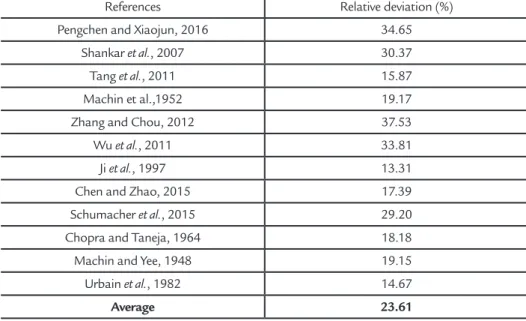
Table 4 shows the relative deviation considering each reference where the mea-sured viscosity data was taken, in order to compare with the calculated values through FactSage.
References Relative deviation (%)
Pengchen and Xiaojun, 2016 34.65
Shankar et al., 2007 30.37
Tang et al., 2011 15.87
Machin et al.,1952 19.17
Zhang and Chou, 2012 37.53
Wu et al., 2011 33.81 Ji et al., 1997 13.31
Chen and Zhao, 2015 17.39
Schumacher et al., 2015 29.20
Chopra and Taneja, 1964 18.18
Machin and Yee, 1948 19.15
Urbain et al., 1982 14.67
Average 23.61
Table 4
Relative deviation between measured and calculated viscosities for each reference.
The relative deviation between the measured and calculated viscosities is in the range 13.31 to 37.53%. The lower relative deviation corresponds to Ji et al. (1997) in the CaO-SiO2-FeO system study. The higher was obtained from Zhang and Chou (2012) for the CaO-SiO2-K2O system. Considering all references and systems, the average deviation between measured and calculated viscosities is 23.61%. Even with the higher relative deviation (37.53%) observed, the calcu-lated viscosities are within the range of uncertainties reported by Mills (1995). According to author (Mills, 1995), the viscosity measurements were subject to experimental uncertainties from the possible arise of problems, such as tem-perature difference from thermocouple
measurement, actual temperature of the melt, and also possible fluorine losses (for CaF2 based slags), which may occur if held in the system for a long time at tem-peratures > 800 ºC. In view of this, the viscosity measurements differ from recom-mended values by an average of ± 30%, and in some cases more than 50%. In this context, it can be said that the obtained results in terms of relative deviation have shown reasonable values, with almost all calculated data within the experimental uncertainty ranges.
Slag viscosity modeling is a chal-lenging activity. As commented before, this physical property of viscosity may exhibit great variability depending on tem-perature and chemical composition. The experimental methodology and its results
are fundamental and can be used as key indicators for the optimization of models for the prediction of slag viscosities. In general, for all the systems described in this study, it was verified that for the lower viscosity values, the coherence between the measured and calculated viscosities were higher. However, it is extremely im-portant to search for a further understand-ing regardunderstand-ing the discrepancy between the data, which is verified when the viscosity becomes higher. In this context, an im-portant first step was taken in this study, where information about the agreement of the viscosity values is presented. Another step is needed to accurately assess the major factors apart from the experimental errors, which may affect the discrepancies observed for higher viscosity indices.
4. Conclusions
Within the realm of experimental uncertainties, the FactSage viscosity model has accurately reproduced the vis-cosity calculation for a wide range of composition and temperatures including different calcium-silicate based slags. The relative deviations between measured and calculated viscosities were consistent with the literature. For the systems
CaO-SiO2-Al2O3-MgO, CaO-SiO2-Al2O3-K2O, CaO-SiO2-Al2O3-MgO-CaF2, CaO-SiO2-MgO, CaO-SiO2-Al2O3 and CaO-SiO2-FeO the average relative deviations between measured and the calculated viscosity values were 25.01, 37.53, 33.81, 29.20, 17.33 and 15.35%, respectively.
For the CaO-SiO-Al2O3-MgO and CaO-SiO2-Al2O3-K2O systems, as
vis-cosity increases the deviation between measured and calculated viscosities becomes higher, when a non-linearity ratio between the values is observed. However, for lower viscosity values (< 0.50 Pa.s for the CSAM system and
10 dPa.s for the CSAK system), there is
with CaF2 shows a good fitting of the values up to 0.075 Pa.s, however around
0.10 Pa.s a dispersion occurs and the
measured viscosities are fourfold higher than the calculated values. In the
CaO-SiO2-MgO system, the measured and calculated viscosities tend to become equal (approaching the y = x line) for viscosity values lower than 0.10 Pa.s.
The two systems, CaO-SiO2-Al2O3
and CaO-SiO2-FeO, showed the best agreement between the experimental method and the method calculated through FactSage 6.4 with a very good fit between the viscosity values.
Acknowledgment
The support of the National Council of Technological and Scientific Development
(CNPq), Luiz Englert Foundation (FLE) and UFRGS are gratefully acknowledged.
References
BALE, C. W. et al. FactSage thermochemical software and databases. Calphad, New York, v. 54, p. 35-53, 2016.
CHEN, M. et al. Viscosities of Iron Blast Furnace Slags. ISIJ International, Tokyo, v. 54, p. 2025-2030, 2014.
CHEN, M., ZHAO, B. Viscosity measurements of SiO2-“FeO”-CaO system in equili-brium with metallic Fe. Metallurgical and Materials Transactions B, Warrendale, v. 46, n. 1, p. 577-584, 2015
CHEN, M., ZHAO, B. Viscosity measurements of the SiO2–K2O–CaO system relevant to biomass slags. Fuel, London, v.180, p. 638-644, 2016.
CHOPRA, S. K., TANEJA, C. A. Utilization of the Indian Blast Furnace Slags. In: SYMPOSIUM ON UTILIZATION OF METALLURGICAL WASTES, 1964, Jamshedpur. Proceedings of Utilization of Metallurgical Wastes. Jamshedpur: National Metallurgical Laboratory, 1964. p. 224-225.
COSTA E SILVA, A. Estimating Viscosities in iron and steelmaking slags in the CaO--Al2O3-MgO-SiO2-(TiO2) system with basis on a thermodynamic model. Journal of Materials Research and Technology, Rio de Janeiro, v. 1, n. 3, p. 154-160, 2012. DAVENPORT, W. G. et al. Extractive Metallurgy of Copper (4th ed.). Oxford:
Pergamon Press, 2002. 432p.
CENTER FOR RESEARCH IN COMPUTATIONAL THERMOCHEMISTRY (CRCT). FactSage modules: viscosity. Canada: 2010. Disponível em: <http://www. crct.polymtl.ca/factsage/fs_viscosity.php>. Acesso em: 07 Jul. 2016.
JI, F. Z. et al. Experimental studies of the viscosities in the CaO-FenO-SiO2 slags. Metallurgical and Materials Transactions B, Warrendale, v. 28, n. 5, p. 827-834, 1997.
JUNG, I. H. et al. Viscosity of slags. In: SEETHARAMAN, S., MCLEAN, A., GUTHRIE, R., SRIDHAR, S. (Orgs.). Treatise on process metallurgy. United Kingdom: Elsevier, 2014. v.2, p. 653-674. (Process Phenomena).
JUNG, I. H. Overview of the applications of thermodynamic databases to steelmaking processes. Calphad, New York, v. 34, n. 3, p. 332-362, 2010.
LIS, T. et al. The impact of the chemical composition of continuous casting moul-ds on their physical properties. Journal of Achievements in Materials and Manufacturing Engineering, Gliwice, v. 55, n. 2, p. 345-348, 2012.
MACHIN, J. S. et al. Viscosity studies of system CaO-MgO-Al2O3-SiO2: III, 35, 45 and 50% SiO2. Journal of the American Ceramic Society, Malden, v. 35, p. 322-25, 1952.
MACHIN, J. S., YEE, T. B. Viscosity studies of system CaO-MgO-Al2O3-SiO2: II, CaO-Al2O3-SiO2. Journal of the American Ceramic Society, Malden, v. 31, p. 200-204, 1948.
MILLS, K. C. et al. ‘Round Robin’ project on the estimation of slag viscosities. Scan-dinavian Journal of Metallurgy, Copenhagen, v. 30, n. 6, p. 396-404, 2001. MILLS, K. C. Viscosities of molten slags – slag atlas (2nd ed.) Düsseldorf: Verlag
Stahleisen GmbH, 1995. 349p.
MULLER, J., ERWEE, M. Blast furnace control using slag viscosities and liquidus temperatures with phase equilibria calculations. In: SOUTHERN AFRICAN PYROMETALLURGY CONFERENCE. 2011. Johannesburg. Proceedings of Southern African Pyrometallurgy. Johannesburg: Southern African Institute of Mining and Metallurgy, 2011. p. 309-326.
Received: 2 March 2017 – Accepted: 26 December 2017
CaO-SiO2(-MgO)-CaF2 slags. Metallurgical and Materials Transactions B, Warrendale, v. 33, n. 5, p. 723-729, 2002.
PELTON, Arthur D., BLANDER, Milton. Thermodynamic analysis of ordered liquid solutions by a modified quasichemical approach – application to silicate slags. Metallurgical and Materials Transactions B, Warrendale, v. 17, n. 4, p. 805-815, 1986.
PENGCHENG, L., XIAOJUN, N. Effects of MgO/Al2O3 ratio and basicity on the vis-cosities of CaO-MgO-SiO2-Al2O3 slags: experiments and modeling. Metallurgical and Materials Transactions B, Warrendale, v. 47, n. 1, p. 446-457, 2016.
ROSYPALOVÁ, L. et al. Verification of mathematical models for calculation of vis-cosity of molten oxide systems. Metalurgija, Sofia, v. 53, n. 3, p. 379-382, 2014. SANTHY, K. et al. Effect of oxygen to silicon ration on the viscosity of metallurgical
slags. ISIJ International, Tokyo, v. 45, n. 7, p. 1014-1018, 2005.
SCHUMACHER, K. J. et al. Viscosities in the calcium-silicate slag system in the range of 1798 K to 1973 K (1525 °C to 1700 °C). Metallurgical and Materials Transactions B, Warrendale, v. 46, n. 1, p. 119-124, 2015.
SHANKAR, A. et al. Experimental investigation of the viscosities in CaO-SiO 2--MgO-Al2O3 and CaO-SiO2-MgO-Al2O3-TiO2 slags. Metallurgical and Materials Transactions B, Warrendale, v. 38, n. 6, p. 911-915, 2007.
SONG, M. et al. Viscosities of the quaternary Al2O3-CaO-MgO-SiO2 Slags. Steel Research International, Düsseldorf, v. 82, n. 3, p. 260-268, 2011.
SUZUKI, M., JAK, E. Development of a quasi-chemical viscosity model for fully li-quid slags in the Al2O3–CaO–‘FeO’–MgO–SiO2 system: the revised model to in-corporate ferric oxide. ISIJ International, Tokyo, v. 54, n. 10, p. 2134-2143, 2014. TANG, X. et al. Viscosities Behavior of CaO-SiO2-MgO-A12O3 Slag With Low Mass
Ratio of CaO to SiO2, and Wide Range of A12O3 Content. Journal of Iron and Steel Research International, Beijing, v. 18, n. 2, p. 1-6, 2011.
URBAIN, G. et al. Viscosity of liquid silica, silicates and alumino-silicates. Geochimica et Cosmochimica Acta, Oxford, v. 46, n. 6, p. 1061-1072, 1982. VARGAS, S. et al. Rheological properties of high-temperature melts of coal ashes
and other silicates. Progress in Energy Combustion Science, Oxford, v. 27, n. 3, p. 237–429, 2001.
WU, L. et al. The effect of calcium fluoride on slag viscosity. Metallurgical and Materials Transactions B, Warrendale, v. 42, p. 928-931, 2011.
XU, J. et al. Experimental investigation on viscosity of CaO-MgO-(-Al2O3)-SiO2 sla-gs and solid-liquid mixtures. Journal of Iron and Steel Research International, Beijing, v. 22, n. 12, p. 1091-1097, 2016.
ZHANG, G., CHOU, K. Measuring and Modeling Viscosity of CaO-Al2O 3--SiO2(-K2O) Melt. Metallurgical and Materials Transactions B, Warrendale, v. 43, n. 4, p. 841-48, 2012.