THE COMPREHENSIVE ASSESSMENT OF
TEAM MEMBER EFFECTIVENESS (CATME):
PERSONALITY PREDICTING TEAMWORK
COMPETENCIES
Armando Garrido Filipe Garine
Project submitted as a partial requirement for the conferral of Master of Human Resources Management
Supervisor: Professor Silvia Dello Russo, ISCTE Business School, Department of Human Resources and Organizational Behavior
- Spine -
TH E C O M P R E H E N S IV E A S S E S S M EN T O F T EA M M E M B E R EF F E C T IV E N ES S ( C A TM PE R SO N A L IT Y PR E D IC T IN G T E A M W O R K C O M PE T E N C IE S A rm an d o G ar ri d o F il ip e G ar in eThe presented dissertation wouldn’t have been possible with the aid of
several persons to whom I am very grateful.
Firstly I would like to thank Professor Silvia Dello Russo, my supervisor
and former professor, for her sage advice, dedication, insightful criticisms
and patient encouragement during the process of writing the thesis. Due to
this learning process I have developed several skills, which without her
support would probably stay latent.
Secondly I would like to thank professor Ana Passos for her initial guidance
of the topic that concerns this dissertation.
I am grateful, to my mother Elizabete and my father Pedro that brought me
to this world. Without their support, it wouldn't have been possible for me to
be where I am today. To my grandfather Eleazar and my grandmother
Palmira, which have loved me unconditionally since the start.
Lastly I am thankful, to my everlasting precious best friends who listened
too much about teamwork: Carolina, Mafalda, Miguel, Silvia, João Correia
and João Frias.
“It is through education that we are liberated from powerlessness, from
the burden of mistrust directed against ourselves.
To awaken the abilities that have been lying dormant within.
To arouse and extend the soul’s aspiration to become full and complete.
Can there be any more sublime experience in life?”
Index&
1.EXECUTIVE SUMMARY ... 1
2.INTRODUCTION ... 3
2.THEORETICAL OVERVIEW ... 5
2.1TEAMS AND INDIVIDUAL TEAMWORK COMPETENCIES ... 5
2.1.2 Teamwork models ... 7
2.1.3 Teamwork competencies – the ABC framework ... 11
2.2MEASURING TEAMWORK COMPETENCIES ... 15
2.2.1 The CATME instrument ... 15
2.2.2 The CATME instrument and teamwork theory ... 18
3.THE FIVE-FACTOR MODEL IN PERSONALITY ... 20
3.1. Personality as a predictor of individual competencies in context of a team 22 3.1.1 Extraversion ... 24 3.1.2 Agreeableness ... 26 3.1.3 Conscientiousness ... 28 3.1.4 Emotional Stability ... 31 3.1.5. Openness to experience ... 32 5. EMPIRICAL STUDY ... 34 5.1.METHOD ... 34 5.1.1 Sample ... 34 5.1.2 Procedure ... 35 5.1.3 Measures ... 35 5.1.4 Data analysis ... 36 5.2RESULTS ... 37 6. DISCUSSION ... 50 6.1 Limitations ... 55
6.CONCLUSION ... 58
7. REFERENCES ... 59
8. ANNEXES ... 63
8.1.DESCRIPTIVE STATISTICS ... 63
8.1.1 Course and gender ... 63
8.1.2 Age ... 64
8.1.3 Normality test for two variables on other ratings ... 65
8.2.SD MEANS AND PAIRED-SAMPLE T-TEST CONDUCTED ON SD OF OTHERS RATINGS AND SELF RATINGS ... 65
1.Executive Summary
The following thesis explores personality as a predictor of teamwork competencies. Nowadays, work design is increasingly based on teams, therefore there is a big topic of research that focus on teamwork. Several researchers reinforce the importance of personality within organizational contexts, since different personality characteristics of team members may have differential effects on the teamwork behaviors considered effective for team performance, which have impact on the organization.
Thus, the main objectives of this thesis are to answer the following research questions: What personality traits should one individual possess in order to be a good team player? What are the personality traits that have an impact in specific teamwork competencies? Which ones are more relevant in predicting a certain competency? The resultant findings can be applied in several Human Resources systems such as performance appraisal, selection and recruitment, as well as the efficient design of work teams.
The second chapter provides a general introduction to several concepts related to teamwork (e.g., team, teamwork competencies, performance behaviors), emphasizing why teams are important in today’s modern world. Further on, several teamwork models and competencies are presented in order to provide different frameworks of analysis to the readers. Still in this chapter, a conceptual bridge is made between the previously discussed models/teamwork competencies and the empirical tool that was used to measure the competencies. The used tool is named “The Comprehensive Assessment Tool of Team Member Effectiveness” (CATME), which has been developed by Ohland and colleagues (2012).
The third chapter defines the personality variables of the Big five of personality (Extraversion, Agreeableness, Conscientiousness, Emotional Stability and Openness to experience), which are the predictor variables of the study. Several hypotheses were drawn out of this chapter concerning personality traits predicting teamwork competencies (assessed by the CATME tool).
Results pointed out that at the individual level, there are several personality traits associated with certain teamwork competencies (when individuals where rating
themselves). These results show that further relevance should be given to personality when predicting competencies (e.g. conscientiousness is able to predict team competencies that are becoming more and more important in organizational contexts).
The findings of this study can be used to understand the influence of personality on teamwork competencies. Future research and practical implications in organizational settings are posited.
2.Introduction
As the world is rapidly changing, new phenomena and demands arise. Companies and organizations have a major interest in adapting to this ever-changing world, in order to become more competitive, dynamic, flexible and having economic sustainability in mind. Therefore a big topic of research focuses on teamwork, since organizational design is increasingly based on teams. Understanding team processes is crucial for the sustainability of organizations, so that managers make informed decisions. Despite the developments in teamwork research, little is known about how individuals contribute to the team intragroup processes and outcomes (Juhász, 2010) and one of the main individual factors that are studied is personality. Morgeson and colleagues (2005) have mentioned that the interactive effects between teamwork knowledge (knowing how to work in teams) and personality characteristics are an area to be explored in the future. Hogan and colleagues (1998) and Neumann and Wright (1999) also share this perspective, mentioning that personality traits predicting individual teamwork behaviors is a promising avenue of research. The dominant way of analyzing teams is usually with the input-process-output (IPO) model at high levels of analysis (e.g. personality and team performance), which implies that there are a variety of individual inputs, which will affect team outputs. It is important to mention that personality is theoretically and empirically more related to team processes measures than outcomes and outputs. Thus, team process criteria should be more strongly related to personality because there is a closer link between team processes, which reflect team interaction, than with the team outcomes (Driskell et al., 1987).
The results from two meta-analyses reinforce the importance of the personality within organizational contexts (Barrick & Mount, 1991; Hurtz & Donovan, 2000); nevertheless, little research has been done on personality and team performance at the lower construct level (Bernstein et al., 2008), e.g. sub-dimensions of personality factors and teamwork competencies. Christiansen and Tett (2013) have argued that most research on this topic focuses on high-level criterion and sometimes a broad criterion can mask underlying relationships. For instance, a broad level predictor such as extraversion is composed by different lower level constructs (assertiveness or sociability – see Driskell et al. 2006) and in turn, teamwork performance has also different lower level constructs that can be related to each of these components of
extraversion. The main question is: what are the best predictors and the best criteria to study such relationship? Research on this topic should deconstruct high level criteria and/or predictors into low level criteria/predictors (e.g. Lepine & Van Dyne, on studying cooperation and voice behavior). Christiansen and Tett (2013) argue that it is useful to examine the effects of personality on work teams to expand criterion measures beyond simple performance outcome measures, since performance is important but the teamwork processes and competencies that lead to a high level performance are also parsimonious. Hurtz and Donovan (2000) have mentioned “there is potential for improving the validity of personality predictors and several dimensions of job performance”. These authors also suggested that research should aim for narrower composites of personality (e.g. subdivision of the Big 5 theory). Furthermore, multiple criteria that distinguish task performance (e.g. relevant KSAs, team monitoring) from contextual performance (e.g. interpersonal relations, cooperation) should be researched because narrower aspects of performance can be theoretically and empirically linked to different personality criteria. Therefore, research on this field can further contribute to the understanding of how personality traits affect teamwork competencies. Different personality characteristics of team members may have differential effects on the behaviors considered effective for team performance (Christian & Tett, 2013; Driskell. et al., 2006). For example, a team member who is highly conscientious might be quite good at task management and planning, nevertheless that person might not be good at having quality interpersonal relationships with other peers, for which another personality trait might be important. Firstly, in order to understand how personality affects teamwork competencies, one should have in mind the main teamwork models, which reflect in several teamwork competencies. Secondly one should choose a personality model that can be used to study the relationship between several predictors and criteria. The next sections will give a general overview regarding teamwork theory and concepts, followed by the chosen model of personality. Furthermore one should be able to measure the teamwork competencies being predicted and for that a newly developed instrument in the literature by Ohland and colleagues (2012), (CATME) has been used.
2.Theoretical overview
2.1 Teams and individual teamwork competencies
What is a team? There are several of definitions concerning this object of study, in different categories such as sport groups, social groups, etcetera. In the workplace, a team is a group of people who dynamically interact to perform vital organizational tasks, restrained by organizational contexts in which there is some degree of interdependence between the individuals that compose teams (Dyer, 1984; Kozlowski & Bell, 2003:334). Teams face different demands (Mathieu, Maynard & Rapp, 2009) and strive to achieve certain goals. In order to function properly, a team requires interaction among its members, therefore teamwork can be described as the dynamic enactment of process mechanisms (interaction between members), which inhibits and/or contributes to team performance (Salas, Stagl, Burke& Goodwin, 2007: 190), in order to deliver superior performance trough the combination of individual efforts.
Designing work around independent or semi-independent teams is essential for organizational effectiveness, being an indispensable part of organizational life (Cascio, 1995; Hackman, 1990). Therefore, teamwork is a common need in organizations. In this context, researchers have developed the concept of emergent proprieties that results from the interaction of the components of the system from which these emergent properties come from (Salas et al, 2009). These emergent properties will not arise if one tends to look at the elements of the system in isolation (namely, individuals, inputs and outputs). Thus, the view on this matter should be holistic, highlighting the fact that “the whole is greater/different from the sum of its parts”. Therefore effective teams should be able to synergistically combine the different characteristics of its team members, producing outcomes beyond the capacity of an individual member or the isolated individual contribution of each team member (Salas et. al, 2009). The former authors developed the following expression: “wisdom of collectivities” – which stands for the increased capacity to deliver superior performance based on the different interactions among team members (Salas et all, 2009). This expression encompasses the core meaning on why teams are so important in organizational settings.
Nowadays, for instance, organizations benefit from employee-assessment systems based on work competencies, which are more dynamic, flexible, and generalizable than context-dependent functional skills (Schippmann et al., 2000). There are competencies at the team level, and at the individual level, adaptable to each business needs. In general, competencies are expressed in behaviors that reflect how individuals perform successfully in a variety of circumstances. Furthermore so as to capture skills that are transferable and more indicative of work activity in contemporary organizations (Consiglio et al., 2013), to be effective in a team and delivering superior performance. In the context of working in a team there are specific competencies, which are named team competencies. Team competencies are divided in two categories: taskwork or teamwork (Morgan et al., 1986). Taskwork competencies refer to the knowledge skills and abilities (KSA’s) used to accomplish individual task performance, which do not require interdependent interaction within the team. On the other hand there are teamwork competencies, which are required for members to function within an interdependent team. Overall, members should not only possess individual technical knowledge regarding their tasks, but they must also have proficiency on the social dynamics of teamwork. Another concept that is relevant to understand is teamwork performance, because teamwork performance reflects the enactment of teamwork competencies. Therefore teamwork performance is the sum of teamwork social processes and individual task work performance (Kozlowski & Klein, 2000) and it is divided into two smaller categories –
performance behaviors, which are actions relevant to achieving goals, reflected by
certain team competencies and performance outcomes which are the consequences of these behaviors in team setup (Mathieu et al., 2009). Performance behaviors are researched in order to understand how people behave within a certain context, within a team, with certain dynamics at different levels. To sum up, both taskwork and teamwork competencies reflect performance behaviors that in turn are followed up by performance outcomes.
The following section will give a general overview of several well-known models in this field in order to further understand team dynamics and more specifically, how individual apply different teamwork competencies in different models.
2.1.2 Teamwork models
Different models of teamwork have been developed over years of research in order to organize and understand team inputs, processes, dynamics and outputs. Some models are more generalist, adaptable to a different range of teams, tasks, and contexts of people, tasks, technologies and settings (Ilgen et al., 2005; Salas, 2009), while others focus on teamwork behaviors from a situational perspective.
In order to analyze team functioning, one should have a framework in mind. Many of these models are used to study which factors and processes make teams more and less efficient, among other topics of research. Therefore, the following models encompass the main existing frameworks to study teams, in different competencies. Further on, since individuals compose teams, more relevance will be given to the teamwork competencies of individuals. Christiansen and Tett (2013) mention that most research on studying teams and their predictors focuses on sole teamwork performance, but they point for a new set of research that focuses on subdivisions of teamwork competencies, therefore it is important to understand teamwork concepts and competencies, within each of the following models.
a) The five teamwork competencies (Big 5 in teamwork)
This model proposes five main teamwork competencies (at the team level) and was developed by Salas and colleagues in 2005.
The first category is team leadership, which in this model is defined by “social problem solving that promotes coordinated, adaptive team performance by facilitating goal definition and attainment”. The authors of this model believe that to respond to increasingly complex task environments team members have to alternate their leadership function in order to take advantage of team member strengths (e.g. knowledge, skills attitudes, contacts, perspectives) – in other words, adopt a shared
leadership. New research has shown that shared leadership in more effective than
traditional leadership structures.
The second category is adaptability, which is defined by “the team’s ability to change team performance processes in response to cues from the environment in a manner that results in functional team outcomes (Burke et. al, 2006)”. This is
especially essential for teams working in constant by changing dynamic environments.
The third component is mutual performance monitoring, which according to Salas (1995) is the ability to keep track of other team members’ work whilst performing their own job, making sure that everything is being followed as expected. Teams should have a culture in which this monitoring is well accepted, in terms of mutual performance monitoring in order to increase the levels of performance. Mutual performance monitoring is a pre requisite for supporting behaviors.
The fourth component is named supporting/backing up behavior, which consists in helping teammates in performing their tasks when there is a workload distribution problem in the team. This leads to a back up behavior from the teammembers (Porter et al., 2003). In other words, teammates help each other when there is to much work concentrated in one or more persons in the team. This backup behavior can either be either verbal or physical.
The fifth component is the individual orientation for teamwork. Essentially it is an individuals’ preference for working within a team (where an individual takes advantage of team member inputs) versus working in isolation. Team orientation is essential for effective teamwork. For instance, individuals tend to focus on their individual work when they are under stress, leading to overall team performance loss. An individual who doesn't have team orientation will compromise the overall performance of the team.
These five components generate three coordinating mechanisms that facilitate communication and the teamwork process. The first coordinating mechanism is shared mental models – “organized mental structures that facilitate execution of interdependent team processes” (Klimoski & Mohammed, 1994). At the team level a mental model is a knowledge framework that is partially shared and distributed among a team, which leads team members to interpret information in a compatible manner among team members, facilitating effective coordination (Salas et al., 2009). The second mechanism is closed loop communication. Teams must acquire information from the environment and distribute that information internally to perform actions (MacMillan, Entin & Serfaty, 2004). Trough communication teams translate individual understanding into team dynamic representations, which will lead to a certain action, for a certain team outcome (Cooke, Salas, Kiekel & Bell, 2004). The third mechanism is mutual trust, which stands for a shared perception that
individuals in the team will protect team interests and will perform expected actions for the welfare of the team (Webber, 2002, p205).
b) The IPO and the IMOI frameworks
The IPO model (Input, process, output) model represents teamwork trough relationships between input variables (individual and team characteristics, task characteristics, context characteristics), process variables (members’ interactions, mutual performance monitoring, communication, coordination, conflict, leadership) and outcome variables (performance outcomes, productivity and satisfaction) (Ilgen et al., 2005; Mathieu et al., 2009). This model originated from the classic team literature by McGrath (1964), in order to study team effectiveness (Mathieu et al., 2009). Although this model is very much used, it has been criticized with several aspects.
The first critic to the IPO framework is that it restrains research into a linear cycle, from inputs to outputs, not having in account any feedback loops, which would lead to a new teamwork cycle. Nowadays outputs such as performance are treated as inputs for future team processes (Ilgen et al., 2005). Furthermore, one has to define periods of time in order to frame the level of analysis of team performance episodes, according to the goals of the team and the team’s progress towards accomplishing them. Therefore performance episodes are “distinguishable periods of time over which performance accrues and feedback is given” (Marks et al., 2001). The IPO framework doesn't take this in account since teams can have different goals at the same time (which usually overlap). This definition of timeframe analysis is not explicit in this model. Mark and colleagues suggested that the IPO cycle should be associated with performance episodes in order to clarify and better understand teamwork (Salas et al., 2009).
The second main critic is that, over time, teams develop and the IPO model doesn’t take this perspective into consideration (Salas et al., 2009). With time there are changes in team members, projects, technology and the organizational context changes; moreover one has to take in account the group structure and behaviors over time and context (McGrath et al., 2000; Salas et al., 2009). Teams and their members continuously change, interacting with themselves and with other people, making teams complex, adaptive and dynamic systems, with multiple forms and levels of
causality operating simultaneously (McGrath et al., 2000). A third critic is that within teams, there are emergent states (ES) that develop over a life of a team and impact team outcomes (Ilgen et al., 2005). Emergent states encompass cognitive, emotional or affective states (Mathieu et al., 2009). Moreover these ES are not processes. As mentioned, there are causal and more complex interactions among the different phases of the model. Having said this, the linearity of the model doesn’t take this complexity in consideration (Ilgen et al., 2005). The IPO model has been widely used and accepted by researchers. It has served as a base to study and understand teams, and to gather knowledge on how teams deliver superior performance. Other models added different constructs to this model enhancing the way researchers look at team complexity.
McGrath and colleagues (2000) have developed a framework to look into team inputs in different levels. The authors describe three levels of dynamic causal reciprocal interactions: the first one is local dynamics that comprise each member’s input of resources and taskwork. Then these dynamics originate group/global level dynamics, which are the norms of the surrounding system, justice climate, cohesion, status structures, group identity, conflict, leadership, that naturally emerge (emergent structures-ES), that affect the first level of local dynamics. The third level is the contextual dynamics that shape the group over time, varying according to the given organizational support, demand for group outputs and other intrinsic factors to the model, for instance. This model also affirms that teams aren’t static and cyclically advance through new inputs through different levels of teamwork that interact and influence each other (Kozlowski et al., 2000).
In order to better represent reality, using the IPO model framework, Ilgen and colleagues (2005) have used recent team development theory, introducing a timeframe notion into the model, together with a behavioral categorization scheme of the ABC (Attitudes, Behaviors and Cognitions) of teamwork competencies to build up a new analysis framework (Input-Mediator-Output-Input - IMOI). One of the main goals of this model was also to address the critics that were firstly mentioned in the original IPO model. The last I in the name of the model represents the episodic performance, cyclical nature of the model in which the outputs revert into new inputs, for instance, which answers to the first critic.
The ABC teamwork competencies are discussed within each of the three phases of the team development theory, which has three phases: Forming stage,
Functioning Stage and Finishing stage (Ilgen et al., 2005). These stages made the base of creation for the IMOI model. The M (mediators) within the model comprises processes (members’ actions) and emergent States (ES). This framework brings a deepened insight, a different analytic perspective compared to the IPO traditional framework, combining an exhaustive list of constructs that enhance the existing models, bringing them closer to reality, since team mechanics are still quite complex to understand.
2.1.3 Teamwork competencies – the ABC framework
It is essential to understand and identify what team competencies are required for effective teamwork in certain setups, in order to properly design team tasks, training, performance appraisal and selection, since that competencies influence all the Human Resources systems within a company. This is why it is important to differentiate taskwork and teamwork competencies. Each of these team competencies will belong to one of these three categories: attitudes (A), a behavior (B), or cognition (C). For a full description of each competency see Salas and colleagues in 2009.
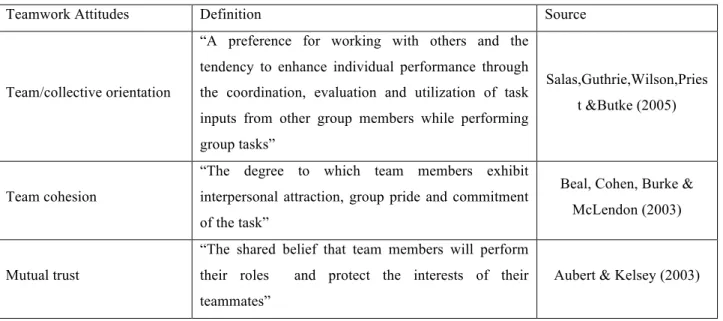
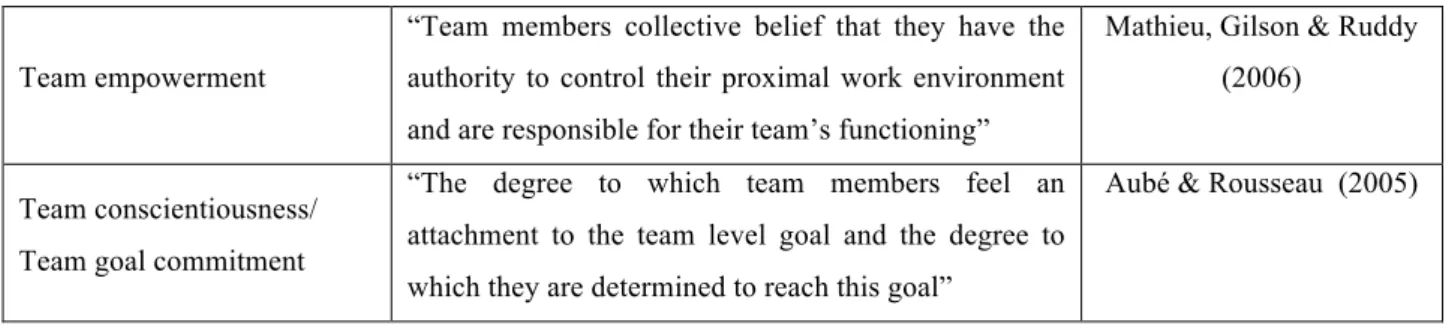
Attitudes are emotional attributes necessary for effective team performance
(Salas et al., 2009). Cannon-Bowers and colleagues (1995) defines attitude as “an internal state that influences an individual’s choices or decisions to act in a certain way under particular circumstances”. Many of the following relevant definitions received empirical support over time, and many teamwork models have developed from this knowledge.
Table 1-Teamwork Attitudes
Teamwork Attitudes Definition Source
Team/collective orientation
“A preference for working with others and the tendency to enhance individual performance through the coordination, evaluation and utilization of task inputs from other group members while performing group tasks”
Salas,Guthrie,Wilson,Pries t &Butke (2005)
Team cohesion
“The degree to which team members exhibit interpersonal attraction, group pride and commitment of the task”
Beal, Cohen, Burke & McLendon (2003)
Mutual trust
“The shared belief that team members will perform their roles and protect the interests of their teammates”
Team empowerment
“Team members collective belief that they have the authority to control their proximal work environment and are responsible for their team’s functioning”
Mathieu, Gilson & Ruddy (2006)
Team conscientiousness/ Team goal commitment
“The degree to which team members feel an attachment to the team level goal and the degree to which they are determined to reach this goal”
Aubé & Rousseau (2005)
Behaviors have been coded by many researchers and have more empirical
support than attitudes or cognitions because they are easier to measure. Behaviors are the competencies in action, which are needed for teamwork (Salas et al., 2009). The following behavioral competencies are considered relevant for the topic in discussion:
Table 2-Teamwork behaviors
Teamwork Behaviors Definition Source
Mutual performance monitoring
“The ability of team members to keep track of fellow team members’ work while carrying out their own, to ensure that everything is running as expected.”
McIntre & Salas (1995)
Adaptability “Ability to adjust strategies based on information gathered from the environment through the use of behavior and relocation of intra-team resources, altering a course of action or team repertoire in response to changing conditions.” (internal or external)
Salas, Sims & Burke (2005)
Backup/supportive behavior
“Ability to anticipate other team member’s needs through accurate knowledge about their responsibilities. This includes the ability to shift workload among members to achieve balance during high periods of workload or pressure “
Salas,Sims & Burke, (2005)
Shared distributed leadership
“The transference of leadership function among team members in order to take advantage of member strengths (e.g., knowledge, skills, attitudes, perspectives, contacts and time available) as dictated by either environmental demands or the development stage of the team”
Burke, Fiore & Salas (2004)
Closed-loop
communication/infor-mation exchange
“A pattern of communication characterized by (1) a message being initiated by the sender, (2) the message being received, interpreted and acknowledged by the intended receiver, and (3) a follow-up by the sender ensuring that the message was received and appropriately interpreted.”
McIntyre & Salas (1995)
Bowers,Jentsch,Sal as & Braun
Problem solving “The process of (1) identyfing and representing a discrepancy between the present and desired state of the environment and (2) discovering a means to close this “gap” – accessing to internal teammember expertise”
Bonner (2004) Jordan & Troth (2004)
Motivation of others “Generating and maintaining goal directed effort toward completion of the team’s mission”
Fleishman & Zaccaro (1992) Conflict management “Preemptive conflict management involves
establishing conditions to prevent, control or guide team conflict before it occurs. Reactive conflict management involves working through task and interpersonal disagreements among team members
Marks, Mathieu & Zaccaro (2001)
Intra-team feedback “The provision of information about team or individual performance either before, during, or after a performance episode”
Inzana,
Driskell,Salas & Jonhnston (1996) Task-related assertiveness “The capacity to effectively communicate in
interpersonal encounters by sharing ideas clearly and directly”
Pearsall & Ellis, (2006)
Coordination “The process of orchestrating the sequence and timing of interdependent actions”
Marks, Mathieu & Zaccaro (2001) Team leadership “Ability to direct and coordinate the activities of other
team performance, assign tasks, develop team knowledge, skills and abilities, motivate team members, plan and organize and establish a positive atmosphere”
Salas, Sims, & Burke (2005)
Planning “The generation of a proposed sequence of actions intended to accomplish a set goal”
Klein & Miller (1999)
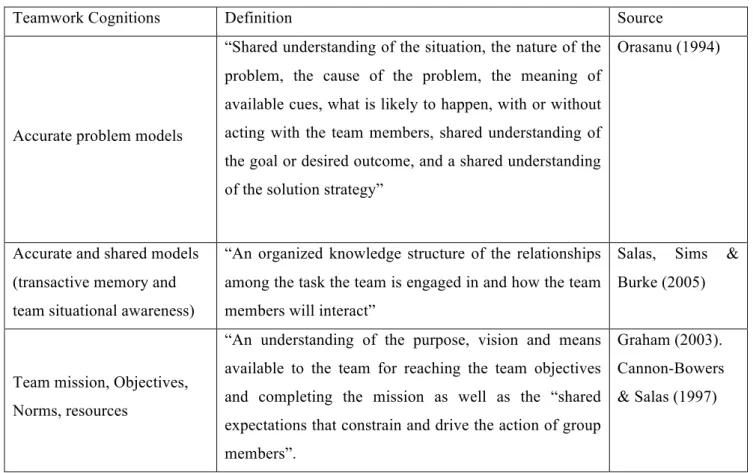
Cognitions are the necessary elements of knowledge and experience
necessary for effective teamwork. In team settings cognitions have their theoretical base in the shared mental models theory, in which teams have to have a “shared understanding of the situation, the nature of the problem, the cause of the problem (Salas et al, 2009) with a high degree of conscientiousness. The relevant teamwork cognitions that were considered are the following.
Table 3-Teamwork cognitions
Teamwork Cognitions Definition Source
Accurate problem models
“Shared understanding of the situation, the nature of the problem, the cause of the problem, the meaning of available cues, what is likely to happen, with or without acting with the team members, shared understanding of the goal or desired outcome, and a shared understanding of the solution strategy”
Orasanu (1994)
Accurate and shared models (transactive memory and team situational awareness)
“An organized knowledge structure of the relationships among the task the team is engaged in and how the team members will interact”
Salas, Sims & Burke (2005)
Team mission, Objectives, Norms, resources
“An understanding of the purpose, vision and means available to the team for reaching the team objectives and completing the mission as well as the “shared expectations that constrain and drive the action of group members”.
Graham (2003). Cannon-Bowers & Salas (1997)
2.2 Measuring teamwork competencies
In order to study teamwork competencies, one has to measure them. The main tool used measure teamwork competency is self and peer evaluation (Rhee, Basu, Parent, 2013). In team assessment, the required team competencies, knowledge, skills and abilities (KSAs) are different from individual ones (Morgeson et al., 2005). Therefore the unique set of skills for teamwork should be analyzed and evaluated (Ohland, Loughry, Woehr, Bullard, Felder, Finelli, Layton, Pomeranz and Schmucker, 2012).
Nowadays, companies desire individuals that have highly developed interpersonal and teamwork skills (Alsop, 2002). Thus, by using rating systems one can understand how peers and individuals perceive teamwork competencies. Although there are many benefits in using peer and self-evaluations, there are several biases that might occur, leading ratings away from their true values. Errors such as leniency and strictness (Inderrieden et al., 2004) are one type of these biases that may occur. Moreover, individuals who have low teamwork skills might overestimate their team skills, not being able to accurately evaluate a teammember (Jassawalla et al., 2009) and team members worry that accurate evaluations might imperil group cohesion (Saavedra & Kwun, 1993). Raters also tend to compare team members to each other rather than using objective evaluation criteria (Saavedra & Kwun, 1993). There are several peer-evaluation systems and tools, yet none of them has gained widespread attention. Nevertheless it is crucial to have a well-designed peer-evaluation instrument that can teach which teammember behaviors are important (Young & Henquinet, 2000).
2.2.1 The CATME instrument
Loughry and colleagues (2007) developed a self/peer evaluation tool (CATME- Comprehensive assessment of team member effectiveness), based on research, for use in college classes. The developers of this tool have researched teamwork literature and applied statistical methods to empirically support their work, finally creating a summarized tool. The authors firstly generated a plethora of potential items based on teamwork and peer evaluation literatures. Additionally they obtained peer evauation forms that professors used to evaluate group projects. Other forms
resulting in a initial pool of 392 items that reflect different types of teamwork behaviors. Then, post doctoral, graduate students and five colleague seniors categorized the behaviors and ranked them from best to worst behavior in each category, which lead to 36 categories. After this, the authors refined their categories with teamwork and peer evaluation experts and the final result was 218 items measuring 36 categories. Finally the authors conducted two studies in order to extract the main factors out of these categories, aiming to refine the measurement instrument.
In this final instrument, the following five teamwork competencies are:
1. Contributing to the team’s work: encompasses several behaviors such as individual contributions that improve the quality of the work, helping teammates who are having difficulties, delivering assignments on time;
2. Interacting with teammates: comprising several behaviors such as active listening towards other colleagues, asking and showing interest towards other colleagues ideas, provides encouragement and enthusiasm to the team;
3. Keeping the team on track: which is reflected in monitoring the team’s progress, providing constructive feedback, knowing what each team member is doing and notices problem;
4. Expecting Quality: this is the competency that defines individuals that motivate the team to do excellent work, strongly believing that the team can do excellent work;
5. Having Relevant Knowledge, Skills and Abilities (KSAs): comprising several behaviors in which individuals are expected to demonstrate the KSAs to do excellent work, not minding to acquire new skills for the benefit of the team, being able to perform any role in the team if necessary.
This instrument is condensed, easy to understand and practical, in opposition to other measurement tool in which the number of items to rate may cause hindrance to its frequent use. Another challenge is that raters might have different preconceptions of the different five levels in each of the teamwork competencies in the CATME instrument. The different levels in each competency (one to five), anchored by certain behaviors, diminish the subjectivity of the evaluation. Therefore, each of the five levels corresponds to certain expected behaviors (from poor to good performance). This is one of the main advantages of the BARS scales. The authors have applied a behaviorally anchored rating scale (BARS), by providing certain behaviors that
exemplify what rating should be given in case that a team member displays such behavior, which reduces subjectivity. The scales provide descriptions of behaviors that people at various levels of performance would typically display (Ohland et al., 2012). Furthermore the BARS instrument was introduced into the CATME tool in order to measure the five categories of team member contributions identified by the research, which reduced the number of ratings (e.g. from 132 decisions per rater - 4 member team - to 20 with a BAR instrument since the behaviors are condensed in 5 levels). The BARS instrument also adds greater inter-rater reliability and less leniency error (Campbell et al., 1973; Ohland, Layton, Loughry & Yuhasz, 2005). Additionally, team members learn about which performance behaviors are associated with a good or a bad performance.
Overall, this is a good instrument to access teamwork competencies; it is practical and consistent with teamwork literature. The following section shows different connections between this tool and the previous mentioned teamwork models, which also served as theoretical background for the development of the CATME.
2.2.2 The CATME instrument and teamwork theory
Driskell and colleagues (2006) have defined several teamwork competencies that can be predictive of certain teamwork behaviors. The relevant teamwork behaviors for this literature review are: performance monitoring and feedback (keeping the team on track), Communication and Interpersonal relations (interaction with teammates). Performance monitoring and feedback encompasses behaviors such as monitoring other team members contributions as well as monitoring team progress, identifying errors, providing feedback, giving advice for performance improvement (Driskell et al., 2006). Communication is the efficient exchange of information, ideas in a clear and timely manner. Interpersonal relations focus on conflict management, encouragement of cooperative behavior, and building team morale.
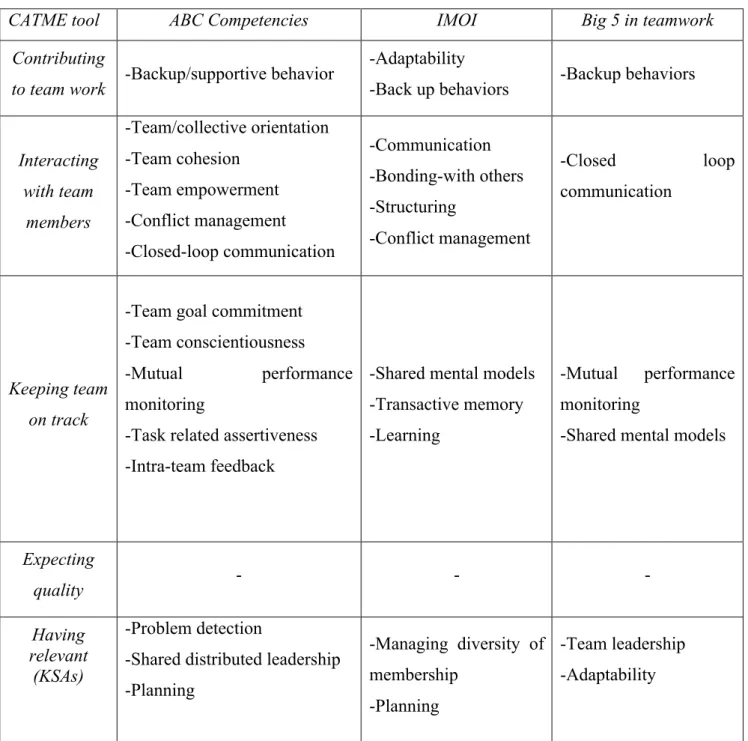
Due to the solid teamwork theory behind its construction, this instrument is very useful for teamwork competencies assessment. Therefore, the following table summarizes several concepts which are present within each teamwork theories, models and competencies that were previously presented, crossing different teamwork concepts with each of the five competencies. These conceptual overlaps recapitulate the relevance of this instrument in order to measure teamwork competencies (table 4).
Table 4 - CATME and Teamwork theory
CATME tool ABC Competencies IMOI Big 5 in teamwork Contributing
to team work -Backup/supportive behavior
-Adaptability
-Back up behaviors -Backup behaviors
Interacting with team members -Team/collective orientation -Team cohesion -Team empowerment -Conflict management -Closed-loop communication -Communication -Bonding-with others -Structuring -Conflict management -Closed loop communication Keeping team on track
-Team goal commitment -Team conscientiousness -Mutual performance monitoring
-Task related assertiveness -Intra-team feedback
-Shared mental models -Transactive memory -Learning
-Mutual performance monitoring
-Shared mental models
Expecting quality - - - Having relevant (KSAs) -Problem detection
-Shared distributed leadership -Planning -Managing diversity of membership -Planning -Team leadership -Adaptability
3.The five-factor model in personality
In order to deepen the understanding of personality, researchers have used several theories to access and measure different personality traits. In general, traits are defined as “enduring dispositions that can be inferred from patterns of behavior, (…) being stable across long periods of time and be similarly assessed by different observers” (McCrae & Jonh, 1992). These authors have searched for the basic dimensions of personality in order to answer to the following research question “What are the basic dimensions of personality (…) in which individuals differ in their enduring emotional, interpersonal, experiential, attitudinal and motivational styles?” Personality structure traits are the patterns of co-variation among the sub-categories within each major personality category, thus traits that co-vary will belong to the same higher hierarchical level of personality. Thus these traits are usually summarized in small factors that are described in five basic dimensions of personality (McCrae & Jonh, 1992). Furthermore, these dimensions are found in other personality traits as well in questionnaires created to operationalize a variety of personality structures (McCrae & Jonh, 1992). One of the most well accepted models that contributes for the link of personality with other research areas is the “Personality Big 5 or Five Factor model (FFM)” by Robert R. McCrae and Paul T. Costa, Jr. T, which is based upon extensive, systematic and rigorous empirical work. This model is used for individual assessment, being an organization of personality traits in terms of five basic dimensions:
• Extraversion (E) – indicates that the person is tendentiously outgoing, social, lively
• Agreeableness (A) – indicate individuals that are sympathetic, warm, gentle, trustful;
• Conscientiousness (C) – indicates that the person is organized, dependable, dutiful, persistent and motivated by goal directed behaviors.
• Emotional stability (opposed to neuroticism-N) (ES)– refers to the person as able to control stress, anxiety and depression;
• Openness to experience (O) – refers that to the person as adventurous, original, complex minded and creative.
Through empirical research, McCrae & Costa have found that all five factors regularly emerged even when measured with different instruments in different countries and ages (McCrae, Oliver; 1992). The FFM can provide a standardized language for psychologists with diverse backgrounds, transcending national languages (McCrae & Costa, 1997), being an efficient model in research organization and a guide for the assessment of individuals in different fields of knowledge (educational, organizational, and psychological). It is important to state that the five factors do not exhaust the description of personality; they only represent the highest hierarchical level of trait description. Each of the factors aggregates groups of traits that co-vary, but are not necessarily interchangeable, because each personality trait is unique in its definition. The five-factor model has gained wide acceptance in the scientific community and so far these 5 dimensions are used with both theoretical and empirical support (McCrae, Oliver; 1992). To summarize, the main pros of this model can be described in three topics: (McCrae, Oliver; 1992):
- It integrates a plethora of personality constructs, easing the communication process among researchers of many different orientations;
- It is comprehensive which can serve to build bridges of investigation between personality and other phenomena, such as individual teamwork competencies. Without this characteristic, studies using personality traits as predictors are inconclusive, because the most relevant traits may be disregarded, which is unlikely to happen when measures of all five factors are included in a study. - To conclude, it is efficient, since personality is summarized in five
3.1. Personality as a predictor of individual competencies in context of a team
The main research question behind this title is: What are the traits that define a good team player? Several authors such as Kozlowski, Salas and Cannon have dug into this question with several different frameworks and perspectives and concluded that each individual possesses specific characteristics (e.g. personal traits, expertise, competencies) that contribute to the team. Therefore the main goal of these researchers is to define traits and other factors that define a team player, for instance, personality traits that predict individual teamwork behaviors. To conclude, one can affirm that several correlations are to take place between core teamwork dimensions the correspondent personality predictors (Driskell et al., 2006).
To effectively study how personality traits (e.g. Big5) predict a certain teamwork behavior, many authors and theorists propose high-order factors, which are more inclusive, easy to empirically apply or lower level facets, which are more specific within personality constructs and can usually offer greater predictive validity (Stewart, 1999). Driskell and colleagues (2006) have made a review of personality traits, within the big five factors perspective, predicting different teamwork competencies. According to these authors extraversion and agreeableness predict communicating and interpersonal teamwork dimensions, whilst conscientiousness predicts performance monitoring and feedback.
An empirical study that focused on personality predictors of teamwork behaviors showed that all big five factors successfully predicted efficient teamwork (Bernstein, Radosevich, Clesca, Masco, 2008), although teamwork behaviors were not clearly defined and grouped in categories. The 465 business students that participated in this study were asked to rate themselves in several measures. Lepine & Van Dyne (2001) have conducted research on 288 business students, linking personality traits with cooperative and voice behaviors, having reached several positive correlations. Tasa and colleagues (2010) have also conducted research on university settings on predicting interpersonal and performance management behaviors managing to reach several positive correlations as well. Most of the studies performed took place in university settings. Morgenson and colleagues (2005) have predicted contextual performance and teamwork knowledge using personality traits. They have conducted research in organizational settings with several employees from different departments.
As mentioned before, all the above-mentioned studies focus on personality as predictors of teamwork behaviors. Nevertheless there are still not that many studies that encompass teamwork behaviors as main dependable variable. Usually the main focus falls under the category of performance as a whole and not in lower level categories as performance. Lepine and Van Dyne (2001) for instance, have associated done their contribution on predicting cooperation and voice behavior and others studies are required to study teamwork competencies at a lower construct level. This study contributes to this line of thought when several teamwork behaviors are studied more specifically, although each teamwork category (from CATME) is broad, there is a degree of association among each behaviors within the instrument. Another benefit of this study is the empirical application of the CATME instrument, which might be beneficial for teamwork in different organizations, as this is a reliable tool able to assess relevant work behaviors (competencies) related to personality traits, tapping different aspects of teamwork. This recently developed competency based instrument was tested in students but it is plausible to use it in organizational settings, across different jobs (clerks, professionals, consultants), across private and public organizations and different raters (Consiglio et al., 2013). Furthermore, it is possible that this instrument might be used in performance appraisal systems (which can also be integrated with other HR processes) in order to evaluate teamwork in different occupational roles, in which the BARS instrument contributes to reduce evaluation errors, since the scales are operationalized at the behavioral level. This thesis also contributes for the dissemination of this instrument, among the scientific community, by successfully predicting meaningful competencies through personality traits. There are many teamwork competencies, models and measures for teamwork performance, however there is not one instrument that is widely accepted and standardized and consistent across different studies, regarding personality traits as predictors of teamwork competencies. Moreover, many investigators have made research on personality predictors and criteria either on the individual level or at the group level in isolation rather than at both levels (Neumann and Wright, 1999). Firstly it has been convincingly shown that predictor –criterion relationships may differ when examined at the individual level (Neumann and Wright, 1999), although group scores are an aggregation of individual results. Nevertheless, when one level/perspective is examined in solation it is not possible to compare the relationship between predictors and criteria at different levels, which is crucial to understand if the processes and
dynamics between predictors and criteria are the same or different levels (Rousseau, 1985). Although the focus of this study is only at the individual level, across the following literature review, many authors adopt two different perspectives to study different predictor-criteria research, making a distinction between self and peer ratings. However, this twofolded perspective is not consistent across research, in other words self-ratings and peer ratings are not usually studied simultaneously. From Rousseau’s (1985) point of view we can affirm that to compare and analyze different predictor- criteria relationship one must analyze different perspectives, namely from the self and peer point of view. This study helps in doing so even if only at the individual level, by studying predictor-criteria relationships from both the individual and peer point of view. Therefore in this empirical section each hypothesis will have two different perspectives: either “rated by self” or “rated by peers”. This will allow one to see if there are differences on the perception of oneself, regarding how one perceives himself in a certain teamwork competency and how other group members perceive an individual in the same competency. All of this being predicted on the perception of oneself personality, which comprises the independent variable.
The following sections explain and illustrate the relationship between the different factors and the teamwork competencies that are found in the CATME instrument. Hypotheses are posited.
3.1.1 Extraversion
One personality characteristic that is relevant in team settings is extraversion. Extraverted individuals are more likely to have a desire to work with others, therefore preferring to work in a group (Barrick et al.1998), being more confident in their ability to work within a team structure (Thoms, Moore & Scott, 1996). Since extroverted individuals are described as sociable, assertive, talkative and active (Digman, 1990), having enhanced social skills (McCrae & Costa, 1999), they are more likely to better communicate within the team (Morgenson et al., 2005). They will be less inhibited in speaking and more comfortable and skilled in communicating their thoughts, new suggestions and ideas, that will contribute to team improvement. Indeed, it has been empirically shown/supported by Lepine & Van Dyne (2001) that extraverts are more willing to express opinions, therefore contributing to the team development through new suggestions. Another empirical study confirms that extraverts usually take leading roles in some aspects of the team projects (Rhee et al.,
2013), enacting effective communication in this role. Driskell and colleagues (2006) also argued that extraversion predicts communication and interpersonal teamwork dimensions. Morgenson and colleagues (2005) empirically showed that teamwork knowledge (that in their study encompassed interpersonal elements such as collaborative problem solving, communication and self management KSAs such as task coordination and goal setting) was correlated with social skills, which in turn were related to extraversion. Extraversion contains elements of positive affectivity, which is an overall sense of well-being and tendency to experience positive emotional states (Morgenson et al., 2005), contributing to positive interactions among team members. Additionally, all these extraversion traits promote positive and cooperative interactions with others in the course of reaching team goals (LePine & Van Dyne, 2001). The study on university teams by Rhee and colleagues (2013) has shown that extroverts usually complete their share of work and deliver their work when it is expected, having in mind the self-rating outcomes. The authors have also found a positive correlation between extraversion and team encouragement on project completion, in other words, extraversion as a predictor of the competency keeping the team on track, according to the CATME framework. This is a conclusion provided by Rhee and colleagues (2013), although Driskell and colleagues (2006) mention that this teamwork dimension is weak and empirically unsupported (being predicted by extraversion). All these facets of extraversion are reflected in a high evaluation on the competency of interaction with teammates and contributing to the team, as they are more likely to show cooperative behaviors (LePine & Van Dyne, 2001).
The following list summarizes further empirical evidence regarding the factor of extraversion, corresponding teamwork competencies, the raters and respective authors of the studies:
Teamwork competency Raters Source
Sociability
(Interaction with the teammates)
Self ratings
Peer ratings Anhalt (1995) Altruism, helping behaviors,
cooperating (Contributing to team)
Self ratings
Peer ratings Organ and Ryan (1995) Communication, sociability
Having in account the theoretical and empirical evidence presented, the following hypothesis are posited:
H1: Extraversion is positively correlated with the competence “contributing to the team competency” as evaluated by a) the self and b) peers
H2: Extraversion is positively correlated with the competence “interacting with teammates” as evaluated by a) the self and b) peers
H3: Extraversion is positively correlated with the competence “keeping the team on track” as evaluated by a) the self and b) peers
3.1.2 Agreeableness
In team settings agreeableness reflects traits such as selflessness, cooperativeness, helpfulness and flexibility (Digman, 1990). According to McCrae and Costa, agreeableness represents several personality traits such as: trust (attributing benevolent intentions to others), tendency to be frank and straightforward with people, altruistic, compliancy and tender-mindedness (Neumann and Wright, 1999). Furthermore, Neumann and Wright (1999) found a correlation between individuals’ agreeableness and peer interaction with teammates, as evaluated by the peers. It is worth to mention that since peer ratings were aggregated, the authors had to measure the interrater agreement, which was quite homogeneous, as an indicator of perception convergence within the group. In the same research, extraversion was positively correlated with agreeableness. Driskell and colleagues (2006) also argued that agreeableness predicted communication and interpersonal teamwork dimensions. In team settings, collaboration is required and agreeable individuals are more likely to cooperatively work with others, opposed to competitively work with others (verified by two external coders) (Lepine & Van Dyne, 2001), partially because agreeable individuals are viewed as helpful and non-threatening (Neumann & Wright, 1999). Empirical evidence exists proving that agreeableness predicts job performance and different personality traits within the agreeableness factor are desirable for teamwork (Rose et al., 1994), (e.g. trust, tender-mindedness) (Neumann & Wright, 1999). Not surprisingly, it has been researched that agreeableness was
negatively correlated to efforts to excessively dominate group discussions (Rhee et al., 2013). Additionally the latter authors found out that agreeableness was higher in individuals that encouraged the group to complete the project in a timely basis, when rated by peers and when individuals were rating themselves. Thus, this behavior indicates that agreeable individuals are more likely to have a high score in “Keeping the team on track”, although Driskell and colleagues (2006) mention that only one facet of agreeableness, trust, has a positive correlation with team monitoring, the other facet, cooperation has a weak empirical correlation. Nevertheless this should be tested in different setups in order to better understand this relationship.
Agreeable individuals are better able to resolve conflicts, facilitating their resolution when they arise (Barrick et al., 1998; Neumann & Wright, 1999), suggesting that conflict resolution might be a teamwork competency related to agreeableness. Moreover, Rhee and colleagues (2013) found out that agreeableness is negatively correlated with conflict and group domination behaviors, which supports the latter suggestion. Furthermore, agreeable individuals will be more likeable because they are more sympathetic towards others and likely to help (Organ & Ryan, 1995). Summing up, agreeable individuals showing altruism and trust should have required interpersonal skills to relate to others (Neumann & Wright, 1999). As it has been demonstrated empirically, agreeable individuals tend to be involved in more teamwork, are more cooperative, having higher quality interpersonal interactions (Lepine & Van Dyne, 2001). The following list summarizes further empirical evidence regarding the factor of agreeableness, respective teamwork competencies, the raters and respective authors of the studies.
Teamwork competencies Raters Source
Altruism cooperation (Contributing to team)
Self ratings
Other ratings Organ and Ryan (1995) Social cohesion (Interaction
with teammates) Other ratings Stewart and Barrick (1998) Social role
(Interaction with teammates) Peer ratings
Stewart, Barrick and Fulmer (2005)
Altruism
(Contributing to team) Self ratings
Kumar, Bakhshi, Ekta Rani (2009)
Having in account the theoretical and empirical evidence presented, the following hypothesis are formulated:
H4: Agreeableness is positively correlated with the competence “contributing to the team” as evaluated by a) the self and b) peers
H5: Agreeableness is positively correlated with the competence “interacting with teammates” as evaluated by a) the self and b) peers
H6: Agreeableness is positively correlated with the competence “keeping the team on track” as evaluated by a) the self and b) peers
3.1.3 Conscientiousness
Individual contributions are essential for the success of a team. The personality attributes of hardworking and dependability are reflected in individuals high in Conscientiousness (Costa & McCrae, 1988). Additionally, conscientious individuals tend to be dependable and feel responsible being more likely to contribute with constructive suggestions and ideas for improvement of the situation, therefore contributing to the team’s success (Lepine & Van Dyne, 2001). Individuals that are hardworking, dependable and perseverant (conscientious individuals) are usually engaged in teamwork, fully participate in discussion meetings, deliver work when needed and make important contributions for the team to succeed (Morgenson et al., 2005, Rhee et al., 2013). These latter behaviors have been empirically demonstrated at the individual level with self ratings (Rhee et al., 2013). Due to all the above mentioned characteristics of conscientious individuals, one can say that they are expecting that the teams perform well since they are more likely to put their best in order to archive a good performance. They are more likely to believe that the team can cope with its responsibilities. Therefore it is coherent to theorize that the competence “ expecting quality” will be positively correlated with conscientiousness.
Individuals that have a high score in conscientiousness are willing to perform any role within the team and learn new knowledge in order for the team to be
Interpersonal teamwork behaviors
(Interacting with teammates)
successful, regardless of their specific assigned role (Barrick et al.1998). In teams that have a high amount of workload sharing, this is an essential personal characteristic (Morgenson et al., 2005), which is reflected in an excellent rating in the competency of expressing relevant KSAs. Thus, individuals have to have the relevant KSAs to positively contribute to the team or have to be willing to learn new ones; this is especially true for disciplinary teams in which individuals are supposed to be specialized in their functional knowledge. This perspective has not been studied empirically but since conscientious individuals are hardworking and dependable, it is most likely that there is a significant correlation between conscientiousness and having KSAs.
When the work is interdependent requiring strong interpersonal relationships, conscientious individuals will engage in greater cooperative behaviors with others than those who have lower conscientiousness (LePine & Van Dyne, 2001), thus scoring high ratings in “backing up” behaviors. The authors provided empirical data that supports that conscientiousness is correlated with cooperation with teammembers, in this study the observed cooperative behaviors were coded by external raters. These “backing up” behaviors are reflected both in high contribution to the team, as well as the positive interaction with teammates (Mount et al., 1998), which is not completely supported both empirically and theoretically (Driskell et al., 2006). However, Rhee and colleagues (2013) provide empirical data that Conscientious individuals communicate ideas clearly and effectively, therefore contributing for a better communication (self rates).
Persons that have high values in conscientiousness are task focused and will be concerned with performing their required behaviors and accomplish team goals (Lepine, Hollenbeck, Ilgen & Hedlund, 1997), keeping the team on track in order to reach its goals. This has been empirically demonstrated by Rhee and colleagues (2013) on the following behavior: “Encouraged group to complete the project on a timely basis”, regarding self rates. Conscientiousness is then predictive of team members who are concerned with completing task assignments on a scheduled and orderly manner (Neumann & Wright, 1999). The self-discipline, sense of dutifulness (adhere to obligations and duties that are held within the team) and dependability of conscientious individuals working within the team is likely to create a work team climate that fosters personal accountability and norms (Neumann & Wright, 1999; Barry &Stewart, 1997). Moreover, in their peer rated empirical study, Tasa and
colleagues (2010) have made a link between progress monitoring, team coordination and goal definition. These perspectives reinforce the possible correlation with the teamwork competency of keeping the team on track, which has already been supported, both empirically and theoretically by Driskell and colleagues (2006).
The following list summarizes further empirical evidence regarding the factor of conscientiousness, respective teamwork competencies, the raters and respective authors of the studies:
Having in account the theoretical and empirical evidence presented, the following hypothesis are posited:
H7: Conscientiousness is positively correlated with the competency “contributing to the team” as evaluated by a) the self and b) peers
H8: Conscientiousness is positively correlated with the competency “ keeping the team on track” as evaluated by a) the self and b) peers
H9: Conscientiousness is positively correlated with the competency “expecting quality” as evaluated by a) the self and b) peers
H10: Conscientiousness is positively correlated with the competency “having relevant KSAs” as evaluated by a) the self and b) peers
Teamwork competencies Rating type Source
Ambition (Contributing to the team)
Self ratings Peer ratings
Anhalt and Rebecca Lynn (1995) Altruism, helping
behaviors cooperating (Contributing to the team)
Self ratings Peer ratings
Organ and Ryan (1995)
Task oriented
(Contributing to team) Peer ratings
Stewart,Barrick and Fulmer (2005) Altruism
(Contributing to the team)
Self ratings Kumar,Bakhshi,
,Ekta and Rani (2009) Performance management
(Keeping the team on track)
Peer ratings
Tasa and colleagues (2010)