Electronic journal
Brazilian Journal of Natural Sciences www.bjns.com.br
¹Graduation Student - Pharmacy Course - CCBS - Mackenzie Presbyterian University. São Paulo, SP, Brazil.
²Pharmacist - Semi-industrial Laboratory - Pharmacy Course - CCBS - Mackenzie Presbyterian University. São Paulo, SP, Brazil.
³Teacher – Laboratory of Teaching and Research of the Pharmacy Course, University Health Center, ABC (CUSABC), Santo André, SP, Brazil.
4Teacher - Semi-industrial Laboratory - Pharmacy Course - CCBS - Mackenzie Presbyterian University. São Paulo, Brazil.
e-mail: [email protected].
Authors: Fernanda Arriel Pedrozo Rezende¹; Anna Luiza de Aveiro Ruocco¹; Bruno Batista da Silva²; Robson Miranda da Gama³; José Armando-Jr³, Marcelo Guimarães4,A.
POLYMERIC NANOPARTICLES CONTAINING TITHONIA DIVERSIFOLIA
(HEMSL) A. GRAY FLOWERS ALCOHOLIC EXTRACT AND COATED
BY HYALURONIC ACID: DEVELOPMENT, SYNTHESIS, AND
CHARACTERIZATION
Original Article
ACorresponding author
Marcelo Guimarães – E-mail: [email protected] – ORCID: https://orcid.org/0000-0002-9480-2957 DOI: https://doi.org/10.31415/bjns.v3i1.88 - Article received on: February 26, 2020; accepted February 27, 2020; published on March 10, 2020. Brazilian Journal of Natural Sciences, Vol. 3, N.1, March 2020. Available online from March 10, 2020, ISSN 2595–0584. www.bjns.com.br. All authors contributed equally to the article. The authors declare that there is no conflict of interest. This is an open access article under the CC - BY license: http://creativecommons.org/licenses/by/4.0.
Abstract
Nanoparticles are systems formed by biodegradable, synthetic or natu-ral polymers, that have gained significant importance in different industry segments, as well as being the highlight of essential researches. These tiny particles present various promising characteristics, such as: site-specific and gradual drug release and improvement of active principle solubility and sta-bility. The combination of nanotechnology with medicinal plants could be able to enhance the action of plant extracts, such so that many innovative drug carriers have emerged, including polymeric nanoparticles. The objec-tive of this study was to synthesize and characterize polymeric nanoparti-cles coated with hyaluronic acid, containing Tithonia diversifolia (Hemsl) A. Gray flowers alcoholic extract, aiming to improve the nanoparticle’s stability, for possible future applications. The synthesis occurred through emulsion polymerization, where the monomer n-butyl-cyanoacrylate was incorporat-ed with Dextran® into an aqueous HCl solution, with posterior addition of Keywords:
Polymeric nanoparticles;
Tithonia diversifolia
(Hemsl) A. Gray;
poly (n-butyl-cyanoacry-late), hyaluronic acid.
Article ID
(Compliance with ethical standards: We submitted to the national genetic heritage management system and associated
traditional knowledge and was registered in SisGen, in compliance with the provisions of Law 13,123/2015 and certificate number A516224).
Resumo
As nanopartículas são classificadas como qualquer material ou partícula coloidal, farmacologicamente ativo ou inerte, com a capacidade de veicular agentes terapêuticos, que se encontrem no intervalo nanométrico de 10 a 1000 nm (1 µm). Têm sido utilizadas no setor farmacêutico para várias apli-cações, obtendo um significativo avanço na liberação de fármacos em sítios específicos. Observa-se uma notável melhora na solubilidade e estabilidade dos princípios ativos incorporados, assim como da velocidade de distribui-ção. Esse estudo apresenta o processo de desenvolvimento de nanopartículas poliméricas revestidas com ácido hialurônico, contendo o extrato alcóolico de folhas de Tithonia diversifolia (Hemsl) A. Gray. O objetivo da pesquisa focou o oferecimento de subsídios nanotecnólogicos para aplicações futu-ras, viabilizando a melhoria da estabilidade do princípio ativo e possivel-mente da sua ação terapêutica. A síntese das nanopartículas ocorreu através do processo de polimerização por emulsão, onde foram adicionados a uma solução aquosa de HCl 0,01M (pH 2,5), o monômero n-butil-cianoacrilato (BCA), juntamente com Dextran®, com posterior incorporação do extrato vegetal e neutralização do meio. O nanossistema obtido foi avaliado por di-ferentes métodos físico-químicos que incluíram a avaliação da estabilidade física das nanopartículas pela Espectroscopia (IV), Microscopia Eletrônica de Varredura (MEV), Termogravimetria (TG) e Calorimetria Exploratória Diferencial (DSC). Os resultados das análises a que as amostras foram sub-metidas apresentam indicativos que sugerem sucesso na obtenção de um nanossistema de liberação de fármacos estável e inovador, bem como uma efetividade do ácido hialurônico em relação ao objetivo proposto, eviden-ciada nos resultados obtidos por Espectroscopia (IV), Microscopia Eletrô-nica de Varredura (MEV), Calorimetria Exploratória de Varredura (DSC), bem como pela Termogravimetria (TG).
Palavras Chave: Nanopartículas polimé-ricas; Tithonia diversifolia (Hemsl) A. Gray; poli (n-butil-cianoacrila-to), ácido hialurônico.
Informações do artigo
Introduction
Over the last decade, there has been an intensifi-cation in researches involving vectors that can control
the alcoholic plant extract and neutralization reaction with NaOH. Stabil-ity parameters, such as hydrodynamic diameter, polydispersStabil-ity index, zeta potential, spectroscopy (IV), Scanning Electron Microscopy (SEM), ther-mogravimetry (TG) and Differential Exploration Calorimetry (DSC) were analysed. The nanoparticle system was evaluated taking into consideration particle stability prior and posterior to the addition of the extract, as well as coated and uncoated particles. The results demonstrated the good reactivity of the monomers of cyanoacrylates, as well as effectiveness of hyaluronic acid in relation to the proposed objective, evidenced in the results obtained by Infrared Spectroscopy, by SEM, DSC and, also, TG. The study demon-strated that there are possible future applications for this method.
drug release at specific sites of action, improving both the rate of distribuition and the dosage regime. The main systems studied for these purposes have been microparticles and coloidal systems (liposomes and
nanoparticles). Nanoparticles are systems formed by biodegradable, synthetic or natural polymers, that have gained significant importance in different indus-try segments, as well as being the highlight of essen-tial researches. These tiny particles are applicable in the health segment due to the easiness of controlling chemical structures, surface functionalities and parti-cle diameter (AKAGI et al., 2007).
Nanostructures present various promising char-acteristics, such as: site-specific and gradual drug re-lease, as well as improvement of active principle solu-bility and stasolu-bility, enhancement of the desired action of a formulation, and allowing the combination of active substances of varying hydrophilic/lipofilic de-grees (SINTOV & SHAPIRO, 2004; CUNHA et al., 2003).
Several nanotechnological stratagies, such as poly-meric nanoparticles, allow substances with different properties to be applied in the same formulation, mak-ing it possible to alter the properties and behaviour of a given substance in a biological environment (BON-IFÁCIO et al., 2014; GUTERRES, et al., 2012).
Polymeric nanoparticles present diameters rang-ing from 10 to 1000 nanometers, and can be syn-thesized through various methods. The most com-mon methods used for the production of polymeric nanoparticles are: in situ polymerization (with dis-persed monomers) and precipitation method of pre-formed polymers. Regardless of the chosen method, the products are obtained as colloidal dispersions or aqueous microemulsions, generating thermodynami-cally stable systems (BEHAN, et al., 2001; BERTHO-LON, et al., 2006).
Compared with conventional formulations, poly-meric nanoparticles are capable of increasing the sol-ubility of constituents, reducing the therapeutic dose and improving absorption of active componentes. Furthermore, when circulating in the bloodstream, nanoparticles have the advantages of being stable, non-toxic, non-thrombogenic, non-immunogen-ic and non-inflammatory (BONIFÁCIO et al., 2014, SIMEONOVA, 2009).
With the intention of enhancing the stability of the nanoparticles, the present study uses the alter-native of hyaluronic acid coating, in an attempt of increasing the effectiveness of the nanosystem as a whole.
In parallel, the use of plants for medicinal pur-poses has aroused a growing interest in several
sci-entific communities, as it allows the development of innovative products with lower potential side effects (COSTA et al., 2010). Plant extracts provide sever-al beneficisever-al properties with different applications, however they are not physical-chemically stable, which may lead to the loss of their antioxidant prop-erties (DAUDT et al., 2013). Thus, the combination of nanotechnology with medicinal plants might be able to enhance the action of plant extracts, such so that many innovative drug carriers have emerged, including polymeric nanoparticles.
Several authors have studies based on active in-gredients derived from plants that present antioxi-dante and healing properties. Contemplated within the Asteraceae family, the species Tithonia diversifolia (Hemsl) A. Gray has been used as a medicinal plant (LACERDA et al., 2011), having anti-inflammato-ry action (OWOYELE et al., 2004) and containing chemical compounds such as total phenols, tannins and flavonoids that also contribute to an antioxidant (GAMA et al., 2013), anticancer (CHOWDHURY et al., 2002; CAI et al., 2004), antimicrobial (NASCI-MENTO et al., 2000; CUSHINE & LAMB, 2005) and healing action (NAYAK & PEREIRA, 2006).
Objective
The objective of this study was to develop, syn-thesize and characterize polymeric nanoparticles coated with hyaluronic acid, containing Tithonia di-versifolia (Hemsl) A. Gray flowers alcoholic extract, aiming to improve the nanoparticle’s stability, for possible future applications.
Materials and methods Alcoholic extract preparation
The alcoholic extract is obtained using the flowers of the Tithonia diversifolia (Hemsl) A. Gray plant. The flowers undergo a week long drying process us-ing a hot air chamber at approximately 50ºC. These flowers are then reduced by a mill, remaining in a 100% ethanol solution, under stirring and at room temperature for 24 hours. This mixture is then sub-jected to a filtration process and through the use of a rotary evaporator conected to a vacum pump, the extract is condensed to a concentration of 0.1g/mL (GAMA, R.M. et al., 2014).
HCL and NaOH solutions
Hydrocloric acid solution (HCl) and sodium hy-droxide solution (NaOH) were previously prepared. The ideal HCl solution should have a hydrogen poten-tial (pH) close to 2.5, as the polymerization reaction is pH dependent, occurring best in an acidic medium. The NaOH solution is basic, being able to neutralize the acidic pH of the reaction medium and thus inter-rupt the polymerization reaction (SCHAFFAZIK et al., 2003; VAUTHIER et al., 2003).
Polymerization
The nanoparticles were synthesized through the process of emulsion polymerization, at 800 rpm, where the monomer n-butyl-cyanoacrylate together with 100 mg of Dextran® were incorporated into 10 mL of the aqueous HCl solution (0,01M, pH 2,5), with posterior addition of the alcoholic plant extract and final reaction neutralization with NaOH (pH 7,0 ± 0,3). The resulting polymer poly (n-butyl-cyanoacry-late) (PBCA) was then filtered and stored in an Ep-pendorf, being labeled as ´Plain´PBCA.
For the incorporation of the extract, the same pro-cess was repeated, but after one hour of the continu-ous stirring, 1mL of PBCA was removed and 1 mL of the alcoholic plant extract was added to the mixture present in the conical flask. The stirring carried on for three hours and then process was then terminated with the addition of the NaOH solution and posteri-or filtration with a glass funnel and filter paper. The resulting mixture was stored and identified as PB-CA-Extract (polymer containing the alcoholic plant extract) (GUIMARÃES, M., 2015).
Hyaluronic acid coating
The process of coating was based on the work of HE and collaborators (2009), where a 1% (w/v) hyalu-ronic acid dispersion is prepared using purified water, under stirring. The obtained dispersion was posterior-ly added, drop by drop, under stirring (800 rpm) to 5 mL of the PBCA-Extract (GUIMARÃES, 2015). After one hour, a sample was collected and labeled as Coa-ted PBCA containing Extract. The same method was applied to 5 mL of the ´Plain´PBCA and the resulting mixture obtained was labeled as Coated PBCA. The final stored samples were posteriorly lyophilized in
order to carry out the absorption spectroscopy in the infrared region and the scanning electron microsco-py.
Nanoparticle characterization
pH and macroscopic characterization
pH readings were carried out in triplicates for each reading and the mean value for each measure-ment was calculated. Macroscopic characterization was based on the visual color of the obtained samples, as well as possible presence of precipitates or phase separation posterior to the end of the polymerization reaction.
Medium hydrodynamic diameter, nanoparticle size distribution and zeta potential
The polydispersivity index, hydrodynamic diame-ter and the particle size distribution were performed with the aid of a Zetasizer equipment (3000 HS (Mal-vern Instruments), at 25 °C and 90°, through the pro-cess of light scattering. Zeta potential readings were based on the electrophoretic mobility, utilizing a force field of 20 V/cm.
The analyses were performed in triplicate, aiming to reduce the possible errors associated with the tech-nique.
Infrared absorption spectroscopy (FTIR)
Spectroscopy provides information on the concen-tration of specific compounds and their chemical and morphological structure. Vibrational spectroscopies, more specifically infrared spectroscopy, allow the identification of functional groups corresponding to the absorption bands generated by the vibration of the molecule/atom. The infrared band most commonly used is the medium infrared (400-4000 cm-1), due to
the easiness of associating a band with a specific func-tional group (CUFFINI, 2009).
For the proposed study, pellets were obtained through sample mixture with potassium bromide (KBr). Spectrums were performed utilizing a Fourier Transform Infrared spectrometer (FT-IR).
Characterization of nanoparticles by scanning electron microscopy (SEM)
SEM has been widely used to evaluate the struc-tures of nanoparticles, including their shape and size, and depending on their formulation, average particle size variation, as well as general eff ects of the drug in the reactional medium (SCHAFFAZICK et al., 2003). Samples were analyzed with a JEOL microscope, mo-del JSM, 6510LV series and a magnifi cation of 30x – 5000x.
Diff erential scanning calorimetry (DSC)
Samples of ´Plain´PBCA, PBCA-extract, Coated PBCA coated and Coated PBCA containing Extract were analyzed. Th e analyses were performed in a DSC 7020 scanning calorimeter (Exstar, SII Nano Techno-logy Inc., Japan), 25 - 400 °C, utilizing approximately 2 mg of each sample, heating ratio of 10°C/min and dynamic atmosphere of nitrogen with fl ow rate of 50 ml/min.
Th ermogravimetry (TG)
Th ermogravimetry is contemplated within the thermal analysis methods and aims to verify the wei-ght variation of a certain substance(s), in relation to the temperature and/or time variation, under control-led conditions of temperature and atmosphere (VO-GEL, 2017).
Th e resulting graphs can be used to obtain infor-mation regarding the thermal stability of the subs-tance, its composition and intermediate products/ residues formed (SILVA et al., 2007). TG analysis was carried out in a Netzsch cell (STA 449F3a) with ni-trogen atmosphere. Samples of ´Plain´PBCA, PBCA--extract, Coated PBCA and Coated PBCA containing extract were analyzed
Results and discussion
Regarding macroscopic aspects, the nanoparticle emulsion presented itself as homogeneous, with a whitish color and milky aspect, without the presen-ce of precipitate or phase separation (Figure 1). Th e emulsion remained with its whitish tint even aft er the addition of the yellow alcoholic plant extract. Th e aspect of the formulation remained constant throu-ghout the experiment. Th e non-evidence of phase se-paration suggests that the combination of extract and polymer obtained a good stability.
Figure 1.
Figure 1 – Appearance of the nanoparticle emulsion
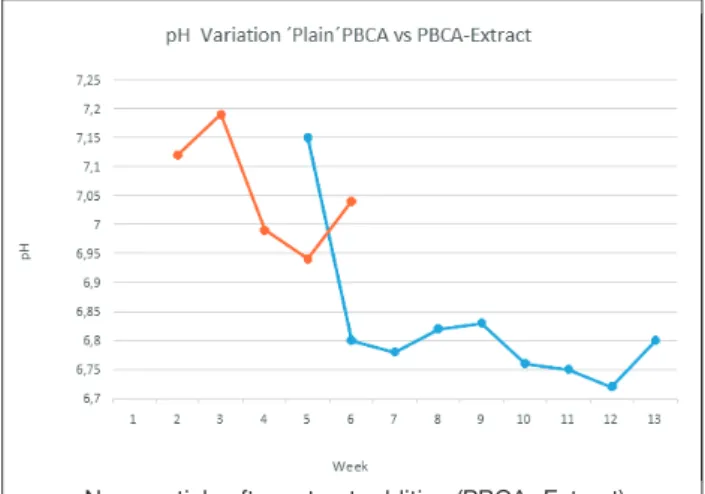
before the addition of the alcoholic plant extract In terms of the pH variation (Figure 2), it is possi-ble to see that both ´Plain´PBCA and PBCA-Extract formulations started with a pH 7.0 ± 0.3, since this is the pH required for the completion of the polymer-ization reaction. pH value remained relatively stable throughout the weeks, within the variation of ± 0.3.
Figure 2.
Nanoparticle after extract addition (PBCA- Extract) Nanoparticle before extract addition (´Plain´PBCA)
Figure 2 – Weekly pH comparison of the emulsion
with and without the alcoholic plant extract
Th e fact that the pH remained close to neutrality is a good indicator of formulation stability, as an in-crease in acidity could indicate possible polymer deg-radation, due to the hydrolysis of the polymeric chain, generating carboxyl groups (SANTOS, 2010).
The nanoparticles presented a mean diameter (151.6 nm for the ´Plain´PBCA and 180.0 nm for the PBCA-Extract), consistent with the range described in literature of 100 – 300 nm (Table 1). The values obtained for PBCA without the extract are similar to those described by Bertholon et al. (2006) also using the emulsion polymerization method with Dextran. An increase in the mean diameter, as well as in the
polydispersivity index was observed, which could be explained by the addition of the extract before the end of the polymerization reaction, since it may lead to the formation of larger particles (SCHAFFAZICK, 2003). This average hydrodynamic increase can be in-dicative of the adsorption of the extract to the Poly-mer, according to Table 1.
Table 1 – Determination of the mean hydrodynamic diameter, polydispersity index and zeta potential of the
nanoparticles
* Values expressed as mean ± standard deviation (n=3)
Nanoparticle Mean hydrodynamic diameter (nm) Polydispersity Index Zeta potential (mV)
´Plain´PBCA 151,6 ± 5,4 0,06 ± 0,02 - 1,46 ± 1,04
PBCA-Extract 180,0 ± 2,2 0,10 ± 0,33 - 0,70 ± 1,27
The zeta potential is associated with the surface potential of particles. Results obtained showed slightly negative values, which may be associated with the fact that the reaction occurs in an acidic medium (lower pH), contributing to a reduced dissociation of the free acrylic acid groups (REDDY & MURTHY, 2004).
The polydispersivity index is associated with the distribution of the particle weight, being contemplat-ed on a scale from 0 to 1. Both results obtaincontemplat-ed for the samples (0.06 for the ´Plain´PBCA and 0.10 for the PBCA-Extract) demonstrated a good distribution, given that values below 0.2 present a narrow distribu-tion of size, that is, a system closer to being monodis-persed (DAS et al., 2012). The standard deviation was
low, suggesting that the method showed good repro-ducibility.
According to Figure 3, a relatively similar beha-vior can be perceived between the three samples, with only a small variation in transmittance. The sample presented by a red line on the graph referes to the na-noparticle containing the plant extract but without the hyaluronic acid coating. One can observe that the sample presented significant peaks, demonstrating a greater instability when compared to the other curves. This result suggests that the hyaluronic acid coating of the nanoparticle containing the extract is essential in the process of stabilizing them.
Figure 3.
Figure 3 – Infrared spectroscopy of the
The characterization of nanoparticles by scanning electron microscopy (SEM), was also obtained (see
Fig res 4, 5, and 6). Figure 4.
Figure 4 – ´Plain´ PBCA SEM scan. Figure 5.
Figure 5 – PBCA-Extract without coating SEM
scan
Figure 6.
Figure 6 – Coated PBCA with plant extract SEM
scan
The images provided by SEM demonstrated that the nanoparticles were not completely spherical, but rather varied in format (Figures 4, 5, and 6). Althou-gh no particle size alteration was observed posterior to the addition of the plant extract, a change in the particle agglomeration state could be noticed. Parti-cles were perceived as being more dispersed, possibly due to the presence of the plant extract inside the na-noparticle (Figure 5).
Coated nanoparticles presented different superfi-cial characteristics (Figure 6) when compared to the other two samples. Particles appeared to have a spon-gy characteristic to them due to clearly visible super-ficial pores.
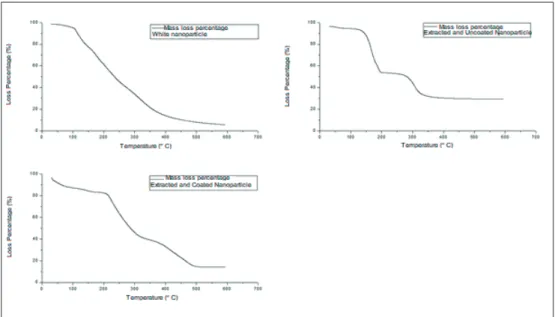
The thermal stability of nanoparticles was evalua-ted through differential scanning calorimetry (DSC) and thermogravimetry (TG) (Figure 7).
The curve of the DSC analysis (Figure 7) obtained for the nanoparticle containing the plant extract and the coating presents an endothermic peak in the range of 300-450° C, which is characteristic of simul-taneous and/or subsequent events. One can infer that this event occurred due to loss of moisture during the analysis. The beginning of the process of degradation of the polymeric structure referring to the sample with
extract and with coating is approximately at 200 ° C. TG analysis of the main formulation developed in this study (nanoparticles containing plant extract and with coating) demonstrated the absence of an
exo-thermic peak (Figure 8). This result may be indicative of possible adsorption of the hyaluronic coating to the surface of the nanoparticles, protecting the latter against degradation.
Figure 7 – DSC analysis of ‘Plain’ PBCA, PBCA-Extract without coating and Coated PBCA containing
ex-tract, obtained using sealed aluminum capsule, heating ratio 10°C/in and nitrogen atmosphere with a flow rate of 50mL/minute.
Figure 8 – Curves refering to TG analysis of ‘Plain’ PBCA nanoparticles, PBCA-Extract without coating
and Coated PBCA containing extract, obtained using sealed aluminum capsule, heating ratio of 10 °C/min and dynamic nitrogen atmosphere with a flow rate of 100mL/minute.
Furthermore, the endothermic events of the nano-particles containing plant extract and coating appear wider and/or displaced, indicating possible interac-tions between particle, extract and the hyaluronic acid coating. This observation also reinforces eviden-ce of nanoparticle coating.
Conclusion
Considering the objectives of this work, one can conclude that the development of the nanoparticles of poly (n-butyl-cyanoacrylate) allowed the addition of the alcoholic extract of the plant Tithonia
diversifo-lia (HEMSL) A. Gray, as well as the use of hyaluronic
acid as a coating medium. This process generated a nanostructure, which remained stable in relation to its physical, and morphological characteristics. Re-sults evidenced by spectroscopy, SEM, DSC and also by TG, demonstrate the effectiveness of hyaluronic acid as a coating medium, supporting the qualitative aspect of the reasearch to improve the physicochemi-cal stability of the nanosystem. Future studies taking into consideration these analyses may add to the set of nanotechnological subsidies for the pharmaceuti-cal área.
References
AKAGI T; BABA M; AKASHI M. Polymer 2007, 48, 6729. [CrossRef]. www.crossref.org > Acesso em 8/05/2015.
BEHAN, N.; BIRKINSHAW, C.; CLARKE, N. Poly n-butyl cyanoacrylate nanoparticles: a mechanism study of polymerization and particle formation. Bio-materials, v.22, p. 1335-1344, 2001.
BERTHOLON, I.; VAUTHIER, C.; LABARRE, D. Complement activation by core-shell poly(iso-butylcyanoacrylate)-polysaccharide nanoparticles: Influences of surface morphology, length, and type of polysaccharide. Pharmaceutical Research, v. 23, p.1313–1323, 2006.
BONIFÁCIO B V; et al. Nanotechnology-based drug delivery systems and herbal medicines: a re-view. Int J Nanomedicine. 2014; 9: 1–15. Disponível em: <https://www.ncbi.nlm.nih.gov/pmc/articles/ PMC3862741/> Acesso em: 17 de jul. 2018.
CAI Y.; et al. Antioxidant activity and phenolic compounds of 112 traditional Chinese medicinal plants associated with anticancer. Life Science. v. 74, n.11, pp. 2157-2184, 2004.
CHOWDHURY A R.; et al. Luteolin, an emerging anti-cancer flavonoid, poisons eukaryotic DNA to-poisomerase I. Biochemistry Journal. v. 366, n. 5, pp. 653-661, 2002.
COSTA EMMB, BARBOSA A S, ARRUDA T A, et al. Estudo in vitro da ação antimicrobiana de extratos de plantas contra Enterococcus faecalis. J Bras Patol Med Lab. 2010; 46(3):175–180.
CUFFINI Silvia L; PITALUGA JUNIOR Altivo; TOMBARI Dora. Polimorfismo em Fármacos. In: STORPIRTIS, Sílvia et al. Biofarmcotécnica. Rio de Janeiro: Guanabara Koogan, 2009. p. 26-28.
CUNHA ASC, JR, et al. Microemulsões como veí-culo de drogas para administração ocular tópica. Arq Bras Oftamol. 2003;66(3):385–391.
CUSHINE T P T.; LAMB A J. Antimicrobial activi-ty of flavonoids. International Journal Antimicrobials Agents. v. 26, n. 5, pp. 343,356, 2005.
DAUDT R M. et al. A nanotecnologia como estra-tégia para o desenvolvimento de cosméticos. Cienc. Cult., São Paulo, vol.65, n.3, Julho 2013. Disponível em: http://cienciaecultura.bvs.br/scielo.php?scrip-t=sci_arttext&pid=S0009- 67252013000300011&ln-g=en&nrm=iso > Acesso em: 4 Outubro 2017.
DAS S; NG W K.; TAN R B H. Are nanostructured lipid carriers (NLCs) better than solid lipid nanopar-ticles (SLNs): development, characterizations and comparative evaluations of clotrimazole-loaded SLNs and NLCs? European journal of pharmaceutical sci-ences : official journal of the European Federation for Pharmaceutical Sciences, v. 47, n. 1, p. 139–51, 2012.
GAMA R M; ARMANDO-JR J, GUIMARÃES M. Phytochemical screening and antioxidant activity of etanol extract of Tithonia diversifolia (Hemsl) A. Gray dry flowers. Asian Pac J Trop Biomed 2014; 4(9): 740-742.
GUIMARÃES M. Desenvolvimento de nanopartí-culas de poli (n-butil-cianoacrilato) com zidovudina revestidas por ácido hialurônico para veiculação em gel de uso transdérmico. 2015. 149 p. Tese (Doutora-do) - Curso de Farmácia, Produção e Controle Farma-cêuticos, Universidade de São Paulo, São Paulo, 2015. GUTERRES, S.S.; BNVENUTTI, E.V.; POHL-MANN, A.R.Nanopartículas poliméricas para admi-nistração de fármacos. In: DURÁN, N.; MATTOSO, L.H.C.; MORAIS, C.P. (eds), Nanotecnologia: Intro-dução, preparação e caracterização de nanomateriais e exemplos de aplicação. 2 ed. Artliber Editora. São Paulo, 2012.
HE, M.; ZHAO, Z.; YIN, L.; TANG, C.; YIN, C. Hyaluronic acid coated poly(butyl cyanoacrylate) na-noparticles as anticancer drug carriers. International
Journal of Pharmaceutics, v.373, p.165-173, 2009.
JÚNIOR J.A. Avaliação do efeito do extrato etanó-lico das flores secas de Tithonia diversifolia (Hemsl) A. Gray veiculado em emulsão no processo de reparação tecidual induzido na pele de ratos wistar. Faculdade de Medicina do ABC. 2014.
LACERDA A.M.; et al. Screening of plants with potential phototoxic. Revista Brasileira de Farmácia. v. 92, n. 4, pp. 352-355, 2011.
NASCIMENTO G G F.; et al. Antibacterial activity of plant extracts and phytochemicals on antibiotic re-sistant bacteria. Brazilian Journal Microbiology. v. 31, n. 2, pp. 247-256, 2000.
NAYAK B S; PEREIRA L M P. Catharanthus roseus flower extract has wound- healing activity in Sprague Dawley rats. BMC Complementary and Alternative Medicine. V. 6, n.4, 2006.
OWOYELE V B; et al. Studies on the anti-in-flammatory and analgesic properties of Tithonia
di-versifolia leaf extract. Journal of Ethnopharmacology.
V. 90, n. 2, pp. 317-321, 2004.
RADAIC, A. Como estudar interações entre nano-partículas e sistemas biológicos. Quím. Nova, São Pau-lo , v. 39, n. 10, p. 1236-1244, Dec. 2016 . Available from http://www.scielo.br/scielo.php?script=sci_arttex- t&pid=S0100=0422016001001236-&lng=en&nrm-iso >. Access on 25 Mar. 2017. http://dx.doi. org/10.21577/0100-4042.20160146.
REDDY L H.; MURTHY R. R. Influence od po-lymerization variables on the particle properties and release kinetics of methotrexate from poly(butylcya-noacrylate) nanoparticles. Acta Pharma, India,n. 54, p.103-118, 26 fev. 2004.
SCHAFFAZICK S R; et al. Caracterização e estabi-lidade físico-química de sistemas poliméricos nano-particulados para administração de fármacos. Quími-ca Nova, v. 26, n.5, p. 726-737, 2003.
SANTOS J S. Nanopartículas: Aplicações cosmé-ticas e farmacêucosmé-ticas. São Paulo: Pharmabooks, 2010. SILVA E C da et al. Análise térmica aplicada à cosmetologia. Brazilian Journal Of Pharmaceutical Sciences, São Paulo, v. 43, n. 3, p.347-356, jul. 2007.
SIMEONOVA, M. Physicochemical characteri-zation and in vitro behavior of daunorubicin-loaded poly(butylcyanoacrylate) nanoparticles. Acta Bioma-terialia, v. 5, p. 2109–2121, 2009.
SINTOV A C; SHAPIRO L. New microemulsion vehicle facilitates percutaneous penetration in vitro and cutaneous drug bioavailability in vivo. J Control Release.2004;95(2):173–183.
VAUTHIER C et al. Poly(alkylcyanoacrylates) as biodegradable materials for biomedical applications. Advanced Drug Delivery Reviews. V. 55, n. 4, p. 519-548, 2003.
VOGEL A I et al. Análise Química Quantitati-va. 6. ed. Rio de Janeiro: Ltc, 2017. 488 p. Disponí-vel em: https://integrada.minhabiblioteca.com.br/ books/978-85-216-2580-3/epubcfi/6/10[;vnd.vst. idref=copyright]!/4/10/6@0:0 >. Acesso em: 20 out. 2017.