The profile of orthodontists in relation to the
legal aspects of dental records
Giovanni Garcia Reis Barbosa*, Ronaldo Radicchi **, Daniella Reis Barbosa Martelli***,
Heloísa Amélia de Lima Castro****, Francisco José Jácome da Costa*****, Hercílio Martelli Júnior ******
Objective: The purpose of this study was to acquire knowledge about the key legal aspects of
orthodontic practice, which may be used as important defense tools in the event of ethical and/ or legal actions. Methods: A cross-sectional study was conducted with dentists in Belo Hori-zonte, Minas Gerais State, Brazil, by means of a specific instrument (questionnaire) addressing the ethical and legal disputes that involve the orthodontic specialty. Participants were asked to fill out the following questionnaire fields: personal identification, academic background, orth-odontic accessories, oral hygiene, treatment plan, service provision, orthorth-odontic documentation, drug prescription and forms of communication with patients, among others. Results: A total of 237 orthodontists, all members of the Regional Council of Dentistry, Minas Gerais State (CRO-MG) and living in Belo Horizonte, were given the data collection instrument. Out of this total, 69 (29.11%) answered and returned the questionnaires. Of the 69 respondents, 57.97% were male and 42.03% female. It was found that 52.17% of these professionals graduated from Higher Education Institutions (ISEs). It was observed that 34.78% of these orthodontists com-pleted specialization between 5 and 10 years after graduation. Most professionals (94.2%) enter into their medical records information about any damage caused to the orthodontic accessories used by their patients and 53.62% of the orthodontists keep their patients’ orthodontic docu-mentation on file throughout their active professional life. Conclusions: This study revealed that some analysis parameters were very satisfactory, such as: the availability of service provision contract models, communication with patients and/or their lawful guardians in case of abandon-ment of treatabandon-ment, orthodontic docuabandon-mentation files and the entering into the dental records of information concerning the breakage of and damage to orthodontic accessories. However, some practices have yet to be adopted, such as: patient signature should be collected in the event of damage to orthodontic accessories and copies of drug prescriptions and certificates should be kept on file.
Abstract
Keywords: Civil liability. Orthodontics. Forensic dentistry.
* Dentist, Dental Surgeon. Specialist in Forensic Dentistry, Brazilian Dental Association - ABO-MG.
** MSc in Forensic Dentistry and Ph.D. in Anatomy - Piracicaba School of Dentistry - Universidade Estadual de Campinas - Unicamp, Head of the Specializa-tion Course in Forensic Dentistry, Brazilian Dental AssociaSpecializa-tion - ABO-MG.
*** Specialist in Collective Health. Center of Biological Sciences and Health - Universidade Estadual de Montes Claros - Unimontes. **** Associate Professor, Department of Morphology, FOP/Unicamp.
***** Dentist, Dental Surgeon. Specialist in Forensic Dentistry, Brazilian Dental Association - ABO-MG.
INTRODUCTION
With the new Brazilian Constitution of 1988 and new laws that have arisen or have been refor-mulated after this constitution, such as the Con-sumer Protection Code in 1990 and the Brazilian Civil Code in 2002, society has come to exer-cise effective citizenship grounded in the spirit of democratization contained in these laws with a greater awareness of individual and collective rights.4 Thus, civil relations, contractual or
other-wise, have been modified as a result of this new context.4 The relationship between dentist and
patient is no exception to this rule11.
A key indicator of change in doctor-patient relationship is the growing number of ethical and civil lawsuits filed against dentists in re-cent years, which contrasts with the small and/ or negligible number of these cases in the early 1980s.8 Dental professionals, even if apparently
timid, have been increasingly concerned with the growing likelihood of being sued and the in-evitable havoc that these actions can inflict in their professional and financial status. The cur-rent context has contributed to the creation of a new concept and a new approach to the den-tist-patient relationship. “Defensive Dentistry”, a term that bears resemblance to other existing classifications, such as “defensive driving”, is de-fined as any activity designed to produce early evidence of good dental practices.8 The use of
“Defensive Dentistry” has been growing steadily while undergoing improvements carried out by the various dental specialties, which seek to con-form to their new reality. Orthodontics is a case in point, probably because it is one of the most often targeted dental specialties when it comes to ethical and civil litigations.8
Vanrell17 maintains that one manner in which
to produce early evidence of good professional practices is by gathering legal dental documents, i.e., statements, oral or written, signed by the dentist during the course of his profession ac-tivity, and grouping such evidence in the form
of medical records. In addition to serving the traditional clinical purposes it may be used as evidence in case of legal actions. Dental records are the major documents and the dental profes-sional’s key defense weapon.
Proffit10 believes that diagnosis in
orthodon-tics, as in other areas of dentistry and medicine, requires a proper collection of basic patient data. Based on these data one can analyze and record clearly and objectively the problems and changes that take place during patient evaluation. Treat-ment planning is the synthesis of possible solu-tions to the problems identified by the dentist. However, it is necessary to pursue a specific strategy for the treatment by taking into account the best possible therapy for the particular case of the patient under evaluation. The adoption of these procedures, provided they are in line with changes in the law, leads to the application of “de-fensive orthodontics” instruments, which are of paramount importance for compliance with and fulfillment of civil liability obligations. Among these routine instruments, orthodontists should mandatorily produce anticipated evidence such as accurate and updated clinical records. The present study aims to determine whether the specialists in orthodontics in Belo Horizonte, Minas Gerais State, Brazil, are knowledgeable of the legal den-tal issues pertaining to denden-tal records, which can prove relevant for “defensive orthodontics”.
MATERIAL AND METHODS
contained the following fields: personal identi-fication, academic background, orthodontic ac-cessories, oral hygiene, treatment plan, service provision, orthodontic documentation, drug pre-scription and means of communication with the patient, among others.
The orthodontists were identified from the records provided by the Regional Council of Dentistry, Minas Gerais (CRO-MG). The list of experts only comprised orthodontists who were registered in the State of Minas Gerais as of the month of April 2005, whose home and workplace addresses were located in the city of Belo Horizonte.
From the list of experts provided by CRO-MG, which contained the names and addresses of the orthodontists, the authors selected those (n = 237) who were to receive, between May and June 2005, the questionnaire and a term of free and informed consent that would enable them to contribute to this scientific investigation. It should be underscored that the criteria for ex-clusion from the study included deceased profes-sionals and those who no longer worked in den-tistry. After the questionnaires had been filled out and returned, data were collected for statisti-cal analysis of the joint distribution of frequency and to determine the significance of effects by means of Fischer’s test, when necessary. A confi-dence level of 95% was therefore established. It should be noted that this study was approved by the Ethics Committee of Universidade Federal de Minas Gerais, UFMG.
RESULTS
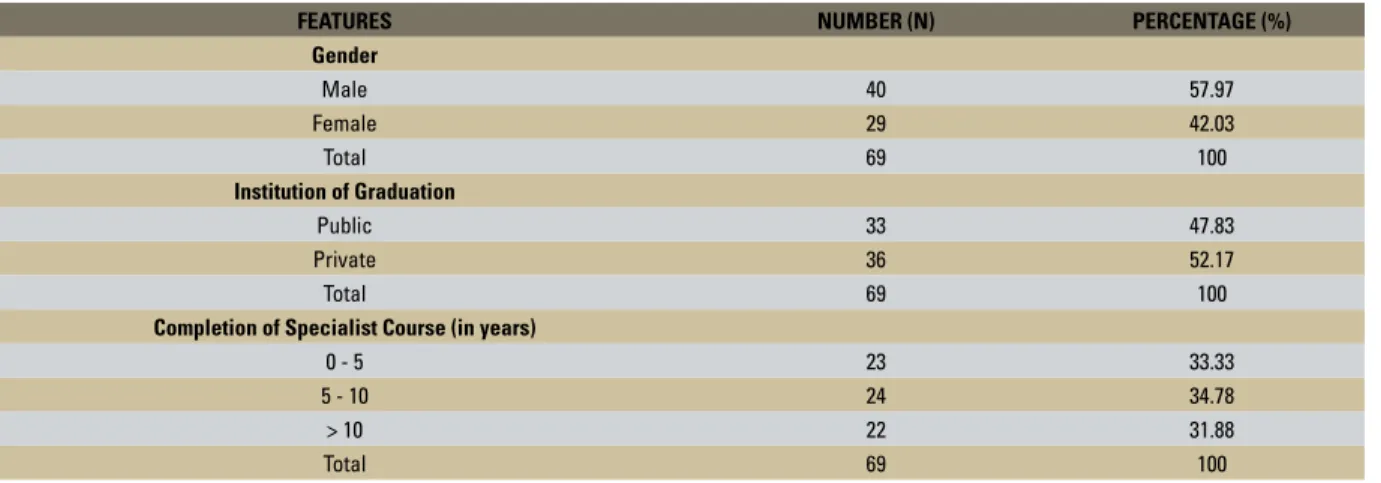
The population of this study consisted of 237 dentists, registered in the CRO-MG and domiciled in Belo Horizonte (MG). Of the 237 questionnaires that were sent out, 69 (29.11%) were returned. The demographic profile of the orthodontists is illustrated in Table 1. As can be observed, the time period required to complete the specialization course is consistent across the
board, as is the nature of the institution where they completed their graduate course.
Tables 2 and 3 refer to the variables: (1) orthodontic accessories and (2) oral hygiene effectiveness. As can be observed, the vast ma-jority of orthodontists recommend at least one oral hygiene method. Table 2 also shows that the minority of patients (23.19%) are required to sign a document when orthodontic accesso-ries are damaged.
Table 4 shows the treatment plan and ser-vice provision contract. As can be noted, most professionals require patients or their lawful guardians to sign the proposed treatment plan and most also use their own service provision contract model.
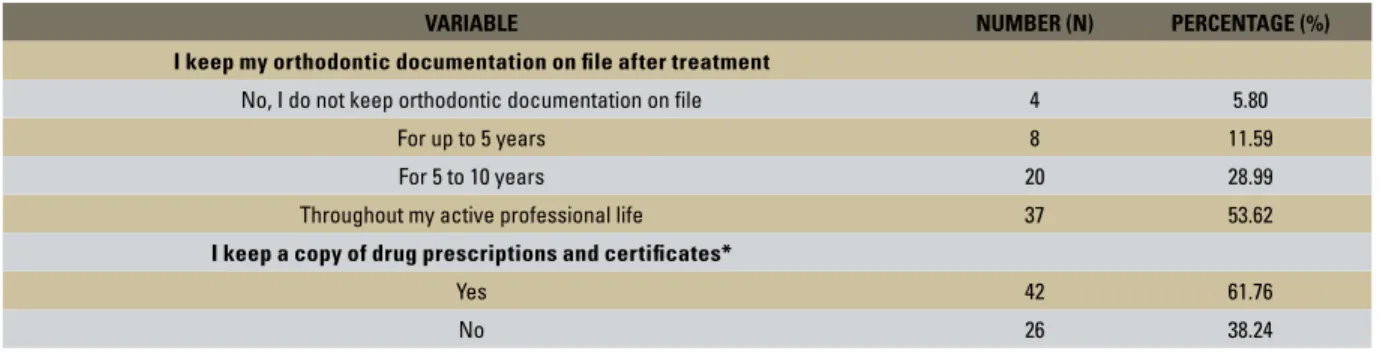
Table 5 shows that most professionals (53.62%) keep their patients’ orthodontic doc-umentation on file throughout their active pro-fessional life. A similar behavior was observed regarding the archiving of prescriptions and certificates.
Table 6 shows heterogeneity with regard to the orthodontist’s request for periapical radio-graphs for use in orthodontic treatment control. The most common request was for periapical radiographs once a year (37.31%), followed by twice a year and other intervals (23.88%) differ-ent from those included in the data collection instrument. According to Table 6, the most com-mon form of documentation at the completion of the orthodontic treatment was a combina-tion of photographs, radiographs and dental cast models (50.7%).
VARIABLE NUMBER (N) PERCENTAGE (%)
I enter information about damage to orthodontic accessories into the dental records
Yes 65 94.20
No 4 5.80
I have patient sign a document when orthodontic accessories are damaged
Yes 16 23.19
No 53 76.81
TABLE 2 - Analysis of the explanatory variables selected with regard to orthodontic accessories.
FEATURES NUMBER (N) PERCENTAGE (%)
Gender
Male 40 57.97
Female 29 42.03
Total 69 100
Institution of Graduation
Public 33 47.83
Private 36 52.17
Total 69 100
Completion of Specialist Course (in years)
0 - 5 23 33.33
5 - 10 24 34.78
> 10 22 31.88
Total 69 100
TABLE 1 - Demographic features of orthodontic specialists in Belo Horizonte, Minas Gerais, Brazil.
VARIABLE NUMBER (N) PERCENTAGE (%)
I enter information about poor oral hygiene into the dental records*
Yes 35 51.47
No 33 48.53
I recommend the following method(s) to improve patient oral hygiene*
Verbal warning 22 32.35
Recommendation in writing (I do not keep a copy for my records) 20 29.41
Recommendation in writing (I keep a copy for my records) 15 22.05
A combination of methods 11 16.17
Other methods 0 0
TABLE 3 - Analysis of the explanatory variables selected with regard to oral hygiene.
*One professional did not respond.
VARIABLE NUMBER (N) PERCENTAGE (%)
I require a signature authorizing implementation of treatment plan
Yes 60 86.96
No 9 13.04
I have my own service provision contract model*
Yes 60 88.24
No 8 11.76
TABLE 4 - Analysis of explanatory variables selected as regards treatment plan and service provision contract.
TABLE 5 - Analysis of explanatory variables selected as regards orthodontic documentation file, drug prescription and certificate.
VARIABLE NUMBER (N) PERCENTAGE (%)
I keep my orthodontic documentation on file after treatment
No, I do not keep orthodontic documentation on file 4 5.80
For up to 5 years 8 11.59
For 5 to 10 years 20 28.99
Throughout my active professional life 37 53.62
I keep a copy of drug prescriptions and certificates*
Yes 42 61.76
No 26 38.24
*One professional did not respond.
VARIABLE NUMBER (N) PERCENTAGE (%)
Frequency with which I request periapical radiographs for treatment control*
Once a year 25 37.31
Twice a year 16 23.88
Only at the beginning of treatment 4 5.97
Only at the end of treatment 6 8.95
Other 16 23.88
Form(s) of documentation at the end of the orthodontic treatment
Photographs 2 2.89
Dental cast models 2 2.89
Radiographs 4 5.79
Dental cast model photographs 3 4.34
Radiographs and photographs 14 20.28
Radiographs and Dental cast models 5 7.24
Photographs, Radiographs and Dental cast models 35 50.7
No documentation 4 5.79
TABLE 6 - Analysis of explanatory variables selected as regards the request for periapical radiographs, initial documentation and final documentation.
*Two professionals did not respond.
VARIABLE NUMBER (N) PERCENTAGE (%)
In the event of abandonment of treatment I send a communication to my patient
Yes 64 92.75
No 5 7.25
At the end of orthodontic treatment my patient is “discharged” in writing and I sign the document
Yes 15 21.74
No 54 78.26
Occlusal analysis is performed after the end of orthodontic treatment
Yes 53 76.81
No 10 14.49
Other method(s) 6 8.69
DISCUSSION
Liability is the obligation to account for one’s own actions or those of others. It encompasses both moral and legal aspects. The former denotes good behavior, good conduct, conformity with the rules of society. The latter refers to the duty to account, both criminally and civilly, for viola-tion of a specific right established by law. There-fore, liability is the result of action by which in-dividuals express their behavior in light of such duty or obligation.15 In Brazilian law, criminal
liability and civil liability are independent from each other¹.
Civil liability depends on the existence of a causal link between two conditions: a) a person’s conduct, which is regarded as inappropriate and b) damage resulting from such conduct. Civil li-ability is founded in these two circumstances of cause and effect. The conduct referred to above may be omissive or commissive.7 In general,
li-ability within the civil scope is manifested in the application of the value of compensation, in the act of prevention or indemnification for dam-ages.9 Thus, legal science has a direct bearing on
dental activity, and orthodontists have both the duty and the right to learn about the basic provi-sions governing their professional activities so as to comply with them and thus avoid legal prob-lems.8 This study sought to highlight and clarify
the legal and civil liabilities associated with orth-odontic practice.
The scientific literature points to the impor-tance of documentation in the course of clini-cal practice.3 Initially, one of the key concerns
of this investigation focused on receiving the re-turn letters with the completed questionnaires. Of the 237 dentists who were targeted, only 69 (29.11%) answered the questionnaire, providing the data presented in Tables 1 to 7. It should be noted that similar statistics was also observed in other scientific studies².
Regarding the demographics of the popu-lation under study, there was a predominance
of males (57.97%), compared with females (42.03%). When analyzing the nature of the institution where the respondents completed their graduation course, certain percentage sim-ilarities between public and private can be iden-tified. This is likewise true of their specializa-tion course, which varied in intervals of fewer than 5 years, 5 to 10 years and above 10 years after graduation.
Machen6 asserts that the most glaring
weak-ness displayed by orthodontists is their ineffi-ciency to keep records of the following facts: oral hygiene, damage to orthodontic accessories, tooth decay, damaged restorations and cancellation of or missed appointments. Constantly warning about problems by establishing an open and hon-est communication channel could go a long way towards influencing the decision of whether or not to file a lawsuit. It was found that most profes-sionals enter into their dental records information about events involving damage to the orthodon-tic accessories (94.20%), but only a minority re-quires their patients to sign a document attesting to their awareness of this fact (23.19%) (Table 2). Regarding oral hygiene, there was a prevalence of verbal instruction and a combination of methods encompassing verbal warnings and instruction models. Twenty orthodontists replied that they provide professional orientation on oral hygiene in writing, or through texts, but do not keep a copy of the document. Fifteen orthodontists gave their assurance that they behave identically, but always file a copy of the document signed by the patient or lawful guardian (Table 3).
Riedel13 asserts that the orthodontic
by professionals to the contract, both regarding treatment implementation and the existence of a service provision contract.
Orthodontists, like any other health care pro-fessionals, should always be well documented and ready for any legal disputes. Any sign of dis-satisfaction by the patient should immediately be detected and discussed.16 Some patients pursue
legal actions against dentists long after comple-tion of treatment, many of whom believe they are under the care of these professionals for ever and that these specialists are responsible for any problems that may arise in future.5 According
to the variable regarding the orthodontic docu-mentation, shown in Table 5, most professionals keep their documentation on file for time peri-ods of either 5 to 10 years (28.99%) or through-out their career (53.62%). The same concern, however, does not apply to certificates and drug prescriptions since only 61.76% of orthodontists archive these documents.
Preappointed evidence consists of all dental documentation developed throughout clinical practice. Therefore, documentation of all phases of professional activity is of utmost importance.14
Professionals agree that there is a need to record all events that occur daily in the care of their patients.12 When it comes to recording the end
of treatment, most orthodontists (n = 35) use photographs, radiographs and dental casts for documentation (Table 6). Table 6 shows that the majority of orthodontists (n = 25) request peri-apical radiographs once a year for orthodontic
treatment control. Also according to Table 7, 53 professionals replied that they request an occlu-sal analysis by the end of treatment.
Terra et al16 recommended that professionals
develop a high level of communication with the patient. This means not only speaking clearly and objectively but also listening, being atten-tive and showing interest and consideration. Concerning this issue, Table 7 shows, in par-ticular, that most orthodontists (92.75%) try to contact patients and/or their lawful guardians in the event of abandonment of treatment. Nev-ertheless, a minority of professionals (21.74%) require their patients and/or lawful guardians to sign a document at the end of the orthodontic treatment (Table 7).
CONCLUSIONS
1. Brasil. Código civil brasileiro. 1ª ed. São Paulo: Saraiva; 1986. p.1086.
2. Contandriopoulos AP. Saber preparar uma pesquisa: definição, estrutura, fracionamento. 2ª ed. São Paulo: Lucitec; 1997. p. 59-95.
3. Crosby DR, Crosby MS. Professional liability in Orthodontics. J Clin Orthod. 1987 Mar;21(3):162-6.
4. Fernandes F, Cardozo HF. Responsabilidade civil do cirurgião-dentista: o pós-tratamento ortodôntico. Rev ABO Nac. 2004 out-nov;12(5):298-305.
5. Jerrold L. It’s not my job. Am J Orthod Dentofacial Orthop. 1996 Oct;110(4):454-5.
6. Machen DE. Legal aspects of orthodontic practice: risk management concepts. The uncooperative patient: terminat-ing orthodontic care. Am J Orthod Dentofacial Orthop. 1990 Jun;97(6):528-9.
7. Nascimento TMC. Responsabilidade civil no código do consu-midor. 1ª ed. Rio de Janeiro: Aide; 1991. p. 150.
8. Nemetz LC. Manual de Odontologia defensiva. Blumenau: Associação Brasileira de Odontologia; 2002.
REFERENCES
Contact address
Hercílio Martelli Júnior
Rua Iracy de Oliveira Novaes, 220 – 207 A CEP: 39.400-000 – Montes Claros/MG, Brazil E-mail: [email protected]
9. Oliveira MLL. Responsabilidade civil odontológica. 1ª ed. Belo Horizonte: Del Rey; 1999. p. 344.
10. Proffit WR. Ortodontia contemporânea. 2ª ed. Rio de Janeiro: Guanabara Koogan; 1995. p. 125-26.
11. Prux OI. Responsabilidade civil do profissional liberal no Códi-go de Defesa do Consumidor. 1ª ed. Belo Horizonte: Del Rey; 1998. p. 368.
12. Pueyo VM, Garrido BR, Sánchez JAS. Odontologia legal y forense. 1ª ed. Barcelona: Masson; 1994. p. 123-9. 13. Riedel RA. A review of the retention problem. Angle Orthod.
1960 Oct;30:179-99.
14. Silva M. Compêndio de Odontologia legal. 1ª ed. Rio de Janei-ro: Medsi; 1997. p. 490.
15. Stoco R. Responsabilidade civil e sua interpretação jurisprun-dencial. 3ª ed. São Paulo: R. dos Tribunais; 1997. p. 49-70. 16. Terra MS, Majolo MS, Carillo VEB. Responsabilidade
profissio-nal, ética e o paciente em Ortodontia. Ortodontia. 2000 set; 33(3):74-85.
17. Vanrell JP. Odontologia legal e antropologia forense. 1ª ed. Rio de Janeiro: Guanabara Koogan; 2002.