DOI: 10.1590/1518-8345.1652.2852 www.eerp.usp.br/rlae
Cultural adaptation and validation of an instrument on barriers for the
use of research results
1Maria Beatriz Guimarães Ferreira
2Vanderlei José Haas
3Rosana Aparecida Spadoti Dantas
4Márcia Marques dos Santos Felix
5Cristina Maria Galvão
6Objective: to culturally adapt The Barriers to Research Utilization Scale and to analyze the metric
validity and reliability properties of its Brazilian Portuguese version. Method: methodological
research conducted by means of the cultural adaptation process (translation and
back-translation), face and content validity, construct validity (dimensionality and known groups) and
reliability analysis (internal consistency and test-retest). The sample consisted of 335 nurses,
of whom 43 participated in the retest phase. Results: the validity of the adapted version of the instrument was conirmed. The scale investigates the barriers for the use of the research results in clinical practice. Conirmatory factorial analysis demonstrated that the Brazilian Portuguese version of the instrument is adequately adjusted to the dimensional structure the scale authors originally proposed. Statistically signiicant differences were observed among the nurses holding a Master’s or Doctoral degree, with characteristics favorable to Evidence-Based Practice, and
working at an institution with an organizational cultural that targets this approach. The reliability
showed a strong correlation (r ranging between 0.77 and 0.84, p<0.001) and the internal
consistency was adequate (Cronbach’s alpha ranging between 0.77 and 0.82). Conclusion: the
Brazilian Portuguese version of The Barriers Scale was valid and reliable in the group studied.
Descriptors: Nursing; Research; Evidence-Based Nursing; Validation Studies; Factor Analysis,
Statistical; Organizational Culture.
1 Paper extracted from Doctoral Dissertation “Cultural adaptation and validation of The Barriers to Research Utilization Scale: brazilian portuguese
version”, presented to Escola de Enfermagem de Ribeirão Preto, Universidade de São Paulo, WHO Collaborating Centre for Nursing Research Development, Ribeirão Preto, SP, Brazil. Supported by Conselho Nacional de Desenvolvimento Cientíico e Tecnológico (CNPq), Brazil, process #301909/2010-5.
2 PhD, Professor, Universidade de Uberaba, Uberaba, MG, Brazil.
3 PhD, Visiting Professor, Universidade Federal do Triângulo Mineiro, Uberaba, MG, Brazil.
4 PhD, Associate Professor, Escola de Enfermagem de Ribeirão Preto, Universidade de São Paulo, WHO Collaborating Centre for Nursing Research
Development, Ribeirão Preto, SP, Brazil.
5 Doctoral student, Universidade Federal do Triângulo Mineiro, Uberaba, MG, Brazil. Scholarship holder from Coordenação de Aperfeiçoamento
de Pessoal de Nível Superior (CAPES), Brazil.
6 PhD, Full Professor, Escola de Enfermagem de Ribeirão Preto, Universidade de São Paulo, WHO Collaborating Centre for Nursing Research
Development, Ribeirão Preto, SP, Brazil.
How to cite this article
Ferreira MBG, Haas VJ, Dantas RAS, Felix MMS, Galvão CM. Cultural adaptation and validation of an instrument
on barriers for the use of research results. Rev. Latino-Am. Enfermagem. 2017;25:e2852. [Access ___ __ ____];
Available in: ____________________. DOI: http://dx.doi.org/10.1590/1518-8345.1652.2852.month day year
Introduction
The growing demand to improve the quality of
health services implies nursing’s search for actions
to implement Evidence-Based Practice (EBP), aiming
to promote the increased quality of nurses’ care and
professional growth. In addition, the traditionalist
and ritualistic practice of the profession is currently
inadmissible(1).
EBP is a problem-solving approach to deliver health
care that integrates the best evidence originating in
well-designed studies and care data, in combination
with the patient’s preferences and values and the health
professional’s expertise(2).
Hence, the implementation of EBP can offer beneits for the patient, health service and professionals working in the area, including the nurse. This approach
increases the patient’s access to information on effective
treatments and can improve the institution, facilitating
decision making consistently and at a lower cost. In
addition, through information, it helps the nurse to
make decisions, recycling these professionals by means of technologies and enhancing their eficiency(3).
The use of research results in clinical practice is
one of the components of EBP. Despite the increased
volume of nursing research in many countries,
transferring knowledge to practice remains a challenge.
One of the actions that could minimize the gap between
the knowledge produced and its application is the identiication of barriers that impede the interdependence between research and practice(4).
The Barriers to Research Utilization Scale was
developed to investigate the barriers for the use of
research results in clinical practice. The instrument
consists of 29 items and three open questions. The
items make up the four factors or domains of the scale.
Factor 1 refers to the nurse’s characteristics concerning
the research, that is, value attributed, skills and
knowledge, and includes eight items. Factor 2 pictures
the characteristics of the organization where the
research can be used, the barriers and limitations of this
scenario, also including eight items. Factor 3 consists of six items, which relect the research characteristics, such as methodological inadequacy and conlicting results in the literature. Factor 4 focuses on the communication
characteristics (supply and accessibility of the research),
consisting of six items, including the lack of readability
and clarity of the study’s implications for the practice(5).
For each scale item, the respondent marks one out of ive options on a Likert scale, in which scores 1 to 4 indicate the increase of the perceived barrier, and
5 that the participants does not opine. Thus, higher
scores indicate greater barriers for the use of research
results in practice. It is highlighted that item 27 in the
scale is not scored, as it was not included in any of
the factors. Nevertheless, the authors of the original
instrument maintained this item based on the experts’
assessments(5).
The use of the scale can permit the identiication of area lacking intervention, enhance the usage process of
research results in practice, guide the development of
educative programs, support dialogues among clinicians,
researchers and administrators with a view to reducing
gaps between research and its application(5).
Studies exist in the literature in which the scale was
validated for the context of the country(6-16), as well as
studies whose authors applied the instrument to identify
the barriers for the implementation of evidence in the
local practice(17-20).
Due to the lack of research in the Brazilian
literature on a measure to investigate the barriers for
the use of research results in clinical practice, this study
was intended to develop the cultural adaptation of the
instrument The Barriers to Research Utilization Scale, as
well as to analyze the metric properties of validity and
reliability of its version for Brazilian Portuguese.
Method
A methodological research was started after getting
agreement from the main author of the instrument The
Barriers to Research Utilization Scale.
The Barriers Scale was submitted to the cultural
adaptation process proposed by experts on the procedure(21),
changing the order of the back-translation phase, which
took place after the expert committee phase(22). This change is justiied, as it maintains the objective of the back-translation, which is to observe possible errors of meaning
between the adapted version and the original version. That
would not be the case if the adapted version were further modiied by the expert committee(22).
Hence, two independent persons (research and
Brazilian teacher of English) translated the original
version of the instrument into Brazilian Portuguese,
resulting in a single version after the consensus
meeting. The single version was submitted to an expert
committee for assessment. The experts were selected
based on their knowledge on EBP and their development
of nursing research (four nurses/faculty holding a
Ph.D.) and one professional mastering English. The
experts assessed the cultural, semantic, conceptual and
idiomatic equivalence, as well as the face and content
validity. They requested that the original layout of the scale be mentioned and that modiications be made in the formulation of some instrument items (examples:
documented need to change the”; from “inds” to “has access to”). The changes the experts suggested resulted
in the Brazilian Portuguese version of the instrument
The Barriers Scale, which two independent translators
translated to English: during a consensus meeting, the
single version was formulated, which was then forwarded
to the main author of the original version for evaluation,
who answered that he had no contributions to add. Conirmatory factor analysis was used to test the dimensional construct validity, and the known groups
technique to test the construct validity, delimited by
professional and academic criteria as well as by the
workplace (hospital where EBP had been incorporated in
the organizational culture and institution that did not adopt
this approach in its organizational culture). Reliability was
analyzed by means of internal consistency and the
test-retest phases, with a seven-day interval, similar to the
analysis developed in the original version of the instrument.
The study was developed at two hospitals, called
A and B. Hospital A has not incorporated EBP into its
organizational culture. It is located in the interior of
the state of Minas Gerais and, at the time of the data
collection, 184 nurses were serving on its staff. Hospital
B does have this culture and is located in the city of
São Paulo, with 542 nurses serving on the staff. The
eligibility criteria of the participants were nurses working
at the different hospital services with at least one month
of formal employment at the sector.
For the sample size, the literature recommendations for conirmatory factor analysis were considered, that is, superior to at least 200 participants(23) and appropriate
balancing of the sample between both hospital. Hence,
it was determined that at least 300 nurses should
participate. All nurses at hospital A who complied with
the criteria were invited to participate in the study.
At hospital B, a draw was held but, due to the low
adherence, we decided to invite everyone until reaching the pre-established igure. The study sample consisted of 335 nurses (hospital A=164; hospital B=171). For
the retest phase, using a draw, 43 nurses answered the
measure twice at distinct times.
The data were collected between October 2014
and June 2015, applying the instruments by means of
a software model, which allowed the nurse to answer
in logical order to complete the three delimited phases
(Free and Informed Consent Term, sociodemographic
and professional characteristics and The Barriers
Scale-Brazilian Portuguese version). The application of the
instruments was available on-line on the website http://
www.thebarriers.com.br. By e-mail, the nurses received
an explanation about the importance of the study and
the access link. For the participants without e-mail,
the instruments were answered in the presence of
the researcher, at a pre-arranged time and place, at a reserved room without the inluence of third parties.
In the data analysis, descriptive analyses were
developed of the instrument items, identifying central
trend and dispersion measures. The dimensional construct validity was assessed by means of the conirmatory factorial analysis, and the construct validity by means of known
groups was investigated using Student’s t-test, predicting
higher scores for the group of nurses with characteristics
unfavorable to EBP and working at the hospital with an
organizational culture that does not target that approach.
Cohen’s d was also adopted to classify the magnitude of
the difference between the mean scores of the groups or criteria studied as small (d<0.20), moderate (≥0.20 to <0.50) and big (≥0.50). The reliability was veriied using the Intraclass Correlation Coeficient, with appropriate coeficients >0.70 and Pearson’s Correlation Coeficient, considering the magnitude of the correlation as weak (0-0.29), moderate (0.30-0.49) and strong (≥0.50). The assessment of the internal consistency of the instrument
items was calculated using Cronbach’s alpha, acceptable coeficients being superior to 0.70. Signiicance was set at 0.05.
Approval for the research project was obtained
from a Research Ethics Committee (protocol 844.856),
according to Resolution 466/2012, and all participants
signed the Free and Informed Consent Form.
Results
Among the 335 participants, 297 (88.70%) were
women. The average age was 33.2 years (minimum 23,
maximum 69 years). The majority (272; 81.2%) held
a stricto sensu post-graduation degree (Master’s) and
had no other employment bond (285; 85.1%). Table 1
displays the data on the research variables related to the
training and use of research results in clinical practice.
The presence of professional characteristics
favorable to the use of research results in practice
was greater in the group of nurses from hospital B, highlighting the reading of scientiic articles about nursing practice (161, 94.2%).
As regards the response frequencies for the items
of The Barriers Scale – Brazilian Portuguese version, the nurses at hospital A identiied the following as the main barriers: item 18–Physicians will not cooperate with
implementation (50.6%), 6–The facilities are inadequate
for implementation (40.2%) and 13–The nurse does not
feel (s)he has enough authority to change patient care
procedures (37.8%), all items belonging to Factor 2
(organizational characteristics). At hospital B, the main
barriers the nurses reported also referred to Factor 2,
is insuficient time on the job to implement new ideas (24.6%). In the analysis of the average among the factors
of the scale, Factor 2 also presented the highest mean
score, and Factor 3 (research characteristics) the lowest.
In Figure 1, the results of the conirmatory factor analysis are presented to determine the dimensional
construct validity of The Barriers Scale – Brazilian
Portuguese version.
Table 1 – Distribution of the nurses according to professional characteristics, considering the variables related to the
training and use of research results in clinical practice. Uberaba, MG, São Paulo, SP, Brazil, 2014, 2015
Variables
Hospital A Hospital B Total
n % n % n %
Training about use of research results in practice
Yes 93 56.7 124 72.5 217 64.8
No 71 43.3 47 27.5 118 35.2
Course on the use of research results in practice
Yes 21 12.8 29 17.0 50 14.9
No 143 87.2 142 83.0 285 85.1
Training on search for scientiic evidence in databases
Yes 48 29.3 114 66.7 162 48.4
No 116 70.7 57 33.3 173 51.6
Reading of scientiic articles on nursing practice
Yes 137 83.5 161 94.2 298 89.0
No 27 16.5 10 5.8 37 11.0
Nursing research development
Yes 112 68.3 117 68.4 229 68.4
No 52 31.7 54 31.6 106 31.6
,15 ,15 ,58 ,57 ,66 ,79 ,56 ,62 ,65 ,50 ,47 ,52 ,58 ,48 ,65 ,61 ,46 ,50 ,61 ,66 ,54 ,68 ,74 ,99 ,81 ,75 ,66 ,65 ,82 ,46 ,55 ,60 ,46 ,57 ,77 ,34 ,32 ,43 ,63 ,31 ,39 ,42 ,25 ,22 ,27 ,33 ,23 ,42 ,38 ,21 ,25 ,12 ,15 ,15 ,23 ,27 ,37 –,23 –,15 ,12 ,14 –,24 ,37 ,44 ,29 ,46 ,54 ,21 ,30 ,36 ,22 ,32 ,60 –,20 –,23 ,14 ,24 ,25 ,29 Comunication Research Organization Nurse
Item 5 e5 e9 e15 e16 e20 e21 e26 e28 Item 9 Item 15 Item 16 Item 20 Item 21 Item 26 Item 28
Item 6 e6
e7 e13 e14 e18 e19 e25 e29 Item 7 Item 13 Item 14 Item 18 Item 19 Item 25 Item 29
Item 8 e8
e10 e11 e17 e22 e23 Item 10 Item 11 Item 17 Item 22 Item 23
Item 1 e1
e2 e3 e4 e12 e24 Item 2 Item 3 Item 4 Item 12 Item 24
The model tested included a four-factor structure,
containing the latent variables, indicated by the
ellipses in Figure 1, characteristics of the nurse
(Factor 1, containing eight items), characteristics of
the organization (Factor 2, containing eight items),
research characteristics (Factor 3, containing six
items) and communication characteristics (Factor
4, containing six items). The items are indicated by rectangles and the factor loadings by the coeficients in the arrows.
As for the model it indicators, concerning the absolute it measures, the chi-square coeficient corresponded to χ2(327)=744.78, p<0.001, the root mean square error of approximation was RMSEA=0.062 (90% CI=0.056-0.068) and the goodness of it index was GFI=0.87; while the Tuker-Lewis Index corresponded
to TLI=0.86 and the Comparative Adjustment Index to
CFI=0.87. It is highlighted that, although the hypothesis
of equality between the variance-covariance matrices needs to be rejected based on the chi-squared coeficient (predicted by the model and obtained based on the data),
the RMSEA lies within the limits considered as indicating adequate itness of the model to the proposed factorial structure. In addition, the incremental measures are
very close to the cut-off point recommended (0.90) for adequate goodness of it. Hence, it is concluded that the model is it to the dimensional structure proposed in the original version of the measure.
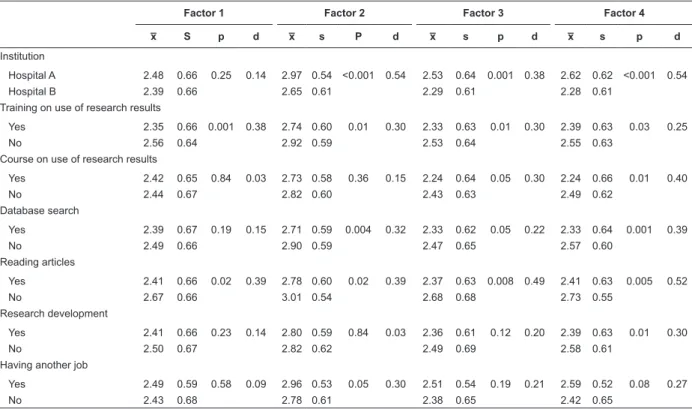
To understand the data presented in Table 2,
lower means represent lesser barriers as appointed by
the participants, while higher means indicate greater
barriers. In descriptive terms, the means of all variables
were lower when characteristics favorable to EBP were
present, demonstrating that, when the nurse possesses
these characteristics, in her opinion, she indicated lesser
barriers to use the research results in practice.
Table 2 – Mean (x̅), standard deviation (s) and effect size (Cohen’s d) for the construct validity, considering the
research variables, for each of the factors of The Barriers Scale. Uberaba, MG, São Paulo, SP, Brazil, 2014, 2015
Factor 1 Factor 2 Factor 3 Factor 4
x̅ S p d x̅ s P d x̅ s p d x̅ s p d
Institution
Hospital A 2.48 0.66 0.25 0.14 2.97 0.54 <0.001 0.54 2.53 0.64 0.001 0.38 2.62 0.62 <0.001 0.54
Hospital B 2.39 0.66 2.65 0.61 2.29 0.61 2.28 0.61
Training on use of research results
Yes 2.35 0.66 0.001 0.38 2.74 0.60 0.01 0.30 2.33 0.63 0.01 0.30 2.39 0.63 0.03 0.25
No 2.56 0.64 2.92 0.59 2.53 0.64 2.55 0.63
Course on use of research results
Yes 2.42 0.65 0.84 0.03 2.73 0.58 0.36 0.15 2.24 0.64 0.05 0.30 2.24 0.66 0.01 0.40
No 2.44 0.67 2.82 0.60 2.43 0.63 2.49 0.62
Database search
Yes 2.39 0.67 0.19 0.15 2.71 0.59 0.004 0.32 2.33 0.62 0.05 0.22 2.33 0.64 0.001 0.39
No 2.49 0.66 2.90 0.59 2.47 0.65 2.57 0.60
Reading articles
Yes 2.41 0.66 0.02 0.39 2.78 0.60 0.02 0.39 2.37 0.63 0.008 0.49 2.41 0.63 0.005 0.52
No 2.67 0.66 3.01 0.54 2.68 0.68 2.73 0.55
Research development
Yes 2.41 0.66 0.23 0.14 2.80 0.59 0.84 0.03 2.36 0.61 0.12 0.20 2.39 0.63 0.01 0.30
No 2.50 0.67 2.82 0.62 2.49 0.69 2.58 0.61
Having another job
Yes 2.49 0.59 0.58 0.09 2.96 0.53 0.05 0.30 2.51 0.54 0.19 0.21 2.59 0.52 0.08 0.27
No 2.43 0.68 2.78 0.61 2.38 0.65 2.42 0.65
The nurses appointed lesser barriers when
characteristics favorable to the use of research results
in clinical practice were present, with statistically signiicant differences when they worked at an institution with an organizational culture targeting
EBP for Factors 2, 3 and 4. The same was true when
they received training on the use of research results
offered by the institution, for all Factors; courses on
the application of research for Factors 3 and 4; search for scientiic evidence in databases for Factors 2, 3
and 4; research development for Factor 4 and single
employment bond for Factor 2 (Table 2).
In descriptive terms, nurses holding a specialization degree experts identiied greater barriers for all factors (Factor 1: x=2.54; Factor 2: x=2.88; Factor 3: x=2.52; Factor 4: x=2.66) when compared to the nurses holding a Master’s or Doctoral
degree (Factor 1: x=2.43; Factor 2: x=2.80; Factor
though, which made discrimination power impossible for the qualiication variable, which distinguished the participants’ education in the lato sensu and stricto
sensu modalities.
In Table 2, Cohen’s d is displayed, deined by the difference of means divided by the standard deviation
of the difference, which indicates the effect size. Thus,
it is considered that, the greater the effect, the greater
the impact of the presence of a characteristic favorable
to the nurse’s practice based on EBP. For most variables,
the effect size was moderate and high, except for
Factor 1, concerning the institutional variable, search for scientiic evidences in databases and having another job, as well as for Factors 1 and 2 concerning the course
on the use of research results.
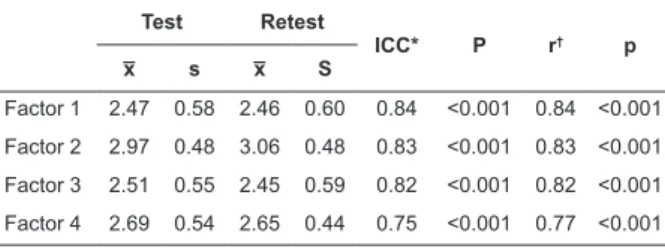
Forty-three nurses participated in the retest
phase through a draw. Pearson’s Correlation and the Intraclass Correlation Coeficient were used to assess the reliability. The correlations indicated
similarity between the test-retest items. The Intraclass Correlation and Pearson’s Correlation Coeficients evidenced excellent and strong reliability indicators, with a statistically signiicant difference for all factors. To assess the internal consistency of the items, Cronbach’s alpha coeficients were calculated, which were acceptable: 0.92 (Barriers total), 0.82 (Factor 1),
0.78 (Factor 2), 0.78 (Factor 3) and 0.77 (Factor 4)
(Table 3).
Table 3 – Test-retest reliability analysis of The Barriers
Scale, considering the factors. Uberaba, MG, São Paulo,
SP, Brazil, 2014-2015
Test Retest
ICC* P r† p
x̅ s x̅ S
Factor 1 2.47 0.58 2.46 0.60 0.84 <0.001 0.84 <0.001
Factor 2 2.97 0.48 3.06 0.48 0.83 <0.001 0.83 <0.001
Factor 3 2.51 0.55 2.45 0.59 0.82 <0.001 0.82 <0.001
Factor 4 2.69 0.54 2.65 0.44 0.75 <0.001 0.77 <0.001
*Intraclass Correlation Coeficient †Pearson Correlation Coeficient
Discussion
The methodological research results on The Barriers
Scale were similar to this study concerning the female
sex and the age(5,7,11-16). The habit of reading scientiic
articles and research development characterized most
of the nurses in this study. Differently from a study
involving Spanish nurses, whose results evidenced that
the professionals possessed less than 40 hours of
non-formal preparation for research (455; 69.15%), and had done their most recent scientiic reading between the past month and more than one year earlier(15).
Based on the analysis of the methodological studies identiied in the literature, it can be afirmed that the main barriers the nurses reported were similar to the
barriers reported in this study, in that they belonged
to Factor 2 (organizational characteristics), more speciically items 6 and 13(6-8,10-13,15).
In a study developed in Turkey, involving 300 nurses
from four hospitals, the results indicated the goodness of it of the proposed factorial model, similar to this study, demonstrating that the Turkish version of the scale
consisted of the same four factors as the original version
of the measure. The factor loadings varied between 0.58
and 0.84 for Factor 1; 0.56 and 0.95 for Factor 2; 0.69
and 0.88 for Factor 3 and between 0.48 and 0.97 for Factor 4. The indicators presented the goodness of it of the model (GFI=0.97; RMSEA=0.06), and Cronbach’s
alpha for the general scale corresponded to 0.92,
ranging between 0.73 and 0.80 for the factors(14).
It is highlighted that, in the methodological studies,
in which the authors developed exploratory factor
analysis, the results evidenced factorial structures that
differed from the original model(7-9,11,13).
As for the discrimination of the scale’s validity, it is
highlighted that no methodological research has been identiied in the literature that was developed in two realities (institution with organizational culture targeting
EBP and another without that culture). In one study
only, in the metric analysis of the Chinese version of
The Barriers Scale, the authors used the qualiication
variable to estimate the construct validity for known groups, afirming that this validity rests on the fact that higher scores were observed among nurses with a
higher education level. Nurses holding a Master’s degree
or higher presented higher mean barrier scores for the
use of research results in (x̅=2.91) when compared
to nurses holding an undergraduate degree (x̅=2.69;
p=0.001)(16).
These research results were different. Controversies
exist in the literature. Nurses with higher education levels are expected to ind it easier to apply the research results in clinical practice. Nevertheless, there
is ongoing discussion on whether these professionals
identify greater or lesser barriers for the use of research
results, as it depends on the context they are working
in. To give an example, Master’s and Doctoral graduates
working at an institution without an organizational
culture that targets EBP tend to identify greater barriers
to apply the research results in practice. On the other
hand, if they work at a service with such organizational
culture, they tend to identify lesser barriers. In view
implementation of research results in clinical practice
and the organizational context of the health service. No studies were identiied in the literature whose authors assessed the reliability of the instrument using
the test-retest phases, as executed in this study and
in the original version of the scale(5). In this research,
the reliability of the instrument was assessed, using the analysis of the Intraclass Correlation Coeficient and of Pearson’s Correlation Coeficient. The coeficients of the latter (between 0.77 and 0.84) were similar to the
original study (between 0.68 and 0.83)(5), indicating the
temporal stability of the scale between two assessments.
Conclusions
The Barriers Scale – Brazilian Portuguese version is
a valid and reliable tool that is easy to apply and can be
used at health services.
The assessment of its use in practice depends on
the development of new studies in different contexts.
Its application permits diagnosing the main barriers for
nurses to use research results. The scale is a management
tool that can further the understanding of the needs
to promote the implementation of EBP, improving the
quality of care, reducing health institutions’ operating costs and beneiting nurses’ evidence-based decision making process.
References
1. Chen SH, Shao JH, Hsiao YC, Lee HC. Barriers to
research utilization by registered nurses in Taiwan.
Res Nurs Health. [Internet] 2013 [Access Aug
29, 2016];36(2):191-202. Available from: http://
onlinelibrary.wiley.com/doi/10.1002/nur.21521/abstract
2. Melnyk BM, Fineout-Overholt E, Stillwell SB,
Williamson K. The seven steps of evidence-based
practice. Am J Nurs. [Internet] 2010 [Access Aug
29, 2016];110(1):51-3. Available from: http://
download.lww.com/wolterskluwer_vitalstream_com/
PermaLink/NCNJ/A/NCNJ_165_516_2010_08_23_
DGSODKGNM_1651_SDC516.pdf
3. Eizenberg MM. Implementation of evidence-based
nursing practice: nurses’ personal and professional
factors? J Adv Nurs. [Internet] 2011 [Access Aug 29,
2016];67(1):33-42. Available from: http://onlinelibrary.
wiley.com/doi/10.1111/j.1365-2648.2010.05488.x/
abstract
4. Kajermo KN, Boström AM, Thompson DS,
Hutchinson AM, Estabrooks CA, Wallin L. The BARRIERS
Scale–the barriers to research utilization scale: a
systematic review. Implement Sci. [Internet] 2010
[Access Aug 29, 2016];5(32):1-22. Available from:
http://implementationscience.biomedcentral.com/
articles/10.1186/1748-5908-5-32
5. Funk SG, Champagne MT, Wiese RA, Tornquist
EM. BARRIERS: The Barriers to Research utilization
Scale. Appl Nurs Res. [Internet] 1991 [Access
Aug 29, 2016];4(1):39-45. Available from: http://
www.appliednursingresearch.org/article/S0897-1897(05)80052-7/pdf
6. Dunn V, Crichton N, Roe B, Seers K, Williams K.
Using research for practice: a UK experience of the
BARRIERS Scale. J Adv Nurs. [Internet] 1997 [Access
Aug 29, 2016];26(6):1203-10. Available from:
http://onlinelibrary.wiley.com/doi/10.1046/j.1365-2648.1997.00462.x/epdf
7. Retsas A, Nolan M. Barriers to nurse’s use of research:
an Australian hospital study. Int J Nurs Stud. [Internet]
1999 [Access Aug 29, 2016];36(4):335-45. Available
from: http://www.journalofnursingstudies.com/article/
S0020-7489(99)00027-9/abstract
8. Retsas A. Barriers to using research evidence in
nursing practice. J Adv Nurs. [Internet] 2000 [Access
Aug 29, 2016];31(3):599-606. Available from:
http://onlinelibrary.wiley.com/doi/10.1046/j.1365-2648.2000.01315.x/epdf
9. Closs SJ, Bryar RM. The BARRIERS scale: does it ‘it’ the current NHS research culture? J Res Nurs. [Internet]
2001[Access August 29 2016];6(5):853-65. Available
from: http://jrn.sagepub.com/content/6/5/853.full.
pdf+html
10. Marsh GW, Nolan M, Hopkins S. Testing the revised
Barriers to Research Utilization Scale for use in the UK. Clin
Eff Nurs. [Internet] 2001 [Access Aug 29,
2016];5(2):66-72. Available from: http://www.sciencedirect.com/
science/article/pii/S136190040190192X
11. Hutchinson AM, Johnston L. Bridging the divide:
a survey of nurses’ opinions regarding barriers to,
and facilitators of, research utilization in the practice
setting. J Clin Nurs. [Internet] 2004 [Access Aug
29, 2016];13(3):304-15. Available from: http://
o n l i n e l i b r a r y. w i l e y. c o m / d o i / 1 0 . 1 0 4 6 / j . 1 3 6 5
-2702.2003.00865.x/abstract
12. Thompson DR, Chau JP, Lopez V. Barriers to, and
facilitators of, research utilization: A survey of Hong Kong
registered nurses. Int J Evid Based Healthc. [Internet]
2006 [Access Aug 29, 2016];4(2):77-82. Available from:
http://onlinelibrary.wiley.com/doi/10.1111/j.1479-6988.2006.00036.x/epdf
13. Mehrdad N, Salsali M, Kazemnejad A. The spectrum
of barriers to and facilitators of research utilization in
iranian nursing. J Clin Nurs. [Internet] 2008 [Access
Aug 29, 2016];17(16):2194-202. Available from:
Received: May 13th 2016
Accepted: Nov. 15th 2016
Copyright © 2017 Revista Latino-Americana de Enfermagem
This is an Open Access article distributed under the terms of the Creative Commons (CC BY).
This license lets others distribute, remix, tweak, and build upon your work, even commercially, as long as they credit you for the original creation. This is the most accommodating of licenses offered. Recommended for maximum dissemination and use of licensed materials.
Corresponding Author: Maria Beatriz Guimarães Ferreira Rua Jonas de Carvalho, 125, Ap. 22 Bairro: Olinda
CEP: 38055-440, Uberaba, MG, Brasil E-mail: [email protected]
14. Temel AB, Uysal A, Ardahan M, Ozkahraman S.
Barriers to Research Utilization Scale: psychometric
properties of the Turkish version. J Adv Nurs. [Internet]
2010 [Access Aug 29, 2016];66(2):456-64. Available
from:
http://onlinelibrary.wiley.com/doi/10.1111/j.1365-2648.2009.05162.x/abstract
15. Moreno-Casbas T, Fuentelsaz-Gallego C, González-María E, Miguel AGil. Barreras para la utilización de la investigación. Estudio descriptivo en profesionales de enfermería de la práctica clínica y en investigadores
activos. Enferm Clin. [Internet] 2010 [Access Aug 29,
2016];20(3):153-64. Available from: http://www.
elsevier.es/es-revista-enfermeria-clinica-35-articulo-
barreras-utilizacion-investigacion-estudio-descriptivo-S113086211000015X?redirectNew=true
16. Wang SC, Lee LL, Wang WH, Sung HC, Chang HK,
Hsu MY, et al. Psychometric testing of the Chinese
evidence-based practice scales. J Adv Nurs. [Internet]
2012 [Access Aug 29, 2016];68(11):2570-7. Available
from:
http://onlinelibrary.wiley.com/doi/10.1111/j.1365-2648.2012.06011.x/abstract
17. Tan M, Akgün Sahin Z, Kardas Özdemir F. Barriers
of research utilization from the perspective of nurses in
Eastern Turkey. Nurs Outlook. [Internet] 2012 [Access
Aug 29, 2016];60(1):44-50. Available from: http://www.
nursingoutlook.org/article/S0029-6554(11)00252-1/pdf
18. Chien WT, Bai Q, Wong WK, Wang H, Lu X. Nurses’
perceived barriers to and facilitators of research utilization
in Mainland China: a cross-sectional survey. Open Nurs
J. [Internet] 2013 [Access Aug 29, 2016];7:96-106.
Available from: https://www.ncbi.nlm.nih.gov/pmc/
articles/PMC3731799/pdf/TONURSJ-7-96.pdf
19. Chen SH, Shao JH, Hsiao YC, Lee HC. Barriers to
research utilization by registered nurses in Taiwan.
Res Nurs Health. [Internet] 2013 [Access Aug
29, 2016];36(2):191-202. Available from: http://
onlinelibrary.wiley.com/doi/10.1002/nur.21521/abstract
20. Wang LP, Jiang XL, Wang L, Wang GR, Bai YJ.
Barriers to and facilitators of research utilization:
a survey of registered nurses in China. PLoS One.
[Internet] 2013 [Access Aug 29, 2016];8(11):1-9.
Available from: http://journals.plos.org/plosone/article/
asset?id=10.1371%2Fjournal.pone.0081908.PDF
21. Guillemin F, Bombardier C, Beaton D. Cross-cultural
adaptation of health-related quality of life measures:
literature review and proposed guidelines. J Clin
Epidemiol. 1993;46(12):1417-32.
22. Ferrer M, Alonso J, Prieto L, Plaza V, Monsó E, Marrades R, et al. Validity and reability of the St Geroge’s
Respiratory Questionaire after adaptation to a different
language and culture: the spanish example. Eur Respir
J. [Internet] 1996 [Access Aug 29,
2016];9(6):1160-6. Available from: http://erj.ersjournals.com/content/
erj/9/6/1160.full.pdf
23. Myers ND, Ahn S, Jin Y. Sample size and power estimates for a conirmatory factor analytic model in exercise and sport: a Monte Carlo approach. Res
Q Exercise Sport. [Internet] 2011 [Access Nov 3,
2016];82(3):412-23. Available from: http://www.
tandfonline.com/doi/abs/10.1080/02701367.2011.105