Assessment of access to primary health care among children and
adolescents hospitalized due to avoidable conditions
ANA PAULA SCOLEZE FERRER1*, SANDRA JOSEFINA FERRAZ ELLERO GRISI2
1PhD in Pediatrics and Assistant Physician at Instituto da Criança, Hospital das Clínicas, Faculdade de Medicina, Universidade de São Paulo (HC-FMUSP), São Paulo, SP, Brazil 2Full Professor, Department of Pediatrics, FMUSP, São Paulo, SP, Brazil
S
UMMARYStudy conducted at Department of Pediatrics, Faculdade de Medicina, Universidade de São Paulo (FMUSP), São Paulo, SP, Brazil
Article received: 6/29/2016 Accepted for publication: 7/26/2016
*Correspondence: Instituto da Criança Address: Rua Dr. Enéas de
Carvalho Aguiar, 647 São Paulo, SP – Brazil Postal code: 05403-000
http://dx.doi.org/10.1590/1806-9282.62.06.513
Introduction: Hospitalizations for ambulatory care-sensitive conditions (HACSC) are considered an indicator of the effectiveness of primary health care (PHC). High rates of HACSC represent problems in the access or the qual-ity of health care. In Brazil, HACSC rates are high and there are few studies on the factors associated with it.
Objective: To evaluate the access to PHC offered to children and adolescents
hospitalized due to ACSC and analyze the conditioning factors.
Method: Cross-sectional study with a quantitative and qualitative approach.
Five hundred and one (501) users (guardians/caregivers) and 42 professionals of PHC units were interviewed over one year. Quantitative data were obtained using Primary Care Assessment Tool validated in Brazil (PCATool-Brazil), while qualitative data were collected by semi-structured interview. The independent variables were: age, maternal education, family income, type of diagnosis, and model of care offered, and the dependent variables were access and its compo-nents (accessibility and use of services).
Results: Sixty-ive percent (65.2%) of hospitalizations were ACSC. From the
per-spective of both users and professionals, access and its components presented low scores. Age, type of diagnosis, and model of care affected the results.
Conclusion: The proportion of HACSC was high in this population. Access to services is inappropriate due to: barriers to access, appreciation of the emergen-cy services, and attitude towards health needs. Professional attitudes and opin-ions reinforce inadequate ideas of users relecting on the pattern of service use.
Keywords: health services accessibility, primary health care, health evaluation,
hospitalization, child health, health services.
I
NTRODUCTIONIn the late 1980s, a study that aimed to evaluate the im-pact of socioeconomic conditions on hospitalizations in New York found that timely and effective action taken by outpatient services would lessen the risk of hospitalization, which led to the emergence of the idea of “causes of hos-pitalization due to ambulatory care-sensitive conditions”.¹ The use of these hospitalizations, which are considered to be preventable, as an indicator of the performance of out-patient services began in the United States and was soon tested in other countries. After its use in Spain, a country with universal national health care system based on pri-mary health care (PHC), ambulatory care-sensitive
condi-tions (ACSC) began to be used as an indicator of the effec-tiveness of this level of the system. In Brazil, the indicator is called “hospitalizations due to primary care-sensitive conditions” and in 2008 the Ministry of Health published an ordinance with the Brazilian list of these hospitaliza-tions, which should be used as a tool for primary care eval-uation and/or use in hospital care, and may be applied to evaluate the performance of the health system at the fed-eral, state, and municipal levels.²
FERRERAND GRISI
514 REV ASSOC MED BRAS 2016; 62(6):513-523
of hospitalization. Many studies relate a well-structured PHC system with lower rates of hospitalization. On the other hand, high rates of hospitalization for these causes could represent problems in access and/or the quality of the primary care offered.3-5
Publications about the hospitalizations for ambula-tory care-sensitive conditions (HACSC) are still recent in Brazil, and most studies describe the trends (in number and/or causes) of these hospitalizations and are mostly based on secondary data from the Hospital Information System of the Brazilian uniied health system (SUS). As such, most studies have described a tendency towards a decrease in the proportion of HACSC, mainly associated with the expansion of the Family Health Strategy (FHS).6-10
However, these results are not unanimous, and in large urban centers, some authors have veriied the opposite trend.7,11 Despite describing a reduction of HACSC in the
state, between 2000 and 2007 Rehem and Egry found that in greater São Paulo the trend was the opposite, with an increase of 17.65% of total hospitalizations.7
In the United Kingdom, despite the PHC system be-ing well structured, it was noted that access barriers are associated with the high prevalence of demand for emer-gency services and unnecessary hospitalizations.12
Stud-ies about the factors that may be associated with avoid-able hospitalizations are rarer in Brazil and are generally limited to describing the variables that were most linked to the risk of hospitalization for these conditions.13 The
studies seeking to understand access to and quality of the care provided to patients for these causes are rare, de-spite this type of evaluation being considered fundamen-tal to deine public health policies.
Considering the high rates of HACSC among the pe-diatric population and the low number of studies on the characteristics of the PHC provided to these patients, the aim of this study is to evaluate and analyze the different determining factors of access to PHC among children and adolescents hospitalized for preventable conditions.
M
ETHODThis is a cross-sectional study with a quantitative and qualitative approach carried out with users and profes-sionals at the basic health units (BHU) in the western side of the city of São Paulo. This research is included in a more comprehensive study on the quality of the PHC pro-vided to children and adolescents living in this region.14
The study was developed in the Butantã/Jaguaré mi-cro-region of the city of São Paulo, composed of six ad-ministrative districts serving 478,080 inhabitants, with 19.5% between 0 and 14 years of age and approximately
44.5% dependent on the SUS.15 The care network is
com-posed of fourteen BHU, including units that are part of the FHS program, units providing care under the tradi-tional models, and some mixed units.
Given that the reference unit for pediatric hospital-izations in this region is the University Hospital of the University of São Paulo (HU-USP), the location for select-ing users was the pediatric ward of this hospital. The sam-ple was made up of children and adolescents from 0 to 14 years of age admitted to the pediatric ward from Jan-uary 1 to December 31, 2011, who were users of one of the fourteen BHU in the region studied.
To obtain quantitative data, we sought a universal sample of children hospitalized for preventable condi-tions, according to the following criteria:
• Inclusion criteria: The child or adolescent was hos-pitalized in a pediatric ward of the HU-USP; the main diagnosis on admission was an HACSC based on the Brazilian list,² and health monitoring conducted at a BHU located in the west side of São Paulo.
• Exclusion criteria: The child or adolescent’s guardian had already responded to the questionnaire in ano-ther hospitalization that occurred during the data collection period, the child or adolescent was not ac-companied by their guardian at the time of the inter-view, the guardian was unable to inform the outpa-tient monitoring carried out by the child or adolescent, or the guardian of the child or adolescent did not agree to participate in the research.
In 2011, there were 2,031 hospitalizations in the pediat-ric ward of the HU-USP. Of these, 1,325 (65.2%) were caused by ACSC. One hundred eighty-eight (188) of these 1,325 cases (14.2%) were lost for being discharged before the interview. In accordance with the patient inclusion/ exclusion criteria, the inal sample for the quantitative data included 501 interviewed users. These interviews took place during the hospitalization period.
Twenty-ive semi-structured questionnaires (Annex 1) were applied, with 18 patients being monitored at a BHU, but not seeking out this service in the presence of a new health problem, and seven patients not being monitored at a BHU. The interviews were recorded, after consent, us-ing a digital recorder.
Three professionals at each BHU (the manager, one physician, and one nurse) also participated in the study as interviewees, after making themselves available to participate and agreeing to the informed consent form. These professionals were randomly chosen and inter-viewed at their place of work. Considering the 14 BHU in the area of coverage, 42 professionals responded to the interview.
The quantitative data was obtained through the Pri-mary Care Assessment Tool(validated inBrazil – PCA-Tool-Brazil) using the child version and professional ver-sion.16 In 2010, the Ministry of Health incorporated this
tool as an assessment method, propagating it as part of its technical manuals, which contains the tool itself as well as the guidelines for its implementation and for the calculation of scores.17 For the evaluation of access, which
is the object of this research, the instrument applied to the users consisted of six questions to assess Accessibili-ty (structure) and three to assess Use (process) (Annex 2). The questionnaire applied to the professionals consisted of nine questions related to Accessibility (Annex 3). The answers to each of the items are presented as a Likert-type scale: 4. Deinitely yes; 3. Probably yes; 2. Probably not; 1. Deinitely not; and 9. Don’t know/don’t remember. In addition to the PCATool-Brazil child version, the care-givers of the children or adolescents were asked questions to enable the characterization of the social and demo-graphic conditions and, for each BHU manager, a ques-tionnaire was applied for characterization of the unit.
The independent variables were: age of the child or adolescent calculated on the day of hospital admission, the mother’s level of education, family income, and the nature of the diagnosis. The dependent variable was the First Contact Access, and its two components, use and accessibility.
The data was submitted to double entry, by different people, and validation, using the programs SPSS version 10.0 (SPSS Inc., Chicago, USA) and Excel 2000 software (Microsoft Corp. USA). For each completed questionnaire the score of First Contact Access and its components was calculated, according to the tool’s Manual, with a strong orientation towards the principles of PHC considered for scores ≥ 6.6 and a weak orientation for scores < 6.6. For each of the dimensions analyzed, we compared the
pro-portion of level of orientation to the PHC (weak/strong) for each variable studied using Pearson’s chi-square tests, adopting a signiicance level of p<0.05.
The qualitative interviews were transcribed and cat-egorized using N-Vivo 9 software and assessed using the content analysis technique according to thematic cate-gories. The responses were used to supplement the dis-cussion relating to the quantitative results.
The study was approved by the Research Ethics Com-mittee of the University of São Paulo’s University Hospi-tal (no 1039/10) and the Research Ethics Committee of
Municipal Health Department of the city of São Paulo (no 0095.0167000-11). All of the participants, users and
professionals were given clear information about the study and only those who agreed and signed the respective In-formed Consent Form were interviewed.
R
ESULTSIn the period studied there were 2,031 hospitalizations, with 1,325 (65.2%) due to ACSC, and the vast majority for respiratory diseases (78%). Eighty-seven percent (87%) of the 501 interviews with users were answered by the moth-ers. Most of the children were male (57.7%) and the age ranged from 20 days old to 14 years, with a median of 15.6 months. A little over half were white (54.7%), 75% of the families received between 1 and 5 minimum wages, and 42% of mothers only studied up to middle school level. Hospitalization times varied from 1 to 42 days, with an average of 4.9 days. In relation to the type of HACSC, 409 (82%) of cases were classiied as acute, 90 (18%) as chron-ic, and only two cases as immune-preventable diseases. Re-garding the model of care received by patients, 39% of the sample was under the care of the FHS. Sixty-nine (13.7%) of the 501 cases were referred for hospitalization from a BHU, with the remainder (86.3%) originating from urgent and emergency services.
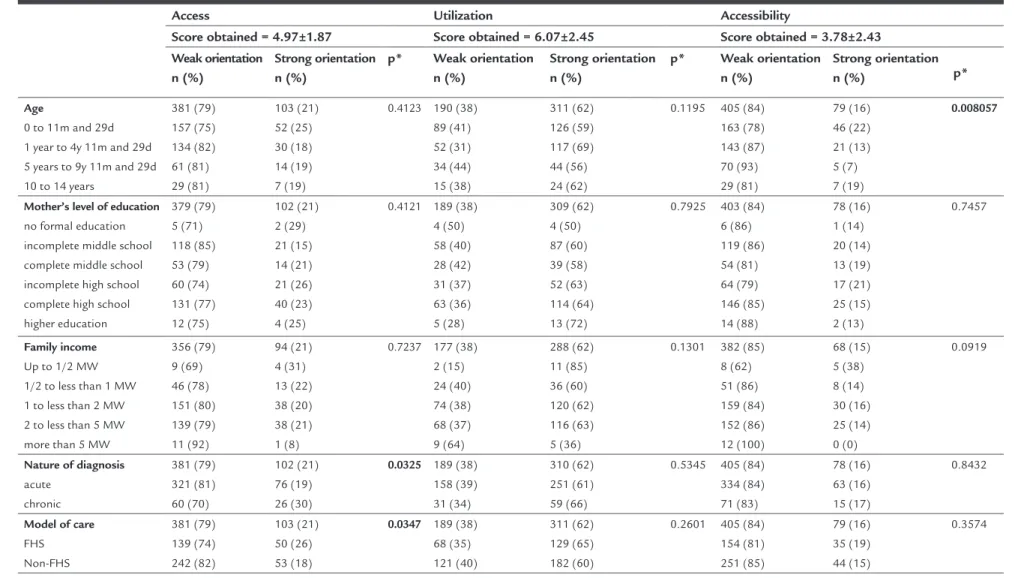
From the perspective of users, both the First Contact Access and its two components [Use (process) and Acces-sibility (structure)] presented weak orientation to the principles of PHC, with the respective scores being: 4.97±1.87, 6.07±2.45 and 3.78±2.43. Table 1 presents the bivariate analysis between the level of orientation to PHC and the independent variables.
F ER R ER AN D G R IS I 5 1 6 R EV A SS O C M ED B R AS 2 0 1 6 ; 6 2 (6 ):5 1 3 -5 2 3
TABLE 1 Bivariate analysis between the level of orientation to PHC and the characteristics of the patient and the model of care for the attribute First Contact Access and its components: Use and Accessibility.
Access Utilization Accessibility
Score obtained = 4.97±1.87 Score obtained = 6.07±2.45 Score obtained = 3.78±2.43
Weak orientation n (%)
Strong orientation n (%)
p* Weak orientation n (%)
Strong orientation n (%)
p* Weak orientation n (%)
Strong orientation
n (%) p*
Age
0 to 11m and 29d 1 year to 4y 11m and 29d 5 years to 9y 11m and 29d 10 to 14 years
381 (79) 157 (75) 134 (82) 61 (81) 29 (81) 103 (21) 52 (25) 30 (18) 14 (19) 7 (19)
0.4123 190 (38) 89 (41) 52 (31) 34 (44) 15 (38) 311 (62) 126 (59) 117 (69) 44 (56) 24 (62)
0.1195 405 (84) 163 (78) 143 (87) 70 (93) 29 (81) 79 (16) 46 (22) 21 (13) 5 (7) 7 (19) 0.008057
Mother’s level of education no formal education incomplete middle school complete middle school incomplete high school complete high school higher education 379 (79) 5 (71) 118 (85) 53 (79) 60 (74) 131 (77) 12 (75) 102 (21) 2 (29) 21 (15) 14 (21) 21 (26) 40 (23) 4 (25)
0.4121 189 (38) 4 (50) 58 (40) 28 (42) 31 (37) 63 (36) 5 (28) 309 (62) 4 (50) 87 (60) 39 (58) 52 (63) 114 (64) 13 (72)
0.7925 403 (84) 6 (86) 119 (86) 54 (81) 64 (79) 146 (85) 14 (88) 78 (16) 1 (14) 20 (14) 13 (19) 17 (21) 25 (15) 2 (13) 0.7457 Family income Up to 1/2 MW 1/2 to less than 1 MW 1 to less than 2 MW 2 to less than 5 MW more than 5 MW
356 (79) 9 (69) 46 (78) 151 (80) 139 (79) 11 (92) 94 (21) 4 (31) 13 (22) 38 (20) 38 (21) 1 (8)
0.7237 177 (38) 2 (15) 24 (40) 74 (38) 68 (37) 9 (64) 288 (62) 11 (85) 36 (60) 120 (62) 116 (63) 5 (36)
0.1301 382 (85) 8 (62) 51 (86) 159 (84) 152 (86) 12 (100) 68 (15) 5 (38) 8 (14) 30 (16) 25 (14) 0 (0) 0.0919
Nature of diagnosis acute chronic 381 (79) 321 (81) 60 (70) 102 (21) 76 (19) 26 (30)
0.0325 189 (38) 158 (39) 31 (34)
310 (62) 251 (61) 59 (66)
0.5345 405 (84) 334 (84) 71 (83) 78 (16) 63 (16) 15 (17) 0.8432
Model of care FHS Non-FHS 381 (79) 139 (74) 242 (82) 103 (21) 50 (26) 53 (18)
0.0347 189 (38) 68 (35) 121 (40)
311 (62) 129 (65) 182 (60)
0.2601 405 (84) 154 (81) 251 (85) 79 (16) 35 (19) 44 (15) 0.3574
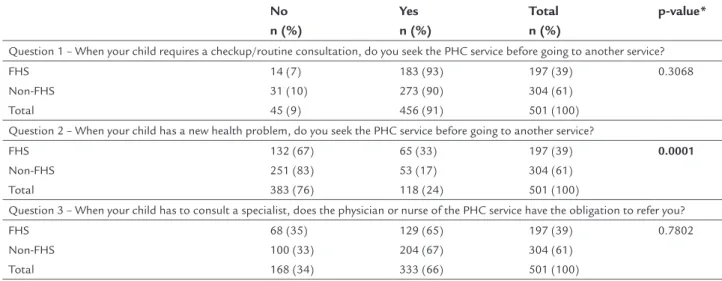
PHC in new health problems situations, this was signii-cantly more frequent than non-FHS users of the BHU (17%) (Table 2).
First Contact Access score was higher in the evalua-tion of users of the BHU compared to the professionals (scores of 4.97±1.87 and 2.99±1.08, respectively), with 100% of those interviewed considering the level of orien-tation to the principles of the PHC as low.
The responses to the semi-structured questionnaire are presented below in the discussion.
D
ISCUSSIONIn the period studied, 65.2% of the 2,031 hospitalizations that occurred in the pediatric ward were due to ambulato-ry care-sensitive conditions (ACSC). This proportion was higher in comparison with other studies, in which the rates of HACSC range from 35 to 60%.6,8,18-21 This inding
sug-gests that either access and/or the quality of care offered are inadequate, further reinforcing the importance of this study. Both First Contact Access and its two components [structure (accessibility) and process (use of the service)] received a low evaluation among users. Among the vari-ables studied, those that appeared to inluence the evalu-ation were the type of diagnosis and the model of care re-ceived (Table 1). The assessment made by the professionals was even worse. The interpretation of these results is not simple, initially requiring weighing with relation to the concept of access and its components/determinants.
The concept is complex, and there is no consensus in the literature about its scope. In this study, we adopted Starield’s conception, in which First Contact Access means that the PHC service should be the irst resource
contacted when a medical or health necessity arises, act-ing as the “gateway” into the system.22 This concept
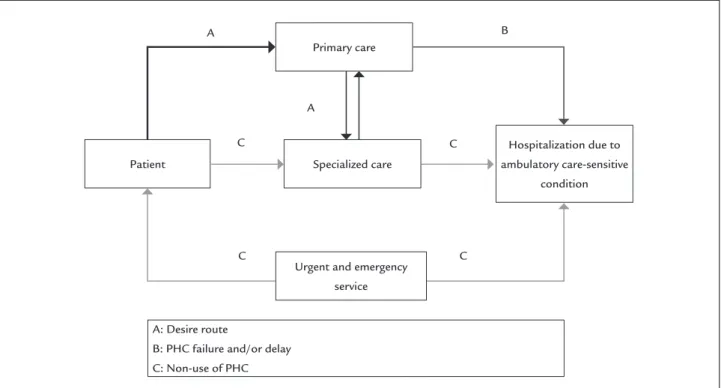
as-sumes that primary care should be able to solve 85% of demands and, when necessary, be responsible for refer-ring the patient to other levels of care (path A represent-ed in the theoretical model) (Figure 1). Thus, PHC servic-es need to be accservic-essible, to act as a gateway and to be recognized as such, to solve the need, and to offer com-prehensive care coordinated with the other levels of health care. The alternative paths mean that primary care had a low resolution capacity, failing to avoid hospitalization (B), or that the patient did not use primary care (C). Low resolution capacity can be related both to inadequate clin-ical management as well as late intervention, either be-cause the service was not suficiently accessible or bebe-cause of delayed contact by the user. Failure to use the service can also derive not only from accessibility problems but also from factors related to the patient, such as sociode-mographic and cultural characteristics, attitudes in rela-tion to the illness, and the way the different services are recognized, among others.4 Therefore, assessing
wheth-er a swheth-ervice works propwheth-erly as a point of irst contact in-volves evaluation of both accessibility (structural element) and use (procedural element). Accessibility is what facil-itates or prevents people from receiving care and, there-fore, it includes both a geographic component as well as a socio-organizational component. The use of the service, in turn, depends on the active attitude of the user, but is strongly inluenced by the characteristics of the services. Therefore, it should be noted that the First Contact Ac-cess attribute is conditional upon a complex relationship between the characteristics of the patient and society, such
TABLE 2 Responses to each question of the Use component according to the model of care. No
n (%)
Yes n (%)
Total n (%)
p-value*
Question 1 – When your child requires a checkup/routine consultation, do you seek the PHC service before going to another service? FHS
Non-FHS Total
14 (7) 31 (10) 45 (9)
183 (93) 273 (90) 456 (91)
197 (39) 304 (61) 501 (100)
0.3068
Question 2 – When your child has a new health problem, do you seek the PHC service before going to another service?
FHS Non-FHS Total
132 (67) 251 (83) 383 (76)
65 (33) 53 (17) 118 (24)
197 (39) 304 (61) 501 (100)
0.0001
Question 3 – When your child has to consult a specialist, does the physician or nurse of the PHC service have the obligation to refer you? FHS
Non-FHS Total
68 (35) 100 (33) 168 (34)
129 (65) 204 (67) 333 (66)
197 (39) 304 (61) 501 (100)
0.7802
FERRERAND GRISI
518 REV ASSOC MED BRAS 2016; 62(6):513-523
“Because the health center nearest to home takes too long. Sometimes it takes months for you to make an appoint-ment. And even for an appointment the queue is usually long, miles long. You have to get up early to get in the queue.” (patient: N.A.S.B.)
“They’re not giving priority, there are no openings. The pe-diatricians there see patients aged up to 19 years.” (patient: T.C.M.)
Among those who seek the services but did not attend the BHU when a new health problem arose, several claimed that it was dificult or even impossible to get an appoint-ment without booking in advance, although all of the managers responded that at their units there is a possi-bility of itting in an appointment for acute complaints. Some statements exemplify this information:
“It’s very dificult. Only if someone gives up, only if some-one doesn’t come to their appointment, or if we wait until everyone is seen.” (patient: G.C.N.)
“Yes, and I come to the ER at the HU. I tried to be squeeze in at the health center but I couldn’t.”
(patient: L.C.S.)
FIGURE 1 Schematic representation of the route traveled by the patient and the outcome of hospitalization due to ambulatory
care-sensitive condition.
Source: adapted from Caminal and Casanova, 2003.4
as income, level of education and health needs, the orga-nizational characteristics of the health services, such as the availability of service, and the characteristics and his-tory of public policies.
The evaluation of accessibility was worse than that of use of the service, with scores reaching 3.78 and 6.07, respectively. This inding was similar to that of other stud-ies,23-26 demonstrating that the availability of services does
not meet the expectations of the population.
The qualitative interviews enabled us to identify the presence of problems related to the organization of the services as one of the reasons justifying such a low eval-uation. Four of the seven that “did not attend the BHU” cited reasons considered as barriers to access:
“Look, the truth is that I went once and he used to study in the morning and they only had a physician, a pediatrician, in the morning. So it wasn’t possible. Because if I miss school, you know, right? Because there at the health cen-ter, I go and they only have a pediatrician in the morning.” (patient: E.D.S.)
“Also, it’s so dificult to get an appointment that if the child is well and does not bother you, you just don’t go.” (patient: M.F.S.)
B A
A
C
C C
C
Primary care
Specialized care
Urgent and emergency service
A: Desire route
B: PHC failure and/or delay C: Non-use of PHC Patient
Hospitalization due to ambulatory care-sensitive
“No. Even an appointment for a routine checkup is difi-cult.” (patient: L.S.M.) – answer to the question of wheth-er an appointment could be made on the same day.
“Because the service is so slow, and if you don’t have an ap-pointment booked they won’t see you.” (patient: M.P.S.)
“Because they say they can only let you be seen if you have an appointment. I ask for them to squeeze me in and they say they can’t, and that you have to go to the nearest emer-gency room.” (patient: R.V.S.)
“Because of the bureaucracy to make an appointment. If you go there in person they tell you it’s by phone, and say that there are no openings. I explain that I need an appoint-ment, but I can never get one.” (patient: V.T.M.)
“Because they don’t work like that, only in the emergency room. You have to make an appointment; they only see you after 1 or 2 months.” (patient: W.R.M.M.)
Note that one of the main reasons for customer dissatis-faction refers to being “squeezed in” or “unscheduled” ap-pointments for the resolution of acute complaints, which may explain the signiicant association between low scores in First Contact Access and the nature of the diagnosis (Table 1) – patients hospitalized with acute conditions rated it worse than those hospitalized due to decompen-sation of chronic diseases. This data is similar to that de-scribed by other authors who report the presence of ac-cess barriers as the primary reason for seeking care at emergency rooms.27,28
However, the solution to access problems cannot be resolved simply through organizational changes. In 2002, in the UK, a waiting period of 24 hours was established so that the user could be seen by a health professional. However, an undesirable impact was noted: a reduction in scheduled appointments and impairment of long-term medical monitoring,29 as well as a high and often
unnecessary demand for emergency room services and hospitalizations.12 In the present study, it was found that
other aspects, besides the organization of services, have an impact on access and use of the services. The way of thinking and acting when faced with health needs may have contributed to the low scores found. Some inter-viewees explained the search for emergency services in-stead of the basic network services in the presence of acute complaints as “personal preferences”, justifying this choice because they considered those sites to have a greater capacity for resolution:
“I bring her straight here, because over there they don’t re-solve anything.” (patient: M.F.M.S.)
“Because there are more resources here.” (patient: Y.J.S.O.)
“Because it’s better here. Because there it’s only for appoint-ments. Because there are more resources here.” (patient: Y.L.F.)
Kovacs et al.27 analyzed the trajectory traveled by children
served at an emergency room (ER), and its relationship to the basic health units, noting that 61.5% of patients had not sought the basic network and that only 15.2% of the reasons for going to the ER required this kind of ser-vice. The reasons found by these and other authors30 were
similar to those veriied in this study: dificulties getting an appointment at PHC and, mainly, valuing the techno-logical density found at emergency services. In the pres-ent study, the answers to the semi-structured questions exemplify the collective mindset that values the techno-logical density, built on the relationship of the popula-tion with the health system. It is worth noting the role that the actual basic network professionals seem to exert on the depth of this conception:
“Because they say we should have gone to the ER, that the pediatrician won’t be able to resolve it, and that you have to go straight to the emergency room.” (patient: C.E.M.S.L.)
Farias et al.31 interviewed FHS professionals to analyze
the reception and resolution of emergencies at primary care services and concluded that these professionals have dificulty identifying situations and do not consider that PHC is appropriate for this type of care. Certain prob-lems in the training of these professionals have been de-scribed as a factor that hinders the (actual) reorientation of the health care model.32,33
Other factors may be correlated to technological per-formance and distortion of the concept of complexity: the hierarchical design of the SUS, as described by Mendes;34 the adoption of the term “basic care”, which
FERRERAND GRISI
520 REV ASSOC MED BRAS 2016; 62(6):513-523
only 24% had the same response to the question about taking the child to the BHU before going to another ser-vice when a new “health problem” arises. This notion on the part of users may also translate the statistically sig-niicant correlation found between the assessment of ac-cessibility and the age of the child – the higher the age, the worse the evaluation (Table 1). Historically, public pol-icies on child health have always prioritized children in the early years of life through speciic programs. If, on the one hand, policies are made for the organization of the services, on the other, there are other concepts “learned” by the population over time. Guardians consider that old-er children need less care, in spite of having a chronic dis-ease. The following statements exemplify this inding:
“Look, unfortunately, we didn’t think it was necessary. So, that’s why she’s not being monitored.” (patient: D.M.S.D. – hospitalized due to an asthma attack)
“Well, in fact, when the child is younger, there are those rou-tine follow-ups. This starts getting further apart – further apart until you don’t go anymore.” (patient M.F.S. – hos-pitalized due to an asthma attack)
The other variable that showed a correlation with the eval-uation of First Contact Access, from the perspective of the users, was the BHU’s model of care. Although both the patients under the non-FHS model and the FHS model evaluated this attribute poorly, the score was signiicant-ly better in the latter (Table 1). The comparison between the FHS and the traditional model of the BHU in terms of access has already been described by other authors, with most inding little difference between the two models,25,35,36
while others describe problems relating to the organiza-tion of the services and conclude that the FHS has not worked as a good gateway.26,37 In the present study, 74%
of users of the FHS gave a score of less than 6.6 to First Contact Access, but this assessment was signiicantly bet-ter than that made by patients in the traditional model (Table 1). The better performance of the FHS may possi-bly be related to the greater connection provided by this model, as the sensation of “greater belonging” to the ser-vice favors its use and has an impact on the expectations of user in relation to the satisfaction of their needs.27 The
better evaluation of access between users of the FHS must have favored the statistically signiicant difference found for the use of the service, when the child has a new health problem, between the two models of care (Table 2).
In our study, the professionals evaluated First Contact Access poorly, similar to that described by other
evalua-tors.23,24 This low score given by the professionals represents
the barriers imposed by the organization of the services and is relected in the pattern of use of the network by users, giv-en that it giv-encourages the notion of dificulty and uncertain-ty of access among them.
The present study only evaluated patients hospital-ized due to ACSC and the proportions found for these hospitalizations do not represent the risk of hospitaliza-tion due to these condihospitaliza-tions in the region studied or es-tablish inferences as to whether the variables studied re-lated to a higher or lower risk of hospitalization due to these causes. Likewise, the design of our study does not allow us to establish a causal relationship but only an as-sociation between the variables and the scores obtained for First Contact Access and its components.
C
ONCLUSIONThe proportion of HACSC was high in the population studied, reinforcing the importance of research on the quality of care provided and access to PHC services. The present study reiterates the importance of evaluations from the perspective of the various players involved and under the approach of different and complementary meth-ods, enabling the understanding of the various factors involved in the quality of care and of the complex rela-tionship established between them.
Access and its components (accessibility and use of services) were poorly evaluated, identifying the following as probable determining factors: the presence of barriers to access, especially for unscheduled appointments, the validation of emergency services, and those with higher technological density before the population, and en-trenched culture that older children and teenagers do not require routine medical monitoring. The negative assess-ment made by the professionals themselves in relation to access probably reinforces these concepts regarding ac-cess among the population, with possible relections on the pattern of use of the services.
These results indicate that to improve access merely by promoting improvements in the organization of the services is not suficient. It is necessary to seek strategies that enable a change of culture on the use of health ser-vices in the medium and long term. Investment in the qualiication and training of professionals involved in PHC is also critical for the reorganization and enhance-ment of PHC.
F
UNDINGDesenvolvi-mento Cientíico e Tecnológico) and approved under number 480932/2010-7, thus receiving funding for the costs foreseen in the budget.
R
ESUMOAvaliação do acesso à atenção primária à saúde entre crian-ças e adolescentes internados por condições evitáveis
Introdução: internações por condições sensíveis à
aten-ção primária (ICSAP) é um indicador da efetividade da atenção primária à saúde (APS). Altas taxas de ICSAP re-presentam problemas no acesso e/ou na qualidade da APS oferecida. Veriicam-se altas taxas dessas hospitali-zações e poucos estudos sobre os fatores associados às ICSAP em nosso meio.
Objetivo: avaliar o acesso à APS entre crianças e adoles-centes com ICSAP e analisar os fatores condicionantes.
Método: estudo de corte transversal quanti-qualitativo. Foram entrevistados 501 responsáveis por crianças inter-nadas por ICSAP no período de um ano, usuárias de uni-dades básicas de saúde no município de São Paulo, e 42 proissionais. Os dados quantitativos foram obtidos com o Instrumento de Avaliação da Atenção Primária à Saúde (PCATool-Brasil), e os dados qualitativos, por entrevista semiestruturada. Variáveis independentes: idade, escolari-dade materna, renda familiar, tipo de diagnóstico e mode-lo de atenção; variáveis dependentes: o acesso e seus com-ponentes (acessibilidade e utilização de serviços).
Resultados: sessenta e cinco por cento (65,2%) das
hos-pitalizações foram ICSAP. Tanto os usuários como os proissionais atribuíram baixos escores para o acesso e seus componentes. A idade, o tipo de diagnóstico e o mo-delo de atenção inluenciaram a avaliação dos usuários.
Conclusão: a proporção de ICSAP foi alta na população estudada. O acesso aos serviços de APS está inadequado e está relacionado a: presença de barreiras de acesso, va-lorização dos serviços de urgência e atitude frente às ne-cessidades de saúde. A postura e as opiniões dos prois-sionais reforçam os conceitos inadequados dos usuários, reletindo no padrão de utilização dos serviços.
Palavras-chave: acesso aos serviços de saúde, atenção pri-mária à saúde, avaliação em saúde, hospitalização, saúde da criança, serviços de saúde.
R
EFERENCES1. Billings J, Zeitel L, Lukomnik J, Carey TS, Blank AE, Newman L. Impact of socioeconomic status on hospital use in New York City. Health Aff (Millwood). 1993; 12(1):162-73.
2. Brasil. Ministério da Saúde. Portaria n. 221, 17 de abril 2008. Publica em forma do anexo a Lista Brasileira de Internações por Condições Sensíveis à Atenção Primária. Diário Oicial da União [online]. Brasília (DF). 2008. Available from: http://dtr2001.saude.gov.br/sas/PORTARIAS/Port2008/ PT-221.htm.
3. Casanova C, Starield B. Hospitalizations of children and access to primary care: a cross-national comparison. Int J Health Serv. 1995; 25(2):283-94. 4. Caminal JCH, Casanova C. La evaluación de la atención primaria y las
hospitalizaciones por ACSC. Marco conceptual. Aten Primaria. 2003; 31(1):61-5.
5. Caminal J, Stariled B, Sánchez E, Casanova C, Morales M. The role of primary care in preventing ambulatory care sensitive conditions. Eur J Public Health. 2004; 14(3):246-51.
6. Moura BLA, Cunha RC, Aquino R, Medina MG, Mota ELA, Macinko J, et al. Principais causas de internação por condições sensíveis à atenção primária no Brasil: uma análise por faixa etária e região. Rev Bras Saude Matern Infant. 2010; 10(Suppl 1):583-91.
7. Rehem TCMSB, Egry EY. Internações por condições sensíveis à atenção primária no Estado de São Paulo. Cien Saude Colet. 2011; 16(12):4755-66. 8. Barreto JO, Nery IS, Costa MOS. Estratégia Saúde da Família e internações hospitalares em menores de 5 anos no Piauí, Brasil. Cad Saude Publica. 2012; 28(3):515-26.
9. Boing AF, Vicenzi RB, Magajewski F, Boing AC, Moretti-Pires RO, Peres KG, et al. Redução das Internações por Condições Sensíveis à Atenção Primária no Brasil entre 1998-2009. Rev Saude Publica. 2012; 46(2):359-66. 10. Brasil VP, Costa JSD. Hospitalizações por condições sensíveis à atenção
primária em Florianópolis, Santa Catarina – estudo ecológico de 2001 a 2011. Epidemiol Serv Saúde. 2016; 25(1):75-84.
11. Costa JSD, Pattussi MP, Morimoto T, Arruda JS, Bratkowski GR, Sopelsa M, et al. Tendência das internações por condições sensíveis à atenção primária e fatores associados em Porto Alegre, RS, Brasil. Ciênc Saúde Coletiva. 2016; 21(4):1289-96.
12. Cecil E, Bottle A, Cowling TE, Majeed A, Wolfe I, Saxena S. Primary care access, emergency department visits, and unplanned short hospitalizations in the UK. Pediatrics. 2016; 137(2):e20151492.
13. Nedel FB, Facchini LA, Martín M, Navarro A. Características da atenção básica associadas ao risco de internar por condições sensíveis à atenção primária: revisão sistemática da literatura. Epidemiol Serv Saude. 2010; 19(1):61-75.
14. Ferrer APS. Avaliação da atenção primária à saúde prestada a crianças e adolescentes na região oeste do município de São Paulo. 2013 [thesis]. São Paulo: Faculdade de Medicina da Universidade de São Paulo; 2013. Available from: http://www.teses.usp.br/teses/disponiveis/5/5141/tde-26022014-085334. 15. CEINfo – Coordenação de epidemiologia de informação da Prefeitura Municipal de São Paulo – Indicadores para diagnóstico sintético de saúde. Cidade de São Paulo 2004 – 2011. Ano 8(5); 3 abril de 2013.
16. Harzheim E, Starield B, Rajmil L, Álvarez-Dardet C, Stein AT. Consistência interna e coniabilidade da versão em português do Instrumento de Avaliação da Atenção Primária (PCATool-Brasil) para serviços de saúde infantil. Cad Saude Publica. 2006; 22(8):1649-59.
17. Brasil. Ministério da Saúde. Secretaria de Atenção à Saúde. Departamento de Atenção Básica. Manual do instrumento de avaliação da atenção primária à saúde: primary care assessment tool. Brasília (DF): Ministério da Saúde. Secretaria de Atenção à Saúde. Departamento de Atenção Básica; 2010. Available from: http://189.28.128.100/dab/docs/publicacoes/geral/manual_ instrumento_avaliacao.pdf.
18. Nedel FB, Facchini LA, Martín-Mateo M, Vieira LAS, Thumé E. Programa Saúde da Família e condições sensíveis à atenção primária, Bagé (RS). Rev Saude Publica. 2008; 42(6):1041-52.
19. Lenz MLM, Flores R, Pires NV, Stein AT. Hospitalizações entre crianças e adolescentes no território de abrangência de um serviço de Atenção Primária à Saúde. Rev Bras Med Fam Com. 2008; 3(12):271-81.
20. Caldeira AP, Fernandes VBL, Fonseca WP, Faria AA. Internações pediátricas por condições sensíveis à atenção primária em Montes Claros, Minas Gerais, Brasil. Rev Bras Saude Matern Infant. 2011; 11(1):61-71.
21. Carvalho SC, Mota E, Dourado I, Aquino R, Teles C, Medina MG. Hospitalizations of children due to primary health caresensitive conditions in Pernambuco State, Northeast Brazil. Cad Saude Publica. 2015; 31(4):744-54.
FERRERAND GRISI
522 REV ASSOC MED BRAS 2016; 62(6):513-523
23. Elias PE, Ferreira CW, Alves MCG, Cohn A, Kishima V, Escrivão Jr A, et al. Atenção Básica em Saúde: comparação entre PSF e UBS por estrato de exclusão social no município de São Paulo. Ciênc Saude Colet. 2006; 11(3):633-41. 24. Ibañez N, Rocha JSY, Castro PC, Ribeiro MCSA, Forster AC, Novaes HMD,
wt al. Avaliação do desempenho da atenção básica no Estado de São Paulo. Ciênc Saude Colet. 2006; 11(3):683-703.
25. Oliveira VBCA, Veríssimo MLOR. Assistência à saúde da criança segundo suas famílias: comparação entre modelos de Atenção Primária. Rev Esc Enferm USP. 2015; 49(1):30-6.
26. Silva SA, Fracolli LA. Avaliação da assistência à criança na Estratégia de Saúde da Família. Rev Bras Enferm. 2016; 69(1):54-61.
27. Kovacs MH, Feliciando KVO, Sarinho SW, Veras AACA. Acessibilidade às ações básicas entre crianças atendidas em serviços de pronto-socorro. J Pediatr (Rio J). 2005; 81(3):251-8.
28. Puccini PT, Cornetta VK. Ocorrências em pronto-socorro: eventos-sentinela para o monitoramento da atenção básica em saúde. Cad Saude Publica. 2008; 24(9):2032-42.
29. Kontopantelis E, Roland M, Reeves D. Patient experience of Access to primary care: identiication of predictors in a national patient survey. BMC Fam Pract. 2010; 11:61.
30. Buboltz FL, Silveira A, Neves ET. Estratégias de famílias de crianças atendidas em pronto-socorro pediátrico: a busca pela construção da integralidade. Texto Contexto Enferm Florianópolis. 2015; 24(4):1027-34.
31. Farias DC, Celino SDM, Peixoto JBS, Barbosa ML, Costa MC. Acolhimento e resolubilidade das urgências na estratégia Saúde da Família. Revista Brasileira de Educação Médica 2015; 39(1):79-87.
32. Motta LCS, Siqueira-Batista R. Estratégia Saúde da Família: clínica e crítica. Rev Bras Educ Med. 2015; 39(2):196-207.
33. Arantes LJ, Shimizu HE, Merchán-Hamann E. Contribuições e desaios da Estratégia Saúde da Família na Atenção Primária à Saúde no Brasil: revisão de literatura. Ciênc Saúde Coletiva. 2016; 21(5):1499-510.
34. Mendes EV. O SUS que temos e o SUS que queremos: uma agenda. Revista Mineira de Saúde Pública [online]. 2004; 4(ano 3):4-26. Available from: http://www.esp.mg.gov.br/wp-content/uploads/2009/07/revista04.pdf. 35. Harzheim E. Evaluación de la salud infantil del Programa Saúde da Família
em la región sur de Porto Alegre, Brasil [thesis]. Alicante: Departamento de Salud Pública, Universidad de Alicante; 2004. Available from: http://bvsms. saude.gov.br/bvs/ct/pdf/erno2005.pdf.
36. Macinko J, Almeida C, Oliveira ES, Sá PK. Organization and delivery of primary health care services in Petrópolis, Brazil. Int J Health Plann.Manage. 2004; 19(4):303-17.
ANNEX 1 Semi-structured questionnaire for obtaining qualitative data.
To the guardians that responded that they did not seek the BHU when the child/adolescent presented a new health problem (question 2 of the Use component), at the end of the application of the PCATool we asked:
1. Why didn’t you seek the BHU?
2. If you want an appointment at the BHU when your child gets sick, are they able to “squeeze you in”? 3. To which service do you usually take the child/adolescent when they get sick?
4. Does the child/adolescent usually get sick very often?
For those guardians of children/adolescents who were not monitored at the BHU (identiied during the selection of patients) we asked:
1. What is the reason for the child/adolescent not to be monitored at the BHU? 2. Is the child/adolescent monitored by an outpatient service? What is this service?
3. To which health care service is the child/adolescent taken when they present a health problem? 4. Does the child/adolescent have a chronic health problem?
ANNEX 2 Questionnaire applied to users to evaluate access (PCATool-Brazil child version). First Contact Access – Use
1. When your child needs a checkup (“routine consultation”), do you seek the basic health unit (BHU) before going to another health service? 2. When your child has a new health problem, do you seek the BHU before going to another health service?
3. When your child has to consult a specialist, does the physician or nurse of the BHU have the obligation to refer you? First Contact Access – Accessibility
1. When the BHU is open and your child gets sick, does someone from this health service attend to you on the same day? 2. Do you have to wait a long time or talk to many people to book an appointment at the BHU?
3. Is it easy to book an appointment for a checkup of the child (routine consultation) at the BHU?
4. When you arrive at the BHU, do you have to wait more than 30 minutes for your child to see the physician or nurse (not including screening or reception)?
5. Is it hard for you to get medical care for your child at the BHU when you think it is necessary? 6. When the BHU is open, can you get advice quickly over the phone if needed?
ANNEX 3 Questionnaire applied to professionals of the BHU for evaluation of access (PCATool-Brazil professional version). First Contact Access – Accessibility
1. Is your health care service open Saturday or Sunday?
2. Is your health care service open until 8 pm at least some days of the week?
3. When your health care service is open and there is a sick patient, does someone from your service attend to them on the same day? 4. When your health care service is open, can patients quickly obtain advice over the phone when judged necessary?
5. When your health care service is closed, is there a phone number to which patients can call when they get sick?
6. When your health care service is closed on Saturdays and Sundays and a patient gets sick, does someone from your service attend to them on the same day?
7. When your health care service is closed at night and a patient gets sick, does someone from your service attend to them that night? 8. Is it easy for a patient to make an appointment for a checkup (routine consultation) at your health care service?