Casimir Force in Confined Polymer Blends or Ternary Polymer Solutions
M. Benhamou, M. El Yaznasni, H. Ridouane, and E.-K. Hachem Laboratoire de Physique des Polym`eres et Ph´enom`enes Critiques Facult´e des Sciences Ben M’sik, B.P. 7955, Casablanca, Morocco
Received on 4 May, 2006
This paper is devoted to a review of recent progresses concerning the computation of the Casimir force between two parallel plates delimitating a polymer blend or a ternary polymer solution (with a good solvent). We assume that, close to the consolute point, one or the two polymers of the mixture are strongly attracted by the plates (critical adsorption). For both systems, the induced force originates from the fluctuations of composition near the consolute point. In polymer blends case, it was found that the force decreases with separationLbetween the two plates asL−4, with a knownuniversalamplitude. For ternary polymer solutions, however, it has been shown that the interaction force decays rather asL−3. This drastic change of the force expression is due to the presence of the good solvent, which gives rise to additional fluctuations of polymer concentration. To do calculations, for the two systems, use is made of the standardϕ4-theory, where the fieldϕis the order parameter
or composition fluctuation.
Keywords: Polymer mixtures; Confinement; Casimir Forces
I. INTRODUCTION
The computation of the interaction forces induced by the fluctuations of some physical entity in confining geometries is an old problem. The first investigation was due to Casimir [1], who discovered that the vacuum fluctuations of a confined electromagnetic field generate an attractive force between two parallel uncharged conducting plates, which are a finite dis-tanceL apart. This is the Casimir effect[2], which has re-ceived its final confirmation in recent experiments[3,4].
Afterwards, Fisher and de Gennes [5] remarked that an analogous effect also appears in the context of Statistical and Condensed Matter Physics, for those critical systems re-stricted by boundaries. In this case, the critical fluctuations of the order parameter play the role of the vacuum quantum fluctuations.
Confined critical fluids, such as a fluid near the liquid-gas critical point, a binary liquid near the consolute point,4He liq-uid near theλ-point, generate long-range forces between the confining walls. These forces, termed critical Casimir forces in literature[6], obey universal scaling functions[7−10]. At criticality, these scaling functions reduce to universal ampli-tudes multiplying a negative power law in separation L be-tween the confining walls[7−10]. From a theoretical point of view, the critical Casimir forces have been extensively in-vestigated, using conformal invariance in d =2 [11−15], Renormalization-Group (RG) ind=4−ε[6,9,10,16−21], and Monte Carlo (MC) simulations[22]. Experimentally, con-fined critical fluids or colloids immersed in binary liquid mix-tures have been the subject of numerous investigations[23].
Very recently [24], one has shown the existence of some universal force within critical polymer blends confined to two parallel plates, which strongly adsorb polymers near the critical point Tc. This is the so-called critical adsorption [5,25−35]. It was found [24] that this force, Π, decays with thicknessL according to a negative power law, that is
Π∼L−4, with a known universal amplitude. These results were extended to ternary solutions made of two chemically
incompatible polymers immersed in a good solvent, and re-stricted by the same boundaries[36]. Of course, the pres-ence of the good solvent affects the expression of the induced force. It has been shown[36]that the latter decreases rather as
Π∼L−3.
In this paper, we review recent trends concerning the com-putation of the Casimir force between two parallel plates de-limitating a polymer blend or a ternary polymer solution. To this end, use will be made of theϕ4-field theory, where the fieldϕis nothing else but the composition fluctuation.
The remainder of the presentation proceeds as follows. In Sec. II, we present the computation of the induced force of a confined binary polymer mixture. Extension to ternary poly-mer solutions is the aim of Sec. III. We draw some concluding remarks in the last section.
II. CASIMIR FORCE IN CONFINED POLYMER BLENDS
Consider a critical mixture made of two incompatible polymers A and B confined between two parallel homoge-neous plates 1 and 2, which are separated by a finite dis-tanceL. We assume that the thickness L is much smaller than the bulk thermal correlation length of the mixtureξ0
t ∼
2, respectively. Because of the homogeneity property of the two plates, the order parameter ϕdepends only on the per-pendicular distancez. The translational symmetry property along the parallel directions implies that the surface composi-tion fluctuacomposi-tions are independent on the considered point, and they will be simply denoted byϕ1andϕ2. We shall be con-cerned only with two special cases :symmetricorasymmetric plates. For symmetric plates, we have the same composition on both sides, and we will setϕ1=ϕ2≡ϕ0. While for asym-metric plates, we have opposite surface compositions, and we will setϕ1=−ϕ2≡ −ϕ0.
The confined polymer mixture can be described by the fol-lowing free energy functional (per unit area)[24]
F[ϕ]
A
kBT=f1(ϕ1) +f2(ϕ2) +a−3 L
0
dz
G(ϕ) +κ dϕ
dz 2
,
(1) where
A
is the plates area,T the absolute temperature andkBthe Boltzmann constant. The first two terms f1(ϕ1)and
f2(ϕ2) account for the contributions of the surfaces to the free energy. Their forms will be given below. The last one accounts for the bulk contribution, with G(ϕ)the bulk free energy density[37],
G(ϕ) =χc−χ
4 ϕ
2+ 1 12Nϕ
4,
(2)
which is the expansion to fourth order of the standard Flory-Huggins (FH) free energy[37,38], in the vicinity of the critical monomer fractionΦc=1/2, or equivalently aroundϕ=0. In the above expression,χis the standard Flory interaction pa-rameter, which is inversely proportional to the absolute tem-peratureT, andχc=2/N its critical value. In relation (1),
κ=a2/9 is a constant. The surface contribution is that usu-ally encountered in surface critical phenomena[39,40], that is
f1(ϕ1) +f2(ϕ2) =
∑
i=1,2
−hiϕi+
ci 2ϕ
2 i
. (3)
In this equality,hi’s are the surface chemical potentials dif-ferences of the two polymers, andci’s the surface coupling constants measuring the interaction strength of A and B -monomers with plates. Let us discuss these surface parame-ters. First, the surface coupling constant is the same for sym-metric and asymsym-metric plates, and will be simply denoted by c≡c1=c2. For the symmetric case, the surface field has the same values on both surfaces, and will be denoted by h≡h1=h2. While for the asymmetric one, the fields on the two sides are opposite, that ish≡ −h1=h2. The critical ad-sorption emerges in the limith→∞, at fixed surface coupling constantc>0. This is equivalent to impose the condition :
ϕ0→∞, which is the fixed point of the so-callednormal
tran-sition[40].
The equilibrium profile, ϕ(z), can be obtained through a standard minimization of the above total free energy, that is
δF/δϕ=0. Then, the profile is solution to the following non-linear differential equation
χc−χ
2 ϕ
2+ 1 3Nϕ
3 −2κd
2ϕ
dz2 =0, (4)
together with the following boundary conditions
2a−3κ
dϕ
dz z=0=cϕ0−h, 2a −3κ
dϕ
dz z=L=−cϕ0+h, (5) for symmetric plates, or
2a−3κ dϕ
dz z=0=cϕ0−h, 2a −3κ
dϕ
dz z=L=cϕ0−h, (6) for asymmetric ones.
The first integral of the above differential equation is
κ dϕ
dz 2
=G(ϕ) +C, (7) whereCis an integration constant that depends on the bulk parameters, the surface onescandhand the separationL. For symmetric plates whereϕ(0) =ϕ(L) =ϕ0, the expected pro-file exhibits a minimum point at the middle of the film[41], that is at z=L/2. In this case, the integration constantC is directly related to the value of the FH free energy density G(ϕm), that isC=−G(ϕm). Here,ϕm=ϕ(L/2)is the min-imal value of the equilibrium profile. For asymmetric plates whereϕ(0) =−ϕ(L) =ϕ0, it becomes rather a monotonously decreasing function fromz=0 toz=L.
We have now all necessary ingredients for the determina-tion of the induced force, which results from the fluctuadetermina-tions of composition, that are strong near the critical point. To this end, we first consider the symmetric case, for which the equi-librium profile is solution to the differential equation(4)with boundary conditions(5). The starting point is the first integral defined by relation(7), withC=−G(ϕm). It is easy to show, from this relation, that the minimal valueϕm of the equilib-rium profile is given by the quadrature formula
L=2 ϕ0
ϕm
κ
G(ϕ)−G(ϕm)dϕ, (8) where the functionG(ϕ) is taken at the critical point, that is G(ϕ) = ϕ4/12N. The above relation expresses the de-pendence of the minimal valueϕm on the film thickness L and surface compositionϕ0. On the other hand, the attrac-tive force (per unit area),Πa, is given by the first derivative of the total free energy, with respect to separationL, that is
Πa=−(1/
A
kBT)∂F/∂L. It has been shown [41] that this force is simply given byΠa=−
kBTc
a3 G(ϕm). (9)
Then, the induced force is directly proportional to the integra-tion constantC, that isΠa=kBTca−3C. SinceG(ϕm)is pos-itive definite, the force isattractive. In addition, relation(9) indicates that the induced force is simply given by the knowl-edge of the minimal valueϕmof the profile.
Come back to quadrature formula(8)and make the variable change :ϕ→x=ϕ/ϕm, to get
L a√N =
4 √ 3
1
ϕm ϕ0/ϕm
1
dx
√
In the critical adsorption limit, the upper bound of the above integral goes to infinity, that isϕ0/ϕm→∞, and one finds the following exact expression for the interaction force[24]
Πa=
NkBTc
a3
∆↑↑
(L/a)4 , (11) with the universal amplitude
∆↑↑=−[Γ(1/4)] 8
432π2 ≃ −7.002693379, (12)
whereΓ(z)is thegamma function[42].
For asymmetric plates, the profile is solution to the differen-tial equation(4)with the boundary conditions(6). The asso-ciated force is directly proportional to the integration constant Cas in symmetric case, that isΠr=kBTca−3C[24,41]. Since
Cis positive[24,41], this force isrepulsive. To obtain its scal-ing behavior, one can follow the same techniques as above. We recall simply the result[24]
Πr=
NkBTc
a3
∆↑↓
(L/a)4, (13) with the universal amplitude
∆↑↓=[Γ(1/4)] 8
108π2 ≃28.01077353. (14)
Now, let us comment the above results.
Firstly, we note that both attractive and repulsive forces de-cay with separationLaccording to the same power law, that is
Πa,r∼∓L−4.
Secondly, when these forces are reduced by theNkBTca−3 -factor, they exhibit a universal behavior, and depend only on film thickness L and not on surface interactions details (throughcandh). The surface parameterscandhcontribute only to corrections to the leading critical behavior. In addition, the corresponding amplitudes∆↑↑and∆↑↓arepurenumbers.
Thirdly, as it should be, these forces are proportional to the polymerization degreeNof chains.
Fourthly, remark that this power law in L resembles that defining the electromagnetic Casimir force in the same geom-etry[1].
Sixthly, notice that, intuitively, the repulsive force must be stronger than the attractive one, for the same separationL. In-deed, this is due to the fact that, for opposite plates, the mix-ture may be regarded as two lamellar phases alternatively rich isAandB-polymers. Quantitatively, one has the ratio
Πr
Πa
=4, (15)
which is apureinteger number, independently on separation L. This same relation shows that the repulsive force is four timesmore intense than the attractive one.
Finally, attractive and repulsive forces versus distanceLare depicted in Figs. 1 and 2, respectively.
FIG. 1: The reduced attractive induced forcea3Πa/NkBTcversus the separationL(expressed in monomer sizeaunits).
FIG. 2: The reduced repulsive induced forcea3Πr/NkBTcversus the separationL(expressed in monomer sizeaunits).
III. CASIMIR FORCE IN CONFINED TERNARY
POLYMER SOLUTIONS
experience an effective force originating from the strong fluc-tuations of composition near the consolute point. Such a force depends on film thicknessL and the considered surface uni-versality class. For the sake of simplicity, we will assume that either plates have the same preference to attract one compo-nent (symmetric plates) or they have an opposed preference (asymmetric plates). Besides the chemical segregation be-tween unlike chains, one is in the presence of excluded vol-ume interactions leading to swelling of polymer chains.
The fundamental problem to apprehend is a quantitative study of the influence of the good solvent on the force expres-sion. Calculations will be done using, first, the blob model [44], and second the RG.
A. Mean-field results
To determine the induced force, we shall need the free en-ergy. To get its expression, we start by recalling some useful background on the demixing transition in the presence of a good solvent of infinite extent.
Start with a mixture of two chemically incompatible poly-mersAandB, dissolved in a common good solvent. This mix-ture may be polystyrene-poly(methylmethacrylate) in toluene or polystyrene-poly(dimethylsiloxane) in propylbenzene. For simplify, the two polymersAandBare assumed to have the same polymerization degree N (monodisperse system). We denote byΦ=ΦA+ΦBthe overall monomer fraction, where
ΦAandΦBare the respective monomer fractions ofAandB -polymers.
We recall that, in dilute solution, where the overall monomer fractionΦis below the thresholdΦ∗∼N1−νd(ν≃ 0.588, ind =3) [37],A andB-chains behave like separated swollen coils avoiding each other completely, and in princi-ple no phase separation is expected. In semi-dilute solution (Φ∗<<Φ<1), however, chains overlap and can be regarded as a sequence of uncorrelated subunits or blobs of typesAand B. Each chain containsZ(Φ)∼NΦ1/(νd−1) blobs. The blob size orscreening length[37],ξ(Φ), depends only on the total monomer fractionΦ, and scales as[37]: ξ(Φ)∼Φν/(1−νd), whereais the monomer size.
Using field-theoretical RG, it has been shown[44]that, for a high-molecular-weight solution, a given chain cannot distin-guish between anAandB-chain. This means that the chemical difference is irrelevant, and manifests itself only in correction to the leading behavior of the osmotic pressure. In fact, these corrections are important and govern thermodynamics of the demixing transition. From the obtained expression of the os-motic pressure, the authors of Ref. [44]derived the following expression for the free energy
F0
kBT
= x
Z(Φ)lnx+ 1−x
Z(Φ)ln(1−x) +χ(Φ)x(1−x), (16) withx=ΦA/Φthe composition of polymerA. In the above equality, the quantity
χ(Φ)∼χΦ∆2 (16a)
accounts for the Flory effective interaction parameter between unlike blobs, where χ is the standard one, and ∆2 some crossover exponent, of three-dimensional value ∆2 ≃0.30 [44]. This exponent characterizes the correction to the os-motic pressure[44]. Expression(16a)can be understood, in a certain sense, as a renormalization of interactions due to the chemical mismatch betweenAandB-polymers.
Return to expression(16)and notice that it shows an ob-vious analogy with that defining the usual Flory-Huggins free energy of a mixture of two polymersAandBin the molten state[37,38]. The difference comes form the fact thatAand B-chains have blobs of sizeξ(Φ)as new subunits, and the seg-regation parameter is no longerχbut the effective oneχ(Φ), relation(16a). Of course, these two parameters coincide in the limitΦ→1. The model of free energy(16)constitutes the blob model[44], which is a direct consequence of the renor-malization theory.
We recall now the coordinates of the demixing critical point K. These can be obtained equating to zero the first and second derivatives of free energy(16), with respect to compositionx. One gets[44]
χ(ΦK,T) = 2
Z(Φ), xK=
1
2 , (17)
withΦKthe critical monomer fraction, which is larger than the overlap oneΦ∗defined above. The critical pointKis located at the top of the coexistence curve. BelowΦK (Φ<ΦK), the ternary mixture is homogeneous, while aboveΦK (Φ>ΦK), this mixture phase separates in two phases alternatively rich inAandB-polymers. Finally, we recall that the critical tem-perature,TK, at fixed concentration, is given by[44]
χ(TK)∼N−1Φ−1/b, (18) with the exponentb≃0.62(d=3). The above relation tells us that the critical temperatureTK should be proportional to the polymerization degreeN(or molecular-weight).
Now, to describe the critical phase behavior of the ternary mixture, we introduce an order parameter that is defined by
x=1+x
2 , (19)
wherexis the composition ofA-polymer in the solution. The above definition indicates that the order parameterxis propor-tional to the shiftx−xK, wherexK =1/2 is the critical com-position. The order parameterxdepends on thed-dimensional position-vector r= (ρ,z)∈Rd, with the transverse vector
total free energy (per unit area) is given by a formula similar to that defining a binary polymer mixture, relation(1). Then,
we write
F0[x]
A
kBT =∑
i=1,2
−h0ixi+
c0i 2x
2 i
+ξ−d(Φ) L
0
dz
t0 2x
2+u0 4x
4+κ(Φ)
dx dz
2
, (20)
with
A
the common area of plates. Here, t0 = (2/Z(Φ)−χ)/2 is the reduced temperature, u0=1/3Z(Φ) the coupling constant, κ(Φ) =ξ2(Φ)/9, and c0i,h0i
’s are the surface microscopic parameters relative to plates 1 and 2. Notice that the integrand in the bulk part of the above free en-ergy can be obtained expanding the free enen-ergy(16)to fourth order around the critical compositionxK=1/2. The gradient term is introduced to take into account the interfacial energy betweenAandB-rich phases.
We emphasize that the above free energy is similar to that corresponding to a confined binary polymer mixture (Eq.(1)), with the simple substitutions : a→ξ(Φ),N→Z(Φ). This means that chains in semi-dilute solution can be regarded as sequences ofZ(Φ)blobs of the same sizeξ(Φ). Taking ad-vantage of those results derived in Sec. II, and using the above substitutions, one finds that the induced forces (per unit area) is given by
Π0 a
kBTK =∆
0
↑↑
L4 , (21)
for symmetric (or attractive) plates, and
Π0 r
kBTK =∆
0
↑↓
L4 , (22)
for asymmetric (or repulsive) ones, with the following univer-sal amplitudes
∆0↑↑=−Na[Γ(1/4)]
8
432π2 Φ
(1−ν)/(3ν−1), (22a)
∆0
↑↓=Na
[Γ(1/4)]8 108π2 Φ
(1−ν)/(3ν−1). (22b)
Let us discuss these derived results.
First, we note that the above expressions obtained using the blob model, show that the presence of a good solvent simply induces a renormalization of the force amplitudes, through the multiplicative power factorΦ(1−ν)/(3ν−1)
∼Φ1/2 (d=3,ν=3/5)depending on the monomer fractionΦ.
Second, for both symmetric and asymmetric plates, the at-tractive and repulsive forces decay according to the same neg-ative fourth power law, but with different amplitudes.
Third, as for confined polymer blends, the repulsive force is four times more important than the attractive one.
Finally, in the limitΦ→1, the results corresponding to the molten state are then recovered.
The blob model is a mean-field theory, and it has been shown [44] that this is valid only for extremely high-molecular-weight or very high monomer concentration. To go beyond the mean-field theory, and in order to obtain correct results close to the critical point where fluctuations of compo-sition are strong enough, use will be made of RG applied to the field theory described below.
B. RG results
The starting point is to rewrite the free energy(20) rescal-ing the composition fluctuation in bulk and at surfaces and parameters of the problem, according to
ϕ=κ(Φ) [ξ(Φ)]−d/2x, ϕi=
κ(Φ) [ξ(Φ)]−d/2xi, (23a)
t= 1
κ(Φ)t0, g= 6
[κ(Φ)]2[ξ(Φ)] du
0, (23b)
ci= 1
κ(Φ)[ξ(Φ)] d
c0i , hi= 1
κ(Φ)[ξ(Φ)] d/2
h0i ,
(23c) where (t0,u0) and c0i,h0i
’s are those parameters defined above, andξ(Φ)the screening length. With these consider-ations, the total free energy reads
F[ϕ]
kBT =
∑
i=1,2
dρ−hiϕi+
ci 2ϕ
2 i
+
dr
1 2(∇ϕ)
2 +t
2ϕ 2+ g
4!
ϕ22
. (24)
The fieldϕdepends on the spatial coordinatesr= (ρ,z), with
Therefore, the theoretical model is a ϕ4-field theory de-scribed by the above Landau-Ginzburg-Wilson Hamiltonian. Recall that the critical adsorption emerges in the limithi→ ±∞.
With the help of this field model, one can compute the Casimir force. To this end, we first note that the above Hamil-tonian is nothing else but that describing the critical properties of binary liquid mixtures of small molecules near the con-solute point, one-component fluids near the liquid-gas criti-cal point, or Ising-like magnetic materials near the Curie tem-perature. Thus, theϕ-field (order parameter) may play the role of the difference between compositions for simple liquid mixtures, the difference between liquid and gas densities for one-component fluids, or the local magnetization for Ising-like magnetic materials. In this sense, the ternary mixture of our interest belongs to the universality class(n=1,d), where nis the number of components of the order parameter. Thus, the critical phase behavior of ternary polymer mixtures is of Ising type[45,46]. One can thus take advantage of some work by Krech[10], which was concerned with the computation of the Casimir force in confined liquid mixtures. To determine the force expression for confined ternary polymer mixtures, one can follow those techniques used by the author. Let us first write the Casimir force as[36]
Πa,r=Π0a,r+δΠa,r. (25)
The quantityΠ0
a,ris the mean-field force calculated above, re-lations(21)or(22). The remaining part,δΠa,r, represents the force deviation due to strong fluctuations of composition. We recall that the induced force is defined through the expectation mean-value of perpendicular component of the stress tensor [10], which has been calculated using the well-known loop-expansion [45,46]. The mean-field contribution Π0
a,r repre-sents the zeroth order of this expansion, whileδΠa,raccounts for the contribution of higher orders.
To determinate the force deviation, the authors of Ref.[36] started form the Casimir free energy per unit area,δfa,r, which can be written on the following scaling form
δfa,r
kBT = 1
Ld−1ga,r
L
ξt
. (26)
The factor 1/Ld−1 simply expresses the natural dimension of the reduced Casimir energy δfa,r/kBT. Here, ξt ∼
R(Φ) [Z(Φ)]−νt+1/2
|1−T/TK|−νt denotes the thermal cor-relation length, where νt ≃0.6 is the standard Ising expo-nent [45,46], and R(Φ)∼aN1/2Φ(2ν−1)/2(1−3ν) the size of a chain in semi-dilute solution[37], with the swelling expo-nentν≃0.588[47]that must not be confused withνt. On the other hand, the scaling functionga,r(x)is analytic forx<<1 (L<<ξt). Then, at the critical point T =TK (ξt→∞),
ga,r(0)is finite and we write it as : ga(0) =δ∆↑↑/(d−1)or gr(0) =δ∆↑↓/(d−1), whereδ∆↑↑ andδ∆↑↓ are the Casimir amplitudes. Then, at the critical point, the Casimir free energy decays in a universal way as
δfa
kBTK
=δ∆↑↑/(d−1)
Ld−1 ,
δfr
kBTK
=δ∆↑↓/(d−1)
Ld−1 . (27)
The Casimir force deviation (per unit area)δΠa,r is given by the first derivative ofδfa,r with respect to separationL :
δΠa,r=−∂δfa,r/∂L. One then finds, at three dimensions,
δΠa
kBTK
=δ∆↑↑
L3 , (28)
for attractive walls, and
δΠr
kBTK
=δ∆↑↓
L3 , (29)
for repulsive ones. Notice that, in general, the force ampli-tudes are universal, and they depend only on space dimension d and surface universality class (choice of boundary condi-tions). The amplitudesδ∆↑↑ andδ∆↑↓ have been calculated through a perturbative expansion with respect to the coupling constantg. Then, at fixed pointg∗, these amplitudes become series inε=4−d (4 is the critical dimension of the system) that must be resummed using Borel-Leroy techniques[45,46] to get their best values at dimensiond=3(ε=1). In three dimensions, these force amplitudes are[10]
δ∆↑↑≃ −0.652, δ∆↑↓≃4.48. (30)
These values are in good agreement with MC simulation[48]. With these considerations, the total Casimir forces (per unit area) write
Πa
kBTK =∆
0
↑↑ L4 +
δ∆↑↑
L3 , (31)
Πr
kBTK =∆
0
↑↓ L4 +
δ∆↑↓
L3 , (32)
where the mean-field amplitudes∆0
↑↑and∆0↑↓are those defined by relations(22a)and(22b).
Let us make some commentaries.
Firstly, Eqs. (31)and(32)indicate that, when they are re-duced by thekBTK-factor, the attractive and repulsive Casimir forcesΠa,rare universal, independently on the chemical struc-ture of polymers and plates.
Secondly, we emphasize that the force expressions (31) and(32), when they are compared to those corresponding to the molten state[24], show that the solvent induces a drastic change of the force expression. Indeed, the swelling of chains modifies the dependence of the force on distance, through the appearance of theL−3-decay. This change of the behavior is not surprising, since in the presence of a good solvent, fluctu-ations of composition close to the consolute point are strong enough.
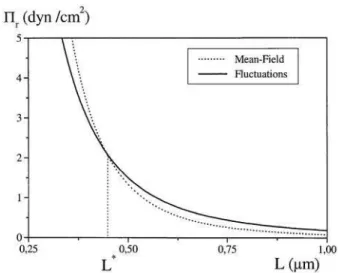
Thirdly, the above formulae suggest the existence of a cross-over phenomenon occurring at some characteristic dis-tanceL∗, obtained making a comparison between the mean-field contribution∼L−4and the fluctuation one∼L−3. This comparison gives the cross-over distance
L∗∼aNφ(1−ν)/(3ν−1)
which depends on the molecular-weight (through N) and monomer fraction Φ. At the thresholdΦ=Φ∗, the length L∗becomes of the order of the gyration radiusRG∼aNνof a single chain in dilute solution. At high separations(L>>L∗), fluctuations of composition dominate, and then, the effective force behaves asL−3. For low separations(L<<L∗), how-ever, a mean-field result is expected, and the effective force scales rather asL−4. As a matter of fact, this can be under-stood as follows. When the distance between plates is low-ered, the local monomer concentration is increased, and one assists to a strong screening of excluded volume interactions. This is why the mean-field theory works at small distances.
In Fig. 3, we superpose curves representing attractive mean-field forceΠ0
a(dashed line) and attractive fluctuations oneδΠa (solid line), versus separationL. In Fig. 4, we report curves describing repulsive mean-field forceΠ0
r (dashed line) and re-pulsive fluctuations oneδΠr (solid line), versus separationL. For the two cases, curves intersect at the cross-over distance L∗ which is different for the two boundary conditions. All these curves are drawn with parameters: a=10 Angstroms, N=100,Φ=0.5.
FIG. 3: Superposition of curves representing attractive mean-field force (dashed line) and attractive fluctuations force (solid line), ver-sus separationL. The curves are drawn with parameters : a=10 Angstroms,N=100,Φ=0.5.
IV. CONCLUSIONS
In this review paper, we first considered a critical binary mixture made of two incompatible polymers AandB, con-fined between two parallel plates 1 and 2. We assumed that the latter adsorb strongly the polymers at high temperature. The fluctuations of composition generate an effective force between the two plates. We were interested in the computa-tion of such a force. To this end, use was made of the standard
ϕ4-theory, whereϕis the composition fluctuation or order pa-rameter. This plays the role of the magnetization of Ising-like magnetic systems. It was shown that the presence of the sur-faces can be taken into account by imposing two boundary
FIG. 4: Superposition of curves describing repulsive mean-field force (dashed line) and repulsive fluctuations force (solid line), ver-sus separationL. These curves are drawn with the same parameters as for Fig. 3.
conditions, which are similar to the ones usually encountered in surface critical phenomena. These boundary conditions de-pend on two couples of parameters :(c1,h1)for plate 1, and (c2,h2)for plate 2, wherec1andc2(surface enhancements) describe the interaction changes in the surface layers. The pa-rametersh1andh2are analogous to surface magnetic fields. For the sake of simplicity, we have chosen two typical bound-ary conditions : symmetric and asymmetric plates, depending on whether the plates have the same or opposite preferences for the two polymers. For both symmetric and asymmetric plates, one found that the (attractive and repulsive) forces (per unit area) decrease with the separationLaccording to the same negative power law, that isΠr,a∼±L−4, with known exact universal amplitudes. The obtained force for critical poly-mer blends was compared to the electromagnetic one resulting from vacuum fluctuations of the magnetic field confined to the same geometry. Incidentally, the two kinds of forces decrease withLaccording to the same power law.
We think that the expected force could be measured in an experiment similar to that used for measurement of the repul-sive force between two plates coated by an adsorbed polymer [49].
We emphasize that since we were concerned with long-polymer chains(N→∞), mean-field theory was sufficient to describe the phenomenon as demonstrated many years ago by de Gennes[50]. Indeed, the critical region size scales asN−1, and then, a classical behavior should be observed in the limit N→∞.
symmetric and asymmetric plates. The induced force is attrac-tive for symmetric plates, and repulsive for asymmetric ones. Calculations have been done, first, using the blob model. For the two boundary conditions, one found that the forces decay similarly asL−4, and the corresponding amplitudes are simi-lar to those relative to the molten state, up to a multiplicative power factor of the monomer fraction.
Notice that the blob model has a mean-field character, which is valid only for very strong monomer concentrations or extremely high molecular-weights. To see this, denote by
∆∗Φ=Φ−Φ
K and∆∗T =T−TK the ranges of monomer fraction and temperature, respectively. The determination of the size of the critical region has been done using a Ginzburg criterion[44]. We sketch simply the result that : ∆∗Φ/ΦK∼ M−∆2/(1+∆2) and ∆∗T/T
K ∼(ΦK/Φ∗)−1/(3ν−1) with M the molecular-weight, and∆2=∆2(3ν−1)≃0.22 a cross-over exponent. Hence, in the limit of extremely long chains and very high concentrations, the above expressions suggest that the critical region is very narrow, and then, the phase behavior can be obtained using the mean-field approximation.
To go beyond the blob model, and in order to obtain a cor-rect induced force, one applied the RG-machineries to aϕ4 -field theory we described above. In particular, it has been shown the existence of two distance-regimes. Below some characteristic lengthL∗, the blob model is reliable, and the force decays asL−4. AboveL∗, however, one assists to a dras-tic change of the force expression due to the presence of strong fluctuations of composition. In this regime, it was found that the force decreases rather asL−3.
We recall that the used continuous field model belongs to
the same universality class as the (Ising-like) lattice model [51]. The composition fluctuation plays the role of magne-tization, and the surface chemical potential exchange the sur-face magnetic field. Since, we are interested in phenomena occurring at criticality, these models are equivalent for the de-scription of physics.
We point out that we focused our attention on the critical adsorption situation, only. In critical phenomena language, this corresponds to infinitely strong surface field. In this limit, the Casimir force was found to be universal. For both sym-metric and asymsym-metric plates cases, the powers of separation Lare the same, but, as it should be, the corresponding univer-sal amplitudes are numerically different. For finite values of the surface parameters (coupling constants and surface fields), however, the expected force is no longer universal, and must depend on the particular choice of the boundaries conditions.
Finally, we emphasize that, from a theoretical point of view, the Casimir force for a spherical geometry has also attracted much attention. More precisely, in recent works [52−55], the question was addressed to the computation of the induced force between colloidal particles immersed in a critical binary polymer mixture. As main result, the force decays asr−3, whereris the interparticle distance.
Acknowledgments
We would like to thank Professor Daoud for helpful discus-sions. We are much indebted to Professors M. Krech and S. Dietrich for useful correspondences.
[1] H.B.G. Casimir, Proc. K. Ned. Akad. Wet.51, 793 (1948). [2] An extensive list of recent works on the subject can found in : J.
Feinberg, A. Mann, and M. Revzen, Preprint, hep-th/9908149, June 2000.
[3] S.K. Lamoureux, Phys. Rev. Lett.78, 5 (1997).
[4] U. Mohideen and A. Roy, Phys. Rev. Lett.81, 4549 (1998). [5] M.E. Fisher and P.-G. de Gennes, C. R. Acad. Sci. (Paris) S´erie
B287, 207 (1978) ; P.-G. de Gennes, C. R. Acad. Sci. (Paris) II 292, 701 (1981).
[6] M. Krech,The Casimir Effect in Critical Systems(World Sci-entific, Singapore, 1994).
[7] N.M. Barber, in : Phase Transitions and Critical Phenomena, edited by C. Domb and M.S. Green, Vol. 8, (Academic Press, New York, 1983) ; E. Br´ezin, J. Phys. (Paris)43, 15 (1982). [8] V. Privman, in :Finite Size Scaling and Numerical Simulation
of Statistical Systems, edited by V. Privman (World Scientific, Singapore, 1990).
[9] M. Krech and S. Dietrich, Phys. Rev. A46, 1886 (1992). [10] M. Krech, Phys. Rev. E56, 1642 (1997).
[11] H.W.J. Bl¨ote, J.L. Cardy, and M.P. Nightingale, Phys. Rev. Lett. 56, 742 (1986).
[12] I. Affleck, Phys. Rev. Lett.56, 746 (1986). [13] J.L. Cardy, Nucl. Phys. B275, 200 (1986).
[14] T.W. Burkhardt and T. Xue, Phys. Rev. Lett.66, 895 (1991) ; Nucl. Phys. B345, 653 (1991).
[15] T.W. Burkhardt and E. Eisenriegler, Nucl. Phys. B424[FS],
487 (1994).
[16] K. Symanzik, Nucl. Phys. B190[FS], 1 (1981).
[17] M.P. Nightingale and J.O. Indeken, Phys. Rev. Lett.54, 1824 (1985) ; J.O. Indeken, M.P. Nightingale, and W.V. Wang, Phys. Rev. B34, 330 (1986).
[18] M. Krech and S. Dietrich, Phys. Rev. Lett.66, 345 (1991);67, 1055 (1981).
[19] E. Eisenriegler and M. Stapper, Phys. Rev. B50, 10009 (1994). [20] T.W. Burkhardt and E. Eisenriegler, Phys. Rev. Lett.74, 3189
(1995).
[21] E. Eisenriegler and U. Ritschel, Phys. Rev. B51, 13717 (1995). [22] K.K. Mon, Phys. Rev. Lett.54, 2671 (1985); M. Krech and D.P.
Landau, Phys. Rev. E53, 4414 (1996).
[23] A list or recent experimental works can be found in Refs.[6]
and[10].
[24] R. Cherrabi, A. Saout Elhak, M. Benhamou, and M. Daoud, Phys. Rev. E62, 6795 (2000).
[25] D. Beysens and S. Leibler, J. Phys. Lett. (Paris) 43, L-133 (1982).
[26] C. Franck and S.E. Schnatterly, Phys. Rev. Lett.48, 763 (1982). [27] M. Schlossman, X.-L. Wu, and C. Franck, Phys. Rev. B31,
1478 (1985).
[28] J.A. Dixon, M. Schlossman, X.-L. Wu, and C. Franck, Phys. Rev. B31, 1509 (1985).
Sch-lessener, and S. Dietrich, Phys. Rev. E60, 5163 (1999). [30] S. Bl¨umel and G.H. Findenegg, Phys. Rev. Lett.54, 447 (1985). [31] E. Br´ezin and S. Leibler, Phys. Rev. B 27, 594 (1983) ; S.
Leibler,Thesis, (Universit´e Paris XI, 1984).
[32] J. Rudnik and D. Jasnow, Phys. Rev. Lett.48, 1595 (1982). [33] S. Leibler and L. Peliti, J. Phys. C15, L-403 (1982). [34] L. Peliti and S. Leibler, J. Phys. C16, L-2635 (1983). [35] Critical adsorption on curved objects, such as single
spheri-cal and rod-like colloidal particles, has been investigated in : A. Hanke and S. Dietrich, Phys. Rev. E59, 5081 (1999) ; A. Hanke, Phys. Rev. Lett.48, 2180 (2000).
[36] H. Ridouane, E.-K. Hachem, and M. Benhamou, Condensed Matter Physics7, 63 (2004).
[37] P.-G. de Gennes,Scaling Concepts in Polymer Physics(Cornell University Press, Ithaca, New York, 1979).
[38] P.J. Flory,Principles of Polymer Chemistry(Cornell University Press, Ithaca, 1953).
[39] K. Binder, in : Phase Transitions and Critical Phenomena, edited by C. Domb and J.L. Lebowitz, Vol. 8, (Academic Press, London, 1983).
[40] H.W. Diehl, in : Phase Transitions and Critical Phenomena, edited by C. Domb and J.L. Lebowitz, Vol. 10, (Academic Press, London, 1986).
[41] R. Cherrabi, A. Saout Elhak, M. Benhamou, and M. Daoud, J. Chem. Phys.111, 8174 (1999).
[42] I.S. Gradshteyn and I.M. Ryzik,Table of Integrals, Series and
Products(Academic Press, New York, 1980).
[43] V. Privman, in: Finite Size Scaling and Numerical Simulation of Statistical Systems, edited by V. Privman (World Scientific, Singapore, 1990).
[44] D. Broseta, L. Leibler, and J.-F. Joanny, Macromolecules20, 1935 (1987).
[45] J. Zinn-Justin,Quantum Field Theory and Critical Phenomena (Clarendon Press, Oxford, 1989).
[46] C. Itzykson and J.M. Drouffe,Statistical Field Theory:1 and 2(Cambridge University Press, 1989).
[47] J. des Cloizeaux and G. Jannink,Polymers in Solution(Oxford University Press, Oxford, 1990).
[48] M. Krech and D.P. Landau, Phys. Rev. E53, 4414 (1996). [49] K. Shinozaki, Y. Saito, and T. Nose, Polymer23, 1937 (1982). [50] P.-G. de Gennes, J. Phys. Lett. (Paris)38, L-441 (1977) ; J.-F.
Joanny, J. Phys. A11, L-177 (1978) ; K. Binder, J. Chem. Phys. 79, 6387 (1983).
[51] K. de Bell and T. Lookman, Rev. Mod. Phys.65, 87 (1993). [52] H. Ridouane, E.-K. Hachem, and M. Benhamou, J. Chem. Phys.
118, 10780 (2003).
[53] M. Benhamou, H. Ridouane, A. Derouiche, and M. Rahmoune, J. Chem. Phys.122, 244913 (2005).
[54] E.-K. Hachem, Thesis, Hassan II-Mohammedia University, 2003.