Article
Comparative Study of the Coprecipitation Methods for the
Preparation of Layered Double Hydroxides
Eduardo L. Crepaldi, Paulo C. Pavan and João B. Valim*
Departamento de Química, Faculdade de Filosofia, Ciências e Letras de Ribeirão Preto, Universidade de São Paulo, Av. dos Bandeirantes, 3900, 14.040-901, Ribeirão Preto - SP, Brazil
A coprecipitação é o método mais frequentemente utilizado para preparar Hidróxidos Duplos Lamelares (HDLs). Duas variações deste método podem ser utilizadas, dependendo das condições adotadas quanto ao controle de pH durante a etapa de precipitação. No primeiro caso o pH não é controlado e a síntese é conduzida em pH variável, ao passo que no segundo caso o pH é mantido constante durante a precipitação. Apesar de cada grupo de pesquisa ter suas preferências, nenhum estudo sistemático e comparativo destas duas variações do método está disponível na literatura. Desta forma, o objetivo deste estudo foi comparar as propriedades de HDLs preparados através das duas variações possíveis do método de coprecipitação. Os resultados demonstraram que, embora seja mais simples a síntese realizada sem controle de pH, materiais com propriedades mais interessantes do ponto de vista tecnológico foram obtidos pelo método que utiliza pH constante. Materiais com maior cristalinidade, partículas menores, maior área superficial e maior diâmetro médio de poros foram obtidos pelo método de coprecipitação em pH constante.
Coprecipitation is the method most frequently applied to prepare Layered Double Hydroxides (LDHs). Two variations of this method can be used, depending on the pH control conditions during the precipitation step. In one case the pH values are allowed to vary while in the other they are kept constant throughout coprecipitation. Although research groups have their preferences, no systematic comparison of the two variations of the coprecipitation method is available in the literature. On this basis, the objective of the present study was to compare the properties of LDHs prepared using the two forms of pH control in the coprecipitation method. The results showed that even though coprecipitation is easier to perform under conditions of variable pH values, materials with more interesting properties, from the point of view of technological applications, are obtained at constant pH. Higher crystallinity, smaller particle size, higher specific surface area and higher average pore diameter were found for materials obtained by coprecipitation at constant pH, when compared to the materials obtained at variable pH.
Keywords: layered double hydroxides, coprecipitation, intercalation, hydrotalcite.
Introduction
Layered double hydroxides (LDHs) have received con-siderable attention due to their properties and potential ap-plications as catalysts1-4, catalyst precursors or catalyst
support5-6, adsorbents7, and anion exchangers8-10. LDHs
consist of stacks of positively charged metal hydroxide lay-ers which require the presence of interlayer anions to main-tain overall charge neutrality. The most important class of LDHs can be represented by the general formula [M2+1-x M3+x (OH)2]x+ Am-x/m.nH2O, where M2+ is a bivalent
cat-ion, M3+ is a trivalent cation and A an interlamellar anion
with charge m-. The layers have a brucite-like structure
[Mg(OH)2] in which the isomorphic substitution of some divalent cations by trivalent ones gives rise to the positive charge. In order to keep the electroneutrality, the interlamellar domain must be occupied by an adequate number of anions which are generally hydrated. A great variety of this kind of compounds can be obtained by varying the di- and trivalent cations, their proportions and the interlamellar anions.
The direct synthesis of such materials can be performed by various methods such as coprecipitation (or salt-base method)11,12, salt-oxide method10,13 and hydrothermal
syn-thesis11. Other methods of direct synthesis are found in the
literature, such as electrochemical synthesis14,15 and sol-gel
synthesis16, but these methods have been barely studied up
to now. Among the direct methods, the most utilized one is coprecipitation, which can be carried out under constant or
variable pH, depending on the applied conditions. Even though many reports are available in the literature on LDH preparations using this method, a comparative systematic study on the effect of the different conditions involved in this method has not been carried out.
In the present study LDHs were prepared by the coprecipitation method using constant and variable pH values. The cation pairs used in the preparations were Mg(II)-Al(III) and Zn(II)-Cr(III), some of the most fre-quently used combinations. In order to prepare represen-tative materials, two kinds of anions were used, a car-boxylate (terephthalate, represented by TA) and a sulfated surfactant (dodecylsulfate, represented by DS). The aim of this investigation was to study and compare properties such as crystallinity, phase purity, thermal stability, par-ticle size distribution, average parpar-ticle diameter, and tex-tural properties of the prepared materials using the two variations of the coprecipitation methods.
Experimental
All cations salts used, Mg(NO3)2.6H2O, Al(NO3)3 .9H2O, Zn(NO3)2.6H2O and Cr(NO3)3.9H2O were of ana-lytical grade and were purchased from Merck. Sodium dodecylsulfate was also of the highest available purity (Merck), and was further purified by the Soxhlet extraction with hexane in order to extract residual 1-dodecanol. The elimination of 1-dodecanol was confirmed by measurements of the CMC of the surfactant, using a conductiometric method17. Sodium terephthalate was prepared by addition
of a NaOH (Merck >98%) solution to a suspension of tereph-thalic acid (99.9%) which was obtained from Rhodiaco Indústrias Químicas Ltda.
The synthesis conducted at constant pH was carried out by the addition of the cation solution (M2+=2.5×
10-2 mol and M3+= 8.3 × 10⁻³ mol both dissolved in 17 cm3
of water) to a solution of the anion to be intercalated (SDS = 1.66 × 10⁻² mol and terephthalate = 8.3 × 10⁻³ mol each
one dissolved in 70 cm3 of water). A 2 mol dm-3 NaOH
solution was concomitantly added in order to keep the pH constant. Different pH values were used to prepare the LDHs, i.e., 7.0 ± 0.2 for the Zn-Cr-LDHs and 8.5 ± 0.2 for the Mg-Al-LDHs.
In the preparation at variable pH values, the cation solution with an MII:MIII ratio of 3:1 was added (identical to the one used in the constant pH method) to an alkaline solution (0.133 mol of NaOH) of the anion in 70 cm3 of
water. The amounts of cations and anions were identical to those used in the method of coprecipitation at con-stant pH.
In both cases, the materials obtained were water washed by centrifugation and dried under vacuum. Part of the materials obtained was separated before drying and sub-mitted to hydrothermal treatment (100ºC for 18 h at atmo-spheric pressure), after which it was centrifuged again and vacuum dried.
The materials were characterized using powder X-ray diffraction (PXRD), thermogravimetric and differential ther-mal analysis (TG/DTA), light scattering, N2-BET and
scan-ning electron microscopy (SEM).
A Siemens D5005 X-ray diffractometer with a Cu Kα radiation (λ = 1.5406 Å) and a graphite crystal as mono-chromator, was used to obtain the PXRD patterns ranging from 2 to 70º 2θ, using a step of 0.020º s-1. TG/DTA
analy-ses were performed using an SDT 2960 Simultaneous DTA-TGA coupled to a Thermal Analyst 2100, both from TA Instruments, in dry synthetic air at a heating rate of 10ºC min-1.
Size distribution and average diameter of the particles in suspension were determined by light scattering. A Zetasizer 4 coupled to a SX/16 microcomputer from Malvern was used to obtain the measurements. Specific surface area and aver-age pore diameter were determined by the N2-BET isotherm
technique using a Micromeritics ASAP 2010 apparatus. Be-fore the beginning of each measurement, the samples were outgassed at 40°C (higher temperatures were avoided be-cause of the thermal decomposition, see Figure 2) for 1 h.
The SEM images were taken with a Zeiss DSM 960 Digi-tal Scanning Microscope. The powder solids were depos-ited on the sample-holder by dip-coating the supports in the suspension of each material and submitted to gold sput-tering with a Sputter Coater Balzers SCD 050.
Results and Discussion
Prepared materials
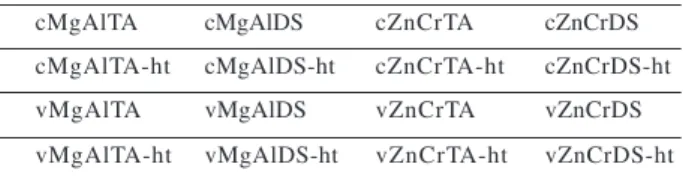
By varying the cation combination, interlamellar anion and pH control during coprecipitation, with or without sub-mission to hydrothermal treatment a total amount of 16 samples was obtained. The prepared materials are orga-nized in Table 1 according to the denomination adopted.
Table 1. Description of the prepared materials.
cMgAlTA cMgAlDS cZnCrTA cZnCrDS
cMgAlTA-ht cMgAlDS-ht cZnCrTA-ht cZnCrDS-ht
vMgAlTA vMgAlDS vZnCrTA vZnCrDS
Powder X-ray diffraction patterns
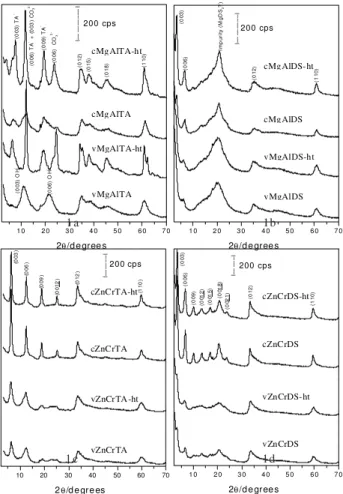
Figure 1 shows the PXRD patterns for the materials pre-pared under different conditions of pH during precipitation and hydrothermal treatment. The basal spacing of ~14 and ~27 Å was found for the TA- and DS-containing LDHs, re-spectively, depending on the system and on the submission to hydrothermal treatment. The Miller indexes indicated were based on literature data18, and the values of basal spacing
were then calculated by the Bragg equation, using the aver-age 1/3(d003 + d006 + d009). The basal spacings obtained agree with those reported in the literature for these anions19.
preparation was conducted at constant pH than at vari-able pH values. Moreover, this crystallinity was little affected by hydrothermal treatment.
Figure 1a shows that the MgAlTA system presented a phase impurity in all cases. The vMgAlTA shows broad reflections, characteristic of LDHs intercalated with hydroxyl anions11. This behavior could be expected, since
coprecipitation at variable pH facilitates the intercalation of this anion. When the material was submitted to a hydro-thermal treatment (vMgAlTA-ht), this phase disappeared, and two new phases appeared. These two phases were also present in both cMgAlTA and cMgAlTA-ht, and could be attributed to: (i) the TA-containing LDH phase and (ii) a carbonate-containing LDH phase. The presence of this second phase was due to CO2 dissolution, since the
hy-drothermal treatment was conducted in an open system, and the medium was alkaline (pH 8.5). It is also possible to observe that coprecipitation at constant pH led to the de-sired material even without treatment, and after hydrother-mal treatment the material was more crystalline in relation to the TA-containing LDH, when compared to that obtained under the same treatment but at variable pH.
Finally, the materials belonging to the MgAlDS system showed a broad reflection of about 20º (2-theta) under all synthesis conditions. This broad reflection was probably due to the Mg(DS)2 salt, which may be formed during the synthesis and present many x-ray diffraction peaks in that 2-theta region.
Thermogravimetric analysis and differential thermal analysis
Figure 2 presents the thermograms obtained for each prepared material, showing that each set of materials pre-sents almost the same decomposition steps. Furthermore, the samples prepared at constant pH and those submitted to hydrothermal treatment presented more defined decom-position ranges. This behavior may be correlated with the higher crystallinity and phase purity of the cited materials. DTA curves (not shown) presented only endo- and isothermic processes, including those involving DS decom-position. The first decomposition step was a common fea-ture of all of the materials prepared. This decomposition is related to water loss3, which occurs from room temperature
to about 150ºC, and represents a mass loss of 5 to 10%. The TA-containing LDHs (Figures 2a and 2c) present three decomposition steps, with the first one related to water loss, as described above. The second decomposition was related to the first step of dehydroxylation, and represented a mass loss of almost 10%3. This decomposition occurred
between 200 and 500 ºC for the materials prepared with the MgAl cation combination, and between 150 to 350ºC with A general analysis of these patterns shows that the
materials prepared with the Zn-Cr cation combination pre-sented higher crystallinity than those containing the Mg-Al cation combination with the same interlamellar anion. Such difference in crystallinity is attributed to the higher similarity of ionic radii for the ion pair Cr(III)/Zn(II) (0.61/ 0.75 Å) than that for Al(III)/Mg(II) (0.53/0.72 Å).
It can be seen that in all of the four systems the ma-terials obtained presented higher crystallinity when the
1 0 2 0 3 0 4 0 5 0 6 0 7 0
(1 10) (0 12) Im p u ri ty ( M g D S2 ?) (0 06) (0 03) 200 cps l— — — ––l cMgAlDS-ht cMgAlDS vMgAlDS-ht vMgAlDS
2θ/d e gree s 1 0 2 0 3 0 4 0 5 0 6 0 7 0
(0 06) O H -(0 03) O H -(1 10) (0 18) (0 15) (0 12) (0 06) C O3 2-(0 09) T A -(0 06) T A - + (0 0 3 ) C O3 2-(0 03) T A -cMgAlTA-ht cMgAlTA vMgAlTA-ht vMgAlTA 200 cps l— ——– — l
2θ/d e gree s
10 20 30 40 50 60 70
(1 1 0 ) (0 1 2 ) (0 0 1 2 ) (0 0 9 ) (0 0 6 ) (0 0 3 ) cZnCrTA-ht cZnCrTA vZnCrTA-ht vZnCrTA 200 cps l— — ––l
2θ/d e gre es
1 0 2 0 3 0 4 0 5 0 6 0 7 0
(0 02 1 ) (0 01 8 ) (1 10) (0 12) (0 01 5 ) (0 01 2 ) (0 09) (0 06) (0 03) cZnCrDS-ht cZnCrDS vZnCrDS-ht vZnCrDS 200 cps l— — – l
2θ/d e gree s
1 a 1b
1 c 1d
Figure 1. PXRD patterns for the following systems: a)MgAlTA;
ent TA salts formed during the heating process in each case19. An overall view of these Figures shows that the
materials obtained at variable pH, without hydrothermal treat-ment, i.e. vMgAlTA and vZnCrTA, present a distinct curve shape, which was related to the amorphous material present under these conditions. However, the materials obtained at constant pH without further treatment showed almost the shape of those treated, indicating again that they were ob-tained with a considerable crystallinity without treatment.
The DS-containing materials (Figures 2b and 2d) pre-sented four decomposition steps. The first one has been already explained. The second decomposition represents a mass loss of more than 20% and is related to the first dehydroxylation step and to the DS decomposition. This decomposition step occurs at about 150-200ºC; however, TG/MS measurements (data not shown) indicated that the DS decomposition proceeded until about 600ºC. Besides the decomposition of the residual DS, the second step of dehydroxylation occurred in the same temperature range, i.e., 250-600 ºC. Finally, the last decomposition can be ob-served at about 950 and 750ºC for the MgAl and ZnCr cation combination respectively, and represents a 10% mass loss. This step is due to the decomposition of the residual sulfate salt originated by the DS hydrophobic chain decomposition (as observed by TG/MS measure-ments). The difference in the decomposition temperature is related to the distinct salts formed in each case (prob-ably MgSO4 and ZnSO4). It is possible to observe that the MgAlDS thermograms are very similar. This resem-blance is not observed for the ZnCrDS materials, for which the thermograms showed an increase in definition when the material was submitted to hydrothermal treatment. This behavior can be explained by the organization of the in-terlamellar domain due to hydrothermal treatment, which in turn, would not increase the crystallinity, as observed in the PXRD patterns.
Size distribution and average diameter of the particles in suspension
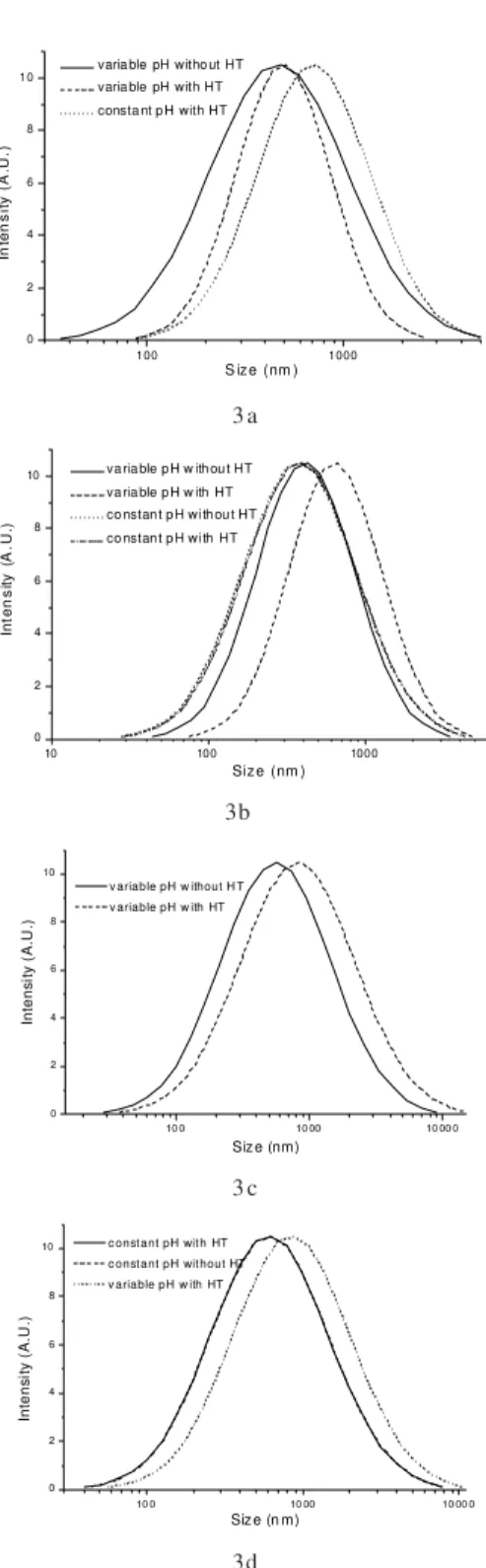
The curves that represent the data obtained can be seen in Figure 3. It was not possible to carry out this analysis for all of the materials due to suspension instability.
The average particle diameter varied without a correla-tion with material precipitacorrela-tion condicorrela-tions or hydrothermal treatment, with values ranging from 0.5 to 0.9 µm. However, a correlation that can be made between particle size distri-bution in a suspension and type of coprecipitation used (constant or variable pH) is that the distribution was less affected by the hydrothermal treatment for those materials precipitated at constant pH, as indicated by the superim-position of the respective curves.
Figure 2. TG analysis for the following; a) MgAlTA; b) MgAlDS; c)
ZnCrTA and d) ZnCrDS.
0 20 0 40 0 60 0 80 0 10 00
cMgAlTA-ht
cMgAlTA
vMgA lTA -ht
vMgA lTA
20 % ma ss
l—
–
——l
Temperature/ºC
0 200 400 600 800 1000
cMgAlDS -ht
cMgAlDS vM gA lDS-ht
vM gA lDS 20% mas s
l—
—–
—l
Temperature/°C
0 200 400 600 800 1000
cZnCrTA-ht
cZnCrTA
vZnCrTA-ht
vZnCrTA 20% mas s
l—
––
—
–
–l
Tem pe ra ture/º C
0 20 0 40 0 60 0 80 0 10 00
cZnCrDS-ht
cZnCrDS
vZnCrDS-ht
vZnCrDS
20 % m as s
l—
———
l
T empe ratu re/° C
2 a
2b
2 c
2d
the ZnCr cation combination20. The last decomposition,
around 20%, was due to the second step of dehydroxylation and to TA decomposition19, occurring at different
differ-Table 2. Specific Surface Area (SSA) and Average Pore Diameter
(APD).
Material S.S.A. (m2g-1) A.P.D. (A)
cZnCrTA 3 9 250
cZnCrTA-ht 4 2 245
vZnCrTA 2 5 182
vZnCrTA-ht 5 156
Figure 3. Particle size distribution of the material in suspension,
related to the following systems: a) MgAlTA; b) MgAlDS; c) ZnCrTA, d) ZnCrDS. For cases (b) and (d), two curves related to the material prepared at constant pH are superimposed.
Specific surface area and average pore diameter
Specific surface area and average pore diameter were de-termined for the ZnCrTA system. The results are summarized in Table 2. As one can see, materials prepared at constant pH presented higher specific surface areas and average pore diameter than those obtained at variable pH values. In
the first case the values were less dependent on hydrother-mal treatment, a behavior consistent with the other analy-ses. PXRD, TG/DTA and light scattering showed that the original characteristics of the materials prepared at con-stant pH were practically unchanged after hydrothermal treatment, showing that this condition of coprecipitation leads to better ordered materials, less dependent on further treatments such as the hydrothermal one.
100 1000
0 2 4 6 8 10
varia ble pH witho ut HT varia ble pH with HT consta nt p H with HT
In
te
n
s
ity
(
A
.U
.)
S iz e (nm )
10 100 1000
0 2 4 6 8
10 va ria ble p H w ith ou t HT va ria ble p H w ith HT co nstan t p H wi th ou t HT co nstan t p H wi th HT
In
te
n
s
it
y
(
A
.U
.)
Siz e (nm )
10 0 10 00 10 00 0
0 2 4 6 8 10
v ariable pH w ithout H T v ariable pH w ith HT
In
te
n
s
ity
(
A
.U
.)
Siz e (nm)
10 0 10 00 10 00 0
0 2 4 6 8
10 c onst ant pH wit h HT c onst ant pH wit hout HT v ariable pH w ith HT
In
te
n
s
ity
(
A
.U
.)
Siz e (n m) 3 a
3b
3 c
3d
The abrupt difference in the SSA and APD values shown by the materials obtained at variable pH with and without hydrothermal treatment is characteristic of the organiza-tion of amorphous material by the hydrothermal treatment. As can be seen in the PXRD and TG/DTA analyses, the ZnCrTA materials presented a considerable difference in their characteristics when submitted to the hydrothermal treatment. The average diameter of the particles also in-creased by a factor of about 45% when they were hydro-thermally treated, which is also directly related to the SSA and APD results.
Scanning electron microscopy
Representative SEM micrographs of the MgAlTA and ZnCrDS system materials are shown in Figure 4. The micro-graphs concerning the other materials (not shown) indi-cate that the materials obtained at constant pH show par-ticles homogeneously aggregated, which means that the constituent particles are smaller. This feature was espe-cially remarkable for the systems containing the TA anion, as can be seen in Figures 4a and 4b. Similar behavior may be found comparing Figures 4c and 4d, but in this case the particles present a plate-like morphology. The Figure also shows that the suspensions spread out, fully covering the sample holder. In these cases the surface-covering capabil-ity of the deposited suspension was much higher for the materials obtained at constant pH.
General Considerations
the cation solution added to the reaction flask. As one can see, LDH formation passes through pH values ranging from to 13.4 to 8.3 and from 13.4 to 6.5 for the MgAl and ZnCr combinations, respectively. This should lead to more heterogeneous material, since the material precipitated at the beginning of the addition will probably differ from the one precipitated at the end. Actually, it has been previously reported that the pH is a determinant factor in the formation of LDH, with a marked influence on the properties of the material obtained12. Among these properties, crystallinity is
the one most affected by pH. Phase purity can also be cited, since at the beginning of the addition (at high pH values), hydroxyl groups have a high tendency to be intercalated13.
Conclusion
On the basis of the present data, we may conclude that the coprecipitation method at constant pH yields materials with more interesting properties with respect to several applications for which controlled particle size and unifor-mity are required. In general, the crystallinity is higher for materials prepared at constant pH, especially for the Zn(II)-Cr(III) cation combination.
The choice of the conditions for the coprecipitation method will depend on the desired specific features of the materials, which can vary from one system to an other. However, the coprecipitation method with constant pH has been used by most investigators because of the high crystallinity, phase purity and homogeneity of the materi-als obtained, as observed in this work. Another advan-tage of this method presented here concerns the textural properties of the materials.
Finally, the advantages shown by the materials obtained by coprecipitation at constant pH are less influenced by the hydrothermal treatment, indicating that they present almost a stable condition that releases the hydrothermal treatment. The hydrothermal treatment is the most energetic and, in general, the longest step in LDH synthesis. Therefore, as the use of constant pH may avoid this step, the use of this method seems to be the best way to produce LDHs, not only due to the costs involved, but also due to the better characteristics obtained.
Acknowledgments
The authors thank the Brazilian agencies Fundação de Amparo à Pesquisa do Estado de São Paulo (FAPESP # 95/ 5752-0, 95/3735-1, 96/6030-1 and 96/12373-9), Conselho Nacional de Desenvolvimento Científico e Tecnológico -Programa de Apoio ao Desenvolvimento Científico e Tecnológico (PCNPq/PADCT) and Fundação Coordenação de Aperfeiçoamento de Pessoal de Nível Superior (CAPES) for financial support. The authors also thank Dr. C. V. Santilli for the BET isotherm measurements, and Rhodiaco Indústrias Químicas Ltda. for the donation of terephthalic acid.
References
1. Nakatsuka, T.; Kawasaki, H.; Yamashita, S.; Kohjiya, S. Bull. Chem. Soc. Jpn.1979, 52, 2449.
2. Kohjiya, S; Sato, T; Nakayama, T.; Yamashita, S.
Makromol. Chem. Rapid Commun. 1981, 2, 231.
3. Reichle, W. T. J. Catal. 1985, 94, 547.
4. Suzuki, E.; Ono, Y. Bull. Chem. Soc. Jpn. 1988, 61, 1008.
5. Schaper, H.; Berg-Slot, J. J.; Stork, W. H. J. Appl. Catal. 1989, 54, 79.
4 a 4b
4 c 4d
Figure 4. SEM micrographs of : a) cMgAlTA; b) vMgAlTA; c)
cZnCrDS and d) vZnCrDS
0 5 10 15 20 25
6 7 8 9 10 11 12 13 14
vM gAlDS
vZ nCrDS
pH
Add e d Vo lu me o f th e C a tion s Solu tio n /mL
Figure 5. pH variation observed in the coprecipitation of
DS-containing LDHs during the addition of the cation solution
6. Barloy, L.; Lallier, J. P.; Battioni, P.; Mansuy, D.; Piffard, Y.; Tournoux, M.; Valim, J. B.; Jones, W. New J. Chem.
1992, 16, 71.
7. Pavan, P. C. ; Gomes, G. A.; Valim, J. B. Micropor. Mesopor. Mater. 1998, 21, 659.
8. Miyata, S.; Kumura, T. Chem. Lett. 1973, 843.
9. Meyn, M.; Beneke, K.; Lagaly, G. Inorg. Chem. 1990,
29, 5201.
10. Boehm, H. P.; Steinle, J.; Vieweger, C. Angew. Chem. Int. Ed. Engl. 1977, 16, 265.
11. Reichle, W. T. Solid State Ionics 1986, 22, 135.
12. de Roy, A.; Forano, C.; El Malki, K.; Besse, J. P. In
Synthesis of Microporous Materials, Occelli, M. L.;
Robson, H.E.; Ed. Van Nostrand Reinhold, New York,
1992, vol. II, p. 108.
13. Lal, M.; Howe, A. T. J. Solid State Chem. 1981, 39,
368.
14. Indira, L.; Dixit, M.; Kamath, P. V. J. Power Sources
1994, 52, 93.
15. Indira, L; Kamath, P. V. J. Mater. Chem. 1994,
4, 1487.
16. Lopez, T.; Bosch, P.; Ramos, E.; Gomez, R.; Novaro, O.; Acosta, D.; Figueras, F. Langmuir 1996, 12, 189.
17. Shirahama, K; Kashiwabara, T. J. Colloid Interface Sci. 1971, 36, 65.
18. Morpurgo, S.; Lojacono, M.; Porta, P. J. Mater. Chem.
1994, 4, 197.
19. Drezdzon, M. A. Inorg. Chem. 1988, 27, 4628.
20. Fuda, K.; Suda, K. Matsunaga, T. Chem. Lett.
1993, 1479.
Received: August 17, 1998