
678 Brazilian Journal of Physics, vol. 34, no. 2B, June, 2004
Strain-Induced Shifts of the Zone-Center Phonons of III-Nitrides
H. W. Leite Alves
∗, J. L. A. Alves
∗, A. M. Santos
†, L. M. R. Scolfaro
†, and J. R. Leite
†∗
Departamento de Ciˆencias Naturais, Universidade Federal de S˜ao Jo˜ao del Rei Caixa Postal 110, 36.300-000, S˜ao Jo˜ao del Rei, MG, Brazil
†
Instituto de F´ısica, Universidade de S˜ao Paulo Caixa Postal 66318, 05315-970, S˜ao Paulo, SP, Brazil
Received on 31 March, 2003
In this work, by using the density-functional theory within the local density approximation, plane wave expan-sions and the pseudopotential method, we present our preliminary results for the strain-induced shifts of the zone center phonon modes and of the effective charges on the III-Nitrides. Our results are in good agreement with the experiment as well as with other calculations, whenever a comparison is possible.
1
Introduction
The group III-Nitrides (AlN, GaN, InN) and the correspond-ing alloys have attracted great interest due to their successful applications in the electronic and optoelectronic device tech-nology [1]. However, their growth in the zincblende struc-ture has been a hard task to the experimentalists, since the most stable structure for these compounds is the wurtzite one. Moreover, by using MBE or MOCVD growth tech-niques, the lattice matching between the III-Nitrides and the most used substrates (such as Al2O3, SiC or GaAs) is around 5 %, leading to strained samples with large contents of struc-tural induced defects. So, in order to avoid such defects, Nitride buffer-layers are introduced but the resulting sam-ple presents hexagonal modifications instead of the desired cubic one.
From the theoretical point of view, while the structural and electronic properties of III-Nitrides were extensively studied in the last years, the amount of knowledge on their dynamical properties are rather scarce: only the description of the phonon dispersion of the unstrained cubic modifica-tion was done [2]. In order to supply the missing informa-tion on the vibrainforma-tional properties of strained III-Nitrides, we have calculatedab initiothe strain-induced shifts of the zone center phonon modes and the effective charges for the III-Nitrides, by using the density-functional theory within the local density approximation (LDA), plane wave expansions and the pseudopotential method (ABINIT code) [3]. We have used the Troullier-Martins pseudopotentials, following the recipe developed by Stampfl and Van de Walle [4] for the III-Nitrides, which includes the d-electrons as valence states for GaN and InN (using the fhi98PP code [5]). The phonon modes and their dispersion curves were obtained us-ing the adiabatic perturbation theory [6]. Details about the converged bulk equilibrium properties of AlN, GaN and InN and their unstrained phonon dispersions were described in our previous work [7].
2
Hydrostatic strains
In Figs. 1, 2 and 3, we show the stress dependence of the frequencies of the zone-center phonons of AlN, GaN and InN, respectively, under a hydrostatic compressive force. It is interesting to note that, as the hydrostatic strains preserve the crystal symmetry, there is no induced splittings of the TO modes. So, the obtained stress dependence can be ex-pressed, by a linear fit, as (in cm−1/GPa units):
i) ∆ωLO = (4.32±0.06).ε and∆ωT O = (4.29±0.06).εfor
AlN;
ii)∆ωLO = (4.33±0.14).εand∆ωT O= (4.16±0.13).εfor
GaN;
iii)∆ωLO= (5.51±0.11).εand∆ωT O= (5.07±0.09).εfor
InN.
From the above results, we can infer that, for AlN and GaN, the LO mode has the same behaviour while, for InN, it is more sensitive to the applied strain. For the TO mode, it is interesting to note that, for GaN, it is less sensitive to the applied strain than for AlN. However, the InN TO mode is still the most sensitive one to the applied strain.
The mode Gr¨uneisen parameter can also be obtained from hydrostatic strains as follows,
γ=−d(lnω)
d(lnV)
So, from our results, we found, for the AlN, GaN and InN LO modes,γ= 1.03, 1.21 and 1.35, respectively. And, for the AlN, GaN and InN TO modes, γ = 1.39, 1.51 and 1.61, respectively. Our values compare well with previous theoretical and experimental ones [8]. Also, comparing our results with the experimental values for the GaN γLO and
γT O, which are 1.2 and 1.4, respectively [8], the agreement
is very good.
H. W. Leite Alveset al. 679
greater than 1, the III-Nitride optical phonon bands will be-come flatter, as observed in recent theoretical calculations [2,7].
Figure 1. Hydrostatic stress dependence of the frequencies of the zone-center phonons of AlN.
Figure 2. Same as Fig. 1 for zone-center phonons of GaN.
Figure 3. Same as Fig. 1 for zone-center phonons of InN.
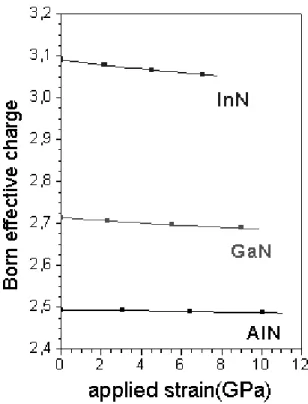
In Fig. 4, we show the stress dependence of the cation Born effective charges of AlN, GaN and InN, respectively, under a hydrostatic compressive force. As noted by Wagner et al. [8], the effective charges decrease monotonically with the rising pressure. However, contrary to Ref. 8, the pres-sure dependence is more pronounced for InN. Moreover, the pressure behaviour of the Born effective charges indicates an electron transfer from the N atom to the cation in compari-son to the pressure-free situation.
Figure 4. Hydrostatic stress dependence of the cation Born effec-tive charges of III-Nitrides.
3
Uniaxial strains
In Fig. 5, we show the stress dependence of the frequen-cies for the AlN TO(Γ) mode under a [100] compressive force. We proceed exactly as described in Ref. 9: we first minimized the [010] and [001] lattice parameters when a [100] strain is applied, and then, we evaluated the phonon frequencies atΓ point in the final minimized structure. In these specific calculations, we have used a 8-atoms super-cell in a cubic symmetry, and a (2 2 2) Monkhorst-Pack grid was used to sample the supercell Brillouin zone.
The obtained stress dependence of the AlN zone-center phonons can be expressed as (in cm−1/GPa units):
∆ωLO= (5.5±0.9).ε,
∆ωT O1= (8.8±0.8).ε, and ∆ωT O2= (-3.8±0.3).ε.
680 Brazilian Journal of Physics, vol. 34, no. 2B, June, 2004
we found that the GaN and InN phonons are even more sen-sitive to hydrostatic strains than the AlN ones. Calculations for the [100] strain dependences of the zone-center phonons of GaN and InN to check this tendence are currently under way.
Figure 5. [100] stress dependence of the frequencies of the AlN TO(Γ)mode.
4
Final Remarks
We present, here, our preliminary results for the strain-induced shifts of the zone center phonon modes and the ef-fective charges on the III-Nitrides. A good agreement with the experiment as well as with other calculations were ob-tained, whenever a comparison is possible. We hope that our results give guidelines for future experiments on this subject. Further details of our calculations and a careful analysis of
the behaviour of the vibration modes under strain will be published soon.
Acknowledgements
The computer resources were provided by the Centro Nacional de Processamento de Alto Desempenho em Mi-nas Gerais & Regi˜ao Centro-Oeste (CENAPAD-MG/CO), Brazil.
References
[1] S. C. Jain, M. Willander, J. Narayan, and R. van Overstraeten, J. Appl. Phys.87, 965 (2000).
[2] F. Bechstedt, U. Grossner, and J. Furthm ¨uller, Phys. Rev. B62, 8003 (2000).
[3] X. Gonze, J.–M. Beuken, R. Caracas, F. Detraux, M. Fuchs, G.–M. Rignanese, L. Sindic, M. Verstraete, G. Zerah, F. Jol-let, M. Torrent, A. Roy, M. Mikami, Ph. Ghosez, J.–Y. Raty, and D. C. Allan, Comput. Mater. Sci.25, 478 (2002), and references therein.
[4] C. Stampfl and C. G. Van de Walle, Phys. Rev. B59, 5521(1999).
[5] M. Fuchs and M. Scheffler, Comput. Phys. Commun.119, 67(1999).
[6] X. Gonze, Phys. Rev. A52, 1096 (1995).
[7] L. S. Pereira, A. M. Santos, J. L. A. Alves, H. W. Leite Alves, and J. R. Leite, Microelect. J.34, 655 (2003).
[8] J. -M. Wagner, G. Portisch, K. Karch, and F. Bechstedt, Mater. Sci. Eng. B59, 248 (1999), and references therein.
![Figure 5. [100] stress dependence of the frequencies of the AlN TO(Γ) mode.](https://thumb-eu.123doks.com/thumbv2/123dok_br/18980899.456984/3.892.122.442.205.452/figure-stress-dependence-frequencies-aln-γ-mode.webp)
