Hospital Santa Izabel - Santa Casa de Misericórdia da Bahia
Mailing address: Paulo José Bastos Barbosa Rua Edístio Ponde, 226/802 -41760-310 Salvador, BA - Brazil
Objective - To identifity characteristics associated with complications during pregnancy and puerperium in patients with rheumatic mitral stenosis.
Methods - Forty-one pregnant women (forty-five pregnancies) with mitral stenosis, followed-up from 1991 to 1999 were retrospectively evaluated. Predictor varia-bles: the mitral valve area (MVA), measured by echocar-diogram, and functional class (FC) before pregnancy (NYHA criteria).Maternal events: progression of heart failure, need for cardiac surgery or balloon mitral valvulotomy, death, and thromboembolism. Fetal/neona-tal events: abortion, feFetal/neona-tal or neonaFetal/neona-tal death, prematurity or low birth weight (<2,500g), and extended stay in the nursery or hospitalization in newborn ICU.
Results - The mean ± SD of age of the patients was 28.8±4.6 years. The eventful and uneventful patients were similar in age and percentage of first pregnancies. As com-pared with the level 1 MVA, the relative risk (RR) of mater-nal events was 5.5 (95% confidence interval (CI) =0.8-39.7) for level 2 MVA and 11.4 (95% CI=1.7-74.5) for level 3 MVA. The prepregnancy FC (FC ≥II and III versus I) was also associated with a risk for maternal events (RR=2.7; 95% CI=1.4-5.3).MVA and FC were not importantly associated with these events, although a smaller frequen-cy of fetal/neonatal events was observed in patients who had undergone balloon valvulotomy.
Conclusion - In pregnant women with mitral stenosis, the MVA and the FC are strongly associated with mater-nal complications but are not associated with fetal/neo-natal events. Balloon mitral valvulotomy could have contributed to reducing the risks of fetal/neonatal events in the more symptomatic patients who had to undergo this procedure during pregnancy.
Key words: pregnancy, mitral stenosis, prognostic factors
Arq Bras Cardiol, volume 75 (nº 3), 220-224, 2000
Paulo José Bastos Barbosa, Antônio Alberto Lopes, Gilson Soares Feitosa, Rosângela Vasconcelos de Almeida, Rosenbert M amédio da Silva, José Carlos Brito, M aria Lúcia Duarte,
A ugusto José Gonçalves A lmeida
Salvador, BA - Brazil
Prognostic Factors of Rheumatic Mitral Stenosis During
Pregnancy and Puerperium
In Brazil, rheumatic disease is a major public health pro-blem, affecting children causing as sequelae valvular le-sions. The clinical manifestations are relatively early, parti-cularly when compared with data from studies conducted in the US 1. During pregnancy, mitral stenosis is the most
frequent chronic rheumatic orovalvular lesion 1-3. The poor
tolerance of patients with mitral stenosis to pregnancy can be explained by their limited adaptation to the physiological cardiovascular changes occurring during pregnancy (parti-cularly the increase in the plasma volume and in the heart rate) 4,5.
Patients with mitral stenosis are found to have frequen-tly overt manifestations of heart failure during pregnancy 6-9.
Even acute lung edema can occur during this period as an initial manifestation of mitral stenosis 10,11. As a
conse-quence of the heart complications, in these patients with mi-tral stenosis the mortality rates are higher than those found in healthy pregnant women. The identification of characte-ristics that indicate the prognosis can help the early se-lection of patients who need special interventions, in addi-tion to allowing better counseling concerning the risks for those who wish to become pregnant. This study was carried out with the basic objective of identifying the clinical and echocardiographic characteristics related to the occurrence of complications during pregnancy and puerperium in patients with mitral stenosis.
Methods
in-house evaluation of the indication, because its protocol imposed restrictions on invasive procedures during pregnancy for patients who remained in functional classes III and IV, with a proper ambulatory clinical treatment. Those patients who remained highly symptomatic were re-ferred preferably for balloon mitral valvulotomy, limiting the indication for heart surgery to those who had contraindi-cations to balloon mitral valvulotomy. The mean gestational age of the 41 pregnant women at the beginning of the follow-up was 6.20±2,1 (median of 5) months.
Although some data were collected retrospectively, information like functional class, drug use, mitral valve area, heart rate, and complications (maternal, fetal, and neonatal) were collected in a systematic manner during the patient follow-up.
The mitral valve area (MVA), measured by the evalua-tion of the pressure half-time through an echodopplercar-diogram, and the functional class before pregnancy, using the criteria of the New York Heart Association, were the most interesting predictor variables. The mitral valve area was divided into three categories: level 1 (MVA>1.5cm2),
le-vel 2 (MVA>1 and <1.5cm2), and level 3 (MVA <1cm2).
Ma-ternal and fetal/neonatal complications occurring during pregnancy, during delivery and up to 30 days postpartum were evaluated. An event was defined as the presence of at least one maternal or fetal/neonatal complication. Maternal complications included: progression of the heart failure, need for heart surgery or balloon mitral valvulotomy, mater-nal death, lung thromboembolism, peripheral or central ner-vous system embolic events. Fetal/neonatal complications included: abortion, fetal or neonatal death, prematurity, low birth weight (<2,500g), need for extended stay in the nurse-ry or newborn ICU.
As a measure of event frequency, the cumulative inci-dence or risk was used. It must, however, be pointed out that patients were not necessarily evaluated at the begin-ning of pregnancy. Thus, the relative risk (RR) estimates are subject to the survival of the patient and maintenance of pregnancy until the time of coming to the cardiology service for follow-up. The descriptive statistics were determined by means of the SPSS frequency, explore, and crosstabs pro-cedures 12. For the comparison between means, t tests were
performed with SPSS 13. The module Trend from Computer
Programs for Epidemiologic Analysis, version 3.0, was
used for the evaluation of statistical significance in the ten-dency of event risks between the categories of predictor variables. The modules RATES1 of the same software were used for the estimation of the 95% confidence intervals of the relative risks.
Results
The mean age ± SD of the 41 patients on admittance to the study was 28.8±4.6 (median=28) years (table I). The mean ages were similar between patients with (29.0±5.1; median=28) and without events (28.6±4.1; median=29). Of the 39 patients with known prepregnancy functional class
(FC), 59% were in FC I, 35.9% in FC II, and 5.1% in FC III. FC I was more frequent in uneventful patients (83.3% versus 38.1%). Based on the electrocardiogram of the first visit, about 92.5% (37/40) of patients presented with sinusal rhythm, and 7.5% (3/40) with atrial fibrillation. All three pa-tients with atrial fibrillation were among those with events. Primigravidae occurred in 37.5% of this sample. In the medi-cal records of six patients, no information was avaiable about the number of pregnancies. The percentage of primi-gravidae was similar between patients with (36.8%, 7/19) and without events (37.5%, 6/16). The mean mitral valve area of the 41 pregnant women was 1.2±0.4cm2, being
smal-ler in the eventful group (1.0±0.2 vs 1.6±0.4cm2).
Table II shows the percentage distribution of maternal and fetal/neonatal complications. The progression to FC III and IV accounted for 48.8% of maternal complications. The other maternal complications were, by frequency, the follo-wing: need for balloon mitral valvulotomy (35.5%), need for
Table I – Characteristics of the 41 pregnant women
General Eventful Uneventful
N=41 N=23 N=18
Age (years)
Mean±SD 28.8±4.6 29.0±5.1 28.6±4.1
Median 29 28 29
Pre-pregnancy FC
I 59% (23/39) 38.1% (8/21) 83.3% (15/18) II 35.9% (14/39) 57.1% (12/21) 11.1% (2/18) III 5.1% (2/39) 4.8% (1/21) 5.6% (1/18) II or III 41% (16/39) 61.9% (13/21) 16.7% (3/18) Rhythm
Sinusal 92.5% (37/40) 87% (20/23) 100% (17/17) AF 7.5% (3/40) 13% (3/23) 0% (0/17) Obstetric history
% primigravidae 37.1% (13/35) 36.8% (7/19) 37.5% (6/16) MVA (cm2 )
Mean±SD 1.2±0.4 1.0±0.2 1.6 ± 0.4
Median 1.1 1.0 1.6
SD- standard deviation; FC- functional class (NYHA); AF- atrial fibrillation; MVA- mitral valve area.
Table II – Distribution of complications by percentage
Maternal complications N %
Progression to functional class III/IV 20/41 48.8 Balloon mitral valvulotomy 16/45 35.5 Need for heart surgery during pregnancy 3/45 6.7
Embolic phenomenon 1/43 2.3
Maternal death 1/43 2.3
Fetal/neonatal complications
Low birth weight 10/34 29.4
Premature delivery 10/42 23.8
Extended stay of newborn in 6/42 14.3 nursery or neonatal ICU
Stillbirth 2/42 4.8
Abortion 1/42 2.4
heart surgery during pregnancy (6.7%), embolism (2.3%), and maternal death (2.3%). Low birth weight (29.4%) and premature delivery (23.8%) were the most frequent fetal/ neonatal complications.
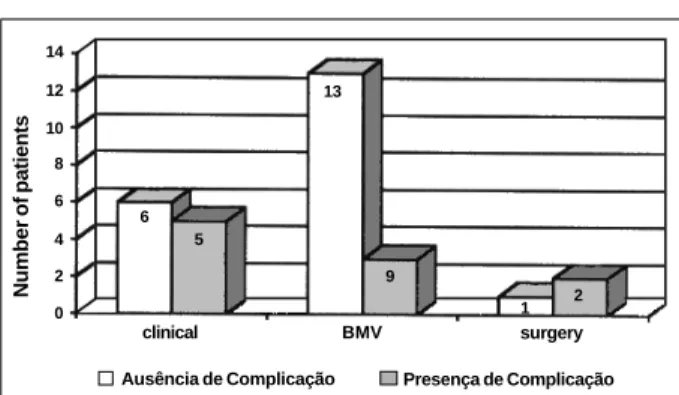
The level 1 mitral valve area was used as a reference for the comparison of maternal and fetal/neonatal events. As compared with level 1 mitral valve area, the relative risk of maternal events was >5 (RR=5.5; confidence interval (CI) 95%=0.8-39.7) for level 2 mitral valve area and >11 (RR=11.4; CI 95%=1.7-74.5) for level 3 MVA; p for the tendency <0.0005 (table III). On the other hand, no statistically signi-ficant (p=0.741) tendency was observed in RR for the asso-ciation between mitral valve area and fetal/neonatal compli-cations (table III). The relative risks of fetal/neonatal events for level 2 (RR=1.5; CI 95%=0.4-5.1) and level 3 (RR=1.3; CI 95%=0.4-4.1) did not exceed 1.5, and the 95% confidence intervals comprised the null hypothesis (i.e., RR=1) therefo-re cortherefo-responding to values of p>0.05. Similar to that obser-ved for MVA, the prepregnancy FC (FC II or III vs. FC I) showed a statistically significant (p<0.05) association with maternal events (RR=2.7; CI 95%=1.4-5.3) (Table IV). The FC was not associated with fetal/neonatal events (RR=1.1; CI 95%=0.5-2.5). An analysis of the restricted group of women with mitral valve area of < 1.5cm2 (Fig. 1) showed that, of the
11 patients kept under clinical treatment, 5 (45.4%) had fetal/ neonatal complications. On the other hand, of the 16 pa-tients who underwent balloon mitral valvulotomy, only 3 (18.7%) had complications of the same kind.
Discussion
According to our data, pregnant women with mitral stenosis still are at a relatively high risk of experiencing ma-ternal complications. The results shown are consistent with those reported by other authors 6,9,14. The association of the
prepregnancy functional class with the risk of maternal events draws the attention to the possibility of reducing
these complications in pregnant women with mitral stenosis by means of early interventions aimed at improving their functional class. The mitral valve area was also strongly and significantly associated with the risk of maternal events. If the mitral valve area was the only determining risk factor for events in these patients, the correction of high-degree ste-nosis should correspond to a pronounced reduction of the occurrence of maternal complications during pregnancy and puerperium. Based on this assumption and with the purpose of reducing the gestational risks, interventional treatment (balloon mitral valvulotomy or surgery) prior to conception has been recommended to patients with severe mitral stenosis who wish to get pregnant 15. However, like in
the present study, usually women with mitral stenosis are referred for cardiological follow-up only after the beginning of pregnancy. Facing these facts and the low incidence of complications observed when the balloon mitral valvulo-tomy technique is used during pregnancy 16-23, this
proce-dure should be seriously considered for the treatment of pregnant women with mitral stenosis and a greatly reduced mitral valve area, independently of their functional class, particularly if we take into account that acute lung edema can be the first clinical manifestation of mitral stenosis du-ring pregnancy 10,11.
Unfortunately, we did not have the opportunity to
eva-Table III – Association between valve area and events, taking the 45 pregnancies into account
Maternal events Events
MVA Yes No % of events RR (CI 95%)
Level 1 1 11 8.3 1.0 (reference)
Level 2 5 6 45.5 5.5 (0.8-39.7)
Level 3 18 1 94.7 11.4 (1.7-74.5) Value of p for tendency<0.0005
Fetal/neonatal events Events
MVA Yes No % of events RR (CI 95%)
Level 1 3 9 25.0 1.0 (reference)
Level 2 4 7 36.4 1.5 (0.4-5.1)
Level 3 6 13 31.6 1.3 (0.4-4.1)
Value of p for tendency = 0.741;
MVA- mitral valve area; RR- relative risk; CI- confidence interval.
Table IV - Association between pre-pregnancy functional class and events, taking the 45 pregnancies into account
Maternal events Events
FC Yes No % of events RR (IC 95%)
I 7 17 29.2 1.0 (reference)
II ou III 15 4 79.9 2.7 (1.4-5.3)
Fetal/neonatal events Events
FC Yes No % of eventos RR (IC 95%)
I 8 16 33.3 1.0 (referência)
II ou III 7 12 36.8 1.1 (0.5-2.5)
FC- functional class (NYHA); RR- relative risk; CI- confidence interval.
Fig. 1 – Fetal/neonatal complications among women with mitral stenosis with a mi-tral valve area ≤1.5cm2, according to the treatment adopted during pregnancy:
clini-cal, treatment, balloon mitral valvulotomy or surgery.
Number of patients
14
12
10 8 6
4
2 0
clinical BMV surgery
Ausência de Complicação Presença de Complicação
6 5
13
9
luate the influence of important covariables on the associa-tions investigated in this study. The magnitude of increase of the plasma volume and of the heart rate, which occur physiologically during pregnancy, are factors worth being taken into consideration in view of their potential influence on the presentation of symptoms in pregnant women with mitral stenosis 3,5. So, it is possible that the analysis of
hemo-dynamic variables measured by means of echocardiogra-phy, such as the mitral transvalvar gradient and pulmonary artery pressure, reflect the interaction between the mitral valve area and physiological cardiocirculatory alterations. The evaluation of such factors might help to explain the fact that patients with moderate mitral stenosis have a wor-sening of their functional class whereas others with severe stenosis tolerate pregnancy well.
As can be seen, approximately 45% of patients in this study required interventional treatment (35.5% balloon mi-tral valvulopathy and 6.7% heart surgery). This percentage is considerably higher than that reported by Avila et al 6, by
whose protocol functional class III/IV patients were hospi-talized for relatively long periods of time, some cases for up to 14 weeks, to intensify the therapeutic measures. By the protocol adopted by us, even though patients in functional class III/IV were hospitalized for therapeutic optimization, the criterium for indication of intervention treatment was the persistence in functional class III or IV despite outpatient treatment (provided they were receiving a therapy consi-dered appropriate). The conduct adopted with the patients of this study can be justified by taking the following points into account: 1) the good results obtained by our team with the balloon mitral valvulopathy technique, a consistent ex-perience with the low incidence of maternal and fetal com-plications related to this procedure, also reported by other investigators 16-24; 2) the high cost of a long hospitalization
of patients; 3) the risk of keeping patients with a relatively severe condition on outpatient follow-up; 4) the patients’ low socioeconomic level, making compliance with thera-peutic decisions difficult.
According to the results of this study, the mitral valve area and the functional class were not significantly associated with fetal/neonatal complications, a finding that may be explained in part by the high percentage of premature births and low birth weights, even among patients with less severe heart diseases (Tables III and IV), as reported by other authors 25,26. In addition to this, it
must be considered that possibly the performance during pregnancy of balloon mitral valvulopathy on 16 (35.5%) patients who were highly symptomatic contributed to a reduction in the incidence of fetal/neonatal events in this group of patients (fig. 1).
Although this study shows interesting findings, limi-tations of a methodological nature cannot be ignored. Among them are inter-observer disagreement and the pos-sibility of error in the measuring of the mitral valve area 27. It
is very unlikely though that the probability of an incorrect diagnosis could have been different (i.e., of differential or nonrandom type) in the group of eventful and of uneventful
patients. Actually, the existence of a differential (or random) error would tend to reduce the strength of the association between mitral valve area and events 28. Therefore the real
association between mitral valve area and events during pregnancy and puerperium may be even stronger than that found in our study. It is important to observe that, in spite of the relatively small size of our sample, a statistically signi-ficant tendency between the mitral valve area and events was detected. It is also important to consider that not all pa-tients were examined at the beginning of their pregnancy. Thus the validity of the associations is restricted to the premise that the findings during pregnancy represent the patient’s condition at the beginning of pregnancy. Should these results be generalized with regard to other popu-lations, the local conditions of the study should also be taken into account. The Santa Izabel Hospital is a referral center in cardiology, which must have contributed to the se-lection of a sample with more severely affected patients.
Despite its limitations, the presented results and the proposed hypotheses can represent a basis for the develop-ment of prospective investigations, for a better unders-tanding of the factors related to the prognosis for a pregnant woman with mitral stenosis. These results confirm the conclusions of the II Brazilian Consensus on Heart Disease and Pregnancy. According to this Consensus, the following factors should be seen as risk factors for complications during pregnancy in women with mitral stenosis: worsening of functional class, atrial fibrillation, frequent supraventri-cular extrasystoles, right atrial surcharge and left atrium >45mm 29. The Consensus stresses the fact that a numerical
cut-off line of the echocardiographic parameters, which are correlated with evolution during pregnancy, has not yet been established. It points out though that a mitral valve area <1.5cm2 is associated with a higher maternal morbidity,
but that, however, it cannot be used separately for the determination of a therapeutic conduct, a correlation with the clinical data being mandatory.
Although this study was not conducted with the primary objective of testing the effectiveness of therapeutic inter-ventions, the experience acquired in the Heart Disease and Pregnancy Sector of the Santa Izabel Hospital supports the idea of a greater use of balloon mitral valvulotomy in pregnant women with mitral stenosis. Another research work 30, also
conducted in our population, showed that in patients with mitral stenosis the echocardiographic score is usually very low, the mean being at 7 points. Under these circumstances, in the absence of pregnancy, balloon mitral valvulotomy proves to be, as compared with surgical treatment, highly effective and of low risk for complications 24,31-33. Similarly, during pregnancy,
1. Avila WS, Grinberg M. Gestação em portadoras de afecções cardiovasculares. Experiência com 1000 casos. Arq Bras Cardiol 1993; 60: 5-11.
2. MacFaul PB, Dorman JC, Lamki H, Boyle D. Pregnancy complicated by maternal heart disease. A review of 519 women. Br J Obstet Gynecol 1988; 95: 861. 3. Guleria R, Vasisht K, Dhall GI, Grover A, Wahi PL. Pregnancy with heart
disea-se. Experience at Postgraduate Institute of Medical and Research, Chandigarh. J Assoc Physicians India 1990; 38: 902-6.
4. Ueland K, Metcalfe J. Circutatory changes in pregnancy. Clin Obestet Gynecol 1975; 18: 41-60.
5. Clapp III JF. Maternal heart rate in pregnancy. Am J Obstet Gynecol 1985; 15: 659-60.
6. Avila WS, Grinberg M, Décourt LV, Bellotti G, Pileggi F. Evolução clínica de por-tadoras de estenose mitral no ciclo gravídico-puerperal. Arq Bras Cardiol 1992; 58: 359-64.
7. Avila WS. Fatores de prognóstico em portadoras de estenose mitral no ciclo gra-vídico-puerperal. Tese de Doutorado. São Paulo: Faculdade de Medicina da Uni-versidade de São Paulo, 1991.
8. Andrade J. A doença reumática no ciclo gravídico-puerperal. Tese de Doutorado. São Paulo: Faculdade de Medicina da Universidade de São Paulo, 1981. 9. Born D. Insuficiência e estenose mitral na gravidez: análise de variáveis maternas
e do concepto. Tese de Doutorado. São Paulo: Escola Paulista de Medicina – Universidade Federal de São Paulo, 1996.
10. Franken RA. Edema agudo de pulmão na gravidez. Arq Bras Cardiol 1986; 47: 413-5.
11. Morley CA, Lim BA. The risks of delay in diagnosis of breathlessness in preg-nancy. Br Med J 1995; 311: 183-4.
12. Norusis MJ. SPSS for Windows: Advanced Statistics, release 6.0, SPSS Inc, Chicago, IL, 1993.
13. Gahlinger PM, Abramson JH. Computer Programs for Epidemiologic Analysis: PEPI. Stone Mountain: USD Inc, 1995.
14. Al Kasab SM, Sabag T, Al Zaibag M, et al. Beta-adrenergic receptor blockade in the management of pregnancy women with mitral stenosis. Am J Obstet Gynecol 1990; 163: (1 Pt 1): 37-40.
15. Braunwald E. Valvular Heart Disease. In: Braunwald E. Heart Disease. A Textbook of Cardiovascular Medicine. 5th Edition. Philadelphia: WB Saunders,
1997: 1014.
16. Mangione JA, Ariê S, Oliveira AS, et al. Valvuloplastia mitral com cateter balão em pacientes grávidas. Arq Bras Cardiol 1989; 52: 99-101.
17. Esteves CA, Ramos AIO, Braga SLN, Harrison JK, Sousa JEMR. Effectiveness of percutaneous baloom mitral valvulotomy during pregnancy. Am J Cardiol 1991; 68: 930-4.
18. Drobinski G, Fraboulet P, Montalescot G, et al. Valvuloplastie mitrale au
quatriè-References
me mois de grossesse. Protection foetale par un manteau de plomb. Arch Mal Couer 1991; 84: 249-51.
19. Grupta A, Lokhandwala YY, Satoskar PR, Salvi VS. Balloon mitral valvuloto-my in pregnancy: maternal and fetal outcomes. J Am Coll Surg 1998; 187: 409-15. 20. Patel JJ, Mitha AS, Hassen F, et al. Percutaneous balloon mitral valvulotomy in pregnancy patients with tight pliable mitral stenosis. Am Heart J 1993; 125: 1106-9.
21. Souza JAM. Valvuloplastia mitral percutânea por cateter-balão em gestantes com es-tenose mitral. Avaliação dos resultados e comparação da evolução obstétrica com gestantes submetidas a comissurotomia mitral cirúrgica. Tese de Doutorado. Escola Paulista de Medicina – Universidade Federal de São Paulo. São Paulo, 1996. 22. Dunn B, Duran CG. Balloon valvotomy for pregnant patients with severe piable
mitral stenosis using the Inoue technique with total abdominal and pelvic shielding. Am Heart J 1992; 124: 1558-61.
23. Andrade JA. Gestante cardíaca em serviço de saúde. O papel da valvuloplastia por cateter-balão, em mulheres portadoras de estenose mitral reumática na gesta-ção. Tese de Livre-Docência. Faculdade de Saúde Pública da Universidade de São Paulo. São Paulo, 1995.
24. Brito JC, Carvalho H, Braga J, et al. Valvuloplastia mitral com cateter-balão de Inoue - análise de 112 casos. Arq Bras Cardiol 1993; 61: 213-16.
25. Ueland K, Metcalfe J. Acute rheumatic fever in pregnancy. Am J Obstet Gynec 1966; 95: 586-7.
26. Faccioli R. Área valvar mitral estenótica em gestantes portadoras de doença reu-mática – correlação com o prognóstico perinatal. Tese de Doutorado. Faculdade de Medicina da Universidade de São Paulo. São Paulo, 1989.
27. Loyd D, Ask P, Wranne B. Pressure half-time does not always predict mitral valve area correctly. J Am Soc Echocardiogr 1998; 1: 313.
28. Henneekens CH, Buring JE. Epidemiology in Medicine. Boston/Toronto: Little, Brown and Co., 1987: 276.
29. Consenso Brasileiro sobre cardiopatia e gravidez. Arq Bras Cardiol 1999; 72(supl III).
30. Feitosa GS, Leite M, Tadeu E, et al. Escore ecocardiográfico em estenose mitral. Arq Bras Cardiol 1991; 57(supl C): 155.
31. Turi ZG, Reyes VP, Raju BS, et al. Percutaneous balloon versus surgical closed comissurotomy for mitral stenosis. A prospective, randomized trial. Circulation 1991; 83: 1179-85.
32. Wilkins GT, Weyman AE, Abascal VM, Palacios IF, Block PC. Percutaneous mi-tral valvotomy. An analysis of echocardiographic variables related to outcome and mechanism of dilatation. Br Heart J 1988; 60: 299.