ABSTRACT
http://dx.doi.org/10.1590/1678-7757201302168
Chemical treatment of the intra-canal dentin
surface: a new approach to modify dentin
hydrophobicity
1 2, Vincent SEMETEY35,
!"#6$%$"7, Elías PÉREZ8 &'(9
1- DDS, MSc, Institutional Doctorate in Engineering and Science Materials, Universidad Autónoma de San Luis Potosí, San Luis Potosí, México. 2- DDS, MSc, Laboratoire Biosanté et Nanoscience, Montpellier, France.
3- PhD, Institut Curie, Centre de Recherche, Paris, France.
4- DDS, MSc, Laboratoire Biosanté et Nanoscience, Montpellier, France.
5- PhD, Institutional Doctorate in Engineering and Science Materials, Universidad Autónoma de San Luis Potosí, San Luis Potosí, México. 6- DDS, PhD, Institutional Doctorate in Engineering and Science Materials, Universidad Autónoma de San Luis Potosí, San Luis Potosí, México. 7- DDS, PhD, Laboratoire Biosanté et Nanoscience, Montpellier, France.
8- PhD, Institutional Doctorate in Engineering and Science Materials, Universidad Autónoma de San Luis Potosí, San Luis Potosí, México. 9- DDS, PhD, Institutional Doctorate in Engineering and Science Materials , Universidad Autónoma de San Luis Potosí, San Luis Potosí, México.
)*%*+%%4 Amaury de J. Pozos-Guillen - College of Stomatology - Universidad Autónoma de San Luis Potosí - Laboratory of Basic Sciences - Manuel Nava 2 - Zona Universitaria - 78290 - San Luis Potosí - SLP - México - Phone: + 52 444 8262357 X 114 - Fax: + 52 444 8139743 - e-mail: apozos@ uaslp.mx
"%4;'(<=<>?<%@"#*4B*'(>C<>?C "")#%4B*'(?D<>?C
O
through chemical silanization with octadecyltrichlorosilane (OTS). Material and Methods: An in vitro experimental study was performed using 40 human permanent incisors thatwere divided into the following two groups: non-silanized and silanized. The specimens dentin hydrophobicity was examined using a water contact angle measurement (WCA). The ! "#$%&' * values of WCA and FPT between the two groups. After silanization, the hydrophobic intra-+! sealed root canal. This chemical treatment is a new approach for improving the sealing of the root canal system.
Key words: Dentin. Surface properties. Octadecyltrichlorosilane.
INTRODUCTION
Micro-leakage directly affects the results of the root-canal treatment. Complete obturation of the / * an apical seal has been proposed as the goal for successful endodontic treatment. However, micro-leakage can occur and is the primary cause of endodontic treatment failure. In cases of endodontic treatment failure, the probabilities of retreatment or surgical success range from 84% to 92%, depending on the material used (Super EBA or MTA) and the technique used (conventional or microsurgery)10.
Nevertheless, the literature suggests that persistent intra-radicular infection and further leakage are the major causes of endodontic treatment failure21.
Root canal obturation involves the three-*5 this procedure is a critical step in endodontic therapy. Root canal obturation serves the following two purposes: the elimination of all sources of leakage from the oral cavity or peri-radicular tissues into the root canal system, and the sealing of any remaining irritants within the root canal system after appropriate shaping and cleaning of the canals8.
the root canal system cannot be overstated; the achievement of this goal depends primarily on the quality of the canal cleaning and shaping as well as on the clinical skills of the professional who performs ! each case include the materials used and the method in which they are used1,3,14,16,21.
The term monoblock has become a familiar term in endodontic literature with a recent interest in the application of dentin adhesive technology to endodontics. The obturation monoblocks created in secondary or tertiary, depending on the number of interfaces between the bonding substrate and the bulk material core. A primary monoblock has only one interface, which extends circumferentially between the material and the root canal wall. Secondary monoblocks are those that have two circumferential interfaces, one between the cement and dentin and the other between the cement and the core material. Tertiary monoblocks are those in which a third circumferential interface is introduced between the bonding substrate and the abutment material. It is clear from the objectives of the root canal treatment that the most critical area is the apical region of the root canal24. A monoblock is
created when the canal space becomes perfectly */ different materials and interfaces and improves the sealing of the root canal system.
The strategy of modifying the surface properties of the intra-radicular dentin to achieve the ideal goal of a monoblock in the root canal space with different materials is still a major challenge. The strategy is to modify the hydrophilic condition to ! & <= >?@G20 (2010) have modeled
!5 * water penetration into the sealed root canals. Wetability is usually determined by the water contact angle (WCA), and it depends on the molecular forces between the water, the interface, and the chemical as superhydrophilic, hydrophilic, hydrophobic and superhydrophobic, according to the WCA values11.
The WCA has been used to evaluate the wetting behavior of root canal sealers and the wetability of composite resins to ascertain the good wetting of tooth surfaces for achieving adhesion15,26.
This study evaluated the hydrophobicity of dentin surfaces that were modified through chemical silanization with octadecyltrichlorosilane (OTS).
MATERIAL AND METHODS
Sample preparation
For the surface characterization, 40 human incisors that were recently extracted for surgical or periodontal reasons were collected and then stored in a 0.1% sodium azide (NaN3) solution (Sigma-Aldrich, Paris, France)9. The dental crowns
were sectioned and 3-mm-thick, radicular dentin slices were obtained using a low-speed cutting machine (Isomet, Buehler, Lake Bluff, IL, USA) under copious water cooling. These slices were randomly divided into the following two experimental groups (10 samples each): non-silanized and silanized. Both groups were evaluated based on the WCA !"#$%
Pretreatment protocol
All of the specimens were pretreated as previously reported to eliminate the smear layer and
+*4K!
were immersed for 3 minutes in 17% ethylene-diamine-tetraacetic acid (EDTA) (J.T. Baker, Mexico City, Mexico) solution, washed with distilled water, immersed for 5 minutes in a 2.5% NaOCl (J.T. Baker) solution, again washed with distilled water, again immersed for 3 minutes in the EDTA solution, and washed with distilled water. The specimens were + XYZ[[ +\\[[ * under a scanning electronic microscope (SEM) (JEOL LUV 5900, Tokyo, Japan) to assess the elimination of the smear layer and the exposure of collagen
Group Mean±Standard Deviation
Silanized 116°±5°
Non-silanized 48°±16°*
Table 1- The mean values of contact angles (Mean±SD)
Silanization protocol
After pretreatment, the specimens underwent silanization by the immersion of each specimen for 1 minute each in 20 mL distilled water, then 20 mL ethanol (Fermont Chemicals, Monterrey, Mexico) and ^[_"`KG% the specimens were immersed for 1 minute each in an 86% octadecyltrichlorosilane (OTS) (100 μL) (Fluka, Sigma Aldrich, Switzerland) solution in ethyl acetate (10 mL), then in ethyl acetate alone (20 mL) "^[_%
Water contact angle measurement
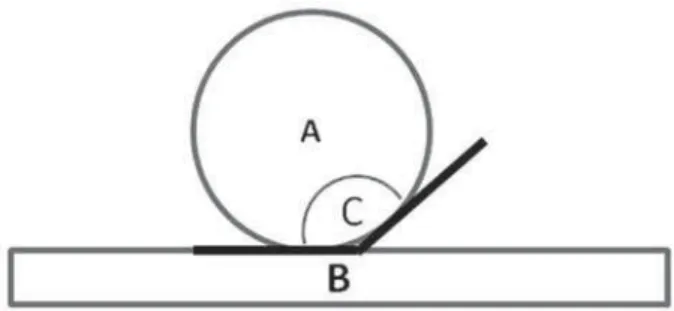
The WCA of the dentin surfaces was measured by the sessile drop technique using a DGD-DX "}K~ #% " _% water was deposited on each dentin surface with a micro-syringe (Figure 1). Images were captured immediately after the deposition using a micro-video system (GBX). The acquired images were analyzed by the Visiodrop software (GBX). The WCA values were analyzed by the Wilcoxon test; *[[\
Fluid permeability test
Recently extracted uniradicular teeth were used. The crowns were sectioned to obtain a standard tooth root length of 10 mm. Patency of the root ^Z/ Z[5 the working length was reached at 0.5 mm from the
apex. The root canal was reamed with the ProTaper Universal system until its size corresponded to that of an F3 instrument. For irrigation, 2.0 mL of 5.25% NaOCl was used at the change of each instrument; *\_Z EDTA. All of the specimens were obturated using gutta-percha with RoekoSeal (Coltène Whaledent, Cuyahoga Falls, Ohio, USA) as a sealer. For the FPT, the external surfaces of the root were sealed with nail varnish, except for the apical third. The FPT was performed using a closed pressure system under a constant pressure of 3 psi27. This pressure was
applied with nitrogen for 16 minutes. An air bubble was introduced with a syringe and it was positioned in the millimeter ruler. The FPT was performed by measuring the path of advancement of the air
*_-1
* TT(r)2·L. The
FPT values were analyzed by the Wilcoxon test; the *[[\
RESULTS
Figure 2 shows the SEM images after pretreatment. As observed in Figure 2A, the smear layer and debris were effectively eliminated * * Figure 2B. Table 1 shows the means and standard deviations of the WCAs of the dentin surfaces in the non-silanized and silanized groups. The contact
Time
Group 2 min &* 6 min 8 min 16 min
Mean±Standard Deviation
Silanized 0.013±0.0013 0.013±0.0012 0.007±0.0002 0.005±0.0001 0.001±0.0001
Non-silanized 0.039±0.0021 0.026±0.0012 0.026±0.0012 0.013±0.0011 0.005±0.0001
Table 2-!"#$%
&%'%/;<=>%-1.
Figure 2- The scanning electron micrography (SEM) image of the pretreated dentin surfaces: A- shows open dentinal ?? %% ;'H#/KO" ? ;H%
* * * with OTS (p<0.05), thereby showing a decreased
! Z (at 2, 4, 6, 8 and 16 min). The FPT showed a ! [Y^[[Z^Y _-1 through
/? ! [ZZ^[[[\ _-1 through the silanized
samples. These values represent the total liquid !* !* *"[[\% shown in Table 2.
DISCUSSION
the intra-radicular dentin surface with OTS in ethyl acetate solvent after chemical pretreatment. OTS is the most effective silanizing agent that is used for the production of hydrophobic surfaces. OTS has been extensively used in semiconductors, bio-membrane models, nanolithography, infrared spectroscopy and Raman spectroscopy5,25.
In dentistry, silanes have been used to coat * + composites and for adhesive bonding to resin and luting porcelain cements in restorative procedures13,18. Silanization is also performed for
post collocation in endodontics, where silanes are coated on the surface of the post for repelling water, blood and saliva23,29. We report a new approach
to the /
surface by converting it to a hydrophobic surface to improve root canal sealing. There are a few reports that focused on changing the properties of an intra-radicular dentin surface12,22.
In this study, subsequent treatments were performed to modify the intra-radicular dentin surface. First, we carried out a pretreatment with EDTA (17%) and NaOCl (2.5%) solutions. Further, the effectiveness of EDTA concentrations in the range of 15%–24% within a period of less than 8 minutes for preventing cell necrosis and maintaining the integrity of the collagen was demonstrated. The use of a 2.5% concentration of NaOCl for less than 1 hour was shown to cause minor changes
*30. The intra-radicular dentin
was not damaged at these concentrations and exposure times, and the integrity of the collagen for chemical interaction with the OTS.
The WCA measurement determined the wetability of the surface. A surface is considered to be hydrophobic when the contact angle is over 90 degrees11,20. The hydrophobicity of the
intra-radicular dentin surface was assessed by the WCA measurements before and after the chemical
* average contact angle of 48°±16°, which indicates the original hydrophilic nature of the intra-radicular dentin. After silanization, the average contact angle was 116°±5°, thereby indicating the hydrophilic to hydrophobic transformation of the intra-radicular dentin surface.
The purpose of this procedure is to allow the * and hydroxyapatite (HA). The chemical interaction between the OTS and the dentin takes place in HA *^^ in the collagen, the principal amino acids for that chemical interaction are glycine, proline and hydroxyproline. OTS interacts with the phosphates in HA, creating the P-O-Si bonds, and in the collagen *+*"% Si-O bonds28.
! measure micro-leakage since 198817, and various
! bacterial growth to evaluate apical leakage as the possible cause of endodontic treatment failure2,19.
#$ ! was directed towards roots that had undergone a hydrophobic chemical treatment, and the opening was sealed with gutta-percha and RoekoSeal. After polymerization and cross-linking, the solid RoekoSeal samples exhibited an external hydrophobic surface, and swell the material. Therefore, RoekoSeal can be used in combination with water without inducing material deformation, indicating that this compound is an ideal complement for use with the dentin surface treatment7. The FPT results
indicated that the modified surface effectively !5 !/ all of the FPTs were performed under hydrophilic conditions to evaluate the techniques and materials for endodontic obturation3,9,16. These studies have
! conditions that range from 0.50 μL/min-1 to 0.26 μL/min-1, depending on the obturation technique ! Y[XZ[/\_ min-1. These results show that the hydrophilic-to-hydrophobic chemical transformation is effective in
*!6.
in vivo+ the periapical region and improved effectiveness in preventing endodontic treatment failure.
CONCLUSIONS
The intra-radicular dentinal surface was chemical silanization with OTS. The hydrophobic dentinal surface exhibited in vitro properties that ! sealed using a lateral gutta-percha condensation and silicon-based sealer. This chemical treatment is a new approach for improving the sealing of the root canal system.
ACKNOWLEDGEMENTS
This work was supported by PCP France-Mexico, PIFI 2011-12, CONACYT 162651, PROMEP/ UASLP/12/CA14, and C12-FAI-03-45.45 grants. Cesar Gaitan is a CONACYT fellow 290541. We would like to thank American Experts, for their assistance in editing this manuscript.
REFERENCES
1- Barbizam JV, Souza M, Cecchin D, Dabbel J. Effectiveness of / * canals. Braz Dent J. 2007;18:20-3.
2- Bergenholtz G, Spångberg L. Controversies in Endodontics. Crit Rev Oral Biol Med. 2004;15:99-114.
3- Cobankara FK, Adanir N, Belli S, Pashley DH. A quantitative evaluation of apical leakage of four root–canal sealers. Int Endod J. 2002;35:979-84.
4- Dutilleul PYC, Fonseca CG, Zimányi L, Romieu O, Pozos-Guillen AJ, et al. Root canal hydrophobization by dentinal silanization: improvement of silicon-based endodontic treatment tightness. J Biomed Mater Res Part B. 2012. In press.
5- Elmore DL, Chase DB, Liu Y, Rabolt JF. Infrared spectroscopy and **/ self-assembled on glass substrates. Vib Spectrosc. 2004;34:37-45. /}*G* guttapercha techniques: Thermafil, Js QuickFill, Soft Core, Microseal, System B and lateral condensation with a computerized !`^[[5Z /Z[Y
7- Hillborg H, Ankner JF, Gedde UW, Smith GD, Yasuda HK, Wikstrom K. Crosslinked polydimethylsiloxane exposed to oxygen ! techniques. Polymer. 2000;41:6851-63.
/_G* different root canal obturation techniques using electrochemical evaluation and dye penetration evaluation methods. Aust Endod J. 2007;33:18-22.
9- Inan U, Aydin C, Tunca YM. In vitro evaluation of matched-taper */!`' Assoc. 2009; 75:123-123c.
10- Kim S, Kratchman S. Modern endodontic concepts and practice: a review. J Endod. 2006;32:601-23.
11- Koch K, Barthlott W. Superhydrophobic and superhydrophilic plant surfaces: an inspiration for biomimetic materials. Philos Transact A Math Phys Eng Sci. 2009;367:1487-509.
12- Lin LM, Rosenberg PA, Lin J. Do procedural errors cause endodontic treatment failure? J Am Dent Assoc. 2005;136:187-93. 13- Matinlinna JP, Lassila LVJ, Urpo AY, Vallittu PK. An Introduction to silanes and their clinical applications in Dentristy. Int J Prosthodont. 2004;17:155-64.
14- Nair PN. Pathogenesis of apical periodontitis and the causes of endodontic failures. Crit Rev Oral Biol Med. 2004;15:348-81. 15- Namen FM, Ferrandini E, Galan Junior J. Surface energy and wettability of polymers light-cured by two different systems. J Appl Oral Sci. 2011;19:517-20.
16- Oliver CM, Timpawat S, Amornchat C, Trisuwan WR. Bacterial coronal leakage after obturation with three root canal sealers. J Endod. 2001;27:36-9.
17- Pashley EL, Tao L, Pashley DH. The sealing properties of *`$Z5[ ^^/ Z/ $G `& ` ` for enhanced silanation of zirconia ceramics. Dent Mater. 2009;25:1116-21.
19- Punia SK, Nadig P, Punia V. An in vitro assessment of apical /G**/! ` Conserv Dent. 2011;14:173-7.
^[/ & ` <= _ >?@G $ * leakage techniques: application to endodontics. Dent Mater. 2010;26:881-90.
21- Siqueira JF Jr. Aetiology of root canal treatment failure: why well-treated can fail. Int Endod J. 2001;34:1-10.
^^/`#&**& review. Br Dent J. 2011;211:81-8.
23- Schmage P, Sohn J, Ozcan M, Nergiz I. Effect of surface treatment of titanium posts on the tensile bond strength. Dent Mater. 2006;22:189-94.
24- Tay FR, Pashley DH. Monoblocks in root canals: a hypothetical or a tangible goal. J Endod. 2007;33:391-8.
25- Tian CS, Shen YR. Structure and charging of hydrophobic material/water interfaces studied by phase-sensitive sum-frequency vibrational spectroscopy. Proc Natl Acad Sci USA. 2009;106:15148-53.
26- Tummala M, Chandrasekhar V, Rashmi AS, Kundabala M, Ballal V. Assessment of the wetting behavior of three different root canal sealers on root canal dentin. J Conserv Dent. 2012;15:109-12. 27- Veríssimo DM, do Vale MS. Methodologies for assessment of G** review. J Oral Sci. 2006;48:93-8.
^/ *''*>*> *'/ toughening effect on PLLA/HA porous composite. J Mater Sci Mater Med. 2009;20:667-72.
29- Zamboni SC, Baldissara P, Pelogia F. Fatigue resistance of ¡ surface conditioning. Gen Dent. 2008;56:56-9.