www.atmos-meas-tech.net/6/359/2013/ doi:10.5194/amt-6-359-2013
© Author(s) 2013. CC Attribution 3.0 License.
Atmospheric
Measurement
Techniques
Geoscientiic
Geoscientiic
Geoscientiic
Geoscientiic
Quantification of uncertainties of water vapour column retrievals
using future instruments
H. Diedrich, R. Preusker, R. Lindstrot, and J. Fischer
Institut f¨ur Weltraumwissenschaften, Freie Universit¨at Berlin, Carl-Heinrich-Becker-Weg 6–10, 12165 Berlin, Germany
Correspondence to:H. Diedrich ([email protected])
Received: 12 July 2012 – Published in Atmos. Meas. Tech. Discuss.: 6 September 2012 Revised: 15 January 2013 – Accepted: 21 January 2013 – Published: 14 February 2013
Abstract.This study presents a quantification of uncertain-ties of total column water vapour retrievals based on simu-lated near-infrared measurements of upcoming instruments. The concepts of three scheduled spectrometers were taken into account: OLCI (Ocean and Land Color Instrument) on Sentinel-3, METimage on an EPS-SG (EUMETSAT Polar System – Second Generation) satellite and FCI (Flexible Combined Imager) on MTG (Meteosat Third Generation). Optimal estimation theory was used to estimate the error of a hypothetical total water vapour column retrieval for 27 differ-ent atmospheric cases. The errors range from 100 % in very dry cases to 2 % in humid cases with a very high surface albedo. Generally, the absolute uncertainties increase with higher water vapour column content due to H2O-saturation
and decrease with a brighter surface albedo. Uncertainties in-crease with higher aerosol optical thickness, apart from very dark cases. Overall, the METimage channel setting enables the most accurate retrievals. The retrieval using the MTG-FCI build-up has the highest uncertainties apart from very bright cases.
On the one hand, a retrieval using two absorption channels increases the accuracy, in some cases by one order of mag-nitude, in comparison to a retrieval using just one absorption channel. On the other hand, a retrieval using three absorption channels has no significant advantage over a two-absorption channel retrieval.
Furthermore, the optimal position of the absorption chan-nels was determined using the concept of the “information content”. For a single channel retrieval, a channel at 900 or 915 nm has the highest mean information content over all cases. The second absorption channel is ideally weakly cor-related with the first one, and therefore positioned at 935 nm, in a region with stronger water vapour absorption.
1 Introduction
Water vapour is the most important greenhouse gas in the Earth’s atmosphere and has a strong connection to various feedback mechanisms on climate (IPCC, 2007). Detecting local and global trends in the water vapour field is therefore an important task for climate research.
(TOA) measurements. Consequently, this work only consid-ers the wavelength range of NIR.
There are already several instruments and retrievals which operationally retrieve water vapour over cloud-free land sur-faces in the NIR, for example MERIS (MEdium Resolution Imaging Spectrometer) on ENVISAT (Lindstrot et al., 2012; Fischer and Leinweber, 2010). The existing retrievals are var-ious but use a basic principle, the differential absorption tech-nique (Albert et al., 2001, 2005; Bartsch et al., 1996; Gao et al., 1993). The comparison of radiances in a window chan-nel with radiances in an absorption chanchan-nel provides infor-mation about the TCWV.
However, there are a number of error sources for the re-trieval of water vapour from NIR-measurements: one part of the uncertainty is due to technical constraints, such as in-strumental noise or spectral and absolute calibration of the spectrometers. On top of that, the retrieval is based on vari-ous assumptions with respect to, e.g. scattering in the atmo-sphere or the vertical temperature profile. One goal of this study is the quantification of uncertainties of a hypothetical water vapour retrieval using three future concepts of spec-trometers. We selected only concepts of image sensors whose plans include water vapour absorption channels in the NIR. Additionally, we aim to find out how to improve the accuracy of such retrieval by determining the optimal channel setting for the water vapour remote sensing. Although there is no in-formation about the measurement accuracies and the actual retrieval, one can estimate the uncertainties using the optimal estimation theory and the concept of information content.
2 Instruments
2.1 OLCI
TheOcean and Land Color Instrument(OLCI) is planned to be the sequel of MERIS (Medium Resolution Imaging Spec-trometer). It will be installed on the Sentinel-3 orbiter, which is part of the GMES (Global Monitoring for Environment and Security) program. It is scheduled to be launched in 2014 at the earliest with a lifetime of approximately more than 12 yr (fuel for five more years is going to be available). To pro-vide a better temporal resolution, it is planned to operate two identical platforms which orbit the Earth on sun-synchronous tracks at about 815 km height with a delay of 180 degrees. OLCI will be comprised of five identical cameras in a fan shape alignment (role model: MERIS). It will measure the radiation reflected from the Earth in the visible and near-infrared spectrum. The spatial resolution of the spectrome-ter will be 300 m (full resolution), which can be downscaled to reduced resolution (1200 m), and will be able to sample a line of 1300 km (field of view: 68.5◦) at once. The obser-vation geometry will be tilted by 12 degrees to reduce sun glint effects. With a two-satellite composition, global cover-age will be achieved within 4 days. Every 27 days, a cycle
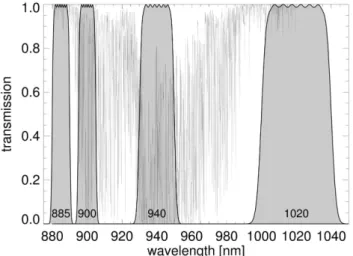
will be repeated. OLCI will be upgraded in comparison to MERIS from 15 to 21 spectral channels in the wavelength range of 0.4 to 1.02 µm1. The planned channels in the near-infrared, relevant for water vapour retrievals, are shown in Fig. 1.
2.2 METimage
METimage will be a multispectral radiometer, mounted on the second generation of EUMETSAT Polar SYSTEM (EPS-SG) satellites. This framework consists of 3 polar orbit-ing MetOp satellites and its prime objective is to provide continuous, long-term data sets of meteorological quanti-ties. Metop-A was launched in 2006, Metop-B in 2012 and Metop-C will follow in 2016. The center of the METimage concept is a rotating telescope developed byJena-Optik. The Visual/Infrared Imager (VII) will detect sunlight, reflected by the Earth, in the visible and near infrared spectrum from 0.4 to 14 µm. A spatial resolution of maximum 250 m and a field of view of 110◦(swath approximately 2800 km) is ex-pected. The radiometer scans 20 pixel simultaneously with a field of view of 1◦(20 km)2. The channel constellation and
the number of channels has not yet been finally decided be-tween a 20-channel or a 30-channel concept. The Institute for Space Science at the Free University Berlin was asked to ascertain the best channel position and combination for the water vapour remote sensing. The planned channels in the near-infrared, relevant for water vapour retrievals, are shown in Fig. 2.
2.3 MTG-FCI
TheMeteosat Third Generation (MTG) system is going to replace theMeteosat Second Generation (MSG). The con-cept of geostationary satellites is based on two three-axis-stabilized platforms, the MTG-I (imager) and the MTG-S (sounder). The scheduled launch will be in 2020. A spec-trometer will be installed on MTG-I, theFlexible Combined Imager(FCI). It can detect the electromagnetic radiation in 16 channels rather than 12 on MSG between 0.4 and 13.3 µm with an expected spatial resolution of maximal 1 km between 0.4 and 2.1 µm and a spatial resolution of 2 km between 3.8 and 13.3 µm3. The planned channels in the near-infrared, rel-evant for water vapour retrievals, are shown in Fig. 3.
3 Theory
3.1 Radiative transfer calculations
In this study the radiative transfer model MOMO was used for the radiative transfer calculations in order to determine
1http://www.ioccg.org/sensors/olci.html. 2http://www.eumetsat.int.
Fig. 1.OLCI channel constellation in the NIR (normalized response functions) and total transmittance of the atmosphere inρσ τ-band.
the sensitivities of certain channels to different atmospheric properties. It is based on the Matrix Operator Method (Plass et al., 1973; Grant and Hunt, 1969a,b; Twomey et al., 1966). MOMO is a one-dimensional model with a coupled ocean– atmosphere system. It derives the upward and downward ra-diative fluxes on the borders of the prior-defined vertical lay-ers for selectable zenith- and azimuth-angles (Fischer and Grassl, 1984; Hollstein and Fischer, 2012). For this inves-tigation, radiative transfer calculations have been performed for a part of theρσ τ-band in the near infrared from 880 to 960 nm. The scattering properties of different atmospheric components like ice clouds or aerosols were calculated using a Mie code based on Wiscombe (1980). The absorption coef-ficients of the atmospheric gases (mainly H2O and O2) were
computed with the k-distribution method (Bennartz and Fis-cher, 2000). Information about the location and width of the absorption lines originate from the HITRAN database (Roth-man et al., 2010).
3.2 Quantification of uncertainies using optimal estimation
3.2.1 Best estimate error
Any measurement (y) has an associated uncertainty (σy). In case of remote sensing, measurements are generally TOA ra-diances. The determination of the measurement error of the instrument is realizable by calibration and comparison mea-surements. Most techniques retrieve physical properties from radiance measurements through the use of sophisticated in-versions. This means that the retrieved quantities (combined in the state vectorx) will also be uncertain (σx is the error of the retrieved quantity). These inversions commonly itera-tively optimize the result of a forward modelF, which uses considerable additional (prior-)information (model parame-tersp) that are also contaminated with errorsσp:
Fig. 2.METimage original channel constellation in the NIR (nor-malized response functions) and total transmittance of the atmo-sphere inρσ τ-band.
Fig. 3.MTG-FCI original channel constellation in the NIR (normal-ized response functions) and total transmittance of the atmosphere inρσ τ-band.
y±σy=F(x±σx,p±σp) . (1) As an example, the TOA radiance reflected from the Earth depends on parameters such as the surface albedo, the aerosol load, the water vapour content, and clouds, the temperature of each which can be measured only to a certain accuracy. The question is, how can we determine the uncertainty of the retrieved atmospheric propertyσxwithout knowledge of the exact retrieval technique? One method was introduced by Rodgers (2000), and uses the Bayes’ with an assumption of normally distributed errors. An overview of the method is presented here; for detailed derivation see the book by Rodgers (2000).
measurement to the parameter is known. For example, in cases where the uncertainty of a model parameter is large but the sensitivity of the measurement to the parameter is neg-ligible, there is no significant increase in the uncertainty of the retrieved state. The influence of individual parameters on the measurement can be simulated with a radiative transfer model (e.g. MOMO). The Jacobian of the radiance accord-ing to a certain parameter can be approximated by the change in radiance in response to a small change in the parameter, while keeping all other parameters constant.
A matrixKp is constructed, which contains information about the sensitivity of the parameters to the measurement and whose size depends on the number of channels and pa-rameters. The entries in the matrix are effectively the deriva-tives of the radiance in a channelito the variation of thej model parameter:
Kpi,j =
δy i δpj
. (2)
In this case, local linearity must be assumed. The uncertainty of the prior knowledge of each model parameter is stored in a covariance matrixSp:
Spi,j =ci,jσp,iσp,j , (3)
whereσp,iis the uncertainty in units of standard deviation of theimodel parameter andci,j is the linear correlation coef-ficient between theiandj parameter. For many applications this correlation is zero, resulting in a diagonal matrixSp. The measurement error covariance matrixSyis defined as Syi,j =
ci,jσy,iσy,j , (4) whereσy,i is the measurement error in units of standard de-viation for theichannel of the spectrometer andci,j is the correlation between the error in theiandj channel, which is zero for standard spectrometer. SoSyhas the diagonal el-ements:
(σi,iy)2=(Li/SNRi)2+12i, (5) whereLi is the radiance measured in channel i, SNRi the signal to noise ratio (SNR =y/σy) and1i the uncertainty of the absolute calibration of channeli. The matrixKcarries information about the sensitivity of the measurement in thei channel to thej element of the state vectorx, so the deriva-tives of radiance to the retrieval quantity are
Ki,j = δy
i δxj
. (6)
Finally, the error covariance matrix of the state vector is de-fined by
Sx=ci,jσx,iσx,j . (7)
This matrix describes the uncertainties of the retrieved quan-tity. The square route of the diagonal elements ofSx speci-fies the error in the unit of the retrieved value, and is thus the sought after quantity
According to Rodgers (2000), the approach to calculate Sx is as follows. First, the model uncertaintySe is derived by propagating the model parameter uncertaintySpinto the measurement space, and adding the measurement uncertainty Sy:
Se=Sy+KpSpKpT . (8)
The second step is the propagation ofSe into the state vec-tor space, which is different from standard error propagation. The inverse model uncertainty is combined with the Jacobian of the forward operator (K):
Sx=(KTSe−1K)−1. (9)
Prior or background knowledge of the retrieval quantity is not included in this approach.
3.2.2 Information content
Another way of evaluating the retrieval error is the informa-tion content (Shannon and Weaver, 1949), which is analo-gous to the concept of entropy in thermodynamics. The in-formation contentHprovides the “value” of a measurement. It is the reduction in entropyS:
H=S(P1)−S(P2), (10)
whereP1is the uncertainty before andP2after the
measure-ment. For a Gaussian distribution, the information content is calculated by Eq. (11):
H=0.5 log2(σa2)−0.5 log2(σx2), (11) whereσais the standard deviation due to the natural variabil-ity of the parameter andσxis the uncertainty of the retrieved parameter.Hdetermines the number of possible states of the measurement in binary bits. For example, the water vapour column content normally varies between 1 and 70 mm. If the retrieval can only derive the water vapour content with an ac-curacy of 10 mm,H is very low because the uncertanty is in the range of the natural variation. According to simple log-arithm laws, Eq. (11) implies the quotient of the variances of the retrieval value and its uncertainty, which is similar to the concept of the signal-to-noise ratio. Thus, the higher the uncertainty of the retrieval, the lower the information con-tent and the smaller the number of possible states that can be resolved based on the measurements.
4 Atmospheric cases and assumptions
a window channel (Labs,Lwin) provides information about
the TCWV and is hereafter referred to as the apparent trans-mittanceR:
R=Labs/Lwin. (12)
In the NIR spectrum, the apparent transmittance is most sen-sitive to the water vapour column content and is influenced mainly by the surface albedo and the aerosol optical thick-ness. Consequently, three cases were considered for each pa-rameter (low, medium and high values) (see Table 1). This results in a total number of 27 atmospheric cases.
Additionally, three other model parameter sensitivities were determined: the influence of a cirrus cloud (varying the cirrus optical depth between 0.1 and 1.6), the change of the temperature profile (shifting the temperature profile by a con-stant offset of±10 K), and the scale height of an aerosol layer (varying the scale height between 1000 m and 4000 m, homo-geneous aerosol layer with 500 m thickness).
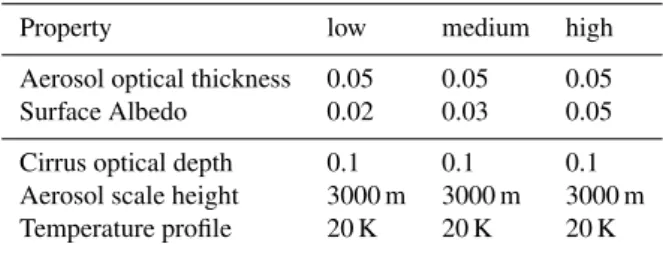
The theory of optimal estimation requires the knowledge of the uncertainties of the model parameters. The assumed accuracies are given in Table 2 as standard deviations. These parameters were considered to account for the error influ-ences on the TCWV. The sensitivity to cirrus clouds was con-sidered to include the influence of sub-pixel cloud contami-nation. Also, present cloud detection algorithms are not ac-curate enough to detect thin clouds. The height of the aerosol layer (see below) and the natural change in the temperature profile are significant error influences. The uncertainties of the parameters were assumed. For the aerosol optical thick-ness, cirrus optical depth, aerosol scale height, and temper-ature profile, the accuracies were kept constant for each of the 27 cases. For the surface albedo, Carrer et al. (2010) was taken into account. This validation report is very comprehen-sive and includes a large number of results for the uncer-tainties of the albedo. The inter-comparisons between differ-ent procedures show a spread between 0.02 and 0.05. On the one hand, the uncertainties were determined as constant with higher albedo, but on the other hand, constant in percentage, depending on the assumption regarding the bidirectional re-flectance distribution function. In this study, an increasing error with larger surface albedo was assumed (see Table 2). However, the exact values do not influence the general out-come of this study.
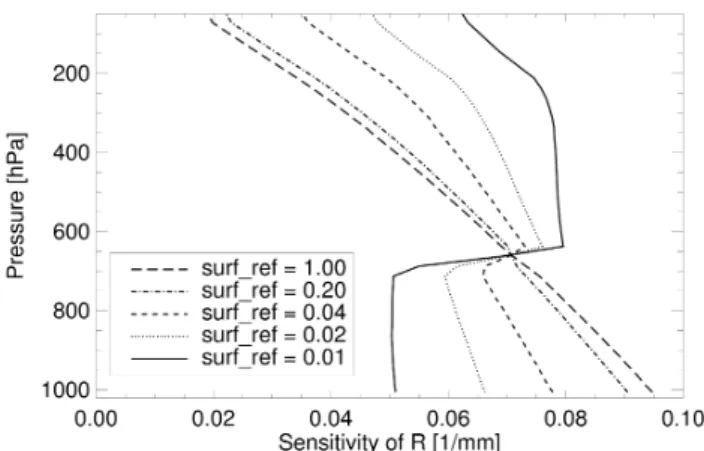
Furthermore, the influences of the profile shape of water vapour, aerosol or temperature were not considered in the de-termination of the uncertainties. Again, only the temperature profile was altered equally in every layer. The US Standard atmosphere profile was used. The calculated uncertainties refer only to the whole vertical column of the atmosphere. Nevertheless, the profile shape plays an important role when interpreting the influences of the albedo and aerosol optical thickness. The peak altitude of the sensitivity for the water vapour column at the TOA can be understood from Fig. 4. Here, the sensitivities of the apparent transmittanceR (win-dow channel at 885 nm, absorption channel at 900 nm) is
Fig. 4.Sensitivity in 1 mm of the apparent transmittanceRto the water vapour column content as a function of pressure (height lev-els) for five different surface reflectances (surf ref). A constant aerosol layer at 700 hPa is present.
Table 1.Sensitivity simulations input parameter cases.
Property low medium high Water vapour column 1 mm 30 mm 70 mm Aerosol optical thickness 0.1 0.4 1.0 Surface albedo 0.05 0.2 0.8
shown as a function of height for five different surface re-flectances. The sensitivities for each layer were derived from the difference between the reference ratio and the ratio sim-ulated with an increased water vapour content (+0.1 mm) in that layer divided by the change in water vapour. For reference, the US standard water vapour profile was cho-sen and a homogeneous continental aerosol layer at 700 hPa (3000±250 m) with an optical thickness at 900 nm of 0.1.
As the figure clearly shows, the peak altitude of the sensi-tivity is governed by the surface reflectance and the aerosol layer height. The lower the surface reflectance, the more in-formation originates from the layer above the aerosol layer. The influence of the aerosol layer increases with higher opti-cal thickness (not shown here). This is a significant error in-fluence for surface reflectances below 0.2. Nevertheless, we only accounted for that in the parameter uncertainties (see Table 2).
Table 2. Sensitivity simulations input parameter uncertainties in unit of standard deviation for each case (see Table 1).
Property low medium high Aerosol optical thickness 0.05 0.05 0.05 Surface Albedo 0.02 0.03 0.05 Cirrus optical depth 0.1 0.1 0.1 Aerosol scale height 3000 m 3000 m 3000 m Temperature profile 20 K 20 K 20 K
The albedo of natural surfaces is a function of wave-length. In cases of real measurements, a common approach to account for this effect is to linearly extrapolate the face reflectance in the window channels to estimate the sur-face reflectance in any spectrally close absorption channel. Within the framework of this study, the so-called albedo slope was not considered in the simulations, meaning that for a fixed case the same albedo was used for all simulated channels. However, when calculating the uncertainties, this phenomenon was included with the help of the following. The surface reflectance uncertainty affects the retrieval in two ways, the uncertainty of the absolute albedo and its spec-tral slope:
1. The uncertainty of the assumed surface reflectance in the window channels, resulting from uncertainties in the atmospheric correction, directly propagates to the uncertainty of the surface reflectance in the absorp-tion channel. However, this error has the same sign in all channels, since the scattering properties hardly vary within the considered spectral ranges. Since the infor-mation used for the water vapour retrieval is provided by the ratio of absorption and window radiances, there is hardly any additional error contribution by the uncer-tain surface reflectance in the absorption channel. This is reflected by a high correlation of the uncertainties of both reflectance values in the error covariance matrix Se.
2. The correlation of the surface reflectance uncertainties is reduced in cases of a strongly varying albedo slope, resulting in a higher error contribution by the absorp-tion channel. A spectral surface albedo database was analysed with respect to the correlation of the surface reflectance values for different surface types and chan-nel positions. Not surprisingly, the correlation is lower for spectrally distant channels, resulting in errors that are less correlated and higher retrieval uncertainties. The error covariance matrixSeof the model parameters
(Eq. 12) was adapted accordingly.
Since the instruments are not built yet and calibration er-rors or signal-to-noise ratios (SNR) are not determined, the measurement errors can only be assumed (guided by the
specifications of the concepts). For this reason, a standard SNR of 400 was preconditioned for each channel, which is in the approximate range of a NIR radiance measurement. The SNR is dependent on the channel width because more energy is coming in with a broader spectral range. However, this quantity turned out to have a non-significant influence and was kept constant. No absolute calibration uncertainties or systematic measurement errors were assumed.
Additionally, the instrument-specific response functions are not available yet. Nevertheless, the shape of response functions has a very low impact on the measured radiance. For convenience, the response function of the MERIS chan-nel 15 was used. It was adapted to the different scheduled po-sitions and widths (see Figs. 1, 2, 3). In the investigation of the optimal channel distribution, this response function was also used.
5 Results
5.1 Uncertainties
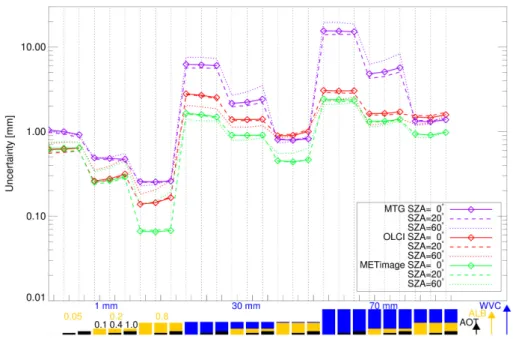
Uncertainties in mm of possible water vapour retrievals us-ing the channel distributions of the original concepts of the three planned instruments are shown in Fig. 5. For OLCI and METimage, two window channels close to theρσ τ-band were chosen. For MTG only one window and one absorption channel were considered. For the OLCI retrieval, two tion channels, and for the METimage retrieval, three absorp-tion channels, will be provided. For the posiabsorp-tions and widths of the considered channels, see Sect. 2. The uncertainties of the 27 cases of a combination of three atmospheric properties are plotted. The legend for these cases is displayed below the plot as coloured bars of total water vapour column (TCWV) in blue, surface albedo (ALB) in yellow and aerosol optical thickness (AOT) in black. Although the uncertainties are dis-crete points, for better clarity a line was drawn between the points of each albedo class for sun zenith angle (SZA) of 0 degrees. Additionally, uncertainties for SZA of 20 and 60 degrees were calculated and plotted in dashed lines for each instrument.
Fig. 5.Uncertainties of water vapour retrievals in mm of three channel combinations of future instruments (OLCI, METimage, MTG) for 27 different cases of a combination of three atmospheric properties: total column water vapour (TCWV), albedo (ALB), and aerosol optical thickness (AOT) – for three different sun zenith angles (SZA).
Another finding is the reduction of uncertainties with brighter surfaces, in some cases with one order of magnitude. Brighter surfaces reflect more radiation. Thus, the measure-ment is dominated by photons that have not been scattered at atmospheric particles. Above dark surfaces, a large num-ber relative to the total amount of photons gets scattered back in the atmosphere and consequently does not travel through the whole vertical column of water vapour (Lindstrot et al., 2012) (see also Fig. 4). Hence, the uncertainty is higher for dark than for bright surfaces.
The dependency of the accuracy of the retrievals to the aerosol load is more dissimilar. In cases of a bright surface, the uncertainty slightlyincreaseswith a larger optical thick-ness of the aerosol layer. In contrast, in cases of a dark sur-face, the uncertainty slightlydecreases with higher aerosol load. This is due to the fact that the aerosol layer, located in the lower troposphere, reflects a part of the radiation. Al-though this radiation does not reach the surface, the presence of the aerosol layer increases the fraction of measured pho-tons that originate from the lower troposphere and thus de-creases the error in the water vapour path (see Sect. 4 and Fig. 4).
To interpret the influence of the errors on the measure-ment, it is more enlightening to examine the uncertainties relative to the simulated amount of TCWV (not shown here). Generally, the relative uncertainties decrease with higher wa-ter vapour value. This is consistent because the sensors have limited measurement sensitivities. A very small change in transmittance due to a small TCWV amount can only be de-termined with low accuracy. In cases of MTG, the relative
uncertainty exceeds 100 %; and in cases of METimage and OLCI, it is around 70 % over dark surfaces. The lowest val-ues can be examined over bright surfaces. Again, higher intensities provide more information for the sensor and there-fore the uncertainties are smaller. For medium water vapour amounts around 30 mm, one has to expect a relative error of around 1 to 10 %, depending on the surface and atmospheric circumstances.
To determine the influence of the different viewing geome-tries, uncertainties for two exemplary sun zenith angles were calculated and plotted. The impact of a SZA of 20 degrees on the accuracy is negligible. For dry cases, the uncertainties of all retrievals is higher at a SZA of 60 degrees than for a SZA of zero degrees. This applies also for MTG in the humid cases but not for OLCI and METimage.
5.2 Retrievals with one and two absorption channels
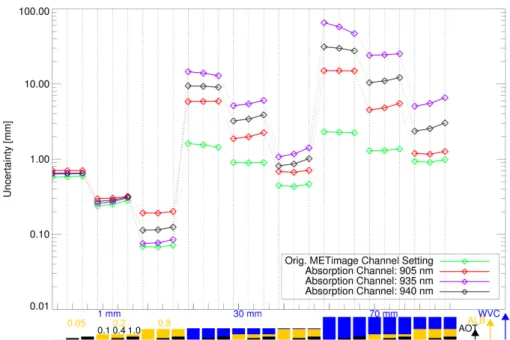
In the previous paragraph the behaviour of the scheduled channels was illustrated. The question arises as to whether this is the optimal distribution and combination of channels. As seen in Fig. 5, it seems that not only the location but also the number of absorption channels have an impact on the ac-curacy of the retrievals. MTG with only one absorption chan-nel has larger uncertainties than the OLCI and METimage with two and three absorption channels.
Fig. 6.Uncertainties in mm of water vapour retrievals using one absorption channel and two window channels (METimage concept) for 27 different cases of a combination of three atmospheric properties: total column water vapour (TCWV), albedo (ALB), and aerosol optical thickness (AOT).
window channels at 865 and 1020 and one of the three ab-sorption channels, respectively (905 nm in red, 935 nm in purple, 940 nm in dark grey). Obviously, the retrievals using only one absorption channel have larger uncertainties than the original METimage setup, in some (dark surface) cases even one order of magnitude. For cases with medium- and high water vapour, the lowest uncertainties were found for the retrieval using the absorption channel at 905 nm. The other two have a very low accuracy, especially in the hu-mid cases. This is due to the fact that they reach saturation more easily because they are located in a strong absorbing wavelength range. However, this behaviour benefits their ac-curacy in the dry cases. For low water vapour contents, the uncertainties are quite similar. Here, the retrievals with the absorption channels 935 and 940 have lower uncertainties.
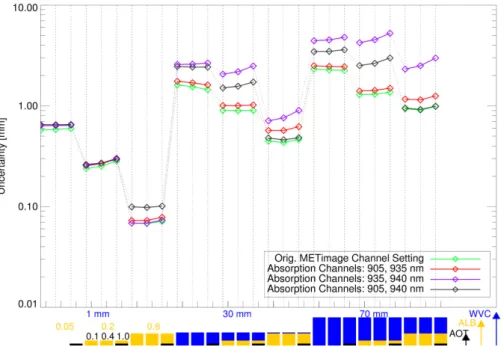
Figure 7 shows the results of the uncertainty calculation of retrievals with two window channels and a combination of two absorption channels (see the legend on the right bottom of the plot). Again, the original METimage retrieval is plot-ted in green. The most evident feature in comparison to Fig. 6 is that the uncertainties are lower (see the scale) in nearly all cases and close to the retrievals using all scheduled channels. The one with the best accuracy is the combination of absorp-tion channel at 905 nm and 935 nm because the difference to the original retrieval is very low in every case. However, the combination of absorption channel at 905 and 940 nm is best in cases of bright surfaces. In dry cases, the different combinations only differ minimally. In medium and humid cases, the combination of 935 nm and 940 nm (the strong ab-sorbing channels) is the poorest. These latter medium and
humid cases also seem to have the strongest sensitivity to the aerosol load.
In summary, retrievals with two absorption channels are more accurate than with only one. The best combination seems to be 905 nm and 935 nm; it is nearly as certain as the original combination of all three absorption channels. The combination of a channel close to the first window channel and one in the strong absorbing range appears to be a good choice.
5.3 Optimal channel setting
In the following, our aim is to ascertain whether the channel positions, widths, and their combinations can be improved in order to decrease the uncertainties of a potential TCWV retrieval. For this purpose it is more convenient to examine the information content because it is similar to the relative error and indicates the quality of a measurement on a linear scale. The example shown is for the METimage build-up. 5.3.1 One absorption channel retrieval
Fig. 7.Uncertainties in mm of water vapour retrievals using two absorption channels and two window channels (METimage concept) for 27 different cases of a combination of three atmospheric properties: total column water vapour (TCWV), albedo (ALB), and aerosol optical thickness (AOT).
Fig. 8.Information content concerning water vapour of a retrieval using two window channels (METimage: 865, 1020 nm) and one absorption channel (width 10 nm, nadir view) for 27 cases of differ-ent atmospheric circumstances (abscissa with legend equivaldiffer-ent to Fig. 5).
Dark blue pixels account for low and red for high information content. Again, in short, the higher the information content, the higher the number of possible states that can be resolved and the lower the uncertainty of the model.
The most noticeable feature is again the decrement of information content with higher water vapour values. The strong connection between information content and surface albedo is also clear and is represented by the vertical bars
of similar color. The highest information content (around 11 bits) was calculated in the dry cases at the strong ab-sorbing channels represented by the deep red pixels. Rea-sons for that were mentioned in the last chapter. The low-est information content (represented by dark blue pixels) was determined for cases with a high water vapour content and in the strong absorbing wavelength range higher than 925 nm. In changing atmospheric cases, the information content be-haves as described before (apart from 880 nm and 885 nm); only the magnitudes differ between the channels. If based ex-clusively on the findings from Fig. 8, it is difficult to decide which channel is the best for a water vapour retrieval. On the one hand, the maximum information content can be seen at 935 nm and 950 nm, but only for dry cases. On the other hand, these give only a small amount information for humid cases. Hence, it is more convenient to analyse the informa-tion content averaged over all cases.
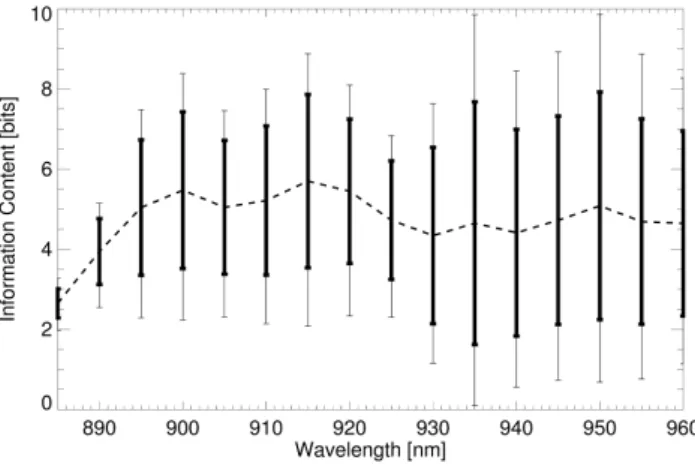
Fig. 9. Mean information content in 27 cases of different atmo-spheric circumstances concerning water vapour of a retrieval using two window channels (METimage: 865, 1020 nm) and an absorp-tion channel (width 10 nm) (broad bars account for the standard de-viation of the cases).
conclusion that for a one absorption channel retrieval, either 900 or 915 can serve as the best choice and the MTG-FCI channel selection is optimal.
5.3.2 Two absorption channel retrieval
The information content of a two absorption channel retrieval is displayed in Fig. 10 with similar logic as in Fig. 9. One ab-sorption channel is at 900 nm (width 10 nm) and the other is at the location indicated at the ordinate (width again 10 nm). Overall, the information content is increased in comparison to Fig. 9. The highest mean, maximum and minimum in-formation contents were determined for wavelengths above 925 nm. The maxima at 935 and 950 nm are outstanding (with a mean of 6.5 respectively 6 bits over all cases). At these wavelengths, the minimum and maximum information content is maximal as well. Thus, the optimal second absorp-tion channel for this case is at 935 nm.
The information content for a two absorption channel re-trieval with a fixed first absorption channel at 915 nm is plot-ted in Fig. 11. Generally, the information contents are in the same range as in Fig. 10. Here, only one maximum in the mean information content at 950 nm is evident and is in the same range as the combination 900 and 935 nm. Con-sequently, the combination of 915 nm and 950 nm is a good choice for a two absorption channel retrieval as well. Com-paring Figs. 10 and 11 reveals that the combination of 900 nm and 935 nm gives slightly higher information contents than 915 nm and 950 nm. The water vapour channels of METim-age are therefore well designed. The 940 nm channel does not improve the retrieval uncertainties significantly (see Fig. 7). This is probably due to the fact that it is planned to have a width of 50 nm and therefore overlap with the 935 nm and 905 nm (see Fig. 2). Generally, a two absorption channel re-trieval is more reliable if the absorption channels are least
Fig. 10.Mean information content in 27 cases of different atmo-spheric circumstances concerning water vapour of a retrieval using two window channels (865, 1020 nm), a fixed first absorption chan-nel at 900 nm and a second absorption chanchan-nel (width 10 nm) (broad bars account for the standard deviation of the cases).
Fig. 11.Mean information content in 27 cases of different atmo-spheric circumstances concerning water vapour of a retrieval using two window channels (865, 1020 nm), a fixed first absorption chan-nel at 915 nm and a second absorption chanchan-nel (width 10 nm) (broad bars account for the standard deviation of the cases).
correlated. This was confirmed by cross-correlating all sim-ulated radiances in the different channels (not shown). The lowest correlation coefficient was calculated for the combi-nation of 900 and 935 nm.
6 Summary and conclusion
Brighter surfaces reflect more radiation and thus the uncer-tainty decreases with higher surface albedo. The accuracy decreases slightly with higher optical thickness over medium and bright surfaces. In cases of a very dark surface, a thick aerosol layer can increase the accuracy slightly because of the increased amount of radiation that has been reflected in the lower troposphere. The overall uncertainty over all cases turns out to be a function of the number of considered ab-sorption channels. The METimage channel setting with three absorption channels was more accurate than the OLCI setting with two absorption channels and the MTG-FCI with one ab-sorption channel for most cases.
The determination of the optimal position of the absorp-tion channels was done in two steps. First, a retrieval using one absorption channel and the instrument-specific window channels were used to calculate the information content for each atmospheric case. The case-dependent behaviour of the information content is similar to the characteristics of the uncertainties: the information content decreases with higher water vapour values (due to H2O-saturation), increases with
higher surface albedo, and decreases slightly with a higher aerosol load. However, there are differences in magnitude be-tween the used absorption channels. The optimal position for the “first” absorption channel was determined to be at 900 or 915 nm. The second step was to calculate the accuracy of a retrieval using the window channels, one fixed absorption channel and a second absorption channel with varying posi-tion. It turned out that the second absorption channel is opti-mally placed in the strong absorbing range above 930 nm. The highest information contents were determined for the combination of 900 nm and 935 nm. This was explained by the low correlation between theses wavelengths. The channel width, which had been varied between 10 and 20 nm, did not seem to have a strong influence on the information content. A second absorption channel of 20 nm width slightly improved the accuracy of the retrievals (not shown). Consequences for the schedules of the instruments are comparably minor. For the METimage concept, the broad 940 nm absorption chan-nel should not be considered. In the OLCI schedule, the loca-tion of the second absorploca-tion channel should be changed to 935 nm. The 914 nm channel of the MTG-FCI concept seems to be a good choice. In general, though, many retrievals and applications already use the 900 nm to determine TCWV. To continue the time series of, e.g. MERIS on ENVISAT, with the same retrievals, the 900 nm channel is the recommended choice.
Edited by: P. Stammes
References
Albert, P., Bennartz, R., and Fischer, J.: Remote sensing of atmospheric water vapor from backscattered sunlight in cloudy atmospheres, J. Atmos. Ocean. Tech., 18, 865–874, doi:10.1175/1520-0426(2001)018<0865:RSOAWV>2.0.CO;2, 2001.
Albert, P., Bennartz, R., Preusker, R., Leinweber, R., and Fischer, J.: Remote sensing of atmospheric water vapor using the moderate resolution imaging spectroradiometer, J. Atmos. Ocean. Tech., 22, 309–314, doi:10.1175/JTECH1708.1, 2005.
Bartsch, B., Bakan, S., and Fischer, J.: Passive remote sensing of the atmospheric water vapour content above land surfaces, Adv. Space Res., 18, 25–28, doi:10.1016/0273-1177(95)00285-5, 1996.
Bennartz, R. and Fischer, J.: A modified k-distribution approach ap-plied to narrow band water vapour and oxygen absorption esti-mates in the near infrared, J. Quant. Spectrosc. Ra., 66, 539–553, doi:10.1016/S0022-4073(99)00184-3, 2000.
Carrer, D., Roujean, J.-L., and Meurey, C.: Comparing Operational MSG/SEVIRI Land Surface Albedo Products From Land SAF With Ground Measurements and MODIS, IEEE T. Geosci. Re-mote, 48, 1714–1728, doi:10.1109/TGRS.2009.2034530, 2010. Fischer, J. and Grassl, H.: Radiative transfer in an
atmosphere-ocean system: an azimuthally dependent matrix-operator approach, Appl. Optics, 23, 1032–1039, doi:10.1364/AO.23.001032, 1984.
Fischer, J. and Leinweber, R. P. R.: Retrieval of total water vapour content from MERIS measurements algorithm theoretical basis document ATBD 2.4, Free University Berlin, Institute for Space Science, Berlin, 2010.
Gao, B.-C., Goetz, A. F. H., Westwater, E. R., Conel, J. E., and Green, R. O.: Possible near-IR channels for remote sens-ing precipitable water vapor from geostationary satellite plat-forms, J. Appl. Meteorol., 32, 1791–1801, doi:10.1175/1520-0450(1993)032<1791:PNICFR>2.0.CO;2, 1993.
Grant, I. P. and Hunt, G. E.: Discrete space theory of radiative trans-fer, I. Fundamentals, P. Roy. Soc. Lond. A Mat., 313, 183–197, 1969a.
Grant, I. P. and Hunt, G. E.: Discrete space theory of radiative trans-fer, II. Stability and non- negativity, P. Roy. Soc. Lond. A Mat., 313, 199–216, 1969b.
Hollstein, A. and Fischer, J.: Radiative transfer solutions for coupled atmosphere ocean systems using the matrix op-erator technique, J. Quant. Spectrosc. Ra., 113, 536–548, doi:10.1016/j.jqsrt.2012.01.010, 2012.
Hess, M., Koepke, P., and Schult, I.: Optical Properties of Aerosols and Clouds: The Software Package OPAC, B. Am. Meteorol. Soc., 79, 831–844, doi:10.1175/1520-0477(1998)079<0831:OPOAAC>2.0.CO;2, 1998.
Lindstrot, R., Preusker, R., Diedrich, H., Doppler, L., Bennartz, R., and Fischer, J.: 1D-Var retrieval of daytime total columnar water vapour from MERIS measurements, Atmos. Meas. Tech., 5, 631– 646, doi:10.5194/amt-5-631-2012, 2012.
No¨el, S., Buchwitz, M., and Burrows, J. P.: Retrieval of total water vapour column amounts from GOME/ERS-2 data, Adv. Space Res., 29, 1697–1702, 2002.
Rodgers, C.: Inverse Methods for Atmospheric Sounding: Theory and Practice, World Scientific Pub Co., Oxford, 2000.
Rothman, L. S., Rinsland, C. P., Goldman, A., Massie, S. T., Ed-wards, D. P., Flaud, J.-M., Perrin, A., Camy-Peyret, C., Dana, V., Mandin, J.-Y., Schroeder, J., McCann, A., Gamache, R. R., Watt-son, R. B., Yoshino, K., Chance, K., Jucks, K., Brown, L. R., Nemtchinov, V., and Varanasi, P.: Reprint of: The HITRAN molecular spectroscopic database and HAWKS (HITRAN At-mospheric Workstation): 1996 edition, J. Quant. Spectrosc. Ra., 111, 1568–1613, doi:10.1016/j.jqsrt.2010.04.019, 2010. Schluessel, P. and Emery, W. J.: Atmospheric water vapour over
oceans from SSM/I measurements, Int. J. Remote Sens., 11, 753– 766, doi:10.1080/01431169008955055, 1990.
Shannon, C. E. and Weaver, W.: The Mathematical Theory of Com-munication, 1949.
IPCC: Climate Change 2007: The Physical Science Basis, Con-tribution of Working Group I to the Fourth Assessment Report of the Intergovernmental Panel on Climate Change, edited by: Solomon, S., Qin, D., Manning, M., Chen Z., Marquis, M., Av-eryt, K. B., Tignor, M., and Miller, H. L., 996 pp., Cambridge University Press, Cambridge, United Kingdom and New York, NY, USA, 2007.
Susskind, J., Barnet, C. D., and Blaisdell, J. M.: Retrieval of atmo-spheric and surface parameters from AIRS/AMSU/HSB data in the presence of clouds, IEEE T. Geosci. Remote, 41, 390–409, 2003.
Twomey, S., Jacobowitz, H., and Howell, H. B.: Matrix methods for multiple-scattering problems, J. Atmos. Sci., 23, 289–298, 1966. Wiscombe, W. J.: Improved Mie scattering algorithms, Appl.