An Analysis of Differences in Terms of Professional Interests Based on
the Project to Replace IAS 39
Cláudia Daniela Ferreira da Mota Carvalho
Instituto Politécnico de Lisboa, Departamento de Contabilidade, Lisboa, Portugal
Fábio Henrique Ferreira de Albuquerque
Instituto Politécnico de Lisboa, Departamento de Contabilidade, Lisboa, Portugal
Joaquín Texeira Quirós
Universidade Autônoma de Lisboa, Departamento de Ciências Econômicas e Empresariais, Lisboa, Portugal
Maria do Rosário Fernandes Justino
Instituto Superior de Contabilidade e Administração de Lisboa, Departamento de Gestão, Lisboa, Portugal
Received on 04.29.2014 – Desk acceptance on 05.26.2014 – 4th version approved on 03.11.2015.
ABSTRACT
The professional interests of the various stakeholders groups are often seen as obstacles to full accounting harmonization. Studying diffe-rent professional interests in the accounting domain is significant for organizations involved in the international accounting harmoniza-tion process, insofar as it enables them to identify the main obstacles to face in order to achieve full harmonizaharmoniza-tion. Thus, this article is aimed at analyzing the differences in terms of professional interests by addressing the participation of various stakeholders groups in the process of issuing/modifying standards of the International Accounting Standards Board (IASB). Based on content analysis, we examined the comment letters sent to the IASB in the context of the first part of the first phase of the project to replace the International Accounting Standard (IAS) 39, entitled “Financial Instruments – Recognition and Measurement”, by the International Financial Reporting Standard (IFRS) 9, on its turn entitled “Financial Instruments”. Respondents were identified according to the stakeholders group, and, later, the collected data underwent a nonparametric chi-square test. The results of this study indicate there are significant differences between the answers obtained from the various stakeholders groups involved in the process of issuing or reviewing a standard of the IASB, above all made clear between the group of financial preparers and the regulatory and/or standard-setting agencies and the professional associations related to accounting.
Keywords: stakeholders groups, accounting harmonization, professional interests, international accounting standards.
1 INTRODUCTION
rently in force three IASB standards that regulate issues related to financial instruments concerning themes on presentation, recognition, and measurement and disclo-sure, namely:
◆ IAS 32 – Financial Instruments: Presentation. his standard establishes the principles for presenting inancial instruments. It applies to the classiication of inancial instruments from the issuer’s viewpoint;
◆ IAS 39 – Financial Instruments: Recognition and Measurement. his standard establishes the principles for recognizing and measuring inancial assets and liabilities; and
◆ IFRS 7 – Financial Instruments: Disclosures. his stan-dard sets out requirements for disclosure of informa-tion on inancial instruments.
The complexity of the theme has also led to suc-cessive changes in the project to modify the issuing of the standard and, as a consequence, the calendar for its adoption. In November 2013, inter alia, some changes were made, with the inclusion of a chapter on hedge ac-counting and the date of application has changed, it was previously scheduled for January 1, 2015 (at the early stages of the project, January, 1, 2013, was expected as date of entry into force). After subsequent amendments, the latest version of IFRS 9, issued in 2014, replaced all previous versions, it must apply to periods beginning on or after January 1, 2018, with early adoption permitted (subject to the requirements of local backing).
In Portugal, the IASB standards were adapted to the national legislation through the Portuguese Accounting Standards and Financial Reporting (NCRF) issued by the Portuguese Accounting Standards Commission (CNC). NCRF 27 – Financial Instruments is the Portuguese stan-dard adapting to the national regulations, at the same time, IAS 32, IAS 39, and IFRS 7 mentioned above.
In Brazil, the Brazilian Accounting Pronouncements Committee (CPC) is the body responsible for adapting the international standards issued by the IASB. Interna-tional accounting standards related to financial instru-ments were adapted to the Brazilian legislation through statements that cover the same names of the standards on which they are based, namely:
◆ CPC 38 – Financial Instruments: Recognition and Measurement, prepared through IAS 39;
◆ CPC 39 – Financial Instruments: Presentation, prepa-red through IAS 32; and
◆ CPC 40 – Financial Instruments: Disclosure, prepared through IFRS 7.
It is worth noticing, finally, that the text of IFRS 9 currently in force has not undergone public discussion, either in Portugal or Brazil.
Nobes and Parker (2006) argue that accounting has undergone changes since the Second World War, due to political transformations (such as the free movement of people and goods), the strong growth of international trade and the internationalization of financial markets and companies. This increasing globalization makes it necessary to reduce differences between the internatio-nal accounting systems, in order to increase the compa-rability level between financial statements of companies from various countries (Nobes & Parker, 2006).
So, one of the main aims of accounting harmoni-zation is to achieve comparability between a financial report published by member countries of the various accounting systems. In the accounting harmonization process, the work provided by the International Ac-counting Standards Board (IASB) stands out, the issuing agency of high quality accounting standards accepted in most countries in the world.
The IASB is an independent issuer of accounting standards and interpretations and financial reporting of international reach, created in 2001, through a res-tructuring of the International Accounting Standards Committee (IASC), created, on its turn, in 1973. It is a member of the International Financial Reporting Stan-dards (IFRS), whose goal is promoting the use and strict application of the standards and interpretations of the IASB and the recognition of a high quality and com-prehensiveness of such standards and interpretations on the part of the adopting countries (International Finan-cial Reporting Standards Foundation, 2013).
It is worth emphasizing that, prior to the reformu-lation of the IASB, the international standards were na-med International Accounting Standards (IAS), issued by the now defunct IASC. Later, these standards were adopted by the IASB.
The international standards issued by the IASB have been widely accepted object on the international sce-ne, with numerous cases of application, directly or by adapting such standards. Particularly, the European Union (EU) has adopted, under the shelter of Regula-tion 1606/2002/EC, from the European Parliament and Council, enacted on July 19, the IASB standards, on a mandatory basis, for all entities with securities admitted to trading on any EU regulated market. The same regu-lation provides that member States include, either on a mandatory or discretionary basis, other entities in the context where these standards are adopted.
cur-IASB standards are principle-based standards, thus leaving room for professional discretion with regard to accounting decisions through concepts specifically outlined in the standards. The existence of subjective concepts in the standards, as well as the possibility of using accounting policies to the detriment of other po-licies also provided for in the standards, may impair the comparability of financial statements, since factors such as the professional interests of each stakeholders group can influence on professional judgment. In this sense, it is worth noticing there are, indeed, differences between the accounting preferences of the various stakeholders groups and whether these interests are reflected in con-tributions submitted to the IASB by each of these groups in the process of issuing or reviewing a standard.
Thus, this article is aimed at investigating differen-ces in terms of professional interests among the users of financial information by addressing the participation of respondents in the processes of issuing/modifying IASB standards in order to provide an answer to the question pointed out in the preceding paragraph. In other words, given the significance of the standard under analysis, in view of the complexity of the issues included in its scope, the main motivation for this study stems from the need to understand whether respondents’ professional inte-rests are reflected in contributions sent to IASB during the process of public discussion of a standard. This is-sue is evaluated through differences in terms of position shown considering the various stakeholders groups par-ticipating in such processes. Also, as already indicated, CPC pronouncements, in Brazil, and the NCRFs from CNC, in Portugal, are based on the IASB standards, and that is the reason why modifications made to internatio-nal standards are especially relevant concerning finan-cial reporting in the context of both countries, analyzed herein as an example.
For the purposes of this study, the questions raised for discussion by the IASB to preparers and users of fi-nancial information and standard-setting agencies re-garding the first part of the first phase of the project to replace IAS 39 by IFRS 9 will be analyzed.
It is worth mentioning that, under the objectives proposed for this study, comments submitted by parti-cipants in the discussion process promoted by the IASB were analyzed without identifying, though, whether the-se comments were, wholly or partly, incorporated by the specific agency.
Authors such as Carmo, Ribeiro and Carvalho (2011) and Jorissen, Lybaert and Van de Poel (2006) argue that the participants in this process have different interests (often contrary), something which leads the answers ob-tained to vary. The studies on which provided this arti-cle with a basis examined the answers sent to standard setters from various perspectives: Tandy and Wilburn (1996) address the participation of academics; Georgiou (2010) analyzes the participation of investment
ma-nagement firms; authors such as Jorissen et al. (2006), Orens, Jorissen, Lybaert and Van Der Tas (2011), and Holder, Karim, Lin and Woods (2013) relate the answers obtained with factors such as culture, tax system, coun-tries’ characteristics or whether the use of IFRS is re-quired or permitted in respondents’ country of origin Huian (2013) examines which are the most participatory stakeholders groups and Carmo, Mussoi and Carvalho (2011) analyze the impact of comments in the process of issuing the standards from the viewpoint of potential groups of interest associated with the process (lobbying).
his study difers from the others, on the one hand, gi-ven the choice of subject matter, insofar as itanalyzes the existence of diferent interests on the part of participants in the regulatory review process, based on the discussion of the project to replace IAS 39. his standard is particular-ly signiicant in the context of the work developed by the IASB, arousing great interest among the stakeholders of inancial information, due to the complexity of the issues included in its scope, particularly in the context of the re-cent economic and inancial crisis of international reach. On the other hand, previous studies about the comment letters received by the IASB have examined such answers from various perspectives. However, in more speciic ter-ms, only the studies by Carmo, Ribeiro et al. (2011) and Adhikari, Betancourt and Alshameri (2014) have a strong similarity to this, to the extent that they analyze the dife-rences on the answers proposed by the various stakehol-ders. his is, however, a diferent research, because in the irst case, the study object accounted for only four ques-tions related to the discussion paper on the IFRS for Small and Medium-Sized Entities (IFRS for SMEs) and, in the second case, the study object was the document issued by the Securities and Exchange Commission (SEC) in order to guide the preparation of inancial reporting in accor-dance with IFRS standards.
The findings shown by these studies do not coincide, since in Carmo, Ribeiro et al. (2011) there is no evidence of different answers depending on the group of interest, whereas in the study by Adhikari et al. (2014) there is evidence of different positions, depending on the res-pondents’ group of interest. Thus, despite the different professional interests, it is not clear that they influence the answers sent to standard-setting agencies within the scope of issuing/modifying accounting standards.
2 THEORETICAL FRAMEWORK
The IASB standards are characterized by their prin-ciples-based approach. This is characterized by dictating principles instead of regulating every possible situa-tion, and, when there is any doubt, people resort to the principle concerned. The principles are defined in the conceptual framework, accompanied by some rules that show how these principles should be applied to speci-fic situations. This approach promotes consistency and transparency, providing the companies with answers in complex and new situations and it implies the need that professionals put professional discretion into practice (Guerreiro, 2008).
The IASB standard-setting process allows all interes-ted parties to participate in public discussions and ex-press an opinion through comment letters.
According to Jorissen et al. (2006), the standardization processes make it possible, in most cases, that stakehol-ders participate and inluence these processes. Since the IASB standard-setting process also allows, over several phases, stakeholders’ participation in the development/ modiication of the standards through comments regar-ding the proposed amendments, there are studies exami-ning the inluence of factors such as culture or the legal system in relation to the origin of the comments received.
here are numerous studies that evaluate the participa-tion of stakeholders groups in the standardizaparticipa-tion proces-ses of the Financial Accounting Standards Board (FASB), the IASB, and the Accounting Standards Board (ASB) in the United Kingdom (Tandy & Wilburn, 1996; Georgiou, 2010; Zülch & Hofmann, 2010; Jorissen et al., 2006; Gi-ner & Arce, 2012; Holder et al., 2013; Huian, 2013).
Tandy and Wilburn (1996) were pioneers in this kind of research by analyzing the participation of academics in the procedures for issuing the standards from the FASB. They conclude, in the study carried out, that aca-demics get involved in the procedures when they have conducted investigations related to the topics under dis-cussion and can contribute by means of their studies and one of the main reasons for the poor participation of this professional class is related to the poor expectations that their views may influence the final decisions.
The study by Anacoreta and Silva (2005) analyzes on a statistical basis the comment letters received by the IASB as part of the introduction of the IFRS standard for SMEs, with the purpose of identifying answer patterns. In the study pointed out, researchers tried to see whe-ther small and medium-sized companies (SMEs) aim at a harmonized accounting and whether the opinions in this context are similar. They concluded that there is a group of answers whose characteristic is having no opi-nion with regard to the IASB questions. They also iden-tified two groups among the answers with an opinion, a group that prefers independent standards for SMEs and another group that prefers interdependence between the two sets of standards.
Jorissen et al. (2006) have analyzed the opinions expres-sed by accounting professionals and standard setters sent to the IASB through comment letters between 2002 and 2005, in an attempt to establish links between the coun-tries’ involvement level in the standardization processes and the characteristics of each country. Among the many assumptions made in this study, some related to the cultu-ral values of Hofstede (1980) and the characteristics of the countries (e.g. non-compliance with regulation costs, tax system) were identiied. Jorissen et al. (2006) conclude that the countries where the costs of non-compliance with stan-dards are higher, accounting professionals try to inluence the standardization process. Countries with high levels of compliance with the standards, with efective judicial sys-tems, and where tax obligations are met have a more active participation in standardization processes. Regarding the cultural variables of Hofstede (1980), mixed results were obtained, but only in relation to the cultural value of power distance we managed to ind a relationship, concluding that high levels of power distance negatively inluence partici-pation in the IASB standardization processes.
The study by Yen, Hirst and Hopkins (2007) shows the analysis of comments submitted to the FASB as an answer to the Exposure Draft (ED) issued during the discussion related to the comprehensive outcome. In this study, the arguments submitted by respondents, in order to understand how the entities try to persua-de the FASB, were categorized and analyzed. The results demonstrate that most of the arguments submitted are related to concerns associated with the entity they re-present. Relationships were found between the proposed amendments and modifications made to the ED that re-sulted in the final standard, something which suggests that the FASB takes into account the opinions expressed.
Georgiou (2010) analyzes the answers to a question-naire related to participation in the IASB processes to issue standards by investment management irms in the United Kingdom. he study reveals that participation in this kind of company is not as low as it is thought to be, because some companies participate through representative agencies, such as associations of investment management irms and that the factor inhibiting these companies to participate is the cost involved in participation. he results also show that these companies think that the accounting professionals, the Eu-ropean standard setters, and the United Kingdom are the dominant groups and they have greater power to inluence the process of issuing the IASB standards.
participatory process is less efective than unlisted companies in the United Kingdom, and one of the main reasons for not participating in the process is the fact they feel that opinions do not inluence the IASB. It is also concluded that preparers of inancial information in Belgium are more involved in the IASB standard-setting process than non-preparers of inancial information. hus, the results seem to conirm the theory that the regulatory system in the country of origin inluences the participation in standardization processes.
Carmo et al. (2011) analyzed the influence of groups of interest (lobbying) in the IASB standard-setting pro-cess. They concluded that only the opinions of accoun-ting professionals, standard setters, and academics in-fluence the IASB’s final decision.
Huian (2013) analyzes the involvement level of key stakeholders groups in the development of new accoun-ting standards related to impairment of financial instru-ments. The results suggest that Europeans and preparers of financial information are the major players, accoun-ting professionals and users are the ones who agree with the new rules, and nearly half of the other groups disa-gree with the rules. Geographically, the greatest oppo-sition is coming from Europe and Australia, while in-ternational organizations have rather balanced opinions. Holder et al. (2013) analyzed the comment letters recei-ved by the FASB and the IASB as part of the amendments proposed to IAS 37 and the Financial Accounting Standard (FAS) 5. hey examined how the answers are afected due to the fact that the use of IFRS is mandatory or permitted in the country of origin of the answers. Greater support for the modiications proposed by the IASB than those proposed by the FASB was found. he IASB has received more answers from countries that permit or require the use of IFRS than countries subject to national standards. Respondents from countries where the use of IFRS is permitted or required tend to respond less favorably to the modiications proposed to the ED, citing the signiicance to support their positions.
Larson and Herz (2013) addressed the participation level of various countries and the factors that inluence the geographical diversity of the comment letters
submit-ted to the IASB from 2001 to 2008. he authors concluded that the most involved countries are those in the EU and those with rather developed capital markets, and 55% of answers were received from 7 countries: Australia, Ca-nada, France, Germany, Switzerland, United Kingdom, and USA. hey found, too, that countries that histori-cally have higher accounting diferences from the IASB standards are more participatory. In most countries, the stakeholders groups of accounting professionals, national standard setters, and accounting irms send at least half of the letters. In the study conducted, the authors also found that when a standard afects particularly one or more countries, their participation tends to increase.
Adhikari et al. (2014) examined the comment letters sent to the SEC in the context of issuing a proposal for a guide to the use of IFRS in order to identify the level at which res-pondents support this proposal, whether there were diferent positions depending on the respondent’s group and also if preparers’ answers varied according to the characteristics of the company they represented. he authors concluded that, although most respondents agree with a group of global high quality accounting standards, an identical majority did not agree with the proposals in the document, identifying that answers vary according to respondents’ characteristics, too.
A literature review on studies that use the comment let-ters received by the IASB within the regulatory review pro-cesses as study object have analyzed the answers from di-ferent perspectives. he analysis of diferences concerning the answers obtained from various stakeholders groups involved in such processes, however, has been relatively neglected in the literature on the theme. his study aims to investigate whether there are diferences in the answers obtained by the IASB, given the diferent characteristics and interests of various stakeholders groups, just like the study by Carmo, Ribeiro et al. (2011). However, these au-thors used a diferent study object, namely, the standard on IFRS for SMEs, identifying potentially inconclusive results.
The next section provides the methodological outli-ne adopted to conduct the empirical study proposed for this article.
3 METHODOLOGY
This study analyzes the existence of significant di-fferences in the answers submitted in the context of the comment letters in answer to the ED – Financial Ins-truments Classification and Measurement, concerning the project to replace IAS 39 by IFRS 9 (first part of the first phase of the project), based on the existence of va-rious professional interests and having a ranking based on different stakeholders groups. The choice of this pro-ject is related to the fact that the accounting approach to financial instruments is regarded as a complex theme that involves issues in which it is possible to identify the influence of professional interests in the answers. Ano-ther factor that lies on the basis of this choice is related to the high participation rate, given the interest that the subject awakens in various stakeholders (among others, preparers, users of financial reporting, and the standard--setting agencies).
Jorissen et al. (2006) have tested in one of the as-sumptions the involvement level of professionals in the IASB process to issue standards depended on their pro-fessional qualification. The authors concluded that pre-parers of financial information tend to participate more than users, that the vast majority of answers came from professional associations, and that the agencies most
directly affected by the standards participate more ac-tively. They also argue that participants in the process of discussing the standards respond in defense of their interests and that these interests often differ from and conflict with the interests of other professionals. Par-ticularly, the interests of information users may differ from the interests of preparers. Although advocating for the existence of differences in the answers provided by the various stakeholders groups, Jorissen et al. (2006) have not analyzed the existence of differences between the answers obtained, only the answers related to factors such as the national characteristics of the respondent countries.
Carmo, Ribeiro et al. (2011) think, in the same sen-se, that respondents have different interests and, there-fore, the answers may vary. However, despite conduc-ting a study on the existence of differences between the answers, only four questions of the discussion paper on the IFRS for SMEs were analyzed. Since this is a standard aimed at small entities and taking into account that most respondents in the process of issuing/modifying stan-dards work in large companies, the existence of differen-ces between the answers motivated by different interests may not be apparent.
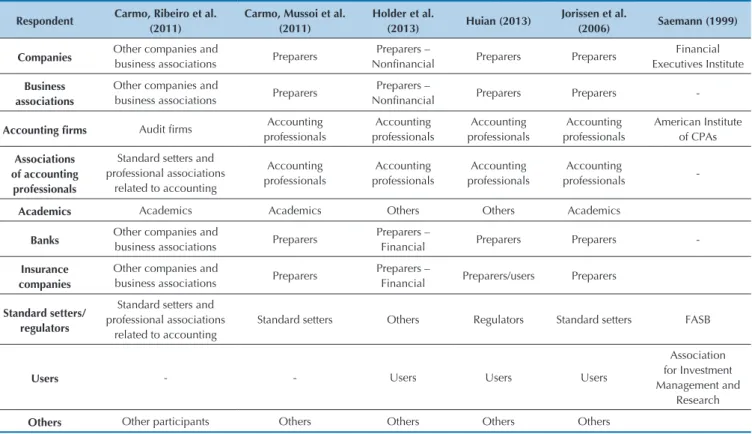
Respondent Carmo, Ribeiro et al. (2011)
Carmo, Mussoi et al. (2011)
Holder et al.
(2013) Huian (2013)
Jorissen et al.
(2006) Saemann (1999) Companies Other companies and
business associations Preparers
Preparers –
Noninancial Preparers Preparers Executives InstituteFinancial
Business associations
Other companies and
business associations Preparers
Preparers –
Noninancial Preparers Preparers
-Accounting irms Audit irms Accounting
professionals
Accounting professionals
Accounting professionals
Accounting professionals
American Institute of CPAs
Associations of accounting
professionals
Standard setters and professional associations
related to accounting
Accounting professionals
Accounting professionals
Accounting professionals
Accounting
professionals
-Academics Academics Academics Others Others Academics
Banks Other companies and
business associations Preparers
Preparers –
Financial Preparers Preparers
-Insurance companies
Other companies and
business associations Preparers
Preparers –
Financial Preparers/users Preparers
Standard setters/ regulators
Standard setters and professional associations
related to accounting
Standard setters Others Regulators Standard setters FASB
Users - - Users Users Users
Association for Investment Management and
Research
Others Other participants Others Others Others Others
According to Cortese, Irvine and Kaidonis (2010), large accounting/audit multinational firms collaborate with the IASB not only through technical comments, but also through monetary support. Saemann (1999) thinks that accounting professionals may take various positions in the standard issuing processes, and the participation of professionals aims at ensuring that the public interest is met. Thus, accounting professionals seek to ensure, si-multaneously, the interests of users of financial informa-tion and their clients/employees/associates, advocating for the existence of higher disclosure and uniformity le-vels and lower conservatism lele-vels.
According to Durocher, Fortin and Côté (2007) and Georgiou (2010), the main purpose of user participa-tion in the process of issuing standards of the IASB is to achieve financial statements with relevant and transpa-rent information for decision making. Saemann (1999) believes that users of financial information have a gre-ater interest in uniform financial statements, since this increases comparability between companies, making the financial information more noticeable. They also prefer high disclosure levels.
According to Zeff (2006), the main purpose of pre-parers’ participation in the standard issuing process is related to the maintenance of flexibility when managing outcomes in the financial statements. Thus, the prepa-rers of financial information usually take an unfavora-ble position with regard to uniform practices. Saemann (1999) thinks that preparers are opposed to accounting practices that require higher costs, such as, for instance, retrospective application of new practices. The author also believes that preparers usually take unfavorable po-sitions with regard to high disclosure levels, since, be-sides increasing costs for preparing the financial state-ments, they make companies more transparent, making it easier to detect unfavorable results. According to Sae-mann (1999), preparers of financial information tend to oppose to accounting practices that increase volatility in the financial statements, showing a more conservative attitude.
The main purpose of regulators/standard setters, when participating in the process of issuing the IASB standards, is to ensure the issue of standards that pro-vide useful information for decision making (Saemann, 1999). The IASB believes that they play a key role in collaboration with the IASB for preparing high quality accounting standards (International Financial Repor-ting Standards Foundation, 2013). According to Zeff (2006), government agencies tend to advocate for legis-lation that meets the interests of domestic enterprises. Saemann (1999) argues that these organizations tend to reflect the goals of users of financial information, i.e. preference for greater uniformity, transparency, and lo-wer conservatism.
Larson, Herz and Kenny (2011) believe that the par-ticipation of academics and their research play a major role to develop high-quality accounting standards.
Ac-key role in the process of issuing standards, as they are economically independent and have the theoretical kno-wledge needed for a correct evaluation of the proposals. In view of previous research, the following hypothe-sis was defined for this study:
General hypothesis: There are significant differen-ces between the answers obtained by the IASB in the context of the ED “Financial Instruments: Classification and Measurement”, in view of the various stakeholders groups participating in the process.
The classification of answers obtained is appropria-te, given the study features and purposes, just like those conducted by Jorissen et al. (2006), Carmo, Ribeiro et al. (2011), Holder et al. (2013), Huian (2013), among others.
So, based on the literature review presented, the clas-sification of respondents will be based on the following distinction: nonfinancial preparers, financial preparers, accounting professionals, academics, standard setters and professional associations related to accounting and users (Carmo, Ribeiro et al., 2011; Holder et al., 2013).
To carry out the study proposed, data were collected from the answers to the ED analyzed by the authors of this study. Such answers, as mentioned above, were sent to the IASB through comment letters between July 14, 2009, and September 14, 2009. Within this period, 246 comment letters regarding inancial instruments were submitted to the IASB, and 10 situations where their con-tent was inaccessible. Additionally, one respondent sent 2 comment letters, 2 letters did not bring any identiication of the country of origin, and only 2 respondents just made comments, not answering any of the questions actually asked. hus, 231 answer letters to the irst phase of the exposure drat were analyzed, the subject of this article. Access to the comment letters was obtained through the website of the IFRS Foundation. Where appropriate, the information providing respondents’ characterization with a basis, in view of the literature review conducted, was identiied by means of the respective websites informed in the answers sent.
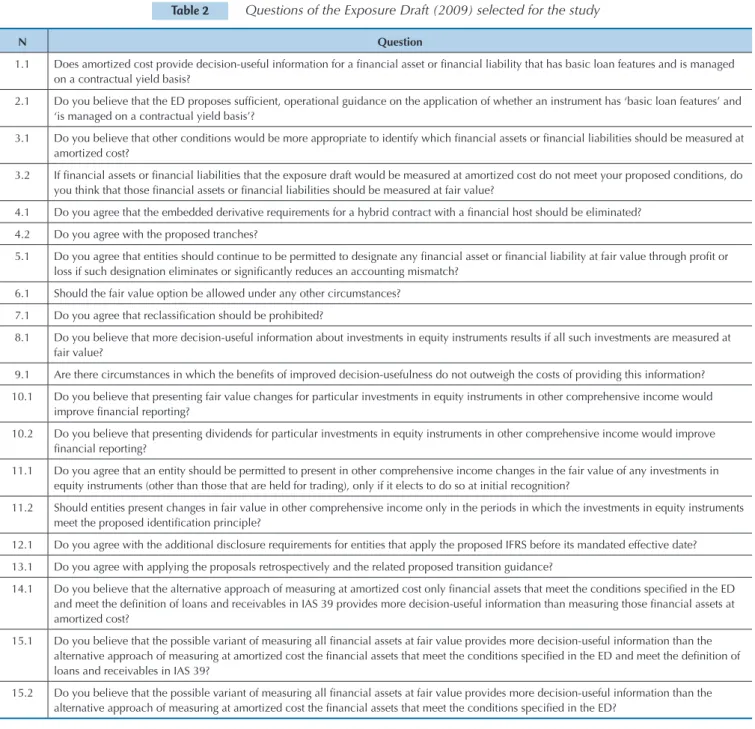
20 questions underwent analysis, taking into account the possibility of a more objective coding way, depending on
the agreement or disagreement with the proposal. These 20 questions are displayed in Table 2.
It is worth noticing that, despite most respondents have followed the structure of the questions, some did not, just stating their general position. Some respon-dents gave brief answers, occasionally just “yes” or “no”, and others provided an exhaustive answer, with exam-ples, detailed explanations of their positions, and how the modifications would affect their organizations and, in some cases, they provided alternative hypotheses and suggestions for improvement. In some cases, an analysis of the answers was rather direct and, in other cases, ra-ther subjective, requiring a more detailed examination to determine the respondent’s position.
In order to conduct the study proposed, the questions were analyzed through their transformation into dicho-tomous variables, so the analysis has “yes” (agreement) or “no” (disagreement) to each of the questions, coded as “1” and “0”, respectively, was regarded as enough to achieve the proposed goals, just like Carmo, Ribeiro et al. (2011).
Thus, according to Carmo, Ribeiro et al. (2011), ac-counting professionals include large acac-counting/audit firms.
This group of users includes the rating agencies, in-vestors, investors associations, and individual answers
N Question
1.1 Does amortized cost provide decision-useful information for a inancial asset or inancial liability that has basic loan features and is managed
on a contractual yield basis?
2.1 Do you believe that the ED proposes suficient, operational guidance on the application of whether an instrument has ‘basic loan features’ and
‘is managed on a contractual yield basis’?
3.1 Do you believe that other conditions would be more appropriate to identify which inancial assets or inancial liabilities should be measured at amortized cost?
3.2 If inancial assets or inancial liabilities that the exposure draft would be measured at amortized cost do not meet your proposed conditions, do you think that those inancial assets or inancial liabilities should be measured at fair value?
4.1 Do you agree that the embedded derivative requirements for a hybrid contract with a inancial host should be eliminated?
4.2 Do you agree with the proposed tranches?
5.1 Do you agree that entities should continue to be permitted to designate any inancial asset or inancial liability at fair value through proit or loss if such designation eliminates or signiicantly reduces an accounting mismatch?
6.1 Should the fair value option be allowed under any other circumstances?
7.1 Do you agree that reclassiication should be prohibited?
8.1 Do you believe that more decision-useful information about investments in equity instruments results if all such investments are measured at fair value?
9.1 Are there circumstances in which the beneits of improved decision-usefulness do not outweigh the costs of providing this information? 10.1 Do you believe that presenting fair value changes for particular investments in equity instruments in other comprehensive income would
improve inancial reporting?
10.2 Do you believe that presenting dividends for particular investments in equity instruments in other comprehensive income would improve
inancial reporting?
11.1 Do you agree that an entity should be permitted to present in other comprehensive income changes in the fair value of any investments in
equity instruments (other than those that are held for trading), only if it elects to do so at initial recognition?
11.2 Should entities present changes in fair value in other comprehensive income only in the periods in which the investments in equity instruments
meet the proposed identiication principle?
12.1 Do you agree with the additional disclosure requirements for entities that apply the proposed IFRS before its mandated effective date?
13.1 Do you agree with applying the proposals retrospectively and the related proposed transition guidance?
14.1 Do you believe that the alternative approach of measuring at amortized cost only inancial assets that meet the conditions speciied in the ED and meet the deinition of loans and receivables in IAS 39 provides more decision-useful information than measuring those inancial assets at amortized cost?
15.1 Do you believe that the possible variant of measuring all inancial assets at fair value provides more decision-useful information than the alternative approach of measuring at amortized cost the inancial assets that meet the conditions speciied in the ED and meet the deinition of loans and receivables in IAS 39?
15.2 Do you believe that the possible variant of measuring all inancial assets at fair value provides more decision-useful information than the alternative approach of measuring at amortized cost the inancial assets that meet the conditions speciied in the ED?
(Holder et al., 2013).
Nonfinancial preparers include nonfinancial compa-nies and their associations (Holder et al., 2013).
Financial preparers include financial institutions and financial institutions associations and financial profes-sionals. Although financial institutions are often regar-ded as users of financial statements, due to their invest-ment activities, they were regarded as preparers in this study, since they are the biggest users and developers of financial instruments (Chatham, Larson & Vietze, 2010).
Regulatory bodies and/or professional associations related to accounting include the national standard--setting agencies, regulators of capital markets, other government agencies, and professional associations in the accounting area (Carmo, Ribeiro et al. 2011).
Finally, the answers from academics were considered in the group named “Academics” (Jorissen et al. 2006; Carmo, Ribeiro et al. 2011).
Table 3 shows the number of answers obtained accor-ding to the respondent’s stakeholder group.
We observe that the most participatory stakeholders group in the discussion concerned was that of financial preparers and, in turn, accounting professionals, acade-mics, and users were less participatory groups. The fre-quent participation of financial preparers may be seen as an outcome of the frequent use and promotion of finan-cial instruments by finanfinan-cial institutions (Huian, 2013). On the other hand, the poor participation of academics and users in the accounting standardization processes is confirmed, just as previously identified in studies by Durocher et al. (2007) and Tandy and Wilburn (1996).
In this sense, and since the answers obtained from the groups of academics, accounting professionals, and
users are not sufficiently representative (under 30), they will not be taken into account for the purposes of this study. Thus, the study population is reduced to a num-ber consisting of 189 respondents.
To analyze the assumptions made, we used in this stu-dy the nonparametric chi-square test, usually employed in studies like this (e.g. Carmo, Ribeiro et al., 2011). he chi-square test was used in this study by means of the sta-tistical sotware Predictive Analytics SotWare (PASW), and a signiicance level (or p value) at 5% was used.
he next section is devoted to presenting the results obtained in view of the methodological outline described above.
4 RESULTS
This study aims to identify the existence of signifi-cant differences between the answers obtained and the various professional interests, having in mind the clas-sification made on the basis of distinct respondents’
of groups with representative participation: financial/ nonfinancial preparers (Table 4); regulatory and/or standard-setting agencies and professional associations related to accounting vs. nonfinancial preparers (Table Table 3 Answers according to the respondent’s stakeholder group
Stakeholders group Number of answers Participation (%) Regulatory/standard-setting agencies and professional associations related to accounting 56 24%
Professional association in the accounting area 23 10%
Regulatory/standard-setting agencies 33 14%
Financial preparers 102 44%
Business associations and inancial professionals 51 22%
Financial companies 51 22%
Noninancial preparers 31 13%
Noninancial companies 17 7%
Business associations and noninancial professionals 14 6%
Accounting professionals 10 4%
Accounting/audit irms 10 4%
Users 17 7%
Users 17 7%
Academics 15 6%
Academics 15 6%
cies and professional associations related to accounting vs. financial preparers (Table 6). To this end, the ques-tions raised for discussion by the IASB among preparers and users of financial information and standard-setting agencies will be analyzed concerning the first part of the
first phase of the project to replace IAS 39 – Financial Instruments: Classification and Measurement by IFRS 9.
Table 4 displays the results obtained by comparing two groups: financial preparers and nonfinancial pre-parers.
It is observed, by analyzing Table 4, regarding inancial and noninancial preparers, that the hypothesis is supported on answers to the questions 5.1, 6.1, and 9.1, and in the last two questions a greater amount of inancial preparers who prefer fair value measurement is evidenced. It is also observa-ble, having the answers to questions 15.1 and 15.2 as a basis,
that both inancial and noninancial preparers disagree 100% with a measurement of all inancial instruments at fair value.
Table 5 identifies, in turn, the comparison of answers obtained from nonfinancial preparers and regulators and/or standard-setting agencies and professional as-sociations related to accounting.
Table 5 Results obtained from nonfinancial preparers and regulatory agencies
Financial preparers Noninancial preparers Pearson’s chi-square
0 % 1 % Total 0 % 1 % Total
Question 1.1 4 5% 78 95% 82 2 8% 23 92% 25 0.553 Question 2.1 76 93% 6 7% 82 19 95% 1 5% 20 0.713 Question 3.1 17 21% 65 79% 82 4 17% 20 83% 24 0.660 Question 4.1 16 21% 59 79% 75 7 30% 16 70% 23 0.368 Question 4.2 6 8% 67 92% 73 1 7% 13 93% 14 0.892 Question 5.1 1 1% 80 99% 81 2 11% 17 89% 19 0.033 Question 6.1 51 73% 19 27% 70 4 24% 13 76% 17 0.000 Question 7.1 76 93% 6 7% 82 21 91% 2 9% 23 0.826 Question 8.1 22 26% 63 74% 85 2 8% 22 92% 24 0.067 Question 9.1 16 23% 53 77% 69 0 0% 23 100% 23 0.011 Question 10.1 21 24% 65 76% 86 5 20% 20 80% 25 0.646 Question 10.2 76 86% 12 14% 88 21 81% 5 19% 26 0.482 Question 12.1 24 40% 36 60% 60 6 35% 11 65% 17 0.725 Question 13.1 53 74% 19 26% 72 11 73% 4 27% 15 0.982 Question 14.1 1 2% 65 98% 66 1 6% 17 94% 18 0.319 Question 15.1 0 0% 64 100% 64 0 0% 19 100% 19 -Question 15.2 0 0% 63 100% 63 0 0% 19 100% 19
-Table 4 Results obtained from financial and nonfinancial preparers
Regulators/professional associations related to accounting Noninancial preparers Pearson’s chi-square
0 % 1 % Total 0 % 1 % Total
The results obtained in this analysis show that the hy-pothesis is confirmed only in the answers to questions 3.1, 7.1, 8.1, 9.1, and 13.1.
Regarding the question 3.1, it is observed that stan-dard setters/professional associations related to accoun-ting are divided concerning the increase of financial instruments measured at amortized cost, while nonfi-nancial preparers prefer, in most cases, increasing the application range of this method.
Regarding the question 7.1, we notice that, while standard setters/professional associations related to ac-counting are rather divided concerning the prohibition of reclassification, nonfinancial preparers are observed in 91% of the cases against the prohibition of reclassifi-cation of financial instruments.
Also concerning questions 8.1 and 9.1, standard setters/ professional associations related to accounting are rather divi-ded. hus, while inancial preparers think, in 92% of the cases, that inancial information does not become more useful if all inancial instruments are measured at fair value, 100% of the answers identiied situations where the beneit of measuring all inancial instruments at fair value does not exceed the cost.
As for the question 13.1, it is found that, while 73% of the standard setters/professional associations related to accounting agree with the retrospective application of IFRS 9, the same percentage of noninancial preparers di-sagree with this measure.
Table 6 displays, inally, the results obtained on inan-cial preparers versus standard setters/professional asso-ciations related to accounting.
Table 6 Results obtained from financial preparers and regulatory agencies
Table 6 shows a reasonable support for the existence of significant differences between the responses obtai-ned with a view to professional respondent classification (financial preparer versus standard setter/professio-nal associations related to accounting) concerning the answers 3.1, 4.2, 6.1, 7.1, 10.2, 12.1, 13.1, 15.1, and 15.2.
In the case of question 3.1, standard setters/profes-sional associations are rather divided, while 79% of fi-nancial preparers think it is appropriate to increase the application range of amortized cost.
As for the question 4.2, it is observable that, while 21% of standard setters agree with the proposal of tran-ches, only 8% of financial preparers agree with this pro-posal, as this measure implies increasing financial ins-truments measured at fair value.
It is noticed that, concerning question 6.1, the cate-gory of standard setters is divided, while 73% of the fi-nancial preparers agree with the possibility that the fair
Concerning the question 7.1, while standard setters are divided, 93% of the financial preparers disagree with the prohibition of reclassification of financial instru-ments.
The question 10.2 shows that 65% of standard set-ters/associations disagree with the measurement of divi-dends from financial instruments directly in other com-prehensive income, while 86% of the financial preparers disagree with it.
Regarding further disclosure for companies that ap-ply IFRS 9 before its effective date (question 12.1), stan-dard setters agreed in 86% of cases, while only 60% of the financial preparers agree, something which indicates that they are rather divided as for disclosure issues.
Considering the question 13.1, it is observed that, while 73% of the standard setters are in favor of the re-trospective application of the standard, 74% of the fi-nancial preparers are against such application, citing
Standard setters/professional associations related to
accounting Financial preparers Pearson’s chi-square
0 % 1 % Total 0 % 1 % Total
As for the questions 15.1 and 15.2, it is observed that 100% of the inancial preparers do not agree with the me-asurement of all inancial instruments at fair value. his percentage is reduced to 90% with regard to standard set-ters/professional associations related to accounting.
Overall, it is observed that preparers are oten inluen-ced by the costs that the application of measures implies, something which does not occur with standard setters/ professional associations related to accounting, which are rather focused on the quality of the information provided. It is also noticed that the preparers are more frequently opposed to uniform practices, disclosure practices, and less conservative practices, as opposed to standard
set-ters/professional associations related to accounting, who have rather divided opinions concerning uniformity, dis-closure, and conservatism, something consistent with that established by Saemann (1999).
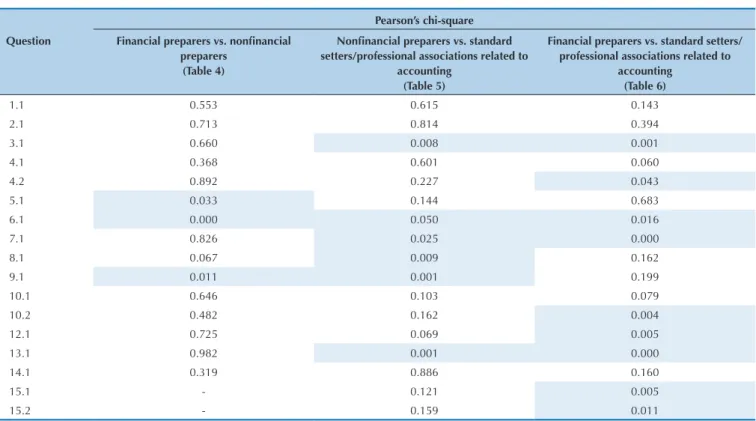
Subsequently, Table 7 summarizes the results ob-tained and already presented in previous tables in the context of this study, considering the questions identi-fied and the various stakeholders groups under analysis. Based on such results, it is possible to observe, in short, a greater number of significant differences (significance level lower than 5%) when comparing financial prepa-rers to standard-setting agencies or professional associa-tions related to accounting.
Table 7 Summary of the results obtained in this study
Finally, the next section shows the main conclusions, limitations, and prospects for further development iden-tified for this study.
5 CONCLUSIONS
According to the results shown, it was possible to establish, in general terms, there are different positions among the various stakeholders groups, observable es-pecially among the group of financial preparers and re-gulators and/or standard setters and professional asso-ciations related to accounting.
Thus, comparing the various stakeholders groups, we highlight the following key findings:
i. Financial preparers vs. noninancial preparers: ac-cording to the results obtained by analyzing Table 4, there is evidence of diferences between the group
of inancial preparers and the group of noninancial preparers regarding the answers obtained in only 3 questions, showing a larger amount of inancial pre-parers who prefer fair value measurement.
ii. Noninancial preparers vs. regulatory and/or standard-setting agencies and professional asso-ciations related to accounting: according to the results obtained by analyzing Table 5, the group of noninancial preparers and the regulatory and/or standard-setting agencies and professional associa-tions related to accounting, in turn, there is a greater
Pearson’s chi-square Question Financial preparers vs. noninancial
preparers (Table 4)
Noninancial preparers vs. standard
setters/professional associations related to accounting
(Table 5)
Financial preparers vs. standard setters/ professional associations related to
accounting (Table 6)
1.1 0.553 0.615 0.143
2.1 0.713 0.814 0.394
3.1 0.660 0.008 0.001
4.1 0.368 0.601 0.060
4.2 0.892 0.227 0.043
5.1 0.033 0.144 0.683
6.1 0.000 0.050 0.016
7.1 0.826 0.025 0.000
8.1 0.067 0.009 0.162
9.1 0.011 0.001 0.199
10.1 0.646 0.103 0.079
10.2 0.482 0.162 0.004
12.1 0.725 0.069 0.005
13.1 0.982 0.001 0.000
14.1 0.319 0.886 0.160
15.1 - 0.121 0.005
divergence between the answers obtained, and the hypothesis is conirmed in about 1/3 of the questions examined (more precisely, in 6 out of the 17 ques-tions analyzed). Also, the regulatory agencies and/or standard-setting and professional associations rela-ted to accounting have more diferent answers from each other, while noninancial preparers have more homogeneous viewpoints shown in the answers. iii. Financial preparers vs. regulatory and/or
stan-dard-setting agencies and professional associa-tions related to accounting: according to the results obtained by analyzing Table 6, the comparison be-tween the answers obtained from inancial preparers and regulators and/or standard setters and professio-nal associations related to accounting shows, iprofessio-nally, a reasonable support for the existence of signiicant diferences between various stakeholders groups, since out of the 17 questions discussed, 9 signiican-tly difer (about half). his analysis has, in this sense, a rather strengthened support for the hypothesis pro-posed in this study, when compared to the results of the analysis shown.
It is also observed, in general terms, that preparers, either financial or nonfinancial, are more often opposed to uniform practices, disclosure practices, and less con-servative practices, as opposed to standard setters/pro-fessional associations related to accounting, which have rather divided opinions when it comes to consistency, disclosure, and conservatism.
The existence of significant differences found in the answers, given the different stakeholders groups, is in line with the studies by Huian (2013) and Chatham et al. (2010) and it is opposite to the results obtained by Carmo, Ribeiro et al. (2011), who do not identify
signi-ficant differences between the responses obtained from the groups mentioned.
For further research, it is suggested to conduct the study proposed at the other stages in the process to replace IAS 39 by IFRS 9, as well as the expansion of this study to other stan-dards that are also undergoing a replacement process, thus covering other themes diferent from inancial instruments.
he main limitation of this study refers to the research method adopted, content analysis, since it provides cer-tain subjectivity to the study, especially in cases where the answers are unclear and hinder interpretation. he study of international diferences in the domain of accounting and the various interests of stakeholders groups in inan-cial information is signiicant to the countries and organi-zations involved in the international accounting harmo-nization process. hus, we aim that the results obtained in this study provide the support needed to decision-making on the part of the agencies that issue international stan-dards, as well as by national agencies in charge of adop-ting these standards.
Noticing the impact and incidence of concepts related to the accounting practice, based on professional discretion, contributes so that the goals behind the harmonization pro-cess, namely an efective comparability of inancial reporting at the international level, are more easily achieved.
Further research may use the comment letters sub-mitted to the national agencies responsible for issuing accounting and financial reporting standards as a study object, namely CNC (in Portugal) and CPC (in Brazil). Other investigations may also use as a study object pu-blic discussions provided by the IASB after issuing and/ or modifying a new standard, having in mind, inter alia, the evaluation of potential problems that are raised after its entry into force.
Adhikari, A., Betancourt, L., & Alshameri, F. (2014). he SEC’s proposed IFRS roadmap: an analysis of comment letters using content analysis and textual sotware. Journal of International Accounting, Auditing and Taxation, 23,98-108.
Anacoreta, L., & Silva, L. (2005). International accounting standards for SME’s: an exploratory study (working paper). Porto: Universidade Católica Portuguesa.
Carmo, C., Mussoi, A., & Carvalho, L. (2011). A inluência dos grupos de interesse no processo de normatização contábil internacional: o caso do discussion paper sobre leasing. In Anais do11º Congresso USP de Controladoria e Contabilidade. São Paulo, SP. Recuperado de http:// www.congressousp.ipecai.org/web/artigos112011/208.pdf Carmo, C., Ribeiro, A., & Carvalho, L. (2011). Convergência de fato
ou de direito? A inluência do sistema jurídico na aceitação das normas internacionais para pequenas e médias empresas. Revista Contabilidade Financeira, 22(57), 242-262.
Chatham, M., Larson, R., & Vietze, A. (2010). Issues afecting the development of an international accounting standard on inancial instruments. Advances in Accounting, 26, 97-107.
Cortese, S., Irvine, H., & Kaidonis, M. (2010). Powerful players: how constituents captured the setting of IFRS 6, an accounting standard
Durocher, S., Fortin, A., & Côté, L. (2007). User’s participation in the accounting standard-setting process: a theory-building study.
Accounting, Organizations and Society, 32, 29-59.
Georgiou, G. (2010). he IASB standard-setting process: participation and perceptions of inancial statement users. he British Accounting Review, 42, 103-118.
Giner, B., & Arce, M. (2012). Lobbying on accounting standards: evidence from IFRS 2 on share-based payments. European Accounting Review,
21(4), 655-691.
Guerreiro, M. (2008). Harmonização contabilística internacional: tendências internacionais. Revista Auditores e Revisores, 43, 46-53. Hofstede, G. (1980). Culture’s consequences: international diferences in
work-related values. Londres: Sage.
Holder, A., Karim, K., Lin, K., & Woods, M. (2013). A content analysis of the comment letters to the FASB and IASB: accounting for contingencies. Advances in Accounting, 29, 134-153.
Huian, M. (2013). Stakeholder’s participation in the development of the new accounting rules regarding the impairment of inancial assets.
Business Management Dynamics, 2(9), 23-35.
International Financial Reporting Standards Foundation. (2009). Constitution. Recuperado de http://www.ifrs.org/Current-Projects/
Financial-Instruments-Recognitio/Phase-I-Classiication-and-measurement/Pages/Phase-I-Classiication-and-measurement.aspx International Financial Reporting Standards Foundation. (2013).
Constitution. Recuperado de http://www.ifrs.org/he-organisation/ Governance-and-accountability/Constitution/Documents/IFRS-Foundation-Constitution-January-2013.pdf
Jorissen, A., Lybaert, N., & Van de Poel, K. (2006). Lobbing towards a global standard setter – do national characteristics matter? An analysis of the comment letters written to the IASB. In Gregoriou, G. N., & Gaber, M. (Eds.), International accounting: standards, regulations and inancial reporting (pp. 1-40). Netherlands: Elsevier.
Larson, R., & Herz, P. (2013). A multi-issue/multi-period analysis of the geographic diversity of IASB comment letter participation. Routledge,
10, 99-151.
Larson, R., Herz, P., & Kenny, S. (2011). Academics and the development of IFRS: an invitation to participate. Journal of International Accounting Research, 10(2), 97-103.
Nobes, C., & Parker, P. (2006). Comparative international accounting (9a ed.). London: Prentice Hall.
Orens, R., Jorissen, A., Lybaert, N., & Van Der Tas, L. (2011). Corporate lobbying in private accounting standard setting: does the IASB have to reckon with national diferences? Accounting in Europe, 8(2), 211-234. Saemann, G. (1999). An examination of comment letters iled in the U.S.
inancial accounting standard-setting process by institutional interest
groups. Abacus, 35(1), 1-28.
Tandy, P., & Wilburn, N. (1996). he academic community’s participation in standard setting: submission of comment letters on SFAS nos. 1-117. Accounting Horizons, 10(3), 92-111.
Weber, R. (1990). Basic content analysis (2a ed.). Newbury Park, CA: Sage. Yen, A., Hirst, D., & Hopkins, P. (2007). A content analysis of the
comprehensive income exposure drat comment letters. Research in Accounting Regulation, 19, 53-79.
Zef, S. (2006). Comparative international accounting: political lobbying on accounting standards – national and international experience. London: Prentice Hall.
Zülch, H., & Hofmann, S. (2010). Lobbying on accounting standard setting in a parliamentary environment: a qualitative approach (HHL Working Paper n. 94). Leipzig: HHL Leipzig Graduate School of Management.
Correspondence address:
Cláudia Daniela Ferreira da Mota Carvalho Instituto Politécnico de Lisboa
Avenida Miguel Bombarda, 1069-035, Lisboa