WORKING PAPER SERIES
CEEAplA WP No. 05/2006
Teaching Keynes’s Principle of Effective Demand
and Chapter 19
Corrado Andini
Teaching Keynes’s Principle of Effective Demand
and Chapter 19
Corrado Andini
Universidade da Madeira (DGE)
e CEEAplA
Working Paper n.º 05/2006
Abril de 2006
CEEAplA Working Paper n.º 05/2006 Abril de 2006
RESUMO/ABSTRACT
Teaching Keynes’s Principle of Effective Demand and Chapter 19
This paper extends a model proposed by Dalziel and Lavoie (2003) and discuss the main difference between Keynes and the neoclassical theory in the extended framework: the consequences of money-wage flexibility.
Keywords: Keynes, Effective Demand, Real Wage, Money Wage, Employment. JEL Classification: E12, E24.
Corrado Andini
Departamento de Gestão e Economia Universidade da Madeira
Edíficio da Penteada Caminho da Penteada 9000-390 Funchal
Teaching Keynes’s Principle of Effective Demand and Chapter 19
Corrado Andini*
ABSTRACT
This paper extends a model proposed by Dalziel and Lavoie (2003) and discuss the main difference between Keynes and the neoclassical theory in the extended framework: the consequences of money-wage flexibility.
JEL Classification: E12, E24.
Keywords: Keynes, Effective Demand, Real Wage, Money Wage, Employment.
*
Corresponding Address: Corrado Andini, Universidade da Madeira, Departamento de Gestão e Economia, Campus Universitário da Penteada, 9000-390 Funchal Portugal.
Telephone: +351 291 70 50 53 Fax: +351 291 70 50 40 Email: [email protected]
Corrado Andini is assistant professor of economics at the University of Madeira, Portugal. The author is
Teaching Keynes’s Principle of Effective Demand and Chapter 19
ABSTRACT
This paper extends a model proposed by Dalziel and Lavoie (2003) and discuss the main difference between Keynes and the neoclassical theory in the extended framework: the consequences of money-wage flexibility.
JEL Classification: E12, E24.
1. INTRODUCTION
Over the last forty years, there has been a discontinuous effort of translating Keynes’s principle of effective demand into the real-wage vs. employment space. Several works by Barro and Grossman (1971), Davidson (1983, 1998), Dalziel and Lavoie (2003) and Lavoie (2003) testify for the interest in this issue. One of the objectives of existing literature consists of proposing a unified, teaching-friendly framework for comparing Keynes’s theory of employment with neoclassical theory: the real-wage vs. employment space.
My contribution is twofold. I extend a model proposed by Dalziel and Lavoie (2003) and discuss the main difference between Keynes and neoclassics in the extended Dalziel-Lavoie framework: the consequences of money-wage flexibility (see also Simonazzi and Vianello, 2005).
2. PREVIOUS RESEARCH
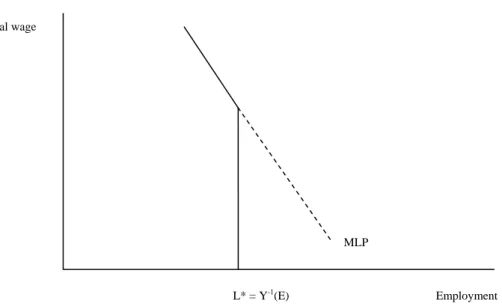
According to Barro and Grossman (1971), a Keynesian labour-demand is formed by two parts (see Figure 1): a downward-sloping part corresponding to the marginal labour-productivity schedule (MLP); and a vertical part that intersects the horizontal axis at the employment level associated with the production level determined by a given real aggregate-demand E. It is doubtful, however, that the Keynesian demand prospected by Barro and Grossman (1971) is an appropriate translation of Keynes’s principle of effective demand into the real-wage vs. employment space (see Lavoie, 2003).
A different approach is taken by Davidson (1983, 1998) who correctly interprets Chapter 3 of The General Theory. The level of employment is determined by the
intersection, the so-called point of effective demand, between the aggregate nominal demand and the aggregate nominal supply, both defined for a given monetary wage (see Figure 2). The associated real wage is therefore determined by the so-called market-equilibrium curve, based on the equality between real wage and marginal-labour productivity in a purely competitive economy (see Figure 3).
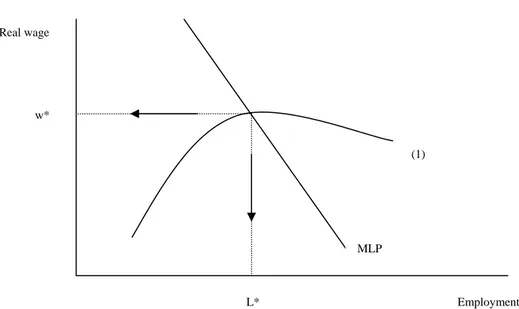
A similar approach is taken by Lavoie (2003) as well as by Dalziel and Lavoie (2003) who point out that the quantity of labour and the real wage, associated with the point of effective demand, can be determined by the interception between the notional demand for labour, that is the marginal labour-productivity schedule, and the aggregate-demand constraint translated into the real-wage vs. employment space:
(1) Y(L)=wL+B
where B is an autonomous component of real demand, wL are total real wages and is a production function, increasing in employment L at a decreasing rate (see Figure 4).
) L ( Y
3. AN EXTENSION OF THE DALZIEL-LAVOIE MODEL
Marc Lavoie (2003, p. 169) claims that his model is robust to a more general specification of the aggregate-demand constraint, such as the following one:
(2) Y(L)=(1−sω)wL+(1−sπ)π+A
where sω∈
[
0,1]
is the propensity to save of wage-earners, sπ∈[ ]
0,1 is the propensity to save of profit-earners with sπ > sω , A is an autonomous component of real demand, πare real profits. I agree with Lavoie’s claim, although some qualifications seem useful for discussing a point of the Dalziel-Lavoie work that I do not consider consistent with what Keynes argues in the Chapter 19 of The General Theory.
Let us assume, for sake of simplicity, that Y(L)= Lε with ε∈(0,1) being the (constant) elasticity of Y with respect to L. Under (2), the point of effective demand (in Figure 5) is given by: (3) ε ω π ⎥⎦ ⎤ ⎢ ⎣ ⎡ ε + ε − = 1 s s ) 1 ( A * L and w*=ε(L*)ε−1.
Therefore, one can easily show that:
(4) 0 * L * w < ∂ ∂ , 0 A * L > ∂ ∂ , 0 s * L < ∂ ∂ π and 0 s * L < ∂ ∂ ω .
4. A CRITIQUE TO DALZIEL AND LAVOIE
Dalziel and Lavoie (2003) seem to argue that Keynes would agree with the following statement:
“In particular, workers and firms are unable to restore full employment by reducing real wages, […]” (p. 333).
“When Keynes wrote The General Theory of Employment, Interest and
Money during the Great Depression of the 1930s, his aim was to explain
situations of high unemployment that were not self-correcting through workers accepting lower real wages” (p. 333).
Consistently with the above statement, Dalziel and Lavoie show that a reduction in the real wage, due to either a fall in the money wage or a rise in the general level of prices, is unable to increase the employment level (p. 337).
In contrast to Dalziel and Lavoie, I will argue that Keynes wrote The General Theory to explain situations of high unemployment that were not self-correcting through workers accepting lower money wages. Further, I will show that if a money wage cut is able to reduce the real wage, then the lower real wage necessarily imply - in Keynes’s view - a higher, and permanent, level of employment.
Let me start making explicit that, in my view, the main difference between Keynes and neoclassics is not about the effects on unemployment of a reduction in the real wage; it is about the effects on unemployment of a reduction in the money wage (see Keynes 1936, Chapter 19). Both Keynes and neoclassics would agree that a lower real wage is associated with a higher employment level and vice-versa. The main question is whether or not a lower money wage is associated with a lower real wage and a higher employment level. Specifically, a neoclassic would argue that a money-wage cut determines a real-wage cut and therefore determines a higher employment level, while Keynes would reply that a money-wage cut does not imply a higher employment level and therefore does not imply a real-wage cut.
To be more precise, in the neoclassical theory, if there is unemployment and the money-wage W can freely decrease, provided that the quantitative theory of money
) L ( PY
MV= holds1, then a reduction of W generates a less-than-proportional reduction of the price-level P. This, in turn, implies a decrease in the real wage and a tendency toward full employment.
According to Keynes, a fall in the money wage W decreases the real wage if the following condition holds:
(5) 0 W * L * L * w W * w > ∂ ∂ ∂ ∂ = ∂ ∂
Given that the sign of * L * w ∂ ∂
is unambiguously negative, for (5) to hold, the following condition must hold:
(6) 0 W * L < ∂ ∂ .
By consequence of (5) and (6), if a money wage cut is able to reduce the real wage, then the level of employment associated with the lower real wage must be higher.
The sign of W * L ∂ ∂
, however, depends on a number of factors. Specifically, one can formalize the problem as follows:
(7) W s s * L W s s * L W * L W A A * L W * L ∂ ∂ ∂ ∂ + ∂ ∂ ∂ ∂ + ∂ ε ∂ ε ∂ ∂ + ∂ ∂ ∂ ∂ = ∂ ∂ ω ω π π . 1
In the Chapter 19 of The General Theory, Keynes discusses the signs of W A ∂ ∂ , W ∂ ε ∂ , W s ∂ ∂ π , W s ∂ ∂ ω
and concludes that the impact of a reduction in the money wage on the employment level is likely to be either null or negative, that is:
(8) 0 W * L ≥ ∂ ∂ .
As a matter of example, Keynes maintains that, in a closed economy, the main argument supporting the idea that a reduction in the money wage increases employment is that the reduction in W implies a decrease in P2, which increases the real money-supply and decreases the real interest-rate. The latter, in turn, increases autonomous investments3
⎟ ⎠ ⎞ ⎜ ⎝ ⎛ < ∂ ∂ 0 W A
. The rest of the effects of a reduction in W, in presence of unemployment, do not necessarily go - according to Keynes - into the right direction4. The implied decrease in P determines an increase in the real value of debts which negatively affects investment decisions of indebted entrepreneurs5 ⎟
⎠ ⎞ ⎜ ⎝ ⎛ > ∂ ∂ 0 W A
. In addition, the decrease in
2
“A reduction of money-wages will somewhat reduce prices.” (Keynes 1936, p. 262). It is likely that
Keynes relies this statement on an equation likeP=W(w*)−1, where w* is as in expression (3).
3
This assumes that investments respond positively to a reduction in the real cost of borrowing, which is
non-obvious as argued in past empirical and theoretical studies (Ebersole 1938, Schalke 1946, Wilson and
Andrews 1951, Garegnani 1978, Garegnani 1979).
4
We select Keynes’s arguments in Chapter 19 that can be discussed in the extended Dalziel-Lavoie
framework.
5
Investment decisions of entrepreneurs are also negatively affected, in Keynes’s view, by the expectation
W generates workers’ discontent and discourages both debt-financed investments ⎟ ⎠ ⎞ ⎜ ⎝ ⎛ > ∂ ∂ 0 W A
and profit-financed investments ⎟ ⎠ ⎞ ⎜ ⎝ ⎛ < ∂ ∂ π 0 W s
. Further, a reduction in W creates the expectation of future money-wage cuts and postpones consumption of wage-earners
⎟ ⎠ ⎞ ⎜ ⎝ ⎛ < ∂ ∂ ω 0 W s
. The sum of positive and negative effects on employment of a money-wage
reduction is, in Keynes’s view, null or negative6 as in expression (8).
Let us consider the case that the net effect of a reduction in money wages is null. This, in the extended Dalziel-Lavoie model, means that the point of effective demand (in Figure 5) is unchanged, the real wage implied by the point of effective demand is unchanged and the reduction of W fully translates into a reduction of P. If, instead, the net effect is negative, then the locus of effective demand (2) shifts upward, the implied real wage rises and the reduction of W generates a more-than-proportional reduction of P7.
6. CONCLUSION
If a cut in money wages is able to generate a cut in real wages, as supposed by Dalziel and Lavoie (2003, p. 337), then the lower real wage would inevitably be associated - in Keynes’s view - with a higher, and permanent, level of employment. Therefore, the argument of Dalziel and Lavoie (2003) that workers and firms are unable to restore full employment by reducing real wages is not consistent with Keynes’s view. Students
6
“There is, therefore, no ground for the belief that a flexible wage policy is capable of maintaining a state
of continuous full employment” (Keynes 1936, p. 267).
7
“It follows, therefore, that if labour were to respond to conditions of gradually diminishing employment
by offering its services at a gradually diminishing money wage, this would not, as a rule, have the effect
of reducing real wages and might even have the effect of increasing them, through its adverse influence
must be aware that, according to Keynes, workers and firms are unable to restore full employment by reducing money wages as a reduced money wage does not automatically imply a reduced real wage8.
8
“There may be no expedient by which labour can reduce its real wage to a given figure by making
REFERENCES
Barro, J. and H. Grossman. 1971. A General Disequilibrium Model of Income and Employment, American Economic Review, 61(1): 82-93.
Dalziel, P. and M. Lavoie. 2003. Teaching Keynes’s Principle of Effective Demand Using the Aggregate Labor Market Diagram, Journal of Economic Education, 34(4): 333-340.
Davidson, P. 1983. The Marginal Product Curve is Not the Demand Curve for Labor and Lucas’s Labor Supply Function is Not the Supply Curve for Labor in the Real World, Journal of Post-Keynesian Economics, 6(1): 105-117.
Davidson, P. 1998. Post Keynesian Employment Analysis and the Macroeconomics of OECD Unemployment, Economic Journal, 108(448): 817-831.
Ebersole, J. F. 1938. The influence of Interest Rates upon Entrepreneurial Decisions in Business - A Case Study, Harvard Business Review, 17(1): 35-39.
Garegnani, P. 1978. Notes on Consumption, Investment and Effective Demand (Part I)
Cambridge Journal of Economics, 2(4): 335-353
Garegnani, P. 1979. Notes on Consumption, Investment and Effective Demand (Part II)
Keynes, J.M. 1936. The General Theory of Employment, Interest, and Money, New York: Harcourt, Brace & Co.
Lavoie, M. 2003. Real Wages and Unemployment with Effective and Notional Demand for Labor, Review of Radical Political Economics, 35(2): 166-182.
Shackle, G.L.S. 1946. Interest Rates and the Pace of Investment, Economic Journal, 56(221): 1-17.
Simonazzi, A. and F. Vianello. 2005. Price and Prejudice. The Statics and Dynamics of Money Wage Flexibility, DEP Working Papers, Department of Public Economics, University of Rome La Sapienza, nº 86, August.
Wilson, T. and P.W.S. Andrews. 1951. Oxford Studies in the Price Mechanism, Oxford: Oxford University Press.
Figure 1 Barro-Grossman’s model Real wage MLP L* = Y-1(E) Employment
Figure 2
Davidson’s model (part 1)
Supply S (S) Demand (D) D L* Employment
Figure 3
Davidson’s model (part 2)
Real wage
w*
MLP
Figure 4 Dalziel-Lavoie’s model Real wage w* (1) MLP L* Employment
Figure 5
Extended Dalziel-Lavoie’s model
Real wage
w*
(2)
MLP