Genetic analysis of scattered populations of the Indian eri silkworm,
Samia cynthia ricini
Donovan: Differentiation of subpopulations
Appukuttannair R. Pradeep
1*, Anuradha H. Jingade
1#, Choba K. Singh
2$, Aravind K. Awasthi
1,
Vikas Kumar
1, Guruprasad C. Rao
1and N.B. Vijaya Prakash
11
Seribiotech Research Laboratory, CSB Campus, Carmelaram P.O., Bangalore, Karnataka, India.
2Central Eri Muga Research and Training Institute, Ladoigarh, Jorhat, Assam, India.
Abstract
Deforestation and exploitation has led to the fragmentation of habitats and scattering of populations of the economi-cally important eri silkworm,Samia cynthia ricini, in north-east India. Genetic analysis of 15 eri populations, using ISSR markers, showed 98% inter-population, and 23% to 58% intra-population polymorphism. Nei’s genetic dis-tance between populations increased significantly with altitude (R2= 0.71) and geographic distance (R2= 0.78). On
the dendrogram, the lower and upper Assam populations were clustered separately, with intermediate grouping of those from Barpathar and Chuchuyimlang, consistent with geographical distribution. The Nei’s gene diversity index was 0.350 in total populations and 0.121 in subpopulations. The genetic differentiation estimate (Gst) was 0.276 among scattered populations. Neutrality tests showed deviation of 118 loci from Hardy-Weinberg equilibrium. The number of loci that deviated from neutrality increased with altitude (R2= 0.63). Test of linkage disequilibrium showed
greater contribution of variance among eri subpopulations to total variance. D’2
IS exceeded D’2
ST, showed significant contribution of random genetic drift to the increase in variance of disequilibrium in subpopulations. In the Lakhimpur population, the peripheral part was separated from the core by a genetic distance of 0.260. Patchy habitats promoted low genetic variability, high linkage disequilibrium and colonization by new subpopulations. Increased gene flow and habitat-area expansion are required to maintain higher genetic variability and conservation of the originalS. c. ricini gene pool.
Key words:subpopulation differentiation, scattered population,Samia cynthia ricini,ISSR loci, gene diversity.
Received: October 21, 2010; Accepted: May 4, 2011.
Introduction
The Indian eri silkworm,Samia cynthia ricini(=S.
ricini Donovan; Lepidoptera: Saturniidae) is a domesti-cated silkworm that feeds primarily on leaves of the castor plant,Ricinus communisL. This species, initially reported from the foot-hills of Himalaya, was later introduced into temperate countries. For more than a century, a few popula-tions have been used for commercial silk production in northeast India, in such regions as the Brahmaputra river valley, east and west Garo Hills, east and west Khasi Hills, Nagaland and Manipur (Singh and Benchamin, 2002; Pie-gler and Naumann, 2003). Primary and secondary food plants occur in abundance in the surroundings character-ized by temperatures of 7 °C to 34 °C and an average annual rainfall of 2800 mm. Fifteen populations of the eri
silk-worm were recognized from localities at various altitudes ranging from 35 to 925 meters above sea level (MSL) (Ta-ble 1). Although morphological characterization indicated phenotypic variability, molecular data on genetic relations and structure are required to improve the population char-acterization. Recently, the species was identified as a po-tential source for exploring functional genomics (Arun-kumaret al., 2008), although prior to their use in assessing genetic diversity, variations in EST and putative gene ex-pression need to be ascertained. The lack of co-dominant markers, such as microsatellites from the eri silkworm it-self, has added to the problem when analyzing population genetic status.
Inter simple-sequence repeat (ISSR) primers were de-signed from regions of microsatellite abundance in the ge-nome, which exhibit high level of polymorphism (Schlot-terer, 2000). As ISSR, the dominant marker system is simpler to use though not entailing prior information on tar-get regions (Zietkiewiczet al., 1994; Nagarajuet al., 2002), it has been extensively employed for identifying inter-and intra-populational genetic variability in several insect spe-cies, including domestic and wild silkworms (Ehteshamet
www.sbg.org.br
Send correspondence to A.R. Pradeep. Seribiotech Research Lab-oratory, CSB Campus, Carmelaram P.O., Bangalore 560035 Kar-nataka, India. E-mail: [email protected].
#
Present address: Central Silkworm Germplasm Resource Center, Hosur, Tamil Nadu, India.
$
Present address: Regional Tasar Research Station, Mantripukhri, Imphal, Manipur, India.
al., 1995; Pradeepet al., 2005, 2007, 2008; Vijayanet al., 2005, 2006; Santana et al., 2009; Saravanakumar et al., 2010). Hence the ISSR marker system has been selected for genetic analysis of the eri populations.
On route, many unexploited eri populations from re-mote areas of northeast India were identified. Habitats were isolated by high mountains, farm land and human dwell-ings, all leading to the formation of patchy inbred popula-tions. Habitat fragmentation had deleteriously affected the genetic structure of natural populations (Haleet al., 2001), thus causing a loss in biological diversity (Davieset al., 2001). Furthermore, commercial exploitation gave rise to gene-pool mixing, thus contributing to the loss of tion identity. Genetic analysis of these scattered popula-tions using molecular markers becomes imperative, in order to develop a sustainable strategy for conserving the various genetic resources as yet available. The aim was to analyze the genetic structure of unexploited, scattered eri populations, as well as the genetic interaction with topo-graphic features of collection sites. The data demonstrated a loss of genetic diversity in sub-populations, as well as the genetic reorganization of certain populations, which can be considered as markers of eco-genetic consequences on in-sects undergoing regional habitat fragmentation.
Materials and Methods
DNA extraction and PCR
Fifteen populations of S.c.ricini, duly named after their place of origin, were collected from coincident loca-tions at different altitudes in northeast India, viz., Barpathar (E1), Chuchuyimlang (E2), Borduar (E3), Khanapara (E4), Titabar (E5), Nongpoh (E6), Dhanubhanga (E7),
Mendi-pathar (E8), Imphal (E9), Dhansiripar (E10), Diphu (E11), Lakhimpur (E12), Dhemaji (E13), Dhakuakhana (E14) and Cachar (E15). Cocoons (n= 200 each or more) were col-lected, and transferred to the germplasm station located at the Central Eri Muga Research and Training Institute, La-doigarh, Jorhat in Assam State, northeast India. On emer-gence, 30 moths were randomly collected from each popu-lation, and preserved at -80 °C, prior to DNA extraction.
DNA extracted from individual moths by the phe-nol:chloroform method (Suzuki et al., 1972), was incu-bated with RNase A to remove RNA contamination and then re-extracted. The purified DNA was dissolved in Tris-EDTA (TE; pH 8.0) buffer and quantified on 0.8% agarose gels. PCR amplification was carried out on an MJ Research Thermal-Cycler, PTC 200, using 20mL reaction mixture containing 10x PCR buffer, 2 mM dNTPs, 2.5 mM MgCl2, 0.10mL of Taq DNA polymerase (recombinant;
Fermentas) (5 U/mL), 2.0mL of 1.5mM ISSR primer and 40 ng of DNA. The ISSR primers (set # 9) were purchased from the Nucleic Acid & Protein Service of Biotechnology Laboratory (University of British Columbia, Vancouver, Canada). Of the 100 primers tested, only 20 showed repro-ducible amplification. Each reaction was replicated at least twice for reproducibility. The PCR cycle followed was 94 °C for 2 min followed by 35 cycles of 94 °C for 30 s, an-nealing at 50 °C for 30 s and extension at 72 °C for 2 min and a final extension at 72 °C for 10 min. Following PCR, the reaction mixture was loaded on a 1.5% agarose gel in Tris-Boric acid-EDTA (TBE) buffer and resolved at 60 V in a submarine electrophoresis system. The gel was illumi-nated with UV and the ISSR profiles were photographed using a gel documentation system (Syngene).
Table 1- Geographical characters of the place of collection of 15 populations of the eri silkworm,Samia cynthia ricinifrom north-eastern states of India.
Code Population State District Latitude Longitude Altitude* Physiography
E1 Barpathar Assam Golaghat 26°20’ N 93°36’ E 99 m Flat terrain
E2 Chuchuyimlang Nagaland Makokchung 26°20’ N 94°31’ E 925 m Hilly terrain
E3 Borduar Assam Kamrup 25°55’ N 90°38’ E 61 m Flat plain
E4 Khanapara Assam Kamrup 26°23’ N 91°51’ E 78 m Flat terrain
E5 Titabar Assam Jorhat 26°60’ N 94°20’ E 104 m Flat terrain
E6 Nongpoh Meghalaya Ribhoi 25°46’ N 91°46’ E 525 m Hilly terrain
E7 Dhanubhanga Assam Goalpara 25°09’ N 91°10’ E 35 m Flat terrain
E8 Mendipathar Meghalaya East Garo Hills 25°52’ N 90°38’ E 300 m Hilly terrain
E9 Imphal Manipur Imphal West 24°38’ N 93°37’ E 785 m Flat terrain
E10 Dhansiripar Nagaland Dimapur 25°54’ N 93°44’ E 304 m Foot Hill
E11 Diphu Assam Karbi Anglong 25°49’ N 93°43’ E 609 m Plateau
E12 Lakhimpur Assam Lakhimpur 27°14’ N 94°07’ E 102 m Flat terrain
E13 Dhemaji Assam Dhemaji 27°49’ N 94°58’ E 133 m Flat terrain
E14 Dhakuakhana Assam Lakhimpur 27°12’ N 94.28’E 68 m Flat terrain
E15 Cachar Assam Cachar 25°32’ N 92°41’ E 680 m Flat terrain
Statistical analyses
Amplification products were scored in a binary mode (1, 0), where “1” represented the presence of a marker and “0” its absence. The data was analyzed by SPSS 11.5 soft-ware and POPGENE version 1.32 (Yeh, 1998). Polymor-phism levels were expressed as the percentage of all the loci that proved to be polymorphic in the profile. The null hy-pothesis was tested with Chi-square (c2) and likelihood ra-tio (G2) analysis for each locus, which determined the prob-ability of homozygosity under Hardy-Weinberg equilibrium. The Ewens-Watterson test for neutrality was applied for assessing variation from Hardy-Weinberg equi-librium (H-WE) in 1000 simulated samples. The Nei (1972) genetic distance, the Nei (1973) gene diversity in-dex (h), the Shannon Information inin-dex (I) (Lewontin, 1972), observed number of alleles (na), effective number of alleles (ne) (Kimura and Crow, 1964) and coefficient of ge-netic differentiation (Gst), were estimated using the POPGENE program. According to Nei (1973) genetic di-versity statistics,Gst, a measure of population differentia-tion, is defined as the proportion of genetic diversity that re-sides among populations. Gst values range from zero to one, with low values indicating little inter-population ge-netic variation (Culleyet al., 2002). Pair-wise genetic simi-larity was calculated as 2Nij/(Ni+ Nj), where Nij is the number of common bands iniandjpopulations, and Niand Njthe total number of bands produced by the populationsi
andj(Nei and Li, 1979). A phylogeny tree was constructed based on the dissimilarity (1-similarity value) matrix, using cluster analysis by UPGMA (Unweighted Pair Group Method using an Arithmetic average), available in the clus-tering program, PHYLIP version 9.0. Bootstrap analysis was performed using 10000 replicates as provided in PAUP* software (Swofford, 1998).
Linkage disequilibrium among pairs of loci for each population was calculated using ISSR loci that deviated from HWE, according to Weir (1979). Non-random associ-ation between two loci was assessed by Chi-square testing. Variance components of linkage disequilibrium were cal-culated by two-locus analysis, as per D - Statistics of Ohta (1982). Total variance (D2IT) was partitioned into intra-(D2IS, D’2IS) and inter- (D2ST, D’2ST) population compo-nents, both calculated with POPGENE software.
Relation between genotypic parameters and geo-graphical parameters of the site of collection was analyzed by linear regression analysis and correlation coefficient (R2).
The distribution pattern of individuals within each population was analyzed by ALSCAL multidimensional scaling available in the SPSS program. In this analysis, the genetic distance was computed and a dissimilarity matrix created, using Euclidean distances acquired from the ISSR profile. Euclidean distance was used for data stimulus con-figuration, using the classical Young-Householder multidi-mensional scaling procedure (Younget al., 1984; Young
and Harris, 1990). Canonical discriminant function analy-sis (DFA, as given in the SPSS program) was applied for analyzing the contribution of altitude to the genetic status of eri populations, by using altitude and ISSR loci for defin-ing the percentage of variance of the dependent variable (altitude), as inferred from independent loci. Altitudes were categorized as class 1; 0-100 MSL, class 2; 101-200 and so on. The multivariate stepwise approach, with the same limit of F value for stepwise entry and removal of variables (ISSR loci in this case), was used for calculating Maha-lanobis distance (D2) statistics, and arriving at estimates of Chi-square and Wilks’ Lambda (Anderson, 1984; Introna Jret al., 1997). For DFA, squared Mahalanobis distance (D2) was used for testing the distance from the group cen-troid in each case. The shorter the distance, the closer the case was to the group itself, and thus more likely for classi-fication as belonging thereto (Mahalanobis, 1936).
Results
Phenotypic variability
Of the 15 S.c.ricini populations, eight were from lower (35-150 MSL), two from mid- (~300 MSL) and five from higher (500-925 MSL) altitudes (Table 1). Eri larvae have a distinct blue or yellow body-color, with or without zebra markings, and spines. The color of the cocoons pro-duced by the various populations was either white or brick-red, or both.
Inter population genetic status
Twenty ISSR primers amplified 194 products from genomic DNA of the 15 populations within a size range of 0.3 kb to 3.0 kb. The UBC842 primer produced 15 bands, the maximum, whereas UBC807 and UBC812 produced only five, the minimum. According to AMOVA, inter-po-pulation polymorphism was 98%. The Nei (1972) genetic distance was the highest between Dhemaji and Dhanu-bhanga (0.593), and the lowest between Dhakuakhana and Cachar (0.0686). The average genetic distance among the Lakhimpur, Dhemaji and Dhakuakhana populations lo-cated in close proximity (an average distance of 21 km) in the Brahmaputra river basin in upper Assam, was 0.109, and between these populations and those geographically farther placed was 0.442. The geographic distance between Mendipathar and Cachar was 915 km and the genetic dis-tance 0.413. Regression of genetic disdis-tances between popu-lations over geographical distances, revealed significant positive correlation (R2= 0.783; p < 0.0009; Y = 0.0009 X + 0.121).
the dendrogram was strongly supported by significantly high bootstrap values. At the node representing Barpathar and Chuchuyimlang clustering, bootstrap value was 87%. On plotting the phylogeny tree onto a geographical map of the collection sites, the Barpathar and Chuchuyimlang pop-ulations were found to be at an intermediate position in a north-south direction, both on the map itself and the phylo-gram(Figure 1).
Analysis of genetic variability revealed low gene di-versity throughout both the total eri population (Ht = 0.350 ± 0.019) and subpopulations (Hs = 0.121±0.008). Among loci, UBC808-71200 bpand
UBC885-11550 bppresented the highest Ht of 0.42. The coefficient of
genetic differentiation (Gst) was lower among the scattered non-commercial populations than among the commercial (Table 2). In the total eri population, gene flow was 0.263. The contribution of ISSR loci to population heterogeneity was assessed by Chi-square analysis. Out of the 194 loci, 10
showed significant probability ((c2)/g2< 0.05 or better) val-ues indicative of a significant contribution (p < 0.01 or better).
Locus-variation from H-WE was examined by the Ewens-Watterson test for neutrality. Deviation occurred in 118 loci (Table 3), with 77 loci had the F-values above the upper limit of expectancy (95% confidence), and 41 below the lower limit. Linkage disequilibrium was calculated for the total population, in order to assess the contribution of non-selective forces on the fluctuation of loci from HWE. Single population linkage disequilibrium analysis (Weir 1979) showed significant (p < 0.05) disequilibrium in
S.c.ricinipopulations. In populations from areas of low alti-tude (< 200 MSL), linkage disequilibrium was more pro-nounced when compared to those from higher altitudes. Total variance (D2IT) of the disequilibrium (Ohta, 1982) was 0.2601. D’2IS (0.2416) was greater than D’2ST (0.0185), an indication of close-to-zero variance in the total population, and consequently the more pronounced
inde-Figure 1- Mapping of the phylogeny tree to geographical map of the collection sites of 15 populations (E1 - E15) ofSamia cynthia ricinifrom north-east India. These are as depicted in Table 1. Note the intermediate position of the Barpathar (E1) and Chuchuyimlang (E2) populations in north-south direction between the upper and lower Assam populations, both on the dendrogram and map. Bootstrap values coincide with dendrogram nodes. The states where collections occurred are indicated (Schematic map, not to scale).
Table 2- ISSR polymorphism and population genetic characteristics of total, commercial and non- commercial scattered populations of the eri silkworm,
Samia cynthia ricini.
Population category % Polymorphism Ht Hs Gst+ Nm* h** I***
Non-commercial scattered (E1,E2,E9-E15) 97.94 0.3445±0.1225 0.6444±0.0242 0.2759 1.312 0.0879 0.1288
Commercial (E3-E8) 78.35 0.2479±0.0345 0.1186±0.0158 0.5216 0.459 0.2483 0.3766
Total 100 0.3505±0.0195 0.1209±0.0078 0.6550 0.263 -
pendence of loci. On the other hand, D2ST (0.258) was greater than D2IS (0.0022), thus indicating that a larger pro-portion of total variance in disequilibrium resulted from de-viation “among the subpopulations” than that from “within populations”.
Intra-population genetic status
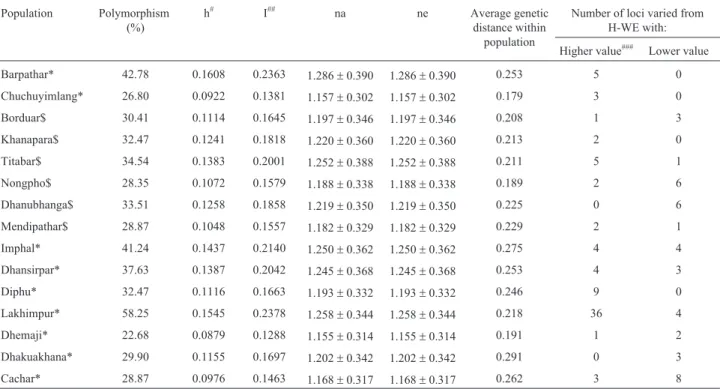
Intra-population polymorphism was the highest in the Lakhimpur (58%) and the lowest in the Dhemaji and Chu-chuyimlang (22% and 26%, respectively) (Table 3). In the Lakhimpur, 113 loci were polymorphic, as against 62 in the Cachar. Nei’s intra-population gene diversity (h) was the highest in the Barpathar (0.161) and Lakhimpur (0.155) and the lowest in the Dhemaji (0.088), Cachar (0.098) and Chuchuyimlang (0.092). Generally, gene diversity was somewhat higher in the populations of the lower Assam and Meghalaya regions (~0.12), when compared to the upper Assam and Nagaland regions (~0.11). The Shannon Infor-mation index (I) was the lowest in the Dhemaji population (0.12) and the highest (0.238) in the Lakhimpur. The ob-served number of alleles varied from 1.227 in the Dhemaji to 1.583 in the Lakhimpur, whereas the effective number of alleles varied from 1.155 in the Dhemaji to 1.286 in the Barpathar.
Genetic distances were calculated, so as to assess ge-netic relationships among individuals within each popula-tion. These ranged from 0.179 in the Chuchuyimlang to
0.291 in the Dhakuakhana population (Table 3). In Dhemaji and Nongpoh also, the genetic distance among in-dividuals (~0.190) was low.
The distribution of individuals within each popula-tion was assessed by ALSCAL multidimensional scaling. Except for Lakhimpur, they were either uniformly distrib-uted on the matrix or clustered in the center (data not shown). Although in the Lakhimpur population (E12), one group of individuals was clustered together (core popula-tion), another was separated, thus forming a peripheral group (Figure 2). The average genetic distance among core population individuals was 0.17, whereas that between clustered and peripheral was 0.26, thus significantly higher (p < 0.007; Studentt-test). On the dendrogram, individuals of the peripheral population, besides being grouped sepa-rately, presented less genetic differentiation (Data not shown).
Relationship between geographic variation and genetic status
DFA of altitude-dependent genetic variance among the eri populations showed significant (p < 0.000) genetic variance, supported by significant (0.000) Wilkland Chi-square estimates and large canonical-correlation coeffi-cients (R2= 0.996). The mean genetic distance of high alti-tude populations, such as those of Diphu, Cachar, Imphal and Chuchuyimlang, from low altitude populations was
Table 3- ISSR polymorphism, Nei (1973) gene diversity, average genetic distance and loci selected by Ewans-Watterson test of neutrality of 15 popula-tions of the eri silkworm,Samia cynthia ricini.
Population Polymorphism
(%)
h# I## na ne Average genetic
distance within population
Number of loci varied from H-WE with:
Higher value### Lower value
Barpathar* 42.78 0.1608 0.2363 1.286±0.390 1.286±0.390 0.253 5 0
Chuchuyimlang* 26.80 0.0922 0.1381 1.157±0.302 1.157±0.302 0.179 3 0
Borduar$ 30.41 0.1114 0.1645 1.197±0.346 1.197±0.346 0.208 1 3
Khanapara$ 32.47 0.1241 0.1818 1.220±0.360 1.220±0.360 0.213 2 0
Titabar$ 34.54 0.1383 0.2001 1.252±0.388 1.252±0.388 0.211 5 1
Nongpho$ 28.35 0.1072 0.1579 1.188±0.338 1.188±0.338 0.189 2 6
Dhanubhanga$ 33.51 0.1258 0.1858 1.219±0.350 1.219±0.350 0.225 0 6
Mendipathar$ 28.87 0.1048 0.1557 1.182±0.329 1.182±0.329 0.229 2 1
Imphal* 41.24 0.1437 0.2140 1.250±0.362 1.250±0.362 0.275 4 4
Dhansirpar* 37.63 0.1387 0.2042 1.245±0.368 1.245±0.368 0.253 4 3
Diphu* 32.47 0.1116 0.1663 1.193±0.332 1.193±0.332 0.246 9 0
Lakhimpur* 58.25 0.1545 0.2378 1.258±0.344 1.258±0.344 0.218 36 4
Dhemaji* 22.68 0.0879 0.1288 1.155±0.314 1.155±0.314 0.191 1 2
Dhakuakhana* 29.90 0.1155 0.1697 1.202±0.342 1.202±0.342 0.291 0 3
Cachar* 28.87 0.0976 0.1463 1.168±0.317 1.168±0.317 0.262 3 8
#h and##I are as given under Table 2; na = Observed number of alleles; ne = Effective number of alleles (Kimura and Crow, 1964);###Outlier loci with
0.329. As a whole, genetic distances among eri populations increased with altitude, a clear indication of a significant re-lationship between the two parameters (R2 = 0.71; p < 0.004). Notwithstanding, genetic distances among indi-viduals within a specific population was not influenced by the prevailing altitude (data not shown). In the high altitude populations of Chuchuyimlang and Cachar, Nei’s gene di-versity was low (~0.09), whereas in the low altitude, such as Dhanubhanga and Dhakuakhana, it was high (~0.12). The regression of Nei’s gene diversity on altitude, revealed only a weak negative correlation between the two parame-ters (R2= 0.118; Y = -3E-05X + 0.1251). There was no cor-relation in populations from Imphal and Dhemaji, as shown by the R2value decreasing from 0.437 to 0.118. On assess-ing the deviation of loci from neutrality, the significant in-crease in the number of loci that deviated from H-WE coincided with the increase in altitude (R2 = 0.627; Y = 0.0081X + 3.4111).
Discussion
Infiltration and the use of forest areas for farming and human dwellings have been the cause of forest-fragmentation in northeast India. This, besides contributing to genetic erosion, has negatively affected the survival of many flora and fauna species, including theSamia(Piegler and Naumann, 2003). The fragmentation of habitats has in-duced scattered distribution, geographical isolation and lo-calized inbreeding of eri silkworm populations. Those from the different altitudes have shown significant phenotypic variation due to varied gene expression. Moreover, 118 loci (60%) have given evidence of deviation from H-W E. Pre-sumably, in different geographic locations, natural selec-tion acts on different genomic regions (Weiniget al., 2003; Mitchell-Olds and Schmitt, 2006). Fragmented populations are highly susceptible to those environmental factors
capa-ble of inducing genetic divergence (Antonovics, 1976; Williet al., 2006). Herein, an attempt was made to employ molecular markers for assessing genetic hazard due to frag-mentation of habitats, and the subsequent impact on eri-subpopulation differentiation. In these populations, the positive correlation between geographic and genetic dis-tances clearly indicated the effect of geographical isolation on genetic structure. On the contrary, in Cachar (altitude: 680MSL) from lower Assam and Dhakuakhana (altitude: 68 MSL) from upper Assam, there was both phenotypical and genotypical proximity, as well as joint grouping on the phylogram. These populations presented low genetic poly-morphism (28%), relatively lesser observed alleles (1.2±0.4) and lower gene diversity (h = 0.09 and 0.11 re-spectively), apparently through deficient selection in patchy habitats. Nevertheless, in the commercial popula-tions (E3 to E8), the grouping together in the phylogram in-dicated genetic similarity, due to the continuous multiplication by inbreeding and/or genetic mixing through human intervention.
The increased rate of inbreeding and genetic drift can be considered as possible causes of erosion in genetic di-versity in small eri populations (Keyghobadiet al., 2005; Oumaet al., 2005). Wide-spread linkage disequilibrium, a further indication of recuperated allelic variability, gives added support to this hypothesis. The decrease in disequi-librium with the increase in altitude implies low genetic di-versity in high-altitude populations. Tests showed D2ST > D2IS to be an indication that disequilibria was more pronounced amongS.c.ricinisubpopulations. In contrast, D’2IS > D’2ST implies a significant contribution of random genetic drift to the increase in disequilibrium variance (Ohta, 1982). Such random fluctuation is enhanced by the differentiation in those subpopulations (Ohta, 1982) that presents low genetic variation (Hedrick, 2000; Vuorinen and Eskelinen, 2005). Although less loci deviating from H-WE within the different subpopulations can be an indica-tion of allele fixaindica-tion by natural selecindica-tion under geograph-ical isolation, random drift may also have induced popula-tion differentiapopula-tion under condipopula-tions of low gene migrapopula-tion. A significant decrease in gene diversity coinciding with the increase in altitude (35 to 900 MSL) in eri popula-tions places in evidence the influence of the heterogeneous topographical conditions of northeast India on population build-up, as reported forDrosophila melanogaster (Hof-fmannet al., 2001; Andersonet al., 2005) and other ani-mals (Pariset et al., 2009), under varying geographical conditions. Continuous mountain ranges, by restricting gene flow between scattered populations, have contributed significantly to the large-scale inbreeding, excess of homo-zygotes and stabilization of divergent sub-populations, which have ultimately led to the Wahlund effect (Wahlund, 1928), as noticed earlier inAnopheles arabiensis(Kamauet al., 2007), the Atlantic dipteran, Ochlerotatus taeniorhynchus(Bello and Becerra, 2009), and wild
lations of the muga silkworm,Antheraea assama (Arun-kumar et al., 2009). The availability of local congenial survival conditions was evident by most of the eri popula-tions having been uniformly distributed on the ALSCAL matrix. Despite low gene diversity, the high survival rate (~90.52%) indicated the voidance of threshold gene-diversity for survival. Notably, most of the loci that devi-ated from H-WE revealed high F- values and a tendency to-wards homozygosity, thus enhancing their dominance in eri subpopulations. High homozygosity, homogeneous distri-bution and the high survival rate exerted a positive influ-ence on genes favorable for fitness, thus confirming the significant association between alleles and fitness traits that contribute to the survival (Schulze and McMahon, 2002; Lyonset al., 2009) of eri populations under environmental stress (e.g.high altitudes), instead of high heterozygosity, which tends to be non-heritable.
Differentiation of sub-populations
By plotting the phylogram onto a geographic map, the intermediate geo-genetic positions of the Barpathar and Chuchuyimlang populations in northeast India became ap-parent. But the absence of intermediate status, on compar-ing phenotypic traits in them with other eri populations, in-dicated the independency of genetic expression. Moreover, the low hatching rate (~70%) indicated instability in ex-pressing an important fitness trait. Geographically, whereas Barpathar is situated at a low altitude (99 MSL), Chuchuyimlang is at higher altitude (925 MSL). Polymor-phism was 43% in the Barpathar population and 27% in the Chuchuyimlang. Gene diversity in both was low (h = 0.161 and 0.092 respectively), whereas genetic distance to other populations was proportionately higher (mean = 0.349). DFA grouping of these populations with those at low alti-tudes revealed mutual genetic closeness. Such an unstable genetic structure is mostly due to the loss of rare alleles by a slower-rate drift (Cornuet and Luikart, 1996). The low hatching rate, coupled with low gene-diversity and inter-mediate geo-genetic positioning, imply their origin by chance hybridization, but with reduced hybrid fitness (Pe-tersonet al., 2005). Gene diversity in these eri sub-popu-lations may also be influenced by non-genetical parame-ters, preferably geographical mountain-barriers, variations in altitude, low flying capacity, etc., that are non-supportive to natural hybridization. Alternatively, genetic grouping of these geographically separated populations supposes ge-netic invasiveness and subsequent intra-habitat adaptation. How invasion occurred requires further investigation.
In the Lakhimpur population, situated at 102 MSL, both polymorphism (58%) and gene diversity (h = 0.155) were higher, when compared with the others. Individuals hereof were separated into core and peripheral groups, with an intermediate genetic distance of 0.263. Segregation of the peripheral population may be due to partial isolation of the population where non-adaptive inbreeding permits
nat-ural selection to enter into play (Charlesworth and Wright, 2001), which possibly induced the deviation from H-WE. Most of the quantitative traits of the Lakhimpur population showed intermediate values, an indication that natural se-lection had played upon different traits. The shift can possi-bly be associated with changes in habitat also (Calsbeeket al., 2009). Such genetic reorganization within the Lakhim-pur sub-population is an indication of the occurrence of ecological devastation with genetic consequences in the Brhmaputra river valley.
Genetic distances among eri populations increased with the increase in altitude and geographical distance. The low gene diversity in high-altitude populations could be at-tributed to geographic isolation by mountain-barriers, low gene flow due to long-distance flying incapacity of the moths, and the enhanced action of drift in patchy habitats (Barrett and Kohn, 1991; Leimar, 2009). Notably, patchy habitat induces low genetic variability, high linkage dis-equilibrium and colonization of new subpopulations. Such genetic pressure leads to discrete modes of selection, thus causing plasticity in phenotypes under varying environ-mental conditions. Thus, the revelation of the challenges faced by scattered subpopulations, through the interaction between genomic and ecological processes, will help both in evaluating the total eri population status, and conserving the originalS. c. ricinigene pool. Both enlargement in the effective size of subpopulations and habitat protection are essential for maintaining genetic variability and increasing gene flow among eri populations. A strongly differentiated subpopulation, as that of Lakhimpur, is to be considered as an evolutionarily active habitat for conservation planning.
Acknowledgments
The authors are thankful to the anonymous referees for their critical reading and to the Central Silk Board, Gov-ernment of India, for financial support in the form of re-search project AIG 3323.
References
Anderson AR, Hoffmann AA, McKechnie SW, Umina PA and Weeks AR (2005) The latitudinal cline in the In(3R) Payne inversion polymorphism has shifted in the last 20 years in AustralianDrosophila melanogasterpopulations. Mol Ecol 14:851-858.
Anderson TW (1984) An Introduction to Multivariate Analysis. 2nd edition. Wiley, New York, 704 pp.
Antonovics J (1976) The nature of limits to natural selection. Ann Missouri Bot Gard 63:224-247.
Arunkumar KP, Tomar A, Daimon T, Shimada T and Nagaraju J (2008) Wild Silkbase: An EST database of wild silkmoths. BMC Genomics 9:e338.
Barrett SH and Kohn JR (1991) Genetic and evolutionary conse-quences of small population size in plants: Implications for conservation. In: Falk DA and Holsinger KE (eds) Genetics and Conservation of Rare Plants. Oxford University Press, Oxford, pp 1-15.
Bello F and Becerra V (2009) Genetic variability and heterogene-ity of Venezuelan equine encephalitis virus vector Ochle-rotatus taeniorhynchus(Diptera, Culicidae) populations of the Colombian Atlantic coast, based on microsatellite loci. Genet Mol Res 8:1179-1190.
Calsbeek R, Buermann W and Smith TB (2009) Parallel shifts in ecology and natural selection in an island lizard. BMC Evol Biol 9:e3.
Charlesworth D and Wright S (2001) Breeding system and ge-nome evolution. Curr Opin Genet Dev 11:685-690. Cornuet JM and Luikart G (1996) Description and power analysis
of two tests for inferring recent population bottlenecks from allele frequency data. Genetics 144:2001-2014.
Culley TM, Wallace LE, Gengler-Nowak KM and Crawford DJ (2002) A comparison of two methods of calculating Gst, a
genetic measure of population differentiation. Am J Bot 89:460-465.
Davies KF, Gascon C and Margules CR (2001) Habitat fragmen-tation: Consequences, management, and future research pri-orities. In: Soule ME and Orians GH (eds) Conservation Bi-ology: Research Priorities for the Next Decade. Island Press, Washington DC, pp 81-97.
Ehtesham NZ, Bentur JS and Bennett J (1995) Characterization of a DNA sequence that detects repetitive DNA elements in the Asian gall midge (Orseolia oryzae) genome: Potential use in DNA fingerprinting of biotypes. Gene 153:179-183. Hale ML, Lurz PW, Shirley MD, Rushton S, Fuller RM and Wolff
K (2001) Impact of landscape management on the genetic structure of red squirrel populations. Science 293:2246-2248.
Hedrick PW (2000) Genetics of Populations. 2nd edition. Jones & Barlett, Sudbury, 553 pp.
Hoffmann AA, Hallas R, Sinclair C and Mitrovski P (2001) Levels of variation in stress resistance inDrosophilaamong strains, local populations, and geographic regions: Patterns for desiccation, starvation, cold resistance, and associated traits. Evolution 55:1621-1630.
Introna Jr F, Di VG, Campobasso CP and Dragone M (1997) Sex determination by discriminant analysis of Calcanei mea-surements. J Forensic Sci 42:725-728.
Kamau L, Munyekenye GO, Vulule JM and Lehmann T (2007) Evaluating genetic differentiation ofAnopheles arabiensis
in relation to larval habitats in Kenya. Infect Genet Evol 7:293-297.
Keyghobadi N, Roland J, Matter SF and Strobeck C (2005) Among- and within-patch components of genetic diversity respond at different rates to habitat fragmentation: An em-pirical demonstration. Proc R Soc Lond B Biol Sci 272:553-560.
Kimura M and Crow JF (1964) The number of alleles that can be maintained in a finite population. Genetics 49:725-738. Leimar O (2009) Environmental and genetic cues in the evolution
of phenotypic polymorphism. Evol Ecol 23:125-135. Lewontin RC (1972) Testing the theory of natural selection.
Na-ture 236:181-182.
Lyons EJ, Amos W, Berkley JA, Mwangi I, Shafi M, Williams TN, Newton CR, Peshu N, Marsh K, Scott JAG,et al.(2009) Homozygosity and risk of childhood death due to invasive bacterial disease. BMC Med Genet 10:e55.
Mahalanobis PC (1936) On the genetical distance in statistics. Proc Nat Inst Sci India 2:265-275.
Mitchell-Olds T and Schmitt J (2006) Genetic mechanisms and evolutionary significance of natural variation in
Arabidopsis. Nature 441:947-952.
Nagaraju J, Kathirvel M, Kumar RR, Siddiq EA and Hasnain SE (2002) Genetic analysis of traditional and evolved Basmati and non-Basmati rice varieties by using fluorescence-based ISSR-PCR and SSR markers. Proc Natl Acad Sci USA 99:5836-5841.
Nei M (1972) Genetic distance between populations. Am Nat 106:283-292.
Nei M (1973) Analysis of gene diversity in subdivided popula-tions. Proc Natl Acad Sci USA 70:3321-3323.
Nei M and Li H (1979) Mathematical model for study the genetic variation in terms of restriction endonucleases. Proc Natl Acad Sci USA 74:5267-5273.
Ohta T (1982) Linkage disequilibrium due to random genetic drift in finite subdivided populations. Proc Natl Acad Sci USA 79:1940-1944.
Ouma JO, Marquez JG and Krafsur ES (2005) Macrogeographic population structure of the tsetse fly, Glossina pallidipes
(Diptera, Glossinidae). Bull Entomol Res 95:437-447. Pariset L, Cuteri A, Ligda C, Ajmone-Marsan P, Valentini A and
ECONOGENE Consortium (2009) Geographical patterning of sixteen goat breeds from Italy, Albania and Greece as-sessed by Single Nucleotide Polymorphisms. BMC Ecology 9:e20.
Peterson, MA, Honchak BM, Locke SE, Beeman TE, Mendoza J, Green J, Buckingham KJ, White MA and Monsen KJ (2005) Relative abundance and the species-specific reinforcement of male mating preference in the Chrysochus(Coleoptera, Chrysomelidae) hybrid zone. Evolution 59:2639-2655. Piegler RS and Naumann S (2003) A Revision of the Silkmoth
GenusSamia. University of Incarnate Word, San Antonio, pp 227.
Pradeep AR, Chatterjee SN and Nair CV (2005) Genetic differen-tiation induced by selection in an inbred population of the silkworm Bombyx mori, revealed by RAPD and ISSR marker systems. J Appl Genet 46:291-298.
Pradeep AR, Anuradha HJ and Raje Urs S (2007) Molecular markers for biomass traits: Association, interaction and ge-netic divergence in SilkwormBombyx mori. Biomarker In-sights 2:197-217.
Pradeep AR, Awasthi AK and Raje Urs S (2008) Association of A/T rich microsatellites with responses to artificial selection for larval developmental duration in the silkwormBombyx mori. Mol Cell 25:467-478.
Santana QC, Coetzee MPA, Steenkamp ET, Mlonyeni OX, Ham-mond GNA, Wingfield MJ and Wingfield BD (2009) Micro-satellite discovery by deep sequencing of enriched genomic libraries. Biotechniques 46:217-223.
Schlotterer C (2000) Evolutionary dynamics of microsatellite DNA. Chromosoma 109:365-371.
Schulze TG and McMahon FJ (2002) Genetic association map-ping at the crossroads: Which test and why? Overview and practical guidelines. Am J Med Genet (Neuropsych Genet) 114:1-11.
Singh KC and Benchamin KV (2002) Biology and ecology of the eri silkmoth,Samia ricini (Donovan) (Saturniidae): A re-view. Bull Ind Acad Sericult 6:20-33.
Suzuki, Y, Gage L and Brown DD (1972) The genes for silk fibroin inBombyx mori. J Mol Biol 70:637-649.
Swofford DL (1998) PAUP*: Phylogenetic analysis using parsi-mony (*and other methods), v. 4. Sinauer, Sunderland. Vijayan K, Nair CV, Kar PK, Mohandas TP, Sarathchandra B and
Urs SR (2005) Genetic variability within and among three ecoraces of the tasar silkwormAntheraea mylittaDrury, as revealed by ISSR and RAPD markers. Int J Indust Entomol 10:51-59.
Vijayan K, Anuradha HJ, Nair CV, Pradeep AR, Awasthi AK, Saratchandra B, Rahman SAS, Singh KC, Chakraborti R and Urs SR (2006) Genetic diversity and differentiation among populations of the Indian eri silkworm, Samia Cynthia ricini,revealed by ISSR markers. J Insect Sci 6:e30. Vuorinen JA and Eskelinen O (2005) Long-term stability of
allozyme frequencies in a wood lemming, Myopus schisticolor, population with biased sex ratio and density fluctuations. Heredity 94:443-447.
Wahlund S (1928) Zusammensetzung von Population und Kor-relationserscheinung vom Standpunkt der Vererbungslehre aus betrachtet. Hereditas 11:65-106.
Weinig C, Dorn LA, Kane NC, German ZM, Halldorsdottir SS, Ungerer MC, Toyonaga Y, Mackay TFC, Purugganan MD
and Schmitt J (2003) Heterogeneous selection at specific loci in natural environments inArabidopsis thaliana. Genet-ics 165:321-329.
Weir BS (1979) Inferences about linkage disequilibrium. Bio-metrics35:235-254.
Willi Y, Van Buskirk J and Hoffmann AA (2006) Limits to the adaptive potential of small populations. Ann Rev Ecol Evol Syst 37:433-458.
Young FW, Easterling DV and Forsyth BN (1984) The general Euclidean model for scaling three mode dissimilarities: The-ory and application. In: Law HG, Snyder Jr GW, Hattie J and McDonald RP (eds) Research Methods for Multi-Node Data Analysis in the Behavioral Sciences. Praeger, New York, pp 440-465.
Young FW and Harris DF (1990) Multidimensional scaling: Pro-cedure ALSCAL. In: Norusis M (ed) SPSS Base System: Users’ Guide. SPSS, Chicago, pp 397-461.
Zietkiewicz E, Rafalski A and Labuda D (1994) Genome finger-printing by simple sequence repeats (SSR)-anchored poly-merase chain reaction amplification. Genomics 20:176-183.
Internet Resources
Yeh FC (1998) POPGENE16, v. 1.31. Agriculture and Forestry, Molecular Biology and Biotechnology Center, University of Alberta and Center for International Forestry Research, http://www.ualberta.ca/~fyeh.
Associate Editor: Louis Bernard Klaczko