Dement Neuropsychol 2017 December;11(4):459-461
459
Barbosa et al. Gerstmann’s syndrome and optic ataxia
Case Report
Gerstmann’s syndrome and unilateral
optic ataxia in the emergency department
Breno José Alencar Pires Barbosa1, Marcelo Houat de Brito1, Júlia Chartouni Rodrigues1,
Gabriel Taricani Kubota1, Jacy Bezerra Parmera1
ABSTRACT. A 75-year-old right-handed woman presented to the emergency department with simultanagnosia and right unilateral optic ataxia. Moreover, the patient had agraphia, acalculia, digital agnosia and right-left disorientation, consistent with complete Gerstmann’s syndrome. This case highlights the concurrence of Gerstmann’s syndrome and unilateral optic ataxia in the acute phase of a left middle cerebral artery stroke.
Key words: Gerstmann syndrome, stroke, carotid artery diseases, agnosia.
SÍNDROME DE GERSTMANN E ATAXIA ÓPTICA UNILATERAL NA SALA DE EMERGÊNCIA
RESUMO. Uma paciente de 75 anos e destra se apresentou à sala de emergência com quadro de simultanagnosia e ataxia óptica unilateral à direita. Além disso, a paciente tinha agrafia, acalculia, agnosia digital e desorientação direita-esquerda, compatíveis com a síndrome de Gerstmann. O presente caso destaca a ocorrência simultânea da síndrome de Gerstmann com ataxia óptica unilateral na fase aguda do acidente vascular cerebral da artéria cerebral média esquerda.
Palavras-chave: síndrome de Gerstmann, acidente vascular cerebral, doenças da artéria carótida, agnosia.
CASE REPORT
A
75-year-old right-handed womanpre-sented to the emergency department with headache and mental confusion 6 hours before admission. She had 5 years of formal education and was able to read and write perfectly. here was no prior medical history other than tobacco use for 50 years. Her fam-ily reported that she initially complained of diiculties in handling objects with her right hand and they noticed she was confused.
Initial evaluation revealed a blood pres-sure of 220 × 120 mmHg and a mild pro-nator drift of the right upper limb. She was alert and oriented, with no global attention or language abnormalities. Testing was posi-tive for mild right spatial neglect with sensory extinction alone. Her score on the National Institute of Health Stroke Scale (NIHSS) was 1. he patient underwent initial stabiliza-tion and a Computed Tomography (CT) scan,
which revealed only a residual calciied lesion in the left post-central gyrus. Interestingly, a more detailed cognitive evaluation revealed simultanagnosia (she could not integrate parts of the Boston Cookie heft Picture or small letters into a global form) and unilat-eral right optic ataxia (video). Moreover, the patient had agraphia, acalculia, digital agnosia and right-left disorientation, consistent with complete Gerstmann’s syndrome (video).
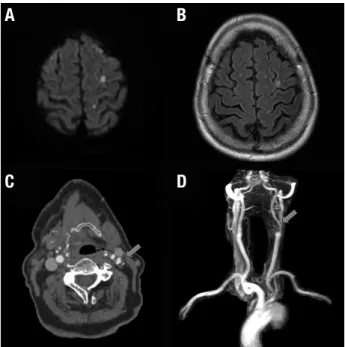
CT angiography showed difuse atheroma-tosis, with moderate stenosis of 50% in the left carotid bulb due to an ulcerated plaque (Figure 1). Difusion-Weighted Imaging MRI revealed small hyperintense lesions in the ter-ritory of the left middle cerebral artery, pre-dominantly posterior and cortical (Figure 1). Serial electroencephalogram testing was nega-tive for epileptiform activity, but there was a focal electrical slowing in the left hemisphere. After a complete neurovascular work-up, we
This study was conducted at the Divisão de Clínica Neurológica do Hospital das Clínicas da FMUSP.
1Department of Neurology, Hospital das Clínicas, University of São Paulo Medical School – São Paulo, SP, Brazil.
Breno José Alencar Pires Barbosa. Divisão de Clínica Neurológica do Hospital das Clínicas da FMUSP – Av. Dr. Enéas de Carvalho Aguiar, 255 / 5º andar / sala 5084 – 05403-900 São Paulo SP – Brazil. E-mail: [email protected]
Disclosure: The authors report no conflits of interest.
Received October 26, 2017. Accepted in final form November 13, 2017.
Dement Neuropsychol 2017 December;11(4):459-461
460 Gerstmann’s syndrome and optic ataxia Barbosa et al.
concluded the patient had a stroke due to an evident large artery atherosclerosis mechanism.
he patient was treated with dual antiplatelet ther-apy and a high-potency statin at standard doses for secondary prevention. All cognitive deicits resolved spontaneously within 3 days of admission and she was discharged at day 4 with a modiied Rankin-scale of 1 for outpatient follow-up, rehabilitation and smoking cessation.
DISCUSSION
his case highlights the concurrence of Gerstmann’s syndrome, right spatial neglect and unilateral right optic ataxia in the acute phase of a left middle cerebral artery stroke. hese syndromes have been described in association with a wide range of neurological condi-tions, including neurovascular diseases.1-6
Gerstmann’s syndrome is deined in the presence of inger agnosia, right-left disorientation, agraphia and acalculia. Agnosia is the inability to recognize exter-nal information in the absence of substantial sensory deicits. Agraphia and acalculia reveal impairment in the ability to write and manipulate numbers, respec-tively. Zukic et al.3 observed 194 acute stroke cases
and reported the inding of alexia, agraphia and acal-culia alone, or in combination, in up to 30.4% of cases. However, complete Gerstmann’s syndrome was only reported in less than 5% of the patients in this series.
Despite some controversies with regard to Gerst-mann’s syndrome topographic value,7 there is
reason-able agreement that the most probreason-able location involves the left angular gyrus with some subcortical extension. João et al.6 recently reported an interesting case of
tran-sient Gerstmann’s syndrome following a left middle cerebral artery infarct with lesion to the inferior frontal lobe and insula. his case illustrates the occurrence of Gerstmann’s syndrome even in cases where the angular gyrus is spared. his is probably explained by a discon-nection of association ibers connecting the frontal and parietal lobes (i.e. superior longitudinal and arcuate fas-ciculus), as illustrated by tractography studies.8
Optic ataxia is the inability to accurately reach a tar-get under visual guidance. he lesions for optic ataxia are most probably related to the parieto-occipital border zones and represent a disorder of the sensory-guided motor behavior of the posterior cerebral cortex, with contributions from the supplementary motor area in the frontal lobes.9
Regarding the neural systems subserving visual pro-cessing, the outputs from primary and secondary visual cortex are traditionally divided into the dorsal and
ven-tral streams. Whereas the venven-tral stream is associated with transforming visual input into representations of objects’ characteristics, the dorsal stream mediates navigation and the visual control of actions directed at objects.10 here is, however, new evidence that the dorsal
stream is further subdivided into a ventro-dorsal and dorso-dorsal system. he subject was recently revisited by Binkofsky and Buxbaum.11 On one hand, the
ventro-dorsal stream plays a major role in processing object use representation, such as the use of tools (use system). On the other hand, the dorso-dorsal stream is the visual pathway for action, such as reaching targets with various locations in space (grasp system). A lesion to this system would result in optic ataxia.
An interesting inding in our case is the concurrence of unilateral right optic ataxia and simultanagnosia. Nagaratnam et al.12 reported 5 cases of optic ataxia due
to unilateral stroke. he lesion was located in the pari-eto-occipital regions in three patients but were anatomi-cally further forwards in the remaining two cases. he optic ataxia was bilateral in one patient, but the deicit was more prominent on the contralateral side of the cerebral lesion.
Dement Neuropsychol 2017 December;11(4):459-461
461
Barbosa et al. Gerstmann’s syndrome and optic ataxia
he absence of a functional imaging study in this case is a limiting factor, since it could have demonstrated regional reduced activity and further corroborated our discussion.
In conclusion, since these symptoms may be tran-sient, our case highlights the importance of testing for cognitive syndromes such as Gerstmann’s and Balint’s in suspected cases in the acute phase of neurovascular conditions.
Author contributions. Dr. Barbosa wrote the manuscript.
Dr. Barbosa, Dr. de Brito, Dr. Rodrigues and Dr. Kubota contributed to data collection and interpretation. Dr. Parmera contributed to conception, interpretation of the data and revision of the manuscript.
Video. Testing optic ataxia (irst part) and Gerstmann’s
syndrome (second part). he patient was also tested for acalculia separately with written numbers (not shown) (available in www.demneuropsy.com.br).
REFERENCES
1. Moore MR, Saver JL, Johnson KA, Romero JA. Right parietal stroke with Gerstmann’s syndrome. Appearance on computed tomography, magnetic resonance imaging, and single-photon emission computed tomography. Arch Neurol. 1991;48(4):432-5.
2. Bhattacharyya S, Cai X, Klein JP. Dyscalculia, dysgraphia, and left-right confusion from a left posterior peri-insular infarct. Behav Neurol. 2014;2014:823591.
3. Zukic S, Mrkonjic Z, Sinanovic O, Vidovic M, Kojic B. Gerstmann’S syndrome in acute stroke patients. Acta Inform Medica AIM J Soc Med Inform Bosnia Herzeg Cas Drustva Za Med Inform BiH. 2012; 20(4):242-3.
4. Beis J-M, Paysant J, Bret D, Le Chapelain L, André J-M. Specular right-left disorientation, finger-agnosia, and asomatognosia in right hemisphere stroke. Cogn Behav Neurol Off J Soc Behav Cogn Neurol. 2007;20(3):163-9.
5. Rousseaux M, Delafosse A, Devos P, Quint S, Lesoin F. [Balint syndrome as a result of a biparietal infarct. Neuropsychological analysis]. Cortex J Devoted Study Nerv Syst Behav. 1986;22(2):267-77.
6. João RB, Filgueiras RM, Mussi ML, Barros JEF de, João RB, Filgueiras RM, et al. Transient Gerstmann syndrome as manifestation of stroke: Case report and brief literature review. Dement Amp Neuropsychol. 2017;11(2):202-5.
7. Ardila A. A proposed reinterpretation of Gerstmann’s syndrome. Arch Clin Neuropsychol Off J Natl Acad Neuropsychol. 2014;29(8):828-33. 8. Catani M, Dell’acqua F, Bizzi A, Forkel SJ, Williams SC, Simmons A, et
al. Beyond cortical localization in clinico-anatomical correlation. Cortex J Devoted Study Nerv Syst Behav. 2012;48(10):1262-87.
9. Damasio AR, Benton AL. Impairment of hand movements under visual guidance. Neurology. 1979;29(2):170-4.
10. Milner AD, Goodale MA. Two visual systems re-viewed. Neuropsycho-logia. 2008;46(3):774-85.
11. Binkofski F, Buxbaum LJ. Two action systems in the human brain. Brain Lang. 2013;127(2):222-9.