ISSN 0104-6632 Printed in Brazil
www.abeq.org.br/bjche
Vol. 33, No. 04, pp. 1003 - 1010, October - December, 2016 dx.doi.org/10.1590/0104-6632.20160334s20140234
*To whom correspondence should be addressed
Brazilian Journal
of Chemical
Engineering
KINETICS OF ULTRASOUND ASSISTED
EXTRACTION OF WEDELOLACTONE
FROM
Eclipta alba
T. W. Charpe and V. K. Rathod
*Chemical Engineering Department, Institute of Chemical Technology, Matunga, Mumbai, 400019, India. Phone: + 91-22-33612020, Fax +: 91-22-33612010
E-mail: [email protected]
(Submitted: December 22, 2014 ; Revised: April 13, 2015 ; Accepted: July 21, 2015)
Abstract - Ultrasound assisted extraction of wedelolactone, a major coumestan present in Eclipta alba, is investigated in the present work.Various process parameters such as type of solvent, power, solvent to solid ratio and extraction temperature, which affect the extraction yield, are optimized. In the ultrasound-assisted extraction with final optimized conditions, i.e., methanol as solvent, 170 W power, 60:1 solvent to solid ratio, 50 °C temperature and 60% duty cycle, amaximum extraction yieldof 0.62 mg/g is obtained in 45 minutes. The kinetic model (Peleg’s model) has been used for the prediction of the yield of wedelolactone in the extract at a given time for all experimental conditions. The values of predicted yields show good agreement with the experimental data for all parameters, i.e., power, solvent to solid ratio and temperature. The extraction of wedelolactone from Eclipta alba is also carried out by conventional extraction methods, i.e., Soxhlet and batch extraction. Ultrasound-assisted extraction gives higher extraction yield in less time as compared to batch extraction (0.41 mg/g in 90 min) and Soxhlet extraction(0.7 mg/g in 360 min). The ultrasound-assisted extraction of wedelolactone from Eclipta alba is an effective way of extraction with the advantages of lower time and higher extraction.
Keywords:Eclipta alba; Wedelolactone; Ultrasound; Extraction kinetics; Bioseparations; Optimisation; Mass transfer.
INTRODUCTION
Eclipta alba is used in traditional herbal medicine
worldwide. It is reported to possess anti-hyperglyce-mic, anti-hepatotoxic, antioxidant, anti-inflamma-tory, antifungal activities and also a good hair growth regulator and potential memory modulator
(Karthiku-mar et al., 2007; Wagner et al., 1986; Dalal et al.,
2010). E. Alba is traditionally used to calm the mind, remove memory disorders, relieve swollen glands, strengthen the spleen, stimulate digestion, as a general tonic, for treatment of edema, fevers, rheumatic joint pains, liver damage due to cirrhosis, infective hepati-tis, and hepatic enlargement, enlarged spleen and skin disorders. The plant contains the alkaloid ecliptine
along with other chemicals such as wedelolactone, demethylwedelolactone, wedelic acid, apigenin, lute-olin, triterpenoid glucoside ecliptasaponin D, Eclip-tasaponin C, daucosterol stigmasterol-3-O-glucoside etc (Dalal et al., 2010).
ef n n (H (B (D ti h U p p v ex w In w p p u g su si sp p ex u en g re tu co o so 2 ce o p le co co v ffective and ovel method atural produ Hatami et al
Bagherian, Dey and Rat ion (Dunford ave their ow Ultrasound as romising te roducts due ent consump xtraction can which can av
nspite of the wedelolactone lored and rep resent work sing ultrasou
Figur
Ultrasound redients from uch as extrac
is (Dey and R pearmint (Po orted that, xtraction of t ltrasound-as nhanced due rows in size elease of ene ure and pres
ollapse is as f liquid. The olid surface 003). Theref ellular mater f cell conten hysical effec ence produce ontact surfac ompounds b ent into the s
d economica ds that are po
ucts are sup
l., 2012), mic 2011), ultra thod, 2013),
d et al., 2010
wn advantage ssisted extra chniquesfor to reduction ption. In ad n be carried
void therma ese advantag e using ultr ported in the optimizatio und has been
re 1: Structur d-assisted ex m natural so ction of β-car Rathod, 2013
orto and De by the appl these natural sisted extrac e to cavitati e and then ergy, thus in sure. Close ymmetric an e liquid jets (Luque-Gar fore, greater rial occurs an nt into the b cts such as li ed by cavita ce area betwe by permitting sample matri
al extraction opular for th percritical f crowave ass asound assis
pressurized 0) etc. All th es as well as action (UAE the extract n in extractio ddition, ultra
out at a low al damage t ges of UAE rasound has e literature. T n of the ext n carried out.
re of wedelo xtraction of ources has b rotene from Sp
3), flavour co ecorti, 2009 lication of u l ingredients ction, the ex ion. The ca
collapse abr ncreasing the
to a solid bo nd produces
have strong rcia and Lu
penetration nd this impro bulk medium
iquid circula ation help in een the solve g greater pen
ix.
n method. T he extraction fluid extract isted extract sted extract solvent extr hese techniqu disadvantag ) is one of tion of natu on time and s asound-assis wer temperatu
to the extrac E, extraction not been Therefore, in traction proc lactone. many other een carried Spirulina plat ompounds fr ) etc. It is ultrasound, is enhanced xtraction rate avity develop ruptly with local tempe oundary, cav high-speed j g impact on que de Cast of solvent i oves the rele m. Similarly, ation and turb n increasing
ent and targe netration of s
The n of tion tion tion rac-ques ges. the ural sol-sted ure, cts. n of ex-the cess in-out ten-rom re-the d. In e is ped the era-vity jets the tro, into ease the rbu-the eted sol-tra rat fas the var is pro ble ver be tra po stu ext ton net M loc an an pre 50 Hi cal Ind ch Ind Ap a 6.5 23 app 20 equ ler pan Po vo Ul (fl he Kinetic stud action proces te, i.e., whet st can be eas e process. K rious factors
important to ocess. Althou e which rep
ry few pape st of our kn action kinetic orted up to n
udy is to dev traction proc ne from E. a
tics of this p
MAT
aterial
Eclipta alb
cal market ( d acetone u alytical grad epared de-io . Methanol igh Pressure
l grade purc dia. Standar ased from N dia.
pparatus
Ultrasound-dual-frequen 5l200 H, Da 0 mm x 150 prox. 6.5 lit 0 watts and uipped with r/indicator. A
nel to selec ower variatio oltage through
ltrasound-A
The extract at bottom, 3 ight) kept in
dies play a v sses and the ther the extr sily obtained Kinetic studi s that affect t o study the ugh various r ort the ultra ers report th nowledge, th cs of wedelo ow. Thus, th velop the opti cess for the
alba leaf pow rocess.
TERIALS AN
a leaf powd size: 40-50 sed as solve de.Water used nized water and acetic Liquid Chro chased from rd wedelolac Natural Reme -assisted extr ncy ultrasoun akshin, India 0 mm x 150 tres, with a d frequencies heater and d A selector sw
t one operat on is possible h an auto-tra ssisted Extr
tion was car 3.5 cm inter n an ultraso
very importa e knowledge
raction proce d from the ki
ies help in the extraction
kinetics of research pap asound-assist he kinetic as he ultrasoun olactone hav he objective timized ultras e extraction
wder and to
AND METHO
der was purc mesh). Meth ent for extra
d as a solve from Millip acid used a omatography
Hi Media L ctone (≥ 99 edies Pvt. Lt
traction was und cleaning a) of intern mm and tan
rated ultraso s of 25 kHz digital tempe witch is pro ating frequen e by varying ansformer. raction
rried out in rnal diamete ound bath. T
ant role in e e of extractio
ess is slow inetic study understandin n rate. Thus,
the extractio pers are avail
ted extractio spects. To th nd-assisted e
e not been r of the prese sound-assiste
of wedelola o study the k
ODS
chased from hanol, ethan action were
nt was fresh pore Milli –
as solvent f y were analyt
Ltd., Mumba 9%) was pu td., Bangalor
carried out g bath (Mod al dimension nk capacity onic power z and 40 kH
rature contro ovided on th ncy at a tim g the input A
Kinetics of Ultrasound Assisted Extraction of Wedelolactone from Eclipta alba 1005
Brazilian Journal of Chemical Engineering Vol. 33, No. 04, pp. 1003 - 1010, October - December, 2016
vessel was kept at the position and depth (2.54 cm above the bottom of the bath)optimized previously earlier (Kulkarni and Rathod, 2014).1 g of the E.
alba leaf powder was taken in a glass vessel and 40
mL solvent was added to it. In order to avoid the loss of solvent, the glass vessel was covered with a lid before it was placed in an ultrasound bath. The ultra-sound was introduced for 80 minutes. Very small aliquots were withdrawn at a specific time interval, so as not to disturb the volume. These samples were then filtered, diluted and analysed using HPLC. Ex-traction experiments were carried out to study the effect of different parameters that affect the extrac-tion yield, such as different solvent, extracextrac-tion time and physical parameters like power, solvent to solid ratio and extraction temperature. Input Power was varied from 100W to 170 W. Solvent to solid ratio was varied from 20:1 to 80:1, keeping all other pa-rameters constant. The bath temperature was varied from 30 °C to 70 °C using the heater provided with the ultrasound cleaning bath and all other parameters were kept constant.
Soxhlet Extraction
A conventional Soxhlet apparatus, which con-sisted of a distillation flask placed in an oil bath, thimble holder and the condenser, was used for ex-traction of wedelolactone from E. alba. 2 g of the powder of E. Alba leaves was packed in filter paper and placed in a thimble holder and 200 mL solvent was placed in the distillation flask. When the boiling of the solvent in the distillation flask started, the thimble holder was filled with condensed fresh sol-vent. Very small aliquots were withdrawn after each extraction cycle and analysed using HPLC. The ex-periment was continued until complete exhaustion of the raw material.
Batch Extraction
Batch extraction was carried out in a glass reactor of capacity 150 ml equipped with a six bladed (pitched blade) glass turbine for agitation. 1 g of the
E. Alba leaf powder was placed in a glass reactor and
40 mL solvent added to it. The mixture was agitated for 3 hrs. Very small aliquots were withdrawn after a specific interval of time and filtered. The clear liquid samples are then diluted and analyzed for wedelolac-tone using HPLC. Different parameters affecting the extraction such as extraction time, solvent to solid ratio, speed of agitation and extraction temperature were optimized and the final extraction experiment
at the optimized conditions was carried out to com-pare it with ultrasound assisted extraction.
Analytical Method
The wedelolactone was analyzed using HPLC. The HPLC instrument was anAgilent 1260 series HPLC system equipped with a diode-array UV–vis detector (DAD, model G1315D). Analysis was performed on a XBD-C18 reversed-phase column (Eclipse, 250×4.6 mm, 5 µm) at the wavelength of 351 nm. The mobile phase consists of a mixture of 60% methanol and 40% acidified water (1% acetic acid) and the flow rate was maintained at 1 ml/min.
Kinetic Model
The well-known semi-empirical kinetic model introduced by Peleg (1988) is widely used to explain the extraction curves of biological materials from plant sources because of the similarity to the shape of sorption curves (Peleg, 1988). The model describes the sorption isotherms of materials as follows:
0
1 2
= +
+
t
t
C C
K K t (1)
where Ct is the concentration of wedelolactoneat time t (mg/g), K1 is Peleg’s rate constant (min g/mg) and K2 is Peleg’s capacity constant (g/mg).
The C0 term can be omitted from Peleg’s equation as the initial concentration of the target solute is zero in the extraction solvent because fresh solvent is used at the beginning. The extraction occurs in two stages, i.e. at the very beginning it is first order and in the latter phase of the process decreases to zero order. The modified Peleg’s equation representing the concentration of the target solute in the extraction solvent against time is shown below:
1 2
= +
t
t C
K K t (2)
Ct can be calculated using the above mentioned Eq. (2) by determining the K1 (Peleg’s rate constant) and K2 (Peleg’s capacity constant) values by plotting the graph of 1/Ct vs. 1/t.
2 1
→∞ = =
t e
C C
K (3)
RESULTS AND DISCUSSION
Soxhlet and Batch Extraction
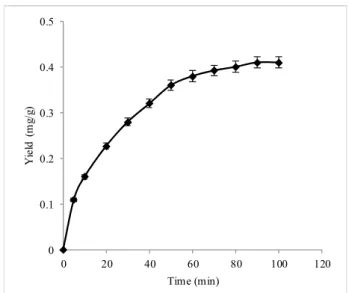
Soxhlet extraction for 6 hours resulted in awede-lolactone yield of 0.70 mg/g. This is considered as the maximum obtainable yield, i.e., 100% extraction and used for comparison with the yield obtained by UAE. In batch extraction, process parameters which affect the extraction yield, i.e., extraction time, speed of rotation (200, 400 and 600 rpm), solvent to solid ratio (20:1, 40:1, 60:1 80:1, and 100:1) and tempera-ture (30, 40, 50,60 and 70 °C) were varied and opti-mized. Final optimized conditions are found as: ex-traction time 90 min, speed of agitation 400 pm, solvent-to-solid ratio 80:1 and temperature 70 °C. The final experiment using these conditions resulted in the yield of 0.41 mg/g as shown in Figure 2.
Figure 2: Batch extraction of wedelolactone at the optimized conditions.
Effect of extraction time in UAE
To identify the equilibrium time of the extraction process, the effect of time on extraction yield was studied. Other parameters were: power 170 W, sol-vent to solid ratio 40:1, temperature 30 °C. The vari-ation in the amount of wedelolactone extracted per g
of E. alba with time is shown in Figure 3. It can be
seen that the yield of wedelolactone increases rapidly upto 45 min and thereafter a gradual increase in the yield is observed. This trend matches with the classi-cal extraction process from the plant material.
0 0.1 0.2 0.3 0.4 0.5 0.6
0 20 40 60 80 100
Y
ie
ld (
m
g/
g)
Time (min)
Figure 3: Effect of time on the extraction yield of wedelolactone.
Effect of Different Solvents in UAE
The solubility of a certain compound in a particu-lar solvent varies with the nature of the solvent, i.e., a polar solute is soluble in polar solvents whereas a non-polar solute dissolves in non-polar solvents. But the complex structure of natural products and chemi-cal characteristics of the solvent make it difficult to predict the chemical interaction between them. The effect of different solvents on the extraction yield was investigated and the results are shown in Figure 4. Different solvents like water, methanol, ethanol, and acetone were used for the extraction of wedelo-lactone. All the experiments were carried out for 45 minutes at a power of 170 W, solvent-to-solid ratio of 40:1 and 30 °C. Figure 3 shows that the maximum extraction yield is obtained using methanol followed by ethanol. But the extraction of wedelolactone is very low with water and acetone. Solubility of the solute in the solvent plays an important role in the extraction process. The solubility of wedelolactone is higher in methanol than in other solvents. Polarity of the solvent is also a significant factor which affects the extraction yield. There are several parameters such as solvent viscosity, surface tension and vapour pres-sure which affect the cavitation and hence extraction yield. It has been reported by Luo et al. (2013) that the solvent viscosity, surface tension and vapour pressure affect the cavitation. A solvent that has high surface tension and high viscosity probably has an increased energy barrier for the formation of cavities, which is unfavorable for cavitation (Luo et al., 2013). The higher extraction obtained for methanol is proba-bly due to its higher polarity, lower viscosity (0.544 mPa s) and lower surface tension (22.07 mN m-1) as compared to other solvents. Hence for further experi-ments, methanol was used as solvent.
0 0.1 0.2 0.3 0.4 0.5
0 20 40 60 80 100 120
Y
ie
ld
(
m
g/
g)
Kinetics of Ultrasound Assisted Extraction of Wedelolactone from Eclipta alba 1007
Brazilian Journal of Chemical Engineering Vol. 33, No. 04, pp. 1003 - 1010, October - December, 2016
0 0.1 0.2 0.3 0.4 0.5 0.6
Methanol Ethanol Water Acetone
Y
ie
ld
(
m
g
/g
)
Figure 4: Effect of different solvents on the extrac-tion yield of wedelolactone.
Optimization of Operating Parameters of UAE and Validation of the Kinetic Model
The operating parameters which affect the extrac-tion yield are power, solvent to solid ratio and tem-perature. Hence these parameters are varied and opti-mized in UAE. The experimental data obtained are used to predict the parameters of Peleg’s kinetic model, i.e., K1 (Peleg’s rate constant) and K2 (Peleg’s capacity constant) from the slope and the intercept of the graphs of 1/Ct vs. 1/t at different powers, solvent to solid ratios and temperatures. Values of K1 and K2 are reported in Table 1. Then these values are used for the prediction of extraction yield of wedelolac-tone for different operating parameters.
Effect of Power
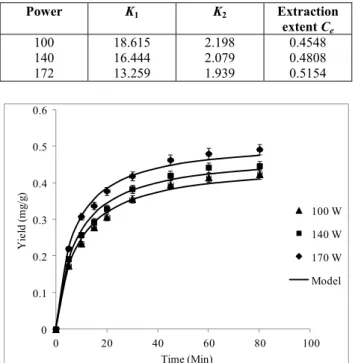
The effect of ultrasound power on the extraction of wedelolactonewas studied by varying input power at 100, 140 and 170 W. Other experimental parame-ters were a frequency of 25 kHz, temperature 30 °C and solvent to solid ratio 40:1. The actual power dis-sipated at these input powers was estimated calori-metrically and the values were 31.7, 37.3 and 46.5 W for input powers of 100, 140 and 170 W, respectively. The results are shown in Figure 5. When the ultra-sound power was increased from 100 to 170 W with an extraction time of 45 min, the yield of wedelolac-tone increased. The vibration caused by ultrasound waves that occurred at the interfaces between solvent and solid matrix affects the extraction. For a given medium and a fixed radiation area, the vibration is proportional to the ultrasound power. At higher power, larger amplitude ultrasound waves are gener-ated through the solvent, which results in formation of a greater number of bubbles and collapse. The generated shock wave causes penetration of solvent into cells, which accelerates mass transfer rate and
the rate of extraction. Hence the maximum yield is obtained at the highest power input.
By applying Peleg’s kinetic model described above for this experimental data, values of K1 and K2 were calculated. These values were then used to pre-dict the yield of wedelolactone at different time and at equilibrium. Values of K1, K2 and Ce are tabulated in Table 1. In Figure 5, experimental and predicted yields of wedelolactoneare plotted where bullets represent the experimental data and the solid line represents the predicted yield. It can be seen from the Figure that there is a good agreement between ex-perimental and predicted yield of wedelolactone. Table 1: Effect of ultrasonic power on the kinetic parameters and calculated Ce (mg/g).
Power K1 K2 Extraction
extent Ce 100 18.615 2.198 0.4548 140 16.444 2.079 0.4808 172 13.259 1.939 0.5154
0 0.1 0.2 0.3 0.4 0.5 0.6
0 20 40 60 80 100
Y
ie
ld
(
m
g/
g)
Time (Min)
100 W
140 W
170 W
Model
Figure 5: Effect of power on the extraction yield of wedelolactone.
Effect of Solvent to Solid Ratio
further addition of solvent does not affect the extrac-tion yield. As there is a marginal change in extracextrac-tion yield for 60:1 and 80:1ratio, the former was taken as the optimized ratio and used for all further experi-ments.
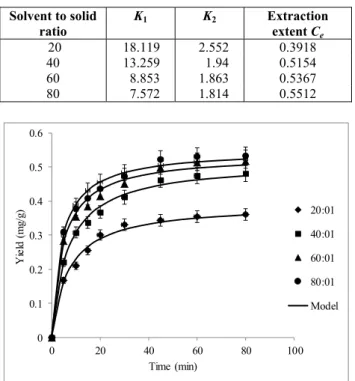
The values of K1, K2 and Ce were calculated from the model and listed in Table 2. To validate the ki-netic model, values of the concentration of wedelo-lactone in the extract at different times for different solvent to solid ratios are calculated from the model and plotted in the graph. Figure 6 shows that there is a good agreement between the experimental and predicted values of concentration of wedelolactone in the extract.
Table 2: Effect of Solvent to solid ratio on the kinetic parameters and calculated Ce (mg/g).
Solvent to solid ratio
K1 K2 Extraction
extent Ce
20 18.119 2.552 0.3918
40 13.259 1.94 0.5154
60 8.853 1.863 0.5367
80 7.572 1.814 0.5512
0 0.1 0.2 0.3 0.4 0.5 0.6
0 20 40 60 80 100
Y
ie
ld (
m
g/
g)
Time (min)
20:01
40:01
60:01
80:01
Model
Figure 6: Effect of solvent to solid ratio on the ex-traction yield of wedelolactone.
Effect of Temperature
It is well known that the solubility of solute in-creases with temperature and thus the extraction yield also increases. The temperature also influences the vapour pressure and physical properties like vis-cosity, surface tension of the solvent and the cavita-tion in the case of ultrasound-assisted extraccavita-tion. Therefore, the effect of temperature on the extraction yield of wedelolactone was studied and the results are shown in Figure 7. Extraction was carried out at different bath temperatures, i.e., 30 °C, 50 °C and 70 °C. It is observed that the extraction yield in-creased with an increase in temperature which is a
result of increased solubility at higher temperature. However, the change in extraction yield is marginal from 50 to 70 °C. Vapor pressure significantly influ-ences the occurrence and the intensity of acoustic cavitation. When the temperature is low, bubbles are few but they collapse with relatively high intensity, which enhances the cell disruption and thus the mass transfer. But, when temperature is high, though more bubbles are created, they collapse with less intensity. Hence, at higher temperature the change in extrac-tion yield is marginal and thus the 50 °C temperature is taken as optimum.
The values of K1 and K2 are calculated from the model and listed in Table 3. Values of the concentra-tion of wedelolactone in the extract at different time intervals for different temperatures are calculated from the model and plotted in Figure 7. This shows that agreement between the experimental and pre-dicted values of the concentration of wedelolactone in the extract is quite good.
Table 3: Effect of temperature on the kinetic pa-rameters and calculated Ce (mg/g).
Temperature (°C)
K1 K2 Extraction
extent Ce 30 13.884 1.967 0.5083 50 11.711 1.619 0.6176
70 9.917 1.538 0.6501
0 0.1 0.2 0.3 0.4 0.5 0.6 0.7
0 20 40 60 80 100
Y
ie
ld
(
m
g/
g)
Time (min)
30°C
50°C
70°C
Model
Figure 7: Effect of temperature on the extraction yield of wedelolactone.
The Effect of Temperature on the Peleg’s Rate Constant
Kinetics of Ultrasound Assisted Extraction of Wedelolactone from Eclipta alba 1009
Brazilian Journal of Chemical Engineering Vol. 33, No. 04, pp. 1003 - 1010, October - December, 2016
is assessed by the linearized Arrhenius equation, giving the relationship between 1/K1 and extraction temperatures as follows:
( )
1 1
ln⎛⎜ ⎞ =⎟ ln − ⎝ ⎠
a E A
K RT (4)
where K1 is the Peleg rate constant (min g/mg UA), A is a constant called as frequency factor (min−1), Ea the activation energy (J/mol), R the universal gas constant (8.314 J/(mol K)), and T the absolute tem-perature (K).
The plot of the ln(1/K1) vs. 1/T should result in a straight line with the negative of the slope equal to
Ea/R and intercept equal to ln(A). The activation energies of the ultrasound-assisted extraction and batch extraction were found to be 7.26 kJ/mol and 10.95 kJ/mol, respectively. From these results, we can conclude that the initial extraction rate is more temperature sensitive for the conventional batch extraction process than for UAE. This means that an increase in the temperature will affect the initial ex-traction rate of the batch exex-traction process more than in the case of UAE. Similar results are also reported by Vetal et al. (2013) for the extraction of ursolic acid from Ocimum sanctum by ultrasound. Effect of Duty Cycle
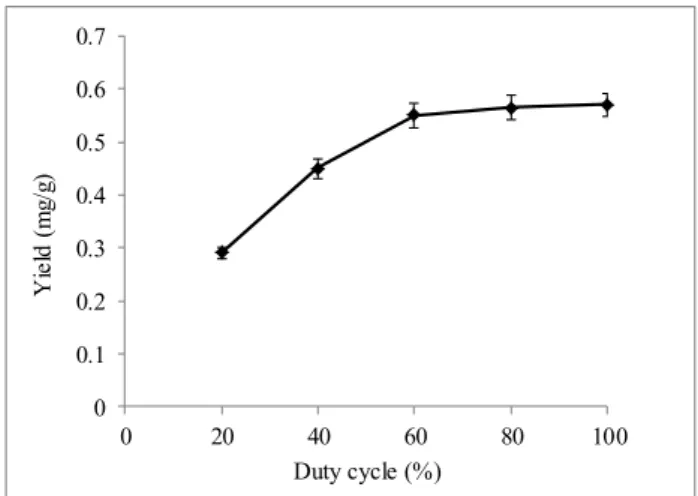
The duty cycle, i.e., ON–OFF timing, of the ultra-sonicator must be optimized for better extraction, as an unnecessary increase in the ON timing would lead to excessive heating and excessive energy consump-tion. The effect of duty cycle on the extraction yield of wedelolactone was studied at 20%, 40%, 60%, 80% and 100% duty cycles and results are presented in Figure 8. It can be seen from the figure that the extraction yield increased with an increase in the duty cycle from 20% to 60% and then became al-most steady up to 100% duty cycle. Hence the 60% duty cycle was selected as the optimum value as there is no change in extraction yield after 60% duty cycle. Similar results are also reported by Dey and Rathod (2013), who carried out the extraction of β -carotene from Spirulina platensis and Sun et al. (2011) who investigated the effects of different fac-tors of ultrasound treatment on the extraction yield of all-trans-β-carotene.
Comparison of UAE with Traditional Extraction Techniques
In order to compare the efficiency of UAE, the ex-traction of wedelolactone was also performed using
conventional techniques, viz., Soxhlet and batch extraction. Table 4 shows the optimum results ob-tained with the Soxhlet extraction, batch extraction and UAE. It is observed that the time taken by UAE is much less compared to Soxhlet extraction, i.e., using UAE, a yield of 0.62 mg/g is obtained within 45 min of extraction time whereas the Soxhlet extrac-tion required 6 hrs for extracextrac-tion of 0.70 mg/g of wedelolactone. In case of batch extraction the time required for extraction is double that for UAE and the extraction yield is stilllower than that in UAE. The solvent consumption was also reduced with the use of ultrasound. In batch extraction 80 mL of solvent is required per g of the raw material; however, in UAE the solvent requirement was reduced to 60 mL per g of raw material. Thus, UAE is more efficient extrac-tion technique than convenextrac-tional techniques in terms of time and solvent required and yield.
0 0.1 0.2 0.3 0.4 0.5 0.6 0.7
0 20 40 60 80 100
Y
ie
ld (
m
g/
g)
Duty cycle (%)
Figure 8: Effect of duty cycle on the extraction yield of wedelolactone.
Table 4: Comparison of UAE, batch extraction and Soxhlet extraction.
Technique of extraction
Time required
(min)
Solvent required
(ml/g)
Temperature (°C)
Yield (mg/g)
Soxhlet 360 - 90 0.70
Batch 90 80 70 0.41
UAE 45 60 50 0.62
CONCLUSIONS
highest extraction yield was obtained at 170 W. Ex-traction initially increased rapidly with an increase in solvent-to-solid ratio and then gradually, giving maxi-mum yield at a 60:1 ratio. It was also observed that the extraction yield increases with temperature and the initial extraction rate of the conventional process was more temperature dependent than UAE. With op-timized conditions, i.e., methanol as solvent, 170 W power, 60:1 solvent to solid ratio, 50 °C temperature, a 0.62 mg/g yield was obtained. The extraction yield obtained with ultrasound-assisted extraction was com-pared with that of Soxhlet extraction and batch ex-traction. Ultrasound-assisted extraction gavea higher extraction yield with lower solvent consumption as compared to batch extraction. It also required less time as compared to both Soxhlet and batch extrac-tion. Hence, it can be concluded that the ultrasound-assisted extraction of wedelolactone from Eclipta alba is an effective method for extraction with the advantages of lower time and solvent requirement and higher extraction yield. Peleg’s kinetic model was used for the prediction of yield of wedelolac-tonein the extract at a given time for all experimental conditions.The values of predicted yields showed good agreement with the experimental data for all parameters, i.e., power, solvent to solid ratio and temperature.
REFERENCES
Bagherian, H., Ashtiani, F. Z., Fouladitajar, A., Moh-tashamy, M., Comparisons between conventional, microwave and ultrasound-assisted methods for extraction of pectin from grapefruit. Chem. Eng. Process. Process Inten., 50, 1237-1243 (2011). Dalal, S., Kataria, S. K., Sastry, K. V., Rana, S. V. S.,
Phytochemical screening of methanolic extract and antibacterial activity of active principles of hepatoprotective herb, Eclipta alba. Ethnobot. Leaflets, 14, 248-58 (2010).
Dey, S, Rathod, V. K., Ultrasound assisted extraction of b-carotene from Spirulina platensis. Ultrason. Sonochem., 20, 271-276 (2013).
Dunford, N. T., Irmak, S., Jonnala, R., Pressurised
solvent extraction of policosanol from wheat straw, germ and bran. Food Chem., 119, 1246-1249 (2010).
Hatami, T., Cavalcanti, R. N., Takeuchi, T. M., Mei-reles, M. A. A., Supercritical fluid extraction of bi-oactive compounds from Macela (Achyrocline
satureioides) flowers: Kinetic, experiments and
modelling. J. Supercrit. Fluids, 65, 71-77 (2012). Karthikumar, S., Vigneswari, K., Jegatheesan, K.,
Screening of antibacterial and antioxidant activi-ties of leaves of Eclipta prostrate (L). Sci. Res. Essays, 2, 101-104 (2007).
Kulkarni, V. M., Rathod, V. K., Mapping of an ultra-sonic bath for ultrasound assisted extraction of mangiferin from Mangifera indica leaves. Ultra-son. Sonochem., 22(2), 606-611 (2014).
Luo, J., Fang, Z., Smith Jr., R. L., Ultrasound-en-hanced conversion of biomass to biofuels. Prog. Energ. Combust., 41, 56-93 (2014).
Luque-Garcia, J. L., Luque de Castro, M. D., Ultra-sound: A powerful tool for leaching. Trends Anal. Chem., 22, 41-47 (2003).
Peleg, M., An empirical model for the description of moisture sorption curves. J. Food Sci., 53, 1216-1219 (1988).
Porto, C. D., Decorti, D., Ultrasound-assisted extrac-tion coupled with under vacuum distillaextrac-tion of flavour compounds from spearmint (carvone-rich) plants: Comparison with conventional hy-drodistillation. Ultrason. Sonochem., 16, 795-799 (2009).
Sun, Y., Liu, D., Chen, J., Ye, X., Yu, D., Effects of different factors of ultrasound treatment on the extraction yield of the all-trans-b-carotene from citrus peels. Ultrason. Sonochem., 18, 243-249 (2011).
Vetal, M. D., Lade, V. G., Rathod, V. K., Extraction of ursolic acid from Ocimum sanctum by ultra-sound: Process intensification and kinetic studies. Chem. Eng. Process. Process Intensif., 69, 24-30 (2013).
Wagner, H., Geyer, B., Kiso, Y., Kikino, H., Rao, G. S., Coumestans as the main active principles of the liver drugs Eclipta alba and Wedelia