REM: R. Esc. Minas, Ouro Preto, 68(3), 319-322, jul. sep. | 2015 319 Daniel Geraldo Cruz and Rosa Malena Fernandes Lima
Abstract
This paper presents the study results of Mn2+ ion inluence on reverse cationic
lo-tation of iron ore at pH 10.5. A small inluence was observed on all response variables evaluated: mass recovery, Fe metallurgical recovery, grade of Fe and SiO2 in obtained concentrates for dosages of MnCl2 from 600 g/ton. The conditioning of pulp with ethylene diamine tetraacetic acid - EDTA complexing agent (720 g/ton) in presence of MnCl2 (600 g/ton) at natural pH, before the addition and conditioning with corn starch (400 g/ton) and amine (50 g/ton) at pH 10.5, produced a concentrate with 63% Fe, 5.1% SiO2, which is similar to results obtained in lotation test without manganese species present in pulp.
keywords: Iron ore; reverse cationic lotation, Mn2+ ion, EDTA.
Daniel Geraldo Cruz
Engenheiro metalurgista e mestre pelo PPGEM Universidade Federal de Ouro Preto
Escola de Minas - Engenharia de Minas Ouro Preto – Minas Gerais – Brasil [email protected]
Rosa Malena Fernandes Lima
Professora Associada
Universidade Federal de Ouro Preto Escola de Minas - Engenharia de Minas Ouro Preto – Minas Gerais – Brasil [email protected]
Influence of Mn
2+
ion in reverse
cationic flotation of iron ore
Mining
Mineração
http://dx.doi.org/10.1590/0370-44672015680051
1. Introduction
The Brazilian iron ore reserves correspond to 13.6% of the total world reserves. The world production of iron ore in 2013 was estimated at 3 billion tons (similar to the previous year). The Brazilian production was of 386.3 Mt with an average content of 63.6% Fe (third largest world production) split into pebble ore (10.7 %) and ine products (pellet feed and sinter feed) (89.3 %). About 70 % of Brazilian production comes from Minas Gerais State (60 Mt in 2012) (DNPM, 2014).
It is a common practice in Iron Quadrangle – Minas Gerais State to concentrate the fraction ines of iron ore by gravimetric, magnetic separation and lotation methods. As well known, the method choice to concentrate a speciic iron ore depends on several factors such as its physical and mineralogical proper-ties, and the liberation fraction size of quartz (Araujo et al., 2003; Filippov et
al., 2014).
The cationic reverse lotation at pH 10.5, using corn starch as iron min-erals depressant and amine as silicate gangue collector, is the most successful route used to concentrate ines of iron ores (Filippov et al., 2014, Araujo et al., 2005). However, the particles in frac-tion size smaller than 4 µm hamper the selectivity of this process route. To solve this problem a previous deslaming op-eration is used, which causes metal loss (Houot, 1983; Ma et al., 2011; Filippov
et al., 2014).
Multivalent cations and its hy-droxy-complexes formed in water can adsorb on the surface of minerals in pulp, modifying their surface charges and thus interfering in the action of lotation reagents, causing the loss of selectivity in the process. Therefore, it is necessary to treat the process water or to complex the multivalent metallic cations present
in the pulp before addition of depressant and collector reagents (Pinheiro et al. 2012, Lelis, 2014).
Lelis (2014) studied the effect of Mn2+ species on recoveries of hematite
and quartz at pH 10.5 without and with previous complexion by EDTA. In this basic, study the researcher ob-served that the depression of quartz by manganese species was effective only for dosages from 100 mg/L. In this pH value the dominant manganese species is Mn(OH)2(s), which settled on both mineral surfaces. The recoveries of both minerals studied were restored by previ-ous complexation of manganese species by EDTA.
In this paper are presented the results of the effect of MnCl2 on bench cationic reverse flotation carried out with an iron ore at pH10.5 and the use of EDTA as complexing agent of Mn2+
ions in pulp.
2. Materials and methods
2.1 Materials
The iron ore from conventional lotation feed of industrial low sheet of Samarco A. S. was used in bench lota-tion tests at pH 10.5. The d80 of the ore was equal to 135μm. The mineral phases identiied by X-ray diffractometry were quartz, hematite and goethite. The
con-tents of Fe and SiO2 were respectively 44.7% and 31.8% (Cruz, 2015).
In the lotation tests, the follow-ing reagents were used: commercial etheramine acetate (Flotigam EDA) with 50% of neutralization degree (Clariant A.S.) as collector; MnCl2.4H2O (Mn2+
320
Influence of Mn2+ ion in reverse cationic flotation of iron ore
REM: R. Esc. Minas, Ouro Preto, 68(3), 319-322, jul. sep. | 2015
2.2 Methods
The bench lotation tests, using tap water, were performed using a CDC lota-tion cell, at 1200 rpm speed , pulp density of 45 %wt., using a vessel of volume 2L. All tests were carried out at pH 10.5, 400 g/ton of corn starch and 50 g/ton of amine, which was determined by Cruz (2015).
The procedure adopted for bench lotation tests was (Cruz, 2015):
i. Preparation of a pulp with 45 %wt. density (1800 mL of water at pH 10.5 and 1500g of ore).
ii. Setting speed cell at 1200rpm. iii. Addition of the appropriate
solu-tion volume with ions Mn2+,
correspond-ing to the established dosage for each test, and conditioning for 6 minutes.
iv. Addition of starch solution (1 %wt.), corresponding to 400g/ton dosage.
v. Pulp pH setting to 10.5 and con-ditioning for 5 minutes.
vi. Addition of amine solution (1 %wt.), corresponding to the dosage of 50g/ton.
vii. pH correction, if necessary, and conditioning for 3 more minutes.
viii. Opening of the air injection valve and lotation for 3 minutes.
ix. Collecting of the lotation prod-ucts, drying and weighing.
In the lotation tests, using EDTA as complexing agent of Mn2+ species, the
MnCl2 dosage was ixed at 600g/ton and the conditioning was performed in the pulp natural pH (~7.5). Then, EDTA was added, which lowered the pulp pH for approximately 4.0 (depending on dosage added), and it was conditioned for 6 min-utes. Subsequently, starch (400g/ton) and amine (50g/ton) were added, following the standard procedure, steps from iv to ix described previously.
3 Results and discussion
Figure 1 presents the mass recoveries and Fe metallurgical recoveries of
lota-tion tests in funclota-tion of MnCl2 dosages. Figure 2 presents the Fe and SiO2 grades
in the obtained concentrates in function of MnCl2 dosage.
Figure 1
Mass recovery and Fe metallurgical recovery vs MnCl2 dosages (400g/ton starch, 50g/ton amine, pH 10.5).
Figure 2
Fe and SiO2 grades in the concentrates vs dosage of MnCl2 (400g/ton starch, 50g/ ton amine, pH 10.5).
The mass recovery reached value around 75 % for the dosage of 2,400g/ ton MnCl2. The Fe metallurgical recov-ery reached value of 96 %. It means an
increase of little more than 10% for mass recovery and 6% for Fe metallurgical recovery compared to the test performed without Mn2+ ion (mass recovery = 62.6
REM: R. Esc. Minas, Ouro Preto, 68(3), 319-322, jul. sep. | 2015 321 Daniel Geraldo Cruz and Rosa Malena Fernandes Lima results are coherent with Lelis (2014),
which veriied decrease in recoveries in micro-flotation tests of hematite and quartz, carried out at pH 10.5 and 5 mg/L amine, with increase of MnCl2 dosage.
As can be observed in Figure 2, both Fe and SiO2 grades have almost the same values up 300 g/ton MnCl2. Only from 600 g/ton on, was there observed a decrease of Fe grades and increase in SiO2 grades in obtained concentrates.
In accordance with manganese diagram species (Fuerstenau, 1985), at pH 10.5, the concentrations of Mn2+ and
MnOH+ are very low. The predominant
specie is Mn(OH)2(s). At the maximum dosage of MnCl2 (2,400g/ton), a dark aspect of the pulp was observed. Duarte (2012) and Lelis (2014) also highlighted the formation of a brown precipitate, due to the Mn(OH)2(s) and MnO(OH)2(s) pre-cipitation on the mineral surfaces, which was responsible for the decrease in their loatabilities, due the "slime coating" phe-nomenon. Thus, the increased mass recov-ery, observed in Figure 1 is related mainly to precipitation of the specie Mn(OH)2 on surfaces of quartz and iron minerals.
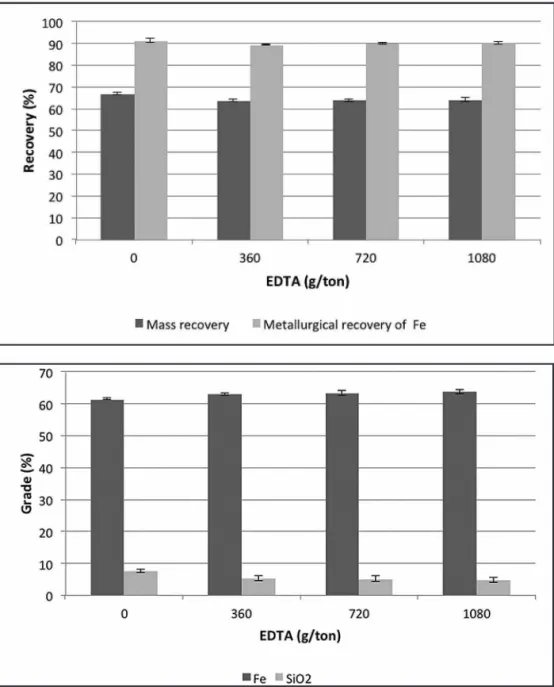
Figure 3 presents the mass recovery and Fe metallurgical recovery in function
of EDTA dosage and Figure 4 presents the Fe and SiO2 grades in the obtained concentrates in function of EDTA dosage at ixed dosage of 600 g/ton MnCl2.
As can be observed in Figures 3 and 4, the metallurgical recoveries and grades of Fe were around 90% and 63%, respectively. The SiO2 grades in obtained concentrates remained in the range of 5% independent of EDTA dosage (in the absence of EDTA, the SiO2 grade was 7.5%). Such grades are within the range of commercial specifications required for sinter feed (~63.5% Fe, 4-6% SiO2) (Lima, 1997).
Figure 4 Fe and SiO2 grades in the concentrates vs dosage of EDTA (MnCl2 600 g/ton, 400g/
ton starch, 50g/ton amine, pH 10.5).
4 Conclusions
Based on results of cationic re-verse lotation tests at pH 10.5, per-formed with an iron ore sample in the presence of manganese species, it is concluded that the presence of ions Mn2+ increased the mass
recover-ies, Fe metallurgical recoverrecover-ies, SiO2 grades and decreased the Fe grades in obtained concentrate only from 600 g/ton MnCl2. With addition of EDTA at 600 g/ton MnCl2 before addition and conditioning with corn starch and
amine, concentrates with greater Fe grade (~63.5%) and lower SiO2 grade (~5%) were obtained, which are close to the commercial speciications of pel-let feed, generally lower than 5% SiO2 and higher than 60% Fe.
322
Influence of Mn2+ ion in reverse cationic flotation of iron ore
REM: R. Esc. Minas, Ouro Preto, 68(3), 319-322, jul. sep. | 2015
ARAUJO, A.C. et alii. Ore mineralogy and its relevance for selection of concentra-tion methods in processing of Brazilian iron ores. Miner. Process. Extr. Metall. (Trans.
Inst. Min. Metall. C). 112, C44–C64, 2003.
ARAUJO, A. C. et alii. Reagents in iron ore lotation. Minerals Engineering, v. 18, p. 219-224, 2005.
CRUZ, D. G. Inluência dos íons Ca2+, Mg2+ e Mn2+ na lotação catiônica de
minério de ferro: estudos de bancada. Ouro Preto: Escola de Minas, Universidade
Federal de Ouro Preto, 2015. 74 f. (Dissertação de Mestrado em Engenharia Mineral). DEPARTAMENTO NACIONAL DE PRODUÇÃO MINERAL. Sumário
Min-eral 2014. v. 34. p.1-25 e p. 72-73. Disponível em: <http://www.dnpm.gov.br/dnpm/
sumarios/sumario-mineral-2014> Acesso em: 12/03/2015.
DUARTE, R. S. Estudo da lotação de inos de minério de manganês
sílico-carbonatado com amina. Ouro Preto: Escola de Minas, Universidade Federal de Ouro
Preto, 2012. 82 f. (Dissertação de Mestrado em Engenharia Mineral).
FILIPPOV, L. O. et alii. An overview of the beneiciation of iron ores via reverse cationic lotation. International Journal of Mineral Processing, v. 127, p. 62–69, 2014.
FUERSTENAU, M. C. et alii. Chemistry of Flotation. New York: Society of Mining Engineers of the American Institute of Mining, Metallurgical and Petroleum Engineers, Inc., p. 1985. 177 p.
HOUOT, R. Beneiciation of iron ore by lotation: review of industrial and poten-cial applications. International Journal of Mineral Processing, v. 10, p. 183-204, 1983. LELIS, D. F. Inluência de cátions polivalentes na lotação catiônica de minério
de ferro: estudos fundamentais. Ouro Preto: Escola de Minas, Universidade Federal de
Ouro Preto, 2014. 88 f. (Dissertação de Mestrado em Engenharia Mineral).
LIMA, R. M. F. Adsorção de amido e amina sobre as superfícies da hematita e quartzo e sua inluência na lotatção. Belo Horizonte: Escola de Engenharia, Universi-dade Federal de Minas Gerais, 1997. 238 f. (Tese de doutorado).
MA, X. et alii.. Comparative studies of reverse cationic/ anionic lotation of Vale iron ore. International Journal of Mineral Processing, v. 100, p.179-183, 2011.
PINHEIRO, V.S. et alii. Flotação com amina: a importância da qualidade da água. REM: R. Esc. Minas, Ouro Preto, v. 65, n. 4, p. 549-552, 2012.
Received: 23 March 2015 - Accepted: 15 May 2015.
6. References
5. Acknowledgments
The authors would like to thank CNPq by inancial support and a schol-arship for one of the authors, CAPES
for a scholarship for one of the authors, Samarco A.S. by iron ore sample supply, Clariant A. S. by amine reagent supply