Vocal discomfort in individuals with cervical complaints:
an approach based onself-assessment questionnaires
Desconforto vocal em indivíduos com queixa cervical: uma
abordagem a partir de questionários de autoavaliação
Flávia Azevedo Righi Badaró1, Rubens Corrêa Araújo2, Mara Behlau1
ABSTRACT
Purpose: To verify the relationship between the occurrence of vocal
discomfort and cervical complaints by using self-assessment question-naires. Methods: Thirty individuals (18–65 years of age) with various cervical complaints answered a translated and culturally adapted version of the self-assessment cervical questionnaire, The Copenhagen Neck Functional Disability Scale (CNFDS), titled Escala Funcional de Inca-pacidade do Pescoço de Copenhagen (EFIPC), the vocal self-assessment instruments Voice-Related Quality of Life (V-RQOL), and the Vocal Tract Discomfort Scale (VTDS). Statistical tests were used to analyze the possible relationships between the data obtained. Results: Most of the participants reported the presence of vocal discomfort, with almost half presenting with a significant number of vocal discomfort symp-toms; among these symptoms, dryness was reported most frequently and itching was reported with the highest intensity. No correlation was found between the EFIPC and V-RQOL or VTDS findings, but a neg-ative correlation was found between the V-RQOL and VTDS findings. Conclusion: Although the participants reported a high occurrence of
vocal discomfort, no correlation was found between the selected ques-tionnaires.
Keywords: Neck pain; Questionnaires; Self-assessment; Perturbance;
Voice
RESUMO
Objetivo: Verificar a relação entre a ocorrência de desconforto vocal e
queixa cervical, a partir de questionários de autoavaliação. Métodos: Trinta indivíduos de 18 a 65 anos de idade, todos com algum tipo de queixa cervical, responderam à versão traduzida e adaptada cultural-mente do questionário de autoavaliação cervical The Copenhagen Neck Functional Disability Scale (CNFDS) - denominado em português Es-cala Funcional de Incapacidade do Pescoço de Copenhagen (EFIPC) - e dois instrumentos de autoavaliação vocal: o Questionário de Qualidade de Vida e Voz (QVV) e a Escala de Desconforto do Trato Vocal (EDTV). Testes estatísticos foram aplicados para analisar a possibilidade de re-lação entre os dados obtidos. Resultados: A maioria dos participantes referiu presença de desconforto vocal, sendo que quase metade deles apresentou relevante quantidade de sintomas desse desconforto. Dentre esses, a secura foi referida com maior frequência e a coceira, o sintoma que apresentou maior intensidade. Não houve correlação entre o EFIPC e o QVV ou o EDTV. Houve correlação negativa entre QVV e EDTV. Conclusão: Apesar dos participantes apresentarem ocorrência elevada
de desconforto vocal não houve correlação entre os questionários es-colhidos.
Descritores: Cervicalgia; Questionários; Autoavaliação; Perturbação; Voz
Study conducted at the Centro de Estudos da Voz – CEV – São Paulo (SP), Brazil, as a pre-requisite for the completion of a specialization in Voice Area. (1) Centro de Estudos da Voz – CEV – São Paulo (SP), Brazil.
(2) Department of Physiotherapy, Universidade de Taubaté – UNITAU – Taubaté (SP), Brazil. Conflict of interests: No
Author’s contribution: FARB lead researcher, research development, schedule planning, literature survey, data collection and analysis, article writing, and article submission and procedures; RCA co-supervisor, data analysis, corrections to the draft paper, and approval of the final version; MB supervisor, research develop-ment, schedule planning, data analysis, corrections to the draft paper, and approval of the final version.
Correspondence address: Flávia Azevedo Righi Badaró. R. David Maria Monteiro Gomes, 105, Centro, Taubaté (SP), Brazil, CEP: 12020-300. Email: [email protected]
INTRODUCTION
Communication supported by the use of voice is a highly individualized human ability derived from organic, emotional, and interactional aspects. Under satisfactory conditions, the voice contributes to appropriate speech intelligibility and to effective communication according to the speaker’s profes-sional and social demands. When the voice is abnormal, it is characterized by a condition of dysphonia, a communication disorder in which the voice presents difficulty in effectively fulfilling the oral transmission of a message(1).
In a broad sense, it can be said that various organic, func-tional, and organic-functional(1) factors may be related to the
origin of vocal disorders. These factors include the individual’s physical vulnerability, abnormalities in the respiratory tract, or personality factors, which may cause discomfort or truly interfere with an individual’s personal life(1,2).
Even before a condition characteristic of voice disorder manifests, the patient may report the presence of vocal dis-comfort in some situations(3). The term discomfort is used to
describe a subjective experience representing a condition that compromises the optimal functionality of a structure, which is the vocal tract in this case. In this study, the term vocal discomfort was considered a synonym of pain as well as an indication of burning, tightness, dryness, sore throat, itching, throat sensitivity, throat irritation, and the feeling of a lump in the throat. Clinical experience suggests that many dysphonic individuals present with some discomfort in the vocal tract that probably results from some type of overexertion, such as that involving the perilaryngeal muscles(3).
The frequency of use and the conditions under which the voice is produced may indicate how a voice disorder arose, and this is mainly applicable to cases in which the voice is greatly influenced by the individual’s professional activity(3).
For example, a professor is required to use his/her voice con-tinuously and, often, excessively in a noisy environment. A recent study conducted in this population (with and without vocal complaints) showed that professors who self-reported the presence of vocal discomfort had at least 3 manifestations of this type of discomfort. Further, even the professors who had not previously self-reported the presence of vocal discomfort were able to identify the occurrence of 3 or fewer manifestations of discomfort, showing the significant impact of the demands of this profession(3).
The shoulder girdle and, in particular, the cervical region, which houses the larynx with the structures responsible for phonation, may also have specific abnormalities and be the subject of varying complaints independent of dysphonia. Evaluating symptoms present in individuals with cervical complaints requires specific knowledge and discerning clinical ability. These symptoms may manifest as a result of unspecific conditions (headaches and diffuse myalgia, for example) or because of complaints from well-defined
conditions (inflammatory, degenerative, and neoplastic inju-ries and processes)(4,5).
Several studies on cervical pain(6-9) emphasize that, among
the principal manifestations reported, pain and “neck dysfunc-tion” in general are only surpassed in prevalence by lumbar pathologies.
Among the characteristics related to cervicalgia, an exten-sive range of etiological possibilities and various consequences exist. These include an individual’s anatomical conditions, such as articular abnormalities (through injury or a degenerative process), nerve root impairment, structural abnormalities of the occipital ligaments, and neck muscle sensitivity(9,10).
Although the literature is a rich source of reports on cervical issues, these numerous reports confirm that neck pain is a very complex issue that may not yet be fully understood(9).
A study of dysphonic women with muscular disorders(11)
raised some controversy regarding whether the extrinsic mus-cles of the larynx participate in voice production. However, the authors stated that dysphonias, particularly hyperfunctional dysphonias, may be related to misalignment in the cervical muscles, in which organic abnormalities could lead to an un-suitable functional adjustment(11).
In the literature, several questionnaires have been used to standardize vocal evaluation instruments and cervical problems. These questionnaires include the Voice-Related Quality of Life Questionnaire (V-RQOL)(12,13), known in Portuguese as
the Questionário de Qualidade de Vida em Voz (QVV), which seeks to better understand how a voice problem can interfere with daily activities; the Portuguese version (not validated) of the Vocal Tract Discomfort Scale (VTDS)(14), titled Escala
de Desconforto do Trato Vocal (EDTV), which selects 8 pos-sibilities of vocal discomfort that are marked according to the frequency and intensity of occurrence; and the Brazilian Portuguese translation of The Copenhagen Neck Functional Disability Scale (CNFDS)(15), titled Escala Funcional de
Incapacidade do Pescoço de Copenhagen (EFIPC)(16), which
evaluates how an individual’s cervical complaints can impair or interfere with their daily activities.
For clinical conditions in which vocal discomfort and neck problems are present, the question remains whether it is pos-sible to establish a relationship between these questionnaires. Notably, no study making this correlation was found in a literature review.
Therefore, the aim of this study was to verify whether man-ifestations of vocal tract discomfort exist in individuals who present with any type of cervical complaint by applying the V-QROL, VTDS, and EFIPC questionnaires and determining whether correlations exist between these questionnaires.
METHODS
All participants signed an informed consent form (Termo de Consentimento Livre e Esclarecido - TCLE).
The questionnaires were selected for this study because they are self-assessment questionnaires; this quality facilitates their application and rules out the possibility of researcher bias in the responses.
The Copenhagen Neck Functional Disability Scale (CNFDS), a cervical self-assessment questionnaire, was se-lected as the starting point for this study. In order to use this instrument properly, it was translated into Brazilian Portuguese and was modified to account for cultural differences, result-ing in the Escala Funcional de Incapacidade do Pescoço de Copenhagen (EFIPC)(16).
After selecting the questionnaires, 30 individuals respond-ed to the cervical self-assessment questionnaire (EFIPC) and the following vocal self-assessment instruments: the Voice-Related Quality of Life Measure (V-RQOL)(12,13) and
the Portuguese version (not validated) of the Vocal Tract Discomfort Scale (VTDS)(14), titled Escala de Desconforto
do Trato Vocal (EDTV)(14).
The EFIPC instrument comprises 15 questions, each of which has 3 possible answers with scores that range from 0 to 2. The sum of these scores (with a maximum of 30 points) places the individual into a classification of cervical dysfunc-tion, according to the dysfunction classification of the original questionnaire, The Copenhagen Neck Functional Disability Scale(CNFDS)(15):
- 1 to 3 points = minimal disability; - 4 to 8 points = mild disability;
- 9 to 14 points = mild to moderate disability; - 15 to 20 = moderate disability;
- 21 to 26 = moderate to intense disability; - 27 to 30 = intense disability.
The V-RQOL instrument comprises 10 questions (6 in the physical domain – questions 1, 2, 3, 6, 7 and 9 – and 4 in the socio-emotional domain – questions 4, 5, 8 and 10), with a maximum score of 100; the closer the score is to 100, the better the voice-related quality of life. This instrument was only used in this study to complement the information regarding the pos-sible impact that vocal abnormalities (in this case, vocal tract discomfort) may have on an individual’s life.
The VTDS instrument comprises 8 possible manifestations of vocal tract discomfort, evaluated according to their frequency and intensity, on a scale of 0 to 6. A higher score indicates that greater vocal tract discomfort is present.
The study participants were of both genders and any race, and were between 18 and 65 years of age. Because the participants were not selected according to profession, they represented a variety of vocations, such as student, general services assistant, public servant, healthcare professional, engineer, lawyer, journalist, secretary, professor, and retiree. All of the participants were drawn from private physiotherapy offices whose main operating area is orthopedics or from the
Orthopedic Clinical School at the Faculty of Physiotherapy, Universidade de Taubaté - UNITAU, all located in the city of Taubaté (SP). All participants were required to present with some type of neck complaint; none had undergone vocal reha-bilitation previously, and none presented with a self-reported neurological or psychiatric impairment.
The gender distribution of the participants in this study according to the occurrence of patients with neck complaints in the selected healthcare services was random. Thus, 8 male and 22 female participants were evaluated.
In the orthopedic therapy sector, both in private practice and in the clinical school, all of the patients were screened in order to select only those who both presented with cervical complaints and began treatment in 2012. The questionnaires were administered in the same office where the individual had undergone the physiotherapy treatment, immediately at the end of their session.
Thus, the inclusion criteria were individuals complaining of cervicalgia, regardless of prior treatment at other institu-tions, who did not present with any neurological, cognitive, and/or psychiatric disorders, and who were capable of understanding of the instructions and/or were not illiterate, which would make it impossible to apply the protocol. The exclusion criteria were lack of availability for participation in the study, previous speech therapy, and refusal to sign the informed consent form.
After applying the three questionnaires, the collected data were analyzed statistically according to the total EFIPC score and its corresponding classification; the total V-RQOL score and the score of its physical and socio-emotional domains; and the quantity, frequency, and intensity of vocal tract discomfort from the VTDS. For statistical analysis, the variance of the means was compared by using the ANOVA test (among the cervical dysfunction classification obtained by the EFIPC, and the means of the V-RQOL and VTDS). The Pearson’s correlation test was used to verify the interrelatedness between the variables of the physical and socio-emotional domains and the total of the V-RQOL, VTDS, and EFIPC, and the Student’s t-distribution was used to calculate the p-values. The propor-tion of magnitudes regarding the occurrence of manifestapropor-tions of vocal discomfort and the frequency and intensity were calculated in order to obtain a correlation matrix to correlate different variables.
RESULTS
Characteristics determined from the questionnaires
The Copenhagen Neck Functional Disability Scale (Escala Funcional de Incapacidade do Pescoço de Copenhagen - EFIPC)
classification was “moderate disability” (50.0%), followed by “mild to moderate disability” (30.0%). However, these values were not statistically different. The original version of the CNFDS does not have a cut-off score; therefore, by following the model of the original questionnaire, the scale used herein (EFIPC) did not have a reference cut-off score.
All of the participants in this study scored higher than zero in their responses. Thus, because all of the participants presented with some type of cervical complaint, this lack of zero scores indicated that this condition reflected negatively, to a greater or lesser extent, on the cervical functional capacity of the participants (Table 1).
Vocal Tract Discomfort Scale (VTDS)
Among the eight possibilities of vocal tract discomfort contained in the VTDS, “dryness” had the highest occurrence among the individuals (76.6%), followed by “throat irritation” (63.3%) and “itching” (56.6%).
Among the possibilities of vocal tract discomfort, “dryness” was reported most frequently (53.3%), followed by “burning,” “itching,” and “throat sensitivity,” all with a frequency of 20%. Similar characteristics were found with respect to the greater intensity of discomfort, with 50% for “dryness,” 30% for “itching,” and 20% for “burning” (Table 2).
Of the population surveyed, 29 participants (96.67%) re-ported 1 or more manifestations of vocal tract discomfort: 13 out of these 29 (44.8%) reported 5 to 8 manifestations of vocal
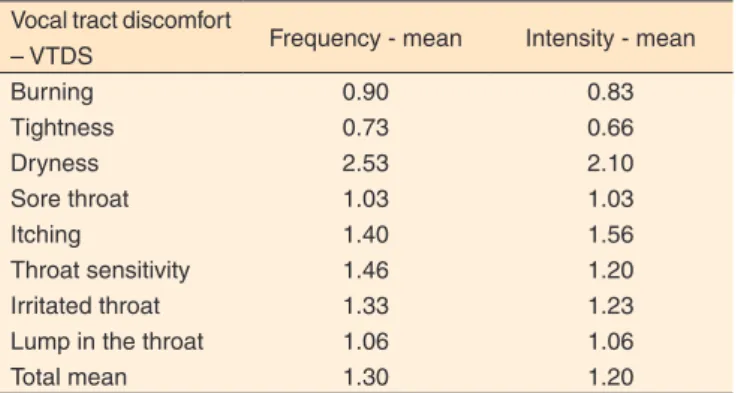
tract discomfort, and 6 (20.7%) reported only 1 manifestation. Only 1 individual (3.33%) reported a lack of any type of vocal discomfort. Among the 8 possibilities of vocal tract discom-fort, the mean occurrence was 4.0. Regarding the frequency of manifestations, “dryness” had the highest mean (2.53) and “tightness” had the lowest mean (0.73). Consequently, with respect to intensity, “dryness” had the highest mean (2.1) and “tightness” had the lowest mean (0.66) (Table 3).
Voice-Related Quality of Life (V-RQOL)
Among those surveyed, 7 (23.3%) reported not having any problem in their voice-related quality of life. The mean obtained for the total score was 87.16. A mean of 85.41 was obtained in the physical domain, and a mean of 96.31 was obtained in the socio-emotional domain.
Correlation characteristics of the questionnaires
Among the 30 individuals surveyed, all of whom had cer-vical complaints, 96.67% said they experienced manifestations of vocal discomfort; 13 (43.33%) of these individuals had 5 or more manifestations, whereas 6 (20%) mentioned only 1 related manifestation. However, when measuring the extent of the relationship between the total EFIPC score, the physical and socio-emotional domain scores, the total V-RQOL score, and the number of manifestations of vocal discomfort of the VTDS, we found no correlation between the EFIPC and the other instruments used (the V-RQOL or the VTDS), demonstrating that the results of these instruments are independent. However, a negative correlation was observed between the VTDS and the V-RQOL, demonstrating that the V-RQOL result decreases as the occurrence of vocal discomfort manifestations increases, and vice-versa (Table 4).
The values obtained from our analyses indicate that al-though manifestations of vocal discomfort occur in participants with cervical complaints, no correlation exists among the scales used. In other words, no relationship exists between the EFIPC Disability Classification, the V-RQOL indices, and the number of manifestations of vocal discomfort (VTDS) (Table 5).
Table 2. Vocal Tract Discomfort Scale: the occurrence of manifestations and their in frequency/intensity proportions (highest score)
Manifestations of discomfort
General occurrence
(%)
Frequency (%)
Intensity (%)
Burning 40 20 20
Tightness 30 10 10
Dryness 76.6* 53.3* 50*
Sore throat 43.3 13.3 13.3
Itching 56.6 20 30
Throat sensitivity 53.3 20 16.6
Irritated throat 63.3* 16.6 16.6
Lump in the throat 33.3 16.6 16.6
* Values with higher occurrence – Test of proportionality between magnitudes Table 1. Frequency distribution of the different classifications from the Copenhagen Neck Functional Disability Scale (Escala Funcional de Incapacidade do Pescoço de Copenhagen – EFIPC)
EFIPC Classification n % p-value
Mild disability 2 6.7 <0.001*
Mild to moderate disability 9 30.0 0.114 Moderate disability 15 50.0 Ref. <0.05 Moderate to intense disability 4 13.3 0.002* *Significant values (p≤0.05) – Correlation test (and Student’s t-distribution) Note: EFIPC = Escala Funcional de Incapacidade do Pescoço de Copenhagen;
Ref. = most prevalent p-value
Table 3. Mean distributions of the scores on the Vocal Tract Discomfort Scale (VTDS) (from 0 to 6)
Vocal tract discomfort
– VTDS Frequency - mean Intensity - mean
Burning 0.90 0.83
Tightness 0.73 0.66
Dryness 2.53 2.10
Sore throat 1.03 1.03
Itching 1.40 1.56
Throat sensitivity 1.46 1.20
Irritated throat 1.33 1.23
Lump in the throat 1.06 1.06
Total mean 1.30 1.20
DISCUSSION
The attempt to establish a relationship between cervical and vocal abnormalities has been shown to be a difficult un-dertaking. Several previous studies(11,17) sought to understand
this interrelationship better by using different methodologies, but they failed to achieve this goal.
A study that measured the impact of cervical abnormalities in Americans(18) found that craniocervical dysfunction is a
common condition, and it was estimated that two-thirds of the population would experience neck pain at some point in life. On the other hand, one-third of the population will experience a voice problem at some point in life(19).
The presence of laryngeal symptoms causes discomfort that can interfere with the act of speaking and compromise good vocal production, which can disrupt an individual’s work or even social environment(11). A limitation in an individual’s
qual-ity of life because of vocal issues can affect his/her physical,
emotional, and social state. This reinforces the idea that a change in voice affects the life of a person in different ways(19).
This aspect was confirmed in the present study through the responses obtained in the V-RQOL, a protocol that allows analysis of the impact of a voice problem on an individual’s life. Most participants reported some degree of dissatisfaction with their quality of life because of vocal discomfort. In this study, the discomfort “dryness” had the highest occurrence among the participants; this was also one of the most reported vocal symptoms in another study carried out in a population presenting with cervical and vocal abnormalities(11).
In a recent study conducted in professors in São Paulo, “dryness” was the discomfort with the highest mean frequen-cy/intensity in both the group that self-reported vocal tract discomfort and the group that reported no vocal discomfort(3).
Similarly, this manifestation of vocal tract discomfort had the highest mean frequency/intensity among the individuals surveyed in this study.
Table 5. Comparison of the Disability Classification on the Copenhagen Neck Functional Disability Scale (Escala Funcional de Incapacidade do
Pescoço de Copenhagen) with the indices of Voice-Related Quality of Life and the occurrence of vocal discomfort by the Vocal Tract Discomfort Scale
Classification EFIPC Mean Median Standard
deviation VC Min Max n IC p-value
V-RQOL Physical
Mild 89.60 89.6 2.97 3% 87.5 91.7 2 4.12
0.401
Mild/Mod 80.09 87.5 22.41 28% 45.8 100 9 14.64
Moderate 90.00 91.7 8.74 10% 70.8 100 15 4.42
Mod/Intense 78.10 83.3 25.10 32% 45.8 100 4 24.59
V-RQOL Socio-emotional
Mild 93.75 93.75 8.84 9% 87.5 100 2 12.25
0.123
Mild/Mod 84.72 100 29.17 34% 12.5 100 9 19.06
Moderate 97.93 100 5.09 5% 81.3 100 15 2.57
Mod/Intense 68.75 81.25 41.46 60% 12.5 100 4 40.63
V-RQOL Total
Mild 91.25 91.25 5.30 6% 87.5 95 2 7.35
0.222
Mild/Mod 81.94 92.5 23.97 29% 32.5 100 9 15.66
Moderate 93.17 95 6.30 7% 80 100 15 3.19
Mod/Intense 74.38 82.5 31.58 42% 32.5 100 4 30.95
VTDS – amount of discomfort
Mild 6.00 6 2.83 47% 4 8 2 3.92
0.510
Mild/Mod 4.22 5 2.05 49% 1 8 9 1.34
Moderate 3.47 4 2.45 71% 0 8 15 1.24
Mod/Intense 4.50 4.5 2.89 64% 1 8 4 2,83
ANOVA Test
Note: EFIPC = Escala Funcional de Incapacidade do Pescoço de Copenhagen; V-RQOL = Voice-Related Quality of Life; VTDS = Vocal Tract Discomfort Scale; Mod =
moderate; VC = variation coefficient; Min = minimum; Max = maximum; CI = confidence interval
Table 4. Correlation between the Copenhagen Neck Functional Disability Scale (Escala Funcional de Incapacidade do Pescoço de Copenhagen), Voice-Related Quality of Life, and the amount of vocal tract discomfort
EFIPC Total V-RQOL Physical V-RQOL Socio-emotional V-RQOL Total
V-RQOL Physical Corr. -17.7%
p-value 0.350
V-RQOL Socio-emotional Corr. -23.6% 83.0%
p-value 0.209 < 0.001*
V-RQOL Total Corr. -21.5% 95.9% 95.3%
p-value 0.255 < 0.001* < 0.001*
Amount of discomfort – VTDS Corr. -7.1% -43.1% -40.9% -43.9%
p-value 0.708 0.017* 0.025* 0.015*
*Significant values (p≤0.05) – Correlation test (and Student’s t-distribution)
Note: EFIPC = Escala Funcional de Incapacidade do Pescoço de Copenhagen; V-RQOL = Voice-Related Quality of Life; VTDS = Vocal Tract Discomfort Scale;
These data support the conclusion that, even though a clinic may be unable to determine precisely how and to what extent vocal discomfort affects people’s lives, manifestations related to the vocal tract should be taken into consideration to provide a more relevant and comprehensive approach to the patient’s needs because this issue can interfere with the patient’s daily life(3).
The gender distribution of the cervicalgia cases was com-pletely random in this study, which suggests that the higher percentage of women observed with cervicalgia was also by chance. However, a higher frequency of neck pain in women has also been observed in reports with gender distribution proportions in the studied population similar to those of this study(20,21). Nevertheless, this may not necessarily indicate that
this population presents with more complaints or that women are more affected than are men, but rather that women seek treatment with greater frequency(20). Alternatively, this can be interpreted
in such a way to suggest that women do not experience more neck discomfort compared to men, but that they complain more frequently than men do because of psychosocial factors(21).
In terms of vocal disorders, evidence suggests that gender does have an influence on the manifestation of a dysphonic condition. Women have a higher predisposition to developing vocal problems because their larynx is larger and has a lower glottis proportion in comparison to men. Moreover, women represent the largest portion of the population seeking speech therapy services(22).
Regardless of the propensity for vocal abnormalities, wom-en are predisposed to the preswom-ence of pain, cervical discomfort, and fatigue in this region. However, reports that refer to the symptom of cervical spine pain in dysphonic individuals are sparse in the literature(11).
A great variety of cervical evaluation instruments are avail-able to clinics, such as those that were selected as instruments in this study(23-25). The EFIPC, which was the cervical
self-as-sessment instrument used for this research, is a questionnaire that has been translated and culturally adapted for Brazilian Portuguese; however, it has not been validated. This tool was shown to be inadequate for establishing a correlation between cervical complaints and vocal discomfort based on the V-RQOL and VTDS, which may have been due to the sample size and the methodology used or because the instruments have different ranges of magnitude and are therefore not comparable.
The published studies tended to utilize practical means to evaluate cervical dysfunction, such as clinical postural assess-ment(26), photogrammetry(17), and photometric analysis(11), in
order to extract a clinical analysis. However, another possibility is to link this analysis to instruments, and, in most cases, these instruments are questionnaires to measure cervical dysfunction. In contrast to the studies mentioned above, this study attempted to compare self-assessment questionnaires (from the areas of physical therapy and speech therapy) without resorting to clinical evaluations in order to verify the possibility of an interrelation-ship between cervical complaints and vocal discomfort.
Two other studies attempted to relate cervical and vocal ab-normalities by investigating cervical abab-normalities in dysphonic women(11) or craniocervical posture in dysphonic women(17).
These studies reported that dysphonia cannot be regarded as a trigger for postural change and that dysphonic women present with greater craniocervical dysfunction compared to women without dysphonia. Along these lines, the authors of one of these studies stated that no research has been published that objectively analyzed posture and dysfunction of the cervical region in patients with dysphonia; further, the authors found that dysphonia is more related to dysfunction in the cervical region than it is to postural changes in this region(17). Thus, this
suggests that speech therapy focused on dysphonia should be carried out in combination with treatment for craniocervical dysfunction in an effort to reduce muscle tension as well as regain functional mobility in this region.
Further, reports regarding vocal abnormalities in individuals with cervical complaints are scarce in the literature, indicating that further scientific studies are required in this field.
This research was conducted without considering the occurrence of cervicalgia according to the afflicted cervical levels. Cervical abnormalities related to the cervical plexus and/or high cervical levels (C1 to C4) are believed to be most likely to cause dysphonia(27,28); however, these are not the major
causes of cervicalgia(28-30).
One possible method for obtaining further evidence of vocal complaints in individuals with cervical abnormalities is to relate the cervical levels to dysphonia; this suggestion is a possible topic for future research. In addition, dysphonia should be investigated further in these cases; such an assessment was not performed in this study because only vocal discomfort was considered. This methodological limitation may explain the absence of correlation among the aspects addressed. Thus, for future research with a similar intent, we suggest performing a complete voice evaluation, which is possible with a method-ology that defines the cervical levels, and choosing a cervical self-assessment questionnaire other than the EFIPC.
A limitation regarding the applicability of this research is that the questionnaires used were not adjusted sufficiently to permit their comparison.
Despite the lack of correlation found in this study, the use-fulness of this research lies in its contribution to the literature in the field of studies that correlate vocal abnormalities with cervical complaints. Thus, we have suggested one possible method for determining this correlation, and we have shown that addressing the areas in question requires rigorous meth-odological criteria with careful selection of the evaluation instruments to be used.
CONCLUSION
V-RQOL were not correlated with the EFIPC. A negative correlation was observed between the VTDS and V-RQOL.
REFERENCES
1. Behlau M, Madazio G, Feijó D, Pontes P. Avaliação de voz. In: Behlau M, organizador. Voz: o livro do especialista. Rio de Janeiro: Revinter; 2001. p. 246-85.
2. Fawcus M. Disfonias: diagnóstico e tratamento. Rio de Janeiro: Revinter; 2001.
3. Rodrigues G, Zambon F, Mathieson L, Behlau M. Vocal tract discomfort in teachers: Its relationship to self-reported voice disorders. J Voice. 2013;27(4):473-80. http://dx.doi.org/10.1016/j.jvoice.2013.01.005 4. Antônio SF, Pernambuco RA. Diagnóstico diferencial das cervicalgias. Temas Reumatol Clín. 2001 [acesso em 9 ago 2011]; 2(1). Disponível em: http://www.moreirajr.com.br/revistas.asp?fase=r003&id_materia=1434 5. Manchikanti L, Singh V, Falco FJ, Cash KA, Fellows B. Comparatives outcomes of a 2-year follow-up of cervical medial branch blocks in management of chronic neck pain: a randomized, double-blind controlled trial. Pain Physician. 2010;13(5):437-50.
6. Peterson C, Bolton J, Humphreys BK. Predictors of outcome in neck pain patients undergoing chiropractic care: comparison of acute and chronic patients. Chirop Manl Therap. 2012;20(1):27. http://dx.doi. org/10.1186/2045-709X-20-27
7. Benyamin R, Singh V, Parr AT, Conn A, Diwan S, Abdi S. Systematic review of the effectiveness of cervical epidurals in the management of chronic neck pain. Pain Physician. 2009;12(1):137-57.
8. Coury HJCG, Moreira RFC, Dias NB. Efetividade do exercício físico em ambiente ocupacional para controle da dor cervical, lombar e do ombro: uma revisão sistemática. Rev Bras Fisioter. 2009;13(6):461-79. http:// dx.doi.org/10.1590/S1413-35552009000600002
9. Cailliet R. Doenças dos tecidos moles. Porto Alegre: Artmed; 2000. 10. Reis FJJ, Mafra B, Mazza D, Marcato G, Ribeiro M, Absalão T. Avaliação dos distúrbios do controle sensório-motor em pessoas com dor cervical mecânica: uma revisão. Fisioter Mov. 2010;23(4):617-26. 11. Menoncin LCM, Jurkievicz AL, Silvério KCA, Camargo, PM, Wolf NMN. Alterações musculares e esqueléticas em mulheres disfônicas. Arq Int Otorrinolaringol. 2010;14(4):461-66.
12. Hogikyan ND, Sethuraman G. Validation of an instrument to measure Voice-Related Quality of Life (V-RQOL). J Voice. 1999;13:557-69. 13. Gasparini G, Behlau M. Quality of life: validation of the Brazilian version of the Voice-Related Quality of Life (V-RQOL) measure. J Voice. 2009;23(1):76-81.
14. Mathieson L, Hirani SP, Epstein R, Baken RJ, Wood G, Rubin JS. Laryngeal manual therapy: a preliminary study to examine its treatment effects in the management of muscle tension dysphonia. J Voice. 2009;23:353-66.
15. Jordan A, Manniche C, Mosdal C, Hindsberger C. The Copenhagen Neck Functional Disability Scale: a study of reliability and validity. J Manipulative Physiol Ther. 1998;21(8):520-7.
16. Badaró FAR, Araújo RC, Behlau M. Escala Funcional de Incapacidade do Pescoço de Copenhagen – EFIPC. Rev Bras Crescimento Desenvolv Hum. 2013. No prelo.
17. Bigaton DR, Silvério KCA, Berni KCS, Distefano G, Forti F, Guirro, RRJ. Postura crânio-cervical em mulheres disfônicas. Rev Soc Bras Fonoaudiol. 2010;15(3):329-34. http://dx.doi.org/10.1590/S1516-80342010000300004
18. Côté P, Cassidy JD, Carroll L. The Saskatchewan health and back pain survey: the prevalence of neck pain and related disability in Saskatchewan adults. Spine (Phila Pa 1976) 1998;23(15):1689-98.
19. Schwartz SR, Cohen SM, Dailey SH, Rosenfeld RM, Deutsch ES, Gillespie MB, et al. Clinical practice guideline: hoarseness (dysphonia). Otolaryngol Head Neck Surg. 2009;141(3 Suppl 2):S1-31. http://dx.doi. org/10.1016/j.otohns.2009.06.744
20. Conti PCR, Ferreira PM, Pegoraro LF, Conti JV, Salvador MCG. Disfunção craniomandibular (DCM). Parte II – Aspectos psicológicos e hiperatividade muscular. Rev ABO Nac. 1996;4(2):103-6.
21. De Vitta A, Neri AL, Padovani CR. Nível de atividade física e desconfortos musculoesqueléticos percebidos em homens e mulheres, adultos e idosos. Rev Bras Fisioter. 2003;7(1):45-52.
22. Putnoki DS, Hara F, Oliveira G, Behlau M. Qualidade de vida em voz: o impacto de uma disfonia de acordo com gênero, idade e uso vocal profissional. Rev Soc Bras Fonoaudiol. 2010;15(4):485-90. http://dx.doi. org/10.1590/S1516-80342010000400003
23. Fejer R, Hartvigsen J. Neck pain and disability due to neck pain: what is the relation? Eur Spine J. 2008;17(1):80-8. http://dx.doi.org/10.1007/ s00586-007-0521-9
24. Schellingerhout JM, Heymans MW, Verhagen AP, Vet HC, Koes BW, Terwee CB. Measurement properties of translated versions of neck-specific questionnaires: a systematic review. BMC Med Res Methodol. 2011;11:87-101. http://dx.doi.org/10.1186/1471-2288-11-87
25. Soklic M, Peterson C, Humphreys BK. Translation and validation of the German version of the Bournemouth Questionnaire of Neck Pain. Chiropr Man Therap. 2012;20(2):1-8. http://dx.doi.org/10.1186/2045-709X-20-2
26. Nelli EA. Estudo da postura corporal em portadores da disfonia [tese]. Bauru: Hospital de Reabilitação de Anomalias Craniofaciais da Universidade de São Paulo; 2006.
27. Virk JS, Majithia A, Lingam RK, Singh A. Cervical osteophytes causing vocal fold paralysis: case report and literature review. J Laryngol Otol. 2012;126(9):963-5. http://dx.doi.org/10.1017/S0022215112001259 28. Rocabado M. Cabeça e pescoço: tratamento articular. Seção 2. São Paulo: Oclusivo; 1999.