Aspects of speech fluency in children with specific
language impairment
Aspectos da fluência da fala em crianças com distúrbio específico
de linguagem
Cláudia Regina Furquim de Andrade1, Debora Maria Befi-Lopes1, Fabíola Staróbole Juste1, Ana Manhani Cáceres-Assenço1, Talita Maria Fortunato-Tavares1
ABSTRACT
Purpose: The present study aimed to assess specific aspects of speech fluency in children with specific language impairment (SLI). This in-cluded examining the typology of speech disruption and rate (in words and syllables per minute), across different age groups. Methods: A total of50 children, aged 3 to 7 years old, presenting with nonverbal IQ and hearing thresholds within normal limits (without the presence of stuttering) participated in the study. Children were divided into two groups: G1 (SLI) included 25 children (7 girls and 18 boys) and G2 (typical development) included 25 children matched on age and gender with G1. Each child was shown a figure and asked to discuss what s/he liked about the figure. Each speech sample included 200 fluent syllables or 100 fluent words. Results: Between-group analyses demonstrated that children aged 3 to 4 years old in G1 had lower speech rate than their age-matched peers from G2. Within-group analyses revealed no diffe-rences in disruption typologies between age groups in G1 participants. In contrast, hesitation was the most frequent typology for 4- to 5-year-old G2 children, whereas hesitation and word repetition typologies were observed in 6- to 7-year-old G2 children. Conclusion: Children with suspected SLI between the ages of 3 to 4 years old showed a reduction in word and syllable production. Hesitation-type speech disruptions were prominently used by typically developing children, regardless of age, and were not observed in SLI children.
Keywords: Child; Language development disorders; Child language; Speech, language and hearing sciences; Speech
RESUMO
Objetivo: Avaliar aspectos específicos da fluência da fala em crianças com DEL, quanto à tipologia de rupturas comuns e velocidade de fala (em palavras e sílabas por minuto), considerando as diferentes faixas etárias. Métodos: Participaram 50 crianças de ambos os gêneros, na faixa etária de 3 a 7 anos, com QI não verbal e limiares auditivos dentro da normalidade e ausência de gagueira. As crianças foram divididas em dois grupos: G1 (DEL), com 25 crianças (sete meninas e 18 meninos, com idades entre 3 e 7 anos) e G2 (desenvolvimento típico), com 25 crianças pareadas em idade e gênero ao GI. Foi apresentada uma figura à criança e solicitado que falasse o que quisesse sobre ela. Cada amostra de fala foi composta por 200 sílabas fluentes ou 100 palavras fluentes.
Resultados: A análise intergrupos demonstrou que crianças de 3 e 4 anos do G1 apresentaram menor velocidade de fala que seus pares em desenvolvimento típico. Na análise intragrupos, no que se refere à tipologia de rupturas, o G1 não apresentou diferenças em nenhuma das faixas etárias. Já o G2, para as faixas etárias de 4 e 5 anos, a hesitação foi mais frequente e aos 6 e 7 anos, a hesitação e a repetição de palavras se diferenciaram das demais tipologias. Conclusão: Crianças com suspeita de DEL nas idades de 3 e 4 anos, aqui estudadas, apresentaram redução da produção de palavras e sílabas. As rupturas de fala, do tipo hesitação, foram recursos usados pelas crianças com desenvolvimento típico de todas as faixas etárias, o que não ocorreu nas crianças com DEL.
Descritores: Criança; Transtornos do desenvolvimento da linguagem; Linguagem infantil; Fonoaudiologia; Fala
This study was performed at the Department of Physiotherapy, Speech-Language Pathology and Audiology, and Occupational Therapy, School of Medicine, University of São Paulo (USP) São Paulo (SP), with research support from grants allocated by the Vice-Dean of Research at USP, process 2012.1.26849.1.555, and National Council for Scientific and Technological Development (CNPq), process number 470539/04-6.
(1)Department of Physical Therapy, Speech-Language Pathology and Audiology, and Occupational Therapy, School of Medicine, Universidade de São Paulo – USP – São Paulo (SP), Brazil.
Conflict of interests: No
Author’s contribution: CRFA designed the study and was responsible for the research and writing the manuscript. DMBL was responsible for clinical diagnoses and writing the manuscript. FSJ was responsible for data collection and tabulation. AMCA coordinated data collection and prepared the final format of the article.
TMFT was responsible for statistical analyses and was involved in discussions of the data.
Correspondence address: Claudia Regina Furquim de Andrade. R. Cipotânea, 51, Cidade Universitária, São Paulo (SP), Brazil, CEP: 05360-160. E-mail: [email protected]
INTRODUCTION
Specific language impairment (SLI) is a diagnosed alte-ration whereby language development is disproportionately poor compared to a child’s other cognitive abilities, for no apparent reason (e.g., the linguistic deficit is not the result of a more severe pathology)(1,2). Thus, to diagnose SLI, the
child must show two or more compromised areas of language without the presence of any neurological, psychiatric, sensory, or intellectual deficits(3).
Linguistic manifestations of SLI are variable; however, it is common for children with SLI to show lexical acquisition deficits(4), morphosyntactic difficulties(5), and trouble with
phonological short-term memory(6). Impaired phonological
short-term memory is a key factor that might compromise le-xical acquisition, morphosyntactic performance, and sentence comprehension in this population(6,7).
It is currently believed that an accurate SLI diagnosis also depends on tests based on speech production and/or non-word repetition. These tests evaluate articulatory abilities and pho-nological short-term memory, which are variables that are considered independent from the environment. This shift has led to evolved diagnostic criteria (i.e., strictly applying language tests should be sufficient to establish a diagnosis)(8-10).
The specific language tests used are considered to be de-pendent on environmental factors (e.g., normality parameters established in other groups, family and school stimulation, quality of life, and socioeconomic conditions), which might cause, in the case of SLI, increased false positives, hindering the establishment of specific pathological attributes(11).
Genetic SLI studies have demonstrated that compromised memory and/or articulation associated with language deficits are always present, and are therefore distinctive attributes of SLI. The improvement in the understanding of his condition allows the evaluation of specific aspects of the speech that might also contribute to higher diagnostic accuracy of SLI cases(12-15).
To produce speech, the motor system has to control articu-latory speed (i.e., the relationship between the time necessary to activate a phoneme and to organize movement sequences). For fluent speech production, the individual has to move va-rious parts of the vocal tract in an agile and soft way, allowing syllabic intelligibility to be continuous and quickly produced. The quicker the speech movements, the greater the muscular activity(16-18).
The motor processes responsible for syllable formation should be ready and stored in memory, forming a group of speech gesture markers. Each gestural group has five elements, which correspond to five independent control subsystems: glottal, velar, tongue body, tongue tip, and lips. The motor group specifies the task to be performed by each subsystem, but does not specify how performance of these tasks should proceed. This is because, depending on the configuration constancy of changes in the peripheral speech mechanisms
(i.e., during connected, and therefore fluent, speech), the task may be performed via different paths, some of which may be more efficient than others(16,19-23).
Due to immaturities in the linguistic system among children with SLI, speech sounds are usually shorter than those of typi-cally developing children during discursive tasks(24), whereas
silent pauses between words are longer(25).
Based on the aforementioned evidence, the goal of the cur-rent study was to evaluate specific aspects of speech fluency in children with SLI, specifically with regard to speech disruption and rate (in words and syllables per minute) typologies.
METHODS
Participant selection and evaluation procedures were initi-ated after adequate ethical procedures were followed. This study was approval by the Ethics Committee for the Analysis of Research Projects of the Clinical Directorate of the Hospital das Clínicas, School of Medicine, Universidade de São Paulo (USP) (266/05), and informed consent was obtained from children’s guardians. The research did not involve invasive or experimental techniques absent of proper approval, which classified our study as having “minimal risk.”
Fifty children between 3-7 years old, presenting nonverbal IQ and hearing thresholds within normal limits and the absence of stuttering, participated in the study. Nonverbal intelligence was evaluated by the Primary Test of Nonverbal Intelligence (PTONI), which measures visual perception, analogical thinking, spatial relations perception, semantic seriation, and classification. Its application is appropriate for children older than 3 years(26).
All children lived in the São Paulo metropolitan area, used the Unified Health System (SUS), and frequently attended a Public Education Institution.
Children were divided into two groups: G1 (SLI) included 25 children (7 girls and 18 boys, 3-7 years old) and G2 (typical development) included 25 children matched on age and gender to the children in G1. Group composition in terms of age is shown in Table 1.
A child was included in G1 (SLI) if s/he fulfilled the follo-wing criteria:
a. Presented normal hearing;
b. Presented language performance below what would be ex-pected for his/her chronological age in terms of vocabulary, phonological, and pragmatic features based on the ABFW(27)
Table 1. Distribution of participants by age in each group
3 years 4 years 5 years 6 years 7 years Total
Group 1 3 7 5 7 3 25
Group 2 3 7 5 7 3 25
Note: Group 1 = specific language impairment; Group 2 = typical language
battery, with average sound length (morphemes and words)(28)
and symbolic entertaining tasks;
c. Did not present speech disruptions typical of stuttering according to the parameter type(29).
A child was included in G2 (typical development) based on the following criteria:
a. Presented normal hearing;
b. Did not present a history of speech, language, and/or lear-ning problems;
c. Presented language performance typical of a child at his/ her chronological age in terms of vocabulary, phonologi-cal, and pragmatic features based on the ABFW(27) battery,
with average sound length (morphemes and words)(28) and
symbolic entertaining tasks;
d. Did not present speech disruptions typical of stuttering according to the parameter type(29).
Speech samples were recorded over approximately 10 mi-nutes. Task procedures followed the methodology proposed by Andrade. Children were shown a figure and asked to discuss what they liked about it. Each speech sample included 200 fluent syllables or 100 fluent words. Speech sample (200 fluent syllables) analysis followed a validated pattern and typology variables related to speech disruptions and rate were tabulated in words and syllables per minute(30).
A digital video camera, tripod, microphone, and digital chronometer were used for recording, and a standardized figure was used to elicit expressive speech. A t-test and analysis of variance (ANOVA) were used for between- and within-group analyses, respectively, with a significance level of 5% (p≤0.05).
RESULTS
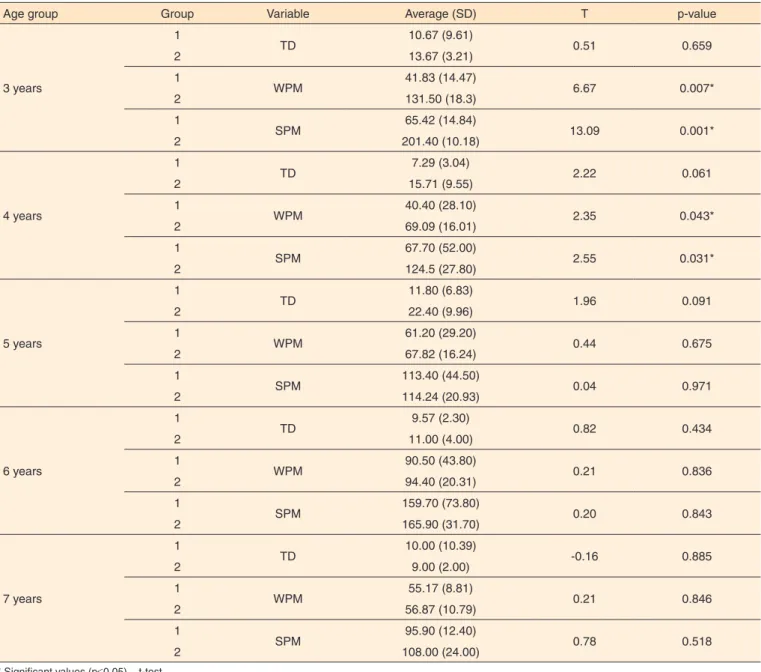
The means (standard deviations) and between-group comparisons (1 and 2) for “typical disfluencies”, “words per
minutes,” and “syllables per minute” are presented in Table 2. The following were observed in the between-group analyses for each age group:
- 3-year-old group: Groups did not differ in terms of the number of typical disruptions (p=0.659). Speech rate was significantly different between groups for both words (p=0.007) and syllables per minute (p=0.001). Speech rate was lower in 3-year-old G1 compared to G2 children. - 4-year-old group: The number of common disruptions did
not differ between groups (p=0.061). Speech rate was signi-ficantly different between groups for both words (p=0.043) and syllables per minute (p=0.031). Speech rate was lower in 4-year-old G1 children.
- 5-year-old group: Groups did not differ on any speech va-riables (number of common disruptions: p=0.091; speech rate: p=0.075 for word/min and p=0.971 for syllables/min). The G1 and G2 children did not differ in this age group. - 6-year-old group: Groups did not differ on any speech
va-riables (number of common disruptions: p=0.434; speech
rate: p=0.836 for word/min and p=0.843 for syllables/min). As with the 5 year olds, 6-year-old children with SLI (G1) did not differ from their typically developing peers (G2). - 7-year-old group: Groups did not differ on any speech
va-riables (number of common disruptions: p=0.885; speech rate: p=0.846 for word/min and p=0.518 for syllables/ min). As with the 5- and 6-year-old children, there were no differences between G1 and G2.
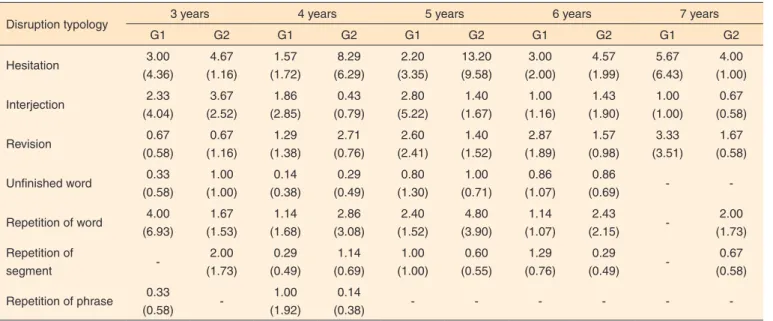
To identify possible differences between the speech disrup-tion types, within-group analyses were performed (Table 3).
The within-group analyses revealed the following: - 3-year-old group: In G1, there were no significant
differen-ces in typologies (F=0.52; p=0.758), but there was a trend toward word repetition. In G2, there were no significant differences in typologies (F=2.89; p=0.061), but there was a trend toward hesitation.
- 4-year-old group: In G1, there were no significant diffe-rences in typologies (F=0.99; p=0.447). In G2, there was significantly more hesitation (F=7.97; p<0.001).
- 5-year-old group: In G1, there were no significant diffe-rences in typologies (F=0.44; p=0.814). In G2, there was significantly more hesitation (F=6.33; p<0.001).
- 6-year-old group: In G1, there were no significant diffe-rences in typologies (F=2.61; p=0.441). In G2, there was significantly more hesitation and word repetition (F=6.93; p<0.001).
- 7-year-old group: In G1, there were no significant diffe-rences in typologies (F=0.90; p=0.450). In G2, there was significantly more hesitation and word repetition (F=5.60; p=0.012).
DISCUSSION
Results from the present study indicate that evaluating speech fluency might improve SLI diagnostic accuracy. The measurement of words per minute indicates the ability to pro-duce and convey a message. The measurement of syllables per
minute indicates the ability to perform articulatory transitions and coarticulation. In the between-group analyses, children with suspected SLI at 3 and 4 years old presented reduced speech rate in terms of both words and syllables per minute; however, this difference was not observed for children aged 5 and older. Therefore, the current results justify the evaluation of speech rate in children with suspected SLI between the ages of 3 and 4(16,30).
Although useful data were obtained, the current study has a few limitations. For example, it is necessary to assess these paradigms with a larger sample to better generalize the results. It would also be useful to extend this method to other Brazilian states and to other languages to determine the influence of variables such as regionality and native language on speech fluency in SLI. Overall, the current results suggest that speech rate in children between the ages of 3 and 4 years deserves careful attention when an SLI diagnosis is not yet conclusive.
CONCLUSION
The current study contributes to the improvement of early
diagnoses for children with suspected SLI. This might be accomplished by assessing speech rate in children aged 3 to 4 years who show a reduction in word and syllable production. In addition, the current study indicates that speech disruptions,
specifically hesitation, are used by typically developing children to allow for elaboration of complex speech (without losses in speed), and do not occur in children with SLI.
ACKNOWLEDGEMENTS
We would like to thank the participants and their families. This study received research support from projects allocated by the Vice-Dean of Research of the Universidade de São Paulo (USP), process 2012.1.26849.1.555, and National Council for
Table 2. Average (standard deviation) and intergroup comparison (1 and 2) for typical disfluency variables, words per minute, and syllables per minute
Age group Group Variable Average (SD) T p-value
3 years
1
TD 10.67 (9.61) 0.51 0.659
2 13.67 (3.21)
1
WPM 41.83 (14.47) 6.67 0.007*
2 131.50 (18.3)
1
SPM 65.42 (14.84) 13.09 0.001*
2 201.40 (10.18)
4 years
1
TD 7.29 (3.04) 2.22 0.061
2 15.71 (9.55)
1
WPM 40.40 (28.10) 2.35 0.043*
2 69.09 (16.01)
1
SPM 67.70 (52.00) 2.55 0.031*
2 124.5 (27.80)
5 years
1
TD 11.80 (6.83) 1.96 0.091
2 22.40 (9.96)
1
WPM 61.20 (29.20) 0.44 0.675
2 67.82 (16.24)
1
SPM 113.40 (44.50) 0.04 0.971
2 114.24 (20.93)
6 years
1
TD 9.57 (2.30) 0.82 0.434
2 11.00 (4.00)
1
WPM 90.50 (43.80) 0.21 0.836
2 94.40 (20.31)
1
SPM 159.70 (73.80) 0.20 0.843
2 165.90 (31.70)
7 years
1
TD 10.00 (10.39) -0.16 0.885
2 9.00 (2.00)
1
WPM 55.17 (8.81) 0.21 0.846
2 56.87 (10.79)
1
SPM 95.90 (12.40) 0.78 0.518
2 108.00 (24.00)
* Significant values (p≤0.05) – t-test
Note: Group 1 = specific language impairment; Group 2 = typical language development; TD = typical disfluencies; WPM = words per minute; SPM = syllables per
Scientific and Technological Development (CNPq), process number 470539/04-6.
REFERENCES
1. Bishop DVM, Hayiou-Thomas ME. Heritability of specific language impairment depends on diagnostic criteria. Genes Brain Behav. 2008;7(3):365-72. http://dx.doi.org/10.1111/j.1601-183X.2007.00360.x 2. Barry JG, Yasin I, Bishop DVM. Heritable risk factors associated with language impairments. Genes Brain Behav. 2007;6(1):66-76. http:// dx.doi.org/10.1111/j.1601-183X.2006.00232.x
3. Bishop DVM. The underlying nature of specific language impairment. J Child Psychol Psychiatry. 1992;33(1):3-66. http://dx.doi. org/10.1111/j.1469-7610.1992.tb00858.x
4. Gândara JP, Befi-Lopes DM. Tendências da aquisição lexical em crianças em desenvolvimento normal e crianças com Alterações Específicas no Desenvolvimento da Linguagem. Rev Soc Bras Fonoaudiol. 2010;15(2):297-304. http://dx.doi.org/10.1590/S1516-80342010000200024
5. Bedore LM, Leonard LB. Grammatical morphology deficits in Spanish-speaking children with specific language impairment. J Speech Lang Hear Res. 2001;44(4):905-24. http://dx.doi.org/10.1044/1092-4388(2001/072)
6. Montgomery JW, Magimairaj BM, Finney MC. Working memory and specific language impairment: an update on the relation and perspectives on assessment and treatment. Am J Speech Lang Pathol. 2010;19(1):78-94. http://dx.doi.org/10.1044/1058-0360(2009/09-0028
7. Alt M. Phonological working memory impairments in children with specific language impairment: where does the problem lie? J Commun Disord. 2010;44(2):173-85. http://dx.doi.org/10.1016/j. jcomdis.2010.09.003
8. Girbau D, Schwartz RG. Phonological working memory in Spanish-English bilingual children with and without specific language impairment.
J Commun Disord. 2008;41(2):124-45. http://dx.doi.org/10.1016/j. jcomdis.2007.07.001
9. Archibald LM, Gathercole SE. Nonword repetition in specific language impairment: more than a phonological short-term memory deficit. Psychon Bull Rev. 2007;14(5):919-24. http://dx.doi.org/10.3758/ BF03194122
10. Montgomery JW, Windsor J. Examining the language performances of children with and without specific language impairment: contributions of phonological short-term memory and speed of processing. J Speech Lang Hear Res. 2007;50(3):778-97. http://dx.doi.org/10.1044/1092-4388(2007/054
11. Bishop DVM. What causes specific language impairment in children? Curr Dir Psychol Sci. 2006;15(5):217-21. http://dx.doi.org/10.1111/ j.1467-8721.2006.00439.x
12. Falcaro M, Pickles A, Newbury DF, Addis L, Banfield E, Fisher SE, et al. Genetic and phenotypic effects of phonological short-term memory and grammatical morphology in specific language impairment. Genes Brain Behav. 2008;7(4):393-402. http://dx.doi.org/10.1111/j.1601-183X.2007.00364.x
13. Maillart C, Parisse C. Phonological deficits in French speaking children with SLI. Int J Lang Commun Disord. 2006;41(3):253-74. 10.1080/13682820500221667
14. Shafer VL, Morr ML, Datta H, Kurtzberg D, Schwartz RG. Neurophysiological indexes of speech processing deficits in children with specific language impairment. J Cogn Neurosci. 2005;17(7):1168-80. 15. Bishop DVM. The role of genes in the etiology of specific language impairment. J Commun Disord. 2002;35(4):311-28. http://dx.doi. org/10.1016/S0021-9924(02)00087-4
16. Andrade C. Abordagem neurolinguística e motora da gagueira. In: Ferreira LP B-LD, Limongi SCO, editores. Tratado de Fonoaudiologia. São Paulo: Roca; 2004. Capítulo 80, p. 1001-16.
17. Fredd D. Motor speech disorders: diagnosis and treatment. San Diego: Singular; 2000.
Table 3. Average (standard deviation) disruption typologies according to group (1 and 2) across age
Disruption typology 3 years 4 years 5 years 6 years 7 years
G1 G2 G1 G2 G1 G2 G1 G2 G1 G2
Hesitation 3.00 (4.36) 4.67 (1.16) 1.57 (1.72) 8.29 (6.29) 2.20 (3.35) 13.20 (9.58) 3.00 (2.00) 4.57 (1.99) 5.67 (6.43) 4.00 (1.00) Interjection 2.33 (4.04) 3.67 (2.52) 1.86 (2.85) 0.43 (0.79) 2.80 (5.22) 1.40 (1.67) 1.00 (1.16) 1.43 (1.90) 1.00 (1.00) 0.67 (0.58) Revision 0.67 (0.58) 0.67 (1.16) 1.29 (1.38) 2.71 (0.76) 2.60 (2.41) 1.40 (1.52) 2.87 (1.89) 1.57 (0.98) 3.33 (3.51) 1.67 (0.58) Unfinished word 0.33
(0.58) 1.00 (1.00) 0.14 (0.38) 0.29 (0.49) 0.80 (1.30) 1.00 (0.71) 0.86 (1.07) 0.86
(0.69) -
-Repetition of word 4.00 (6.93) 1.67 (1.53) 1.14 (1.68) 2.86 (3.08) 2.40 (1.52) 4.80 (3.90) 1.14 (1.07) 2.43 (2.15) -2.00 (1.73) Repetition of segment -2.00 (1.73) 0.29 (0.49) 1.14 (0.69) 1.00 (1.00) 0.60 (0.55) 1.29 (0.76) 0.29 (0.49) -0.67 (0.58) Repetition of phrase 0.33
(0.58)
-1.00 (1.92)
0.14
(0.38) - - -
18. Bloodstein O. A Handbook on stuttering. 5th ed. Chicago: National Easter Seal Society; 1995.
19. Munhall KG. Functional imaging during speech production. Acta Psychol (Amst). 2001;107(1-3):95-117. http://dx.doi.org/10.1016/S0001-6918(01)00026-9
20. Andreatta RD, Barlow SM, Biswas A, Finan DS. Mechanosensory modulation of perioral neuronal groups during active force dynamics. J Speech Hear Res. 1996;39(5):1006-17.
21. Archibald L, De Nil LF. The relationship between stuttering severity and kinesthetic acuity for jaw movements in adults who stutter. J Fluency Disord. 1999;24(1):25-42. http://dx.doi.org/10.1016/S0094-730X(98)00023-0
22. De Nil LF, Kroll RM, Lafaille SJ, Houle S. A positron emission tomography study of short- and long-term treatment effects on functional brain activation in adults who stutter. J Fluency Disord. 2003;28(4):357-79; quiz 79-80. http://dx.doi.org/10.1016/j.jfludis.2003.07.002
23. Conture E. Stuttering: its nature, diagnosis, and treatment. Needham Heights: Allyn and Bacon; 2000.
24. Sheng L, McGregor KK. Lexical-semantic organization in
children with specific language impairment. J Speech Lang Hear Res. 2010;53(1):146-59. http://dx.doi.org/10.1044/1092-4388(2009/08-0160) 25. Befi-Lopes DM, Pedott PR, Bacchin LB, Cáceres AM. Relação entre pausas silentes e classe gramatical em narrativas de crianças com distúrbio específico de linguagem. CoDAS. 2013;25(1):64-9. http:// dx.doi.org/10.1590/S2317-17822013000100012
26. Ehler D, McGhee R. Primary test of nonverbal intelligence. Austin: Pro-ed; 2008.
27. Andrade CRF, Befi-Lopes DM, Fernandes FDM, Wertzner HF. ABFW - Teste de linguagem infantil nas áreas de fonologia, vocabulário, lluência e pragmática. 2a ed., rev., ampl e atual. Barueri: Pró-Fono; 2004. 28. Araujo K. Desempenho gramatical de criança em desenvolvimento normal e com Distúrbio Específico de Linguagem [tese de doutorado]. São Paulo: Universidade de São Paulo; 2007.
29. Andrade CRF. Perfil da fluência da fala: parâmetros comparativo diferenciado por idade para crianças, adolescentes, adultos e idosos. Barueri: Pró-Fono; 2006.