Auditory ability in malnourished child
Habilidade auditiva em criança desnutrida
Patrícia Andréia Caldas¹, Célia Maria Giacheti², Simone Aparecida Capellini²
ABSTRACT
Purpose: To characterize and compare the performance of malnourished children and normal children in auditory processing. Methods: The sample comprised 30 children from five to ten years old, both genders, being 15 malnourished children (G1) and 15 children with adequate nutritional status, as a control group (G2). The groups were paired according to gender, age and grade level. Both groups underwent peripheral and central auditory assessment, noting that malnourished children had higher changes in the skill of sequencing score for verbal and nonverbal when compared to normal children, and the same occurred in closing skills and background figure. Results: Regarding the degree of auditory processing disorder, it was more severe in malnourished children. Conclusion: Children with malnutrition have higher frequency alterations in auditory abilities when compared to normal children, being the temporal ordering skills, auditory memory, selective attention, figure-ground and closing the most affected skills.
Keywords: Malnutrition; Hearing; Auditory perception; Auditory per-ceptual disorders; Hearing disorders
RESUMO
Objetivo: Caracterizar e comparar o desempenho de crianças com desnutrição e crianças eutróficas nas habilidades do processamento auditivo. Métodos: A amostra foi composta por 30 crianças na faixa etária de 5 a 10 anos, de ambos os gêneros, sendo 15 crianças com desnutrição, que compuseram o grupo amostral (G1) e 15 crianças com estado nutricional adequado, como grupo controle (G2). Os grupos foram pareados segundo gênero, faixa etária e escolaridade. Ambos os grupos foram submetidos à avaliação auditiva periférica e central.
Resultados: As crianças desnutridas apresentaram maior índice de alterações na habilidade de sequencialização sonora para sons verbais e não verbais, quando comparadas com as crianças eutróficas. O mesmo ocorreu nas habilidades de fechamento e figura fundo. Quanto ao grau do distúrbio do processamento auditivo, houve maior severidade nas crianças desnutridas. Conclusão: Crianças com desnutrição apresen-taram maior frequência de alterações nas habilidades auditivas, quando comparadas a crianças eutróficas, sendo as habilidades de ordenação temporal, memória auditiva, atenção seletiva, figura fundo e fechamento, as habilidades mais afetadas.
Descritores: Desnutrição; Audição; Percepção auditiva; Transtornos da percepção auditiva; Transtornos da audição
Study conducted at the Graduate Program in Speech-Language Pathology and Audiology, Philosophy and Sciences College, Universidade Estadual Paulista “Júlio de Mesquita Filho” – UNESP – Marília (SP), Brazil.
(1) Graduate Program (Master’s Degree) in Speech-Language Pathology and Audiology, Philosophy and Sciences College, Universidade Estadual Paulista “Júlio de Mesquita Filho” – UNESP – Marília (SP), Brazil.
(2)Speech-Language Pathology and Audiology Department, Philosophy and Sciences College, Universidade Estadual Paulista “Júlio de Mesquita Filho” – UN-ESP – Marília (SP), Brazil.
Conflict of interests: No
Author’s contribution: PAC was responsible for the study design, data collection, data analysis and writing of the article; CMG and SAC were responsible for the conception and design of the study, the data analysis, guidance of research and writing of the article.
Correspondence address: Simone Aparecida Capellini. Av. Higyno Muzzi Filho, 737, Campus Universitário, Marília (SP), Brazil, CEP: 17525-900. E-mail: [email protected]
INTRODUCTION
Malnutrition is a pathological condition caused by poor or inadequate calorie intake and/or proteins, presenting itself as a big issue in several countries. It is directly related to poverty, because it reflects the socioeconomic and political inequalities, unequal distribution of income, lack of access to educational resources, thus being one of the biggest factors in infant mor-tality in developing countries(1,2).
The risk of malnutrition is associated to the maternal mental health, unstable family structure, poor education, unemploy-ment and poor housing conditions. Studies also reveal great difficulty in separating the economic, social and cultural causes of malnutrition(3).
Many evidences have been raised in order to demonstrate that nutritional deficiency during fetal and early life period may have deleterious effects on biochemical and morphological maturation of the organism(4). The most severe alterations are
those involving the central nervous system (CNS), because in most cases, are irreversible(4). The earlier Protein-Energy
Malnutrition (PEM) is installed, the more intense and perma-nent are its effects(3). Malnourished children are less responsive,
less curious and less participating in exploratory behavior than the well-nourished infants(3). The specific nutrient deficiencies
may result in decreased ability to pay attention and affect problem-solving skills(3). There is an association between the
child’s alimentary insufficiency and growth, development and behavioral or academic function(3,5-7). Depending on the
dura-tion and intensity of the nutridura-tional deficiency, neural funcdura-tions such as cognition, consciousness, emotion, learning, memory, motivation and anxiety can be affected(8,9).
Malnutrition increases the risk of various diseases due to deficiencies in the individual’s immune system who, as a re-sult of these diseases, may have their physical and intellectual development compromised(5,10).
The World Health Organization (WHO) estimates that over 20 million children are born underweight every year. About 150 million children under 5 are underweight for their age and 182 million (32.5%) have short stature.
In recent decades, the rate of malnutrition in Brazil has declined, but, as in other developing countries, it is still a sig-nificant cause of infant mortality(4).
Maranhão state, in particular, presents the most severe form of malnutrition in the country, with moderate or severe deficits of 30.6%, followed by Piauí, Ceará and Paraíba, with 22.9%, 21.1% and 19.7%, respectively(9,10). According to statistics from
the Ministry of Health, 66 cities from Maranhão are in the list of the cities with the highest number of child malnutrition and the state has the highest number of occurrences of underweight in children aged under 5 years old(11,12).
Severe malnutrition impairs the development of functions such as intelligence, memory, reading and math tests, verbal skills, problem solving ability and motor development. Children
with chronic malnutrition have low scores in (expressive) vocabulary tests which points to the difficulty in organizing thoughts(5).
Considering that malnutrition causes harmful effects to the Central Nervous System (CNS) and that the auditory processing involves complex nerve connections, it reflects on how auditory information is processed by malnourished children.
The Central Auditory Nervous System (ACNS) is a complex system of neural pathways that may be affected by various developmental and pathological factors causing the Auditory Processing Disorder(13), it is considered a deficit in
informa-tion processing of auditory signals without hearing changes in peripheral hearing or intellectual deficit. It is a limitation of the transmission, analysis, organization, transformation, elaboration and memory of specific information of the auditory modality(14-16). There is a lack of studies evaluating the central
auditory nervous system when associated to malnutrition, which was also reported by other authors(17,18), who conducted
studies assessing the central auditory pathway of malnourished children. One of the studies(18) characterized the Long Latency
Auditory Evoked Potential (LLAEP) in malnourished children and it was observed an increased latency in the group with malnutrition. The latencies of P1, N1 and P300 components were higher in the malnourished group than in the eutrophic group, which suggests a reduction in the speed of processing of acoustic information in a cortical level.
An international study(19) conducted a survey of CNS
evaluations in malnourished children. The tests mentioned were: neuroimaging, electrophysiology, neuroradiology, EEG and evoked potentials. In histological studies and imaging on the developing brain, in humans and animals, both macro and microstructures were changed in the malnourished brain. The neuroradiology demonstrated cerebral atrophy and ventricular enlargement with prominence of the Sylvian fissure and basal cavity in children with Kwashiorkor. As for the findings in the electroencephalogram of malnourished children, the dominant frequency was much lower when compared to normal weight children. In the auditory evoked potential, we observed an increase in the latency of waves, suggesting a deficiency in the myelination process, with decrease of the efficiency of the synapses of the auditory system.
As given the above and the lack of national and international studies that relate malnutrition and hearing abilities, this study aimed to characterize the performance in auditory processing in children with malnutrition and compare it to normal children.
METHODS
The sample comprised 30 children, aged from 5 to 10 years old, both genders, being 15 children diagnosed with malnutri-tion, who formed the sample group (G1) and 15 children with adequate nutritional status (normal weight), control group (G2). Both diagnoses were made by a nutritionist.
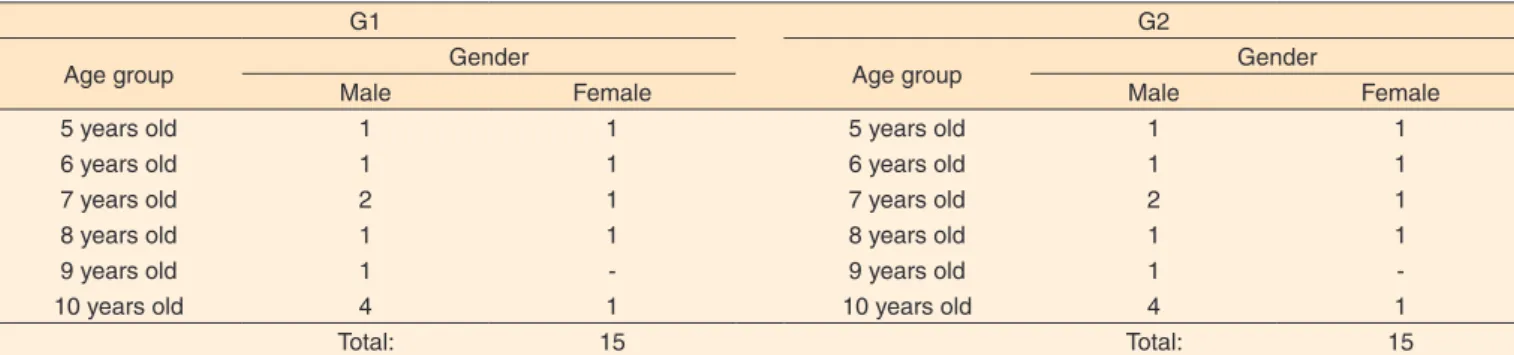
It is noteworthy that in this study, the classification of nutritional status in degrees (mild, moderate and severe) was not used because the protocol used in the institution where the data were collected lacked such classification. Thus, the groups were matched according to gender, age and education (Table 1).
Children previously diagnosed with hearing loss, neurologi-cal or behavioral pathologies and genetic syndromes were ex-cluded from the sample. This criterion was used in both groups. Children who, during the hearing evaluation, showed changes were also excluded from the sample, as shown in Figure 1.
G2 was paired to G1 according to age, gender and education and thus subjected to peripheral and central auditory assess-ment, as shown in Figure 2.
Nutritional assessment
Children with malnutrition were from the Nutrition depart-ment of a public institution. The children who were part of the G2 were selected at a school and subsequently forwarded to nutritional assessment, in order to verify the possibility of belonging to this group.
The curves of weight for age (W/A), height for age (H/A) and body mass index for age (BMI/A) with score-z, considering the World Health Organization (WHO) - Multicenter Growth Reference Study (2007), were used as criterion to assess the nutritional status of children. The anthropometric classifica-tions were those proposed by WHO. Assessment to determine the nutritional status was conducted by a nutritionist from the Service, in a session of approximately one hour.
Socioeconomic assessment
The criterion of Brazil’s economic classification (Brazil Criterion), from the Brazilian Association of Research Companies (Associação Brasileira de Empresas de Pesquisa
- ABEP, 2011) was used as socioeconomic characterization of the subjects. This is a socioeconomic questionnaire based on household goods and academic education, where, for each possession, there is a score and each class is defined by the sum of this score. The classes are divided into A1, A2, B1, B2, C, D and E.
Hearing assessment
The subjects from both groups participated in every stage of the study: (1) anamnesis; (2) inspection of the external auditory canal; (3) audiometry and (4) auditory processing.
The anamnesis allowed obtaining the identification data, Table 1. Distribution of subjects by age and gender groups
G1 G2
Age group Gender Age group Gender
Male Female Male Female
5 years old 1 1 5 years old 1 1
6 years old 1 1 6 years old 1 1
7 years old 2 1 7 years old 2 1
8 years old 1 1 8 years old 1 1
9 years old 1 - 9 years old 1
-10 years old 4 1 10 years old 4 1
Total: 15 Total: 15
Note: G1 = sample group; G2 = Control group
Figure 1. Representation of the selection process for the Sample Group
presence or absence of hearing complaints as well as the pre-sence of risk factors for hearing loss and symptoms related to auditory processing.
The inspection of the external auditory canal was performed in order to check its condition. Individuals with presence of cerumen were referred to ENT evaluation and subsequently underwent audiological evaluation.
With the information obtained in the interview and data on otoscopy, audiological evaluation was initiated, conducted in a soundproof booth, in three sessions of one hour each. The first session was to administer the questionnaires, interview and assessment of peripheral hearing. In the second and third sessions, the test for assessing central hearing was performed by the following procedures:
1) Pure tone audiometry: Interacoustics® AC33 audiometer calibrated according to standards 8253.1, 364.9 ISO3741 resolution was used at frequencies from 250 to 8000 Hz with frequency modulated (warble) sound stimulus(20).
2) Logoaudiometry: two tests were applied: the SRT (Speech Recognition Threshold), using a list of three-syllable and polysyllabic words as sound stimulus. The threshold has been researched by the descending method of intensity and it was obtained when the child would hit 50% of the four words given. The second test was the SDT (speech recog-nition percentage index), in which a list of 25 monosyllabic and 25 disyllable presented as stimuli in a fixed intensity was used (tritone average plus 40 dB HL)(20).
3) Tympanometry: a study of the tympanogram graph and ipsilateral and contralateral reflex pathways(21) was
perfor-med using imitanciometer AT235 calibrated according to standards 8253.1, 364.9 Resolution ISO3741.
4) Auditory Processing (AP): for the AP assessment, the tests described below have been applied:
Diotic tests
a) Test of verbal sound sequencing (TVSS), using as criteria analysis what Pereira and Schochat (2011) proposed(22) and
considered as normal range > 2 hits in 3 attempts. b) Test of non-verbal sound sequencing (TnVSS), also using
as criteria analysis what Pereira and Schochat (2011) proposed(22) and considered as normal range > 2 hits in 3
attempts.
c) Test of localization of the sound (TLS) source in five direc-tions using as criteria analysis what Pereira and Schochat (2011) proposed(22) and considered as normal range > 4 hits.
Monotic tests
a) Pediatric Logoaudiometry abbreviated as PSI (Pediatric Speech Intelligibility). To perform this test it was used a two-channel audiometer, CD player and CD as Pereira and Schochat (2011)(22) proposed, recording ten sentences and
a child’s story, used as the main stimulus and competitive message, respectively, as well as a board of figures related
to the ten sentences. As a criterion of normality, the authors consider > 80% accuracy for MCI = 0; > 70% accuracy for MCI = -10 and> 60% accuracy for MCI = -15.
b) Speech Test with Noise (STN). For this test, the same test equipment mentioned above was employed and as sound stimulus, a list of 25 monosyllables as the main stimulus, and white noise as competitive message, the main stimulus/ competitive message of +5 dB HL, as proposed by Pereira and Schochat (2011)(22). As normality criterion the authors
consider S/N >70% accuracy and difference between SRPI and S/N <20%.
Performance results of the test were also used to classify the severity of Central Auditory Processing Disorder (CAPD), from mild to severe, as proposed by Pereira and Schochat (2011)(22).
Dichotic tests
a) Pediatric Logoaudiometry (PSI). Equipment and procedures were identical to monotic way, the difference is the form of application of sound stimuli, which was presented simul-taneously and contralaterally, with the normality criterion > 90% accuracy.
b) Dichotic digits test (DDT). To perform this test, it was ne-cessary a two-channel audiometer, CD player, CD of sound stimulus, four lists of 20 items each, each item consisting of four selected digits from the numbers 1 to 9 representing disyllables in Portuguese (Four, five, seven, eight and nine). This test was applied in two steps: Binaural Integration and directed listening (right/left). As a criterion of normality, we used the method proposed by Pereira and Schochat (2011)(22).
The results from the audiometric assessment were recorded on audiogram and tympanogram. The results of the Auditory Processing (AP), however, were recorded in protocols proposed by Pereira and Schochat (2011)(22).
Statistical analysis
For statistical analysis, we used the statistical package IBM Statistical Package for Social Sciences (SPSS), in its 21.0ver-sion. The level of significance was 5% (0.050). The applied tests were the Likelihood Ratio Test and the Chi-square Test with Fisher’s variation for proportions, in order to verify possible differences between the studied groups.
RESULTS
of the groups on the sound localization test (SLT) memory test for verbal sounds in sequence (TVSS) and memory test for non-verbal sounds in sequence (TnVSS) is detailed in Table 2.
As for DDT, it was possible to observe effective differen-ce when comparing the two groups in the task of Binaural Integration in which G2 demonstrated superior performance than G. One hundred percent of malnourished children had difficulties in regards to the ability measured by this test. There were differences in performance between G1 and G2 in Speech Test with Noise (STN), where G1 had lower performance, not being observed, however, a significant difference (Table 3).
The values obtained in the Speech Test with noise allowed us to classify the severity of CAPD and the results showed greater severity in G1, being the mild degree the highest inci-dence (Table 4).
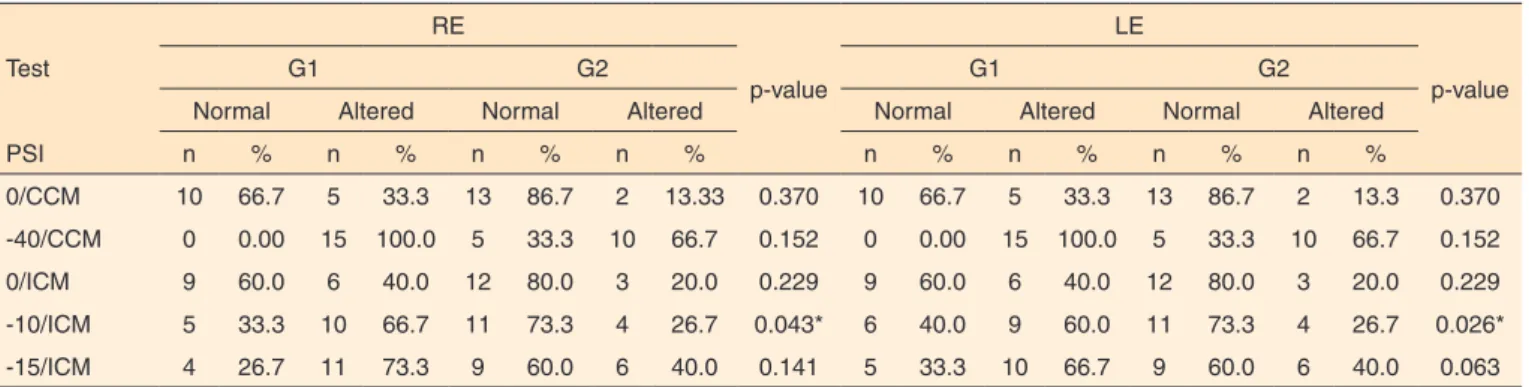
The PSI test was performed with contralateral and ipsila-teral competitive message. In the contralaipsila-teral PSI, there was no statistical significance between groups. However, in the
ipsilateral PSI, G1 showed a higher index of changes in G2, for both ears. During the testing in ICM, there was similarity between the two groups, when the speech/noise ratio was 0 dB HL, but when performed at a speech/noise ratio -10 dB HL and -15 dB HL, there was a worse performance from G1. However, when comparing the performance between the groups, in regar-ds to speech/noise ratio of -15 dB HL, there was no significant difference (Table 5).
The groups were also compared in regards to socioecono-mic status and no significant differences were observed. When compared to gender, there was a higher index on males.
DISCUSSION
Auditory skills are extremely important in the development of language and speech of individuals. The development of these skills depends on processes that involve complex nerve pathways that can be affected by environmental, social and
Table 2. Comparative performance from groups G1 and G2 in the diotic tests
Category
Group G1 Group G2
p-value
Normal Altered Normal Altered
n % n % n % n %
SLT 11 73.3 4 26.7 13 86.7 2 13.3 0.358
TVSS 2 13.3 13 86.7 11 73.3 4 26.7 0.001*
TnVSS 5 33.3 10 66.7 11 73.3 4 26.7 0.026*
*Significant values (p<0.05) – Likelihood Ratio Test
Note: G1 = sample group; G2 = control group; SLT = Sound localization test; TVSS = Test of verbal sound sequencing; TnVSS = Test of non-verbal sound sequencing
Table 3. Comparative performance in TDD and TFR
Category
G1 G2
p-value
Normal Altered Normal Altered
n % n % n % n %
DDT - BI 0 0,0 15 100.0 10 66.7 5 33.3 0.000*
DDT-DA 5 33.33 10 66.67 11 73.3 4 26.67 0.026*
STN 6 40.0 9 60.0 11 73.33 4 26.67 0.062
*Significant values (p<0.05) – Likelihood Ratio Test
Note: G1 = sample group; G2 = control group; DDT-BI = Dichotic digits test- binaural integration); DDT-DA = Dichotic digits test- directed attention); STN = Speech Test with Noise
Table 4. Severity degree of the CAPD groups
Severity degree
G1 G2
RE LE RE LE
n % n % n % n %
Normal 6 40.0 6 40.0 11 73.33 11 73.33
Mild 5 33.33 5 33.33 2 13.33 2 13.33
Moderate 1 6.67 1 6.67 2 13.33 2 13.33
Severe 3 20.0 3 20.0 0 0.00 0 0.00
Total 15 100.0 15 100.0 15 100.0 15 100.0
pathological factors, as described in the literature(1,2,4-6,8)
In the national and international literature there are few studies(23-25) that relate to malnutrition and development of the
auditory processing skills. However, studies have also found lower performance found in children with malnutrition.
Analyzing the tests with diotic task it was identified that in the sound localization test the performance between groups was similar. Whereas the maturation process interferes with the development of listening skills, and the child is able to locate the sound source at around seven months old and the age of our sample was 5 to 10 years old, it cannot be inferred that malnutrition does not interfere with the development of this ability. One study(23) was performed in children aged 0 to
2 years of age with malnutrition, in which the central hearing was assessed by behavioral hearing assessment. The study identified changes in sound location, and may thus suggest that malnutrition could affect this ability.
In TVSS and TnVSS tests assessing memory skills for verbal and nonverbal sounds in sequence, malnourished chil-dren showed inferior performance than the eutrophic ones. Considering that the difference in performance between groups was significant, this may suggest that malnutrition may have affected the performance in the processes involved, due to the type of hearing test performed on the task, which involves complex nerve connections. In this sense, the authors reported that malnutrition can cause damage to cell structure, neuro-transmitters and myelination process(4,26).
With the application of DDT in the sample and control of this study, it was possible to evaluate the performance in the ability to background figure for verbal sounds by means of dichotic tasks/Binaural Integration. Changes in this test may in-dicate impaired ability to background figure for verbal sounds, the physiological mechanism of selective attention and gnostic decoding process. One hundred percent of malnourished chil-dren had low performance, indicating that malnutrition may have affected the central auditory processes mentioned above.
The data found in this study agree with the study(27)
per-formed in a group of malnourished children and in a group of
healthy children, where the author applied the same test and identified significant differences in the changes in the group of children with malnutrition (67.7%), when compared to the control group (38.2%).
The dichotic listening in malnourished children was also investigated in a study(28), in regards to the role of resilience in
dichotic listening tasks in adolescents at social risk. The author noted that, in dichotic digits test for the ability of binaural inte-gration, over 85% of the vulnerable group presented alterations. The data pointed to a difficulty in transferring information from the right hemisphere to the left, which should be processed. We emphasize that the process of maturation should be taken into account when analyzing the results, due to the fact that the skills also are in development period, as mentioned in the literature(29). Thus, given the age of the study population it was
not possible in this study to relate the performance of children with possible changes in the CNS, but it was observed that nutritional factors may interfere with this process.
The tests used to assess the children in this study were also applied in a study(30), in which the auditory processing was
performed in children born preterm. One of the risk factors found in this population was low birth weight, <1,500 Kg. The tests applied were SLT, TVSS, TnVSS, STN, PSI/ CCM, PSI/ ICM e DDT and the authors observed changes in 93.75% of the subjects. The physiological mechanisms that were changed were the recognition of physically distorted verbal sounds and recognition of verbal sounds in monotic (50% of children). Forty-three point seven five percent of children had alterations in temporal processing, 37.5%, of the recognition of sounds in verbal dichotic listening and 6.25% the binaural interaction mechanism. The authors also identified delay in sound locali-zation, temporal ordination, closing and background figure, as well as in the present study.
Study of malnourished children with learning disorders assessed the central hearing through the SSW and, according to the author, 100% of malnourished children showed abnor-malities in the test and the most prejudiced gnostic process was decoding(25).
Table 5. Comparative performance between groups G1 and G2 in PSI
Test
RE
p-value
LE
p-value
G1 G2 G1 G2
Normal Altered Normal Altered Normal Altered Normal Altered
PSI n % n % n % n % n % n % n % n %
0/CCM 10 66.7 5 33.3 13 86.7 2 13.33 0.370 10 66.7 5 33.3 13 86.7 2 13.3 0.370
-40/CCM 0 0.00 15 100.0 5 33.3 10 66.7 0.152 0 0.00 15 100.0 5 33.3 10 66.7 0.152
0/ICM 9 60.0 6 40.0 12 80.0 3 20.0 0.229 9 60.0 6 40.0 12 80.0 3 20.0 0.229
-10/ICM 5 33.3 10 66.7 11 73.3 4 26.7 0.043* 6 40.0 9 60.0 11 73.3 4 26.7 0.026*
-15/ICM 4 26.7 11 73.3 9 60.0 6 40.0 0.141 5 33.3 10 66.7 9 60.0 6 40.0 0.063
*Significant values (p<0.05) – Likelihood Ratio Test
The effects of malnutrition in the ABR in sensory motor stimulation and auditory processing were studied and the fin-dings suggest that malnutrition in early life may cause serious effects on the myelination of the auditory pathway(26).
With this study, we could detect the lack of studies corre-lating malnutrition and development of the skills of the AP. Most research related malnutrition to poor school performance, difficulties in language development and learning. However, they mention that the group which demonstrated difficulties in written language, presented higher incidence of changes in AP than the group that did not manifest changes in written language, indicating that changes in AP may be associated with difficulty in the written language(17,26).
CONCLUSION
Malnourished children had a higher frequency of changes in hearing, when compared to eutrophic children, being the most affected skills the temporal ordering, auditory memory, selective attention, background figure and closing. Regarding the degree of auditory processing disorder, there was a greater severity in malnourished children.
REFERENCES
1. Nunes ML, Batista BB, Micheli F, Batistella V. Efeitos da desnutrição precoce e reabilitação nutricional em ratos. J Pediatr (Rio J). 2002;78(1):39-44. http://dx.doi.org/10.1590/S0021-75572002000100009 2. Monte CMG. Desnutrição: um desafio secular à nutrição infantil. J Pediatr (Rio J). 2000;76(Supl 3):S285-97.
3. Lucas BL, Feucht SA. Nutrição na infância. In: Mahan LK, Escott-Stump S. Krause, alimentos, nutrição e dietoterapia. 12a ed. Rio de Janeiro: Elsevier; 2010. Capítulo 7, p. 22-37.
4. Nóbrega FJ. Distúrbios da nutrição: na infância e na adolescência. 2a ed. Rio de Janeiro: Revinter; 2007. Capitulo 20, Introdução, nomenclatura e metodologia de avaliação; p. 149-56.
5. Miranda MC, Nobrega FJ, Sato K, Pompéia S, Sinnes EG, Bueno OFA. Neuropsicoogia e desnutrição: um estudo com crianças de 7 a 10 aos de idade, em uma comunidade carente. Rev Bras Saúde Mater Infant. 2007;7(1):45-54. http://dx.doi.org/10.1590/S1519-38292007000100006 6. Nunes ML. Desnutrição e desenvolvimento neuropsicomotor. J Pediatr (Rio J). 2010;77(3):159-60. http://dx.doi.org/10.1590/S0021-75572001000300004
7. Santos JN, Lemos SMA, Lamounier JA. Estado nutricional e desenvolvimento da linguagem em crianças de uma creche pública. Rev Soc Bras Fonoaudiol. 2010;15(4):566-71. http://dx.doi.org/10.1590/ S1516-80342010000400015
8. Silva VC, Alameida SS. Desnutrição proteica no início da vida prejudica a memória social em ratos adultos. Rev Nutri. 2006;19(2):195-201. http://dx.doi.org/10.1590/S1415-52732006000200007
9. Sampaio VDF, Oliveira LM, Almeida SS, Marchini JS, Antunes-Rodrigues J, Elias LLK. The effects of early protein malnutrition and environmental stimulation on behavioral and biochemical parameters
in rats. Psycol Neurosci. 2008;1(2):109-19. http://dx.doi.org/10.3922/j. psns.2008.2.004
10. Porto JA, Oliveira AG, Largura A, Adam TS, Nunes ML. Efeitos da epilepsia e da desnutrição no sistema nervoso central em desenvolvimento: aspectos clínicos e evidências experimentais. J Epilepy Clin Neurophysiol. 2010;16(1):26-31. http://dx.doi.org/10.1590/S1676-26492010000100006
11. Thomaz EBAF, Valença AMG. Avaliação do estado nutricional entre pré-escolares na cidade de São Luís – Maranhão – Brasil. Rev Bras Cienci Saúde. 2002;6(3):237-48.
12. Chagas DC, Silva AAM, Batista RFL, Simões VMF, Lamy ZC, Coimbra LC, et al. Prevalência e fatores associados à desnutrição e ao excesso de peso em menores de cinco anos nos seis maiores municípios do Maranhão. Rev Bras Epidemiol. 2013;16(1):146-56. http://dx.doi. org/10.1590/S1415-790X2013000100014
13. Pereira LD. Avaliação do processamento auditivo. In: Lopes Filho, O. Tratado de fonoaudiologia. 2a ed. Ribeirão Preto: Tecmed, 2004. Capítulo 5, p. 111-30.
14. Pereira LD, Schochat E. Processamento auditivo central: manual de avaliação. São Paulo: Lovise; 1997.
15. American Academy of Audiology. Diagnosis, treatment and management of children and adults with central auditory processing disorder. Reston: American Academy of Audiology; 2010. (American Academy of Audiology clinical practice guidelines).
16. American Speech-Language-Hearing Association. Working Group on Auditory Processing Disorders. (Central) Auditory Processing Disorder Audiologist. 2005 [Acesso em: 10 jun 2013]. Disponível em: http://www. asha.org/policy/PS2005-00114/#sec1.3
17. Zuanetti PA. Desempenho de crianças com histórico de subnutrição em idade precoce em linguagem escrita, processamento fonológico e processamento auditivo [dissertação]. Ribeirão Preto: Faculdade de Medicina de Ribeirão Preto da Universidade de São Paulo; 2011. 18. Almeida RP, Matas CG. Potenciais evocados auditivos de longa latência em crianças desnutridas. CoDAS. 2013;25(5):407-12. http:// dx.doi.org/10.1590/S2317-1782201300050000
19. Gladstone M, Mallewa M, Alusine Jalloh A, Voskuijl W, Postels D, Groce N, et al. Assessment of neurodisability and malnutrition in children in Africa. Semin Pedriatr Neurol. 2014;21(1):50-7. http://dx.doi. org/10.1016/j.spen.2014.01.002
20. Lloyd LL, Kaplan H. Audiometric interpretation: a manual of basic audiometry. Baltimore: University Park Press; 1978.
21. Jerger J. Clinical experience with impedance audiometry. Arch Otorhinolaryngol. 1970;92(4):311-24.
22. Pereira LD, Schochat E. Testes auditivos comportamentais para avaliação do processamento auditivo central. São Paulo: Pró-Fono; 2011. 23. Magalhães MSQ, Oliveira PRP, Assencio-Ferreira VJ. Desnutrição como fator etiológico da deficiência auditiva em crianças de 0 a 2 anos. Rev CEFAC. 2001;3(2):183-6.
24. Lima JG, Funayama CAR, Oliveira LM, Rossato M, Colafêmina JF. Effects of malnutrition and sensory-motor stimulation on auditory evoked potentials. Psychol Neurosci. 2008;1(2):121-7. http://dx.doi. org/10.3922/j.psns.2008.2.005
processing, language, and reading disorders. J Speech Lang Hear Res. 2009;52(3):706-22. http://dx.doi.org/10.1044/1092-4388(2008/07-0226)
26. Penido AB, Rezende GHS, Abreu RV, Oliveira ACP, Guidine PAM, Pereira GS, et al. Malnutrition during central nervous system growth and developmente impairs permanently the subcortical auditory pathway. Nutr Neurosci. 2012;15(1):31-6. http://dx.doi.org/10.1179/147683051 1Y.0000000022
27. Almeida RP. Avaliação comportamental, eletroacústica e eletrofisiológica da audição em crianças desnutridas [tese de doutorado]. São Paulo: Faculdade de Medicina da Universidade de São Paulo; 2012.
28. Lima MB. O papel da resiliência nas tarefas de escuta dicótica em adolescentes em situação de risco social [dissertação]. Porto Alegre: Faculdade de Psicologia da Pontifícia Universidade Católica do Rio Grande do Sul; 2013.
29. Casaprima V, Jannelli A, Lobo M, Martínez E, Lezarraga A. Obtención de valores normativos en la evaluación de la función auditiva central. Rev Med Rosario. 2013;79(2):73-7.