Voice quality assessment before and after social and
professional voice use
Análise da qualidade vocal antes e após o uso profissional e
social da voz
Amanda Nocce Aragão1, Thalita Evaristo Couto1, Zuleica Antonia de Camargo2, Marco Aurélio Rocha Santos3,
Ana Cristina Côrtes Gama4
ABSTRACT
Purpose: To analyze the effects of social and professional voice use in the voice quality of women in a time frame of two hours and 30 minutes using auditory-perceptual evaluation. Methods: Acase-control study with two groups: professional voice users, with 31 Belo Horizonte school teachers aged 28-59 years; social voice users, with 42 females aged 31-59 years with no occupational voice use. The data was collected at two time points, in the morning period, before starting the use of voice and after two hours and thirty minutes. The subjects were instructed to read sentences in their normal speaking voice. The same recording scheme was used for the group of social voice use, with normal use of the voice in the home of each participant. The voices were evaluated through an auditory-perceptual assessment by two experienced raters who compared the emissions before and after voice use and determined whether there was improvement, deterioration or similarity between time points. Results:
Both groups had a higher frequency of similarity between the voices before and after the vocal loading according to the auditory-perceptual evaluation. In subjects with changes in their vocal patterns, roughness was the auditory-perceptual parameter that changed the most for both groups, albeit with a low degree of deviance. Conclusion: The social voice use and the professional voice use resulting from the teaching activity, both during two hours and thirty minutes, caused no changes in voice quality as evaluated by auditory-perceptual analysis.
Keywords: Voice disorders; Dysphonia; Faculty; Voice; Voice quality
RESUMO
Objetivo: Analisar, do ponto de vista perceptivo-auditivo, os efeitos do uso profissional e social da voz na qualidade vocal de mulheres, em um intervalo de tempo de duas horas e 30 minutos. Métodos: Pesquisa do tipo caso-controle, formada por dois grupos: grupo de uso profissional da voz, com 31 professoras, faixa etária de 28 a 59 anos e grupo de uso social da voz, com 42 mulheres, faixa etária de 31 a 59 anos, sem o uso profissional da voz e sem queixa vocal. A coleta foi realizada pela ma-nhã, em dois momentos - antes da primeira aula e após duas horas e 30 minutos -, na própria escola em que as professoras lecionavam e consis-tiu em leitura de frases. O grupo de uso social seguiu os mesmos padrões de gravação, com uso da voz na residência de cada participante. As vozes foram avaliadas de forma perceptivo-auditiva por dois avaliadores expe-rientes, comparando-se as emissões antes e após o uso e classificação de melhora, piora ou similaridade entre os momentos. Resultados: Os grupos não apresentaram diferenças entre as vozes, comparando-se os momentos antes e após o uso da voz. Nos casos em que houve modifica-ção do padrão vocal, a rugosidade foi o parâmetro perceptivo-auditivo mais frequente nos dois grupos, porém com baixo grau de alteração.
Conclusão: O uso social e o uso profissional da voz, decorrente da atividade letiva, no período de duas horas e 30 minutos, não causaram alterações na qualidade vocal, analisada de forma perceptivo-auditiva.
Descritores: Distúrbios da voz; Disfonia; Docentes; Voz; Qualidade da voz
Study conducted in the Speech-Language Pathology and Audiology Course, Universidade Federal de Minas Gerais – UFMG – Belo Horizonte (MG), Brazil, funded by a grant awarded by the Conselho Nacional de Desenvolvimento Científico e Tecnológico (CNPq).
(1) Speech-language, Pathology and Audiology Course, School of Medicine, Universidade Federal de Minas Gerais – UFMG – Belo Horizonte, MG, Brazil. (2) Linguistics Department, Pontifícia Universidade Católica de São Paulo – PUC – São Paulo (SP), Brazil.
(3) Otorhinolaryngology Service, Hospital das Clínicas, Universidade Federal de Minas Gerais – UFMG – Belo Horizonte, MG, Brazil.
(4) Speech-Language, Pathology and Audiology Department, School of Medicine, Universidade Federal de Minas Gerais – UFMG – Belo Horizonte, MG, Brazil.
Conflict of interests: No
Authors’ contribution: All the authors of the present study (ANA, TCE, ZAC, MARS, and ACCG) contributed to the study design and development, including the review of the literature, analysis of results, discussion, and conclusions. ANA and TCE collected and tabulated the data; ZAC and MARS reviewed the final version of the manuscript; ACCG supervised the study development phases and prepared the draft of the manuscript.
Correspondence address: Amanda Nocce Aragão. Av. Alfredo Balena, 190, sala 69, Belo Horizonte (MG), Brazil, CEP: 30130-100. E-mail: [email protected]
INTRODUCTION
Among professional voice users, teachers are particularly susceptible to dysphonia(1-3), as they are subject to heavy vocal
loading(4,5) and, consequently, to inadequate vocal
adapta-tions(6,7). The health of teachers, including the voice-related
aspects, is related to the physical environment and management profile of their school(8).
The influence of the working environment includes envi-ronmental and chemical risks such as noise (sound pressure level above 65 dB), extreme temperature changes, and vocal tract dryness caused by air conditioning, inadequate ventilation, vocal discomfort, and chalk dust(9). Individual factors include,
for example, insufficient hydration, allergies, and self-medica-tion(6). Further, there are risks linked to the organization of the
work process, with heavy teaching loads and/or accumulated functions and an excessive number of students per class.
Those are factors that compromise the teachers’ vocal health, and this may manifest as vocal fatigue, dry mouth, palpitations, heartburn, muscle strain, and headaches(9).
Vocal fatigue is cited in the literature as one of the se-veral symptoms of dysphonia(10), and defined as a negative
compensation deriving from prolonged voice use(11), as is
frequently the case of teachers(1,12). Although consensus is
la-cking between studies regarding the definition, characteristics, and mechanisms of vocal fatigue, it can be analyzed through auditory-perceptual, acoustic, aerodynamic, or physiological assessments(13).
The literature highlights that a major factor in voice quality alterations caused by vocal fatigue is a rise in pitch. Other symptoms can be present, such as tiredness, pain, a burning sensation, dry throat, strain of the laryngeal, neck, jaw, and thoracic muscles, progressive hoarseness without vocal fold lesions, vocal effort when increasing or sustaining voice loudness, and body fatigue(14). Therefore, vocal loading has a
multi-faceted impact on voice quality, due to both anatomical and physiological factors and intensive voice use(13,15).
Despite the existence of numerous studies, the great majori-ty of them focus on the analysis of the acoustic characteristics of the voice (fundamental frequency, vocal tremor, aerodynamic measures) using tasks of sustained vowel phonation(15,16), on the
individuals’ self-perception of the voice(17), or on physiological
and laryngeal characteristics(18,19). Little attention has been given
to the study of the auditory-perceptual properties of the voice in situations of prolonged use.
Furthermore, there are few studies analyzing the changes in voice and speech in specific professional groups(16) in the
presence of dysphonia(15) and in real-life ergonomic settings
found in the voice professional’s work environment(20).
In view of this, the purpose of our study was to examine, by auditory-perceptual evaluation, the effects of professional and social voice use on the quality of the voice of women wi-thin a time frame of two hours and thirty minutes. The results
of this study could contribute to the creation of strategies and protocols to promote vocal health and prevent voice problems.
METHODS
The present case-control study included 73 participants: 31 women aged 28-65 years (mode = 59 years) working as teachers in the Belo Horizonte municipal school system (BHMSS), who comprised the group of professional voice users (G1), and 42 women aged 31-59 years (mode = 42 years) without voice complaints or self-reported voice disorders, with no occupational use of the voice, and elementary level education or higher, who constituted the social voice use group (G2). The professional occupations in G2 were: civil servants (11), homemakers (6), shopkeepers (7), business administrators (6), nurses (3), hairdressers (3), engineers (2), dietitian (1), student (1), clergyperson (1), and educationalist (1).
The professional voice use group (G1) comprised elementa-ry school teachers with classroom experience ranging from 5 to 40 years (mode = 20 years) and a teaching load of 12-47 hours per week (mode = 22 hours). Of the teachers, 41.93% worked one shift; 51.61%, two shifts, and 6.45% worked three shifts. Participants were included in G1 if they were female teachers without voice complaints. For G2, the inclusion criteria were female gender and age range matching that of G1. Individuals who were in speech-language therapy (G1) or presented with voice complaints (G2) were excluded from the study.
Professional use of the voice was defined as classroom tea-ching for a continuous period of two hours and thirty minutes; the teachers were instructed to perform their usual teaching activities, which included lectures and class work. Social use of the voice was considered the speaking activity of the women at home, in the family environment, continuously for two hours and thirty minutes.
Both the occupational and social use of the voice were as-sessed in typical settings. The type of voice use (professional or social) was not controlled in our study. All G1 and G2 parti-cipants were instructed to proceed with their activities as usual, both in teaching (G1) as in the home (G2). This instruction was necessary so that the voice assessment could reflect the typical situations of voice use in real-life settings.
All the participants provided their written informed con-sent, expressing their agreement to participate in the study and with the publication of the study and its results, according to Resolution 196/96. This study was approved by the Research Ethics Committee of the Universidade Federal de Minas Gerais (UFMG) under Formal Opinion ETIC 0531/2011.
For G1, the voice samples were collected in the morning, in a quiet room selected by the investigators at the BHMSS schools where the teachers worked. The samples were recorded at two time points – before the beginning of the day’s classes and after the last class – with a length of two hours and thirty minutes. The duration of each recorded sample was approxi-mately 5-7 min. The G2 voice samples were also recorded at two time points and for the same length of time, in a quiet place in their homes.
The same recording equipment was used with both groups. For voice recording, the informants were asked to read the sen-tence “A Lara guarda figuras de pássaros e as suas preferidas são a da arara, da patativa, da garça, do canário e do sabiá amarelo’’(21). Subsequently, they were requested to produce a
semi-spontaneous speech in response to ‘‘Talk about the town where you were born.”
The recordings took place with the individuals seated. A unidirectional Samson® model CO1 condenser microphone was positioned at an angle of 45 degrees and at a distance of 20 cm from the speaker. The microphone was plugged into a Roland UA55 Quad-Capture USB 2.0 Audio Interface–4X4 24 bit 192 kHz connected to an Intel Pentium Inside Dual Core® P6200. The speech samples were stored in “wav”files and processed with the aid of the SONAR LEsoftware.
The voice samples were evaluated independently by four speech-language pathologists with more than 10 years’ prac-tice since graduation and experience in the field of voice. The evaluation was conducted by randomized comparison – the recordings were introduced in randomized pairs to prevent the raters from identifying whether the samples corresponded to the first or second recording. The evaluators should indicate whether the voice quality improved, declined, or was similar at the two time points. If any changes were detected, the raters should grade the deviance on a 10 cm visual analogic scale and mark a maximum of two of the five GRBASI scale parameters (roughness, breathiness, astheny, strain, instability) that in their perception most influenced the voice improvement or decline. The raters listened to the voice samples to perform the auditory-perceptual evaluations using a Coby® CV–3000 headphone, and were allowed to replay the samples as many times as needed. After completion, the ratings of two speech-language pathologists with the greatest inter-rater agreement (Spearman correlation=0.53) were selected to characterize the samples.
Descriptive statistical analysis was performed using percent values to calculate the frequency and degree of improvement, decline, or similarity in the voices as well as the frequency of auditory-perceptual parameters when comparing the two recording time points.
RESULTS
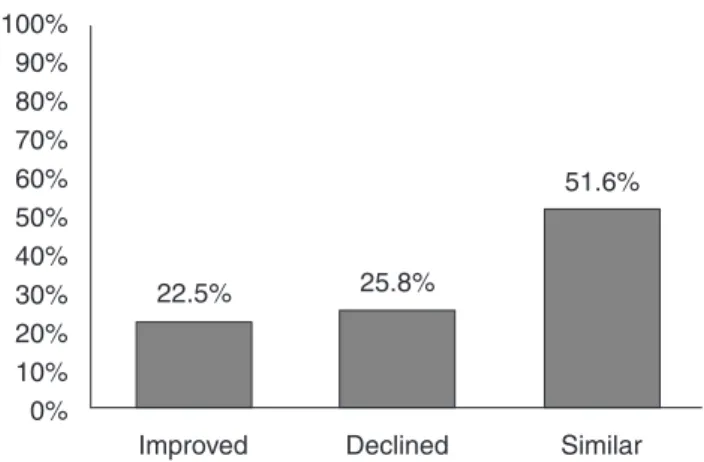
Voice quality was similar before and after two hours and thirty minutes of professional or social voice use. When voice
quality declined after loading, this was more frequent in the group of professional voice use (G1) (Figure 1). Improvements were also more frequent in G1 compared to the group of social voice use (G2) (Figure 2).
The GRBASI scale attributes were distributed according to voice improvement or decline following the vocal loading period. Roughness was the auditory-perceptual parameter with the strongest influence on voice quality - both in the cases of decline and improvement - for the two groups (Tables 1 and 2).
The other auditory-perceptual parameters that showed improvement were astheny in G2 and breathiness in G1. The auditory-perceptual attributes that had an impact on voice
22.5% 25.8%
51.6% 100%
90% 80% 70% 60% 50% 40% 30% 20% 10% 0%
Improved Declined Similar
Figure 1. Comparison of the frequency of voice quality improvement, decline, or similarity after the professional use of the voice (G1)
16.7% 19.0%
64.3% 100%
80%
60%
40%
20%
0%
Improved Declined Similar
Figure 2. Comparison of the frequency of voice quality improvement, decline, or similarity after the social use of the voice (G2)
Table 1. Comparison between the auditory-perceptual parameters in the control group
Parameters Improvement (%) Decline (%)
R 87.5 88.8
B 0 11.2
A 12.5 0
S 0 0
I 0 0
quality decline were breathiness in G2 and instability in G1 (Table 3).
DISCUSSION
Auditory-perceptual evaluation is routine in the clinical practice of speech-language pathology and audiology. Despite its subjectivity, it is the gold standard assessment, as it allows for inferences about pathophysiological correlates and psycho-social aspects of the voice(22,23).
Teachers represent a professional category at high occupa-tional risk for voice disorders, since the voice plays a key role in this profession(3). The present study was prompted by the
need to investigate whether the occupational use of the voice in real-life working conditions at BHMSS schools - in a time frame of two hours and thirty minutes of continuous teaching - can generate voice problems that will eventually affect the teaching activity(24). In addition, we sought to determine whether
a difference exists between professional voice use (i.e., more prolonged and intensive) and social voice use (i.e., less vocally demanding) during these two hours and thirty minutes.
A study(24) involving five BHMSS teachers readapted for
dysphonia identified their behavior regarding strategies of hyperfunction and voice protection. The study results showed that the working conditions can generate heavy vocal loading in the tasks developed by the teachers. Another study(3),
whi-ch aimed to describe voice whi-changes during work, found that some voices were abnormal at the end of the working day. The changes differed between subgroups, including the fundamental frequency (F0), which was found to be increased. When inter-preting the changes, those authors considered that the deviance could be a consequence of vocal loading, which initially leads to voice warm-up and later to vocal fatigue(3).
Another factor to be taken into account with regard to vocal loading in teaching is the time for the development of some
chronic lesions and behavioral dysphonias. An observational epidemiological study(25) correlating age, gender, profession,
relevant pathological history, voice behavior, and the form of onset and duration of dysphonia, conducted during a period of five years with 65 patients diagnosed with functional dysphonia, revealed that the mean age for developing a voice disorder as a result of inadequate voice use was 34 years; 87.7% of the cases were women whose occupation involved great vocal demands. Most patients had gradually progressive dysphonia and the mean time of disease from the initial symptoms to the first appointment with a specialist was less than four years. Additionally, it was noted that when the voice quality alterations were greater in professional voice users, the time of progression since the onset of the voice problem was shorter.
Although there is vast literature concerning the subjective evaluations of a single time point of voice sampling, few studies describe auditory-perceptual correlates deriving from the professional use of the voice before and after teaching activities and in real working conditions compared with indi-viduals who use their voices socially. A study(26) investigating
vocal loading in 21 women (mean age, 22 years) who were not voice professionals showed through auditory-perceptual evaluation that prolonged voice use leads to a reduction in roughness and breathiness, and an increase in pitch, loudness, stability, and sound projection. Self-perception assessment also indicated increased voice effort following vocal loading. These findings suggest that voice quality improves in up to one hour of loading, which represents the limit of laryngeal efficiency for voice production. Another study(27), which
com-pared the voices of 32 dysphonic subjects and 31 subjects with healthy voices before, immediately after, and one hour after vocal loading revealed that the individuals with dysphonia had more voice changes than the group with normal voice, although the frequency of occurrence was small.
The present study indicates similarity in voice quality before and after a teaching period for the group of professional voice users (Figure 1) as well as before and after the social use of the voice (Figure 2). Regarding G1, this finding could be related to the time interval of two hours and thirty minutes between recordings, which may not have been sufficient to cause voice quality alterations, even in settings of heavier vocal demands. This observation is in line with the findings of other studies(13,28)
that, despite using different methods from those of our study, found no significant data with respect to the auditory-perceptual evaluation before and after a vocal loading task.
The occurrence of voice quality improvements and declines after the professional (Figure 1) and social (Figure 2) voice use was similar, and the frequency of such events was small. This complicated the interpretation of the results, which could have been influenced by multiple factors, such as the subjectivity of the auditory-perceptual analysis.
Regarding the five auditory-perceptual parameters (Tables 1 and 2) assessed using the GRBASI scale in the cases of voice
Table 3. Degree of improvement and decline in the control and experi-mental groups
Group Improvement (%) Decline (%)
Control 10.4 10.6
Experimental 9 11
Table 2. Comparison between the auditory-perceptual parameters in the experimental group
Parameters Improvement (%) Decline (%)
R 77.7 72.7
B 22.3 0
A 0 0
S 0 0
I 0 27.3
decline or improvement, the roughness parameter, which en-compasses hoarseness, vocal fry, bitonality, and roughness was prominent, indicating irregular vocal fold vibration(22). For both
groups, roughness was the auditory-perceptual parameter that changed the most in the cases of voice improvement; however, this was more frequent in G2. This fact could be due to the voice warm-up(20) that occurred in the period between time points,
considering that the voices were recorded in the morning. Roughness was also the most prominent attribute in the cases of voice decline in both groups, and was more frequent in G1. In this case, multiple factors (e.g., individual, environmental, and work-related) could have influenced the occurrence of voice problems and resulting vibratory irregularity.
By indicating the degree of voice deviance (Table 3), the auditory-perceptual assessment showed that the extent of the voice change was comparable and small for G1 and G2, both in cases of decline and improvement. This result suggests that the time frame of two hours and thirty minutes was likely not long enough to substantially affect the degree of voice quality deviation in the auditory-perceptual attributes analyzed.
A study(29) concerning the acoustic effects caused by
attri-butes of vocal fatigue, conducted with seven volunteers aged between 20 and 50 years (five males, two females) correlated electromyographic findings to acoustic measures, and confir-med that the changes seen in muscle fatigue were associated with voice tremor and indicated that further effects could arise with the increase in the duration of the test. Further, another study(30) sought to identify signs of vocal fatigue in 51 teachers
by assessing sustained phonation before and after vocal loading. The voice acoustic analysis indicated changes in jitter and pi-tch perturbation quotient; however, these alterations were not sufficient to cause marked voice changes.
Although those studies employed distinct methods from those in our study with regard to data collection and time of exposure, they demonstrate that acoustic analysis contributes to the evaluation of vocal loading, providing objective and punctu-al information on parameters that might show some punctu-alteration.
Arguably, a longer teaching period could more effectively demonstrate the effects of loading on the voice of teachers. We suggest that further studies developed to investigate the effects of vocal loading on teachers after work should include pre-defined days of the week for data collection and a longer time frame between the recording moments. They should also include control for the presence or absence of dysphonia in the study group, the nature of the vocal activity during the teaching period, the work environment and organization status, and esta-blish a correlation between different modalities of evaluation, such as acoustic analysis.
CONCLUSION
The present study shows that the social use of the voice and the professional use in teaching activities, both during
two hours and thirty minutes, did not lead to changes in voice quality according to auditory-perceptual evaluation.
REFERENCES
1. F u e s s V L R , L o r e n z M C . D i s f o n i a e m p r o f e s s o r e s do ensino municipal: prevalência e fatores de risco. Rev Bras Otorrinolaringol. 2003;69(6):807-12. http://dx.doi.org/10.1590/S0034-72992003000600013
2. Giannini SPP, Latorre MRDO, Ferreira LP. Distúrbio de voz relacionado ao trabalho docente: um estudo caso-controle. CoDAS. 2013;25(6):566-76. http://dx.doi.org/10.1590/S2317-17822014000100009
3. Vilkman E. Occupational safety and health aspects of voice and speech professions. Folia Phoniatr Logop. 2004;56(4):220-53. http:// dx.doi.org/10.1159/000078344
4. Gotaas C, Starr CD. Vocal fatigue among teachers. Folia Phoniatr (Basel). 1993;45(3):120-9.
5. Gama ACC, Bicalho VS, Valentim AF, Bassi IB, Assunção AA. Sintomas relacionados à voz e sua produção e autopercepção vocal após alta do tratamento fonoaudiológico: estudo prospectivo. Distúrb Comun. 2010:22(3):201-11.
6. Vieira ABC, Rocha MOC, Gama ACC, Gonçalves DU. Fatores causais e profilaxia da disfonia na prática docente. Cad Educação. 2007;28:255-70.
7. Dragone MLS, Ferreira LP, Giannini SPP, Simões-Zenari M, Vieira VP, Behlau M. Voz do professor: uma revisão de 15 anos de contribuição fonoaudiológica. Rev Soc Bras Fonoaudiol. 2010;15(2):289-96. http:// dx.doi.org/10.1590/S1516-80342010000200023
8. Bauer J, Stamm A, Virnich K, Wissing K, Müller U, Wirscing M et al. Correlation between burnout syndrome and psychological and psychosomatic symptoms among teachers. Int Arch Occup Environ Health. 2006;79(3):199-204. http://dx.doi.org/10.1007/s00420-005-0050-y
9. Behlau M. Voz: o livro do especialista. Rio de Janeiro: Revinter; 2005. Vol. 2.
10. Centro de Vigilância em Saúde. Distúrbios da voz relacionados ao trabalho. Bol Epidemiol Paulista [internet]. 2006;3(26) [Acesso em: 14 abr. 2013]. Disponível em: http://www.cve.saude.sp.gov.br/agencia/ bepa26_dist.htm
11. Scherer RC, Titze IR, Raphael BN, Wood RP, Ramig LA, Blager RF. Vocal fatigue in a trained and an untrained voice user. In: Baer T, Sasaki C, Harris K, eds. Laryngeal function in phonation and respiration. San Diego: Singular; 1991. p. 533-55.
12. Laukkanen AM, Iloma¨ki I, Leppa¨nen K, Vilkman E. Acoustic measures and self-reports of vocal fatigue by female teachers. J Voice. 2008;22(3):283-89. http://dx.doi.org/10.1016/j.jvoice.2006.10.001 13. Welham NV, Maclagan MA. Vocal fatigue: current knowledge and future directions. J Voice. 2003;17(1):21-30. http://dx.doi.org/10.1016/ S0892-1997(03)00033-X
14. Kubota ML. Considerações sobre a hidratação das pregas vocais [monografia]. São Paulo: CEFAC – Saúde e Educação;1997.
fatigue after prolonged reading in individuals with unilateral vocal fold paralysis. J Voice. 2003;17(4):513-28. http://dx.doi.org/10.1067/S0892-1997(03)00067-5
16. Gelfer MP, Andrews ML, Schmidt CP. Effects of prolonged loud reading on selected measures of vocal function in trained and untrained singers. J Voice. 1991;5(2):158-67. http://dx.doi.org/10.1016/S0892-1997(05)80179-1
17. Chang A, Karnell MP. Perceived phonatory effort and phonation threshold pressure across a prolonged voice loading task: a study of vocal fatigue. J Voice. 2004;18(4):454-66. http://dx.doi.org/10.1016/j. jvoice.2004.01.004
18. Stemple JC, Stanley J, Lee L. Objective measures of voice production in normal subjects following prolonged voice use. J Voice. 1995;9(2):127-33. http://dx.doi.org/10.1016/S0892-1997(05)80245-0
19. Doellinger M, Lohscheller J, McWhorter A, Kunduk M. Variability of normal vocal fold dynamics for different vocal loading in one healthy subject investigated by phonovibrograms. J Voice. 2009;23(2):175-81. http://dx.doi.org/10.1016/j.jvoice.2007.09.008
20. Vintturi J, Alku P, Lauri E-R, Sala E, Sihvo M, Vilkman E. Objective analysis of vocal warm-up with special reference to ergonomic factors. J Voice. 2001;15(1):36- 53. http://dx.doi.org/10.1016/S0892-1997(01)00005-4
21. Camargo Z, Madureira S. Voice quality analysis from a phonetic perspective: voice profile analysis scheme profile for Brazilian Portuguese (BP-VPAS). In: Proceedings of the 4th Conference on Speech Prosody; 6 a 9 maio 2008 [acesso em: 12 mar 2013]; Campinas, SP. 2008. Disponível em: http://sprosig.isle.illinois.edu/sp2008/papers/id179.pdf
22. Behlau MS. Voz: o livro do especialista. Rio de Janeiro: Revinter, 2001. Vol. 1.
23. Gama ACC, Santos LLM, Sanches NA, Côrtes MG, Bassi IB. Estudo
do efeito do apoio visual do traçado espectrográfico na confiabilidade da análise perceptivo-auditiva. Rev CEFAC. 2011;13(2):314-21. http:// dx.doi.org/10.1590/S1516-18462010005000123
24. Vianello L, Assunção AA, Gama, ACC. Estratégias implementadas para enfrentar as exigências vocais da sala de aula: o caso das professoras readaptadas por disfonia. Distúrb Comum. 2008;20(2):163-70.
25. Elhendi HW, Caravaca GA, Santos PS. Estudio epidemiológico de pacientes con disfonías funcionales. An Otorrinolaringol Mex. 2012;57(1):44-50.
26. Pellicani AD, Ricz HMA, Aguiar-Ricz LN. Função fonatória após o uso prolongado da voz [internet]. In: 18o Congresso Brasileiro de Fonoaudiologia; 22 a 25 set. 2010; Curitiba, PR. São Paulo: Sociedade Brasileira de Fonoaudiologia, 2010 [acesso em: 24 maio 2013]. Disponível em: http://www.sbfa.org.br/portal/anais2010/resumos/4100. pdf.
27. Jilek C, Marienhagen J, Hacki T. Vocal stability in functional dysphonic versus healthy voices at different times of voice loading. J Voice. 2004;18(4):443-53. http://dx.doi.org/10.1016/j.jvoice.2004.01.002 28. Rantala L, Wilkman E, Bloigu R. Voice changes during work: subjective complaints and objective measurements for female primary and secondary schoolteachers. J Voice. 2002;16(3):344-55. http://dx.doi. org/10.1016/S0892-1997(02)00106-6
29. Boucher VJ, Ayad T. Physiological attributes of vocal fatigue and their acoustic effects: a synthesis of findings for a criterion-based prevention of acquired voice disorders. J Voice. 2010;24(3):324-36. http:// dx.doi.org/10.1016/j.jvoice.2008.10.001