Pressure-assisted cold denaturation
of hen egg white lysozyme: the
influence of co-solvents probed
by hydrogen exchange nuclear
magnetic resonance
Department of Chemistry, Physical Chemistry I, University of Dortmund, Dortmund, Germany K. Vogtt and
R. Winter
Abstract
COSY proton nuclear magnetic resonance was used to measure the exchange rates of amide protons of hen egg white lysozyme (HEWL) in the pressure-assisted cold-denatured state and in the heat-denatured state. After dissolving lysozyme in deuterium oxide buffer, labile protons exchange for deuterons in such a way that exposed protons are substituted rapidly, whereas “protected” protons within structured parts of the protein are substituted slowly. The exchange rates kobs were determined for HEWL under heat treatment (80ºC) and under high pressure conditions at low temperature (3.75 kbar, -13ºC). More-over, the influence of co-solvents (sorbitol, urea) on the exchange rate was examined under pressure-assisted cold denaturation conditions, and the corresponding protection factors, P, were determined. The exchange kinetics upon heat treatment was found to be a two-step process with initial slow exchange followed by a fast one, showing residual protection in the slow-exchange state and P-factors in the random-coil-like range for the final temperature-denatured state. Ad-dition of sorbitol (500 mM) led to an increase of P-factors for the pressure-assisted cold denatured state, but not for the heat-denatured state. The presence of 2 M urea resulted in a drastic decrease of the P -factors of the pressure-assisted cold denatured state. For both types of co-solvents, the effect they exert appears to be cooperative, i.e., no particular regions within the protein can be identified with significant-ly diverse changes of P-factors.
Correspondence R. Winter
Department of Chemistry Physical Chemistry I Otto-Hahn-Str. 6 D-44227 Dortmund Germany
Fax: +49-231-755-3901 E-mail:
Presented at the 3rd International Conference on High Pressure Bioscience and Biotechnology, Rio de Janeiro, RJ, Brazil, September 27-30, 2004.
Received December 8, 2004 Accepted May 10, 2005
Key words
•Pressure-assisted cold
denaturation
•Co-solvents •Lysozyme
•Hydrogen exchange nuclear
magnetic resonance
Introduction
The usually observed positive
denatur-ation increment of heat capacity, ∆Cp, of
proteins implies that the enthalpy change of protein denaturation is a temperature-depend-ent function (1,2). Hence, one can expect
heating but also upon cooling. In contrast to heat denaturation, cold denaturation should then proceed with a release of heat, i.e., a decrease of enthalpy. Unfortunately, for most proteins the low temperature part of the heat capacity function that is connected with cold denaturation takes place at too low tempera-tures to be traced to its completeness even in a supercooled solution. To be able to study the system at temperatures below 0ºC, one may apply moderate pressures which allow studies of aqueous solutions down to tem-peratures of about -15ºC. By this procedure, the pressure-assisted cold-denatured state of many proteins becomes accessible. The na-ture of the cold-unfolded state and its com-parison to the heat- and pressure-induced unfolded state is still a matter of contro-versy, however, and only very little work has been carried out on pressure-assisted cold denaturation of proteins (3-8). Accord-ing to Marques et al. (6), the reason for pressure-assisted cold denaturation lies in the inability of water molecules at the pro-tein surface to arrange in the low density ice-like structures which are favored with de-creasing temperature. With inde-creasing pres-sure, the low density network is less stable, and a more dense state is favored. Hence, water molecules penetrate the protein core which then leads to an at least partial unfold-ing of the protein.
Nash and Jonas (8) examined the cold-denatured state of hen egg white lysozyme (HEWL) by hydrogen exchange nuclear magnetic resonance (NMR) and found that this kind of unfolding scenario is a “mild” one, leaving considerable residual structure of the protein intact. On the basis of this work, we wanted to probe the influence of different types of co-solvents (sorbitol, urea) on the pressure-assisted cold-denatured state. Many additives which preferentially bind to the surface of the protein, such as urea, tend to destabilize, whereas co-solvents, such as sugars, which are repelled from the surface, tend to stabilize the native state of the
pro-tein. Sugars like sorbitol stabilize the native conformation by the preferential hydration effect (9), raising the order of water mol-ecules at the surface of the protein and thus shifting the transition temperature of heat-denaturation to higher values. Hence, prob-ing the influence of co-solvents on the pres-sure-assisted cold-denatured state should also provide information about the role of water in this particular unfolding scenario.
A very valuable method of gaining
infor-mation at the molecular level is by 1H-NMR
via determination of the amide proton ex-change rates. The amide protons in proteins are labile, and therefore, if the protein is dissolved in heavy water, they are replaced by deuterons. The rate of exchange depends on pressure, temperature, pD, and the struc-ture of the protein. Exposed protons are substituted fast, while protons within struc-tured regions of the protein are protected against exchange. The substitution of amide
protons for deuterons is visible in the 1
H-COSY spectrum as a decrease of the Cα
-amide crosspeak intensity. Plotting the in-tensities of these crosspeaks against time and fitting the data to a single exponential function yields the observed rate constant
kobs. The rate constant krc to be expected for
the protein in random coil formation can be calculated using literature data (10). The ratio of krc and kobs is called protection factor
P. This value is a measure of structure around
an amide residue: high P-factors indicate
high structural order, whereas P-factors close to one indicate that the space around the residue resembles a random coil kind of conformation. In the native state of proteins, protection factors are often found to be greater than 106. In general, persistency of structure
Thus P-factors allow us to draw conclu-sions about the structure of the unfolded state and offer the opportunity to examine the influence of co-solvents on the confor-mation of the molecule. In the present study,
P-factors were determined for the
heat-de-naturation (80ºC, pD 3.4) of HEWL in the presence and absence of 500 mM sorbitol, and for the pressure-assisted cold-denatured state (-13ºC, 3.75 kbar) without addition of co-solvents as well as in the presence of sorbitol (500 mM) and urea (2 M).
Material and Metods
HEWL, sorbitol, urea, and citric acid were purchased from Fluka, Buchs, Switzer-land. HEWL was used without further puri-fication. Maleic acid and disodium citrate were purchased from Merck, Darmstadt, Germany, and sodium maleate from Aldrich Chemical Company Inc., Milwaukee, WI, USA. For the heat-induced unfolding, 5 and 10% (w/v) HEWL solutions in 20 mM cit-rate buffer (pD 3.4) were prepared. The heat denaturation experiments in the presence of 500 mM sorbitol were carried out using 5% (w/v) HEWL in 20 mM citrate buffer (pD 3.4). The samples for studying pressure-assisted denaturation consisted of 5% (w/v) HEWL in 20 mM maleic acid buffer solution (pD 2.4).
For heat treatment, the HEWL solutions
were added toNMR-tubes and heated in a
water bath (80ºC) for a well-defined time and subsequently cooled in an ice bath. Samples for pressure-assisted cold denatur-ation, placed in a tube with an O-ring sealed plug, were put in a homemade, precooled pressure vessel (at -13ºC), which was previ-ously filled with a suitable pressure medium (octane). The pressure was increased with a piston pump (HIP High Pressure Equipment Co., Frankfurt, Germany) and the samples were kept at 3.75 kbar at -13ºC. Under these conditions, HEWL appears to be in the pres-sure-assisted cold-denatured state (8). After
the incubation time, the pressure of the ves-sel was slowly released, causing the sample fluid to freeze. This procedure guaranteed that the samples were under pressure-as-sisted, cold-denaturing conditions within minutes and that the exchange was stopped at a well-defined time.
The samples were then stored in a freezer
and their 2D-1H-COSY NMR-spectrum was
measured at a convenient time with a Bruker 400 DRX spectrometer (Rheinstetten, Ger-many). The spectra consisted of 1025 x 256 data points with a spectral width of 4800 Hz and were measured with a total of 16 scans. The spectra were analyzed with the XWINNMR software from Bruker and scaled to two signals of non-exchangeable aromatic
protons. The intensities of the Cα-amide
cor-relation peaks were plotted as a function of time and fitted to a single exponential decay function, thus yielding the observed exchange rate kobs. Each fit consisted of at least 5 data
points. The protection factors, P,were
cal-culated as the average of two sets of meas-urements. The difference of the averaged value and the single values was used as a
measure of the error bar. krc was calculated
by the method of Bai et al. (10) and the influence of the pressure was taken into account as indicated by Nash and Jonas (8).
The krc-values were not corrected for the
influence of sorbitol and urea because the effects of co-solvents on the exchange rates can be neglected at low pH (12,13).
Results
Heat denaturation of HEWL
Figure 1 shows a plot of the relative
intensities of four representative Cα-amide
decays, a slow one followed by a fast one.
The resulting P-factors for the slow kinetic
component, with maximum values in the range between 8 and 14, are shown in Figure
2. The P-factors for the fast kinetic
compo-nent are very low, all of them being even lower than one. This is probably due to the fact that, after heating, it took some seconds to cool the sample down again. This causes rate constants that tend to be slightly too fast, and the faster the respective exchange, the bigger this source of error. Hence, for the fast exchange component we can just note
that the P-factors are very low and in the
range of random coil values, which would be in agreement with literature data (11). We attribute the slow exchange component to a transient state and the fast, final exchange component to the final unfolding of the pro-tein. The P-factors of the transient state show highest P-values at and in the vicinity of the cross-linked cysteines C64 and C94, and notable protection is found also in the ß-sheet region between residues 41 and 60.
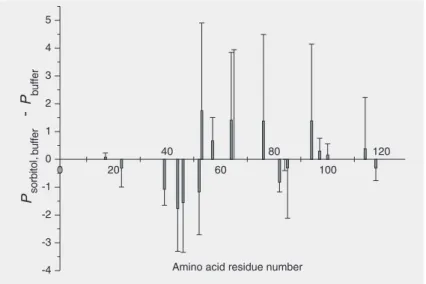
The exchange kinetics under heat-dena-turing conditions was also determined in the presence of 500 mM sorbitol (data not shown). The addition of sorbitol decreased
the quality of the 2-D spectra in the Cα
-amide region, so that not as many crosspeaks could be resolved as in the latter case, and the resulting data points were just fitted to one kinetic component after thermal equilib-rium was reached. Figure 3 shows a plot of
the difference ∆P of the P-factors in the
presence and absence of 500 mM sorbitol versus the sequence of the protein. Within the resolution of the experiment one can say that addition of sorbitol has little, if any,
effect on the resulting P-factors, as can be
seen from the minor changes in P-values.
Cold denaturation of HEWL
Figure 4 shows the P-factors of the
pres-sure-assisted cold-denatured state of HEWL at -13ºC and 3.75 kbar. The values obtained
0 2 4 6 8 10 12 14 16 18 0.0
0.2 0.4 0.6 0.8 1.0 1.2 1.4
C64 (S-S) N44 ( )
L84 (310)
R114 ( )
Time (s)
Relative intensity
Figure 1. Cross-peak intensities of the amino acid residues C64, N44, L84, and R114 of hen egg white lysozyme as a function of time under heat-denaturing conditions (10% lysozyme, 20 mM citrate buffer, pD 3.4, at 80ºC). Residue C64 contains a disulfide bridge (S-S). N44 is part of a ß-sheet (ß), L84 and R114 are in helical regions of the protein (a 310 and an α-helix, respectively). The exchange-behavior can be separated into three phases: an equilibration phase where the system reaches thermal equilib-rium, a slow, transient exchange phase and a final, fast exchange phase.
0 20 40 60 80 100 120
0 2 4 6 8 10 12 14 16 18 20
loop loop
S-S
310 310
loop C D
B A
P
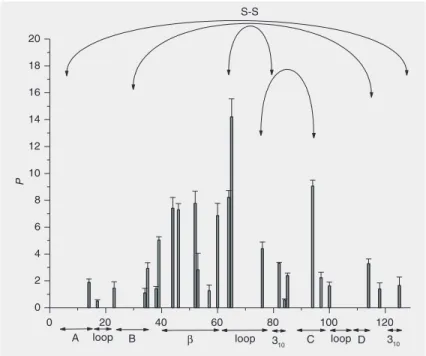
under these conditions were several times higher than those obtained under heat-in-duced unfolding conditions, demonstrating that this kind of denaturation is less harsh than the one induced by heat. Residues at or in the vicinity of disulfide bridges (C64, C94, C115) showed the highest protection factors, while the highest values of other residues were around 20 for both helical and ß-sheet regions. Thus, one can conclude that cross-linked cysteines are a very important factor of structural rigidity under these con-ditions; helices and ß-sheets do not show
great differences with respect to highest P
-factors.
Upon addition of 500 mM sorbitol, the P
-factors increased (Figure 5). The presence of sorbitol decreased the quality of the spectra as it was the case for heat-induced denatur-ation, but due to the much slower exchange rate under the cold-denaturing conditions, the loss of kinetic data was not that severe.
Sorbitol led to a general increase of P
-fac-tors, with high ∆P-values for residues with
high P-factors and low ∆P-values for
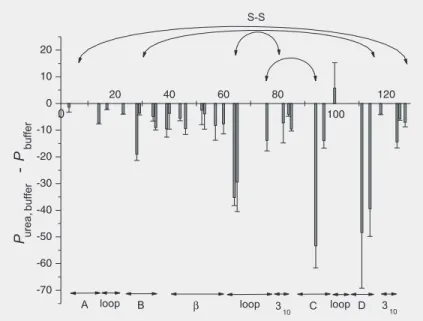
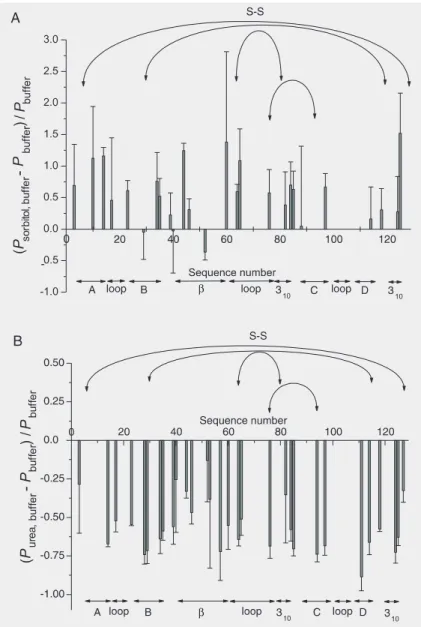
resi-dues with low ones. The same tendency, but with the opposite sign, was observed in the presence of 2 M urea (Figure 6). Sorbitol obviously raised the structural order and rigidity of the pressure-assisted cold-dena-tured state, while urea had the opposite ef-fect. Figure 7 exhibits the corresponding
relative changes of P-values. Interestingly,
both co-solvents seem to exert their influ-ence on the structure of the protein as a whole, i.e., no distinct regions within the protein exhibiting significantly diverse
changes of P-factors could be observed.
Discussion
Heat-induced denaturation
The comparison of the P-factors
deter-mined here for the heat-induced denatur-ation process with those reported by Buck et al. (11) shows that they are of the same
0 20 40 60 80 100 120
0 20 40 60 80 100
loop
loop 3
10
S-S
loop
β C D 310
B A
P
Figure 3.Difference in P-factors, ∆P = Psorbitol, buffer - Pbuffer, between heat-induced denatured state in the presence and absence of 500 mM sorbitol as a function of amino acid residue number. Within the accuracy of the experiment, the addition of 500 mM sorbitol led to no significant change of P-factors.
Figure 4. P-factors of the pressure-induced cold-denatured state of hen egg white lysozyme as a function of residue number (HEWL; 5% HEWL, 20 mM maleate buffer, pD 2.4, at -13ºC, and 3.75 kbar). Highest protection is found at or in the vicinity of the cross-linked cysteines C64, C94 and C115. On the average, the P-factors are about five times higher than those obtained under heat-denaturing conditions. For other explanations, see legend to Figure 2.
magnitude, but they differ on average by
about 40%. Especially the P-values for the
Figure 5. Differences in P-factors, ∆P = Psorbitol, buffer -Pbuffer, upon pressure-assisted cold denaturation of hen egg white lysozyme in the presence and absence of 500 mM sorbitol. Addition of sorbitol led to a drastic increase of P-factors. For other explana-tions, see legend to Figure 2.
Figure 6. Differences in P-factors, ∆P = Purea, buffer - Pbuffer, upon pressure-assisted cold denaturation of hen egg white lysozyme in the presence and absence of 2 M urea as a function of residue number. Upon addition of 2 M urea, the P-factors obtained decreased drastically. For other explanations, see legend to Figure 2.
in both studies highest protection was ob-served for the cysteine residues C64 and C94 (the C115-crosspeak could not be re-solved in our experiments) and all other values - except for the values in the ß-sheet mentioned above - were lower. The differ-ences between these two data sets may be due to several reasons: first, the heat dena-turation experiments cannot be carried out under ideal conditions. It takes some sec-onds until the sample reaches the tempera-ture of the water bath (apparent in Figure 1 as the first kinetic component), and it takes several seconds to cool the sample down again. The resulting error is difficult to as-sess because it depends on the exchange rate of the individual amide proton and the ex-change rate is a function of temperature.
Moreover, the P-factors reported by Buck et
al. (11) were determined at 69ºC and at pH 2.0, while the exchange rates in the present study were measured at 80ºC and pD 3.4, respectively. Although the influence of pH and temperature is taken into account by
calculating the P-factors, it is known that
HEWL is destabilized in a low pH, which
could explain the higher P-values in the
ß-sheet found by us. On the other hand, the temperature of 69ºC in the study by Buck et al. (11) was lower than the transition
temper-ature Tm of HEWL (~70.3ºC at pD 3.4),
which means that less than 50% of the mol-ecules are unfolded under these conditions, whereas at our chosen temperature of 80ºC all HEWL molecules are unfolded in equi-librium. This might also be the reason why we found two transitions, whereas Buck et al. (11) did not observe a second component. We note that this intermediate is not visible in the differential scanning calorimeter (DSC) scan (data not shown).
We are attributing the P-factors of the
slow kinetic component to a transient state. The following fast kinetic component can be attributed to the final, total unfolding of HEWL. In fact, it is well known that HEWL forms a kinetic intermediate upon heat dena-the residues N46 and D52, while dena-the values
found in the C-helix and in the 310-helix
turation, and an equilibrium intermediate has also been found in recent years. Van Stokkum et al. (14) found an intermediate state in their Fourier transform infrared spec-troscopy experiments and attributed this to a partially unfolded state with an intact sec-ondary structure, but collapsed or highly flexible tertiary structure. Hirai et al. (15) combined DSC and small angle X-ray scat-tering measurements and found that the spa-tial-conformational changes of the tertiary structure follow a two-state transition as vis-ible in DSC, while close-range intramolecu-lar changes occur earlier and follow a more complex transition. Our findings also indi-cate a transient state with residual structure (although we cannot judge from these ex-periments if it is an equilibrium one), which is followed by the more or less complete
unfolding of HEWL with P-factors around
or even lower than 1.
Our results show that sorbitol hardly af-fects the compactness and rigidity of the intermediate state between the native and denatured conformation. This finding con-firms that heat denaturation is mainly driven by the large positive configuration entropy term ∆Sconf, and that hydration effects play a
minor role in this unfolding scenario.
Pressure-assisted cold denaturation
The P-factors determined in the present
study for the cold-denatured state at -13ºC and 3.75 kbar qualitatively agree with those reported by Nash and Jonas (8), with high protection found at the cross-linked cysteine C64 and in the D-helix around C115, but the absolute values found in the current study were higher for most residues and in
particu-lar the P-factor determined for the
cross-linked cysteine C94 was of much higher value. This may partially be due to the fact that Nash and Jonas (8) used 1.5 mM
3-(trimethylsilyl)-propionic-2,2,3,3-d4 acid as
chemical shift reference. We did not use it as calibrating agent, because we observed that
chemicals like 3-(trimethylsilyl)-1-propane-sulfonic acid have a detergent-like behavior and thus might influence cold unfolding. The overall results, however, are in good agreement, showing that pressure-assisted cold denaturation is a mild form of unfold-ing, leaving residual structure to a large extent intact.
Our main aim was to study the influence of kosmotropic and chaotropic substances on the cold-denatured state. The models ex-plaining the phenomenon of cold denatur-ation point out the particular role of water in this unfolding scenario, but data at the mo-lecular level, which relate cold destabiliza-tion directly to hydradestabiliza-tion effects, are lack-ing. Co-solvents like sorbitol and urea exert their influence on protein stability essen-tially by the preferential hydration and bind-ing effect, respectively, and thus might al-low to draw conclusions on the role of hy-dration in the pressure-assisted cold-tured state. In contrast to heat-induced dena-turation, which is mainly driven by the large, positive ∆Sconf change, leading to a
disrup-tion of internal, non-covalent bonds, cold denaturation is driven by an increase in hy-dration of polar as well as hydrophobic resi-dues (3), which leads to a swelling of the protein and a concomitant (partial) disrup-tion of the native structure.
Our results show that the structure of the pressure-assisted cold-denatured state of HEWL, concerning regions of highest pro-tection, is comparable to the structure of the transient state of heat-induced unfolding. Both conformations exhibit highest protec-tion at or in the vicinity of the cross-linked cysteines C64 and C94. The pressure-as-sisted cold-denatured state also shows high protection in the vicinity of the cross-linked cysteine C115 in the D-helix. On an absolute
scale, the P-factors of the pressure-assisted
cold-denatured state are much higher than those of the partially heat-unfolded state,
showing that the structure of the latter is much more compact and might be described by a molten globule kind of structure.
The strong influence of the co-solvents on the P-factors underlines the role of hydra-tion effects in the cold unfolding scenario. Sorbitol exerts a stabilizing effect on the structure of the partially unfolded protein, leading to a higher compactness of the pro-tein under cold-denaturing conditions. As the internal non-covalent bonds are not dis-rupted to the same extent as in the case of heat denaturation, the stabilizing effect by preferential hydration by sorbitol leads to a less flexible structure. Urea has, as expected, the opposite effect: preferential binding of urea to the protein causes a more open, water accessible conformation. We find that, within the accuracy of the experiments, the co-solvents exert their influence on the protein structure cooperatively, meaning that stabi-lizing or destabistabi-lizing the hydration of amino acid residues seemingly does not lead to changes of distinct secondary or tertiary struc-ture elements, but to a gradual stabilization or destabilization of the whole, global struc-ture of HEWL. This argues for a lower over-all flexibility in the presence of sorbitol and a higher flexibility in the presence of urea. Hence, the conclusion that the correspond-ing pressure-assisted cold-denatured states are partially unfolded states does not imply that distinct regions of the protein are more or less unfolded, but rather that both co-solvents influence the structure of HEWL in the pressure-assisted cold-denatured state essentially uniformly and cooperatively.
References
1. Privalov PL (1990). Cold denaturation of proteins. Critical Reviews
in Biochemistry and Molecular Biology, 25: 281-305.
2. Privalov PL & Makhatadze GI (1993). Contribution of hydration to protein folding thermodynamics. Journal of Molecular Biology,232: 660-679.
3. Smeller L (2002). Pressure-temperature phase diagrams of biomol-ecules. Biochimica et Biophysica Acta, 1595: 11-29.
4. Caldarelli G & De Los Rios P (2001). Cold and warm denaturation of proteins. Journal of Biological Physics, 27: 229-241.
5. De Los Rios P & Caldarelli G (2001). Cold and warm swelling of hydrophobic polymers. Physical Review. E, Statistical, Nonlinear,
and Soft Matter Physics, 63: 031802.
Physi-cal Review Letters, 91: 138103.
7. Graziano G, Catanzano F, Riccio A et al. (1997). A reassessment of the molecular origin of cold denaturation. Journal of Biochemistry, 122: 395-401.
8. Nash DP & Jonas J (1997). Structure of pressure-assisted cold denatured lysozyme and comparison with lysozyme folding interme-diates. Biochemistry, 36: 14375-14383.
9. Timasheff SN (2002). Protein-solvent preferential interactions, pro-tein hydration, and the modulation of biochemical reactions by sol-vent components. Proceedings of the National Academy of
Sci-ences, USA, 99: 9721-9726.
10. Bai Y, Milne JS, Mayne L et al. (1993). Primary structure effects on peptide group hydrogen exchange. Proteins: Structure, Functions
and Genetics, 17: 75-86.
11. Buck M, Radford SE & Dobson CM (1994). Amide hydrogen
ex-change in a highly denatured state. Hen egg-white lysozyme in urea. Journal of Molecular Biology, 237: 247-254.
12. Bhattacharjya S & Balaram P (1997). Hexafluoroacetone hydrate as a structure modifier in proteins. Protein Science, 6: 1065-1073. 13. Englander SW & Kallenbach NR (1984). Hydrogen exchange and
structural dynamics of proteins and nucleic acids. Quarterly
Re-views of Biophysics, 16: 521-655.
14. Van Stokkum HM, Lindsell H, Hadden JM et al. (1995). Tempera-ture-induced changes in protein structures studied by Fourier trans-form infrared spectroscopy and global analysis. Biochemistry, 34: 10508-10518.
15. Hirai M, Arai S & Iwase H (1999). Complementary analysis of thermal transition multiplicity of hen egg-white lysozyme at low pH using X-ray scattering and scanning calorimetry. Journal of Physical