59 Gössling PAM et al. Spontaneous biloma: a case report
Radiol Bras. 2012 Jan/Fev;45(1):59–60
Spontaneous biloma: a case report and literature review
*
Bilioma espontâneo: relato de caso e revisão da literatura
Pedro Augusto Mânica Gössling1, Giordano Rafael Tronco Alves2, Régis Vinícius de Andrade Silva3, José Roberto Missel Corrêa3, Henrique Ferreira Marques2, Carlos Jesus Pereira Haygert4
Biloma is defined as any collection of bile outside the biliary tree, usually resulting from surgery complications and abdominal trauma. Spontaneous occurrence of bilomas is rare, occasionally associated with choledocolithiasis. The present report describes a case of spontaneous biloma, whose diagnosis was radiologically confirmed. At laparotomy, the presence of a retroperitoneal biloma was observed. Intraoperative cholangiography has not demonstrated the presence of fistula. After drainage, the patient progressed well and was discharged.
Keywords: Biloma; Choledocolithiasis; Retroperitoneum.
Bilioma é qualquer coleção de bile fora das vias biliares. Geralmente, resulta de complicações cirúrgicas e trauma abdominal. A ocorrência espontânea é rara, ocasionalmente associada a coledocolitíase. Relata-se um caso de bi-lioma espontâneo, cujo diagnóstico foi confirmado radiologicamente. À laparotomia, observou-se bibi-lioma retroperito-neal. A colangiografia transoperatória não evidenciou fístula. Após drenagem, o paciente teve boa evolução e alta hos-pitalar.
Unitermos: Bilioma; Coledocolitíase; Retroperitônio. Abstract
Resumo
* Study developed at Hospital Universitário de Santa Maria (HUSM), Santa Maria, RS, Brazil.
1. MD, Radiologist, Unit of Radiology, Hospital Universitário de Santa Maria (HUSM), Santa Maria, RS, Brazil.
2. Graduate Students of Medicine, Monitors for the Discipline of Radiology, Universidade Federal de Santa Maria (UFSM), Santa Maria, RS, Brazil.
3. MDs, Residents, Hospital Universitário de Santa Maria (HUSM), Santa Maria, RS, Brazil.
4. MD, Radiologist, Hospital Universitário de Santa Maria (HUSM), Assistant Professor, Universidade Federal de Santa Maria (UFSM), Santa Maria, RS, Brazil.
Mailing Address: Giordano Rafael Tronco Alves. Rua dos An-dradas, 1985, ap. 201, Centro. Santa Maria, RS, Brazil, 97010-033. E-mail: [email protected]
Received March 29, 2011. Accepted after revision August 3, 2011.
Gössling PAM, Alves GRT, Silva RVA, Corrêa JRM, Marques HF, Haygert CJP. Spontaneous biloma: a case report and literature review. Radiol Bras. 2012 Jan/Fev;45(1):59–60.
0100-3984 © Colégio Brasileiro de Radiologia e Diagnóstico por Imagem CASE REPORT
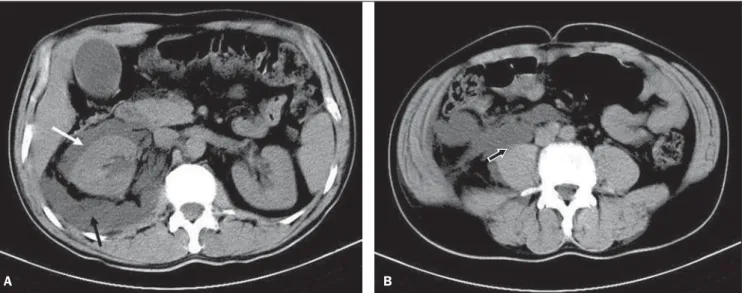
description of retroperitoneal collection with bile, dissecting from the posterior plane of the mesocolon to the pelvis (Fig-ure 1B). Intraoperative cholangiography detected the presence of calculi, but did not demonstrate any fistula. After removal of calculi and biloma drainage, the patient pro-gressed well and was discharged in 18 days.
DISCUSSION
Description and case reports about bilomas are not frequently found in the medical literature. In most of cases, bilo-mas involve the development of a bile col-lection outside the biliary tree after surgery complications or abdominal trauma(1,6,7).
With the advent of the laparoscopic tech-nique, the rate of occurrence of bilomas resulting from iatrogenic perforation in-creased from 0.1% to 0.3-1.5%(2).
Cases of spontaneous bilomas are even more rarely found. In such rare cases, bilomas are most commonly described ei-ther in children, as a result of congenital biliary malformations, or associated with choledocolythiasis in adult individuals(3,7),
as described in the present report(7).
Ac-cording to the authors’ review, this is the first report of spontaneous biloma in the Clinically, abdominal pain, distention,
peri-tonitis, jaundice and, in more severe cases, sepsis, may occur(1,2,5,6). The mean time
between symptoms onset and the diagno-sis is one to two weeks(2). Considering the
rarity of such condition, the authors de-scribe the present case and review this clinical entity.
CASE REPORT
A male, 55-year-old, previously healthy patient has presented right hypochondrium pain, besides acholia and biliuria for 15 days. At clinical examination, the patient was icteric (3+/4+) and afebrile. Labora-tory tests included: gamma-GT: 323 U/L, direct bilirubin levels: 7.08 mg/dl, and li-pase levels: 195 U/L. Microbiological study presented negative results. Ultrasonogra-phy (US) demonstrated biliary dilation, choledocolythiasis and a right renal collec-tion, which US-guided lumbar puncture revealed the presence of a thick, greenish material suggestive of bile. Computed to-mography (CT) confirmed thickening of bile duct walls, biliary dilation and perirenal and retroperitoneal collections at right (Fig-ure 1A). The patient was submitted to lap-arotomy, which confirmed the tomographic INTRODUCTION
Biloma is defined as a bile collection, either encapsulated or not, outside the bil-iary tree, with intra- or extrahepatic loca-tion, generally of iatrogenic nature or re-sulting from abdominal trauma(1,2). The
word “biloma” was first utilized by Gould & Patel, in 1979(3), but there are
descrip-tions of such an entity since the century XIX(4). Spontaneous rupture of the biliary
tree is rarely observed, sometimes being associated with choledocolythiasis(1,5). The
60
Gössling PAM et al. Spontaneous biloma: a case report
Radiol Bras. 2012 Jan/Fev;45(1):59–60
Brazilian literature. Less common causes for bilomas include hepatic infarction, ab-scess, neoplasia and extrapulmonary tuber-culosis(1,5).
There is no consensus on the mecha-nisms by which the bile reaches the retro-peritoneum(1–4). One hypothesis would be the perforation of the inferior two-thirds of the choledoch (retroperitoneal segment), while another hypothesis would be the re-sult from adhesion of the gallbladder to the posterior parietal peritoneum, with chronic inflammation and subsequent perfora-tion(2,4,5). In the authors’ opinion, the present case illustrates the second hypothesis.
Ultrasonography is generally the first imaging method that detects the presence of a biloma. However, CT demonstrates higher accuracy in determining the possible causes as well as the relationship between the collection and the adjacent structures(1,3). Differential diagnoses include cysts, seromas, pseudocysts, hematomas,
lym-phoceles and hepatic abscess(1,5,6). In the present case, the presence of icteric syn-drome and choledocolythiasis suggested the diagnosis of biloma. Radiologically guided percutaneous puncture, as per-formed in the present case with US, is use-ful for both the diagnosis and the treatment of bilomas(1–3,5,6). Biochemical and micro-biological studies allow the differentiation among infectious causes of other etiolo-gies(1,5,6).
The conservative treatment of bilomas includes intravenous hydration and antibi-otic therapy (particularly in cases of sep-sis)(1,2,5). In asymptomatic patients with small bile collections (< 4 cm), only follow-up is proposed, with no intervention(2). However, in most of cases, some therapeu-tic modality is required. For this purpose, percutaneous drainage has been proposed as a first option(1). If resolution is not achieved, retrograde endoscopic cholan-giopancreatography and sphincterectomy
may be performed, either with or without stent insertion(1–3,5,6).
REFERENCES
1. Bas G, Okan I, Sahin M, et al. Spontaneous biloma managed with endoscopic retrograde cholangio-pancreatography and percutaneous drainage: a case report. J Med Case Reports. 2011;5:3.
2. Kannan U, Parshad R, Regmi SK. An unusual pre-sentation of biloma five years following cholecys-tectomy: a case report. Cases J. 2009;2:8048. 3. Akhtar MA, Bandyopadhyay D, Montgomery HD,
et al. Spontaneous idiopathic subcapsular biloma. J Hepatobiliary Pancreat Surg. 2007;14:579–81.
4. Kaushik R, Attri AK. Choleretroperitoneum – an unusual complication of cholelithiasis. Indian J Surg. 2004;66:358–60.
5. Lee JH, Suh JI. A case of infected biloma due to spontaneous intrahepatic biliary rupture. Korean J Intern Med. 2007;22:220–4.
6. Trivedi PJ, Gupta P, Phillips-Hughes J, et al. Biloma: an unusual complication in a patient with pancreatic cancer. World J Gastroenterol. 2009;15: 5218–20.
7. YaÕar NF, YaÕar B, Kebapçi M. Spontaneous com-mon bile duct perforation due to chronic pancre-atitis, presenting as a huge cystic retroperitoneal mass: a case report. Cases J. 2009;2:6273. Figure 1. A: Computed tomography demonstrating the presence of isodense biliary dilation and collections in the perirenal (white arrow) and retroperitoneal (black arrow) spaces, both at right. B: Computed tomography demonstrating dissection of the retroperitoneal space, highlighting the pelvic extension in contact with the psoas muscle (arrow) at right.
A B