* Corresponding author.
E-mail address: [email protected] (A. Kącka) © 2017 Growing Science Ltd. All rights reserved. doi: 10.5267/j.ccl.2016.11.001
Current Chemistry Letters 6 (2017) 15–22
Contents lists available at GrowingScience
Current Chemistry Letters
homepage: www.GrowingScience.com
DFT study of the decomposition reactions of nitroethyl benzoates catalyzed by the
1,3-dimethylimidazolium cation
Agnieszka Kąckaa* and Radomir Jasińskia
aInstitute of Organic Chemistry and Technology, Cracow University of Technology, Warszawska Str. 24, 31-155 Cracow, Poland
C H R O N I C L E A B S T R A C T
Article history: Received August 21, 2016 Received in revised form October 24, 2016 Accepted 8 November 2016 Available online 9 November 2016
DFT calculations indicate that the decomposition reaction of nitroethyl benzoates in the presence of 1,3-dimethylimidazolium cation takes place much faster than in the case of the non-catalyzed process. Additionally, our calculations suggest one-step polar mechanism of title reactions.
© 2017 Growing Science Ltd. All rights reserved. Keywords:
Thermal elimination Quantum chemical study Nitroalkenes
1. Introduction
The synthesis of nitroalkenes is very significant in organic chemistry. Conjugated nitroalkenes (CNA) have been recognized as versatile synthetic intermediates in various organic syntheses because
of their easy conversion to a variety of diverse functionalities.1-5 They react as dienophiles,
heterodienes, 1,3-dipoles and, above all, as Michael acceptors.6-8 Conjugated nitroalkenes are also
distinguished by their biological properties.9-11 Among various biological properties, the anticancer
activity of nitroalkenes and their novel MBH adducts with other activated alkenes has highlighted the
enormous potential of nitroalkene derivatives as bioactive molecules.12-14 Furthermore, nitroalkenes are
important precursors of many insecticides,15 fungicides16 and pharmaceuticals.13
Several methods are available for the preparation of nitroalkenes.1,17-20 However, a great demand
still exists for a method to prepare nitroolefins in a convenient and effective way. The present work is
a continuation of our comprehensive study about the synthesis and fundamental properties of CNA.
21-28 Our previous works27,28 present the decomposition of nitroalkyl carboxylates under thermal
16
This work is a continuation of our quantum chemical study of the decomposition reaction of nitroethyl benzoates in the presence of the 1,3-dimethylimidazolium (DMIM) cation. It should be mentioned, that our recent studies show that some nitroalkene cycloaddition reactions catalyzed by the
imidazolium cation proceed via a stepwise, zwitterionic mechanism,29,30 instead of the one step
mechanism, which was noted in the case of non-catalytic conditions. This cation can be introduced for
reaction as an ionic liquid. Such ionic liquid was used in organic reactions.31-34
2. Results and Discussion
2.1 Computational details
All calculations were carried out using the Prometheus computer cluster in the CYFRONET regional computer centre in Cracow. The mechanism of the decomposition of nitroalkyl benzoates catalyzed by the 1,3-dimethylimidazolium cation have been examined as implemented in the
GAUSSIAN 09 package.35 The geometric parameters for all the reactants, transition states and products
of the reactions studied were fully optimized using the density functional theory (DFT) method. The
calculations were performed using the B3LYP36 with 6-31G(d) basic set. Additionally, calculations in
more advanced 6-31+G(d) and 6-31G(d,p) basis sets, were carry out.
B3LYP is a combination of Becke’s three parameter hybrid exchange functional37 with the Lee,
Yang and Parr correlated functional.38 Geometry optimization calculations have been carried out to
obtain the global minima for the reactant and products, and to locate the saddle point for the transition state. Stationary points were characterised by frequency calculations. All reactants, and products had positive Hessian matrices. All transition states showed only one negative eigenvalue in their diagonalized Hessian matrices, and their associated eigenvectors were confirmed to correspond to the motion along the reaction coordinate under consideration. Transition states were located using the (QST2) algorithm. For the optimization process, the Berny analytical gradient was employed. Intrinsic
reaction coordinate (IRC) calculations39 have been made in all events to verify that the localized
transition state structures connect with the corresponding minimum stationary points associated with
reactants and products. The reaction environment polarity was simulated using PCM.40 It was assumed
that the reaction environment has dielectric constant, = 13, for the reaction catalyzed by the 1,3-dimethylimidazolium cation (the most typical 1,3-1,3-dimethylimidazolium ionic liquids have =~11,6-15,141).
Charge global electron density transfer (GEDT)42 was calculated according to the formula:
GEDT=-ΣqA, (1)
where qA is the net charge and the sum is taken over all the atoms of the substructure.
The values of enthalpies, entropies and free energies in all calculations were calculated with the
standard statistical thermodynamics at 25ºC and 1 atm.43
2.2 Energetical aspects of the decomposition reaction catalyzed by the DMIM cation
The reaction pathway of the decomposition reaction was studied using the B3LYP/6-31G(d)
theoretical level. Recently published reports26,44-48, indicate that a similar approach was used
successfully for the exploration of a reaction involving several different nitrocompounds. These
calculations proved that the first step of the decomposition of nitroethyl benzoate (1a) is the
establishment of a pre-reaction complex ([1][DMIM]) between the ester molecule and the
1,3-dimethylimidazolium cation. Consequently, the creation of a pre-reaction complex entails the drop of
reaction enthalpy by 3.54 kcal·mol-1 (Fig. 1 and Fig. 2). The DMIM cation is located near to the oxygen
A. Kącka and R. Jasiński / Current Chemistry Letters 6 (2017)
Thereafter, the pre-reaction complex is recast to TS, which is associated with an increase in the
enthalpy of activation over 33.31 kcal·mol-1 (Fig. 2). The decomposition reaction of nitroethyl benzoate
1a catalyzed by the DMIM cation proceeded faster than the same reaction without the catalyst. The
enthalpy of the activation of the uncatalyzed process is equal to 38.73 kcal·mol-1.28 Subsequently, the
TS is converted to products 2 and 3 (Scheme 1).
Similar studies have been performed for the decomposition reactions of other nitroethyl benzoates
which are substituted by NMe2 (1b) and NO2 (1c) functional groups. The decomposition process of
substituted ester with the electrodonationg group (NMe2) will lower the activation barrier. In particular,
for the decomposition of compound 1b, the activation barrier is 30.61 kcal·mol-1. The decomposition
process of the 1c compound with an NO2 group has an activation barrier of 35.13 kcal·mol-1. Therefore,
as could be expected, the presence of an electroaccepting group will make the process more difficult (Table 1). For comparison, the uncatalyzed process give similar results (NMe2 – 37.52 kcal·mol-1 ,
NO2 – 39.65 kcal·mol-1).28 It turned out that, regardless of the nature of the substituent in the benzene
ring, the decomposition process always followed the same mechanism (Scheme 1).
We have also performed similar a DFT study using more advanced B3LYP/6-31+G(d) and B3LYP/6-31G(d,p) theory levels. These calculations show that the mechanism of the decomposition reaction of nitroalkyl carboxylates also indicate one-step mechanism and makes that process proceed
more mildly. The value of the enthalpy of activation for compound 1a are 30.07 kcal·mol-1 and 30.47
kcal·mol-1, respectively (Table 1).
Table 1. Kinetic and thermodynamic parameters for the decomposition of nitroethyl benzoates
catalyzed by 1,3-dimethylimidazolium cation (T=298 K; ∆H, ∆G in kcal·mol-1, ∆S in cal·mol-1·K-1;
1a - R=H, 1b - R=NMe2, 1c - R=NO2)
Ester Theoretical level Transition ΔH ΔG ΔS
1a
6-31G(d)
1a+DMIM→[1a][DMIM] -3.54 3.99 -25.24
[1a][DMIM]→TS 33.31 34.31 -2.86
[1a][DMIM]→[2][DMIM]+3a 3.54 -3.99 26.00
6-31+G(d)
1a+DMIM→[1a][DMIM] -0.47 6.43 -23.14
[1a][DMIM]→TS 30.07 32.20 -3.02
[1a][DMIM]→[2][DMIM]+3a -20.54 -28.29 26.00
6-31G(d,p)
1a+DMIM→[1a][DMIM] -4.22 4.88 -30.51
[1a][DMIM]→TS 30.47 31.98 -5.09
[1a][DMIM]→[2][DMIM]+3a 4.22 -4.88 30.51
1b
6-31G(d)
1b+DMIM→[1b][DMIM] -3.74 3.54 -24.44
[1b][DMIM]→TS 30.61 31.23 -2.06
[1b][DMIM]→[2][DMIM]+3b 14.94 1.05 46.59
6-31+G(d)
1b+DMIM→[1b][DMIM] -0.66 6.09 -22.64
[1b][DMIM]→TS 29.38 30.98 -5.36
[1b][DMIM]→[2][DMIM]+3b 11.14 -1.97 43.97
6-31G(d,p)
1b+DMIM→[1b][DMIM] -3.86 3.28 -23.95
[1b][DMIM]→TS 27.78 28.60 -2.76
[1b][DMIM]→[2][DMIM]+3b 11.61 -1.33 45.51
1c
6-31G(d)
1c+DMIM→[1c][DMIM] -3.24 3.66 -23.15
[1c][DMIM]→TS 35.13 36.56 -4.80
[1c][DMIM]→[2][DMIM]+3c 14.09 1.11 43.56
6-31+G(d)
1c+DMIM→[1c][DMIM] 12.30 7.29 -25.28
[1c][DMIM]→TS 31.80 35.61 -4.24
[1c][DMIM]→[2][DMIM]+3c -1.80 -2.60 43.65
6-31G(d,p)
1c+DMIM→[1c][DMIM] -3.32 3.4 -22.52
[1c][DMIM]→TS 34.28 34.28 -6.67
18
Fig. 1. Gibbs free energy profiles for the
decomposition of nitroethyl benzoate 1a
catalyzed by the 1,3-dimethylimidazolium cation
Fig. 2. Enthalpy profiles for the decomposition of nitroethyl benzoate 1a
catalyzed by the 1,3-dimethylimidazolium cation
1
O O
R
N+
O O
-O O
R
N+
O O
-N+
O O
-HO O
R
2
3
[1][DMIM]
N+
N
H3C CH3
[DMIM]:
TS [DMIM]
[DMIM]
[DMIM]
Scheme 1. Mechanism of the decomposition reaction of nitroethyl benzoates catalyzed by the 1,3-dimethylimidazolium cation
2.3 Transition structure of the decomposition reaction
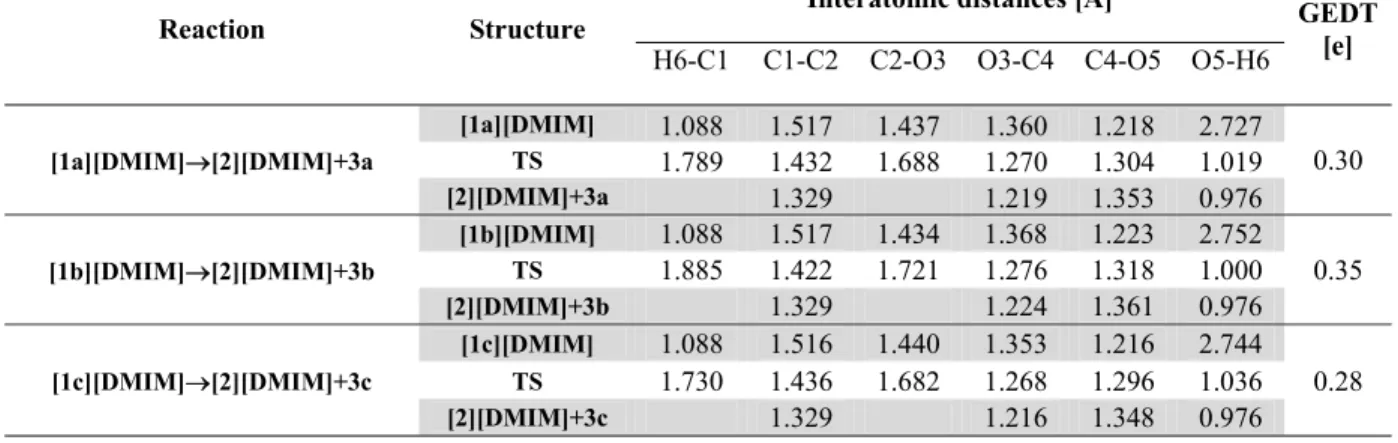
The TS, also in the decomposition reaction catalyzed by the 1,3-dimethylimidazolium cation, has
a six-membered structure (Fig. 3). Simultaneously, new bonds are formed: between atoms O5-H6 and
between atoms C1-C2 and O3-C4 double bonds. The C4-O5 bond is change to a single bond, and
A. Kącka and R. Jasiński / Current Chemistry Letters 6 (2017)
Fig. 3. Transition state TS structure for thedecomposition of nitroethyl benzoates 1a catalyzed by the DMIM cation
Table 2. Key parameters for structures of the decomposition of nitroethyl benzoates catalyzed by the
DMIM cation according to B3LYP/6-31G(d) data (1a - R=H, 1b - R=NMe2, 1c - R=NO2)
Reaction Structure
Interatomic distances [Ǻ] GEDT
[e] H6-C1 C1-C2 C2-O3 O3-C4 C4-O5 O5-H6
[1a][DMIM][2][DMIM]+3a
[1a][DMIM] 1.088 1.517 1.437 1.360 1.218 2.727
TS 1.789 1.432 1.688 1.270 1.304 1.019 0.30
[2][DMIM]+3a 1.329 1.219 1.353 0.976
[1b][DMIM][2][DMIM]+3b
[1b][DMIM] 1.088 1.517 1.434 1.368 1.223 2.752
TS 1.885 1.422 1.721 1.276 1.318 1.000 0.35
[2][DMIM]+3b 1.329 1.224 1.361 0.976
[1c][DMIM][2][DMIM]+3c
[1c][DMIM] 1.088 1.516 1.440 1.353 1.216 2.744
TS 1.730 1.436 1.682 1.268 1.296 1.036 0.28
[2][DMIM]+3c 1.329 1.216 1.348 0.976
Finally, we analysed the influence of the DMIM cation of structure TS. It was found that the H6-C1 bond in the reaction catalyzed by the DMIM cation is broken faster than in the uncatalyzed process. In turn, the C2-O3 bond of the TS of reaction with the ionic liquid cation is broken more slowly than
in the case of the uncatalyzed reaction.28 The nature of the substituent in benzene ring also has an
impact on the transition structure. In the case of reaction [1b][DMIM][2][DMIM]+3b, the H6-C1
and C2-O3 bonds are broken faster than the same bonds in reaction [1a][DMIM][2][DMIM]+3a.
By contrast, the H6-C1 and C2-O3 bonds in the case of reaction [1c][DMIM][2][DMIM]+3c are
broken more slowly than in the case of reaction [1a][DMIM][2][DMIM]+3a (Table 2).
The GEDT value for the transition state for the decomposition reaction catalyzed by the 1,3-dimethylimidazolium cation is 0.30. This value is bigger than the same GEDT value for the transition states of similar non-catalytic processes.
3. Conclusions
20
Acknowledgements
This research was supported in part by PL-Grid Infrastructure and financial support from the Polish State Committee (Grant no. C-2/88/2016/DS) are gratefully acknowledged.
References
1 Corey E. J., and Estreicher H. (1978) A new synthesis of conjugated nitro cyclo olefins, unusually
versatile synthetic intermediates. J. Am. Chem. Soc., 100 (19) 6294-6295.
2 Varma R. S., and Kabalka G. W. (1986) Nitroalkenes in the synthesis of heterocyclic compounds.
Heterocycles, 24 (9) 2645-2677.
3 Barrett A. G. M. (1991) Heterosubstituted nitroalkenes in synthesis. Chem. Soc. Rev., 20 (1) 95-127.
4 Tso H. H., Gilbert B. A., and Hwu J. R. (1993) Novel double functional group transformation:
‘one-flask’ conversion of 1-nitrocycloalkenes to terminally unsaturated nitriles. J. Chem. Soc., Chem.
Commun., 18 669-670.
5 Perekalin V. V. (1994) Nitroalkenes: conjugated nitro compounds, Wiley, New York.
6 Berner O. M., Tedeschi L., and Enders D. (2002) Asymmetric Michael additions to nitroalkenes.
Eur. J. Org. Chem., 2002 (12) 1877-1894.
7 Kranse N., and Hoffmann-Röder A. (2001) Recent advances in catalytic enantioselective Michael
additions. Synthesis, 2001 (2) 171-196.
8 Tietze L. F., and Kettschau G. (1997) Hetero Diels-Alder reactions in organic synthesis, in: Metz P.
(Eds) Stereoselective Heterocyclic Synthesis I. Springer Berlin Heidelberg, Berlin, 1-120.
9 Kabalka G. W., and Varma R. S. (1987) Syntheses and selected reductions of conjugated
nitroalkenes – a review. Org. Prep. Proc. Int., 19 (4-5) 283-328.
10 Blades K., Butt A. H., Cockerill G. S., Easterfield H. J., Lequeux T. P., and Percy J. M. (1997)
Phosphorus(III) ligands with fluorous ponytails. J. Chem. Soc., Perkin Trans. 1, 1997 (24)
3609-3612.
11 Hoashi Y., Yabuta T., and Takemoto Y. (2004) Bifunctional thiourea—catalyzed enantioselective
double Michael reaction of , -unsaturated -ketoester to nitroalkene: asymmetric synthesis of
(-)-epibatidine. Tetrahedron Lett., 45 (50) 9185-9188.
12 Latif N., Asaad F. M., and Hosni H. (1986) N-Unsubstituted (carbamoyloxy)nitrostyrenes: a new
series of aryl- -nitroalkenes with fungicidal properties. Liebigs Ann. Chem., 1987 (6) 495-498.
13 Zee-Cheng K.-Y., and Cheng C.-C. (1969) Experimental tumor inhibitors. Antitumor activity of
esters of -aryl- -nitro- -alken-1-ol and related compounds. J. Med. Chem., 12 (1) 157-161.
14 Dadwal M., Mohan R., Panda D., Mobin S. M., and Namboothiri I. N. N. (2006) The
Morita-Baylis-Hilman adducts of -aryl nitroethylenes with other activated alkenes: synthesis and anticancer
activity studies. Chem. Commun., 2006 (3) 338-340.
15 Brian P. W., Jamieson M., and McGowan J. C. (1948) Toxicity of Sulphydryl Compounds to Seeds.
Nature, 162 (13) 780.
16 Bocobo F. C., Curtis A.C., Block W. D., Harrell E. R., Evans E. E., and Haines R. F. (1956)
Evaluation of nitrostyrenes as antifungal agents. I. In vitro studies. Antibiot. Chemother., 6 (6)
385-390.
17 Hwu J. R., Chen K.-L., and Ananthan S. J. (1994) A new method for nitration of alkenes to α,
-unsaturated nitroalkenes. J. Chem. Soc., Chem. Commun., 12 1425-1426.
18 Kunai A., Yanagi Y., and Sasaki K. (1983) A convenient preparation of conjugated nitro olefins by
electrochemical method. Tetrahedron Lett., 24 (41) 4443-4444.
19 Sy W. W., and By A. W. (1985) Nitration of substituted styrenes aith nitryl iodide. Tetrahedron
Lett., 26 (9) 1193-1196.
20 Jew S. S., Kim H. D., Cho Y. S., Cook C. H. (1986) A practical preparations of conjugated
A. Kącka and R. Jasiński / Current Chemistry Letters 6 (2017)
21 Jasiński R., Ziółkowska M., Demchuk O. M., and Maziarka A. (2014) Regio- and stereoselectivity
of polar [2+3] cycloaddition reactions between (Z)-C-(3,4,5-trimethoxyphenyl)-N-methylnitrone
and selected (E)-2-sybstituted nitroethenes. Central. Eur. J. Chem., 12 (5) 586-593.
22 Jasiński R. (2015) A stepwise, zwitterionic mechanism for the 1,3-dipolar cycloaddition between
(Z)-C-4-methoxyphenyl-N-phenylnitrone and gem-chloronitroethene catalysed by
1-butyl-3-methylimidazolium ionic liquid cations. Tetrahedron Lett., 56 (3) 532-535.
23 Jasiński R. (2014) Searching for zwitterionic intermediates in Hetero Diels-Alder reactions between
methyl a,p-dinitrocinnamate and vinyl-alkyl ethers. Comput. Theor. Chem., 1046 (15) 93-98.
24 Jasiński R. (2009) Regio- and stereoselectivity of [2+3]cycloaddition of nitroethene to (Z)-
N-aryl-C-phenylnitrones. Coll. Czech. Chem. Commun., 74 (9) 1341-1349.
25 Jasiński R. (2015) Nitroacetylene as dipolarophile in [2 + 3] cycloaddition reactions with
allenyl-type three-atom components: DFT computational study. Monatsh. Chem., 146 (4) 591–599.
26 Jasiński R. (2014) Molecular mechanism of thermal decomposition of fluoronitroazoxy compounds:
DFT computational study. J. Fluor. Chem., 160 29-33.
27 Jasiński R., and Kącka A. (2015) A polar nature of benzoic acids extrusion from nitroalkyl
benzoates: DFT mechanistic study. J. Mol. Mod., 21 (3) 59-65.
28 Kącka A., and Jasiński R. (2016) A density functional theory mechanistic study of thermal
decomposition reactions of nitroethyl carboxylates: undermine of “pericyclic” insight. Heteroatom
Chem., 27 (5) 279-289.
29 Jasiński R. (2016) First example of stepwise, zwitterionic mechanism for bicycle[2.2.1]hept-5-ene
(norbornene) formation process catalyzed by the 1-butyl-3-methylimidazolium cations. Monatsh.
Chem., 147 (7) 1207-1213.
30 Jasiński R. (2015) A stepwise, zwitterionic mechanism for the 1,3-dipolar cycloaddition between
(Z)-C-4-methoxyphenyl-N-phenylnitrone and gem-chloronitroethene catalyzed by
1-butyl-3-methylimidazolium ionic liquid cations. Tetrahedron Lett., 56 (3) 532-535.
31 Feng D., Li L., Yang F., Tan W., Zhao G., Zou H., Xian M., and Zhang Y. (2011) Separation of
ionic liquid [Mmim][DMP] and glucose from enzymatic hydrolysis mixture of cellulose using
alumina column chromatography. Appl. Microbiol. Biotechnol., 91 (2) 399-405.
32 Park S., and Kazlauskas R. J. (2003) Biocatalysis in ionic liquids - advantages beyond green
technology. Curr. Opin. Biotechnol., 14 (4) 432-437.
33 Dommert F., and Holm Ch. (2013) Refining classical force fields for ionic liquids: theory and
application to [MMIM][Cl]. Phys. Chem. Chem. Phys., 15 (6) 2037-2049.
34 Kragl U., Eckstein M., and Kaftzik N. (2002) Enzyme catalysis in ionic liquids. Curr. Opin.
Biotechnol., 13 (6) 565-571.
35 Frisch M. J., Trucks G. W., Schlegel H. B., Scuseria G. E., Robb M. A., Cheeseman J. R., Montgomery J. A., Vreven T. J., Kudin K. N., Burant J. C., Millam J. M., Iyengar S. S., Tomasi J., Barone V., Mennucci B., Cossi M., Scalmani G., Rega N., Petersson G. A., Nakatsuji H., Hada M., Ehara M., Toyota K., Fukuda R., Hasegawa J., Ishida M., Nakajima Y., Honda O., Kitao O., Nakai H., Klene M., Li X., Knox J. E., Hratchian H. P., Cross J. B., Adamo C., Jaramillo J., Gomperts R., Stratmann R. E., Yazyev O., Austin A. J., Cammi R., Pomelli C., Ochterski J. W., Ayala P. Y., Morokuma K., Voth G. A., Salvador P., Dannenberg J. J., Zakrzewski V. G., Dapprich S., Daniels A. D., Strain M. C., Farkas M. C., Malick D. K., Rabuck A. D., Raghavachari K., Foresman J. B., Ortiz J. V., Cui Q., Baboul A. G., Clifford S., Cioslowski J., Stefanov B. B., Liu G., Liashenko A., Piskorz P., Komaromi I., Martin R. L., Fox D. J., Keith T., Al-Laham M. A., Peng C. Y., Nanayakkara A., Challacombe M., Gill P. M. W., Johnson B., Chen W., Wong M. W., Gonzalez C.,
and Pople J. A. (2009) Gaussian 09 rev A.1 Gaussian Inc. Wallingford CT.
36 Stephens P., Devlin F. J., Chabalowski C. F., and Frisch M. J. (1994) Ab Initio Calculation of
Vibrational Absorption and Circular Dichroism Spectra Using Density Functional Force Fields. J.
Phys. Chem., 98 (45) 11623-11627.
37 Becke A. D. (1993) Density‐functional thermochemistry. III. The role of exact exchange. J. Chem.
22
38 Lee C., Yang W., and Parr R. G. (1988) Development of the Colle-Salvetti correlation-energy
formula into a functional of the electron density. Phys. Rev. B, 37 (2) 785-789.
39 Fukui K. (1970) Formulation of the reaction coordinate. J. Phys. Chem., 74 (23) 4161-4163.
40 Cossi M., Rega N., Scalmani G., and Barone V. (2003) Energies, structures, and electronic
properties of molecules in solution with the C-PCM solvation model. J. Comp. Chem., 24 (6)
669-681.
41 Wasserscheid P., and Welton T. (2007) Ionic Liquid in Synthesis, 2nd Ed, Wiley-VCH Verlag
GmbH, Weinheim.
42 Domingo L. R. (2014) A new C–C bond formation model based on the quantum chemical topology
of electron density. RSC Adv., 4 (61) 32415-32428.
43 Berski S., Andres J., Silvi B., and Domingo L. R. (2003) The Joint Use of Catastrophe Theory and
Electron Localization Function to Characterize Molecular Mechanisms. A Density Functional Study
of the Diels−Alder Reaction between Ethylene and 1,3-Butadiene. J. Phys. Chem., 107 (31)
6014-6024.
44 Jasiński R. (2015) A new mechanistic insight on beta-lactam systems formation from
5-nitroisoxazolidines. RSC Adv., 5 (62) 50070-50072.
45 Szczepanek A., Jasińska E., Kącka A., and Jasiński R. (2015) An experimental and
quantumchemical study of [2+3] cycloaddition between
(Z)-C-(m,m,p-trimethoxyphenyl)-N-(p-methyphenyl)-nitrone and (E)-3,3,3-trichloro-1-nitroprop-1-ene: mechanistic aspects. Curr. Chem.
Lett., 4 (1) 33-44
46 Domingo L. R., Perez P., and Contreras R. (2004) Reactivity of the carbon–carbon double bond
towards nucleophilic additions. A DFT analysis. Tetrahedron, 60 (31) 6585-6591.
47 Domingo L. R., Arno M., and Andres J. (1999) Influence of reactant polarity on the course of the
inverse-electron-demand Diels−Alder reaction. A DFT study of regio- and stereoselectivity,
presence of Lewis Acid catalyst, and inclusion of solvent effects in the reaction between nitroethene
and substituted ethenes. J. Org. Chem., 64 (16) 5867-5875.
48 Domingo L. R., Jose Aurell M., Kneeteman M. N., and Mancini P. M. (2008) Mechanistic details
of the domino reaction of nitronaphthalenes with the electron-rich dienes. A DFT study. J. Mol.
Struct., 853 (1-3) 68-76.