M. Bujorianu and M. Fisher (Eds.):
Workshop on Formal Methods for Aerospace (FMA) EPTCS 20, 2010, pp. 76–79, doi:10.4204/EPTCS.20.8
c
M. Lazar
This work is licensed under the Creative Commons Attribution License.
Flexible Lyapunov Functions
and Applications to Fast Mechatronic Systems
Mircea Lazar
Dept. of Electrical Eng., Eindhoven Univ. of Technology, P.O. Box 513, 5600 MB Eindhoven, The Netherlands
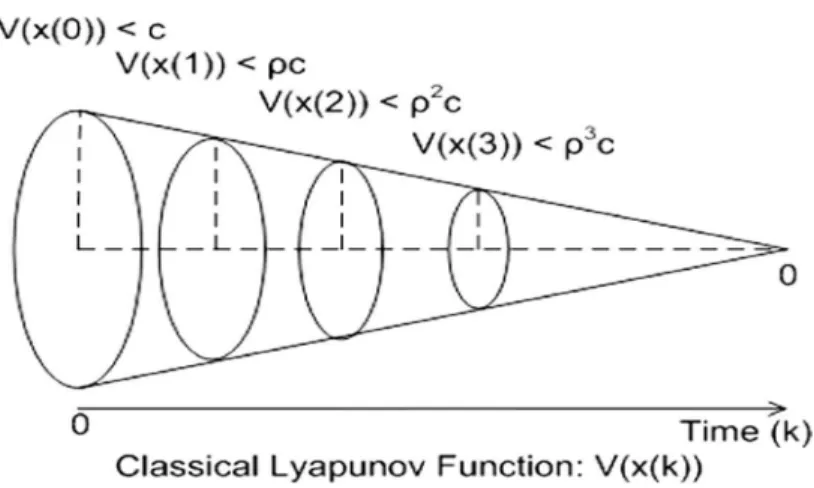
The property that every control system should posses is stability, which translates into safety in real-life applications. A central tool in systems theory for synthesizing control laws that achieve stability are control Lyapunov functions (CLFs). Classically, a CLF enforces that the resulting closed-loop state trajectory is contained within a cone with a fixed, predefined shape, and which is centered at and converges to a desired converging point. However, such a requirement often proves to be overcon-servative, which is why most of the real-time controllers do not have a stability guarantee. Recently, a novel idea that improves the design of CLFs in terms of flexibility was proposed. The focus of this new approach is on the design of optimization problems that allow certain parameters that define a cone associated with a standard CLF to be decision variables. In this way non-monotonicity of the CLF is explicitly linked with a decision variable that can be optimized on-line. Conservativeness is significantly reduced compared to classical CLFs, which makesflexible CLFsmore suitable for stabilization of constrained discrete-time nonlinear systems and real-time control. The purpose of this overview is to highlight the potential of flexible CLFs for real-time control of fast mechatronic systems, with sampling periods below one millisecond, which are widely employed in aerospace and automotive applications.
1
Introductory Overview
One of the interesting problems in nonlinear control systems is the synthesis of control laws that achieve stability [9, 17]. Control Lyapunov functions (CLFs) [2, 16] represent a powerful tool for providing a solution to this problem. The classical approach is based on theoff-linedesign of an explicit feedback law that renders the derivative of the CLF negative. An alternative to this approach is to construct an optimization problem to be solvedon-line, such that any of its feasible solutions renders the derivative of a candidate CLF negative. This method can be traced back to the early results presented in [14], followed by the more recent articles [13, 15], where synthesis of CLFs is performed in a receding horizon fashion. All the above works mainly deal with the continuous-time case, while conditions under which these results can be extended to sampled-data nonlinear systems using their approximate discrete-time models can be found in [5]. An important article on control Lyapunov functions for discrete-time systems is [8]. Therein, classical continuous-time results regarding existence of CLFs are reproduced for the discrete-time case. A significant relaxation in theoff-linedesign of CLFs for discrete-time systems was presented in [4], where parameter dependent quadratic CLFs are introduced. Also, interesting approaches to the off-line construction of Lyapunov functions for stability analysis were recently presented in [11], [7] and [1].
Despite the popularity of CLFs within systems theory there is still a significant gap in the application of CLFs in real-time control in general, and control of fast systems (i.e. systems with a very small sam-pling interval) in particular. The main reason for this is conservativeness of the sufficient conditions for
M. Lazar 77
Figure 1: A graphical illustration of classical CLFs (ρ∈[0,1),c∈R>0).
Figure 2: A graphical illustration of flexible CLFs (c∈R>0).
Lyapunov asymptotic stability which are employed by most off-line and on-line methods for constructing CLFs.
78 Flexible Lyapunov Functions
design is obviously conservative.
Motivated by such examples, recently, in [10], a methodology that reduces the conservatism of CLF design for discrete-time nonlinear systems was proposed. Rather than searching for a global CLF (i.e. on the whole admissible state-space), therein the focus was on relaxing CLF-type conditions for a predeter-mined local CLF through on-line optimization problems, as it is graphically illustrated in Figure 2. The goal of this overview is to highlight the potential of flexible CLFs for real-time control of fast mecha-tronic systems, with sampling periods below one millisecond, which are widely used in aerospace and automotive applications. This includes control of electro-magnetic actuators [6] and a real-time applica-tion to the control of DC-DC power converters.
Acknowledgements This research is supported by the Veni grant “Flexible Lyapunov Functions for Real-time Control”, grant number 10230, awarded by STW (Dutch Science Foundation) and NWO (The Netherlands Organization for Scientific Research).
References
[1] A. A. Ahmadi & P. A. Parrilo (2008): Non-monotonic Lyapunov functions for stability of discrete time non-linear and switched systems. In: 47th IEEE Conference on Decision and Control, Cancun, Mexico, pp. 614–621.
[2] Z. Artstein (1983):Stabilization with relaxed controls.Nonlinear Analysis7, pp. 1163–1173.
[3] M. S. Branicky, V. S. Borkar & S. K. Mitter (1998): A unified framework for hybrid control: model and optimal control theory.IEEE Transactions on Automatic Control43(1), pp. 31–45.
[4] J. Daafouz, P. Riedinger & C. Iung (2002): Stability analysis and control synthesis for switched systems: A switched Lyapunov function approach.IEEE Transactions on Automatic Control47, pp. 1883–1887. [5] L. Gr¨une & D. Nesi´c (2003): Optimization based stabilization of sampled-data nonlinear systems via their
approximate discrete-time models.SIAM Journal of Control and Optimization42(1), pp. 98–122.
[6] R. M. Hermans, M. Lazar, S. Di Cairano & I. V. Kolmanovsky (2009): Low complexity model predictive control of electromagnetic actuators with a stability guarantee. In: 28th American Control Conference, St. Louis, Missouri.
[7] H. Ito (2008): A degree of flexibility in Lyapunov inequalities for establishing input-to-state stability of interconnected systems.Automatica44(9), pp. 2340–2346.
[8] C. M. Kellett & A. R. Teel (2004):Discrete-time asymptotic controllability implies smooth control-Lyapunov function.Systems & Control Letters52, pp. 349–359.
[9] P. Kokotovi´c & M. Arcak (2001): Constructive nonlinear control: a historical perspective. Automatica
37(5), pp. 637–662.
[10] M. Lazar (2009):Flexible Control Lyapunov Functions. In: 28th American Control Conference, St. Louis, USA, pp. 102–107.
[11] M. Malisoff & F. Mazenc (2008): Construction of strict Lyapunov functions for discrete time and hybrid time-varying systems.Nonnlinear Analysis: Hybrid Systems2, pp. 394–407.
[12] F. Mazenc (1997): Stabilization of feedforward systems approximated by a non-linear chain of integrators.
Systems & Control Letters32, pp. 223–229.
[13] P. Mhaskar, N. H. El-Farra & P. D. Christofides (2006): Stabilization of nonlinear systems with state and control constraints using Lyapunov-based predictive control.Systems & Control Letters55, pp. 650–659. [14] E. Polak & D. Q. Mayne (1981):Design of nonlinear feedback controllers.IEEE Transactions on Automatic
M. Lazar 79
[15] J. A. Primbs, V. Nevisti´c & J. C. Doyle (2000): A receding horizon generalization of pointwise min-norm controllers.IEEE Transactions on Automatic Control45(5), pp. 898–909.
[16] E. D Sontag (1983):A Lyapunov-like characterization of asymptotic controllability.SIAM Journal of Control and Optimization21, pp. 462–471.