Original Article
CHEILOSCOPY: A SCIENTIFIC APPROACH FOR PERSONAL
IDENTI-FICATION
Qudusia Sultana *
1, M .H Shariff
2, M uhammed Asif
3, Ramakrishna Avadhani
4.
ABSTRACT
Address for Correspondence: Dr. Qudusia Sultana, Assistant Professor, Depart ment of Anat omy, Yenepoya M edical College, Deralakatte, M angalore 575018 Karnat ka, India.
E-M ail: [email protected]
Access this Article online
Quick Response code Web site:
* 1 Assistant Professor, Depart ment of Anat omy, Yenepoya M edical College, M angalore, Karnataka,
India.
2 Associate Professor, Depart ment of pat hology, Yenepoya M edical College, M angalore, Karnataka,
India.
3 Lect urer, Depart ment of Anat omy, Yenepoya M edical College, M angalore, Karnataka, India.
4 Professor and Head, Depart ment of Anat omy, Yenepoya M edical College, M angalore, Karnataka,
India.
Introduction: Cheiloscopy is derived from Greek w ord “ Cheilosw hich” m eaning lips.It is the st udy of charact eristic pat t ern of elevat ions and depressions on labial m ucosa. It is unique f or every individual like fingerpr int s and hence can be used t o det erm ine t he sex and for personal ident it y.
Aim : This st udy is undert aken t o evaluat e t he uniqueness of lip print s for sexual and personal ident ificat ion of an individual.
M at erials and M ethods:lipst icks, brush, cellophane t ape, bond paper and m agnifying lens. 50 m ale and 50 fem ale st udent s w ere select ed from Yenepoya Universit y. Lipst ick w as applied on t heir lips evenly and t he pr int s w ere taken on folded bond paper. The cellophane tape w as st uck on t he paper t o preserve it as perm anent records. The print s w ere analysed using m agnif ying lens and Tsuchihashi’s classificat ion of lip print s w as used for t o det er m ine t he m ost com m on pat t ern of lip pr int s found in m ales and fem ales and t o st udy any sim ilar it y of lip print s bet w een t w o individuals.
Observat ions and Results: Our st udy show ed in m ales t he predom inant pat t ern w as of t ype III pat t er n (40%), follow ed by t ype IV (22%), t ype I (18%), t ype I’ (12%) t ype II (6%) and t ype V(4%) respect ively. This hierarchy is dif ferent for fem ales, w here t ype I w as m ore predom inant (54%),next w as t ype I’ (28%), t ype III (10%), t ype IV (4%), t ype II (1%)and t ype V(2%) .Hence t hese result s confir m t he uniqueness of lip print s for ever y individual and show it s variat ion according t o gender.
Conclusion: The dat a obt ained from t he above st udy show s prom ising result s and indicat es t he uniqueness of lip print s like finger print s for every individual. They hold a possible pot ent ial t o det er m ine t he sex of an individual and hence can be used as recor ds f or personal ident if icat ion.
KEY W ORDS: Cheiloscopy, personal ident ificat ion, Tsuchihashi’s classif icat ion
Int ernat ional Journal of Anatomy and Research, Int J Anat Res 2014, Vol 2(4):668-72. ISSN 2321- 4287 DOI: 10.16965/ ijar.2014.520
Received: 24 Oct 2014
Peer Review : 24 Oct 2014 Published (O):30 Nov 2014 Accept ed: 10 Nov 2014 Published (P):31 Dec 2014
Internat ional Journal of Anat omy and Research ISSN 2321-4287
w w w.ijmhr.org/ ijar.ht m
INTRODUCTION
Lip p r i n t s o r Ch eil o sco p y i s t h e st u d y o f char act er ist i c p at t er n o f el evat i on s an d depressions on labial m ucosa called as sulci labiorum [1]. Fingerprint s since decades have been used as one of t he im por t ant t ool for personal ident ificat ion by forensic expert s. Since lip print s are unique like t he finger print s for an i nd i v id u al , it can al so b e used as a Supplement ary t ool t o verify t he presence or absence of a person at t he sit e of crime [2].
Lip print s can be ident ified as early as sixt h w eek of int raut erine life and remain same during t he life of an individual. Lip prints recover even aft er t rauma, inflammat ion and diseases like herpes and can be recognized w it hout difficult y [3]. Similarit y in t he lip print pat t erns in members of t he sam e f am ily ar e seen suppo r t ing t hat heredit ary fact ors also play a role in lip print s [4,5,6]. Hence lip patterns are unique, permanent and rarely change w it h age, resist ing m any t ribulat ions and t hus can act as a pot ent ial t ool in ident ificat ion process [2].
The present st udy w as carried out t o invest igat e and evaluat e t he uniqueness of lip print s, t heir r ole in per sonal ident if icat ion w it h help of part icular lip print pat t ern am ong diff erent gender.
Aims and objectives
The present st udy was undertaken t o evaluate t he uniqueness of lip pr int s for sexual and personal ident ificat ion of an individual.
M ATERIALS AND M ETHODS
Elle 18 lipst icks, brush, cellophane t ape, A4 size bond paper, pencil for labelling and magnifying lens (10 xs) w ere t he mat erials used.
50 male and 50 female st udent s aged bet w een 17-22 years w ere sel ect ed f rom Yenep oya Universit y. Written consent was taken from each st udent and clearance w as also t aken from college et hical commit t ee. St udent s allergic t o cosmet ics, w it h ulcers, t rauma or surgical scars t o lips w ere excluded from t he st udy. St udent s w i t h n or m al l i ps w it h o u t an y co ngen it al defor m it y w ere included in t his st udy. For recording t he lip print s, lipst ick w as gent ly and evenly applied on lips using a brush, st udent s
w ere asked t o gent ly rub t heir lips for equal spreading of lipst ick, impression was taken on folded bond paper and t hen cellophane t ape w as past ed on bond paper t o preserve it as a permanent record, it was subsequently analysed w it h help of magnifying lens. The print s w ere st udied and Tsuchihashi’s classificat ion of lip print s w as used for analysis using m agnifying lens t o det ermine t he most common pat t ern of lip print s found in males and females and st udy any sim i l ar i t y o f l i p p r i nt s bet w een t w o individuals.
For personal ident ificat ion,
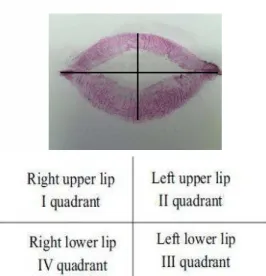
The lip print s w ere divided int o four quadrant s (fig 1) by a horizont al line t hat divides t he upper lip from low er lip and a median vert ical line t hat divides lips int o right and left halves; right upper as t he first quadrant , left upper as t he second quadrant , left low er as t he t hird quadrant , and right low er as t he fourt h quadrant . The lip print s w ere observed using magnifying lens and w ere cat egorised int o part icular type depending upon t he predom inant pat t ern. Then t he lip print pat t er ns w er e classif ied as per Suzuki and Tsuchihashi’s classificat ion [4]. (Figure 2) w hich st at es t hat
1. Type I: clear vert ical grooves t hat run across t he ent ire lips.
2. Type I’: similar t o t ype I but t hat do not run
across t he ent ire lip (incomplet e)
3. Type II: branched groove (branched y pattern).
4. Type III: intersected grooves.
5. Type IV: ret icular grooves.
6. Type V: undetermined.
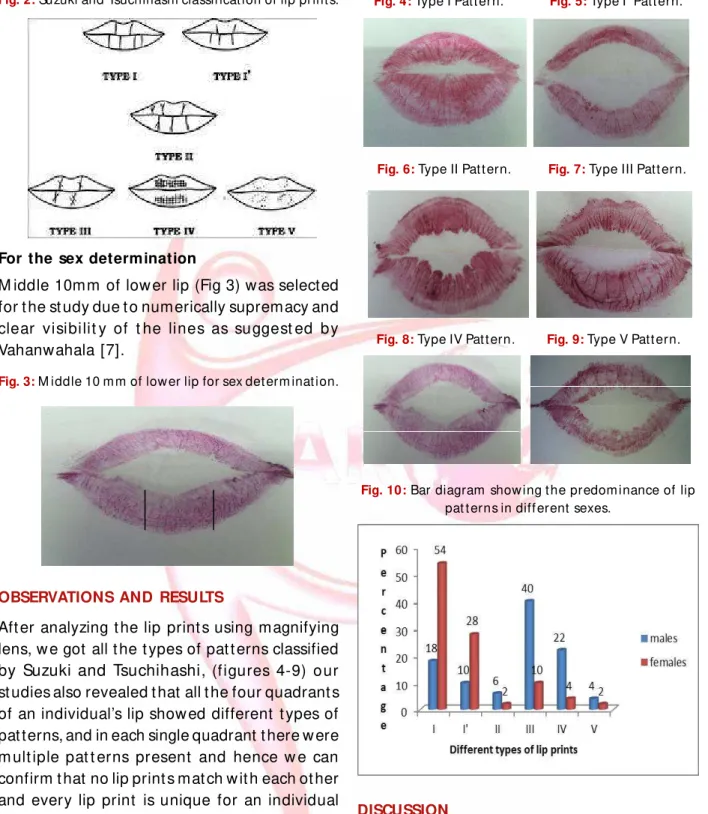
Fig. 2: Suzuki and Tsuchihashi classif icat ion of lip print s.
For the sex determination
M iddle 10mm of low er lip (Fig 3) was selected for t he st udy due t o numerically supremacy and clear visibilit y of t he lines as suggest ed by Vahanwahala [7].
Fig. 3: M iddle 10 m m of low er lip for sex det erm inat ion.
OBSERVATIONS AND RESULTS
Aft er analyzing t he lip print s using magnifying lens, w e got all t he t ypes of pat t erns classified by Suzuki and Tsuchihashi, (figures 4-9) our st udies also revealed t hat all t he four quadrant s of an individual’s lip show ed different t ypes of pat terns, and in each single quadrant t here w ere m ult iple pat t erns present and hence w e can confirm t hat no lip print s mat ch w it h each ot her and every lip print is unique for an individual and can help in personal ident ificat ion.
In our st udy for sex det erminat ion, (figure 10) males show t he predominance of type III patt ern (40%), follow ed by t ype IV (22%) and next is t ype I (18%), t ype I’ (12%) t ype II (6%) and t ype V (4%). This grading is different for females, w here t ype I is more predominant (54%) follow ed by t ype I’ (28%) and next is t ype III (10%), t ype IV (4%), type II (1%)and t ype V(2%). Thus the sexual ident ificat ion of a person involved in medical-legal case is r at h er easy due t o t h e clear differences bet w een t he sexes.
Fig. 4: Type I Patt ern. Fig. 5: Type I’ Patt ern.
Fig. 6: Type II Pat t ern. Fig. 7: Type III Patt ern.
Fig. 8: Type IV Pat t ern. Fig. 9: Type V Patt ern.
Fig. 10:Bar diagram show ing t he predom inance of lip pat t erns in diff erent sexes.
DISCUSSION
Presence of lip print s at crime scene can form basis for evidence regarding number of peoples involved, presence or absence of a suspect and sex of an individual [8]. If an exact descript ion of lip print s of an individual are est ablished and r eco r ded by d et ai led st u d y, t hen t h i s ant em or t em r ecor d can b e co m par ed f o r mat ching w it h t he det ails of lip print s obt ained f r o m po st m o r t em r eco r ds f or p er so nal ident ificat ion of an individual [9].
R.Fischer in 1902 [10].In 1932 Edmond Locard, French criminologist s made use of lip print s for personal ident ificat ion and criminalizat ion [11]. In 1950, Sy n d er i n h i s b o ok Hom i cid e Invest igat ion descrided t he individualit y of lip print s like finger print s [12]. Suzuki, in 1967,
st udied t he measurement of t he lips, t he use and colour of rouge, and t he m et hod for it s extract ion from t he crime scene to obt ain useful dat a for pract ical forensic applicat ion [13]. In 1970, Suzuki and Tsuchihashi t w o Japanese, st udied and classified lip print s int o five t ypes and st at ed t hat t he arrangement of furrow s on t he red part of human lips of each individual is u n iq u e an d i t is p ossi bl e t o u se t hese arrangement for t he ident ificat ion of a person. Tsuchihashi’s classificat ion for different t ypes of lip print is t he most st andard.
Keeping this
classificat ion as t he basis, t he current st udy w as conduct ed t o st udy t he lip print s of different individuals t o est ablish t heir personal ident it y [4]. M c Donell in 1972 report ed t hat it w as difficult t o dist inguish t w o ident ical t w ins by every ot her means but possible by t heir lip print s [11]. In 1990, Kasprzak conduct ed a research for period of five years on 1500 persons t o explain in det ail t he pract ical use of Cheiloscopy [10]. Vahanw ala in 2000 conduct ed a st udy of lip patterns t o uphold the importance of cheiloscopy in forensic science for personal ident ificat ion and stated t hat Type I and I’ are more common in females and t ype III and IV are more common in m ales. Sim ilar findings has been found in Present st udy and st udies done by many authors [7,14,15,16,17,18].Scope: St udies reveal t he possibilit y of obt ain-ing DNA from t he lat ent lip print s of an individual w hich can help t o det ect his genet ic profile. 8
CONCLUSION
Type I was predominant in females w hereas Type V w as t he rarest . M ales had highest frequency of Type IV w hile Type I’ was t he least common. Lip print s can be used as a reliable aid t o human ident ificat ion in t he field of forensic science.
The dat a obt ained from t he above st udy show s promising result s and indicat es t he uniqueness and per m anence of lip pr int s. They hold a conceivable pot ent ial t o det ermine t he sex of an individual. How ever, furt her st udies should be conduct ed on a large number of individuals of different races, family members, t w ins, and siblings in or der t o achieve m or e accurat e r esult s. Resear ch pr ogr ess in t his ar ea w ill cont ribut e not only t o it s direct use in personal ident ificat ion in forensic medicine but w ill also o p en u p a new f i el d t h at can co nt r i bu t e ext en si v ely t o cr im i n al i nv est i gat i o n an d ident ificat ion.
A major limit at ion of Cheiloscopy is t hat in very few circumst ances ant emortem data is available t o compare w it h post -mort em evidence w hich obviously impairs a comparative study. How ever, for living individuals, lip print s can be of t he ut most import ance, primarily due t o t heir abilit y t o dist inguish individuals.
Our st udy led t o t he follow ing conclusions: Lip print pat t erns show variat ion according t o t he gender.
Conflicts of Interests: None
REFERENCES
[1] . Suzuki K, Tsuchihashi Y. A new at t em pt of personal ident if icat ion by m eans of lip print . J Indian Dent Assoc 1970;42:8-9.
[2] . Kinra M , Ram alingam K, Set huram an S, Rehm an F, Lal aw at G, Pan d ey A. Ch ei l o sco p y f o r se x det erm ination: A st udy. Univ Res J Dent . 2014; 4:48-51.
[3] . August ine J, Barpande SR, Tupkar i JV. Chei loscopy as an adjunct t o forensic ident ificat ion: a st udy of 600 individuals. J For ensic Odont ost om at ol.2008; 27(2):44-52.52.
[4] . Suzuki K, Tsuchihashi Y. Personal ident ificat ion by m eans of lip print s. J Forensic M ed 1970;17: 52-57. [ 5] . Hir t h L, Göt t sche H, Goedde HW. Lip pr int s– Var i ab i l i t y an d ge n e t i cs. Hu m an ge n e t i k. 1975;30:47–62.
[6] . Venkat esh R ,David M P. Cheiloscopy: An aid for per sonal ident if icat ion.J Forensic Dent al Sci. 2011 Jul;3(2):67-70. doi: 10.4103/0975-1475.92147. [7] . Vahanw ahal SP, Parekh DK. St udy of lip print s as an
aid t o forensic m et hodology. J Indian Dent Assoc 2000;71:269-71.
[8] . Cast ello A, Alvarez M , Verdu F. Lum inous lip-print s as cr i m i n al ev i d en ce. Fo r e n si c Sci In t 200 5; 155:185-7.
[9] . Sarasw at hi T R, M ishra G, Ranganat han K. St udy of lip print s. J Forensic Dent Sci 2009;1:28-31. [10]. Kasprazak J. Possibi lit ies of chei loscopy. Forensic
Sci Int 1990;46:145-51.
[12]. Synder LM . Text book of Hom ocide invest igat ion. Ident ificat ion of dead bodies. 1950. p. 65. [13]. Suzuki K, Suzuki H, Tsuchihashi Y. On t he fem ale
lips and rouge. Jpn J Leg M ed 1967;67:471. [14]. Sharm a P, Saxena S, Rat hod V. Cheiloscopy: t he
st udy of lip print s in sex ident ificat ion. J Forensic Dent Sci2009;1:24–7.
[15]. Sivapat hasundharam B, Prakash PA, Sivakum ar G. Lip print s (cheiloscopy).Indian J Dent Res. 2001 Oct -Dec;12(4):234-7.
[16]. Costa, V. A. and Caldas, I. M . (2012), M orphologic Pat t erns of Lip Print s in a Port uguese Populat ion: A Prelim inary Analysis. Jour nal of Forensic Sciences,
57: 1318–1322.
[17]. Ar if M ,Chaudhry M K,M aqsood M . Cheiloscopy as an Aid To Personal Ident if icat ion and It s Variat ion According To Gender. J F J M C. 2013;2:26-30. [18]. Dongarw ar GR, Bhow at e RR, Degw ekar SS (2013)
Cheiloscopy-M et hod of Person Ident ificat ion and Sex Det e r m i n at i o n . 2: 6 1 2 d o i : 1 0. 4 1 72 / scient if icreport s.612.
How to cite this article: