Remarks on Noncommutative Field Theories
M. Gomes
Instituto de F´ısica, Universidade de S ˜ao Paulo, Caixa Postal 66318, 05315-970, S ˜ao Paulo, SP, Brazil
Received on 5 January, 2004
Some of the motivations and basic properties of noncommutative field models are presented. I also comment on recent developments in the understanding of these peculiar and intriguing theories.
A basic problem, which has accompanied the develop-ment of quantum field theory since its inception to our days, concerns the ultraviolet divergences of the perturbative cal-culations. Already in the thirties, it was suggested that a possible solution for this problem could come from a detai-led study of the short distance structure of the space-time. The introduction of a momentum space cutoff that would exclude the ultraviolet region from the calculations seemed inevitable, but the implementation of this mechanism was not and still is not an easy task. So it comes with no sur-prise that after the success of the renormalization program for quantum electrodynamics in the second half of the for-ties, this idea was practically abandoned. The renormali-zation program met a precise formulation in the works of BPHZ and BRST, in the late sixties and beginning of the seventies. It is fair to say that, with the exception of the gravitation, there is a satisfactory understanding of the basic interactions, at least as far as renormalization is concerned.
In the analysis of physical systems sometimes it is not convenient to use a more complete theory but instead an ef-fective model where irrelevant degrees of freedom are elimi-nated or, more technically, are summed over. An example of such practical attitude comes from the studies of the hydro-gen atom: to determine the energy levels it is not necessary to know that the proton is made of quarks; however to obtain the hyperfine structure of the levels, one should take into ac-count that the proton is a spin 1/2 fermion. Similarly, in the study of the low-energy weak decays of elementary parti-cles, the Fermi current-current model can be used instead of theSU(2)×U(1)electroweak theory.
It is a generalized idea that all useful theories are ef-fective models, some resulting from simplifications in more precise theories, whereas other originate from our incom-plete knowledge and perhaps should be obtained from more complete theories whose precise formulations are not yet known. Effective theories (for a recent review see [1]) are supposed to furnish good approximations for energies below to some typical energy scale. As the energy scale is incre-ased new effects are discovered, new stages of knowledge are reached and with luck the old theory is replaced by a new one that explains the new phenomena and so has a lar-ger validity range. We do not know how this process ends. However, even with our limited knowledge we may wonder what would happen at very high energies, if energies of the
same order as the Planck’s mass were attained. It has been heuristically argued [2] that at such energy scale all measu-rements of a particle position would loose any operational meaning, due to the formation of a strong gravitational field (a blackhole). Indeed, to measure a coordinate,x, let us say, with an accuracyaleads to an indeterminacy in thex com-ponent of the momentum of the order of1/a. An energy of the same order may then be transmitted to the system and the corresponding energy-momentum tensor generates a gravi-tational field which is a solution of the Einstein’s equation
Rµν− 1
2Rgµν = 8πTµν. (1)
The more precise the measurement of the coordinates the bigger the gravitational field coming from the referred measurement. Whenever this field is so strong as to prevent light or other signs to come out from the region under ob-servation, no operational meaning can be given to the idea of strict localization. In this case, the field interactions are not local and infinite renormalizations which are associated with strict locality would not appear. To investigate if such possibility is indeed realized we can postulate the following commutation relations among the coordinatesqµ
[qµ, qν] =iθµν, (2)
where for simplicity theθµν matrix is assumed to be
cons-tant. Functions of the coordinates no longer commute and therefore it is necessary to furnish rules prescribing as they should be multiplied. Each consistent set of rules defines a quantization scheme. In the Weyl quantization scheme a given classical functionf(x)of the commuting coordinates xiand the operatorfˆ(q)are related by
ˆ
f(q) =
Z dnk
(2π)nT(k) ˜f(k), (3)
wheref˜(k) =R dnxeikµxµf(x)is the Fourier transform of f(x)and the operatorT(k) = e−ik·qsatisfies
1. T†(k) =T(−k) (4)
A very simple example of the use of this ordering is the one associated with the product of two coordinates. In that case, we have
f(x) =x1x2 ⇒ fˆ(q) = 1
2(q1q2+q2q1), (6)
so that the Weyl prescription implies in the symmetrization of the quantum operators.
The inverse of (3) is most easily obtained after the in-troduction of the trace Tr, a cyclic operation which maps products of operators in classical functions. We choose it to be normalized such that
Tr[T(k)] = (2π)nδ(k). (7) We then haveTr ˆf = ˜f(0) =Rdnxf(x),Tr[ ˆf T†(k)] =
˜
f(k)and therefore
f(x) =
Z dnk (2π)ne
−ikxTr[ ˆf T†(k)]
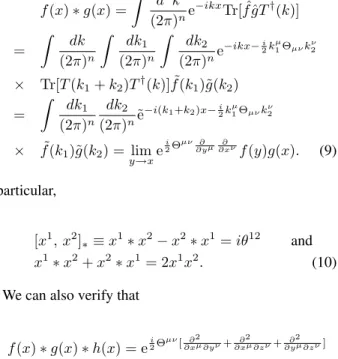
(8) We can now determine the classical function associa-ted to a product of two operatorsfˆ(q)eˆg(q), the so called Moyal product offandg:
f(x)∗g(x) =
Z dnk
(2π)ne
−ikxTr[ ˆfˆgT†(k)]
=
Z dk
(2π)n
Z dk
1 (2π)n
Z dk
2 (2π)ne
−ikx−i 2k
µ 1Θµνk2ν
× Tr[T(k1+k2)T†(k)] ˜f(k1)˜g(k2)
=
Z dk
1 (2π)n
dk2 (2π)n˜e
−i(k1+k2)x−i2k µ 1Θµνkν2
× f˜(k1)˜g(k2) = lim y→xe
i 2Θ
µν ∂ ∂yµ
∂
∂xνf(y)g(x). (9) In particular,
[x1, x2]
∗≡x1∗x2−x2∗x1=iθ12 and
x1∗x2+x2∗x1= 2x1x2. (10) We can also verify that
f(x)∗g(x)∗h(x) = e2iΘ µν[ ∂2
∂xµ ∂yν+ ∂2 ∂xµ ∂zν+
∂2 ∂yµ ∂zν]
×f(x)g(y)h(z)|y=z=x, (11)
from which a generalization for the product ofnoperators is straightforward.
During the recent years noncommutative field theories, obtained by replacing the ordinary pointwise product of fi-elds by the Moyal product, have been under intensive study (see [3] for reviews). This interest was greatly motivated by the fact that noncommutative theories emerge as the low energy limit of the open superstring in the presence of an antisymmetric background field [4]. Nevertheless, nowa-days noncommutative theories are interesting in their own
right. In the sequel we are going to describe some of their intriguing properties.
From the above expressions it is clear that one should proceed carefully when computing time ordered functions of a Moyal product of fields as exponentials containing time derivatives do not commute with the time ordering opera-tion. By forgetting momentarily this problem and writing the mentioned exponentials on the left of the time orde-ring symbol, one is led to the calculation of graphs topo-logically similar to those occurring in the commutative si-tuation but with additional phases at the vertices. In mo-mentum space, such phases may turn convergent some of the integrals because they provide strong oscillations in the integrands. However, in certain circumstances some of the phases cancel producing integrals as divergent as in the com-mutative cases. Whenever the phases are canceled out, the contribution is called planar; otherwise it is said to be non-planar.
There are two points of concern when considering mo-dels defined by replacing the ordinary (pointwise) product of fields by the Moyal one. Firstly, if the noncommutativity in-volves the time coordinate, i.e. ifθ0i 6= 0then unitarity and
causality are in jeopardy [5]. Let us illustrate this by consi-dering the lowest order correction to the two point function in a theory of a self-interacting scalar field [6] whose action is given by
Sint=
Z d4x[1
2∂µφ∂ µφ+m
2φ
2+gφ∗φ∗ ∗φ]. (12)
The corresponding amplitude is proportional to (see Fig. 1)
p−k
k
p
p
Figure 1. Lowest order contribution to the self-energy of theφfield in the model (12).
Z d4k
(2π)4
1 + cos(p∧k)
[(p−k)2−m2+iǫ](k2−m2+iǫ). (13)
wherep∧k = θµνp
µkν. In coordinate space, redefining
θµν→2θµν, we have
∆F(x)∆F(x) + ∆F(x)∗∆F(x). (14) It is clear that the first term in the above expression respects unitarity:
∆2F+ ∆2F = ∆ 2
−+ ∆2+ (15)
where∆+(∆−) is the positive (negative) frequency part of
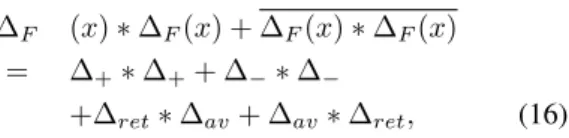
∆F (x)∗∆F(x) + ∆F(x)∗∆F(x) = ∆+∗∆++ ∆−∗∆−
+∆ret∗∆av+ ∆av∗∆ret, (16)
where∆av and∆ret designate the advanced and retarded Green functions of the free scalar field theory. The bre-akdown of unitarity is a direct consequence of the nonva-nishing of the last two terms. However, if the noncommu-tativity does not affect the time, i.e., ifθ0i = 0(h≡h(x0)
represents the Heaviside step function)
∆ret∗∆av ≈[h(1−h)]∆∗∆ = 0. (17) It has been argued that the unitarity problem can be over-come by firstly calculating the Moyal product and then ap-plying the time ordering prescription [6, 7]. For the case of the Fig. 1, this means that the corresponding amplitude now involves objects of the type
h∆+∗∆++ (1−h)∆−∗∆−. (18)
But,
h∆+∗∆++ (1−h)∆−∗∆−+h∆+∗∆+
+(1−h)∆−∗∆−= ∆+∗∆++ ∆−∗∆−(19)
and thus unitarity holds since the last expression also arises in the product of two tree graphs. The procedure just des-cribed leads to much more complicated and laborious com-putations than in the ordinary Feynman graph calculations. Further studies are needed since recent developments indi-cate that in noncommutative gauge theories unitarity may still be broken insofar as the Ward identities which enforce the cancellation of unphysical degrees of freedom are not satisfied [8].
Another problem characteristic of noncommutative the-ories is the ultraviolet-infrared (UV-IR) mixing. The no-menclature indicates a mixture of scales typical of nonlocal models. We recall that in the usual situation of commuta-tive theories, the ultraviolet behavior of Feynman integrals is unrelated to the infrared one. By contrast, in the noncom-mutative setting, the nonplanar part of the integrals contain trigonometric factors which imply in the ultraviolet finite-ness but lead to results that are singular at small momenta. An illustrative example is provided by the tadpole graph of theϕ4model, depicted in the Fig. 2. The nonplanar part of
that graph is given by
k
p
p
Figure 2. A tadpole graph of the noncommutativeϕ4model.
Z d4k
(2π)4
cos(k∧p)
k2−m2 (20)
and, thanks the oscillations of the cosine, the integral turns out to be convergent. However, for small momenta it beha-ves as p˜ζ2 wherep˜µ ≡θµνpνandζis a numerical constant.
This is a troublesome result as multiple insertions of the tad-pole graph into a larger diagram produce nonintegrable sin-gularities implicating in the breakdown of the perturbative expansion. Besides, it is clear that the presence of these infrared singularities may also lead to a violation of unita-rity [9].
In the usual commutative theories, the existence of infra-red divergences signalizes that nonperturbative effects must be incorporated. One may try resummations, rearranging the perturbative series to obtain a better behaved expansion. A difficulty in such procedure is the identification of a per-turbative parameter to control the resummed series. Another possibility is to increase the model by adding new degrees of freedom that hopefully cancel the singularities. In this as-pect supersymmetry may play a decisive role since, at least in the commutative situation, many cancellations of ultra-violet divergences occur in supersymmetric models. A first concrete example in this direction was given by the non-commutative Wess-Zumino model where renormalizability was proven to all loop orders [10]. Gauge invariance brings some additional complications and no general statement, va-lid to all orders, exist. Actually, up to one-loop, in the case of supersymmetric QED4, by employing the formalism of
components fields, it was shown that the contributions to the gauge field two and three point functions are free of dange-rous (i.e., quadratic or linear) infrared divergences [11]. By using powerful superfield techniques, this analysis has been improved [12, 13]. Indeed, by working in an arbitrary co-variant gauge it was proven that the cancellation of the qua-dratic infrared divergences also hold for extended supersym-metry. For the case of the three point function of the gauge superfield where the infrared divergences are at most linear, the dangerous linear infrared divergences turn out to be a gauge artifact disappearing in a particular gauge.
symmetry. In 2+1 dimensions the situation concerning the Goldstone theories is more favorable: In a model of com-plex scalar fields coupled to a combination of quartic and sextuple self-interactions, there is a class of field orderings for which no UV-IR mixing occurs and massless excitati-ons appear. Unlike the four dimensional case this does not require gauge invariant couplings [17].
Recent developments in 2+1 dimensions unveiled other interesting properties: as it happens in its commutative ver-sion, the noncommutative CPN−1 model, with the basic fields belonging to the fundamental representation of the gauge group, turns out to be renormalizable up to the next to leading order of 1/N. This is true in spite of the fact that, due to the lack of charge conjugation [18], new UV di-vergent graphs appear whereas some amplitudes that in the commutative version were divergent gained oscillatory fac-tors and become finite [19]. In contrast, if the basic field belongs to the adjoint representation dangerous infrared sin-gularities are present in the two point function of the gauge field and also in the leading correction to the self energy of the scalar field. These singularities still persist if fermions are minimally coupled to the gauge field but disappear under supersymmetrization.
The existence of the UV-IR mixing implies in a mo-dification of the dispersion relation. For example in the case of the self-interacting scalar theory defined by (12) the usual dispersion relation p2
0 = ~p2 +m2 is deformed to
p2
0 = ~p2+m2 +ζ/p˜2. This fact may have relevant
im-plications in astrophysical observations involving particles of very high energy [20].
Another surprising aspect is the appearance of noncom-mutative solitons in theories which do not allow them if the setting were commutative. In fact, in ordinary scalar theo-ries Derrick’s theorem [21] prevents the occurrence of soli-tons if the spacetime dimension is bigger than two. Howe-ver, it has been shown that for large values of the noncom-mutativity parameter solitons exist even in scalar models [22] (see also [23]).
In 1+1 dimensions noncommutative soliton solutions have, of course, the same analytic expression as the com-mutative ones. A distinctive feature of noncommutativity in these models arises from the fact that the noncommutative solitons lead to the creation of new bound states or even to an infinite tower of bound states; this property has been ex-plicitly verified in theφ4and sine-Gordon models [24].
We have seen that the introduction of noncommutative spaces in field theory produced an avenue with many inte-resting new constructions. Nevertheless, if they are theoreti-cal inspirations that could lead to a consistent picture of the world at very small scale is yet to be seen.
Acknowledgments
This work was partially supported by Fundac¸˜ao de Am-paro `a Pesquisa do Estado de S˜ao Paulo (FAPESP) and Conselho Nacional de Desenvolvimento Cient´ıfico e Tec-nol´ogico (CNPq).
References
[1] I. Z. Rothstein, “TASI Lectures on Effective Field Theories”, hep-ph/0308266.
[2] S. Doplicher, K. Fredenhagen, and J. E. Roberts, Commun. Math. Phys.172, 187 (1995).
[3] N.A. Nekrasov and M. Douglas, Rev. Mod. Phys. 73, 977 (2002); R. J.Szabo, Phys. Rept.378, 207 (2003); M. Gomes, “Renormalization in Noncommutative Field Theory” in Pro-ceedings of the XI Jorge Andr´e Swieca Summer School, Par-ticles and Fields” G. A. Alves, O. J. P. ´Eboli, and V. O. Rivel-les eds, World Scientific Pub. Co, 2002; H. O. Girotti, “Non-commutative Quantum Field Theories”, hep-th/0301237. [4] N. Seiberg and E. Witten, J. High Energy Phys.09, 32 (1999). [5] J. Gomis and T. Mehen, Nucl. Phys. B591, 265 (2000); N. Seiberg, L. Susskind, and N. Toumbas, J. High Energy Phys.
006, 044 (2000).
[6] D. Bahns, S. Doplicher, K. Fredenhagen, and G. Piacitelli, Phys. Lett. B533, 178 (2002); C. Rim and J. H. Yee, Phys. Lett. B574, 111 (2003).
[7] Yi Liao and K. Sibold, Eur. Phys. J. C 25, 479 (2002); S. Denk and M. Schweda, J. High Energy Phys. 0309, 032 (2003).
[8] T. Ohl, R. R¨uckl, and J. Zeiner, Nucl. Phys. B676, 229 (2003).
[9] Chong-Sun Chu, J. Lukierski and W. Zakrzewski, Nucl. Phys. B632, 219 (2002).
[10] H. O. Girotti, M. Gomes, V. O. Rivelles, and A. J. da Silva, Nucl. Phys. B587, 299 (2000); A. A. Bichl, J. M. Grimstrup, H. Grosse, L. Popp, M. Schweda, and R. Wulkenhaar, J. High Energy Phys.0010, 046 (2000).
[11] A. Matusis, L. Susskind, and N. Toumbas, J. High Energy Phys. 12, 002 (2000); F. Ruiz Ruiz, Phys. Lett. B502, 274 (2001).
[12] A. A. Bichl, M. Ertl, A. Gerhold, J. M. Grimstrup, H. Grosse, L. Popp, V. Putz, M. Schweda, and R. Wulkkenhaar, “Non-commutative U(1) Super-Yang-Mills Theory: Perturbative Self-Energy Corrections”, hep-th/0203141.
[13] A. F. Ferrari, H. O Girotti, M. Gomes, A. Yu. Petrov, A. A. Ribeiro, V. O. Rivelles, and A. J. da Silva, “Superfield Cova-riant Analysis of the Divergence Structure of Noncommuta-tive QED4”, Phys, Rev. D. to appear, hep-th/0309154.
[14] H. O. Girotti, M. Gomes, V. O. Rivelles, and A. J. da Silva, Int. J. Mod. Phys. A17, 1503 (2002).
[15] B. A. Campbell and K. Kaminsky, Nucl. Phys. B581, 240 (2000); Nucl. Phys. B606, 169 (2001).
[16] F. J. Petriello, Nucl. Phys. B601, 169 (2001).
[17] H. O. Girotti, M. Gomes, V. O. Rivelles, and A. J. da Silva, Phys. Rev. D67, 125003 (2003).
[18] M. M. Sheikh-Jabbari, Phys. Rev. Lett.84, 5265 (2000), hep-th/0001167; M. Chaichian, K. Nishijima, and A. Tureanu, Phys. Lett. B568, 146 (2003), hep-th/0209008.
[19] E. A. Asano, M. Gomes, A. G. Rodrigues, and A. J. da Silva, “The (2 + 1)D Noncommutative CPN−1Model”, Phys. Rev. D. to appear, hep-th/0307114.
[21] G. Derrick, J. Math. Phys.5, 1252 (1964).
[22] R. Gopakumar, S. Minwalla, and A. Strominger, J. High
Energy Phys.0005, 020 (2000).
[23] J. A. Harvey, “Komaba Lectures on Noncommutative
So-litons and D-Branes”, hep-th/0102076; F. A. Schaposnik, “Noncommutative Solitons and Instantons”, hep-th/0310202. [24] D. V. Vassilevich and A. Yurov, “Space-time