Article
J. Braz. Chem. Soc., Vol. 24, No. 6, 1006-1011, 2013. Printed in Brazil - ©2013 Sociedade Brasileira de Química 0103 - 5053 $6.00+0.00
A
http://dx.doi.org/10.5935/0103-5053.20130128*e-mail: [email protected]
Absolute Configuration and Enantiomeric Composition of Partially Resolved
Mandelic, Atrolactic and Lactic Acids by
1H NMR of their (
S
)-2-Methylbutyl Esters
Francisco A. da C. Andrade,* Maricleide P. de L. Mendes and Neuracy C. da Fonseca
Departamento de Química Orgânica, Instituto de Química, Universidade Federal da Bahia, Campus de Ondina, 40170-280 Salvador-BA, Brazil
Ésteres dos ácidos mandélico, atrolático e lático com o (S)-2-metil-1-butanol foram
examinados como derivados diastereoméricos para análise estereoquímica por ressonância nuclear magnética (NMR) de 1H a 300 MHz dos ácidos mencionados. Diastereômeros destes ésteres apresentaram ressonâncias com diferenças evidentes na região de absorção do grupo metilena alquílico (O−CH2−CH). Por análise dos espectros dos derivados, nesta região, foram atribuídas suas configurações absolutas, especificadas as absorções dos hidrogênios pró-R e
pró-S do grupo metilena e determinadas as composições enantioméricas dos ácidos de origem
parcialmente resolvidos.
The mandelic, atrolactic and lactic acid esters of the (S)-2-methyl-1-butanol were examined
as diastereomeric derivatives for the stereochemical analysis of the mentioned acids by 1H nuclear magnetic resonance (NMR) at 300 MHz. The diastereomeric esters showed distinctive signals in the methylenic absorption range (O−CH2−CH) of the alcoholic moieties. By spectral analysis at this region, absolute configurations were attributed, chemical shifts of the correspondent pro-(R) and
pro-(S) hydrogens from the methylene group of the alcohol moiety were assigned and enantiomeric
compositions were determined for the original partially resolved acids.
Keywords: absolute configuration, enantiomeric composition, NMR spectroscopy, chiral hydroxyacid, chiral primary alcohol
Introduction
A general procedure for the enantiomeric composition of chiral alcohols (and acids) consists in the conversion of the enantiomers into a diastereomeric ester mixture, by using an enantiomerically pure chiral acid (or chiral alcohol) and examining the resultant mixture by nuclear magnetic resonance (1H NMR) spectroscopy.1-4 Those
conversions are also used for assignment of chiral alcohol (and acid) configurations.5,6
An empirical correlation between the configuration and the observed resonances for esters of such acids as the mandelic, atrolactic, α-methoxy-α-(trifluoromethyl) phenylacetic and O-methylmandelic5 has been used for the
deduction of the absolute configuration of the secondary alcohols from which they were prepared. This correlation was extended7 to valine esters and applied for the
stereochemical analysis of some primary chiral alcohols.
1H NMR spectroscopy of 2-methyl-1-alkanol valine ester
derivatives showed that geminal diastereotopic protons, in O−CH2−CH of the alcoholic moiety, display measurable chemical shift non-equivalents for their epimers, at 300 MHz. The chemical shifts caused by HR and HS protons,
around 4 ppm, were farther from each other for one of the valine ester enantiomer while were closer from each other for the correspondent epimer.
To extend the procedure to other derivatives, it seemed interesting to inspect esters of the primary chiral alcohol with mandelic, atrolactic and lactic acids, this last an inexpensive chiral α-hydroxyacid. The referred NMR features led to infer the configuration, assign the HR and
HS resonances and determine the enantiomeric composition
of the original acid.
Experimental
Instruments
Andrade et al. 1007 Vol. 24, No. 6, 2013
obtained in a Perkin Elmer-283B spectrometer. Optical rotations were determined in a Zeiss polarimeter. Proton magnetic resonance (1H NMR) spectra were recorded
on a Varian Gemini (300 MHz) spectrometer, using approximately 0.2 mol L-1 solutions in CDCl
3 and the
following conditions: spectral width 4,500 Hz; pulse width 9.1 µs; flip angle 45o; acquisition time 1.767 s; no recycle
delay; number of transients 128. Reported chemical shifts (d units) are in ppm from internal TMS (tetramethylsilane), coupling constants (J) are in hertz, multiplicity are indicated
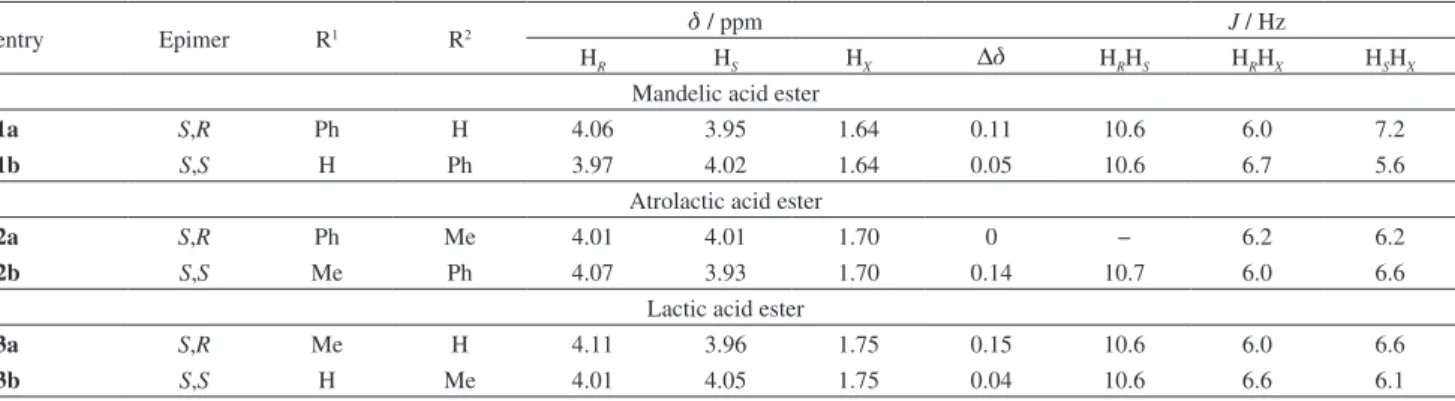
as s, d, t, q, m, respectively for singlet, doublet, triplet, quartet and multiplet, and the ABX patterns of the chiral derivatives are listed in Table 1.
Chemicals
(S)-2-Methyl-1-butanol 99%, (−)-ephedrine, quinine hydrochloride, (±)-lactic acid 85% aq., (S)-(+)-lactic acid 85% aq., p-toluenesulphonic acid, inorganic reagents and
analytical grade solvents, available as commercial products (Aldrich or Merck or Reagen), were used without further purification. Benzaldehyde was distilled before use. Other substances, referred below, were prepared by well known literature procedures.
(±)-Mandelic acid, mp 115-116 oC (118 oC),8 was
prepared from benzaldehyde through formation and posterior hydrolysis of the mandelonitrile.8
(R)-(–)-Mandelic acid 78.8% ee, was prepared by
partial resolution of the (–)-mandelic acid through re-crystallization of their (–)-ephedrine salts in ethanol,9
followed by acidification of the less soluble crop, ether extraction and re-crystallization of the (R)-(–)-mandelic
acid in acetone. The partially resolved product showed mp. 127-128 °C, and [α]D26 –123.7° (c 1.1 H
2O) [mp 133.5 °C,
[α]D20 –156.9° (c 2 H2O)].9
(±)-Atrolactic acid, mp 84-88 °C (88-90 °C),10 was
prepared from acetophenone through formation and hydrolysis of the cyanohydrin.10
(S)-(+)-Atrolactic acid 60.6% e.e. was obtained by
resolution of its quinine salt.11 After six re-crystallizations
from ethanol, the quinine salt melted at 220-225 °C and presents [α]D30 –109° (c 0.55, ethanol) [α]
D
30 –109° (c 0.54,
ethanol)].11 The atrolactic acid regenerated from this salt
melted at 92-95oC and presented [α]D30 +22.6° (c 2.54,
ethanol) [α]D30 +37.3° (c 2.53, ethanol)].11
Analytical samples of esters
Esters were prepared by adapting a reported procedure12
to a smaller scale and substituting the catalyst from sulfuric acid for p-toluenesulfonic acid. A mixture of the acid
(0.2 mmol), alcohol (0.22 mmol), p-toluenesulphonic
acid (5 mg) and benzene (5 mL) was refluxed (4 h) using a trap for water separation. The cold reaction mixture was taken in ether and the extract washed with water, sodium bicarbonate (5%), water again, and dried over anhydrous sodium sulfate. The crude esters (0.12-0.14 mmol) were obtained as yellowish or colorless liquids, after removing drying agent, alcohol excess and the solvent.
2-Methylbutyl mandelates (1): enriched (S,R)-
2-methyl-butyl mandelate 78.8%d.e. was obtained from (R)-mandelic
acid 78.8% e.e. and pure (S)-2-methyl-1-butanol. An
equimolar epimeric pair of (S,R)plus(S,S)-2-methylbutyl
mandelate was obtained from racemic mandelic acid and (S)-2-methyl-1-butanol. 1H NMR d 7.45-7.26 (m, 5H,
C6H5), 5.17 (d, 1H, J 5.6, ArCH), 4.09-3.91 (2H, ABX,
OCH2), 3.55 (d, 1H, J 5.6, OH), 1.73-1.56 (m, 1H, MeCH),
1.36-1.18 (m, 1H, MeCHH), 1.16-0.98 (m, 1H, MeCHH), 0.85-0.76 (m, 6H, 2CH3).
2-Methylbutyl atrolactates (2): enriched (S,R)-2methyl
-butyl atrolactate 60.6%d.e. was obtained from (R)-atrolactic
acid 60.6% e.e. and pure (S)-2-methyl-1-butanol. The
equimolar epimeric pair (S,R plus S,S)-2-methylbutyl
atrolactate was obtained from racemic atrolactic acid and
Table 1. ABX resonances for OCH2CH protons of the ester derivatives
entry Epimer R1 R2 d / ppm J / Hz
HR HS HX Dd HRHS HRHX HSHX
Mandelic acid ester
1a S,R Ph H 4.06 3.95 1.64 0.11 10.6 6.0 7.2
1b S,S H Ph 3.97 4.02 1.64 0.05 10.6 6.7 5.6
Atrolactic acid ester
2a S,R Ph Me 4.01 4.01 1.70 0 − 6.2 6.2
2b S,S Me Ph 4.07 3.93 1.70 0.14 10.7 6.0 6.6
Lactic acid ester
3a S,R Me H 4.11 3.96 1.75 0.15 10.6 6.0 6.6
Absolute Configuration and Enantiomeric Composition of Partially Resolved Mandelic, Atrolactic and Lactic Acids J. Braz. Chem. Soc.
1008
pure (S)-2-methyl-1-butanol. 1H NMR d 7.60-7.25 (m, 5H,
C6H5), 4.11-3.90 (2H, ABX, O−CH2), 3.86 (s, 1H, OH), 1.80 (s, 3H, C−CH3), 1.78-1.62 (m, 1H, MeCH), 1.39-1.25
(m, 1H, MeCHH), 1.21-1.06 (m, 1H, MeCHH), 0.89-0.83 (m, 6H, 2CH3).
2-Methylbutyl lactates (3): enriched (S,S)-2-methylbutyl
lactate was obtained from (S)-2-methyl-1-butanol and
almost pure (S)-lactic acid. An equimolar epimeric mixture
of (S,R)-plus (S,S)-2-methylbutyl lactates was obtained from
pure (S)-2-methyl-1-butanol and racemic lactic acid. 1H NMR
d 4.28 (q, 1H, J 6.7, HO−CH), 4.14-3.93 (2H, ABX, O−CH2), 3.10 (d, 1H, J 6.4, OH), 1.83-1.67 (m, 1H, EtCH), 1.43 (d, 3H, J 6.7, CO−CHCH3), 1.51-1.36 (m, 1H, MeCHH), 1.28-1.13 (m, 1H, MeCHH), 0.95-0.89 (m, 6H, 2CH3).
Results and Discussion
The 1H NMR spectra of the diastereomeric ester
mixtures examined in this work showed that the more distinctive signs were observed in the region of absorption for the methylenic protons in O−CH2−CH of the alcoholic moiety.
Oxymethylene resonances of individual epimers
The identification of resonances for oxymethylenic protons of the diastereomeric esters were made by contrasting the spectra, around the 4 ppm region, of the equimolar diastereomeric mixture with an enriched mixture of known diastereomeric excess or with a pure enantiomer. Example of this procedure for esters of (S
)-2-methyl-1-butanol with mandelic, atrolactic and lactic acids are shown in Figure 1. For each ester, equimolar mixture is displayed on top of the mixture enriched by the next esters.
Upon inspection of the 2-methylbutyl mandelic and lactic acid ester spectra, shown in Figure 1, the (S,R)- or
(R,S)-isomers are recognized by their larger chemical shift
differences of the geminal protons, represented as A and B, and the (S,S)- or (R,R)-isomers by their smaller chemical
shift differences, represented as A’ and B’.
Unexpectedly, the atrolactic ester showed inverted signals. The (S,R)- or (R,S)-isomers were recognized by
their smaller chemical shift differences of the geminal protons, and the (S,S)- or (R,R)-isomers by their larger
chemical shift differences.
Absolute configurations
Absolute configuration of one of the mentioned chiral acids or alcohols could be determined by the observations of
the NMR signals of their esters prepared using the optically pure alcohol or acid, respectively.
Similar correlations of the chemical shifts for oxymethylenic protons with attached groups to C-2 of some primary chiral alcohols were developed by the extension of the Mosher empirical model.5 The extended model,
limited for the (S)-2-methylbutyl esters, is represented by
the chemical structure represented in Figure 2.
The determined chemical shifts for the oxymethylene protons of (S)-2-methybutyl esters, corresponding
to ABX systems, are shown in Table 1. In this table, all (S)-2-methybutyl (R)-carboxylic acid esters are
designated as a entries and named as (S,R)-epimers. The
(S,S)-diastereomers are designated as b entries. Resonances
for the (R,S)- and (R,R)-diastereomers are expected to be
coincident to those shown by their enantiomers, i.e., by
a and b entries, respectively.
Applying the above structural model for the (S,R)-mandelic acid ester (1a) and (S,R)-lactic acid
ester (3a), the phenyl group of mandelate and the methyl
group of lactate have the power to displace to higher magnetic field the absorptions of the oxymethylene proton situated in the same face. Absorption in higher magnetic field of the pro-S hydrogen (HS), relative to the
absorption of pro-R hydrogen (HR), must be presented by
Figure 1. Methylene resonances from (a): equimolar and partially resolved (S,R)-2-methylbutyl mandelate; (b): equimolar and partially resolved (S,S)-2-metylbutyl atrolactate; and (c): equimolar and partially resolved (S,S)-2-metylbutyl lactate.
Andrade et al. 1009 Vol. 24, No. 6, 2013
the (S,R)-mandelate and the (S,R)-lactate. Absorption in
higher magnetic field of the pro-R hydrogen (HR), relative
to the absorption of pro-S hydrogen (HS), must be presented
by the (S,S)-mandelate (1b) and the (S,S)-lactate (3b).
The mentioned correlation resulting in higher magnetic field absorption of the pro-R oxymethylene hydrogen of the
(S)-carboxylic acid esters was proved by comparing the
following 1H NMR spectra: butyl (S)-O-acetylmandelate
versus (R)-[1-2H]-butyl (S)-O-acetylmandelate13 and octyl
(1S)-camphanate versus (R)-(1-2H)-octyl (1S)-camphanate.14
The Mosher model can not be applied to the prediction of the magnetic field for the HS and HR absorptions of
atrolactic esters. In this case, bound on the acidic moiety, the methyl group would have a greater effect than the phenyl group over the geminal protons. Accurate effects are observed by comparing the differences between the HR and HS absorptions (Dd) for the mandelic and lactic
acid esters.
The displacement of the germinal proton absorptions affected by the neighbor substituent is greater by the ethyl group than by the methyl group. It should be pointed out that the ethyl group can cause more shielding or more deshielding effect than the methyl group. Differences between the germinal proton absorptions (Dd) do not change using those effects.
The chemical shifts for the germinal protons of valine esters have been modeled considering the shielding effects of the ethyl and methyl groups over the protons situated in the same face.7 Chemical shifts for the germinal protons
of the current (S)-2-methylbutyl esters were presented
considering the deshielding effects of the ethyl and methyl groups. Structural model correlates the deshielding effects of the ethyl and methyl groups over the protons situated in the opposite face. The relative chemical shifts for mandelic and lactic esters can be assigned based on the Scheme 1.
For the (S,R)-2-methylbutyl mandelate (1a) (Table 1),
the relative effect between phenyl and hydrogen groups resulted in Dd =0.11, while for the (S,R)-2-methylbutyl
lactate (3a), the relative effect between methyl and
hydrogen groups resulted in Dd =0.15.
The referred inversion of the substituent effects for atrolactic esters may be due to the described difference between the effects of the methyl and phenyl groups on the acidic moiety, and to the larger difference between the effects of the ethyl and methyl groups on the alcoholic moiety, which must result in higher magnetic field for HS than for HR oxymethylene proton for the
(S,S)-atrolactate (2b). The relative chemical shifts for
atrolactic esters can be assigned, approximately, based on the Scheme 2.
The above mentioned relative effects of the phenyl and methyl groups over the oxymethylene protons of the atrolactic esters of the primary chiral alcohol are the same of the phenyl and trifluoromethyl groups found for the
α-methoxy-α-(trifluoromethyl) phenylacetic esters.15
Enantiomeric compositions
Enantiomeric compositions are based on the machine integration of non-overlapping peaks of the methylenic protons from the diastereomeric derivatives. The conditions to optimize integral measurements were not determined. The procedure was already detailed in the literature7 for
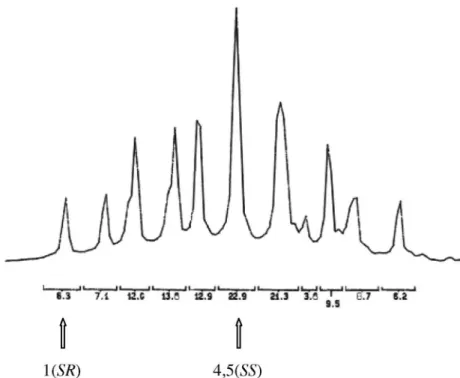
valine esters of 2-methyl-1-alkanols. For the components that display the ABX pattern, to simplify identification, an ordering number from left to right is used to indicate the positions of resulting signals from A and then from B. In a mixture of (S,R)- plus (S,S)-2-methylbutyl mandelate
esters (Figure 1a), for exemplification, the peak 1 of the (S,R) epimer, referred as 1/SR, is non-overlapped with the
peak 1 of the (S,S) epimer, and the peaks 4 and 5 of the
(S,S) epimer, referred as 4,5/SS, are non-overlapped with
peaks of the (S,R) epimer. For coincident absorptions
of the geminal protons of atrolactic acid ester, one peak of the resultant H-X duplet is referred as d1/SR or
d2/SR. Calculations of enantiomeric compositions for acids
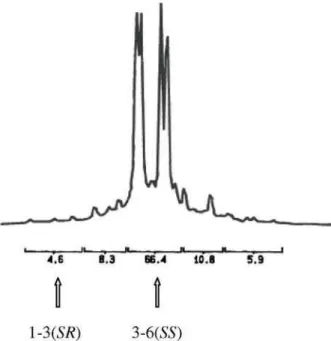
presented in Figure 1 are indicated in Table 2. Scheme 1. Relative chemical shifts of pro-S (HS) and pro-R (HR) protons
for 2-methylbutyl mandelates and lactates.
Scheme 2. Relative chemical shifts of pro-S (HS) and pro-R (HR) protons
Absolute Configuration and Enantiomeric Composition of Partially Resolved Mandelic, Atrolactic and Lactic Acids J. Braz. Chem. Soc.
1010
The integral values for areas of non-overlapped selected peaks from each component of the epimeric pair in the sample are compared with the values shown by the same peaks in an equimolar mixture of epimers. The proportional values obtained from the relations between enriched and equimolar amounts of the epimers are used for the calculations of their enantiomeric compositions.
Conclusions
Assignment of absolute configuration of β-chiral primary alcohols by 1H NMR has been done by correlation
of the anisotropic effect of aromatic groups over the oxymethylene protons absorption.16 (S)-Valine,
(S)-mandelic and (S)-lactic esters of (S)-2-methyl-1-butanol
presented oxymethylene absorptions that show similar effects caused by isopropyl, phenyl and methyl groups, appears as proof for the absence of this anisotropic effect of aromatic groups over the methylene protons.
Our results for the (R)-mandelic acid and the (R)-lactic
acid esters show that HS is more shielded than HR, while
for the (R)-atrolactic acid ester, HR is more shielded than
HS. The shielding effects for HR and HS found for the
(R)-MTPA ester15 were the same than for the above referred
(R)-atrolactic acid ester.
Correlation between structure and absorptions of the methylene protons seems to be associated to the differences of conformations that can favor the flow of electron density of the adjacent nonbonding oxygen orbital, more for the HR or more for the HS proton. While the bright nonbonding
orbital (Figure 3) is attracted by the carbonyl conjugation,
the dark nonbonding orbital interacts more effectively with the antibonding orbital of the adjacent C−H bond, causing more shielding for the bound proton.
One assumption about the conformation that causes the preferential C=O conjugation with one of the nonbonding orbitals is related with the different steric effects of the hydrogen and methyl groups of the acidic moiety, observed by comparing the above structures.
Another assumption is related to the different screw patterns around the C–CO bond, as represented in Figure 4 for the cited acid esters, resultant from the decrease of the determined refractivity values17 correlated to the electron
polarizability.18
Referring to the enantiomeric composition, the (S)-2-methyl-1-butanol was a good derivatizing agent
for the analysis of the α-hydroxi-acids. Equally, a pure
α-hydroxyl-acid can serve as a derivatizing agent for the enantiomeric composition of the 2-methyl-1-butanol.
Supplementary Information
The 1H NMR spectra for structural identification and
composition determination of the esters are available free of charge at http://jbcs.sbq.org.br as PDF file.
Table 2. Enantiomeric composition of mandelic, atrolactic and lactic acids
Selected peak Mandelic acid Atrolactic acid Lactic acid
1/SR 4,5/SS d2/SR 5/SS 1-3/SR 3-6/SS
Enriched 11.6 5.3 11.1 16.4 4.6 66.4
Equimolar 6.3 22.9 24.2 10.0 24.6 62.8
Enriched/Equimolar 1.84 0.23 0.46 1.64 0.19 1.06
Composition / % 88.9 11.1 21.9 78.1 15.2 84.8
Figure 4. The different screw patterns around the C–CO bond for the acid esters.
Andrade et al. 1011 Vol. 24, No. 6, 2013
Acknowledgment
The authors thank the CNPq (Conselho Nacional de Desenvolvimento Científico e Tecnológico) for scholarships to M. P. L. and to N. C. F.
References
1. Raban, M.; Mislow, K.; Top. Stereochem. 1967, 2, 199. 2. Dale, J.A.; Mosher, H. S.; J. Am. Chem. Soc. 1968, 90, 3732.
3. Dale, J. A.; Dull, D. L.; Mosher, H. S.; J. Org. Chem. 1969, 34, 2543.
4. Yasuhara, F.; Yamaguchi, S.; Tetrahedron Lett. 1980, 21, 2827. 5. Dale, J. A.; Mosher, H. S.; J. Am. Chem. Soc. 1973, 95, 512.
6. Seco, J. M.; Quiñoá, E.; Riguera, R.; Chem. Rev. 2004, 104, 17.
7. Andrade, F. A. C.; J. Braz. Chem. Soc. 1998, 9, 85.
8. Giral, F.; Rojahn, C. A.; Productos Químicos y Farmacéuticos,
vol. 2; Atlante: México, 1946, p. 1180.
9. Manske, R. H. F.; Johnson, T. B.; J. Am. Chem. Soc. 1929, 51, 1906.
10. Eliel, E. L; Freeman , J. P.; Org. Synth.1963, 4, 59.
11. Barnes, R. A; Juliano, B. R.; J. Am. Chem. Soc.1959, 81,6462.
12. Leitch, R. E; Rothbart, H. L.; Rieman, W.; Talanta1968, 15, 213.
13. Parker, D.; J. Chem. Soc., Perkin Trans. 21983, 83.
14. Shapiro, S.; Arunachalam, T.; Caspi, R.; J. Am. Chem. Soc1983,
105, 1642.
15. Tsuda, M.;Toriyabe, Y; Endo, T.; Kobayashi; J. Chem. Pharm. Bull.2003, 51, 448.
16. Latypov, S. K.; Ferreiro, M. J.; Quiñoá, E.; Riguera, R.; J. Am. Chem. Soc 1998, 120, 4741.
17. Vogel, A. I.; J. Chem. Soc.1948, 1833.
18. Brewster, J. H.; J. Am. Chem. Soc1959, 81, 5475.
Supplementary Information
S
I
J. Braz. Chem. Soc., Vol. 24, No. 6, S1-S6, 2013.Printed in Brazil - ©2013 Sociedade Brasileira de Química 0103 - 5053 $6.00+0.00
*e-mail: [email protected]
Absolute Configuration and Enantiomeric Composition of Partially Resolved
Mandelic, Atrolactic and Lactic Acids by
1H NMR of their (
S
)-2-Methylbutyl Esters
Francisco A. da C. Andrade,* Maricleide P. de L. Mendes and Neuracy C. da Fonseca
Departamento de Química Orgânica, Instituto de Química, Universidade Federal da Bahia, Campus de Ondina, 40170-280 Salvador-BA, Brazil
Figure S1.1H NMR (300 MHz, CDCl
3) spectrum of partially resolved (S,R)-2-methylbutyl mandelate.
Absolute Configuration and Enantiomeric Composition of Partially Resolved Mandelic, Atrolactic and Lactic Acids J. Braz. Chem. Soc. S2
Figure S3.1H NMR (300 MHz, CDCl
3) spectrum of partially resolved (S,S)-2-methylbutyl atrolactate. Figure S2.1H NMR (300 MHz, CDCl
Andrade et al. S3 Vol. 24, No. 6, 2013
Figure S6.1H NMR (300 MHz, CDCl
3) spectrum of equimolar (S,R+S,S)-2-methylbutyl lactate. Figure S5.1H NMR (300 MHz, CDCl
3) spectrum of partially resolved (S,S)-2-methylbutyl lactate. Figure S4.1H NMR (300 MHz, CDCl
Absolute Configuration and Enantiomeric Composition of Partially Resolved Mandelic, Atrolactic and Lactic Acids J. Braz. Chem. Soc. S4
Figure S8. Methylene integration for equimolar (S,R+S,S)-2-methylbutyl mandelate.
Figure S7. Methylene integration for partially resolved (S,R)-2-methylbutyl mandelate.
Andrade et al. S5 Vol. 24, No. 6, 2013
Figure S10. Methylene integration for equimolar (S,R+S,S)-2-methylbutyl atrolactate.
Absolute Configuration and Enantiomeric Composition of Partially Resolved Mandelic, Atrolactic and Lactic Acids J. Braz. Chem. Soc. S6
Figure S12. Methylene integration for equimolar (S,R+S,S)-2-methylbutyl lactate.