DOI: 10.1590/0004-282X20160016
ARTICLE
Cerebrospinal fluid examination may be useful
in diagnosing neurosyphilis in asymptomatic
HIV+ patients with syphilis
El examen del líquido céfalo raquídeo puede ser útil en el diagnóstico de neurosífilis en
pacientes VIH + asintomáticos con sífilis
Ronald Salamano1, Raquel Ballesté2, Abayubá Perna1, Natalia Rodriguez2, Diego Lombardo1, Natalia
García2, Pablo López2, Pablo Cappuccio3
Whether lumbar puncture should be indicated for di-agnosing neurosyphilis in patients who are coinfected with
the human immunodeiciency virus (HIV) and Treponema pallidum (T. pallidum) but do not have any symptoms or neu -rological signs is a matter for discussion1,2.
he European guidelines recommend lumbar puncture in cases of symptomatic patients (neurological, ophthalmological or otological symptoms) and asymptomatic HIV-positive pa
-tients with Venereal Disease Research Laboratory (VDRL) test results greater than or equal to 1/32 in serum and CD4 less than
or equal to 350. hese guidelines suggest that lumbar puncture
should not be compulsory but that it could be indicated in cases of late latent syphilis or syphilis of undetermined duration3.
In 2002, the Centers for Disease Control and Prevention (CDC) recommended lumbar puncture for patients with
late latent syphilis or syphilis of undetermined duration.
his recommendation was later revised to include reactive VDRL ≥ 1/32 in serum and CD4 cell counts ≤ 350 cells/ml. Since 2010, CDC has not been recommending lumbar punc -ture for asymptomatic patients.
1Hospital de Clínicas, Instituto de Neurología, Sección Neuroinfectología, Cátedra de Neurología, Montevideo, Uruguay;
2Hospital de Clínicas, Departamento de Laboratorio Clínico, Sección Inmunología, Montevideo, Uruguay;
3Hospital Pasteur, Servicio de Enfermedades Infecto-Contagiosas (SEIC), Montevideo, Uruguay.
Correspondence: Ronald Salamano; José E. Rodó 1714/301; Montevideo, Uruguay; E-mail: [email protected]
Conflict of interest:There is no conlict of interest to declare.
Received 08 July 2015; Received in inal form 13 October 2015; Accepted 03 November 2015.
ABSTRACT
Lumbar puncture in neurologically asymptomatic HIV+ patients is still under debate. There are different criteria for detecting neurosyphilis through cerebrospinal luid (CSF), especially in cases that are negative through the Venereal Disease Research Laboratory (VDRL), regarding cellularity and protein content. However, a diagnosis of neurosyphilis can still exist despite negative VDRL. Treponema pallidum hemagglutination assay (TPHA) titers and application of the TPHA index in albumin and IgG improve the sensitivity, with a high degree of speciicity. Thirty-two patients were selected for this study. VDRL was positive in ive of them. The number of diagnoses reached 14 when the other techniques were added. It was not determined whether cellularity and increased protein levels were auxiliary tools in the diagnosis. According to our investigation, CSF analysis using the abovementioned techniques may be useful in diagnosing neurosyphilis in these patients.
Keywords: neurosyphilis, HIV positive, VDRL, TPHA in CSF, TPHA indexes.
RESUMO
La punción lumbar (PL) en pacientes VIH+ neurológicamente asintomáticos es controversial. Existen diferentes criterios para detectar en el líquido cefalorraquídeo (LCR) neurosíilis (NS): el examen Venereal Disease Research Laboratory (VDRL) en primer lugar, en caso de negatividad: la celularidad y el tenor de proteinas. Sin embargo el diagnóstico de NS puede ser sostenido a pesar de la negatividad de las técnicas mencionadas. La titulación del Treponema pallidum hemagglutination assay (TPHA) y la aplicación del índice de TPHA en Albúmina e Ig G mejoran la sensibilidad asociando elevado grado de especiicidad. 32 pacientes fueron seleccionados para este estudio, el VDRL fue positivo en 5. El diagnóstico se elevó a 14 cuando se sumaron el resto de las técnicas. No se evidenció que la celularidad y el aumento de proteínas fueran herramientas auxiliares para el diagnóstico. De acuerdo a nuestro trabajo el estudio del LCR con las técnicas señaladas puede ser de utilidad en el diagnóstico de NS en estos pacientes.
VDRL is still the fundamental tool for diagnosing neuro
-syphilis. Its moderate sensitivity (30-70%) in immunocom -petent patients4 and its signiicantly decreased sensitivity in patients who are immunosuppressed due to HIV, makes it
necessary to use other techniques for diagnosing this
condi-tion. hese may include cellularity and CSF protein levels, in those cases that cannot be detected through VDRL5,6,7.
High cellularity and CSF protein levels are indicative
criteria of neurosyphilis in the absence of other diseases. Unfortunately, these parameters are of little use in cases of
coinfection with HIV. It has been accepted that in cases of HIV-negative patients, presentation of pleocytosis of more than 10 cells and CSF protein levels of more than 0.45 mg/dl would be indicative of neurosyphilis, while for HIV-positive
patients, the parameter of cellularity increases to 20 cells and
the protein level is still the same8.
he polymerase chain reaction (PCR) shows ambiguous responsiveness with regard to diagnosing neurosyphilis9. It is
possible that the low T. pallidum count in CSF makes it im -possible for this technique to be of use10.
he rabbit infectivity test is considered to be the gold standard for making the diagnosis. However, this technique
is cumbersome to put into practice and the results can
take months11.
Other immunological diagnostic alternatives are also applied to CSF, such as the Treponema pallidum
hemag-glutination assay (TPHA) in CSF and the TPHA-IgG and TPHA-albumin tests. hese can also help in this regard, since it occurs in HIV-negative patients with symptoms and signs
of neurosyphilis11,12,13.
TPHA is an indirect hemagglutination test through
which it is possible to assay for anti-T. pallidum speciic an
-tibodies in serum and CSF. Its negativity in CSF has a high negative predictive value (as also seen with the FTA-ABS). Random positive TPHA indings in CSF do not always in -dicate neurosyphilis and they may simply mean that
pas-sage of antibodies from the blood is occurring. hus, TPHA is considered to be a technique with high sensitivity and low speciicity. herefore, authors such as Luger et al. have suggested that the mere presence of high TPHA ti
-ters in CSF could be considered to have diagnostic value
regarding neurosyphilis.
he TPHA-albumin index correlates the anti-Treponema antibody titer in CSF and serum with the albumin quotient,
thus assessing the condition of the blood-brain barrier. On
Reibergrams, this can be seen to be connected with intrathe
-cal production of speciic antibodies (IgG quotient), which would indicate local activity, while the IgG index itself might have less sensitivity in this regard12,13,14,15,16.
hese diagnostic alternatives have made it possible to ob
-tain information in cases of symptomatic HIV-negative pa
-tients. hey are not routinely used for HIV-positive pa-tients. As mentioned earlier, diferent authors4 have agreed that neurosyphilis in HIV-positive patients can be detected more
consistently in those who show at least some of the
follow-ing criteria: CD4 less than or equal to 350 and RPR or VDRL greater than or equal to 1/32. he 2008 European guidelines
accept the possibility that lumbar puncture could be
per-formed in cases of untreated syphilis of unknown duration or that have remained untreated for at least one year, with per
-sistent serological indings despite treatment with penicillin G benzathine3.
he aim of this study was to observe the performance of these techniques: not only those such as CSF VDRL for which a broad consensus exists, but also those deined as alterna
-tive techniques, including investigation of cellularity and CSF protein levels and immunological techniques (CSF TPHA, TPHA-albumin index and TPHA-IgG index), applied to a population of HIV-positive patients who were coinfected
with T. pallidum but were asymptomatic from a
neurologi-cal point of view.
METHOD
A cross-sectional study was conducted on a series of cas
-es between the years 2004 and 2013.
he criterion for selecting the patients was that they needed to be HIV+ and TPHA+ in blood, but were asymp
-tomatic from a neurological point of view. A lumbar puncture was performed on those patients who fulilled at least one of
the following criteria13:
• RPR or VDRL in blood greater than or equal to 1:32 • CD4 less than or equal to 350 mm3
• Untreated syphilis of unknown duration or of over one
year in duration
• RPR or VDRL in blood that was persistent despite treatment with penicillin G benzathine.
hirty-two patients were included, among whom 18 (56%) were male and 14 (44%) were female.
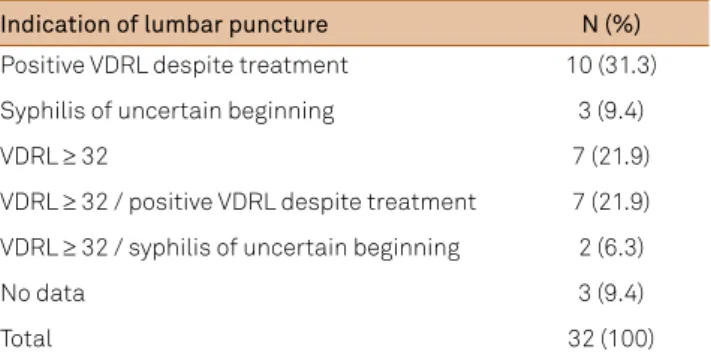
he criteria for lumbar puncture are shown in Table 1. hree of the patients fulilled one or more of the inclusion criteria but no data on them were recorded. he average age was 40 years old (standard deviation, SD = 9). Cases with traumatic lumbar puncture were excluded.
Table 1. Indication of lumbar puncture.
Indication of lumbar puncture N (%)
Positive VDRL despite treatment 10 (31.3) Syphilis of uncertain beginning 3 (9.4)
VDRL ≥ 32 7 (21.9)
VDRL ≥ 32 / positive VDRL despite treatment 7 (21.9) VDRL ≥ 32 / syphilis of uncertain beginning 2 (6.3)
No data 3 (9.4)
Total 32 (100)
Patients were considered to present asymptomatic neu
-rosyphilis if they were VDRL+ in CSF and/or showed TPHA in CSF ≥ 320, and/or showed TPHA-albumin index ≥ 70.
Patients were considered to probably present neurosyph
-ilis if they only showed TPHA-IgG index ≥ 2.
he formulae applied for the TPHA-albumin and TPHA-IgG indexes were as follows:
• TPHA-albumin index: CSF TPHA titer/albumin
quotient x 103 Ref. value ≥ 70
• Albumin quotient: CSF albumin (mg/dl)/serum albumin (mg/dl)
Ref. value: 0.0018-0.0074
• TPHA IgG index: CSF TPHA titer x total serum
IgG/serum TPHA titer x total IgG CSF Ref. value: ≥ 2
he variables analyzed were as follows: serum VDRL, CSF VDRL, CSF TPHA, TPHA-albumin index, TPHA-IgG index, cellularity, CSF protein and glucose levels, AIDS stage, com
-bined anti-retroviral treatment (ART) and CD4 at the time of
the lumbar puncture.
he Reibergram was not taken into account given that the variability of the data obtained might have been a conse
-quence of the coinfection. Positive values were not exclusive -ly due to anti-T. pallidum antibodies that were synthesized
intrathecally. Moreover, negative values would not rule it out within the context of immunosuppression.
For analysis purposes, the sample was irst considered ac
-cording to CSF VDRL positivity and then ac-cording to TPHA positivity in both groups (positive and negative CSF VDRL).
he sample was then analyzed after excluding the CSF VDRL-positive patients, and the performance of CSF TPHA and TPHA-albumin and IgG index assaying was observed in
these patients.
he numbers of cells and protein levels in the patients di
-agnosed with neurosyphilis according to the criteria deined in this study were compared with the levels in patients that did not have this a diagnosis. he same variables were then
compared between the patients who had been diagnosed as
presenting neurosyphilis exclusively through the VDRL test, versus those who were CSF VDRL-negative.
he data were processed and tabulated using the SPSS software, version 17.0. To describe the population, the mean was used for the continuous variables, with the cor
-responding standard deviations, and proportions for the categorical variables.
In comparisons between continuous variables, the Student
t-test and the Mann-Whitney test were used in accordance
with the application conditions, while for the categorical vari -ables, the chi-square test was used to compare proportions.
A signiicance level of alpha = 0.05 was used.
To gather the data, a speciic protocol was established. he data were obtained from the clinical records of two hos
-pitals (HC and SEIC). Lumbar puncture was indicated in
accordance with the current guidelines and purely for the
purposes of clinical care. Strict conidentiality was main -tained with regard to the identity of the patients included
and only the overall data have been disclosed here.
RESULTS
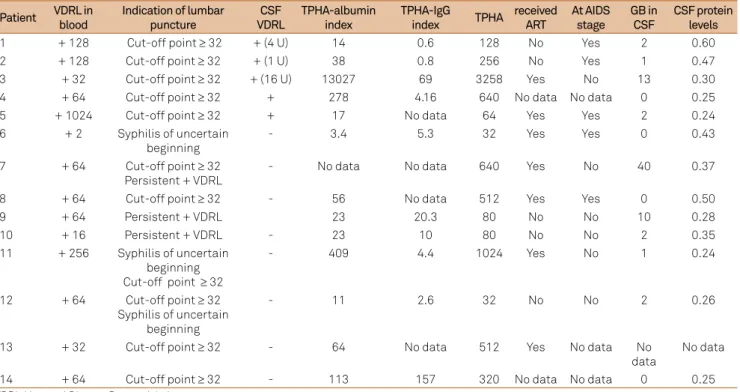
Fourteen patients (43.8%) presented one or more tests that were positive for neurosyphilis. Among them, ive (15.5%) were CSF VDRL-positive, while for the remain
-ing nine, the deinitive probable diagnosis of neurosyphi
-lis was made through CSF TPHA or the TPHA-albumin and TPHA-IgG indexes, which were greater than or equal to the reference values.
he patients with positive neurosyphilis tests showed ti
-ters for serum VDRL between 2 U and 1024 U, with an av
-erage of 64 U. he patients with high titers (above 16 U) were also reactive in the CSF VDRL test, or had more than two positive tests for neurosyphilis, unlike those with low titers (less than or equal to 16 U), which only correspond
-ed to TPHA-IgG indexes. In our study, one patient who was VDRL-positive showed 2U and another showed 16U. Table 2
shows these results.
he patients with diagnoses achieved through CSF with a positive VDRL test were linked in a statistically signif
-icant manner to the fact that they were at the AIDS stage (chi-square test; p < 0.037). his association was not found when the criterion was that patients had to have a positive CSF test. Furthermore, no statistical association was found between ART and a positive VDRL test and the rest of the di -agnostic parameters.
Comparison of cellularity and CSF protein levels in pa -tients with neurosyphilis according to the two diagnostic
cri-teria through CSF mentioned earlier showed that there were no signiicant diferences from a statistical point of view (see Tables 3 and 4).
DISCUSSION
Carrying out a lumbar puncture in HIV-positive pa
-tients with positive serological blood tests for syphilis is a matter of controversy in relation to patients who do not
show any symptoms and/or neurological or ophthalmo-logical signs1,2.
In our study, carrying out a LUMBAR PUNCTURE among
patients who were selected in accordance with the criteria
laid out above, in the Material and Methods section, seems to have been appropriate, given that this allowed us to de
-tect ive patients (15%) who had positive CSF VDRL tests (which therefore conirmed the diagnosis of neurosyphilis). If we add the criteria set forth by Luger et al.11,12, this percentage
Comparison of the patients with neurosyphilis in
accor-dance with the two criteria used in making the diagnosis through CSF with the negative patients did not lead to any correlation with being administered ART or with being at the AIDS stage, with the exception of positive CSF VDRL tests and the AIDS stage.
his suggests that the TPHA-albumin and IgG indexes in CSF, as well as the total amount of TPHA in CSF, could have diagnostic value at stages unconnected to the AIDS stage. It needs to be pointed out that it is important to in
-clude these parameters in making routine diagnoses of neu
-rosyphilis. If we had disregarded them, these patients (who comprised 28.3% of the diagnosed population) would have
remained undiagnosed.
With regard to the correlation with the cytology and
CSF protein levels, we did not ind any data that would
have enabled us to establish whether these parameters
of the cytochemical tests were of diagnostic use under these circumstances.
Validation of these diagnostic indicators is undeniably diicult, because the gold standard tests are diicult to carry out in practice and it is especially diicult to assess the ana
-lytical performance. However, this highlights the importance
of complementary techniques.
he conclusion from our data is that lumbar puncture
should be performed in all the patients who comply with
the aforementioned selection criteria. he indexes described here should be used through the techniques of Luger et al. in CSF, together with the classical VDRL test. All patients who have had positive results in one or more of these tests should be given appropriate treatment, since these tests are indica
-tive of asymptomatic neurosyphilis.
Table 3. Comparison of the CSF cytochemical data, taking at least one positive CSF test as the diagnostic criterion.
Patients with positive neurosyphilis tests (mean, SD)
Patients with negative neurosyphilis
tests (mean, SD) p-value
CSF glucose levels (mg/dl) 0.6(0.1) 0.6 (0.09) 0.45
CSF protein levels (mg/dl) 0.35 (0.10) 0.32 (0.11) 0.20
White blood cell count (mm3) 5.6 (11.1) 1.41 (2.7) 0.14
Table 4. Comparison of the CSF cytochemical data, taking a positive CSF VDRL test as the diagnostic criterion.
Patients with positive neurosyphilis tests (mean, SD)
Patients with negative neurosyphilis
tests (mean, SD) p-value
CSF glucose levels (mg/dl) 0.5 (0.1) 0.6 (0.1) 0.081
CSF protein levels (mg/dl) 0.37 (0.2) 0.32 (0.1) 0.37
White blood cell count (mm3) 3.6 (5.3) 3.2 (8.1) 0.9
Table 2. Main features of the 14 patients with at least one positive test for neurosyphilis.
Patient VDRL in blood
Indication of lumbar puncture
CSF VDRL
TPHA-albumin index
TPHA-IgG
index TPHA
received ART
At AIDS stage
GB in CSF
CSF protein levels
1 + 128 Cut-off point ≥ 32 + (4 U) 14 0.6 128 No Yes 2 0.60
2 + 128 Cut-off point ≥ 32 + (1 U) 38 0.8 256 No Yes 1 0.47
3 + 32 Cut-off point ≥ 32 + (16 U) 13027 69 3258 Yes No 13 0.30
4 + 64 Cut-off point ≥ 32 + 278 4.16 640 No data No data 0 0.25
5 + 1024 Cut-off point ≥ 32 + 17 No data 64 Yes Yes 2 0.24
6 + 2 Syphilis of uncertain beginning
- 3.4 5.3 32 Yes Yes 0 0.43
7 + 64 Cut-off point ≥ 32 Persistent + VDRL
- No data No data 640 Yes No 40 0.37
8 + 64 Cut-off point ≥ 32 - 56 No data 512 Yes Yes 0 0.50
9 + 64 Persistent + VDRL 23 20.3 80 No No 10 0.28
10 + 16 Persistent + VDRL - 23 10 80 No No 2 0.35
11 + 256 Syphilis of uncertain beginning Cut-off point ≥ 32
- 409 4.4 1024 Yes No 1 0.24
12 + 64 Cut-off point ≥ 32 Syphilis of uncertain
beginning
- 11 2.6 32 No No 2 0.26
13 + 32 Cut-off point ≥ 32 - 64 No data 512 Yes No data No
data
No data
14 + 64 Cut-off point ≥ 32 - 113 157 320 No data No data 0 0.25
References
1. Ghanem KG, Moore RD, Rompalo AM, Erbelding EJ, Zenilman JM, Gebo KA. Lumbar puncture in HIV infected patients with syphilis and no neurologic symptoms. Clin Infect Dis. 2009;48(6):816-21. doi:10.1086/597096
2. Libois A, De Wit S, Poll B, García F, Florence E, Del Río A et al. HIV and syphilis: when to perform a lumbar puncture. Sex Transm Dis. 2007;34(3):141-4. doi:10.1097/01.olq.0000230481.28936.e5
3. French P, Gomberg M, Janier M, Schmidt B, Voorst Vader P, Young H et al. IUSTI: 2008 European Guidelines on the Managements of Syphilis. Int J STD AIDS. 2009;20(5):300-9. doi:10.1258/ijsa.2008.008510
4. Tramont EC. Treponema pallidum (syphilis). In: Mandell, Douglas and Bennett’s Principles and practice of infectious diseases. 5th ed. New York: Elsevier; 2009. p. 2474-90.
5. Hart G. Syphilis tests in diagnostic and therapeutic decision making. Ann Intern Med. 1986;104(3):368-76. doi:10.7326/0003-4819-104-3-368
6. Marra CM, Maxwell CL, Collier AC, Robertson KR, Imrie A. Interpreting cerebrospinal luid pleocytosis in HIV in the era of potent antiretroviral therapy. BMC Infect Dis. 2007;7:37. doi:10.1186/1471-2334-7-37
7. Marra CM, Maxwell CL, Smith SL, Lukehart SA, Rompalo AM, Eaton M et al. Cerebrospinal luid abnormalities in patients with syphilis: association with clinical and laboratoryfeatures. J Infect Dis. 2004;189:369-76. doi:10.1086/381227
8. Marra CM. Neurosyphilis in infections of the central nervous system. In: Scheld WM, Whitley RJ, Marra CM, editors. Infections of
the central nervous system. 4th ed. Philadelphia: Wolters Kluwer; 2014. p. 659-73.
9. Marra CM, Gary DW, Kuypers J, Jacobson MA. Diagnosis of Neurosyphilis in patients infected with Human
Immunodeiciency Virus Type 1. J Infect Dis 1996;174(1):219-21. doi:10.1093/infdis/174.1.219
10. Machado L, Livramento JA, Vianna LS. Cerebrospinal luid analysis in infectious diseases of the nervous system: when to ask, what to ask, what to expect. Arq Neuropsiquiatr. 2013;71(9B):693-8. doi:10.1590/0004-282X20130153
11. Turner TB, Hardy PH, Newman B. Infectivity tests in syphilis. Br J Vener Dis. 1969;49(3):183-96.
12. Luger AF, Schmidt BL, Steyer K, Schenwald E. Diagnosis of neurosyphilis by examination of the cerebrospinal luid. Br J Vener Dis. 1981;57(4):232-7.
13. Müller F, Moskophidis M. Estimation of the local production of antibodies for Treponema Pallidum in the Central Nervous System of patients with Neurosyphilis. Br J Vener Dis. 1983;59:80-4.
14. Marra CM. Update on neurosyphilis. Curr Infect Dis Rep. 2009;11:127-34. doi:10.1007/s11908-009-0019-1
15. Ghanem KG, Moore RD, Rompalo AM, Erbelding EJ, Zenilman JM, Gebo KA. Neurosyphilis in a clinical cohort of HIV-1 infected patients. AIDS. 2008;22(10):1145-51. doi:10.1097/QAD.0b013e32830184df