ABSTRACT
BACKGROUND AND OBJECTIVES: Chemotherapy-indu-ced peripheral neuropathy is the most common neurological syndrome secondary to antineoplastic therapy primarily afec-ting patients being treated with taxanes and platinum derivati-ves. Sensory neuropathy is the most frequent type. his study aimed at carrying out a narrative review of the literature on the pathophysiology, clinical manifestations, impact, evaluation, diagnosis treatment and prevention of chemotherapy-induced peripheral neuropathy.
CONTENTS: Recent studies have shown association among inlammatory molecules, oxidative stress and development of chemotherapy-induced peripheral neuropathy. Most frequent symptoms are limbs numbness and tingling, with neuropathic pain having signiicant impact on the functionality of patients submitted to antineoplastic therapy. Several evaluation tools have been tested, being electroneuromyography considered the golden standard for chemotherapy-induced peripheral neuropa-thy diagnosis. here are diferent pharmacological strategies for its therapy and prevention.
CONCLUSION: It is known that chemotherapy-induced peri-pheral neuropathy is a frequent syndrome negatively interfering with cancer patients’ treatment and quality of life. Diferent dru-gs are associated to diferent risk levels, which show its neurobio-logical complexity. Prevention, diagnostic and treatment strate-gies have to greatly evolve to minimize its frequency and severity. Keywords: Cancer, Chemotherapy, Neuropathic pain, Periphe-ral neuropathy.
Chemotherapy-induced peripheral neuropathy: review for clinical
practice*
Neuropatia periférica induzida por quimioterapia: revisão para a prática clínica
Delma Aurélia da Silva Simão1, Munir Murad2, Carolina Martins2, Viviane Cristina Fernandes1, Karine Marley Captein1, Antonio Lúcio Teixeira1
*Received from the Interdisciplinary Laboratory of Medical Investigation, School of Medicine, Federal University of Minas Gerais, Belo Horizonte, MG, Brazil.
1. Universidade Federal de Minas Gerais, Faculdade de Medicina, Belo Horizonte, MG, Brasil. 2. Universidade Federal de Minas Gerais, Serviço de Oncologia, Belo Horizonte, MG, Brasil.
Submitted in February 13, 2015. Accepted for publication in July 27, 2015.
Conlict of interests: none – Sponsoring sources: none.
Correspondence to: Delma Aurélia da Silva Simão
Avenida Alfredo Balena, 190 – Santa Eigênia 30130-100 Belo Horizonte, MG, Brasil. E-mail: [email protected]
© Sociedade Brasileira para o Estudo da Dor
RESUMO
JUSTIFICATIVA E OBJETIVOS: A neuropatia periférica in-duzida por quimioterapia é a síndrome neurológica mais comum secundária à terapêutica antineoplásica e acomete principalmen-te pacienprincipalmen-tes que necessitam de tratamento com taxanes e deriva-dos da platina. A neuropatia sensorial é o tipo mais frequente. O objetivo deste estudo foi realizar uma revisão narrativa de li-teratura sobre a isiopatologia, manifestações clínicas, impacto, avaliação, diagnóstico, tratamento e prevenção da neuropatia periférica induzida por quimioterapia.
CONTEÚDO: Estudos recentes têm demonstrado associação entre moléculas inlamatórias, estresse oxidativo e o desenvol-vimento da neuropatia periférica induzida por quimioterapia. Dentre os sintomas, queixas de dormências e formigamentos nos membros são as mais frequentes, sendo a dor neuropática quadro de signiicativo impacto na funcionalidade dos pacientes em terapia antineoplásica. Diversos instrumentos de avaliação têm sido testados, sendo a eletroneuromiograia considerada o padrão ouro para o diagnóstico de neuropatia periférica induzida por quimioterapia. A terapêutica e a sua prevenção contam com diferentes estratégias farmacológicas.
CONCLUSÃO: Reconhece-se que a neuropatia periférica indu-zida por quimioterapia é uma síndrome frequente e que interfere negativamente no tratamento e na qualidade de vida do paciente com câncer. Fármacos diferentes estão associados a graus vari-áveis de risco, o que mostra sua complexidade neurobiológica. As estratégias de prevenção, diagnóstico e tratamento precisam evoluir sobremaneira no sentido de minimizar a sua ocorrência e a gravidade.
Descritores: Câncer, Dor neuropática, Neuropatia periférica, Quimioterapia.
INTRODUCTION
Recent advances in the development and administration of anticancer therapies have prolonged patients’ lives. However, a consequence of this progress is the increased incidence of toxicity-related symptoms afecting nervous system, espe-cially the peripheral nervous system1. Chemotherapy-induced
ropathy is the most frequent type of CIPN, primarily afec-ting patients treated with taxanes (docetaxel and paclitaxel), platinum derivatives (oxaliplatin, cisplatin and carboplatin), vinca alkaloids (vincristine, vinblastine and vinorelbine), tha-lidomide and bortezomib2,3.
he incidence of CIPN is widely diferent among studies, with rates from 10% to 100%, especially for therapies in-volving taxanes and platinum derivatives. his variation is possibly caused by technical diferences in identifying CIPN and clinical characteristics of the samples2. Although not life
threatening, CIPN symptoms, especially neuropathic pain, have negative impact on quality of life (QL) of people and inluence adhesion to anticancer therapy3.
In light of its clinical relevance, this study presents a narra-tive literature review on CIPN pathophysiology, clinical ma-nifestations, impact, evaluation, diagnosis, management and prevention.
PATHOPHYSIOLOGY OF CHEMOTHERAPY-INDU-CED PERIPHERAL NEUROPATHY
CIPN pathophysiology is in general described as symmetric and bilateral axonopathy where cell bodies of dorsal root ganglia would be involved4. Diferent mechanisms have been
proposed for diferent classes of anticancer agents (Table 1). Platinum derivatives (oxaliplatin, cisplatin and carboplatin) are alkylating agents inhibiting DNA synthesis and replica-tion by mean of cross-bindings established by the platinum complex4. hese drugs may decrease axonal transportation
and, as a consequence, induce sensory neurons apoptosis. Large myelinated ibers are in general the most afected, lea-ding to decreased proprioception and tendon relexes. Dorsal root ganglia seem to be the primary neural injury site, irst afecting lower limb nerves, such as the ibular nerve5. In this
group of drugs, oxaliplatin may induce two types of neuropa-thy: one acute and reversible and the other chronic.
Acute neuropathy seems to be caused by oxalate release, whi-ch is able to kelate extracellular calcium, interfering with sensory neurons depolarization with consequent membrane hyper-excitability6.
Chronic neuropathy has several hypotheses for its development, including the fact that repeated acute neuropathy episodes may lead to chronic neural injuries. In addition, experimental studies show building up of platinum compounds in cell bodies of dor-sal root ganglia, resulting in decreased cell metabolism and anxo-nal transportation. here also seem to be mitochondrial injuries with increased oxidative stress, which would induce chronic
neu-ropathy4. Baptista-de-Souza et al.7 have shown in experimental
study that oxaliplatin is also able to decrease mRNA expression of the 5HT2c receptor in the central nervous system, which could contribute to worsen CIPN neuropathic pain. his would indicate the potential for structural and functional changes in the limbic system caused by oxaliplatin7.
Taxanes, especially paclitaxel, are agents promoting the union of microtubules as from tubuline dimers, stabilizing them and preventing their depolymerization. his interferes with dy-namic physiological reorganization of microtubules network which is essential for cell vital functions8. Taxanes-induced
peripheral neuropathy pathophysiology seems to be associa-ted not only to this action mechanism, but also to oxidative stress induced by such drugs, with initial apoptosis of nervous terminations, followed by efects on Schwann cells9.
Oxygen--reactive species (ORS) seem to play a relevant role in the development and maintenance of paclitaxel-induced pain10.
For bortezomib, a proteasome inhibitor, Bruna et al.11 have
described decreased myelinated and non myelinated ibers and the presence of abnormal inclusion bodies in non myeli-nated axons in rats treated with the drug, which would chan-ge pain threshold. An experimental study with rats has sho-wn by electronic microscopy, that there were no signiicant pathological changes in the morphology of myelin sheath of animals treated with cisplatin, bortezomib and paclitaxel, al-though there has been decreased nervous conduction veloci-ty12. here are evidences that platinum derivatives and taxanes
would induce blood vessels endothelial cells apoptosis, with consequent nervous ibers ischemia13.
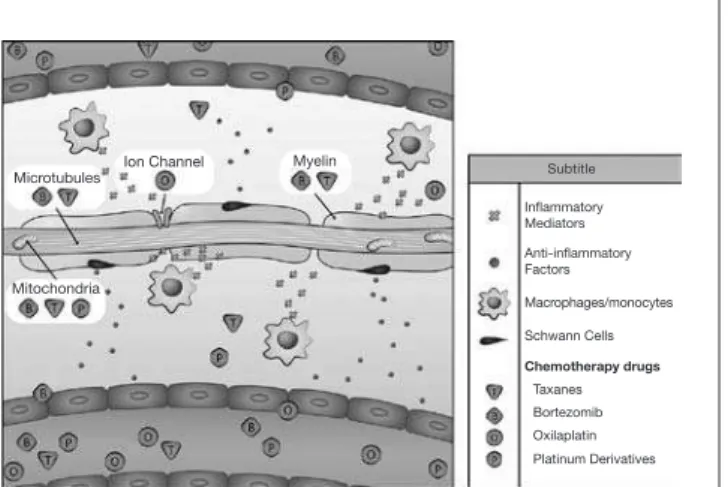
Among pathophysiological CIPN mechanisms, it is currently recognized the role of neuroimmune interaction, since the re-lease of cytokines and chemokines able to trigger peripheral neural injury seems to be a primary mechanism for the deve-lopment of the syndrome. Experimental studies have shown that, in response to toxic injury triggered by anticancer che-motherapy, there might be neural iniltration of monocytes/ macrophages with production of several cytokines (TNFα, IL1β, IL6), chemokines (CX3, CL1, CCL2, CCL3, CCL4, CCL5 and CXCL8) and other inlammatory mediators such as bradykinin, prostaglandins and nitric oxide. Schwann cells may also sufer phenotypic changes and start releasing TNFα, IL1β, IL6 and prostaglandins (PGE2). he same Schwann cells may produce anti-inlammatory factors, such as IL10, in attempt to counterbalance the injury process, thus protecting axons from further injuries (Figure 1)14.
Experimental studies have shown the involvement of neuro-trophic factors on CIPN pathophysiology. For example, Aloe
Table 1. Anticancer agents and respective toxicity mechanisms in the peripheral nervous system Anticancer agent Potential mechanisms for triggering peripheral neuropathy
Carboplatin Cisplatin Oxaliplatin
Decreased axonal transportation Induction of sensory neurons apoptosis. Oxidative stress.
Induction of endothelial cells apoptosis with consequent nervous ibers ischemia, taxanes and platinum deriva-tives.
Paclitaxel Docetaxel
Stabilization of microtubules and induction of oxidative stress.
et al.15 have observed that there is decrease in NGF (neural
growth factor) with cisplatin, which would trigger CIPN. Se-veral studies propose a protective role to BDNF (brain-deri-ved neurotrophic factor) in this syndrome16.
Studies investigating the inluence of inlammatory mediators on human CIPN are still scarce. A cross-sectional study has evaluated the levels of IL6, IL6R and gp130 in 40 females with breast cancer, being 20 with painful CIPN and 20 wi-thout CIPN and who had inished their anticancer therapy between six and 12 months ago. Results have indicated as-sociation of such inlammatory mediators and painful CIPN symptoms, as well as worse QL indices17.
CLINICAL MANIFESTATIONS
CIPN incidence and severity are directly related to dose, num-ber of treatment cycles, previous or simultaneous administra-tion of neurotoxic anticancer agents and the type of impaired nervous iber13,18. For example, when cisplatin is used alone,
the frequency of neuropathic symptoms is around 50%, while 90 to 100% of females receiving the association of cisplatin and paclitaxel for ovarian cancer may present such symptom. Alcohol abuse and other systemic diseases, such as diabetes, related to higher risk of peripheral neuropathy, predispose the onset of more frequent and severe symptoms, even with the use of low doses of anticancer agents18.
CIPN symptoms in general appear in the beginning of the treatment, between the irst and third cycles, with severity peak approximately in the third month of therapy19. At the
end of therapy, diferently from other adverse efects, CIPN symptoms may not stop and may even worsen.
Regardless of the type of anticancer agent, symptoms afect lo-wer limbs, upper limbs and orofacial region. Sensory symptoms are far more common than motor or autonomic symptoms. Among autonomic symptoms there are cardiovascular (blood pressure oscillation), gastrointestinal (constipation) and urolo-gic (erection problems and urinary retention) symptoms. Motor symptoms in general manifest as distal weakness (such as feet weakness), gait and balance disorders, and diiculties with ine movements (writing, buttoning clothes, cutting and sewing)20.
Sensory symptoms are described as bilateral paresthesias, of-ten reported as numbness and tingling in 90% of CIPN cases. In addition, it is common the report of sensation of “wearing a thin sock or glove”, as well as “diiculty to hold things” and to discriminate shape, texture and/or temperature. Ac-cording to the International Association for the Study of Pain (IASP), neuropathic pain is deined as “pain caused by injury or disease of the somatosensory system”. Neuropathic pain is characterized by the combination of negative symptoms, such as partial or complete loss of sensitivity, as well as positive symptoms which include dysesthesia, paresthesia and pain. Its incidence is 40% of cancer pain patients, being described as “burning” pain and “sensation of shock”, in general involving hands and feet. CIPN may be considered predictor of neuro-pathic pain, being that CIPN patients have three times more chance of developing neuropathic pain after treatment18.
It is worth stressing acute pain induced by paclitaxel (P-APS) and the subsequent risk of developing CIPN. P-APS is cha-racterized by difuse muscle and joint pain, especially in lower limbs and hips, which starts during the administration of the drug with evolution until one week after the end of the infu-sion. It is believed that this syndrome might be a red lag for
Figure 1. Role of neuroimmune communication in the pathophysiology of chemotherapy-induced peripheral neuropathy
b) The exposure of the sensory nerve to the action of poten-tially neurotoxic anticancer agents induces response to the injury, with consequent iniltration of monocytes/macropha-ges producing and releasing inlammatory mediators. In the attempt to counterbalance tissue injury, there is release of an-ti-inlammatory mediators by Schwann cells. Preferred action sites of chemotherapy drugs are also illustrated. For example, microtubules may be the target of bortezomib and taxanes. a) In physiological conditions stands out the vascularization of
sen-sory neuron axons located in dorsal root ganglia and the release of mediators by Schwann cells.
Inlammatory Mediators
Anti-inlammatory Factors
Macrophages/monocytes
Schwann Cells
Chemotherapy drugs
Taxanes Bortezomib Oxilaplatin Platinum Derivatives
Microtubules
Mitochondria
the need of a prophylactic agent to prevent or minimize the development of taxane-induced CIPN. he severity of P-APS symptoms seems to be directly proportional to the severity of neuropathic symptoms21.
CIPN may be dose-limiting. his means that symptoms may evolve to a point in which people can no longer live with them being necessary to decrease anticancer agent dose or even discontinue treatment22. In this context, many patients
avoid reporting symptoms, delaying CIPN diagnosis by heal-th professionals, which is only possible when heal-the condition is severe and more diicult to handle21.
IMPACT
CIPN has signiicant impact on QL, directly interfering with daily activities (DA), functionality and behavior of cancer patients23. Verbalization of frustration feelings is common as
a consequence of social role impairment, of distress due to functional skills changes, in addition to dismay and loss of objectives due to the need to give up some activities24. A study
has investigated 240 females with breast cancer and CIPN, observing frequent reports of diiculties to drive, to notice texture and temperature diferences, to walk on high heels, to button a blouse, to comb their hair or even to cook23.
In addition, patients developing neuropathic pain need to come twice as much to health services, need further care and a larger number of drugs as compared to those not developing painful CIPN18.
A cross-sectional study has evaluated 706 patients with regard to the inluence of CIPN in the development of mental and sleep disorders after the fourth week of potentially neurotoxic anticancer treatment. he worst CIPN severity, the highest the frequency of anxiety, depression and sleep disorders, whi-ch were worsened by neuropathic pain24. Cognitive
impair-ment, non-adherence to treatment and loss of self-care ability
are also described.
Efects on motility and balance up to 2.5 years after treatment are reported, being related to clinical decay of the elderly who received chemotherapy. Patients under potentially neurotoxic chemotherapy are at higher risk for falls, which increases at every chemotherapy cycle, especially in patients receiving pa-clitaxel as compared to those receiving platinum derivatives25.
DIAGNOSIS AND EVALUATION OF CHEMOTHERA-PY-INDUCED PERIPHERAL NEUROPATHY
A lot has been discussed about diagnostic and evaluation me-thods for CIPN severity, but there is still no consensus about which would be the best strategy for the clinical practice25.
As a consequence, studies on CIPN prevention and manage-ment have been impaired by the absence of a simple, clinically useful, psychometrically valid tool in a universally known language to oncology and which could be implemented by diferent health professionals taking care of this population26.
he golden standard for CIPN evaluation is electroneu-romyography (ENMG), method able to detect nervous beha-vior changes, especially of myelinated ibers, deining the neuropathic involvement27. ENMG more commonly shows
decrease or absence of sensory potentials amplitude, espe-cially in the sural nerve. Nervous conduction velocity may also be decreased28. However, conventional ENMG does not
detect neuropathy of thin ibers and may not identify cases of CIPN restricted to them, which in general course only with pain. here are other limiting factors, such as the fact of being an uncomfortable and high cost exam performed by clinical neurophysiology specialists27.
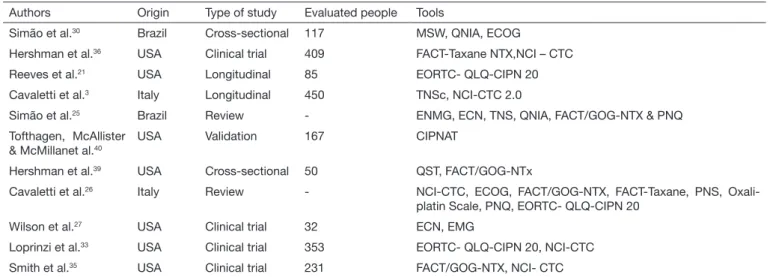
A Medline literature search using descriptors “CIPN” (che-motherapy-induced peripheral neuropathy), “evaluation” and “diagnosis” has identiied tools that are being used in the clinical practice (Table 2). Each one has advantages and disadvantages
Table 2. Studies of evaluation and diagnosis of chemotherapy-induced peripheral neuropathy using different clinical tools
Authors Origin Type of study Evaluated people Tools
Simão et al.30 Brazil Cross-sectional 117 MSW, QNIA, ECOG
Hershman et al.36 USA Clinical trial 409 FACT-Taxane NTX,NCI – CTC
Reeves et al.21 USA Longitudinal 85 EORTC- QLQ-CIPN 20
Cavaletti et al.3 Italy Longitudinal 450 TNSc, NCI-CTC 2.0
Simão et al.25 Brazil Review - ENMG, ECN, TNS, QNIA, FACT/GOG-NTX & PNQ
Tofthagen, McAllister & McMillanet al.40
USA Validation 167 CIPNAT
Hershman et al.39 USA Cross-sectional 50 QST, FACT/GOG-NTx
Cavaletti et al.26 Italy Review - NCI-CTC, ECOG, FACT/GOG-NTX, FACT-Taxane, PNS,
Oxali-platin Scale, PNQ, EORTC- QLQ-CIPN 20
Wilson et al.27 USA Clinical trial 32 ECN, EMG
Loprinzi et al.33 USA Clinical trial 353 EORTC- QLQ-CIPN 20, NCI-CTC
Smith et al.35 USA Clinical trial 231 FACT/GOG-NTX, NCI- CTC
related to applicability, reliability and association to other clini-cal parameters such as QL26. Recently, the CI-PeriNoms Group,
made up of 46 research centers of diferent countries, has been dedicated to establishing the validity and reliability of diferent CIPN measurement tools. According to their conclusion, avai-lable scales have highly diverting reliability and there are gaps, especially in determining the severity of CIPN symptoms29.
In Brazil, investigators are studying the use of Semmes-Weins-tein Monoilaments (MSW) and the Anticancer Agents-Indu-ced Neurotoxicity Questionnaire (QNIA) to evaluate CIPN. QNIA has shown high reliability, being clearly understood by respondents. By means of a cross-sectional study, QNIA and MSW were applied to 87 people in potentially neurotoxic anticancer treatment and to 30 healthy controls. here have been signiicant diferences between groups in all evaluated items, as well as good matching between tools. MSW were able to detect subclinical CIPN presentations30.
MANAGEMENT AND PREVENTION
Aiming at preventing CIPN, diferent substances are being studied such as vitamin E, aminophosphatine, glutathione, adrenocorticotrophic hormone analogs (ACTH) and diethyl-citiocarbamate. To date, the eicacy of these approaches is not clearly deined. A Cochrane review on interventions to pre-vent cisplatin-induced neuropathy has concluded that data are insuicient to prove the eicacy of any studied agent31.
he role of calcium and magnesium infusion to prevent oxa-liplatin-induced CIPN in colorectal cancer patients was eva-luated in meta-analysis involving four prospective and three retrospective studies with 1,170 patients. Among them, 892 have received calcium and magnesium infusions (Ca++/Mg++) and 368 constituted the control group. he incidence of acute neurotoxicity level 3 was lower in the group receiving calcium and magnesium (OR=0.26; CI95%=0.11-0.62; p=0.0002). Cumulative and late toxicity level 3 rates were also lower in the group receiving ion infusions (OR=0.42; CI95% 0.26-0.65; p=0.0001; OR=0.60; CI95% 039-0.92; p=0.02, respective-ly). he diference in the number of oxaliplatin cycles between groups was also signiicant, indicating better tolerance to tre-atment by the experimental group. here were no diferences in progression-free survival, in global survival or response rate, showing that the administration of calcium and magnesium has not decreased the eicacy of chemotherapy32.
However, the study N08CB denies such results: 353 patients receiving adjuvant oxaliplatin for colon cancer were randomi-zed in three arms: intravenous Ca++/Mg++ (IV), 1g calcium gluconate, 1g magnesium sulfate before and after oxaliplatin; placebo before and after oxaliplatin, and the arm receiving IV Ca++/Mg++ before oxaliplatin and placebo after. Prima-ry outcome was cumulative neurotoxicity. here has been no beneit with ions administration, being that cumulative neu-rotoxicity, acute neurotoxicity and chemotherapy discontinu-ation rates were similar for all groups33.
he possible beneit of venlafaxine was suggested in a small placebo-controlled study with 48 patients with
oxaliplatin--induced acute neuropathy. he group receiving 50mg ven-lafaxine 1h before oxaliplatin infusion, followed by 37.5mg twice a day from the second to the 11th day, had acute
symp-toms relief as compared to the group receiving placebo (31 versus 5%). Even three months after treatment, less patients had neurotoxicity symptoms in the venlafaxine group (6 ver-sus 39%). Although promising, these data need conirmation by more robust studies34.
he irst large phase III study describing an efective interven-tion for CIPN was recently published. In the double-blind placebo-controlled study (CALBG 170601) involving 231 patients with CIPN induced by taxanes or oxaliplatin, the eicacy of duloxetine was evaluated. Patients received one tablet (30mg) per day during one week and then 2 tablets (60mg) per day for four weeks. he National Cancer Institu-te-Common Terminology Criteria for Adverse Efects (NCI--CTCAE) was used to classify the level of painful CIPN. his is a subjective scale which evaluates adverse events related to toxicity including peripheral, sensory and motor neuropathy, dysesthesia, paresthesias, as well as neuralgias, with scores from 1 to 5 according to symptoms severity.
With regard to pain and QL, the following tools were used: Short Form of the Brief Pain Inventory (BPI-SF), which mea-sures pain intensity and interference, Functional Assessment of Cancer herapy/Gynecologic Oncology Group-Neurotoxicity (FACT/GOG-Ntx) which evaluates QL and neurotoxicity, in addition to the European Organization for Research and Treatment of Cancer (EORTC) and the Quality of Life Ques-tionnaire 30 (QLQ-30) used to evaluate QL. As compared to placebo, the relative risk of 30% less in pain with duloxetine was 1.96 (CI95%=1.15-3.35) and of 50% less pain was 2.43 (CI95%=1.11-5.30). Patients treated with oxaliplatin had hi-gher beneit as compared to those treated with taxanes. Duloxe-tine was also associated to functional and QL improvement35.
A criticism to the study relates to tools to evaluate the level of neuropathy, which were based only on subjective judgment. A diferent perspective for CIPN management would be Alcar, an L-carnitine ester which helps energetic metabolism and may be endogenously produced or acquired by diet22. Preliminary
studies showed that Alcar would probably not inluence ova-rian cancer treatment and could have a neuroprotecting efect by diferent mechanisms, including increased NGF receptor expression22. he Southwest Oncology Group (SWOG) S0715
study has contradicted initial optimism after evaluating the role of Alcar in preventing CIPN in 409 patients receiving taxanes during adjuvant breast cancer therapy. With regard to control group, there has been a trend to worsening neurological symp-toms in the intervention group after 24 weeks of follow-up36.
In summary, from pharmacological viewpoint, there are no con-sistent evidences about the eicacy of CIPN prevention strategies. Duloxetine is the best available evidence to treat CIPN-related symptoms. Given the eicacy of neuropathic pain management, tricyclic antidepressants (nortriptyline, amitriptyline) and gaba-pentin may be considered in the context of painful CIPN38.
Even without scientiic evidences, non-pharmacological stra-tegies are widely employed for CIPN symptoms, including physiotherapy, acupuncture, physical activity, massages and occupational therapy, in addition to educative interventions aiming at encouraging patients and their families to be careful with symptoms and to plan home environment23.
CONCLUSION
It is known that CIPN is a frequent problem negatively in-terfering with anticancer therapy. Diferent drugs are associa-ted to variable risk levels, which shows CIPN neurobiological complexity. Prevention, diagnosis and management strategies still have to evolve to minimize CIPN incidence and severity. Patients should be informed about the limitations of scientiic evidences for CIPN prevention and management, as well as about their potential risks, beneits and costs.
ACKNOWLEDGMENTS
his study was partially supported by CNPq & Fapemig, Brazil.
REFERENCES
1. Malik B, Stillman M. Chemotherapy-induced peripheral neuropathy. Curr Neurol Neu-rosci Rep. 2008;8(1):56-65.
2. Velasco R, Bruna J. Chemotherapy-induced peripheral neuropathy: an unresolved issue. Neurologia. 2010;25(2):116-31.
3. Cavaletti G, Frigeni B, Lanzani F, Piatti M, Rota S, Briani C, et al. he Total Neuropathy Score as an assessment tool for grading the course of chemotherapy-induced peripheral neurotoxicity: comparison with the National Cancer Institute-Common Toxicity Scale. J Peripher Nerv Syst. 2007;12(3):210-5.
4. Miltenburg NC, Boogerd W. Chemotherapy-induced neuropathy: a comprehensive sur-vey. Cancer Treat Rev. 2014;40(7):872-82.
5. Cavaletti G, Tredici G, Marmiroli P, Petruccioli MG, Barajon I, Fabbrica D. Morphome-tric study of the sensory neuron and peripheral nerve changes induced by chronic cisplatin (DDP) administration in rats. Acta Neuropathol. 1992;84(4):364-71.
6. Grolleau F, Gamelin L, Boisdron-Celle M, Lapied B, Pelhate M, Gamelin E. A possible explanation for a neurotoxic efect of the anticancer agent oxaliplatin on neuronal voltage--gated sodium channels. J Neurophysiol. 2001;85(5):2293-7.
7. Baptista-de-Souza D, Di Cesare Mannelli L, Zanardelli M, Micheli L, Nunes-de-Souza RL, Canto-de-Souza A, et al. Serotonergic modulation in neuropathy induced by oxalipla-tin: efect on the 5HT2C receptor. Eur J Pharmacol. 2014;735:141-9.
8. Rowinsky EK, Donehower RC. Paclitaxel (taxol). N Engl J Med. 1995;332(15):1004-14. Erratum in: N Engl J Med. 1995;333(1):75.
9. Argyriou AA, Polychronopoulos P, Koutras A, Iconomou G, Gourzis P, Assimakopoulos K, et al. Is advanced age associated with increased incidence and severity of chemotherapy--induced peripheral neuropathy? Support Care Cancer. 2006;14(3):223-9.
10. Fidanboylu M, Griiths LA, Flatters SJ. Global inhibition of reactive oxygen species (ROS) inhibits paclitaxel-induced painful peripheral neuropathy. PLoS One. 2011;6(9):e25212. 11. Bruna J, Udina E, Alé A, Vilches JJ, Vynckier A, Monbaliu J, et al. Neurophysiological, his-tological and immunohistochemical characterization of bortezomib-induced neuropathy in mice. Exp Neurol. 2010;223(2):599-608.
12. Gilardini A, Avila RL, Oggioni N, Rodriguez-Menendez V, Bossi M, Canta A, et al. Mye-lin structure is unaltered in chemotherapy-induced peripheral neuropathy. Neurotoxicolo-gy. 2012;33(1):1-7.
13. Kanbayashi Y, Hosokawa T, Okamoto K, Konishi H, Otsuji E, Yoshikawa T, et al. Statis-tical identiication of predictors for peripheral neuropathy associated with administration of bortezomib, taxanes, oxaliplatin or vincristine using ordered logistic regression analysis. Anticancer Drugs. 2010;21(9):877-81.
14. Abraham KE, McMillen D, Brewer KL. he efects of endogenous interleukin-10 on gray
matter damage and the development of pain behaviors following excitotoxic spinal cord injury in the mouse. Neuroscience. 2004;124(4):945-52.
15. Aloe L, Manni L, Properzi F, De Santis S, Fiore M. Evidence that nerve growth factor promotes the recovery of peripheral neuropathy induced in mice by cisplatin: behavioral, structural and biochemical analysis. Auton Neurosci. 2000;86(1-2):84-93.
16. Cavaletti G, Marmiroli P. he role of growth factors in the prevention and treatment of chemotherapy-induced peripheral neurotoxicity. Curr Drug Saf. 2006;1(1):35-42. 17. Starkweather A. Increased interleukin-6 activity associated with painful
chemotherapy--induced peripheral neuropathy in women after breast cancer treatment. Nurs Res Pract. 2010;2010:281531.
18. Reyes-Gibby CC, Morrow PK, Buzdar A, Shete S. Chemotherapy-induced peripheral neuropathy as a predictor of neuropathic pain in breast cancer patients previously treated with paclitaxel. J Pain. 2009;10(11):1146-50.
19. Verstappen CC, Postma TJ, Hoekman K, Heimans JJ. Peripheral neuropathy due to the-rapy with paclitaxel, gemcitabine, and cisplatin in patients with advanced ovarian cancer. J Neurooncol. 2003;63(2):201-5.
20. Argyriou AA, Zolota V, Kyriakopoulou O, Kalofonos HP. Toxic peripheral neuropathy associated with commonly used chemotherapeutic agents. J BUON. 2010;15(3):435-46. 21. Carlson K, Ocean AJ. Peripheral neuropathy with microtubule-targeting agents:
occurren-ce and management approach. Clin Breast Canoccurren-cer. 2011;11(2):73-81.
22. Engle DB, Belisle JA, Gubbels JA, Petrie SE, Hutson PR, Kushner DM, et al. Efect of acetyl-l-carnitine on ovarian cancer cells’ proliferation, nerve growth factor receptor (Trk-A and p75) expression, and the cytotoxic potential of paclitaxel and carboplatin. Gynecol Oncol. 2009;112(3):631-6.
23. Speck RM, DeMichele A, Farrar JT, Hennessy S, Mao JJ, Stineman MG, et al. Scope of symptoms and self-management strategies for chemotherapy-induced peripheral neuropa-thy in breast cancer patients. Support Care Cancer. 2012;20(10):2433-9.
24. Hong JS, Tian J, Wu LH. he inluence of chemotherapy-induced neurotoxicity on psycho-logical distress and sleep disturbance in cancer patients. Curr Oncol. 2014;21(4):174-80. 25. Simão DAS, Lima ED, Souza RS, Alves KR, Maia WM. Instrumentos de avaliação da
neuropatia periférica induzida por quimioterapia: revisão integrativa e implicações para a prática de enfermagem oncológica. Reme Rev Min Enferm. 2012;16(4):609-15. 26. Cavaletti G, Frigeni B, Lanzani F, Mattavelli L, Susani E, Alberti P, et al.
Chemotherapy--induced peripheral neurotoxicity assessment: a critical revision of the currently available tools. Eur J Cancer. 2010;46(3):479-94.
27. Wilson RH, Lehky T, homas RR, Quinn MG, Floeter MK, Grem JL. Acute oxaliplatin--induced peripheral nerve hyperexcitability. J Clin Oncol. 2002;20(7):1767-74. 28. Chaudhry V, Rowinsky EK, Sartorius SE, Donehower RC, Cornblath DR. Peripheral
neuropathy from taxol and cisplatin combination chemotherapy: clinical and electrophy-siological studies. Ann Neurol. 1994;35(3):304-11.
29. Cavaletti G, Cornblath DR, Merkies IS, Postma TJ, Rossi E, Frigeni B, et al. he che-motherapy-induced peripheral neuropathy outcome measures standardization study: from consensus to the irst validity and reliability indings. Ann Oncol. 2013;24(2):454-62. 30. Simão DAS, Teixeira AL, Souza RS, de Paula Lima ED. Evaluation of the
Semmes-Weins-tein ilaments and a questionnaire to assess chemotherapy-induced peripheral neuropathy. Support Care Cancer. 2014;22(10):2767-73.
31. Albers JW, Chaudhry V, Cavaletti G, Donehower RC. Interventions for preventing neuropathy caused by cisplatin and related compounds. Cochrane Database Syst Rev. 2011(2):CD005228.
32. Wen F, Zhou Y, Wang W, Hu QC, Liu YT, Zhang PF, et al. Ca/Mg infusions for the prevention of oxaliplatin-related neurotoxicity in patients with colorectal cancer: a meta--analysis. Ann Oncol. 2013;24(1):171-8.
33. Loprinzi CL, Qin R, Dakhil SR, Fehrenbacher L, Flynn KA, Atherton P, et al. Phase III randomized, placebo-controlled, double-blind study of intravenous calcium and mag-nesium to prevent oxaliplatin-induced sensory neurotoxicity (N08CB/Alliance). J Clin Oncol. 2014;32(10):997-1005.
34. Durand JP, Deplanque G, Montheil V, Gornet JM, Scotte F, Mir O, et al. Eicacy of venlafaxine for the prevention and relief of oxaliplatin-induced acute neurotoxicity: results of EFFOX, a randomized, double-blind, placebo-controlled phase III trial. Ann Oncol. 2012;23(1):200-5.
35. Smith EM, Pang H, Cirrincione C, Fleishman S, Paskett ED, Ahles T, et al. Efect of du-loxetine on pain, function, and quality of life among patients with chemotherapy-induced painful peripheral neuropathy: a randomized clinical trial. JAMA. 2013;309(13):1359-67. 36. Hershman DL, Unger JM, Crew KD, Minasian LM, Awad D, Moinpour CM, et al.
Ran-domized double-blind placebo-controlled trial of acetyl-L-carnitine for the prevention of taxane-induced neuropathy in women undergoing adjuvant breast cancer therapy. J Clin Oncol. 2013;31(20):2627-33.
37. Barton DL, Wos EJ, Qin R, Mattar BI, Green NB, Lanier KS, et al. A double-blind, placebo-controlled trial of a topical treatment for chemotherapy-induced peripheral neu-ropathy: NCCTG trial N06CA. Support Care Cancer. 2011;19(6):833-41.
38. Hershman DL, Lacchetti C, Dworkin RH, Lavoie Smith EM, Bleeker J. Loprinzi CL, et al. Prevention and management of chemotherapy-induced peripheral neuropathy in survi-vors of adult cancers: American Society of Clinical Oncology clinical practice guideline. J Clin Oncol. 2014;32(18):1941-67.
39. Hershman DL, Weimer LH, Wang A, Kranwinkel G, Brafman L, Fuentes D, et al. As-sociation between patient reported outcomes and quantitative sensory tests for measuring long-term neurotoxicity in breast cancer survivors treated with adjuvant paclitaxel chemo-therapy. Breast Cancer Res Treat. 2011;125(3):767-74.