DOCTORAL CONGRESS
in ENGINEERING
Book of Abstracts
3
rd
Symposium on Mechanical
Porto
July 2019
Editors:
Abel D. Santos, José César de Sá, Rui L. Amaral, Carolina Furtado
Book of Abstracts
of the
3
rd
Symposium on
This volume contains the abstracts presented at the Symposium on Mechanical Engineering, within the 3rd Doctoral Congress in Engineering - DCE19, held in Porto,
between June 27th and 28th, 2019.
Title: Book of Abstracts of the Symposium on Mechanical Engineering Edited by Abel D. Santos, José César de Sá, Rui L. Amaral, Carolina Furtado Published by: FEUP Edições
https://paginas.fe.up.pt/~dce/2019/symposia/symposium-on-mechanical-engineering/ https://sigarra.up.pt/feup/pt/pub_geral.pub_view?pi_pub_base_id=334765
First edition July 2019 ISBN. 978-972-752-252-1
Universidade do Porto, Faculdade de Engenharia, Departamento de Engenharia Mecânica, Rua Dr. Roberto Frias s/n 4200-465 Porto, Portugal
CONTENTS
CONTENTS
CONTENTS
CONTENTS
PREFACE ... vi COMMITTEES ... viii PROGRAMME ... x ABSTRACTS ... 1 AUTHORS INDEX ... 68 AWARDS ………..72
PREFACE
PREFACE
PREFACE
PREFACE
The Symposium on Mechanical Engineering was held within the Third Doctoral Congress in Engineering (DCE19), hosted at Faculty of Engineering of the University of Porto (FEUP), from June 27th to June 28th, 2019.
The scope of the Mechanical Symposium is focused on the science and practice of mechanical engineering. The presented proposals are quite broad and clearly reflect the multidisciplinarity of the area, its applications and recent developments.
This Book, which collects the abstracts or extended abstracts accepted for presentation at DCE, was reproduced directly from the files sent by the authors, having been compiled by the Organizing Committee of the Mechanical Engineering Symposium.
We use this opportunity to thank all the authors and the keynote speakers for sharing their research experience and also the members of the scientific committee for all their efforts and contribution to the success of this edition of Symposium on Mechanical Engineering.
Porto, July 2019 Symposium Organizing Committee
COMMITTEES
COMMITTEES
COMMITTEES
COMMITTEES
Symposium Chairs
Abel Dias dos Santos | FEUP José César de Sá | FEUP
Symposium Organizing Committee
Rui Amaral | PhD candidate in Mechanical Eng, FEUP Carolina Furtado | PhD candidate in Mechanical Eng, FEUP
Scientific Committee
Abel Dias dos Santos | FEUP
Abílio Manuel Pinho de Jesus | FEUP Albertino José Castanho Arteiro | FEUP Alexandre Miguel Prior Afonso | FEUP António Augusto Fernandes | FEUP
António Gil d’Orey de Andrade Campos | U.Aveiro António Torres Marques | FEUP
Armando Carlos Figueiredo Coelho de Oliveira | FEUP Carlos Alberto da Conceição António | FEUP
Clito Félix Alves Afonso | FEUP
Diogo Mariano Simões Neto | U.Coimbra Eduardo André de Sousa Marques | FEUP Fernando Gomes de Almeida | FEUP Fernando Jorge Lino Alves | FEUP Francisco Manuel Andrade Pires | FEUP Joaquim Gabriel Magalhães Mendes | FEUP João Manuel Ribeiro da Silva Tavares | FEUP José Fernando Dias Rodrigues | FEUP
José Luís Carvalho Martins Alves | U.Minho José Valdemar Bidarra Fernandes | U.Coimbra Lucas Filipe Martins da Silva | FEUP
Marco Paulo Lages Parente | FEUP
Marcelo Francisco de Sousa Ferreira de Moura | FEUP Marta Cristina Cardoso de Oliveira | U.Coimbra Paulo Manuel Salgado Tavares de Castro | FEUP
PROGRAMME
PROGRAMME
PROGRAMME
PROGRAMME
Symposium on Mechanical Engineering
Chairs: Abel D. Santos and José César de Sá
Organizing Committee: Rui Amaral and Carolina Furtado Location: room B023
Time for oral presentation: 10’ presentation + 5’ discussion
Session I (27th.June, 10:30 - 12:30) | Moderated by Albertino Arteiro
• Erfan Azinpour, Cesar de Sa and Abel Santos. Application of phase-field diffusive crack approach in a ductile damage model. #182, p.30
• Carolina Furtado, Giuseppe Catalanotti, Albertino Arteiro, Patrick J. Gray, Brian L. Wardle and Pedro P. Camanho. Simulation of failure in laminated polymer composites: building-block validation. #169, p.32
• Rafael Santos, António Pereira, Marilena Butuc and Luciano Moreira. Identification of GTN model parameters for dual-phase steels under tensile loading conditions. #102, p.5
• João Brito, Marta Oliveira, Diogo Neto, José Luís Alves and Luís Menezes. An assessment of a micromechanical damage model for porous solids exhibiting tension–compression asymmetry. #212, p.34
• Armando Marques, Pedro Prates, André Pereira, Marta Oliveira and José Fernandes. Hole Expansion Tests of Metal Sheets: Numerical Study. #209, p.36
• Carlos Andrade, João Barros, Diogo Neto, Amílcar Ramalho, Marta Oliveira, Luís Menezes and José Alves. Mechanical characterization of a polyurethane using a hyper-viscoelastic constitutive model. #214, p.38
• Mohammad Pasandidehpoor, Mohamad Shariyat, Gabriela Tamara Vincze, Augusto Luís Barros Lopes and António Manuel de Bastos Pereira. Multi-objective design optimization for wide tapered multi-cell energy absorber made of aluminum. #124, p.6
Session II (27th.June, 14:15 - 16:45) | Moderated by Eduardo Marques
• Invited Speaker: Lucas da Silva, Recent advances in Adhesion research, Faculty of Engineering, University of Porto.
• Valentina Haralanova. Education and Student Exchange Opportunities - Linnaeus University, Sweden.
• José Marques, Ana Barbosa and Lucas da Silva. Manufacturing functionally graded joints: An overview. #20, p.50
• M.G. Cardoso and R.D.S.G. Campilho. Adherend material effect on the tensile strength on adhesive bonded tubular joints. #97, p.51
• Paulo Nunes, Catarina Borges, Eduardo Marques, Ricardo Carbas, Alireza Akhavan-Safar and Lucas da Silva. An apparatus for fracture envelope determination of adhesives under impact loads. #21, p.53
• Luís Ramalho, Raul Campilho and Jorge Belinha. Using Radial Point Interpolation Meshless Methods to Analyse Adhesive Single-Lap Joints. #71, p.54
Session III (28th.June, 09:00 - 10:30) | Moderated by Marco Parente
• Daniel Rodrigues, Jorge Belinha, Lúcia Dinis and Renato Natal Jorge. A modified Hill yield criterion combined with meshless methods formulation for the elasto-plastic analysis of FFF printed thermoplastics. #77, p.42
• Felipe Klein Fiorentin, Tiago Silva and Abílio Jesus. A Numerical Study on Distortions Prediction of an Additive Manufactured Component and Experimental Validation. #100, p.44
• T. Silva, T. Leça, A. Amaral, J. Xavier and A. Jesus. Additively Manufactured AISI 316L Characterization for Metal Cutting Force Modelling. #107, p.8
• Santiago D Castellanos, Jorge Lino Alves and Rui Neto. Chip Formation and Cutting Forces in Turning a Gamma Titanium Aluminide Alloy. #199, p.10
• Soumitra Gain, T.E.F. Silva, José Xavier, Ana Reis and Abílio Jesus. Mechanical behaviour of the AlSi9Cu3 aluminum alloy under combined stress fields. #76, p.11
• Claudia Facca, Jorge Lino Alves and Ana Mae Barbosa. Digital Fabrication, Engineering and Design: New ways of thinking, creating, acting, manufacturing and learning. #44, p.13
Poster Session (28th June, 10:30 - 11:30)
• Cláudia C. Rua, Elza M. M. Fonseca, Paulo A. G. Piloto, Vânia C. C. Oliveira, Jorge Belinha,
Renato M. N. Jorge and José C. Vasconcelos. Biomechanical stabilization of bone metastases and tumor necrosis due to the thermal effects for different patient age group #4, p.46
• Lino Silva and Elza M. M. Fonseca. Design of wood-steel connections with dowel fasteners
subjected to fire #10, p.47
• Catarina Silva, Jorge Lino Alves, Gabriela Caldas and Jorge Belinha. Influence of the infill shape
and orientation on mechanical properties of PLA 3D parts #69, p.15
• João Araújo Afonso, Jorge Lino Alves, Gabriela Caldas and Jorge Belinha. Influence of 3D printing
process parameters on the mechanical properties of PLA parts and comparison with simulated values #70, p.57
• Bruno Areias, Marco Parente, Fernanda Gentil, Eurico Almeida and Renato Natal Jorge. Numerical study of the human cochlea. #72, p.48
• Daniel Cruz, Miguel Trindade, Abel D. Santos, Joaquim Mendes, Rui L. Amaral and Sara S.
Miranda. Development of a miniature testing for sheet metal mechanical characterization #114, p.17
• Miguel Trindade, Joaquim Mendes, Abel D. Santos, Rui L. Amaral and Sara S. Miranda.
Development of a mechanical sheet metal characterization system using LabVIEW #125, p.18
• João Sousa, Joaquim Mendes, Abel D. Santos, Rui L. Amaral and Sara S. Miranda. Development
of a control unit and data acquisition system for a sheet metal universal testing machine #130, p.19
• Rogério Lopes, Abel Santos, Dipak Wagre, Rui L. Amaral and Sara S. Miranda. Sheet metal
forming simulation and experimental validation using defined benchmarks #144, p.20
• Jozef Pobijak, Tomáš Pavlusík, Abílio M. P. de Jesus, Abel D. Santos and Andrej Czán. Overview
about the Application of Driven Tools for Turning Operations #271, p.21
• Tomáš Pavlusík, Jozef Pobijak, Abel D. Santos, Abílio M. P. de Jesus and Andrej Czán. Residual
Session IV (28th.June, 11:30 - 13:00) | Moderated by Alexandre Afonso
• João Duarte Marafona, Pedro Marques, Ramiro Martins and Jorge Seabra. Analysis of the Dynamic Tooth Loads on Integer Overlap Ratio Helical Gears. #117, p.59
• Behzad Farahani, Francisco Barros, Pedro J. Sousa, Paulo J. Tavares and Pedro Moreira. Geometry and Defect Extraction of Scaled Railway Tunnels Using a 3D Laser Scanning Technique. #63, p.63
• Vítor Gomes, Abílio de Jesus and Miguel Figueiredo. Fatigue Behaviour of Double Shear Bolted Butt Joints Made of Thin Steel Plates. #85, p.63
• Behzad Shahzamanian Sichani, Joao Soares, Szabolcs Varga, Armando Oliveira and Ana Palmero. Development of a small scale triple effect desalination unit driven by solar energy. #123, p.65
• Angela Ribau, Luis Ferrás, Maria Luisa Morgado, Magda Rebelo and Alexandre M. Afonso. Further Developments on Complex Viscoelastic Flows. #54, p.67
Session V (28th.June, 14:00h - 15:00) | Moderated by Abílio Jesus
• Filip Dorčiak, Milan Vaško, Carlos Antonio and Jorge Lino. Flexural test for specimen with different size and shape of inner structures created by 3D printing. #269, p.23
• Sara S. Miranda, Abel D. Santos, Rui L. Amaral, Luís T. Malheiro and José V. Fernandes. Effect of Mechanical Properties Variability of an Advance High Strengh Steel in Sheet Metal Forming Processes. #226, p.25
• Dipak Wagre, Rui L. Amaral and Abel D. Santos. Numerical Analysis Based on Non‐associated Flow for Forming of Anisotropic Sheet Metals. #129, p.26
• Rui L. Amaral, Abel D. Santos, Sara S. Miranda and José César de Sá. Drawability and formability numerical and experimental analysis of dual-phase steels using a deep drawing test. #225, p.27
ABSTRACTS
ABSTRACTS
ABSTRACTS
ABSTRACTS
Materials and Manufacturing Processes
Identification of GTN model parameters for dual-phase steels under tensile loading conditions #102 ... 3 Multi-objective design optimization for wide tapered multi-cell energy absorber made of aluminum #124 ... 4 Additively Manufactured AISI 316L Characterization for Metal Cutting Force Modelling #107 ... 6 Chip Formation and Cutting Forces in Turning a Gamma Titanium Aluminide Alloy #199 ... 8 Mechanical behaviour of the AlSi9Cu3 aluminium alloy under combined stress fields #76 ... 9 Digital Fabrication, Engineering and Design: New ways of thinking, creating, acting, manufacturing and learning #44 ... 11 Influence of the infill shape and orientation on mechanical properties of PLA 3D parts #69 ... 13 Development of a miniature testing for sheet metal mechanical characterization #114 ... 15 Development of a Mechanical Sheet Metal Characterization System #125 ... 16 Development of a Control Unit and Data Acquisition System for a Sheet Metal Universal Testing Machine #130 ... 17 Sheet metal forming simulation and experimental validation using defined benchmarks #144 ... 18 Overview about the Application of Driven Tools for Turning Operations #271 ... 19 Residual stresses in PMO material during the production of tools #307 ... 20 Flexural test for specimen with different size and shape of inner structures created by 3D printing #269. ... 21 Effect of Mechanical Properties Variability of an Advance High Strength Steel in Sheet Metal Forming Processes #226 ... 23 Numerical Analysis Based on Non‐associated Flow for Forming of Anisotropic Sheet Metals #129 ... 24 Drawability and formability numerical and experimental analysis of dual-phase steels using a deep drawing test #225 ... 25
Computational Mechanics
Application of phase-field diffusive crack approach in a ductile damage model #182 ... 29 Simulation of failure in laminated polymer composites: building-block
Hole Expansion Tests of Metal Sheets: Numerical Study #209 ... 35 Mechanical characterization of a polyurethane using a hyper-viscoelastic constitutive model #214 ... 37 Residual stresses in a casting component by multiscale analysis #81 ... 39 A modified Hill yield criterion combined with meshless methods formulation for the elasto-plastic analysis of FFF printed thermoplastics #77 ... 41 A Numerical Study on Distortions Prediction of an Additive Manufactured Component and Experimental Validation #100 ... 43 Biomechanical stabilization of bone metastases and tumor necrosis due to the thermal effects for different patient age group #4 ... 45 Design of wood-steel connections with dowel fasteners subjected to fire #10 ... 46 Numerical study of the human cochlea #72 ... 47
Adhesive Joints
Manufacturing functionally graded joints: An overview #20 ... 49 Adherend material effect on the tensile strength on adhesive bonded tubular joints #97 ... 50 An apparatus for fracture envelope determination of adhesives under impact loads #21 ... 52 Using Radial Point Interpolation Meshless Methods to Analyse Adhesive Single-Lap Joints #71 ... 53
Dynamic Analysis, Fluids and Experimental Mechanics
Influence of 3D printing process parameters on the mechanical properties of PLA parts and comparison with simulated values #70 ... 57 Analysis of the Dynamic Tooth Loads on Integer Overlap Ratio Helical Gears #117 ... 59 Geometry and Defect Extraction of Scaled Railway Tunnels Using a 3D Laser Scanning Technique #63 ... 61 Fatigue Behaviour of Double Shear Bolted Butt Joints Made of Thin Steel Plates #85 ... 63 Development of a small scale triple effect desalination unit driven by solar energy #123 ... 65 Further Developments on Complex Viscoelastic Flows #54 ... 67
MATERIALS AND MANUFACTURING
PROCESSES
MATERIALS AND MANUFACTURING
PROCESSES
MATERIALS AND MANUFACTURING
PROCESSES
MATERIALS AND MANUFACTURING
PROCESSES
Identification of GTN model parameters for dual-phase
steels under tensile loading conditions
Rafael Oliveira Santos1,2,3, António Manuel de Bastos Pereira1, Marilena
Carmen Butuc1, Luciano Pessanha Moreira3
1TEMA – Centre for Mechanical Technology and Automation, Department of Mechanical
Engineering, Universidade de Aveiro, Campus Universitário de Santiago, 3810-193 Aveiro, Portugual. ([email protected]; [email protected]).
2Department of Mechanical Engineering, Centro Federal de Educação Tecnológica Celso
Suckow da Fonseca, Rua do Areal, 522, CEP 23953-030, Angra dos Reis – RJ,Brazil.([email protected]).
3Department of Metallurgical Engineering, Universidade Federal Fluminense, Av. Dos
Trabalhadores, 420, CEP 27255-125, Volta Redonda-RJ, Brazil. ([email protected]).
Abstract
Application of advanced high strength steels, such as dual-phase steels, has been received great significance in the automotive industry. This is related to the high ultimate yield strength values which improve the crash energy absorption performance. Furthermore, the advanced high strength steels allow manufacturing of structural components with reduced thickness, that is, lighter vehicles with reduction of fuel consumption and greenhouse gas emissions. In this work, the damage behavior of cold-rolled zinc coated dual-phase steel sheets DP600, and DP800 grades were evaluated using uniaxial tensile tests microstructural characterization and numerical modeling (Zhao 2016). The damage evolution in ductile metals arises from the growth of existing voids and nucleation of new voids by means of mechanisms of cracking or interface decohesions of inclusions and or precipitate particles (Saeidi 2014). The proposed procedure allowed identifying the parameters of the Gurson-Tvergaard-Needleman (GTN) damage model for these dual-phase steels (Santos 2018). The DP800 steel displayed improved strain-hardening and increased yield strength along with a lower critical strain to failure owing to higher martensite volume fraction. The resulting ductility effect can be attributed to the void nucleation sites which increase with the number of martensitic islands and ferrite-martensite interfaces.
Keywords. Dual-phase steel, Damage, GTN model, Tensile tests, Finite element modeling.
References
Saeidi, N; Ashrafizadeh, F; Niroumand, B; Forouzan, M. R; Barlat, F. 2014. “Damage mechanism and modeling of void nucleation process in ferrite-martensite dual phase steel.” In Engineering Fracture Mechanics, Vol. 127, 97-103.
Santos, R. O; Silveira, L. B; Moreira, L. P; Cardoso, M. C; Silva, F. R. F; Paula, A. S; Albertacci, D. A. 2018. “Damage identification parameters of dual-phase 600-800 steels based on experimental void analysis and finite element simulations”. In Journal of Materials Research and Technology, Vol. 8 (1), 644-659.
Zhao, P. J; Chen, C. F; Dong, C. F. 2016. “Failure analysis based on microvoids damage model for DP600 steel on in-situ tensile tests”. In Engineering Fracture Mechanics, Vol. 154, 152-168.
Multi-objective design optimization for wide tapered
multi-cell energy absorber made of aluminum
M. Pasandidehpoor1, M. Shariyat 2, G. Vincze1, A.B. Lopes3, A.B.Pereira1
1Center Centre for Mechanical Technology and Automation, Department of Mechanical
Engineering, University of Aveiro, Campus Universitário de Santiago, 3810-193, Portugal.
2Department of Mechanical Engineering, Khaje Nassir University of Technology,
19395-1999 Tehran, Iran
3CICECO, Department of Materials and Ceramic Engineering, University of Aveiro, Campus
Universitário de Santiago, 3810-193, Portugal
Abstract
Due to the extensive use of cars, it has become necessary to design vehicles with higher levels of safety standards. Development of the computer aided design and analysis techniques has enabled employing well-developed commercial finite-element-based crash simulation computer codes, in recent years. The present study is an attempt to optimize behavior of the structural components of a passenger car in a full-frontal crash through including a proposed wide tapered multi-cell energy absorber. The optimization technique relies on the design of experimental (DOE) method to enables finding the absolute extremum solution through Gray Relational Grade (GRG). First, the car is modeled in PATRAN and meshed in ANSA software. Then, the full-scale car model is analyzed in ABAQUS/CAE software. The optimization has been accomplished through a multi-objective function to simultaneously, maximize the observed energy and minimize the passenger’s deceleration. Results are verified by the experimental results.
Keywords: Multi-objective optimization, Crash safety, Design of experiment, Energy absorption, Design of Experiments
1. Introduction
Since the skin panels of the car body are chosen thinner to reduce the vehicle body weight and, consequently, reduce fuel consumption and increase the speed and acceleration in modern cars, investigation of the occupant safety in the frontal crashes has become a crucial issue more than before. Crashworthiness analysis of the passenger cars is generally conducted based on the theory of nonlinear finite element by means of special computer codes. Vehicle behavior determination techniques go through various stages before the model becomes ready for analysis (Kirkpatrick 2000).
2. Materials and Methods
In this study, damage criteria are used to obtain results that are comparable to the experimental results. These criteria include ductile damage for the steel (ρ =7800 (kg⁄m^3 ), E=210 (GPa), σy =776 (MPa), σu =953 (MPa), ϑ =0.3) used in the car body, as well as shear
ductile damage and FLD damage for more detailed modeling of wide tapered multi-cell energy absorber made of aluminum 1060 (ρ =2700 (kg⁄m^3 ), E=68 (GPa), σy =113 (MPa),
σu =147 (MPa), ϑ =0.3). Energy absorbent plays an important role in the energy absorption
and reduction of acceleration force exerted on the occupants in frontal crashes. Therefore, the history of this component was investigated in the present study.
3. Discussion
Analysis of the proposed energy absorber in the ABAQUS/CAE and comparison of results with two other absorbers on the basis of SEA and CFE factors showed that a wide energy absorber behaves much better than two smalls energy absorber assembled between two
panels. Based on the results obtained from this test, it is presented a completely new model to improve the energy absorbers behavior that finally led to development of the energy absorber geometry shown in (Figure 1). Wide energy absorber with length 1.125 (m) and width 0.08 (m) is embedded behind the bumper. The constituent materials and the wideness of this absorber have enabled it to behave much better than two small absorbers on both sides of the vehicle.
Figure 1: Energy absorber 64×4 cells status in time instants following the impact
Gray Relational Grade (GRG) was discovered by Deng in 1982 for working with incomplete information. Gray Relational Analysis can be used to solve complex inter-relationships among multi-objective. Gray normalized ranking for each level is calculated by averaging the coefficients of gray. Overall, in the GRD model if maximum or minimum quantities of objective are desired the output data is obtained using the eq. 1 or 2 respectively. Table 1 shows the value of each factor that uses for the optimization problem.
Xi°(k) =
Xi(0)(K) − min. Xi(0)(K)
max. Xi(0)(K) − minXi(0)(K) (1) Xi°(k) = max. Xi(0)(K) − Xi(0)(K)
max. Xi(0)(K) − minXi(0)(K) (2) Table 1: Factor levels of the GRG optimization problem.
Factor Variable Level (1) Level (2) Level (3)
1 Number of Cells 8x2 64x4 128x8
2 Draft Angle 3 5
4. Conclusions
The results represent a relative improvement in energy absorption and maximum acceleration responses in 64×4 Cells and 5 draft angle energy absorber. Application of the newly- introduced wide tapered multi-cell energy absorber has had a significant impact on energy absorption during full-frontal crash test.
Acknowledgments
The authors acknowledge the support from the projects POCI-01-0145-FEDER-032362, UID/EMS/00481/2013 and CENTRO-01-0145-FEDER-022083.
Additively Manufactured AISI 316L Characterization for
Metal Cutting Force Modelling
T. Silva1, T. Leça2, A. Amaral2, J. Xavier3, A.M.P. Jesus2 1INEGI, Rua Dr. Roberto Frias, 4200-465 Porto, Portugal ([email protected])
2Faculdade de Engenharia, Universidade do Porto, Rua Dr. Roberto Frias 400, 4200-465
Porto, Portugal ([email protected], [email protected], [email protected])
3Departamento de Engenharia Mecânica e Industrial, Faculdade de Universidade Nova de
Lisboa, Calçada de Alfazina 2, 2825-149 Lisboa, Portugal ([email protected])
Abstract
Despite the great deal of attention given to additive manufacturing (AM) of metallic components, functional parts obtained by that method are submitted to subtracting manufacturing finishing operations to ensure dimensional tolerances. The AM process nature results in parts with a distinct mechanical behaviour when compared to conventional equivalent materials (high anisotropy), putting emphasis on its characterization. This study focuses on the mechanical characterization of the AISI 316L stainless steel aiming the machining simulation. Distinct loading conditions and build orientations are explored for multiple specimen geometry fabricated with a fixed set of optimal parameters. Digital image correlation technique is used to validate the multiple applied loading conditions on the specimens. Experimental technological cutting tests are performed and the identification of constitutive laws is discussed.
Keywords. Additive Manufacturing; Metallic Materials; Material Characterization; Numerical Modelling.
1. Introduction
The distinct unconventional manner of additively fabricating parts has been gaining popularity due to the compelling design freedom and good mechanical behaviour, using minimum material resources. Such advantages make it suitable for a wide range of applications, from aeronautics to mould technology. Given that the main purpose of the fabricated parts is serving as functional components in system’s assemblies (Wohlers 2017), surface quality as well as dimensional and geometrical tolerances need to be ensured. Subtractive methodologies (such as finishing metal cutting operations) are most often applied in the post-processing stages in order to meet those requirements (Kaynak et al. 2019). Despite the great focus given to the technology‘s parameters, little has been investigated regarding the material characterization that, due to the layer-by-layer manufacturing nature, reveals distinct properties from the conventionally manufactured materials and even less when it comes to characterization methodologies aiming to the metal cutting simulation (focusing on the characteristic high strain, strain rate and temperature conditions). The predictive control of the metal cutting operations can be of utmost importance in order not to jeopardize a highly valuable AM component but also in the way it can soften the effect of what is a major drawback in the additively fabricated parts – residual stresses. The large thermal gradients involved in the process result in compressive and tensile strains and stresses of the newly processed layers which contribute to the component’s distortion when removed from the fabrication baseplate. The numerical simulation of the metal cutting process may allow to more accurately control the thermally induced state of stress, which goes in line with the current trends of smart manufacturing and process modelling.
This work focuses the development of a material characterization methodology for the AISI 316L stainless steel, envisioning the numerical simulation of metal cutting operations. A
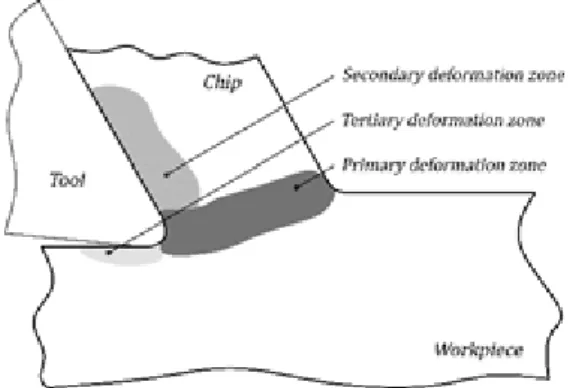
batch with multiple specimen geometries was fabricated in order to cover the study of various loading conditions (such as compression, mixed shear/compression and shear/tension) as well as different building orientations. Digital image correlation is used in order to confirm the predicted loading conditions are ensured, allowing for the identification of the plastic behaviour under different states of stress, which goes in line with the current constitutive modelling trends (Baie t al. 2008). It is important to note that these loading conditions are selected due to being identified as prevailing in primary deformation zone of the orthogonal cutting model, illustrated in Figure 1.
Figure 1: Orthogonal cutting model with the three deformation zones identified.
Since this study does not focus on the processing parameters selection, an already studied optimal configuration was chosen and a standard annealing heat treatment procedure was applied for residual stress relief. Since the material characterization in high ranges of strain, strain rate and temperature is a challenging and costly task, specimens destined to metal cutting experiments (orthogonal cutting and turning) were planned, enabling the discussion of using this experimental data to inversely identify constitutive laws capable of portraying the metal cutting plasticity and fracture phenomena.
Acknowledgments
The MAMTool project financed by Programa Operacional Competitividade e Internacionalização e Programa Operacional Regional de Lisboa, supported by FEDER and national funds (FCT) (no.031895).
References
I. Wohlers Associates, Wohlers report 2017 : 3D printing and additive manufacturing state of the industry : annual worldwide progress report
Y. Kaynak and O. Kitay, “The effect of post-processing operations on surface characteristics of 316L stainless steel produced by selective laser melting,” Additive Manufacturing, vol. 26, pp. 84–93, mar 2019.
Y. Bai and T. Wierzbicki, “A new model of metal plasticity and fracture with pressure and Lode dependence,” International Journal of Plasticity, vol. 24, pp. 1071–1096, 2008.
Chip Formation and Cutting Forces in Turning a Gamma
Titanium Aluminide Alloy
S. D. Castellanos1,2, J. Lino Alves1, R. Neto1
1INEGI, Faculdade de Engenharia, Universidade do Porto, Rua Dr. Roberto Frias, 4200-465
PORTO, Portugal ([email protected])
2Universidad de las Fuerzas Armadas - ESPE, Av. General Rumiñahui, 171103, Sangolquí, Ecuador
Abstract
The study of chip formation is a methodology commonly used for assessment the machinability of materials. This criterion identifies the main characteristics of chips and associates them with material properties, cutting parameters, cutting tools, process type and other factors involved in machining process (Astakhov 2010). γ-TiAl alloys are considered difficult to machining materials, mainly due to its low ductility and anisotropic microstructure. Consequently, the study of chip formation is not an easy task in this material. It is evident, that chip formation theories explained for metallic materials may not be appropriate to describe the mechanics of chip creation during machining γ-TiAl alloys (Priarone et al. 2012; Vargas Pérez 2005). The present research is focused on the comparative study of the chip formation in turning process of a gamma titanium aluminide alloy (Ti-48Al-2Nb-0.7Cr-0.3Si). Chip segmentation were study using a high-speed filming method. Experimental trials were conducted using cutting tools with PVD coated WC-Co inserts with round geometry, varying the cutting processing parameters (Vc: 45-70 m/min, and ap: 0.3-0.5 mm). Also, a cutting force were analyzed and discussed.
Keywords. Machinability, Titanium aluminide alloys, chip formation, cutting forces, round inserts.
Acknowledgments
Authors gratefully acknowledge the funding of Project NORTE-01-0145-FEDER-000022 - SciTech - Science, and Technology for Competitive and Sustainable Industries, co-financed by Programa Operacional Regional do Norte (NORTE2020), through Fundo Europeu de Desenvolvimento Regional (FEDER)
References
Astakhov, Viktor P. 2010. “Surface Integrity -- Definition and Importance in Functional Performance.” In Surface Integrity in Machining, edited by J Paulo Davim, 1–35. London: Springer London. https://doi.org/10.1007/978-1-84882-874-2_1.
Priarone, Paolo Claudio, Stefania Rizzuti, Luca Settineri, and Guido Vergnano. 2012. “Effects of Cutting Angle, Edge Preparation, and Nano-Structured Coating on Milling Performance of a Gamma Titanium Aluminide.” Journal of Materials Processing Technology 212 (12): 2619–28. https://doi.org/10.1016/j.jmatprotec.2012.07.021.
Vargas Pérez, R. G. 2005. “Wear Mechanisms of WC Inserts in Face Milling of Gamma Titanium Aluminides.” Wear 259 (7–12): 1160–67. https://doi.org/10.1016/j.wear.2005.02.062.
Mechanical behaviour of the AlSi9Cu3 aluminium alloy
under combined stress fields
Soumitra Gain1,2, Tiago Fraga1,2, José Xavier3, Abílio M. P. de Jesus1,2,
Ana R. Reis1,2
1Faculty of Engineering, University of Porto, Rua Dr. Roberto Frias, 4200-465 PORTO,
Portugal
2INEGI, University of Porto, Rua Dr. Roberto Frias, 4200-465 PORTO, Portugal
([email protected], [email protected], [email protected], [email protected]
3FCT-UNL, Department of Mechanical and Industrial Engineering, Faculty of Sciences and
Technology, NOVA University of Lisbon, Campus de Caparica, 2928-516 Caparica, Portugal ([email protected])
Abstract
The paper investigates the plastic and fracture behaviours of the AlSi9Cu3 cast alloy covering low negative to high positive triaxialities, and exploring a recently proposed new testing specimen (so called Astakhov specimen) for intermediate negative-positive triaxialities. In addition, tensile tests of smooth and notched specimens were explored. The material revealed a pressure sensitive yield behaviour, as well as a fracture strain showing a cut-off limit for negative stress triaxialities, below which no failure is observed, and a sudden decrease of the facture strain with increasing stress triaxiality. A transition damage regime is expected for low positive stress triaxialities.
Keywords. AlSi9Cu3 cast alloy, Constitutive modelling, Drucker-Prager model, Damage, Fracture locus.
1. Introduction
Aluminium cast alloys (e.g. AlSi9Cu3) are very important for sustainable transports development. Despite an intensive research focus has been devoted to wrought aluminium allows, cast alloys have deserved less attention, despite their importance (Silva, 2019). Understanding the mechanical behaviour of cast aluminium alloys under combined multiaxial stress fields is fundamental, taking into account their applications in mechanical components. This is also important for the appropriate simulation of their processing such as by machining. Recently a new testing specimen (so called Astakhov specimen) has been proposed to allow the material behaviour characterization under combined stress fields: shear, shear+tensile and shear+compression loading. These tests were applied to investigate the plastic and fracture behaviours of the material. The experimental tests also included tensile and compression tests, which are presented and discussed, supported on numerical simulations using of Drucker-Prager constitutive material model.
2. Results and Conclusions
Tensile and compressive tests of smooth cylindrical specimens allowed identifying a significant strength-differential effect of the ALSi9Cu3 alloy, meaning a pressure sensitive yielding behaviour. The Drucker-Prager plasticity criterion was used to model the material plastic behaviour, the results being shown in Figure 1, left. The tensile tests were also performed for notched specimens allowing the evaluation of the material’s ductility for high positive stress triaxialities. The compression tests on smooth cylindrical specimens did not revealed a clear failure mode.
Figure 1: Smooth tensile and compressive behaviours – experimental vs. Drucker-Prager simulation results (left) and failure locus (right) for AlSi9Cu3
alloy.
Figure 2: Astakhov fracture test results: failure appearance vs. DIC shear strain fields at failure instants.
A recently testing specimen was used to evaluate the material behaviour under combined stress fields: shear, shear+tensile and shear+compression loading. The tests were monitored using Digital Image Correlation (see Figure 2) and simulated using Drucker-Prager model. These tests allowed the material characterization between low negative triaxialities to low positive values. The resulting failure locus is presented in Figure 1 (right) for the cast alloy. The material revealed a pressure sensitive yield behaviour, as well as a fracture strain showing a cut-off limit for negative stress triaxialities, below which no failure is observed, and a sudden decrease of the facture strain with increasing stress triaxiality. A transition damage regime is expected for low positive stress triaxialities. Above triaxialities of -0.1, the material show very britle behaviour with failure strains bellow 0.05, which is due to the hard phases in α-Al matrix.
Acknowledgments
This work was funded by the Project NORTE-01-0145-FEDER-000022-SciTech, cofinanced by NORTE2020, through FEDER. The grated scholarship by Erasmus Mundus Lot 13 Project 2013-2540/001-001 is also acknowledged.
References
Silva, T.E.F., Gain , S., Pinto , D., de Jesus, A.M.P., Xavier, J., Reis, A., and Rosa, P.A.R. 2019. “Fracture Characterization of a Cast Aluminum Alloy Aiming Machining Simulation”. Proceedings of the
Institution of Mechanical Engineers, Part L: Journal of Materials: Design and Applications 233(3):
Digital Fabrication, Engineering and Design: New ways
of thinking, creating, acting, manufacturing and
learning
Claudia Facca1, Jorge Lino Alves2, Ana Mae Barbosa3
1Faculdade de Engenharia, Universidade do Porto, Rua Dr. Roberto Frias, 4200-465
PORTO, Portugal – Universidade Anhembi Morumbi, SÃO PAULO, Brasil – Instituto Mauá de Tecnologia, SÃO PAULO, Brasil ([email protected])
2Departmento de Engenharia Mecânica, Faculdade de Engenharia, Universidade do Porto,
Rua Dr. Roberto Frias, 4200-465 PORTO, Portugal ([email protected])
3Pós Graduação em Design, Universidade Anhembi Morumbi, Av. Roque Petroni Jr. 630,
04707-000, SÃO PAULO, Brasil ([email protected])
Abstract
This work discusses the interdisciplinary educational relationship between engineering and design in the context of digital fabricating. New social, cultural, economic and policy needs have demanded different educational approaches that stimulate creativity and inventiveness. The design can contribute in this context, demonstrating new ways to see, think, and act, centering in people needs, providing techniques and tools of project development and solution of complex problems based on design thinking principles like empathy, co-creation and experimentation as ways to integrate with other areas of knowledge such as engineering. The digital fabrication refers to processes that use the computer-controlled tools and the most important thing about design in this process is about to produce tangible objects on demand for business and education. The digital fabrication laboratories can be an environment where there is an opportunity to introduce more efficiently and naturally scientific and academic contents, necessary for the basic training of engineering. Keywords. Digital fabrication, Engineering, Design Thinking, Higher Education.
1. Introduction
In engineering higher education, we have several questions to be answered: What needs are being generated? What competencies are required? What are the challenges proposed? What are the next steps that can turn the difficulties into possibilities? And we need a lot of actions necessary to attend these demands, such as: academic curriculum closer to professional practice, development of communication skills and teamwork, raising awareness of social, environmental, economic and legal issues, student-centered teaching and learning strategies, etc. (Mills & Treagust 2003). New social, cultural, economic, and policy needs have demanded different educational approaches that stimulate creativity and inventiveness (Imbernón 2000). The design can contribute in this context, demonstrating new ways to see, think, and act, putting people and their needs at the center of the process, providing techniques and tools of project development and solution of complex problems based on the design thinking principles like empathy, co-creation and experimentation as ways to integrate with other areas of knowledge such as engineering. The digital fabrication refers to processes that use the computer-controlled tools and the most important thing about design in this process is about to produce tangible objects on demand for business and education (Gershenfeld 2012). In this scenario, digital fabrication laboratories can be an environment where there is an opportunity to introduce more efficiently and naturally scientific and academic contents, necessary for the basic training
2. Materials and Methods
The research was based on a theoretical referential survey based on the following topics: the current scenario in engineering and design higher education, aspects of engineering design, "soft skills" currently required in the formation of the engineer, the industry 4.0, the maker movement and digital fabrication, the (r)evolution of design/fabrication process and the aspects of the maker education.
3. Discussion
The main discussion here is about how is the process of project development, teaching and learning in a digital fabrication mode, what is the characteristics of a digital fabrication educational lab and what is the contribution of design in this context. Some case studies will be presented to show some applications of digital manufacturing in both industry and engineering academic scopes.
4. Conclusions
This paper is part of a larger project in progress, a doctoral research, that addresses the teaching of design in the engineering courses in a transdisciplinary way and analyzes how this relationship happens more specifically in the prototyping laboratories like the Fab Labs. Acknowledgments
This study was financed in part by the Coordination of Improvement of Higher Education Personnel (CAPES - Brazil) - Finance Code 001, Anhembi Morumbi University (UAM – Brazil) and Mauá Institute of Technology (IMT - Brazil).
References
Gershenfeld, Neil. 2012. “How to Make Almost Anything. The Digital Fabrication Revolution”. In: Foreign Affairs. Vol. 91, No 6. Accessed 10 March, 2019. http://cba.mit.edu/docs/papers/12.09.FA.pdf.
Imbernón, F. (Org.). 2000. “A educação no século XXI”. Porto Alegre, RS: Artmed.
Martin, Lee. 2015. “The Promise of the Maker Movement for Education”. In: Journal of Pre-College Engineering Education Research (JPEER): Vol. 5: Iss. 1, Article 4. Accessed 10 March, 2019. https://docs.lib.purdue.edu/jpeer/vol5/iss1/4/.
Mills, Julie E. & Treagust, David F. 2003-04. “Engineering Education – Is Problem based or Project-Based Learning the Answer?” In: Australasian J. of Engng. Educ., online publication. Accessed 10 March, 2019. http://www.aaee.com.au/journal/2003/mills_treagust03.pdf.
Moore, Gideon. 2019. “3 ways to be a good leader in the Fourth Industrial Revolution”. World Economic Forum Annual Meeting. Accessed 10 March, 2019. https://www.weforum.org/agenda/2019/01/the-fourth-industrial-revolution-needs-new-forms-of-leadership/.
Schön, Sandra. 2014. “The Maker Movement. Implications of new digital gadgets, fabrication tools and spaces for creative learning and teaching”. eLearning Papers, nº 39. Accessed 10 March, 2019.
https://www.researchgate.net/publication/263655746_The_Maker_Movement_Implications_ of_new_digital_gadgets_fabrication_tools_and_spaces_for_creative_learning_and_teaching. Nascimento, Maria M. et al. (Ed.). 2018. “Contributions to Higher Engineering Education”.
Influence of the infill shape and orientation on
mechanical properties of PLA 3D parts
Catarina Silva1, Jorge Lino Alves1, G. Caldas1, J. Belinha2 1INEGI,Faculty of Engineer of the University of Porto, Rua Dr. Roberto Frias, 4200-465PORTO, Portugal ([email protected], [email protected], [email protected])
2School of Engineering, Polytechnic of Porto (ISEP), Rua Dr. António Bernardino de
Almeida 431, 4200-072 Porto, Portugal ([email protected])
Abstract
The use of low-cost Fused Filament Fabrication (FFF) machines has been growing in the last years. However, it is also necessary to have parts with better quality and mechanical properties. Recent studies about gyroid models produced by Additive Manufacturing have shown that this geometry is very resistant due to its isotropic mechanical behavior. This work aims to study the influence of this inner infill geometry on the mechanical properties of PLA parts. Samples for tensile, compression and bending were printed in a Ender3 and Creality CR10s were produced with 100% infill and orientations: 0ᵒ ,45ᵒ,+-45ᵒ,90ᵒ and with the gyroid infill, 20%,50%,80% density. The specimens were tested on a universal testing machine.
Keywords. Gyroid models, low cost machines, Fused Filament Fabrication, Infill
1. Introduction
Fused Filament Fabrication (FFF) is one of the most used Additive Manufacturing technologies due to low cost machines and materials. It is accessible to everyone, regardless of their technic know-how. The main difference between FFF and Fused Deposition Modelling (FDM) concerns more in the legal aspects than in the technological one. FDM is the designation for a technology and commercial brand patented by Stratasys. The designation FFF was adopted later and boosted by the open source concept, RepRap, as a more generic way to present the additive material extrusion manufacturing through the material deposition passing by a nozzle (Wohlers et al. 2018).
The biggest barriers for FFF machines being widely used in the industry is its low repeatability and the difficulty to predict quantitatively the influence of the printing parameters on the printed parts.
The Gyroid is a porous complex structure. It was experimentally discovered by Alan Schoen in 1960 and its main interest is due to the combination of local and global homogeneity, so it presents equal resistance to compression regardless of the solicitation direction. This structure is only possible to be produced by additive technologies because of its complex surface, which is even more important than the material itself. The use of this structure to build a repetitive foam will allow to achieve enhanced properties with PLA, making it a stronger and lighter part (Khaderi, Deshpande and Fleck 2014; Monkova et al. 2017). Thus, this work aims to study the influence of the infill geometry on the mechanical properties of the parts.
2. Materials and Methods
The study was divided in two stages. First, the specimens were printed with 100% and orientations of :45º, +-45º, 90º, 0º. Hence, they were tested in tensile, bending and
The second stage was designed to test the gyroid infill. Samples were printed with three different densities: 20%, 50%, 80% and characterized under the same standards (10 samples for each density). Cubic specimens (2 x 2 x 2 mm) were also printed to evaluate the isotropy (15 samples). So, generating in total 135 samples.
3. Discussion
The mechanical properties of the PLA parts were determined by tensile, compression and bending tests. The bonding morphology of the layer on fracture surfaces of the tested samples were evaluated by optical an electronic microscopy.
4. Conclusions
The experimental results indicate that the infill used is very important on the mechanical properties obtained, being the gyroid infill the best option, because of the combination of the mechanical properties gained, the speed of the process and weight. The best combination of properties for a 100% infill orientation is, as expected, gained with the +/- 45º orientation.
Acknowledgments
The authors truly acknowledge the funding provided by Ministério da Ciência, Tecnologia e Ensino Superior - Fundação para a Ciência e a Tecnologia (Portugal) by project funding MIT-EXPL/ISF/0084/2017. Additionally, the authors acknowledge the funding of Project NORTE-01-0145-FEDER-000022 - SciTech - Science and Technology for Competitive and Sustainable Industries, co-financed by Programa Operacional Regional do Norte (NORTE2020), through Fundo Europeu de Desenvolvimento Regional (FEDER).
References
Khaderi, S. N., V. S. Deshpande, and N. A. Fleck. 2014. "The stiffness and strength of the gyroid lattice". International Journal of Solids and Structures 51, no. 23: 3866-77.
https://doi.org/10.1016/j.ijsolstr.2014.06.024.
http://www.sciencedirect.com/science/article/pii/S002076831400256X.
Monkova, Katarina, Peter Monka, Ivana Zetková, Pavel Hanzl, and Dusan Mandulak. 2017. Three
Approaches to the Gyroid Structure Modelling as a Base of Lightweight Component Produced by Additive Technology. 10.12783/dtcse/cmsam2017/16361.
Wohlers, Terry, Ian Campbell, Olaf Diegel, and Joseph Kowen. 2018. Wohlers Report 2018 - 3D
Development of a miniature testing for sheet metal
mechanical characterization
Daniel J. Cruz1,2, Miguel Trindade2, Abel D. Santos1,2, Joaquim Mendes1,2,
Rui L. Amaral2, Sara S. Miranda2
1Faculty of Engineering, University of Porto, Rua Dr. Roberto Frias, 4200-465 Porto,
Portugal ([email protected], [email protected], [email protected], [email protected])
2INEGI, Institute of Science and Innovation in Mechanical and Industrial Engineering, Rua
Dr. Roberto Frias, 400, 4200-465 Porto, Portugal, ([email protected],
Abstract
The miniature tensile testing is a simple yet powerful method to characterize the behavior of a material (Sousa, 2017). Based on this technique, an experimental system was developed aiming the determination of sheet metal mechanical properties. A tensile-compression loading device was designed capable to achieve a strain rate of about 10 -3 s-1at the gage section level. Being the buckling behavior an important phenomenon, a miniature sample geometry was studied and optimized to minimize and to avoid such effect (Boger, 2005). The sample has an uniform section
of 2x2 mm. The device includes custom-made clamps that guarantee the alignment of the sample with respect to the loading axis, guided by linear bearings; it also includes a recirculating roller screw actuated by a step-motor that ensure a continuous and accurate motion. To measure the force during the test an "S"- type load cell is used while the evaluation of the surface strain fields is performed by digital image correlation technique. Following these measurements, hardening curves are evaluated and plotted. Additionally, numerical simulations are performed for the different loading conditions and the obtained results are compared with experimental data, thus being possible to study phenomena such as the Bauschinger and stress differential effects of metallic sheets.
Keywords. tensile test, material mechanical characterization, Bauschinger effect, stress differential.
Acknowledgements
The authors gratefully acknowledge the financial support of the Portuguese Foundation for Science and Technology (FCT) under the projects PTDC/EMS-TEC/6400/2014 ((POCI-01-0145-FEDER-016876), POCI-01-0145-FEDER-031243 and POCI-01-0145-FEDER-030592 by UE/FEDER through the program COMPETE 2020. The fifth author is also grateful to the FCT for the Doctoral grant SFRH/BD/119362/2016.
References
Sousa, A. "Orientation and Location Dependency of the Mechanical Properties of an Alsi10mg Part Produced Using Direct Metal Laser Sintering (DMLS) - a Microsample Approach", Master Thesis, Faculty of Engineering of the University Porto (FEUP), 2017.
Boger, R. K., R. H. Wagoner, F. Barlat, M. G. Lee, and K. Chung. "Continuous, Large Strain, Tension/Compression Testing of Sheet Material." International Journal of Plasticity 21, no. 12 (2005/12/01/ 2005): 2319-43, 2005.
Development of a Mechanical Sheet Metal
Characterization System
Miguel Trindade1,2, Rui L. Amaral2, Sara S. Miranda2, Abel D. Santos1,2,
Joaquim Mendes1,2
1Faculdade de Engenharia, Universidade do Porto, Rua Dr. Roberto Frias, 4200-465 Porto,
Portugal ([email protected], [email protected], [email protected])
2Instituto de Ciência e Inovação em Engenharia Mecânica e Engenharia Industrial, Rua Dr.
Roberto Frias, 400, 4200-465, Porto, Portugal ([email protected] ,
Abstract
Tensile machines are commonly used in mechanical labs to perform tensile, compression or bending tests (Callister, 2007). This work presents the development of a LabVIEW software application to control and acquire the data of a tensile testing machine. This device is meant to perform experimental mechanical tests in metallic sheet specimens with the main goal of promoting the development and study of plastic forming processes. The device can be controlled either through a GPIB (General Purpose Interface Bus) communication protocol, using a GPIB to USB-B converter or by the local HMI (Human Machine Interface) attached to the machine load frame. The acquisition of the force and displacement is performed using a National Instruments data acquisition board, and a LabVIEW application that is able to read, process, display and record the data, as well as, to interact with the tensile testing using the GPIB for status check and commands (Mihura, 2001). Two cameras were installed in the machine, a Microsoft HD webcam for overall scene record, and a professional Ethernet camera equipped with a 75x zoom to evaluate the deformation of the specimen. Thus, the software includes also a module for artificial vision, which is able to process the images and extract the deformation. The interface includes the most common tests and default settings for the respective parameters, making the user interface friendly and easy to use, even for non-specialized professionals.
Keywords: LabVIEW, Tensile Tester, INSTRON 4466, IEEE-488, GPIB, Data Acquisition, Computer Control Acknowledgments
The authors gratefully acknowledge the financial support of the Portuguese Foundation for Science and Technology (FCT) under the projects PTDC/EMS-TEC/6400/2014 ((POCI-01-0145-FEDER-016876), POCI-01-0145-FEDER-031243 and POCI-01-0145-FEDER-030592 and by UE/FEDER through the program COMPETE 2020. Rui L. Amaralis also grateful to the FCT for the Doctoral grant SFRH/BD/119362/2016.
References
William D. Callister. Materials Science and Engineering. Jonh Wiley and Sons, Inc., Seventh edition, 2007.
Development of a Control Unit and Data Acquisition
System for a Sheet Metal Universal Testing Machine
João Sousa1,2, Rui L. Amaral2, Sara S. Miranda2, Abel D. Santos1,2,Joaquim Mendes1,2
1Faculdade de Engenharia, Universidade do Porto, Rua Dr. Roberto Frias, 4200-465 Porto,
Portugal ([email protected], [email protected], [email protected])
2INEGI, Rua Dr. Roberto Frias, 400, 4200-465 Porto, Portugal, ([email protected],
Abstract
A sheet metal universal testing machine is a fundamental need to material formability characterization. This type of machine is flexible enough to perform various tests, which include formability testing such as Nakajima, Fukui, Marciniak and Swift tests, in addition to Hole Expansion tests. The failure prediction of formability behaviour during analysis of sheet metal forming helps the optimization of process and the tool design, by evaluating the manufacturability of a designed part and the selection of materials, based on the complexity and strength requirements (Altan and Tekkaya 2012). The upgrade and new developments in the universal testing machine are divided into three main tasks: (i) collected the machine information and characteristics; (ii) replacement of old components, adding current automation and control capabilities, namely a new programmable logic controller (PLC) and human machine interface (HMI) with updated specifications; (iii) experimental mechanical tests and comparison with the numerical results. The PLC is linked to a Matlab application for real-time data acquisition using the app designer (Matworks) add-on using Ethernet communication. The PLC implements the standard tests, control position and displacement of the Punch. Results of developments will bring a better understanding and validation of numerical results and will provide flexibility to future developments, in order to improve control and data analysis, in addition to allowing diverse mechanical tests with up-to-date technological components. The connectivity and flexibility commonly used in Industry 4.0 will be conceivable to use for web control or remote data acquisition (Ortelt et al. 2014).
Keywords. Universal testing machine, sheet metal forming, formability, automation.
Acknowledgments
The authors gratefully acknowledge the financial support of the Portuguese Foundation for Science and Technology (FCT) under the projects PTDC/EMS-TEC/6400/2014 (016876), 031243, 030592 and POCI-01-0145-FEDER-032466 by UE/FEDER through the program COMPETE 2020. Rui L. Amaral is also grateful to the FCT for the Doctoral grant SFRH/BD/119362/2016.
References
Altan, Taylan, and A. Erman Tekkaya. 2012. Sheet Metal Forming - Fundamentals. ASM International.
Ortelt, T. R., A. Sadiki, C. Pleul, C. Becker, S. Chatti, and A. E. Tekkaya. 2014. “Development of a Tele-Operative Testing Cell as a Remote Lab for Material Characterization.” In 2014 International
Conference on Interactive Collaborative Learning (ICL), 977–82. IEEE. https://doi.org/10.1109/ICL.2014.7017910.
Sheet metal forming simulation and experimental
validation using defined benchmarks
Rogério Lopes1, Abel D. Santos1,2, Dipak Wagre1, Rui L. Amaral2, Sara S.
Miranda2
1Faculdade de Engenharia, Universidade do Porto, Rua Dr. Roberto Frias, 4200-465 Porto,
Portugal ([email protected], [email protected], [email protected])
2Instituto de Ciência e Inovação em Engenharia Mecânica e Engenharia Industrial, Rua Dr.
Roberto Frias, 400, 4200-465 Porto, Portugal ([email protected], [email protected])
Abstract
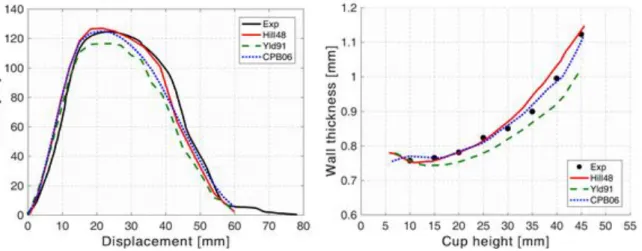
Stamping is a plastic forming process, starting from a sheet of metal in which the main objective is to obtain a part by plastic deformation. Nowadays, numerical simulation is a key point in the design phase of a product, aiming to predict, validate and optimize the results of the manufacturing process. However, accuracy of forming and springback predictions represents a key point on finite element analysis of sheet metal forming processes (Barros et al. 2016), especially when using high strength steels and aluminum alloys. In this contribution case studies are presented, aiming to test and validate numerical results and corresponding model definitions of process conditions and material descriptions. One application is the prediction of forming and springback for an aluminum panel of a car component. This part has been defined and proposed as a benchmark at NUMISHEET 2016 series of conferences. Results are compared with experiments, as well as other numerical results, submitted by benchmark participants. Another application is a deep drawing cylindrical cup test and the objectives include the study and the influence of different yield criteria in the finite element (FE) results (Amaral et al. 2019). Dual-phase steel sheets containing different amounts of martensite are considered. Results for this kind of advanced high strength steels include punch force evolution and the earing height profiles. Experimental tests are also being carried out, thus being possible to compare and validate obtained numerical results.
Keywords. Springback Prediction, Finite Element Method, Sheet Metal Forming
Acknowledgements
The authors gratefully acknowledge the financial support of the Portuguese Foundation for Science and Technology (FCT) under the projects PTDC/EMS-TEC/6400/2014 ((POCI-01-0145-FEDER-016876), POCI-01-0145-FEDER-031243 and POCI-01-0145-FEDER-030592 by UE/FEDER through the program COMPETE 2020. The fourth author is also grateful to the FCT for the Doctoral grant SFRH/BD/119362/2016
References
Barros, P., Alves, J.L., Oliveira, M., Menezes, L. (2016). Tension-compression asymmetry modelling: strategies for anisotropy parameters identification. MATEC Web of Conferences. 80. 05002. 10.1051/matecconf/20168005002.
NUMISHEET 2016: 10th International Conference and Workshop on Numerical Simulation of 3D Sheet Metal Forming Processes, Editors: Rui P.R. Cardoso, A.B. Adetoro, 4–9 Sep 2016, Bristol, UK.
R. L. Amaral, A. D. Santos, S. S. Miranda (2019). Limiting Drawing Ratio and Formability Behaviour of Dual Phase Steels - Experimental Analysis and Finite Element Modelling, In: Silva L. (eds) Materials Design and Applications II, Advanced Structured Materials, 98, pp. 469-486, Springer, Cham. DOI: 10.1007/978-3-030-02257-0_32.
Overview about the Application of Driven Tools for
Turning Operations
Jozef Pobijak1, Tomáš Pavlusík1, Abílio M. P. de Jesus2, Abel D. Santos2,
Andrej Czán1
1Faculty of Mechanical Engineering, University of Žilina, Univerzitná 8215/1, 010 26 Žilina,
Slovakia ([email protected], [email protected], [email protected])
2Faculty of Engineering, University of Porto, Rua Dr. Roberto Frias, 4200-465 PORTO,
Portugal ([email protected], [email protected])
Abstract
In this modern age full of various kinds of products most of the companies are pushed to create and manufacture a lot of products requested by the market with maintaining their quality and accuracy. This process is necessary in the mechanical engineering. Companies focused on mechanical engineering must addere to this situation if they want to stay in competition. Mechanical engineering companies are willing to apply the system this development process to get better their machinery, manufacturing processes and tools as well. Workers in development field develop these things in addiction to what the market needs and what will help with making their productions easier. These facts are very important from an economic perspective, because when companies need to create some products and their nowadays machines that are not able to create requested options. They have an option to buy new equipments. This decision is in many cases not ideal from the economic perspective and development field can create solution like upgrading already used machines or tools, which can save a lot of money. This work solves the situation with upgrading machining center for turning. For machining center will be designed new rotary tool with external drive. Contraction solution have to count on spatial restriction and required stiffness. Whole construction needs to be reliable and resist vibrations and overcome resistance when the tool is cutting metal. Tool will be designed to make angular adjustment possible as well. This adjustment cause deflection from cutting position and will needed to return to his origin position. To return to its original position it will be necessary for construction to provide linear guidance with setting position. This whole upgrade of the machine provides new possibilities for turning, because of adding for machining another driven axis. Big advantage is in possibilities for machining very hard materials, for example titanium alloys because tools with his own rotation cause that the heat is dissipated from the cut place. Tools like that have longer lives, better performance and bigger effectivity. Main reason is good cooling of the tool, which is done by rotation draining the heat from the cutting place. Big advantages are that you can modify your machine cheaper and create machine with another driven axis and create better technology. Also, you can create more complex products, practically in one clamp. In turning area are already rotary tools used, but mainly those so-called autorotation tools. It means that main rotary movement is caused by the friction between workpiece surface and surface of the cutting part of the tool. Tools like that were testing for example in past at University of Zilina by professor Pilc. Turning with rotary tool which is driven externally are not tested that frequently and this work will provide research regarding that tools and provide new possibilities of usage these tools in practical manufacture. The research could possibility solve the quality requirements of the surface after machining by changing the directions in rotary movements and rotary speed as well. Another possibility is the changing of the tool angle and check its impact on machining quality. Final part of the research is focused on chip control. Keywords. Driven tools, machining, turning, develop, materials
Residual stresses in PMO material during the
production of tools
Tomáš Pavlusík1, Jozef Pobijak1, Abel Dias dos Santos1, Abílio M. P. de
Jesus2, Andrej Czán1
1Faculty of Mechanical Engineering, University of Žilina, Univerzitná 1, 010 26 Žilina,
Slovakia ([email protected], [email protected], [email protected])
2Faculty of Engineering, University of Porto, Rua Dr. Roberto Frias, 4200-465 PORTO,
Portugal ([email protected]; [email protected],)
Abstract
The process of multi-axis machining and the change of technological production operations ensure significantly shortening manufacturing times in the production of moulds. This is an inseparable part of the efficiency improvement in moulding tools production. Another major factor in the production of these tools is the required surface quality. The surface quality is affected by many factors like, fatigue strength, wear rate, corrosion resistance and so on. Steel components go through different temperature phases during production. Therefore, it is necessary to examine the integrity of the surface in the production of moulding tools. They are introduced in heat processing and machining. The residual stress values that are included in each operation are diametrically different, so it is crucial to choose the most appropriate operations. In the experimental part we will examine if we are able to maintain the required precision and quality of the tool when we change the production technology from grinding to hard milling. Subsequently, we will examine if the introduced residual stresses have a positive or negative impact on tool longetivity. During experimental measurements of tools that were made by grinding technology, we found residual stresses that had a negative impact on durability. The goal of this work is to analyse the residual stress induced by the designed prototype of the moulding tools with X-ray diffractometer and also to evaluate and review if the residual stresses under the surface have the required values and if it is possible to make moulding tools of the demanded quality by using selected materials and production technologies or if it is vital to make some changes in production technology. There is an acceptable occurrence of pressure stresses in moulding tools, then atoms tend to be grouped and counteract the cracks in the workpiece. Whereas no one dealt with a similar solution in certain material and certain production conditions, it is appropriate to publish these experimental measurements and results to further progress.
Keywords. Tools, production, residual stress, materials.
References
Šajgalík, Pavlusík, Pilc, Mikloš, Daniš, Martinček, Pustay. 2017. Identification of residual stress in the production of molding tools by turn-milling technology. In Technological Engineering