http://dx.doi.org/10.1590/1980-57642018dn12-020007
Delirium in elderly inpatients
admitted to clinical wards
Prevalence and investigation of clinical
conditions in a Brazilian sample
Fernando de Bortoli Pereira1, Marcos Antonio Lopes1
ABSTRACT. In Brazil there is scarce data about the occurrence of delirium among hospitalized elderly patients. Objective: This study aimed to evaluate the prevalence of delirium among elderly patients hospitalized in clinical wards. Methods: This cross-sectional study examined a sample of elderly inpatients admitted to three clinical wards of a general hospital between July 2011 and May 2012. The presence of delirium was detected by applying the Confusion Assessment Method (CAM). Dementia diagnosis was conducted in two steps: screening and diagnosis (Cambridge Examination, CAMDEX, was applied during hospitalization at a second timepoint). Other medical diagnoses and medications in use were extracted from medical records. Results: A sample of 173 elderly inpatients was examined; mean age 71.2 years (SD: 7.8; 60-92 years); 64.2% male. Thirty-one patients were diagnosed with delirium; prevalence of 17.9% (95% CI: 12.2-23.6). Delirium was directly associated with Urinary Tract Infection, Renal Failure and Dementia (p<0.05). Conclusion: The principal findings of this study were a high prevalence of delirium and the identification of associated factors, helping to guide preventive approaches and clinical management for at-risk patients in a Brazilian sample.
Key words: delirium, aged, hospitalization, consultation, epidemiology.
DELIRIUM EM IDOSOS INTERNADOS INTERNADOS EM ENFERMARIAS CLÍNICAS: PREVALÊNCIA E INVESTIGAÇÃO DE
CONDIÇÕES CLÍNICAS EM UMA AMOSTRA BRASILEIRA
RESUMO. No Brasil há poucos dados sobre a ocorrência de delirium entre pacientes idosos hospitalizados. Objetivo: Este estudo teve o objetivo de avaliar a prevalência de delirium entre pacientes idosos hospitalizados em enfermarias clínicas. Métodos: Este estudo transversal examinou uma amostra de idosos hospitalizados em enfermarias clínicas de um hospital geral, no período de julho de 2011 a maio de 2012. A identificação de delirium foi feita através da aplicação do Confusion Assessment Method (CAM). O diagnóstico de demência foi conduzido em duas etapas: rastreamento e diagnóstico (o Cambridge Examination, CAMDEX, foi aplicado durante a hospitalização em um segundo momento). Os outros diagnósticos médicos e as medicações em uso foram extraídos dos prontuários médicos. Resultados: Uma amostra de 173 idosos internados foi examinada; média de idade de 71,2 anos (DP: 7.8; 60-92); 64,2% eram homens. Trinta e um pacientes foram diagnosticados com delirium; prevalência de 17,9% (IC 95%: 12,2-23,6). Delirium exibiu uma associação direta com infecção urinária, insuficiência renal e demência. (p<0,05). Conclusão: A principal implicação deste estudo foi prover informação útil – alta prevalência de delirium e identificação de fatores associados – com o propósito de orientar abordagens preventivas e manejo clínico dirigidos a pacientes com maior risco em uma amostra brasileira. Palavras-chave: delirium, idoso, hospitalização, interconsulta, epidemiologia.
A
ccording to a well-established definition,delirium is a neurobehavioral syndrome
caused by the acute and transient impairment of brain activity. The clinical context usually
This study was conducted at Internal Medicine Department Federal University of Santa Catarina, Florianópolis, SC, Brazil.
1Health Science Center, Internal Medicine Department, Federal University of Santa Catarina, Florianópolis, SC, Brazil.
Marcos Antonio Lopes. Departamento de Clínica Médica – Hospital Universitário Universidade Federal de Santa Catarina – Rua Maria Flora Pausewang, Campus Universitário – 88040-970 Florianópolis SC – Brazil. E-mail: [email protected]
Disclosure: The authors report no conflicts of interest.
involves a vulnerable patient, susceptible to predispos-ing factors, such as clinical illness, cognitive and sensory deficits, with precipitating factors occurring during the period of hospitalization.1 It is highly prevalent in
clini-cal wards, being considered the most common complica-tion of hospital admission in elderly people.2 Although
this medical emergency is cited as one of the oldest diseases described in medicine, its pathophysiological mechanisms are not well defined.
Studies estimate failure to recognize delirium by
physicians in up to 70% of cases,3 a cause of concern
since failure to detect the disease in clinical emergencies is associated with a 7-fold increase in mortality.4 This
disease is directly associated with a worse prognosis,5
being related, among other factors, to a 2-fold increase in mortality, an average of eight additional days of hos-pital stay, worsening of physical and cognitive recovery after 1 year of hospitalization and longer institutional-ization time after discharge.6 A systematic review
ana-lyzing the occurrence of delirium and its consequences in hospitalized patients evaluated 42 studies and found rates ranging from 11% to 42%.7 Regarding Brazilian
data, an article analyzing the prevalence and incidence of delirium among elderly hospitalized with hip frac-tures revealed rates of 16.5% and 12.6%, respectively.8
Although widely explored in international studies, there is little knowledge about the occurrence of delirium
among hospitalized patients in Brazil, especially among elderly patients, the population most affected by this clinical condition. The importance of the present article, therefore, lies in filling this gap in the national literature, focusing on a condition of extreme relevance in the clini-cal context of general hospitals in Brazil. The objectives of this article were to evaluate the prevalence of delirium among elderly patients hospitalized in the clinical wards of the University Hospital of the Federal University of Santa Catarina (HU-UFSC) and its distribution in rela-tion to sociodemographic characteristics, clinical condi-tions and medicacondi-tions.
METHODS
Study design and sample
This cross-sectional study was conducted at the HU-UFSC in Florianópolis (approximately 400,000 population, of which 10.8% were aged 60 years and older, according to the 2010 census). In the study period, 55% of the 77 clinical ward beds at the HU-UFSC were occupied by elderly people. All elderly patients (60 years of age or older) admitted to the Medical Clinic Units of the HU-UFSC between July 2011 and May 2012 for a hospital stay of up to 30 days were included
in the sample. The macro-region of Florianópolis had five general hospitals. The principal causes of admission of elderly people to general hospitals in this region were related to cardio-circulatory (30.1%), oncologic (16.9%), respiratory (14.1%), and digestive (10.0%) diseases.
Instruments
The Confusion Assessment Method (CAM) instrument was used for detecting delirium. The CAM is an
instru-ment created for the diagnostic evaluation of delirium,9
with sensitivity of 94.1%, specificity of 96.3% and inter-rater reliability of 0.70.10 The diagnosis of delirium
requires the presence of items 1 and 2 of the CAM (acute onset and attention disorder) and/or items 3 and 4 (disorganized thinking and altered level of conscious-ness). This instrument is associated with satisfactory validity and reliability, and is greater when involving multiple clinical observations.11
A questionnaire collecting socioeconomic and medi-cal data was applied to the informant/relative, obtaining data regarding age, sex, marital status, education, cog-nitive and affective symptoms, as well as the patient’s medical history. The medical diagnoses and medica-tions in use by patients during the hospital stay were extracted from medical records.
An investigation for the diagnosis of dementia was also performed, in two steps: screening and diagnosis. In the screening phase, the Mini-Mental State Examina-tion (MMSE)12 and the Bayer-Activities of Daily Living
scale (B-ADL)13,14 for the six months prior period were
used. Similarly to a study that investigated dementia in patients with delirium using a scale for informants,15 the
present study applied the B-ADL scale to the informant/ relative to screen dementia. The B-ADL scale has been previously tested for differentiating between mild-to-moderate dementia and normal aging, with sensitivity and specificity of 87.9% and 96.6%, respectively.16 At
a second timepoint during hospitalization, in the diag-nostic phase, the Cambridge Examination (CAMDEX)17
was partially applied to the positively screened cases and informant/relative. Subsequently, a clinical discussion with a geriatric psychiatrist was conducted and the diag-nosis established based on the criteria established by the Diagnostic and Statistical Manual of Mental Disorders, 4th edition (DSM-IV).18 The findings of the dementia
investigation have been published elsewhere.19
Statistical analysis
compare the frequency of controls and cases of delirium
(dependent variable) in relation to several independent variables (sociodemographic factors, clinical conditions and use of medications), employing the Chi-square test. Odds Ratios (OR) and a 95% Confidence Interval (95% CI) were calculated; a P-value <0.05 was consid-ered statistically significant. The multivariate analysis, employing the logistic regression method, was conducted to examine the interference of the independent vari-ables in the association with the dependent variable.
Ethics statement
The project was approved by the local research ethics committee (CEPSH-UFSC). All participants (elderly or relatives) were required to sign a consent form.
RESULTS
During the study period, 296 elderly persons were admitted, of which 123 (41.5%) were subject to attrition, leading to a final sample of 173 subjects. The principal reasons for attrition included medical discharge before the interview (64.6%), death (16.1%), long hospital stay (7.6%) and voluntary drop-out from the study by relatives (7.4%). The sample comprised predominantly subjects who were male (64.2%), had a low level of education (≤4 years, 73.5%) and were married (60.1%); with a mean age of 71.2 years (SD: 7.8; 60-92 years) (Table 1). A total of 31 patients (17.9%; 95% CI: 12.2-23.6) were diagnosed with delirium. The association of delirium with sociodemographic factors, several clinical
Table 1. Sociodemographic distribution of sample.
N %
Age (range) 60-69 81 46.8
70-79 61 35.3
≥80 31 17.9
Gender Male 111 64.2
Female 62 35.8
Education (years) 0 (illiterate) 24 14.1
1-4 101 59.4
5-8 24 14.1
≥9 21 12.4
Marital status Single 7 4.0
Married 104 60.1
Divorced 11 6.4
Widower/widow 51 29.5
Day of evaluation mean
(SD; minimum-maximum) 8.7 (5.9; 1–28)
Table 2. Comparison of participants with and without delirium for sociodemographic variables, clinical conditions and medications.
Without delirium With delirium
p** OR 95%CI
N % N %
Age (range) 60-69 70 86.4 11 13.6 0.162
70-79 50 82 11 18
≥80 22 71 9 29
UTI* No 130 85 23 15 0.018 3.29 1.17-9.25
Yes 12 63.2 7 36.8
Renal failure No 129 86 21 14 0.002 4.25 1.61-11.18
Yes 13 59.1 9 40.9
Cardiac failure No 135 84.4 25 15.6 0.022 3.85 1.13-13.12
Yes 7 58.3 5 41.7
Dementia No 97 91.5 9 8.5 <0.001 6.46 2.21-18.89
Yes 15 62.5 9 37.5
Morphine No 137 84 26 16 0.006 5.26 1.42-19.50
Yes 5 50 5 50
*UTI: urinary tract infection; **Chi-square test.
conditions and use of medications was determined. The bivariate analysis revealed no association with the sociodemographic variables. Regarding clinical variables, presence of delirium was directly associated
with urinary tract infection (UTI), renal failure, cardiac failure and dementia. With respect to medications, use of morphine was directly associated with presence of delirium (Table 2). Age, gender, education, marital
pneu-monia, stroke, hypertension, diabetes mellitus, cancer, angiotensin-converting enzyme inhibitor, losartan, atenolol, digoxin, hydrochlorothiazide, simvastatin, metoclopramide, ranitidine, omeprazole, tramadol, dipyrone, paracetamol, acetylsalicylic acid, prednisone, hydrocortisone, insulin, heparin, marevan, ciproflox-acin, levofloxciproflox-acin, amoxicillin with clavulanate, spiro-lactone, furosemide, hydralazine and benzodiazepine had no association with the presence of delirium.
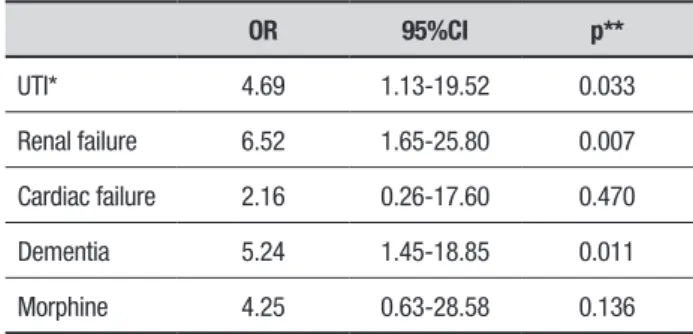
On the multivariate analysis, the presence of UTI, renal failure and dementia were directly associated with
delirium (Table 3).
DISCUSSION
The principal findings of this study were a high preva-lence of delirium in the elderly inpatients and a direct
association of delirium with UTI, renal failure and
dementia.
The present study confirmed the high prevalence of
delirium among elderly inpatients. This rate was very
similar to that reported in Brazilian elderly patients admitted to a geriatric orthopedic ward,8 but lower than
the prevalence of up to 38.3% found in world studies evaluating a geriatric sample.20 The considerable
dispar-ity compared with previous studies is probably related to differences among the populations evaluated, such as patients in the intensive care unit, clinical or surgi-cal wards and inconsistency of diagnostic criteria.20 The
clinical ward setting and the specific scale in this study might explain the relatively low prevalence detected. Moreover, the relatively low rate observed in the other Brazilian study,8 although conducted in an orthopedic
ward, was probably due to use of two procedures within the same study, the prevalence at admission and the incidence during the hospital stay. Some studies, how-ever, have associated the prevalence of delirium with the
quality of the hospital service,2 lending greater
statisti-cal importance to this data.
The association of delirium with certain clinical
condi-tions also corroborated previous studies which observed a strong association with dementia21 and identified
infectious conditions and metabolic disorder among the main causes of delirium in elderly inpatients.22 Between
25% and 75% of patients with delirium have dementia,
and the presence of dementia increases the risk of devel-oping delirium by five.21 A study evaluating the clinical
profile of elderly inpatients admitted with UTI found that delirium was the most common clinical
manifesta-tion, occurring in 56.3% of these patients.23
In relation to the present findings involving mor-phine on the bivariate analysis, it is important to note that, among the precipitating factors of delirium,
medications are implicated in up to 40% of cases1 and
represent an isolated factor in 12%-39%.24 Moreover,
the incidence of delirium increases in direct proportion
to the number of medications used.1 The medications
most commonly associated with delirium are
psychoac-tive medications (such as benzodiazepines), analgesics (such as morphine) and drugs with an anticholinergic effect.24
The main limitations of the present study were the attrition rate (41.5% of initial sample) and the small sample size, which may have led to inaccuracy in the findings (e.g. wide confidence interval on bivariate and multivariate analyses). In addition, although a globally accepted and recognized scale was used for the identifi-cation of delirium, another limitation was the
non-inclu-sion of a medical evaluation to confirm the diagnosis of
delirium.
In conclusion, the findings of this study have sig-nificant implications for clinical practice in identifying the principal factors associated with delirium among
hospitalized elderly in a Brazilian sample. The major contribution of this study is to provide useful informa-tion to help guide a preventive approach and clinical management for at-risk patients, allowing a reduction in delirium incidence, rapid identification and improve-ment in prognosis.25
Author contributions. All authors have contributed to the
work and approved the manuscript.
Acknowledgements: The study was supported by the
FAPESC, grant no. 2451/2011-1.
Table 3. Multivariate analysis with clinical conditions and medications
OR 95%CI p**
UTI* 4.69 1.13-19.52 0.033
Renal failure 6.52 1.65-25.80 0.007
Cardiac failure 2.16 0.26-17.60 0.470
Dementia 5.24 1.45-18.85 0.011
Morphine 4.25 0.63-28.58 0.136
REFERENCES
1. Inouye SK, Charpentier PA. Precipitating risk factors for delirium in hospi-talised elderly persons: predictive model and inter-relationship with base-line vulnerability. JAMA 1996;275:852-7.
2. Inouye SK, Schlesinger MJ, Lydon TJ. Delirium: a symptom of how hospital care is failing older persons and a window to improve quality of hospital care. Am J Med 1999;106:565-73.
3. Levkoff SE, Evans DA, Liptzin B, Cleary PD, Lipsitz LA, Wetle TT, et al. Delirium: the occurrence and persistence of symptoms among elderly hospitalized patients. Arch Intern Med.1992;152:334-40.
4. O’Keeffe ST, Lavan JN. Clinical significance of delirium subtypes in older people. Age Ageing 1999;28:115-9.
5. McAvay GJ, van Ness PH, Bogardus ST, Zhany H, Leslie DL, Leo-Summers LS, et al. Older adults discharged from hospital with delirium: one year outcomes. J Am Geriatr Soc 2006;54:1245-50.
6. McCusker J, Cole M, Dendukuri N, Han L, Bedzile E. The course of delirium in older medical inpatients: a prospective study. J Gen Intern Med 2003;18:696-704.
7. Siddiqi N, House AO, Holmes JD. Occurrence and outcome of delirium in medical inpatients: a systematic literature review. Age Ageing 2006; 35:350-64.
8. Furlaneto ME, Garcez-Leme LE. Delirium in elderly individuals with hip fracture: causes, incidence, prevalence, and risk factors. Clinics 2006; 61(1):35-40.
9. Inouye SK, van Dyck CH, Alessi CA, Balkin S, Sieagl AP, Horwitz RI. Clarifying confusion: the confusion assessment method. A new method for detection of delirium. Ann Intern Med 1990;113(12):941-8. 10. Fabbri RM, Moreira MA, Garrido R, Almeida OP. Validity and reliability
of Portuguese version of the Confusion Assessment Method (CAM) for the detection of delirium in the elderly. Arq Neuropsiquiatr 2001;59 (2-A):175-9.
11. Zou Y, Cole MG, Primeau FJ, McCusker J, Bellavance F, Laplante J. Detection and diagnosis of delirium in the elderly: psychiatrist diagnosis, confusion assessment method, or consensus diagnosis? Int Psychoge-riatr 1998;19(3):303-8.
12. Folstein MF, Folstein SE, McHugh PR. Mini Mental State: a practical method for grading the cognitive state of patients for the clinician. J Psychiatr Res 1975;12:189-198.
13. Hindmarch I, Lehfeld H, Jorgh P, Erzigkeit H. The Bayer Activities of Daily Scale (B-ADL). Dementia 1998;9:20-26.
14. Mapi Research Institute. Cultural Adaptation of the Bayer Activities of Daily Living Scale (B-ADL) into Brazilian Portuguese. Report. Lyon-France: Mapi Research Institute 1999:1-19.
15. Cole MG, McCusker J, Dendukuri N, Han L. Symptoms of delirium among elderly medical inpatients with or without dementia. J Neuro-psychiatry Clin Neurosci 2002;14(2):167-75.
16. Folquitto JC, Bustamante SE, Barros SB, Azevedo D, Lopes MA, Hoto-tian SR, Jacob Filho W, et al. The Bayer: Activities of Daily Living Scale (B-ADL) in the differentiation between mild to moderate dementia and normal aging. Rev Bras Psiquiatr 2007;29(4):350-3.
17. Roth M, Tym E, Mountjoy CQ, Huppert FA, Hendrie H, Verma S, Goddard R. CAMDEX. A standardized instrument for the diagnosis of mental disorders in the elderly with special reference to the early detec-tion of dementia. Br J Psychiatry 1986;149:698-709.
18. American Psychiatric Association. Diagnostic and Statistical Manual of Mental Disorders, 4th ed. Washington, DC: American Psychiatric Asso-ciation, 1994.
19. Maia E, Steglich MS, Lima AP, Troncoso IHZ, Silva KI, Martins TRC, et al. Dementia in elderly inpatients admitted to medical wards in Brazil: diagnosis and comorbidity with other clinical diseases. Psychogeriatrics 2016;16:177-84.
20. Bucht G, Gustafson Y, Sandberg O. Epidemiology of delirium. Dement Geriatr Cogn Disord 1999;10:315-8.
21. Elie LM, Cole MG, Primeau FJ, Bellavance F. Delirium risk factors in elderly hospitalized patients. J Gen Intern Med 1998;13:204–12. 22. Inouye SK. Delirium in older persons. N Engl J Med 2006;354(11):
1157-65.
23. Dallacorte RR, Schneider RH, Benjamin WW. Urinary tract infec-tions profile of the hospitalized elderly in Geriatric Ward. Scientia Med 2007;4:197-204.
24. Alagiakrishnan K, Wiens CA. An approach to drug induced delirium in the elderly. Postgrad Med J 2004;80:388-93.