CHANGES IN THE THYROID GLAND DURING THE
REPRODUCTIVE CYCLE OF THE MALE VESPERTILIONID
BAT,
Scotophilus heathi
KRISHNA, A. and SINGH, K.
Department of Zoology, Banaras Hindu University, Varanasi 221 005, India
Correspondence to: Amitabh Krishna, Department of Zoology, Banaras Hindu University, Varanasi 221 005, India, e-mail: [email protected]
Received October 27, 1997 – Accepted July 02, 1998 – Distributed November 30, 1998
(With 2 figures)
ABSTRACT
The aim of present study was to compare the changes in thyroid gland with the reproductive cycle of S. heathi. Thyroid showed marked seasonal variation in weight, quantity of colloid and follicu-lar epithelial height, suggesting the thyroid gland to be inactive during quiescence and winter dor-mancy and active during the time of recrudescence and breeding similarly to the testicular cycle. Plasma thyroxin (T4) concentration showed a significant seasonal change with high concentration during breeding and post-breeding and low concentration during quiescence. However, the T4 concentration increased from breeding to post-breeding phase, when the testes weight was declining. It is suggested that in S. heathi the positive correlation between thyroid and testicular cycles occurs only during the phases of the reproductive cycle when the body weight and testicular activity are also closely correlated.
Key words: Thyroid, thyroxin, testes, bat, body weight, reproduction.
RESUMO
Mudanças na glândula tireóide durante o ciclo reprodutivo masculino em um morcego
vespertilionídeo Scotophilus heathi
O objetivo do presente estudo foi comparar as mudanças na glândula tireóide com o ciclo reprodutivo de S.heathi. A tireóide mostrou variação sazonal marcada em peso, quantidade de colóide e altura
do epitélio folicular, sugerindo que esta glândula está inativa durante a quiescência e o torpor de inverno e ativa durante o tempo de recrudescência e acasalamento, similarmente ao ciclo testicular. A con-centração de tiroxina (T4) do plasma mostrou significantes mudanças sazonais com alta concentração durante o acasalamento e pós-acasalamento e baixa concentração durante a quiescência. Entretanto, a concentração plasmática de T4 aumentou da fase reprodutiva à pós-reprodutiva, quando o peso dos testículos estava se reduzindo. Sugere-se que, em S. heathi, a estreita correlação entre os ciclos testicular
e tireóideo durante algumas fases do ciclo reprodutivo esteja relacionada à sensibilidade aumentada no período reprodutivo e à atividade metabólica.
Palavras-chave: Tireóide, tiroxina, testículos, morcego, peso corporal, reprodução.
INTRODUCTION
Temperate-zone vespertilionid bats exhibit several unique features in their reproductive cycle such as prolonged sperm retention in the epididy-mis, asynchronous renewal of gametogenesis and the accessory reproductive organs and asynchrony
vespertilionid, does not undergo prolonged hiber-nation, these bats exhibit peculiarities in repro-ductive process as demonstrated in temperate-zone vespertilionid bats. Previous studies from our laboratory have showed an increase in the cir-culating androstenedione concentration during the period of October to December, which was higher than androstenedione concentration reported in most mammalian species (Singh & Krishna, 1995, 1996). This increase in unusually high circulating androstenedione concentration may be responsible for the unique reproductive features noticed in S. heathi. A direct correlation between
the increase in body weight and circulating an-drostenedione concentration was shown in this species (Singh & Krishna, 1996). In: S. heathi,
serum androstenedione level increases during the period of weight gain, and declines during the period of weight loss. These studies suggested that nutritional changes can influence gonadal steroidogenesis in the species. It is therefore possible that the reproductive activity in S. heathi
may be influenced by changing metabolic status. The metabolic hormone, thyroxine (T4), has been implicated in the physiological regulation of energy balance as well as in maintaining nor-mal reproductive function in mamnor-mals (Schwartz
et al., 1992; Boswell et al., 1994; Shi & Barrel,
1992). Further it has been reported that a reduction in the secretion and plasma levels of gonadotrophins was associated with hypo-thyroidism (Hagino, 1971; LaRochelle & Freeman, 1974; Buchanan et al., 1977). Likewise,
Dunn et al. (1976) have shown that the daily
rhythmic release of luteinizing hormone (LH) and prolactin in rats was altered by thyroidectomy. Subsequently, thyroid hormones were shown to be required for a normal transition from the reproductively active to inactive condition and vice versa in several seasonally breeding avian and mammalian species (Shi & Barrell, 1992). Although there are some studies on the thyroid gland of bats (Hudson & Wang, 1979) Itwould be interesting to find out the relationship between thyroid and testes in the bat showing unique reproductive features related to metabolic changes. Therefore, the pattern of seasonal changes in the thyroid gland of S. heathi was
studied in relation to the changes in its repro-ductive cycle.
MATERIALS AND METHODS
All bats were trapped alive in the areas adjacent to Banaras Hindu University Campus. Body weight of each bat was recorded. Based on the reproductive cycle of S. heathi (Krishna &
Singh, 1997), males were classified into the fol-lowing five stages:
1. Quiescence (May to August): Testis do
not show spermatogenesis, the accessory sex glands are regressed and there is no sperm in epididymis.
2. Recrudescence (September to early
No-vember): Testis showing spermatogenesis, the
accessory sex glands are non-secretory but sperm is present in epididymis.
3. Breeding (Mid-November to early
De-cember; February to March): Testis showing
spermatogenesis, the accessory sex glands are active and sperm is present in epididymis.
4. Winter dormancy (Mid-December to
Mid January): Testis not showing
spermatoge-nesis, the accessory sex glands are regressed but sperm is present in epididymis.
5. End of breeding (Late March to April):
Testis showing regressive changes, the accessory sex glands are regressed but sperm is present in epididymis.
Collection of Serum and Tissues Histology
The male bats were sacrificed as soon as they arrived in the laboratory. Their blood serum was collected and stored in – 20ºC until assayed. Testis and thyroid were excised out from the body cavity and excess fat and connective tissue at-tached were separated out. All the tissues were fixed in Bouin’s fluid for 24 hr., followed by preservation in 70% ethyl alcohol. Each tissue was weighed separately after placement in 70% alcohol. The tissues were dehydrated in ethanol, cleared in oxylol, embedded in paraffin wax, se-rial sections at 6 µm were cut and stained with haematoxylin and eosin.
Morphometry
particu-lar section of the thyroid gland was estimated using standard point counting techniques (Weibel, 1979; Singh & Krishna, 1996). Three to five sections regularly spaced throughout the thyroid of each bat were examined at 100 x magnifica-tion under a microphat FX microscope (Nikon) attached to a TV monitor fitted with a square lattice containing 560 crosses. The sections used for morphometric analysis were selected by sys-tematic random scheme (West, 1993). The first section was selected from the first five serial sections of the thyroid, and then every 20th se-rial section was examined. The number of crosses falling on the colloid or epithelial cells (hits) and over the entire thyroid section were counted. At 140X magnification, these crosses fell 70 µm aparts. The number of points falling on the col-loid (P) and over the entire thyroid section (Pt) was obtained for each section examined. The areal fraction (AA) was then calculated using the formula: AA = (Pi)/(Pti), where Pi = number of hits in section i, Pti = number of test point in section i. The mean areal fraction was then calculated from the data (Aa) obtained from each thyroid examined per group. The thyroid from at least 4 males from group were examined for morphometric analysis.
Hormony Assay
Thyroxine: The circulating T4
concentra-tions was measured by radioimmunoassay using RIAK-5 kit obtained from Bhabha Atomic Re-search Center, Bombay, India. Serum sample (10 µl) in duplicate was used for assay. Four differ-ent T4 standards (2.5, 5, 10 and 20 ng/ml) were used. To all samples and standards in 100 µl of assay buffer was added 100 µl each of 125I-T
4 and
T4 antiserum. After mixing the tubes gently, all the tubes were incubated at 37ºC for 30 mins. One ml of polyethylene glycol solution was added to all tubes except total count, mixed well and centrifuged at 2000 xg for 20 mins. Super-natant was discarded without disturbing the pre-cipitate. Average counts per minute (cpm) was taken for all the duplicate tubes in a Beckman Gamma Counter.
Statistical analysis
The data were analysed by one-way analysis of variance followed by Duncan’s test and
cor-relation coefficient were also applied. Differences were considered significant if P < 0.05. Data are expressed as mean ± S.E.
RESULTS
Seasonal changes in body, Testis, and Thyroid Weights
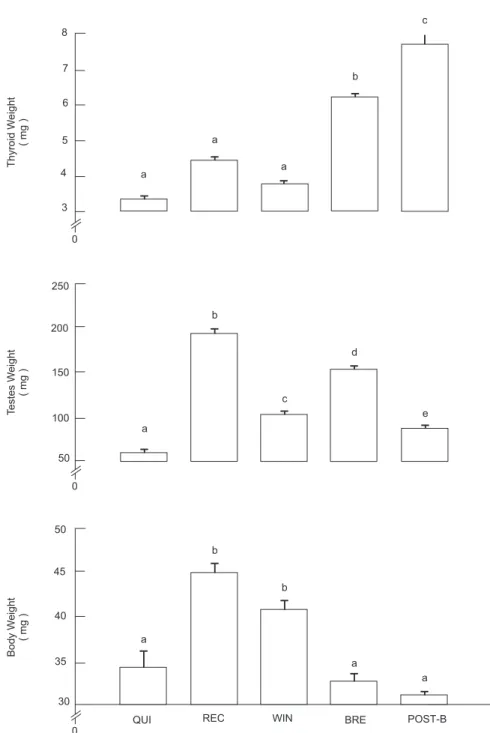
The weights (mean ± SE) of the body, testis, and thyroid during reproductive phases are shown in Fig. 2. There was more than two fold differ-ence between the highest and lowest mean thyroid weight of adult bats caught during differ-ent reproductive phases. The thyroid weight showed two peaks coinciding with the peaks of testicular weight during recrudescence and breed-ing phases. Both thyroid and testes began to in-crease in weight from quiescence (August) and attained a peak during recrudescence (Novem-ber). Thyroid weights declined during winter dormancy similarly to testis weight.
Histology
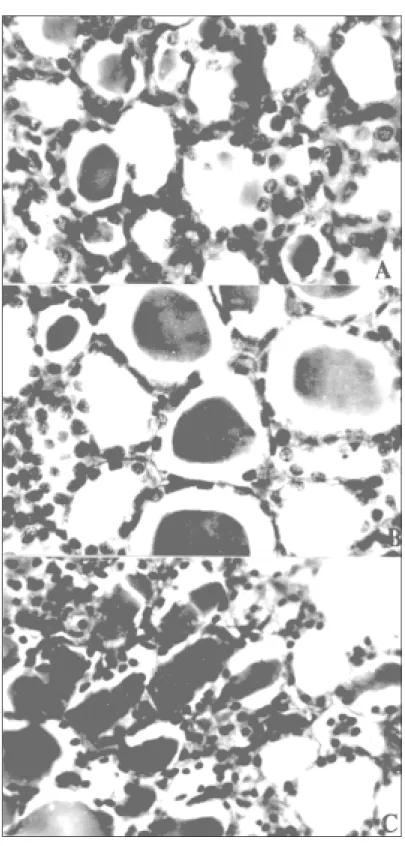
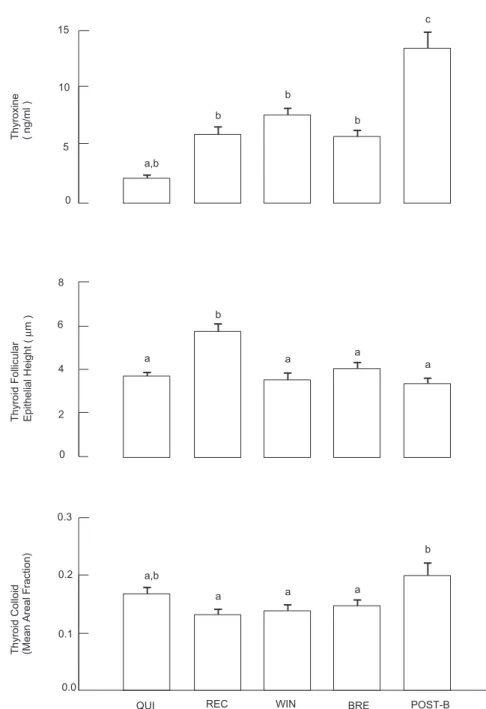
Thyroid gland of S. heathi also showed marked seasonal variation in histology (Fig.1). The percent areal fraction of colloid in the thy-roid gland showed a seasonal variation, with higher values after the end of breeding and lower values during the recrudescence (Fig. 3). Thyroid follicular epithelial cells height also showed a significant increase during the recrudescence stage (Fig. 3).
During quiescence in August, the thyroid was extremely heterogeneous in appearance showing great variability in the height of the epithelium and in the amount of colloid in the various thyroid follicles. The cells of majority of follicles during this phase contain flattened cells having scanty cytoplasm and a small nucleus. Some of the thyroid follicles were empty and others contain only small amounts of colloid in their big lumen. Numerous small follicles containing little colloid were found in the central part of the thyroid. These follicles are lined with cuboidal epithelial cells.
epithe-lium. Occasionally large follicles were also ob-served in the periphery of the gland.
The thyroid gland during winter dormancy showed mostly smaller follicles, which were lined with low cuboidal epithelium but containing large and prominent nuclei (Fig. 1a). Large follicles located in the periphery of the gland filled with colloid were lined with squamous epithelium. The epithelium of the winter thyroid is generally smaller than that of the recrudescence animals and because of this the glands tend to have a less cellular appearance.
During breeding phase in February-March, the thyroid gland contains follicles which were generally larger than those observed in the win-ter dormancy (Fig. 1b). The epithelial cell height was also increased, but not significantly. During the post-breeding phases, in April-May, the thy-roid gland contained mostly medium sized follicles with large lumen completely filled with colloid and low cuboidal epithelial lining (Fig. 1c).
Serum thyroxine concentration
Serum T4 concentration showed a significant (P < 0.05) seasonal pattern of changes (Fig. 3) with the highest concentration observed during April-May (Post-breeding phase) and lowest in August (quiescence). Concentration of T4 in-creased significantly during November (recrudes-cence) as compared to August (quies(recrudes-cence). T4 concentrations remain statistically unchanged from November until March (breeding).
DISCUSSION
Thyroid is a metabolically important gland, which is a suggested to be essential for the nor-mal maintenance of reproductive function, im-pairment of thyroid activity may be inhibitory to reproduction (Peebles et al., 1984; Jannini et al., 1995). The present study also showed a close relationship between changes in the weight and morphological features of the thyroid and the testicular cycle of S. heathi. The thyroid weight was found to be low during quiescence and winter dormancy and increase during recrudescence and breeding phases similar to the changes in the tes-ticular weight, although a significant increase was noticed only during breeding but not during recrudescence (Fig. 1). The increase in thyroid
and testes weight from quiescence to recrudes-cence and the decrease from recrudesrecrudes-cence to winter dormancy were also found to be similar to the pattern of changes shown in the body weight in this species. This indicate that changes in the body, thyroid and testes weights in this species are closely correlated during the period from quies-cence to winter dormancy. A significant correla-tion between body weight and testis has recently been demonstrated during breeding cycle in this species (Singh & Krishna, 1996). In S. heathi the
body weight increases due to fat accumulation during the period of increased food intake and decreases due to metabolism of stored fat during of food scarcity (Singh & Krishna, 1996). This suggests that the increase in both thyroid and testes weight from quiescence to recrudescence and decrease from recrudescence to winter dormancy may be related to seasonal body fat or nutritional cycle. Further changes in the thyroid and testicular activity in this species differ markedly from breeding to post-breeding phase. Thyroid weight and T4 secretion increased whereas the testis weight and spermatogenic activity de-clined significantly from breeding to post-breed-ing phase (Krishna and Spost-breed-ingh, 1997).
However, the body weight did not change significantly during this period. This indicate that changes in the thyroid, testes and body weights are not inter-related with each other during the period from breeding to post-breeding. It thus appears that thyroid and testes in S. heathi are
correlated when the body weight is significantly correlated with the testes weight. Whereas changes in thyroid and testes are not related with each other when the changes in the body weight has no correlation with testicular activity.
This suggest that either nutritional changes have affected both thyroid and testes via common hypothalamic-pituitary axis (Cosgrove et al.,
1995) or nutritional changes have affected testes via thyroid. Further studies are required to confirm the relationship between body weight, thyroid and testes in this species.
Among bats, the thyroid gland was studied mainly in the temperate-zone bats that undergo prolonged hibernation (Sadler & Tyler, 1960a, b,; Azzali, 1964; Velicky & Tiltback, 1972, 1974; Burns et al., 1972; Ifuta et al., 1988). Thyroid
In general, thyroid activity in these bats has been found to increase in the spring, decrease in autumn and remain quiescent throughout most of hibernation. Plasma T4 in adult male bats, Myotis lucifugus, was found to exhibit a well-defined
annual cycle. Levels were lowest at the time of entrance into hibernation in the fall, increased during hibernation, and attained a maximal values in the spring at the time of arousal (Damassa et al., 1995).
However, no such studies are carried out in any of the tropical/subtropical bats. Histology of thyroid in S. heathi also showed changes
compa-rable to its weight cycle. Based on the seasonal changes in the quantity of colloid and in the height of the epithelial cells of the thyroid gland, it can be concluded that the gland appeared in-active during the winter coinciding with the sup-pression of spermatogenesis and most active during the time of breeding and post-breeding phases. In general, the seasonal cycle of serum T4 concentration supported the morphometric finding on thyroid gland except during winter dormancy. In S. heathi, T4 level was observed to
be lower in summer just before the onset of re-production and higher in spring during post-breeding phase.
The present study thus correspond well with the previous findings indicating that animals liv-ing free have inactive thyroids in the summer period. Lower circulating thyroxin levels in the summer are in good correlation with the lower thyroid activity. There was marked activation of structure and gain in weight of thyroid during the recrudescence phase when compared with quies-cent bat. This may indicate that activation of thyroid gland in S. heathi coincided with the
period of transition from the non-breeding state to the breeding state and may be necessary for this transition as shown in other seasonally breed-ing animal (Webster et al., 1991).
S. heathi during winter dormancy exhibits
unique condition regarding thyroidal activity. Similar to most hibernating mammals (Hoffman, 1964; Hudson & Wang, 1979), thyroid gland of
S. heathi appeared inactive during the winter.
However, circulating T4 concentration during this period remained high. Thus, they resemble the chipmunk, Tamias striatus, in which the plasma
T4 level remains the same for hibernating or
normothermic animals (Hudson, 1977). T4 level was also shown to be high during hibernation in
Myotis lucifugus (Damassa et al., 1995). The
mechanism(s) responsible for the elevated serum T4 levels in S. heathi during winter dormancy, a
time of relative metabolic inactivity, are not clearly understood. It may be presumed that the increase in T4 concentration may be due to en-hanced secretion or to decreased metabolism and disposal or to both of these factors.
Observations of enhanced binding of T4 by thyroid binding globulin (TBG) in hibernating ground squirrels and wood chuck have led to the suggestion that elevated TBG levels are partially responsible for winter associated increase in se-rum concentration of thyroid hormones (Magnus & Henderson, 1988; Young et al., 1986). The
hibernating bat, Myotis lucifugus also showed
high TBG levels during winter (Damassa at al.,
1995). Further, decrease in weight and inactive appearance of thyroid during winter could be due to decline rate of thyroglobulin synthesis of re-gressed epithelial cells. But increase of T4 could be due to release of the stored T4.It may be noted here that the gland contains a large extracellular store of its products which might suffice for pro-longed secretion in the absence of synthesis. Another reason of high T4 in the circulation could be due to decreased peripheral conversion of T4 to T3 because of a lowering in liver to T4 -5-mo-nodeiodinase (Webster et al., 1991; Decuypere et al., 1985). It has also been shown that during
fasting plasma T3 concentration decreases due to decreased conversion from T4 (Cameron, 1996).
S. heathi may require a normal T4 to stimulate
sufficient thermogenesis during torpor to prevent body temperature from falling below a critical level that would necessitate arousal. The proposed hypothesis may also explain why the bat do not drop their body temperature much below 20-24ºC during winter dormancy (Hulbert, 1978). Ground squirrel, which have low T4 during most of their hibernation periods, can let their body tempera-ture drop to 0ºC (Lyman & Chatfield, 1955).
None of the various endocrine glands thought to play a role in reproduction has been more thoroughly studied with more conflicting results than the thyroid gland. As far as gonadal-thyroid interrelation in S. reathi is concerned, two
50 100 150 200 250
T
estes
W
eight
(m
g)
Thyroid
W
eight
(m
g)
30 35 40 45 50
QUI REC WIN BRE POST-B
Body
W
eight
(m
g)
0
0
0
0.0 0.1 0.2 0.3
QUI REC WIN BRE POST-B
Thyroid
Colloid
(Mean
Areal
Fraction)
a,b
Thyroid
Follicular
Epithelial
Height
(
m
)
µ
Thyroxine (ng/ml
)
a,b
A positive relationship was observed be-tween thyroid and testes from quiescence to winter dormancy, during this period changes in the body weight also showed a significant corre-lation with changes in the testicular weight and androstenedione synthesis. Whereas relationship between thyroid and testes was not positive dur-ing the phase from breeddur-ing to post-breeddur-ing. Du-ring this period the changes in the testicular activity was not correlated with the body weight. It is suggested that while comparing thyroid-go-nadal relationship changes in the body weight (me-tabolic activity) and its inter-relationship with re-productive axis must be taken into consideration.
REFERENCES
AZZALI, G., 1964, Ultrastructure des cellules para-folliculaires de la thyroid chez quelques mammiferes.
Ann. Endocrinol. (suppl.) 35: 8-22.
BOSWELL, T., WOODS, S. C. & KENAGY, G. J., 1994, Seasonal changes in body mass, insulin, and glucocor-ticoids of free-living Golden-Mantled Ground Squirrels.
Gen. Comp. Endocrinol., 96: 339-346.
BUCHANAN, G. C., TREDWAY, D. R., PITTARD, J. C. & DAANE, T. A., 1977, Gonodotropin secretion and hy-pothyroidism. Obstet. Gynecol., 50: 392-396. BURNS, J. M., BAKER, R. J. & BLEIER, W. J., 1972,
Hor-monal control of delayed development in Macrotus waterhousii. I. Changes in plasma thyroxine during preg-nancy and lactation. Gen. Comp. Endocrinol., 18: 54-58. CAMERON, J. L. 1996, Regulation of reproductive hormone secretion in primates by short-term changes in nutrition.
Rev. Reprod., 1: 117-126.
COSGROVE, J. R., CHARLTON, S. T., COSGROVE, S. J., ZAK, L. J. & FOXCROFT, G. R., 1995, Interactions be-tween nutrition and reproduction in the pig. Reprod. Dom. Anim., 30: 193-200.
DAMASSA, D. A., GUSTAFSON, A. W., KWIECINSKI, C. G. & GAGIN, G. A., 1995, Seasonal influences on the control of plasma sex hormone-binding globulin by T4 in male little brown bats. Am. J. Physiol., 268: R 1303-R 1309.
DECUYPERE, E., KUHN, E. R. & CHADWICK, A., 1995, Rhythms in circulating prolactin and thyroid hormones in the early postnatal life of the Domestic Fowl: Influ-ence of fasting and feeding on thyroid rhythmicity. In: B. K. Follet, S Ishii & A. Chandola (eds.). The Endocrine System and the Environment, Japan Scientific Society Press, Tokyo, pp. 189-200.
DUNN, J. D, HESS, M. & JOHNSON, D. C., 1976, Effect of thyroidectomy on rhythmic gonadotropin release.
Proc. Soc. Exp. Biol. Med., 151: 22-27.
GUSTAFSON, A. W., 1979, Male reproductive patterns in hibernating bats. J. Reprod. Fertil, 56: 317-331.
GUSTAFSON, A. W., 1987, Changes in Leydig cell activ-ity during the annual testicular cycle of the bat (Myotis lucifugus lucifugus): Histology and lipid histochemis-try. Am. J. Anat, 178: 312-325.
HAGINO, N., 1971, Influence of hypothyroid state on ovu-lation in rats. Endocrinology, 88: 1332-1336. HOFFMAN, R. A., 1964, Terrestrial animals in cold:
hiberna-tors. In: D. B. Dill (ed.), Handbook of Physiology,sec. 4, Am. Physiol. Soc., Washington DC, USA, pp. 379-403. HUDSON, J. W., 1977, The role of the thyroid gland in tem-perature regulation of ground squirrels and Chipmunks.
In: Proc. Of the Int. Union of Physiol. Sci. vol. XII, Int. Congr. of Physiol. Sci. Paris, July, 18-23, p. 760. HUDSON, J. W. & WANG, L. C. H., 1979, Hibernation:
En-docrinologic aspects. Annu. Rev. Physiol., 41: 287-303. HULBERT, A. J., 1978, The thyroid hormones: A thesis
con-cerning their action. J. Theor. Biol., 73(1): 81-100. IFUTA, N. B., GEVAERTS, H. & KÜHN, E. R., 1988,
Thy-roid hormones, testosterone and estradiol 17-beta in plasma of Epomops franqueti (Tomes, 1860) (Chiroptera) in the rain forest of the Equator. Gen. Comp. Endocrinol., 69: 378-380.
JANNINI, E. A., ULISSE, S. & D’ARMIENTO, M., 1995, Thyroid hormone and male gonadal function. Endocrine Ver., 16(4): 443-459.
KRISHNA, A. & SINGH, K., 1997, The relationship between testicular activity, accessory sex glands, and circulating steroid concentration during the reproductive cycle in a male vespertilionid bat, Scotophilus heathi. Can. J. Zool., 75: 1042-1050.
LAROCHELLE, F. T. & FREEMAN, M. E., 1974, Superim-position of thyroid hormone regulation on gonadotropin secretion. Endocrinology, 96: 378-387.
LYMAN, C. P. & CHATFIELD, P. O., 1955, Physiology of hibernation in mammals. Physiol. Rev., 35: 403-425. MAGNUS, T. H. & HENDERSON, N. E., 1988, Thyroid
hor-mone resistance in hibernating ground squirrels, Spermo-philus richardsoni. Gen. Comp. Endocrinol., 69: 352-360. PEEBLES, E. D., PAINTER, J. A. & BRADLEY, E. L., 1984, A possible role for the thyroid in reproductive inhibition in laboratory populations of the prairie deermouse (Peromyscus maniculatus). Comp. Biocherm. Physiol., 77A: 293-298.
RACEY, P. A., 1982, Ecology of bat reproduction. In: TH Kunz (ed.), Ecology of bats, Plenum Press, New York, pp. 57-164.
SADLER, W. W. & TYLER, W. S., 1960a, Thyroidal activity in hibernating chiroptera. I. Uptake of [131]-I. Acta Endocrinol., Copenhagen, 34: 586-596.
SHI, Z. D. & BARRELL, G. K., 1992, Effects of thyroidec-tomy on seasonal patterns of live weight, testicular func-tion, antler development and moting in red deer stage.
In: Ed. R. D. Brown (ed.), Proc. 2nd Int. Symp. Biol. Deer, Springer Verlag, New York.
SINGH, K. & KRISHNA, A., 1995, Inhibitory effects of melatonin on testosterone but not on androstenedione production during winter in the verpertilionid bat,
Scotophilus heathi. J. Pineal Res., 19(3): 127-132. SINGH, K. & KRISHNA, A., 1996, Seasonal changes in
cir-culating serum concentration and in vitro testicular se-cretion of testosterone and androstenedione in the male vespertilionid bat, Scotophilus heathi. J. Exp. Zool., 276: 43-52.
VELICKY, J. & TITLBACK, M., 1972, A study of the bat thyroid gland in winter and early spring. Folia Morphol., 20: 406-415.
VELICKY, J. & TITLBACK, M., 1974, Electron microscopic observations in the thyroid gland of active bats. Z. Mikrosk. Anat. Forsch., 88: 1069-1092.
WEBSTER, J. R., MOENTER, S. M., WOODFILL, C. J. I. & KARSCH, F. J., 1991, Role of thyroid gland in seaso-nal reproduction. II. Thyroxine allows a season specific suppression of gonadotropin secretion in sheep. Endo-crinology, 129: 176-183.
WEIBEL, E. R., 1979, Stereological method, vol. 1. Prac-tical method for biological morphometry, New York, Aca-demic Press.
WEST, M. J., 1993, New stereological methods for count-ing neurons. Neurobiol. Aging, 14: 275-285.
YOUNG, R. A., RAJATANAVIN, R., BRAVERMAN, L. E. & TENNANT, B. C., 1986, Seasonal changes in serum thyroid hormone binding proteins in the woodchuck