(Annals of the Brazilian Academy of Sciences)
Printed version ISSN 0001-3765 / Online version ISSN 1678-2690 www.scielo.br/aabc
Development and functional morphology of the larval foregut
of two brachyuran species from Northern Brazil
FERNANDO A. ABRUNHOSA, DARLAN J.B. SIMITH, JOÉLY R.C. MONTEIRO, ANTONIO N. DE SOUZA JUNIOR and PEDRO A.C. OLIVA
Laboratório de Carcinologia, Instituto de Estudos Costeiros (IECOS), Universidade Federal do Pará (UFPA), Campus Universitário de Bragança, Alameda Leandro Ribeiro s/n, Aldeia, 68600-000 Bragança, PA, Brasil
Manuscript received on May 28, 2010; accepted for publication on September 15, 2010
ABSTRACT
Feeding is an important factor for the successful rearing of larvae of the crab species. Further information on the morphological features of the foregut may to reveal larval feeding behaviour and or/whether there is a lecithotrophy in some or even in all stages of the larval cycle. In the present study, the structural development of the foregut and their digestive functions were examined in larvae of two brachyurans,Uca vocatorandPanopeus occidentalis, reared
in the laboratory. During larval development, the foreguts of the larvae in the first and last zoeal stages and in the megalopa stage were microscopically examined, described and illustrated. The zoeal foreguts of both species were well developed, showing specialization with a functional cardiopyloric valve and a filter press. The megalopa stage had a complex and specialized gastric mill similar to that found in adult crabs with the appearance of rigidly calcified structures. These results support the hypothesis that the feeding behaviour of each larval stage is directly related to the morphological structure of the foregut. Such facts strongly indicate that all larval stages of bothU. vocatorand
P. occidentalisneed an external food source before completing the larval development in a planktonic environment.
Key words:digestive system, megalopa,Panopeus occidentalis, stomach,Uca vocator, zoea.
INTRODUCTION
Feeding is an important factor that significantly affects the larvae of several brachyuran crab species, although an external food supply may not be necessary in the case of lecithotrophy, where some larvae reach the sub-sequent larval stage or even complete larval develop-ment without external food (Kittaka 1988, Nishida et al. 1990, Kittaka 1994, Anger et al. 1995, Abrunhosa and Kittaka 1997a, b, Nates and McKenney Jr 2000, Anger 2001). Some species, however, may present a faculta-tive lecithotrophy when external food is not available (Anger et al. 1995, Thessalou-Legaki et al. 1999, Anger 2001). Therefore, further information concerning suit-able feeding measures for larval rearing is needed, and
Correspondence to: Fernando de Araújo Abrunhosa E-mail: [email protected]
this is critical for the successful rearing in the laboratory of this crab species.
Examinations of the behaviour and characteristics of larval morphology in species reared under labora-tory conditions may contribute to this knowledge, and may also provide an understanding of the complex bio-logical and ecobio-logical relationships which that occur among these species in the nature (Anger 2001). Detailed morphological studies of the decapod digestive system have demonstrated a close relationship between the mor-phological characteristics of the digestive system and feeding behaviour (Nishida et al. 1990, Abrunhosa and Kittaka 1997a).
Kit-taka et al. 1997). In these species, a noticeable mor-phological change was observed in the digestive system during metamorphosis, which showed as well as a re-duction of the mandibles and the setal number in the external feeding apparatus and showed an underdevel-oped foregut (Nishida et al. 1990, Wolfe and Felgen-hauer 1991, Mikami and Takashima 1993, Lemmens and Knott 1994). Abrunhosa and Kittaka (1997a, b) ob-served similar facts in king crab species of the genus Paralithodes (important fishery resource of the North Pacific) during the megalopal stage. More recently, a similar behaviour was also observed in zoeal stages of the callianissid Lepidophthalmus siriboia (Abrunhosa et al. 2006).
In previous studies, the development of the foregut and mouthparts have contributed to the better under-standing of the feeding behaviour of a cultured species, which has allowed the identification of an adequate feeding regime and, consequently, has enhanced the survival rate during larval development (Nishida et al. 1990, Minagawa and Takashima 1994, Abrunhosa and Kittaka 1997a). Many studies have focused on the mor-phological and functional aspects of the foregut in adult decapod specimens (Meiss and Norman 1977, Kunze and Anderson 1979, Suthers and Anderson 1981, Suthers 1984, Skilleter and Anderson 1986, Mikami and Taka-shima 1993, Pinn et al. 1999, Jha and Homechaudhuri 2001, Brosing et al. 2002, Castro and Bond-Buckup 2003), however, very few efforts to investigate these aspects in the larval stages have been undertaken in the past. Therefore, in this present study, the morphology of the larval foreguts of two decapod crabs from the Northern Brazil,Uca vocatorHerbst 1804 (Ocypodidae) andPanopeus occidentalis Saussure 1857 (Xanthidae) were investigated, and the functionality of these organs is discussed in detail.
Detailed morphological descriptions of these two were previously reported by Ingle (1985) and Rieger (1999) forP. occidentalisandU. vocator, respectively. Biogeographically, adults of both species are found in mangroves and in the estuarine areas along the coast of the Americas (Atlantic South). In Brazil, these species occur in mangrove areas from state of Pará, northern Brazil, to the state of Santa Catarina, southern Brazil (Melo 1996, Diele et al. 2010).
MATERIALS AND METHODS
LARVALREARING
Larvae were obtained from egg-berried females of U. vocator and P. occidentalis collected one day before hatching in the mangroves of the Caeté river estuary (Northern Brazil). The females were transported to laboratory where they were washed and kept individu-ally in aquaria (5 L) filled with seawater and constant aeration. The crabs were maintained in ambient tem-perature (26◦C), salinity 30, pH 8.0 and without food
until larval release.
After hatching, the zoea larvae were transferred to plastic recipients filled with 150 mL of seawater for culture. The larvae were reared at a density 20 ind./re-cipient in constant conditions of temperature (26 ±
1.5◦C), salinity (30), pH (8.0) and in photoperiod re-gime (12:12 h light:dark cycle) until the megalopal stage. Larvae were fed daily with rotifers Brachionus plicatilis(50 ind./mL),Artemianauplii (5 ind./mL) and microalgaeThalassiosirasp (initial concentration about 30 cel/mL4). The recipient seawater was changed at every two days, and the larvae were monitored daily for mortality or moults to subsequent stages.
LARVALFOREGUTDISSECTION
For both species, at least 10 individuals of the first (ZI), last zoeal stage (ZIV for P. occidentalisand ZV for U. vocator) and megalopa were sampled and used for dissection and illustrations. The methodology ap-plied was similar to that accomplished by Abrunhosa et al. (2003). The samples were fixed in formalin solu-tion 10% (v/v) for a 24 hours period. Then, they were immersed in aqueous solution of potassium hydroxide 5% (KOH) (p/v) and heated to 80◦C for 30 minutes.
Later, the samples were washed with distilled water and immersed in ethylic alcohol 70% + glycerine so-lution (1:1).
ILLUSTRATION ANDDESCRIPTIONS OF THEFOREGUT
solution of methylene blue 1%. The foreguts were ob-served and illustrated in lateral view, aided by a micro-meter disc. The terminology used for descriptions of the foregut follows Meiss and Normann (1977), Nishi-da et al. (1990), Abrunhosa and Kittaka (1997a) and Abrunhosa et al. (2003).
RESULTS
LARVALCULTURE
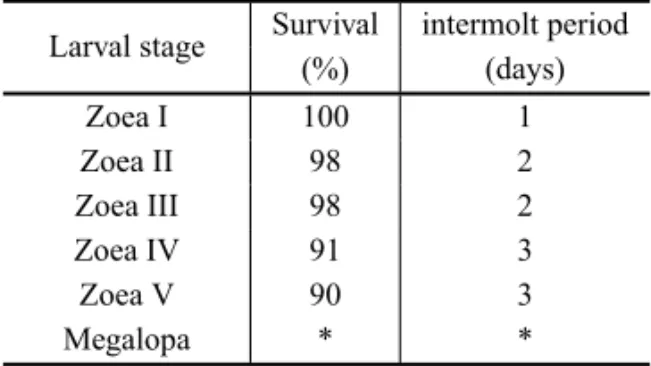
The complete larval development of U. vocator was constituted of 5 zoeal and 1 megalopal stages, while the one ofP. occidentaliswas composed by 4 zoeal and 1 megalopal stages. In U. vocator, the larval survival rate until the megalopa stage was 90%, and the larval development period from hatching to megalopa ranged from 10 to 12 days. ForP. occidentalis, the larval sur-vival rate was 100%, and the development period un-til the megalopal stage was about 12 days. The survival rates and development periods of each zoeal stage of U. vocatorandP. occidentalisare shown in the Tables I and II, respectively.
TABLE I
Survival rate (%) and intermolt period (days) ofUca vocatorlarvae reared in the laboratory.
Larval stage Survival intermolt period (%) (days)
Zoea I 100 1
Zoea II 98 2
Zoea III 98 2
Zoea IV 91 3
Zoea V 90 3
Megalopa * *
*The experiment ended in megalopa and they did not moult to the first juvenile.
MORPHOLOGY OF THELARVALFOREGUTS
Uca vocator
The foreguts of the first and last zoeal stages of U. vocator: showed a cardiopyloric valve separating the cardiac from the pyloric chamber, as well a filter press that becomes specialized during the larval development. There is a degree of specialization of the foregut along the larval development where the number of setae and size are increased. After the metamorphosis to mega-lopal stage, a considerable morphological change in the
TABLE II
Survival rate (%) and intermolt period (days) ofPanopeus occidentalislarvae reared
in the laboratory.
Larval stage Survival intermolt period (%) (days)
Zoea I 72 3
Zoea II 100 2
Zoea III 100 4
Zoea IV 100 3
Megalopa * *
*The experiment ended in megalopa and they did not moult to the first juvenile.
foregut was observed with the appearance of ossicles of the gastric mill and lateral teeth.
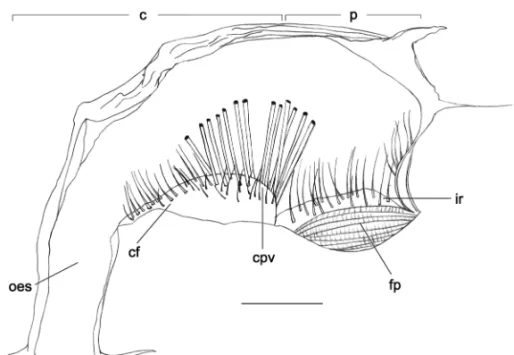
Zoea I (Fig. 1)
Foregut– Simple, chitinous and lacking – hard struc-tures (total length 1.1 mm).
Cardiac chamber– Little larger than pyloric chamber; cardiac wall lacking setae; numerous fine setae on the floor base; cardiopyloric valve redounded and robust bearing many setae on its extension and showing strong setae on the posterior portion.
Pyloric chamber– Bearing fine setae on the posterior portion; fitter press large and well-developed occupy-ing all the inferior portion of the chamber; numerous setae on the inter-ampullary ridge.
Zoea V (Fig. 2)
Foregut– More complex than stage I and lacking – rigid structures (total length 1.8 mm).
Cardiac chamber – Cardiac roof showing fine setae on the roof with row of elongate and fine setae in the anterior portion; posterior portion with numerous rigid and long setae; cardiac wall lacking setae; cardiopyloric valve redounded and large with strong setae almost in all of its extension.
Fig. 1 –Uca vocator. Zoea I foregut in lateral view (right side). Scale bar = 0.3 mm. Abbreviations: fp=filter press; ir=interampulary ridge;
cpv=cardiopyloric valve; cf=cardiac floor; oes=oesophagus; c=cardiac chamber; p=pyloric chamber.
Fig. 2 –Uca vocator. Zoea V (last zoeal stage) foregut in lateral view (right side). Scale bar=0.4 mm. Abbreviations: fp=filter press;
ir=interampulary ridge; cpv=cardiopyloric valve; cf=cardiac floor; oes=oesophagus; c=cardiac chamber; p=pyloric chamber.
Megalopa (Fig. 3)
Foregut– Showing a complex gastric mill, oesophageal valve and other rigid structures (total length 3.8 mm).
Cardiac chamber– Enlarged dorso-ventrally by plates and gastric mill ossicles (about 3 times the pyloric chamber); cardiac floor showing almost vertically; nu-merous ossicles of gastric mill present: mesocardiac, pterocardiac; zygocardiac (supporting the lateral teeth), urocardiac (supporting medial tooth), propyloric,
exo-pyloric and exo-pyloric. Other ossicles are present such as prepectineal, pectineal, exopyloric, subdentate, inferior lateral cardiac and lateral cardiopyloric; valve cardio-pyloric robust and specialized, bearing firm setae on the superior portion (other ossicles as illustrated in Fig. 3).
pres-Fig. 3 –Uca vocator. Megalopa foregut in lateral view (right side). Scale bar=0.4 mm. Abbreviations: app=anterior pleuropyloric ossicle
(a pair); c=cardiac chamber; cpv=cardiopyloric valve; exp=exopyloric (a pair); fp=filter press; ia=inferior ampullary ossicle, ir=
interampullary crista; ilc=anterior lateral cardiac ossicle; lcp=lateral ossicle of the cardiopyloric valve; lt=lateral teeth (a pair); mp=middle pleuropyloric ossicle (a pair); msc=mesocardiac ossicle; oes=oesophagus; p=pyloric chamber; ov=oesophageal valve; pam=pre-ampullary
ossicle; pec=pectineal ossicle (a pair); pip=posterior inferior pyloric ossicle; pop=pos-pectineal ossicle (a pair); pp=pleuro-pyloric ossicle (a pair); ppc=pre- pectineal (a pair); prp=propyloric ossicle; ptc=pterocardiac ossicle; py = pyloric ossicle; sd=subdentate ossicle (a pair); up=uropyloric ossicle; urc=urocardiac ossicle; zyc=zygocardiac ossicle (a pair).
ent: uropyloric, anterior pleuropyloric, posterior pleu-ropyloric; middle pleuropyloric, pre-ampullary; inferior pyloric, anterior inferior and posterior pyloric ossicle (other ossicles as illustrated in Fig. 6).
Panopeus occidentalis
Zoea I (Fig. 4)
Foregut– Simple and chitinous (total length 0.72 mm).
Cardiac chamber – Showing numerous setae on the cardiac floor; cardiac wall lacking setae; cardiopyloric valve redound and robust with firm and erect setae on the posterior portion.
Pyloric chamber– Pyloric wall lacking setae; pyloric floor showing setae in all portion; filter press well-de-veloped and filling all inferior portion of the chamber; inter-ampullary ridge rows of numerous setae.
Zoea IV (Fig. 5)
Foregut – more developed compared to zoea I stage, but similar in shape; lacking rigid structures (total length 3 mm).
Cardiac chamber– Cardiac floor with a row of elon-gate setae; cardiac wall with few setae on the posterior portion; cardiopyloric valve redound, large and holding erect and strong setae on the posterior portion; cardiac floor with fine setae in the posterior portion.
Pyloric camber– Filter press specialized and complex, filling all inferior portion of the chamber; inter-ampul-lary ridge well-developed with rows of medium setae.
Megalopa (Fig. 6)
Foregut– Showing a complex gastric mill; oesophageal valve and rigid structures (total length 3.5 mm).
Fig. 4 –Panopeus occidentalis. Zoea I foregut in lateral view (right side). Scale bar=0.18 mm. Abbreviations: fp=filter press; ir=interampulary ridge; cpv=cardiopyloric valve; cf=cardiac floor; oes=oesophagus; c=cardiac chamber; p=pyloric chamber.
Fig. 5 –Panopeus occidentalis. Zoea IV (last zoeal stage) foregut in lateral view (right side). Scale bar=0.75 mm. Abbreviations: fp=filter press; ir=interampulary ridge; cpv=cardiopyloric valve; cf=cardiac floor; oes=oesophagus; c=cardiac chamber; p=pyloric chamber.
Pyloric chamber – Narrow laterally; filter press spe-cialized showing a well-developed and functional am-pullary net; inter-amam-pullary ridge with rows of long se-tae; some ossicles present, such as: anterior pleuropy-loric, posterior pleuropyloric and middle pleuropypleuropy-loric, preampullary and inferior posterior pleuropyloric (other ossicles as illustrated in Fig. 6).
DISCUSSION
In the literature, the majority of the reports on larval de-velopment and metamorphose forms (glaucothoe, pue-rulus, decapodid and megalopa) of decapods are only limited to the descriptions of the general appendages,
Fig. 6 –Panopeus occidentalis. Megalopa foregut in lateral view (right side). Scale bar=0.75 mm. Abbreviations: Abbreviations: app=anterior pleuropyloric ossicle (a pair); acp=anterior ossicle of cardiopyloric valve; asa=anterior supra-ampullary ossicle (a pair); c=cardiac chamber;
exp=exopyloric (a pair); fp=filter press; ir=interampullary crista; lt=lateral teeth (a pair); mb=main brush; mp=middle pleuropyloric ossicle (a pair); msc=mesocardiac ossicle; oes=oesophagus; p=pyloric chamber; pec=pectineal ossicle (a pair); pip=posterior inferior pyloric ossicle; qpop=“Quill” of pos-pectineal ossicle; pop=pos-pectineal ossicle (a pair); pp=pleuro-pyloric ossicle (a pair); ppc=
pre-pectineal (a pair); prp propyloric ossicle; py=pyloric ossicle; sd=subdentate ossicle (a pair); up=uropyloric ossicle; urc=urocardiac ossicle; zyc=zygocardiac ossicle (a pair).
Detailed analyses of the foreguts in the zoeal and megalopal stages of U. vocator and P. occidentalis showed similarities between these two species in both their structures and functions. The foreguts of the zoeal I stage are morphologically simple, but bearing specific setae and a filter press that is apparently functional. The same pattern were observed in the zoea I larvae. The foreguts of the last zoeal stages, (zoea V forU. vocator and zoea IV forP. occidentalis) also lacked gastric mill apparatus however, an increase in the degree of special-ization of the foregut was also observed, which showed an increment of setae, but the main difference is in the observance of the cardiopyloric valve and the complex-ity of the filter press. Therefore, the last zoeal stage of both species shows an increasing in the ability to pro-cess small particles of food. These observations cor-roborate with those of previous studies with crab larvae (Shinkarenko 1979, Factor 1982, 1989, Minagawa and
Takashima 1994, Abrunhosa et al. 2003).
The foregut is an important component of the di-gestive system for break down food items into fine par-ticles. The elaboration of the gastric mills placed in the cardiac chamber is necessary to the development of the proper digestion of substantial foodstuffs, and also for the mixing of digestive enzymes from the midgut gland (Icely and Nott 1992). Many works listed in the liter-ature show the megalopa of brachyuran crabs as having well-developed mandibles and setose mouthparts (Per-kins 1973 for gerynoids; Gore et al. 1982, Webber and Wear 1981 for majids, Abrunhosa et al. 2003, 2006 for ocypodids).
Significant changes in both morphological and anatomical features of the foregut take place during the metamorphosis of U. vocatorandP. occidentalisfrom zoea to megalopa stages. These foreguts undergo re-markably morphological changes where newly moulted megalopae bear a highly complex foregut. Such moult-ing brmoult-ings about changes in the feedmoult-ing apparatus that is necessary for the processing substantial food in their natural environment.
ACKNOWLEDGMENTS
The present work was financed by the Conselho Nacional de Desenvolvimento Científico e Tecnológico (CNPq).
RESUMO
A alimentação é um importante fator para o sucesso no cultivo larval de espécies de caranguejos. Informações sobre as ca-racterísticas morfológicas do estômago podem contribuir para revelar o comportamento alimentar larval ou, se há lecitotrofia em algum, ou até mesmo, em todos os estágios do ciclo larval. No presente estudo, o desenvolvimento estrutural do estômago e as funções digestivas foram examinados em larvas de duas espécies de braquiúros,Uca vocatorePanopeus occidentalis,
cultivados em laboratório. Durante o desenvolvimento larval, os estômagos das larvas no primeiro e último estágio de zoea e megalopa foram microscopicamente examinados, descritos e ilustrados. Em ambas espécies, o estômago dos estágios de zoea são desenvolvidos e especializados, apresentando uma válvula cardiopilórica e um filtro pilórico funcionais. O estágio de megalopa possui um moinho gástrico complexo e especial-izado semelhante àquele encontrado em caranguejos adultos com o aparecimento de estruturas rígidas e calcificadas. Estes resultados apóiam a hipótese de que o comportamento
alimen-tar de cada estágio larval está diretamente relacionado à estru-tura morfológica do estômago. Tal fato, fortemente indica que todos os estágios larvais de ambosU. vocatoreP. occidentalis
necessitam de uma fonte externa de alimento para completar o desenvolvimento larval no ambiente planctônico.
Palavras-chave: sistema digestivo, megalopa, Panopeus occidentalis, estômago,Uca vocator, zoea.
REFERENCES
ABRUNHOSA FA, ABRUNHOSA JP AND AGUIAR MM. 2003. Development and functional morphology of the foregut of larvae and postlarva of Ucides cordatus
(Decapoda, Ocypodidae). Nauplius 11(1): 37–43. ABRUNHOSAFAANDKITTAKAJ. 1997a. Functional
mor-phology of mouthparts and foregut of the last zoea, glau-cothoe and first juvenile of the king crabsParalithodes camtschaticus, P. brevipes and P. platypus. Fish Sci
63(6): 923–930.
ABRUNHOSA FA ANDKITTAKA J. 1997b. Morphological changes in the midgut gland and hindgut during the larval and postlarval development of the red king crab
Paralithodes camtschaticus. Fish Sci 63(5): 746–754.
ABRUNHOSAFAANDMELOMA. 2002. Morfologia com-parativa do estômago do primeiro e último estágios zoea e juvenil I deMacrobrachium rosenbergii(De Man, 1879) (Decapoda, Ocypodidae). Rev Cien Agron 33(2): 65–68. ABRUNHOSAFAANDMELOMA. 2008. Development and functional morfology of the foreguts of larvae and potlarvae of three crustacean decapods. Braz J Biol 68: 221–228.
ABRUNHOSA FA, MELO M, LIMA JF ANDABRUNHOSA J. 2006. Developmental morphology of mouthparts and foregut of the larvae and postlarvae ofLepidophthalmus siriboiaFelder & Rodrigues, 1993 (Decapoda:
Callianas-sidae). Acta Amaz 36(3): 335–342.
ANGERK. 2001. The biology of decapod crustacean larvae, crustacean issues. Vol. 14. Lisse, The Netherlands: A.A. Balkema Publishers, 419 p.
ANGERK, SCHREIBERDANDMONTÚM. 1995. Abbrevi-ated larval development ofSesarma curacaoense (Rath-bun, 1897) (Decapoda: Grapsidae) reared in the labora-tory. Nauplius 3: 127–154.
BROSINGA, RICHTERSANDSCHOLTZG. 2002. The fore-gut-ossicle system ofDromia wilsoni,Dromia personata
CASTROTSANDBOND-BUCKUPG. 2003. The morphology of cardiac and pyloric foregut ofAegla platensisSchmitt (Crustacea: Anomura: Aeglidae). Mem Mus Vict 60(1): 53–57.
DIELE K, KOCH V, ABRUNHOSA FA, FARIAS J AND SIMITHDJ. 2010. The Mangrove Crab Community of the Caeté Estuary, N-Brazil: Species Inventory, Zonation and Abundance. In: Saint-Paul U and Schneider H (Org), Mangrove Dynamics and Management. 1sted., Berlim: Springer 211: 1–400.
FACTOR JR. 1982. Development and metamorphosis of the feeding apparatus of the stone crab,Menippe mercenaria
(Brachyura, Xanthidae). J Morph 172: 299–312. FACTOR JR. 1989. Development of the feeding apparatus
in decapods crustaceans. In: FELGENHAUER BE, WATLINGLANDTHISTLEAB (Eds), Crustacean issues, Balkema, Rottherdam 6: 185–203.
GORERH, SCOTTOLEANDYANGWT. 1982.Microphrys bicornutus(Latreille, 1825): The complete larval
devel-opment under laboratory conditions with notes on other Mithracine larvae (Decapoda: Majidae). J Crust Biol 2: 512–534.
ICELYJDANDNOTTJA. 1992. Digestion and absorption. Digestive system and associated organs. In: HARRISON FW AND HUMES AG (Eds), Microscopic Anatomy of Invertebrates, Wiley-Liss Inc 10: 147–201.
INGLERW. 1985. Larval development of the mud crab Pano-peus occidentalis Saussure, from Bermuda (Crustacea: Xanthoidea: Panopeidae). Bull Br Mus Nat Hist (Zool.) 48: 233–248.
JHAAANDHOMECHAUDHURIS. 2001. Understanding the gastric mill structure of a macrophagous shrimp Meta-penaeus monoceros(Fabricius). Curr Sci 80(5): 620–622.
KITTAKA J. 1988. Culture of the palinurid Jasus lalandii
from egg to puerulus. Nippon Sui Gak 54(1): 87–93. KITTAKAJ. 1994. Larval rearing. In: PHILLIPSBF, COBB
JS ANDKITTAKA J (Eds), Spiny lobster management, p. 402–423.
KITTAKAJANDIKEGAMIE. 1988. Culture of the palinurid
Panulirus elephasfrom egg stage to puerulus. Nippon Sui Gak 54(7): 1149–1154.
KITTAKAJ, ONOKANDBOOTH JD. 1997. Complete de-velopment of the green rock lobster Jassus verreauxi
from egg to juvenile stage. Bull Mar Sci 61: 57–71. KUNZEJANDANDERSONDT. 1979. Functional
morphol-ogy of the mouthparts and gastric mill in the hermit crabClibanarius taeniatus(Milne Edwards),Clibanarius virescens(krauss),Paguristes squamosusMcCulloch and
Dardanus setifer (Milene Edwards) (Anomura: Paguri-dae). Australian J Mar Fresh Res 30: 683–722.
LEMMENS JWTJ AND KNOTT B. 1994. Morphological changes in external and internal feeding structures dur-ing the transition phyllosoma-juvenile in the western rock lobster (Panulirus cygnus, Decapoda: Palinuridae).
J Morph 220: 271–280.
MEISSDEANDNORMANRS. 1977. Comparative study of the stomatogastric system of several decapod Crustacea. J Morph 152: 21–54.
MELOAM, ABRUNHOSAFAANDSAMPAIOI. 2006. The morphology of the foregut of larvae of postlarva and
Sesarma curacaoenseDe Man, 1892: a species with fac-ultative lecithotrophy during larval development. Acta Amaz 36(6): 375–380.
MELO GA. 1996. Manual de identificação dos Brachyura (caranguejos e siris) do litoral brasileiro. São Paulo: ed., Plêiade/FAPESP, 604 p.
MIKAMI S AND TAKASHIMA F. 1993. Development of the proventriculos in larvae of the slipper lobster,Ibacus ciliatus(Decapoda, Scyllaridae). Aquaculture 116: 199–
217.
MINAGAWA MANDTAKASHIMAF. 1994. Developmental changes in larval mouthparts and foregut in the red frog crab,Ranina ranina(Decapoda: Raninidae). Aquaculture 126: 61–71.
NATES SF AND MCKENNEY JR CL. 2000. Ontogenic changes in biochemical composition during larval and early postlarval development of Lepidophthalmus loui-sianensis, a ghost shrimp with abbreviated development. Comp Bioc Physi 127(4): 459–468.
NISHIDA S, QUIGLEY BD, BOOTH JD, NEMOTO T AND KITTAKA J. 1990. Comparative morphology of the mouthparts and foregut of the final stage phyllosoma, puerulus, and postpuerulus of the rock lobster Jasus edwardsii (Decapoda: Palinuridae). J Crust Biol 10:
293–305.
PERKINS HC. 1973. The larval stages of the deep sea red crab,Geryon quinquedensSmith, reared under laboratory
conditions (Decapoda: Brachyrhyncha). Fish Bull 1: 69– 82.
PINN EH, NIKELL LA, ROGERSON A AND ARKINSON RJA. 1999. Comparison of gut morphology and gut microflora of seven species of mud shrimp (Crustacea: Decapoda: Thalassinidae). Mar Biol 133: 103–114. RIEGERPJ. 1999. Desenvolvimento larval deUca (Minuca)
SHINKARENKOL. 1979. Development of the larval stages of the blue swimming crabPortunus pelagicus(Portunidae: Decapoda: Crustacea). Australian J Mar Fresh Res 30: 485–503.
SKILLETERGAANDANDERSONDT. 1986. Functional mor-phology of the chelipeds, mouthparts and gastric mill of
Ozius truncates(Milne Edwards) (Xanthidae) and Lep-tograpsus variegates(Fabricius) (Grapsidae) (Brachyura).
Australian J Mar Fresh Res 35: 785–792.
SUTHERSIM. 1984. Functional morphology of the mouth-parts and gastric mill inPenaeus plebejusHess (Decapoda: Penaeidae). Australian J Mar Fresh Res 35: 785–792. SUTHERSIMANDANDERSONDT. 1981. Functional
mor-phology of mouthparts and gastric mill ofIbacus peronii
(Leach) (Paninura: Scyllaridae). Australian J Mar Fresh Res 32: 931–944.
THESSALOU-LEGAKI M, PEPPA A ANDZACHARAKI M. 1999. Facultative lecithotrophy during larval devel-opment of the burrowing shrimp Callianassa tyrrhena
(Decapoda: Callianassidae). Mar Biol 133: 635–642. WEBBERWRANDWEARRG. 1981. Life history studies on
New Zealand Brachyura, 5. Larvae of the family Majidae. New Zealand J Mar Fresh Res 15: 331–383.