ABSTRACT: Bacterial halo blight, caused by Pseudomonas syringae pv. garcae, is an important disease of coffee crop occurring in Brazil and other countries. In recent years, outbreaks of this disease have damaged several coffee crops in Brazil. Aggressiveness and genetic diversity of 25 strains of P. s. pv. garcae, obtained between the years 1958 and 2011, in 23 cities of São Paulo and Minas Gerais states, as well as three strains from Kenya were evaluated in this study. The strains were inoculated on coffee seedlings cultivar Mundo Novo, and their genetic diversity was evaluated by ERIC-PCR, REP-PCR, and their combination. All the strains were pathogenic to the coffee seedlings; the results of pathogenicity tests, in both experiments, could be divided in four aggressiviness classes (highly aggressive; aggressive; moderately aggressive and less aggressive). The Kenyan
PLANT PROTECTION - Article
Bacterial halo blight of coffee crop:
aggressiveness and genetic diversity of strains
Karen Wolf Maciel1*, Suzete Aparecida Lanza Destefano1, Luis Otavio Saggion Beriam1,
Irene Maria Gatti de Almeida1, Flavia Rodrigues Alves Patricio2, Lucas Mateus Rivero Rodrigues3, Oliveiro Guerreiro Filho3
1.Instituto Biológico - Laboratório de Bacteriologia Vegetal - Campinas (SP), Brazil. 2.Instituto Biológico - Laboratório de Fitopatologia - Campinas (SP), Brazil. 3.Instituto Agronômico - Centro de Café - Campinas (SP), Brazil.
*Corresponding author: [email protected]
Received: Jul 6, 2016 – Accepted: Feb. 28, 2017
INTROduCTION
Brazil is the world´s largest producer and exporter of coffee. The Arabica coffee (Coffea arabica L.) is cultivated mainly in Minas Gerais, and São Paulo States (ConAB 2015). Bacterial halo blight, caused by Pseudomonas syringae
pv. garcae, is an important disease of coffee in Brazil and outbreaks of this disease have occurred in this country in recent years (Rodrigues et al. 2013; Zoccoli et al. 2011).
The disease is characterized by lesions on leaves, flowers, pin-head berries, and die-back of twigs and branches. The most characteristic symptom of the disease is the presence of brown necrotic lesions on the leaves, surrounded by a chlorotic halo. Growth and coalescence of the lesions on the leaves cause their drop and subsequent defoliation of branches. At the end of the rainy season, the symptoms are confined to the branches that exhibit sometimes severe die-back. Bacterial halo blight also affects seedlings in nurseries, causing lesions on leaves and die-back of the seedlings (Costa et al. 1957).
This disease was first described in 1955, affecting coffee crops in the county of Garça, State of São Paulo, Brazil (Amaral et al. 1956) and was considered of minor importance for approximately 17 years after its emergence, when only isolated cases were reported (Kimura et al. 1973). From 1973 to 1975, a high incidence of the disease was observed in the state of Paraná in nurseries and coffee plantations that were recovered from frost4 (Kimura et al. 1973; Mohan 1976). Bacterial halo
blight has spread across the country and the pathogen has been detected in the States of Paraná, São Paulo and Minas Gerais (Malavolta Junior et al. 2008). Recently, damages caused by the disease were reported in some regions of the State of São Paulo as well as in regions with irregular topography and high altitudes in the State of Minas Gerais, such as Alto Paranaíba, Triângulo Mineiro and Sul de Minas (Zoccoli et al. 2011; Rodrigues et al. 2013).
The rep-PCR technique has been considered an important tool in phylogenetic studies of bacterial populations and shows high correlation with other more laborious techniques such as AFLP and DnA hybridization (Rademaker et al. 2000). This technique is based on the amplification of three families of repetitive DnA sequences that are present in the genome of several bacterial species, the repetitive extragenic palindromic sequence (REP), the enterobacterial repetitive intergenic consensus (ERIC) and the BoX elements (Louws
et al. 1994). Rep-PCR has been frequently used to assess the genetic diversity of several plant pathogenic bacteria such as Xanthomonas axonopodis pv. juglandis (Scortichini et al. 2001), P. syringae pv. syringae (natalini et al. 2006) and studies of inter-and intraspecificity in strains of P. syringae
(Vicente and Roberts 2007; Çepni and Gürel 2012; Gašić et al. 2012).
Although bacterial halo blight occurs in Brazil since 1955, it is unknown if the recent outbreaks of the disease are due to changes in the population of the pathogen or to increases in the aggressiveness of new strains or to other unknown factors. Therefore, aggressiveness and genetic diversity of 25 Brazilian strains of P.syringae. pv. garcae
from several coffee producing areas, obtained between the years 1958 to 2011, were investigated in this study.
MATERIAL ANd METhOdS
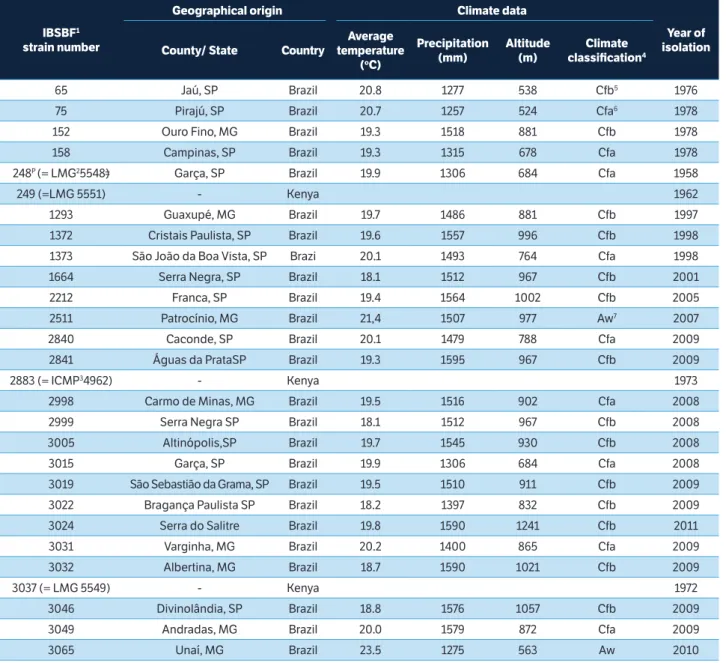
Twenty-five strains of P.syringae. pv. garcae, isolated from coffee crops cultivated in the States of Minas Gerais and São Paulo, Brazil, were investigated in this study. Three strains from Kenya were included in the analysis for comparative purposes, since bacterial halo blight was also reported as an important disease in that country (Kairu 1997). The strains were obtained from the Phytobacteria Culture Collection of Instituto Biológico (IBSBF) andtheir geographical origin, year of isolation, and climate data of the localities of origin are shown in Table 1.
The aggressiveness of the strains was evaluated in two experiments carried out in September and october of 2015, in a greenhouse located at Centro Experimental Central, Instituto Biológico, Campinas, SP, with seedlings of the susceptible coffee cultivar Mundo novo. Four pairs of true leaves of each seedling were inoculated with bacterial suspensions (approximately 108 CFU·mL-1)
prepared by the cultivation of the strains in nutrient agar medium (nA) for 48 h at 28 °C. The inoculations were performed by spraying the suspensions until runoff on leaves that were previously punctured with sterile entomological needles (four punctures per leaf ). Three control plants were inoculated with sterile distilled water. After the inoculations, the plants were kept in a moist chamber for 72 h and then transferred to a greenhouse at room temperature.
4Mohan, S.K. (1976). Investigação sobre Pseudomonas garcae Amaral et al. em
IBSBF1
strain number
Geographical origin Climate data
Year of isolation County/ State Country
Average temperature
(oC)
Precipitation (mm)
Altitude (m)
Climate classification4
65 Jaú, SP Brazil 20.8 1277 538 Cfb5 1976
75 Pirajú, SP Brazil 20.7 1257 524 Cfa6 1978
152 Ouro Fino, MG Brazil 19.3 1518 881 Cfb 1978
158 Campinas, SP Brazil 19.3 1315 678 Cfa 1978
248P (= LMG25548) Garça, SP Brazil 19.9 1306 684 Cfa 1958
249 (=LMG 5551) - Kenya 1962
1293 Guaxupé, MG Brazil 19.7 1486 881 Cfb 1997
1372 Cristais Paulista, SP Brazil 19.6 1557 996 Cfb 1998
1373 São João da Boa Vista, SP Brazi 20.1 1493 764 Cfa 1998
1664 Serra Negra, SP Brazil 18.1 1512 967 Cfb 2001
2212 Franca, SP Brazil 19.4 1564 1002 Cfb 2005
2511 Patrocínio, MG Brazil 21,4 1507 977 Aw7 2007
2840 Caconde, SP Brazil 20.1 1479 788 Cfa 2009
2841 Águas da PrataSP Brazil 19.3 1595 967 Cfb 2009
2883 (= ICMP34962) - Kenya 1973
2998 Carmo de Minas, MG Brazil 19.5 1516 902 Cfa 2008
2999 Serra Negra SP Brazil 18.1 1512 967 Cfb 2008
3005 Altinópolis,SP Brazil 19.7 1545 930 Cfb 2008
3015 Garça, SP Brazil 19.9 1306 684 Cfa 2008
3019 São Sebastião da Grama, SP Brazil 19.5 1510 911 Cfb 2009
3022 Bragança Paulista SP Brazil 18.2 1397 832 Cfb 2009
3024 Serra do Salitre Brazil 19.8 1590 1241 Cfb 2011
3031 Varginha, MG Brazil 20.2 1400 865 Cfa 2009
3032 Albertina, MG Brazil 18.7 1590 1021 Cfb 2009
3037 (= LMG 5549) - Kenya 1972
3046 Divinolândia, SP Brazil 18.8 1576 1057 Cfb 2009
3049 Andradas, MG Brazil 20.0 1579 872 Cfa 2009
3065 Unaí, MG Brazil 23.5 1275 563 Aw 2010
Table 1. Strains of Pseudomonas syringae pv. garcae used in this study.
1IBSBF - Phytobacteria Culture Collection of Instituto Biológico – Brazil (http//www.biologico.sp.gov.br/pdf/catalogo_IBSBF.pdf); 2LMG – Laboratoriumvoor
Microbiology Culture Collection, Rijksuniversitseit, Gent, Belgium; 3ICMP – International Collection of Microorganisms from Plants, Auckland, New Zealand; pPathovar reference strain; 4 Köppen-Geiger Climate classification (Climate.date.org. 2016); 5Cfb - Temperate humidity climate with warm summer; 6Cfa - Temperate
humidity climate with a hot summer; 7Aw -Tropical climate with a dry winter.
The severity of the disease was assessed by the number of lesions and the area affected by the disease in the second and third pairs of leaves of the seedlings at 30 days after the inoculation. To evaluate the area affected by the disease the leaves were photographed and, in order to be measured in the interactive application Leaf Doctor (Pethybridge and nelson 2015), their photographs were modified using Adobe Photoshop to create a black background that surrounded all the individual leaves. The interactive
application Leaf Doctor was used to distinguish diseased from healthy plant tissues and to calculate the percentage of disease severity (Pethybridge and nelson 2015).
In the molecular characterization, the amplification reactions were conducted with primer sets: ERIC1R (5´ - ATG TAA GCT CCT GGG GAT TCA C - 3´); ERIC2 (5´ - AAG TAA GTG ACT GGG GTG AGC G - 3´); REP1R-I (5´ - III ICG ICG ICA TCI GGC - 3´); REP2-I (5´ - ´ICG ICT TAT CIG GCC TAC - 3´), and BoX A1R (5’ CTA CGG CAA GGC GAC GCT GAC G - 3´) (Louws et al. 1994). PCR was conducted in a MyCycle thermal cycler (Bio-Rad) in 25 µL reaction volume containing: 100 ng of genomic DnA; 0.8 µM of ERIC primers; 0.2 mM of deoxynucleoside triphosphates; 2.5 mM of magnesium chloride; and 2.5 units of Taq DnA polimerase (Fermentas) in a reaction buffer. The following cycling conditions were used: one cycle of initial denaturation at 95 °C for 7 min; 30 cycles consisting of 94 °C for 1 min; 52 °C for 1 min; 65 °C for 8 min; and a single final extension at 65 °C for 16 min. REP-PCR reactions were performed in 25 µL volume containing: 100 ng of genomic DnA; 0.5 µM of each primer; 0.2 mM of deoxynucleoside triphosphates; 2.5 mM of magnesium chloride; and 2.5 units of Taq DnA polimerase in a reaction buffer. The amplification conditions included one cycle of initial denaturation at 95 °C for 6 min; 30 cycles consisting of 94 °C for 1 min; 40 °C for 1 min; 65 °C for 8 min; and a single final extension at 65 °C for 16 min.
Aliquots of REP-PCR (8 µL) and ERIC-PCR (10 µL) products were separated by electrophoresis on a 2.5% agarose gel stained with ethidium bromide 10 mg·mL-1
in TAE buffer (0.04 M Tris-acetate/0.001 M EDTA) and then visualized and photographed under UV light using a digital system (Alpha Innotech 2200).
A dendrogram was constructed using fragments ranging from 200 to 1400 bp, scored for presence (1) or absence (0), using the Jaccard (SJ) coefficient and UPGMA (Unweighted Paired Group Method) algorithm from the nTSYS-PC program, version 1.70 (Rohlf 1992).
RESuLTS ANd dISCuSSION
All P. syringae pv. garcae strainsinvestigated herein were pathogenic to the coffee seedlings, but 12 of them, obtained from 1978 to 2011, were more aggressive. Considering the leaf area affected by the disease, in the first experiment the strain IBSBF 1293 was the most aggressiveness, followed by the strains IBSBF 65, 1664,
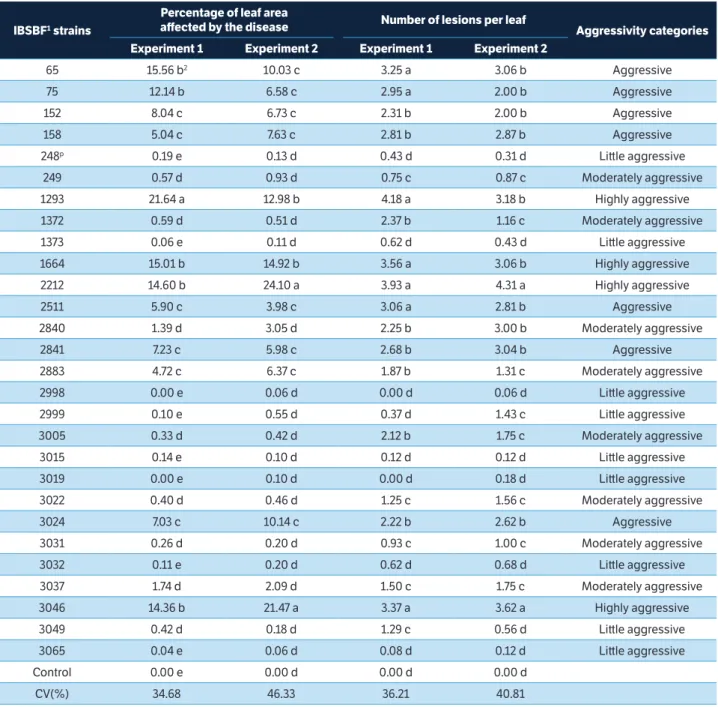
2212, 3046 and 75. In the second experiment, the strains IBSBF 2212 and 3046 were more aggressive followed by the strains IBSBF 1664 and 1293. By observing simultaneously the results of percentage of area affected by the disease and number of lesions per leaves, in both experiments, the isolates can be divided in four categories: HA - highly aggressive; A – aggressive; MA - moderately aggressive and LA - less aggressive. According to this results, the higher aggressive strains were IBSBF 1293, 1664, 2212, e 3046. The aggressiveness classification of all the other strains are described on Table 2. Symptoms of bacterial halo blight were not observed in the control treatments.
This is the first study in which the severity of bacterial halo blight was assessed with the interactive application Leaf Doctor (Pethybridge and nelson 2015). The use of the application was somewhat laborious because all the leaves needed to be photographed, but it reduced the human error involved in estimating the leaf area affected by the disease and also made possible the experiment be well documented, therefore it can be a valuable tool for assessing this disease. There was a significant correlation between the number of lesions per leaf and the area affected by the disease in the first (R2 = 0,776847) and
second experiment (R2 = 0,699389).
IBSBF1 strains
Percentage of leaf area
affected by the disease Number of lesions per leaf Aggressivity categories
Experiment 1 Experiment 2 Experiment 1 Experiment 2
65 15.56 b2 10.03 c 3.25 a 3.06 b Aggressive
75 12.14 b 6.58 c 2.95 a 2.00 b Aggressive
152 8.04 c 6.73 c 2.31 b 2.00 b Aggressive
158 5.04 c 7.63 c 2.81 b 2.87 b Aggressive
248p 0.19 e 0.13 d 0.43 d 0.31 d Little aggressive
249 0.57 d 0.93 d 0.75 c 0.87 c Moderately aggressive
1293 21.64 a 12.98 b 4.18 a 3.18 b Highly aggressive
1372 0.59 d 0.51 d 2.37 b 1.16 c Moderately aggressive
1373 0.06 e 0.11 d 0.62 d 0.43 d Little aggressive
1664 15.01 b 14.92 b 3.56 a 3.06 b Highly aggressive
2212 14.60 b 24.10 a 3.93 a 4.31 a Highly aggressive
2511 5.90 c 3.98 c 3.06 a 2.81 b Aggressive
2840 1.39 d 3.05 d 2.25 b 3.00 b Moderately aggressive
2841 7.23 c 5.98 c 2.68 b 3.04 b Aggressive
2883 4.72 c 6.37 c 1.87 b 1.31 c Moderately aggressive
2998 0.00 e 0.06 d 0.00 d 0.06 d Little aggressive
2999 0.10 e 0.55 d 0.37 d 1.43 c Little aggressive
3005 0.33 d 0.42 d 2.12 b 1.75 c Moderately aggressive
3015 0.14 e 0.10 d 0.12 d 0.12 d Little aggressive
3019 0.00 e 0.10 d 0.00 d 0.18 d Little aggressive
3022 0.40 d 0.46 d 1.25 c 1.56 c Moderately aggressive
3024 7.03 c 10.14 c 2.22 b 2.62 b Aggressive
3031 0.26 d 0.20 d 0.93 c 1.00 c Moderately aggressive
3032 0.11 e 0.20 d 0.62 d 0.68 d Little aggressive
3037 1.74 d 2.09 d 1.50 c 1.75 c Moderately aggressive
3046 14.36 b 21.47 a 3.37 a 3.62 a Highly aggressive
3049 0.42 d 0.18 d 1.29 c 0.56 d Little aggressive
3065 0.04 e 0.06 d 0.08 d 0.12 d Little aggressive
Control 0.00 e 0.00 d 0.00 d 0.00 d
CV(%) 34.68 46.33 36.21 40.81
Table 2. Aggressiveness of Pseudomonas syringe pv. garcae strains to coffee seedlings cv. Mundo Novo, evaluated by the severity, estimated by the leaf area affected by disease and the number of lesions per leaf.
1IBSBF - Phytobacteria Culture Collection of Instituto Biológico - Brazil. (http//www.biologico.sp.gov.br/pdf/catalogo_IBSBF.pdf); 2Means were compared by the
Scott-Knott test at 5 % probability; PPatovar reference strain.
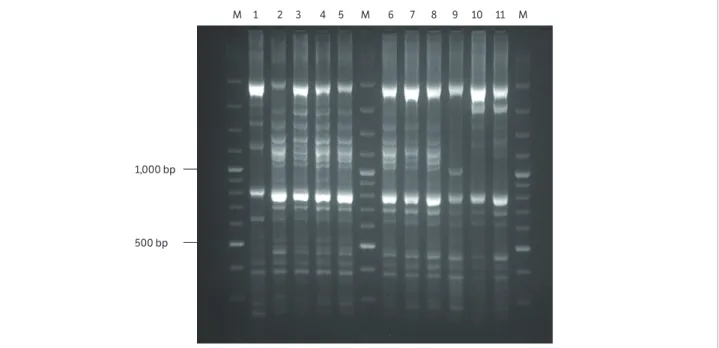
In this study, the strains did not show variations in the BoX-PCR (data not shown) but exhibited variability in the ERIC- and REP-PCR patterns. The genetic relatedness of P. syringae pv. garcae strains, investigated by ERIC- and REP-PCR, yielded fingerprints with 20 and 24 bands ranging from 1900 bp to 80 bp and 1825 bp to 200 bp, respectively. Banding patterns generated by ERIC- and REP-PCR revealed a high genetic diversity among the strains. The dendrogram
Kenya, and the subcluster “b” was further subdivided into two other subclusters, “i” and “ii”, with approximately 53% similarity. The subcluster “ii” allocated strains from the counties of Guaxupé, MG, Andradas, MG, and Varginha, MG, (70% similarity), while the subcluster “i” grouped five strains from Minas Gerais 57% similarity), isolated from 1978 to 2011, and the remaining 12 from the State of São Paulo isolated from 1998 to 2009. one strain from
Albertina, MG, was allocated with São Paulo strains, and the genetic similarity between them probably has occurred due the exchange of vegetal material between these cities which are geographically close (Figures 1 and 2).
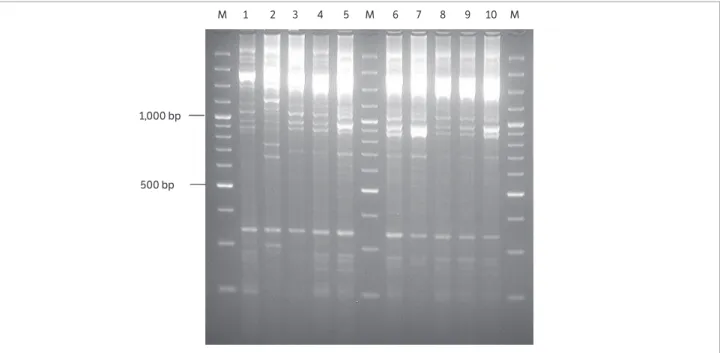
Banding patterns generated by REP-PCR also revealed a high genetic diversity among the strains. In this analysis the strains were separated into two clusters: Cluster I was represented only by the IBSBF 2883 strain from Kenya, with
Figure 1. Amplification of DNAs from Pseudomonas syringae pv. garcae strains with ERIC 1R/ERIC2 primers. (M) Molecular weight marker 100 bp (1) IBSBF 248P; (2) 2999; (3) 3005; (4) 3015; (5) 3019; (6) 3022; (7) 3032; (8) 3046; (9) 249; (10) 2883 and (11) 3037.
0.00 0.25 0.50 0.75 1.00
248 - 1958 - Garça/SP (LA) 65 - 1976 - Jaú/SP (A) 75 - 1978 - Pirajú/SP (A) 158 - 1978 - Campinas/SP (A) 152 - 1978 - Ouro Fino/MG (A) 2511 - 2007 - Patricínio/MG (A) 3024 - 2011 - Serra do Salitre/MG (A) 3065 - 2010 - Unaí/MG (LA) 2998 - 2008 - Carmo de Minas/MG (LA) 1372 - 1998 - Cristais Paulista/SP (MA) 2212 - 2005 - Franca/SP (HA) 2999 - 2008 - Serra Negra/SP (LA) 3005 - 2008 - Altinópolis/SP (MA) 1373 - 1998 - São João da Boa Vista/SP (LA) 3019 - 2009 - São Sebastião da Grama/SP (LA) 3015 - 2008 - Garça/SP (LA)
2841 - 2009 - Águas da Prata/SP (A) 3022 - 2009 - Bragança Paulista/SP (MA) 3032 - 2009 - Albertina/MG (LA) 3046 - 2009 - Divinoândia/SP (HA) 1664 - 2001 - Serra Negra/SP (HA) 2840 - 2009 - Caconde/SP (MA) 1293 - 1997 - Guaxupé/MG (HA) 3049 - 2009 - Andradas/MG (LA) 3031 - 2009 - Varginha/MG (MA) 249 - Kenya (MA)
2883 - Kenya (MA) 3037 - Kenya (MA) i
i
ii ii
(b)
(a)
1,000 bp
M 1 2 3 4 5 M 6 7 8 9 10 11 M
500 bp
1,000 bp
M 1 2 3 4 5 M 6 7 8 9 10 M
500 bp
0.00 0.25 0.50 0.75 1.00
248 - 1958 - Garça/SP (LA) 152 - 1978 - Ouro Fino/MG (A) 1293 - 1997 - Guaxupé/MG (HA) 249 - Kenya (MA)
3037 - Kenya (MA) 2511 - 2007 - Patricínio/MG (A)
i
i
ii ii
(b) (a)
2998 - 2008 - Carmo de Minas/MG (LA) 3024 - 2011 - Serra do Salitre/MG (A) 3065 - 2010 - Unaí/MG (LA) 3031 - 2009 - Varginha/MG (MA) 3049 - 2009 - Andradas/MG (LA) 65 - 1976 - Jaú/SP (A) 2999 - 2008 - Serra Negra/SP (LA) 75 - 1978 - Pirajú/SP (A) 3005 - 2008 - Altinópolis/SP (MA) 1372 - 1998 - Cristais Paulista/SP (MA) 1664 - 2001 - Serra Negra/SP (HA) 2840 - 2009 - Caconde/SP (MA) 158 - 1978 - Campinas/SP (A) 2212 - 2005 - Franca/SP (HA)
1373 - 1998 - São João da Boa Vista/SP (LA) 3019 - 2009 - São Sebastião da Grama/SP (LA) 2841 - 2009 - Águas da Prata/SP (A) 3015 - 2008 - Garça/SP (LA) 3032 - 2009 - Albertina/MG (LA) 3046 - 2009 Divinoândia/SP (HA) 3022 - 2009 Bragança Paulista/SP (MA) 2883 - Kenya (MA)
Figure 3. Amplification of DNAs from Pseudomonas syringae pv. garcae strains with REP1R/REP2I primers. (M) Molecular weight marker 100 bp; (1) IBSBF 248P; (2) 65; (3) 75; (4) 158; (5) 1372; (6) 1373; (7) 1664; (8) 2840; (9) 2841 and (10) 2999.
Figure 4. Genetic diversity of Pseudomonas syringae pv. garcae strains. Dendrogram generated according to the fingerprint of the strains using REP1R/REP2I primers, based on the UPGMA method, using Jaccard similarity coefficient (SJ).
approximately 20% similarity to Cluster II, which allocated the remaining strains and was subdivided into subclusters “a” and “b”, with about 49% similarity to each other. The subcluster “a” included only five strains with 60% similarity, two from Kenya (IBSBF 249 and IBSBF 3037), the pathotype strain (IBSBF 248P), also one strain from Guaxupé, MG, and
another from ouro Fino/MG. The subcluster “b” grouped the remaining 22 strains, which could be further divided into two
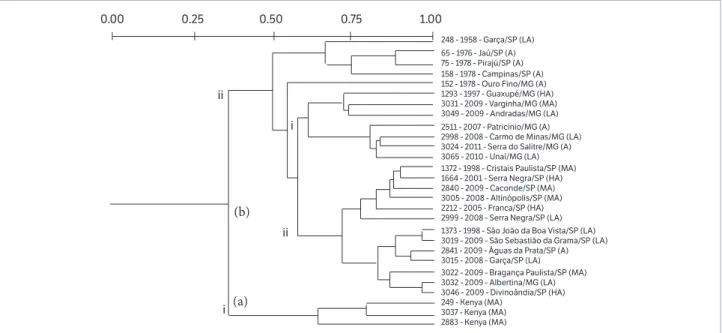
In the combined analysis, the strains were separated in two clusters (Figure 5). Cluster I was only composed by the three strains from Kenya, with approximately 37% similarity with the other strains of this study. Cluster II comprised the remaining 25 strains, divided in two subclusters, “a” and “b”, with approximately 50% similarity with each other. The subcluster “a” was composed by four strains from the State of São Paulo in the period from 1958 to 1978 (IBSBF 65, IBSBF 75, IBSBF158 and IBSBF 248P). The subcluster “b” allocated 21 strains from the
States of São Paulo and Minas Gerais and was subdivided in two subclusters, “i” and “ii”, with approximately 57% similarity between them. The subcluster “i” was composed only by strains from the state of Minas Gerais and “ii” by those from São Paulo, with exception of IBSBF 3032 from Albertina/MG (Figure 5).
In the combined ERIC- and REP-PCR analysis, strains from Guaxupé/MG, Varginha, MG, and Andradas, MG, obtained from 1997 to 2009, grouped in the same sub-group (Figure 5). These counties belong to the same coffee production region in Sul de Minas, with altitudes varying from 865 to 881 m, Cfb and Cfa climate, annual average temperature of 19,7 to 20,2 oC; and 1200 to 1500
mm average annual rainfall (Table 1).
The strains from São João da Boa Vista, São Sebastião da Grama, Águas da Prata, Garça, Bragança Paulista, Divinolândia, all from the State of São Paulo, as well as
Albertina, from Minas Gerais, grouped in similar sub-groups in the REP-PCR, and in the combined ERIC- and REP-PCR dendrograms. These counties, with the exception of Garça (IBSBF 3015), are relatively close to each other, have altitudes varying from 764 to 1021 m, average temperature from 18,2 to 20,1 oC, and 1,493 to
1,590 mm annual average rainfall, as well as Cfa and Cfb climate (Table 1).
Strains from Cristais Paulista, Franca and Altinópolis, that are relatively close to each other, as well as Serra negra and Caconde, that are more distant, grouped in the same sub-group in the combined ERIC- and REP-PCR dendrogram. These counties belong to the same coffee producing region, Mogiana, and show average temperature ranging from 18,1 to 20,1 oC, average
annual rainfall of 1,479 to 1,557 mm, Cfb to Cfa climate classification (Climate date org. 2016) (Table 1).
In this study, the strains did not show variations in the BoX-PCR (data not shown) but exhibited variability in the ERIC- and REP-PCR patterns. Isolates from the same pathovar may have identical REP, BoX and ERIC fingerprints or they may differ in some banding patterns (Louws et al. 1994). Çepni and Gürel (2012) found that ERIC-PCR could not differentiate strains of
P. savastanoi pv. savastanoi from strains of P.syringae.
pv. tomato and P. s. pv. phaseolicola, but the combination of BoX-PCR with REP-PCR allowed the grouping of
0.00 0.25 0.50 0.75 1.00
248 - 1958 - Garça/SP (LA)
i
i
ii ii
(b)
(a)
65 - 1976 - Jaú/SP (A) 75 - 1978 - Pirajú/SP (A) 158 - 1978 - Campinas/SP (A) 152 - 1978 - Ouro Fino/MG (A) 1293 - 1997 - Guaxupé/MG (HA) 3031 - 2009 - Varginha/MG (MA) 3049 - 2009 - Andradas/MG (LA) 2511 - 2007 - Patricínio/MG (A) 2998 - 2008 - Carmo de Minas/MG (LA) 3024 - 2011 - Serra do Salitre/MG (A) 3065 - 2010 - Unaí/MG (LA) 1372 - 1998 - Cristais Paulista/SP (MA) 1664 - 2001 - Serra Negra/SP (HA) 2840 - 2009 - Caconde/SP (MA) 3005 - 2008 - Altinópolis/SP (MA) 2212 - 2005 - Franca/SP (HA) 2999 - 2008 - Serra Negra/SP (LA) 1373 - 1998 - São João da Boa Vista/SP (LA) 3019 - 2009 - São Sebastião da Grama/SP (LA) 2841 - 2009 - Águas da Prata/SP (A) 3015 - 2008 - Garça/SP (LA) 3022 - 2009 - Bragança Paulista/SP (MA) 3032 - 2009 - Albertina/MG (LA) 3046 - 2009 - Divinoândia/SP (HA) 249 - Kenya (MA)
3037 - Kenya (MA) 2883 - Kenya (MA)
strains of different species and hosts in diverse clusters. Gašić et al. (2012) demonstrated that this technique was able to differentiate strains of P.syringae. pv. syringae, P. syringae. pv. morsprunorum and P. syringae. pv. persicae
from stone fruits with rep-PCR. on the other hand, Vicente and Roberts (2007), while studying strains of
P. syringae. pv. syringae from cherry trees and other hosts and P. syringae.pv. morsprunorum isolated from cherry trees, found that strains of P. syringae. pv. syringae
could vary in their rep-PCR patterns, and strains from different hosts grouped together, but strains from P. syringae. pv. morsprunorum were more aggressive and less variable. Kaluzna et al. (2010) found that BoX-PCR provided a better differentiation of the genetic diversity of P.syringae. pv. syringae strains and P. syringae. pv. morsprunorum races 1 and 2 than ERIC-PCR.
In this study, strains from Kenya grouped separately from Brazilian strains in the ERIC- and REP-PCR analysis. The low genetic similarity observed between these strains could be related to their geographic origin. Kairu (1997), previously related differences between strains isolated from Brazil and Kenya, in relation to aggressiveness and biochemical characteristics such as UV fluorescent pigment and bacteriocin production. In a similar pathosystem, Ferrante and Scortichini (2010) also observed that
P. syringae pv. actinidiae strains, the causal agent of an outbreak of bacterial canker on Actinidia chinensis
(yellow kiwifruit) in central Italy, grouped separately by rep-PCR from strains obtained in other countries.
In this study, the ERIC-PCR technique allows to cluster the strains of P. syringae pv. garcae by period of isolation, while with the REP-PCR technique the strains were grouped by geographical origin. Similar results were observed for Xanthomonads of tomato by Louws et al. 1994.
The combination of ERIC with REP-PCR showed the genetic relatedness of the Brazilian strains of P. syringae.
pv. garcae. With some exceptions, the strains obtained after the year of 1997 could be grouped by geographic origin. This may have occurred, probably, because nurseries distribute coffee seedlings in the regions where they are produced, and the exchange of seedlings between different regions may occur, but is rather infrequent. As infected seedlings are the main source of spread of bacterial halo blight to new coffee crops, the strains could evolve separately in each region. This is a relevant
information found in this study and implies that control measures aiming to reduce the disease in coffee seedlings nurseries can impact the spread and management of the disease in new coffee crops. Although some of the strains were grouped by aggressiveness classification, such as, in the combined analysis (ERIC/REP-PCR), the Cluster II, subcluster “a” were allocated three strains (IBSBF 65, 75 and 158) as aggressive, and the three strains of Cluster I (IBSBF 249, 2883 and 3037) as moderately aggressive. Even though some strains were grouped, these results could not be correlated. A study with a major number of strains might give a better correlation of aggressiveness and genetic diversity of P. syringae pv. garcae.
Similar results were observed by Scortichini et al. (2001), while studying strains of Xanthomonas arboricola
pv. juglandis from Persian walnut. The authors observed that, although the genetic similarity of those isolates was high, the strains grouped in three different clusters related to their Italian or Greek geographic origin. Gutiérrez-Barranquero et al. (2013) also reported that the ERIC- and REP-PCR clustered separately P. syringae
pv. syringae strains isolated from mango from strains obtained from other hosts, and also grouped them by their geographic origin.
Since 1997, the majority of the P. syringae pv. garcae
strains (80.9%) was originated from regions near or above 800 m altitude, considered high altitude regions in Brazil. In higher altitude regions, the climatic conditions are very suitable to the coffee crop and are favorable to produce beverage with higher quality. However, in these areas, the milder temperatures and frequent incidence of winds are also favorable for bacterial halo blight. Considering that P. syringae pv. garcae strains isolated in the last years clustered by their region of origin, recent outbreaks of the disease could be related to nurseries distributing infected seedlings in regions with favorable climatic conditions, but further studies are still necessary to validate this hypothesis.
CONCLuSION
All the Pseudomonas syringae pv. garcae strains were pathogenic to coffee seedlings but 12, obtained from 1977 to 2011, were more aggressive on Coffea arabica
Amaral, J. F., Teixeira, C. G. and Pinheiro, E. D. (1956). O bactério causador da mancha aureolada do cafeeiro. Arquivos do Instituto Biológico, 23, 151-155.
Çepni, E. and Gürel, F. (2012).Variation in extragenic repetitive
DNA sequences in Pseudomonas syringae and potential use of modified REP primers in the identification of closely related isolates. Genetics and Molecular Biology, 35, 650-656. http://
dx.doi.org/10.1590/S1415-47572012005000040.
Climate Data Org. Dados climáticos para as cidades mundiais; [accessed 2016 February 22]. PT.climate-data.org
Companhia Nacional de Abastecimento (2014). Avaliação da Safra Agrícola Cafeeira 2014 - Terceira Estimativa - Janeiro/2015; [accessed 2016 January 15]. http://www.conab.gov.br/OlalaCMS/
uploads/arquivos/15_01_14_11_57_33_boletim_cafe_janeiro_2015. pdf.
Costa, A. S., Amaral, J. F., Viegas, A. P. Silva, D. M., Teixeira, C. G. and Pinheiro, E. D. (1957). Bacterial halo blight of coffee in
Brazil. Phytopathologische Zeitschrift, 28, 427-444.
Ferrante, P. and Scortichini, M. (2010). Molecular and phenotypic
features of Pseudomonas syringae pv. actinidiae isolated
during recent epidemics of bacterial canker on yellow kiwifruit
(Actinidia chinensis) in central Italy. Plant Pathology, 59, 954-962. http://dx.doi.org/0.1111/j.1365-3059.2010.02304.x.
Gašić, K., Prokić, A., Ivanović, M., Kuzmanović, N. and Obradović, A. (2012). Differentiation of Pseudomonas syringae pathovars
originating from stone fruits. Pesticides and Phytomedicine, 27, 219-229. http://dx.doi.org/10.2298/PIF1203219G.
Gutiérrez-Barranquero, J. A., Carrión, V. J., Murillo, J., Arrebola, E., Arnold, D. L., Cazorla, F. M. and Vicente, A. (2013). A Pseudomonas syringae diversity survey reveals a differentiated
REFERENCES
In the combined analysis of ERIC- and REP-PCR, the Brazilian strains obtained from 1958 to 1978 grouped separately from the remaining strains and the Kenyan strains grouped separately from the Brazilian strains.
Strains isolated from 1997 to 2011 clustered by their region of origin in the combination of ERIC- and REP-PCR, and were predominately from regions above 800 m.
ACKNOwLEdGMENTS
The authors are grateful to the national Council for Scientific and Technological Development (CnPq) and the Coordination for the Improvement of Higher Education Personnel (CAPES) for financial supports; and Dr. B. C. Trasferetti for the revision of the English language.
phylotype of the pathovar syringae associated with the mango host and mango toxin production. Phytopathology 103, 1115-1129. http://dx.doi.org/10.1094/PHYTO-04-13-0093-R.
Kaluzna M., Ferrante P., Sobiczewski P. and Scortichini M.
(2010). Characterization and genetic diversity of Pseudomonas syringae from stone fruits and hazelnut using repetitive-PCR and MLST. Journal of Plant Pathology, 92, 781-787.
Kairu, M.G. (1997). Biochemical and pathogenic differences between Kenyan and Brazilian isolates of Pseudomonas
syringe pv. garcae. Plant Pathology, 46, 239-246. https://doi. org/10.1046/j.1365-3059.1997.d01-218.x.
Kimura, O., Robbs, C. F. and Ribeiro, R. L. D. (1973). Estudos sobre o agente da “mancha aureolada do cafeeiro” (Pseudomonas
garcae Amaral et al.). Arquivos da Universidade Federal Rural do Rio de Janeiro, 3, 15-18.
Louws, F. J., Fulbright, D. W., Stephens, C. T. and De Bruijn, F. (1994). Specific genomic fingerprints of phytopathogenic
Xanthomonas and Pseudomonas pathovars and strains
generated with repetitive sequences and PCR. Applied and Environmental Microbiology, 60, 2286-2295.
Malavolta Junior, V. A., Beriam, L. O. S., Almeida, I. M. G.,
Rodrigues Neto, J. and Robbs, C. F. (2008). Bactérias fitopatogênicas assinaladas no Brasil: uma atualização. Summa Phytopathologica, 34, 9-88.
Mirik, M., Aysan, Y. and Sahin, F. (2011). Characterization of
Pseudomonas cichorii isolated from different hosts in Turkey. International Journal of Agriculture and Biology, 13, 203-209.
Natalini, E., Rossi, M. P., Barionovi, D. and Scortichini, M. (2006). Genetic and pathogenic diversity of Pseudomonas syringae pv.
syringae isolates associated with bud necrosis and leaf spot of pear in a single orchard. Journal of Plant Pathology, 88, 219-223. http://
dx.doi.org/ 10.4454/jpp.v88i2.866.
Pethybridge, S. J. and Nelson, S. C. (2015). Leaf Doctor: A new portable
application for quantifying plant disease severity. Plant Disease, 99, 1310-1316. http://dx.doi.org/10.1094/PDIS-03-15-0319-RE.
Rademaker, J. L. W., Hoste, B., Louws, F J., Kersters, K., Swings, J., Vauterin, L., Vauterin, P. and Bruijn, F. J. (2000). Comparison of AFLP
and rep-PCR genomic fingerprinting with DNA–DNA homology studies: Xanthomonas as a model system. International Journal of
Systematic and Evolutionary Microbiology, 50, 665-677. http://dx.doi.
org/ 10.10466/J.1439-0434.2001.00628.x.
Rodrigues, L.M.R., Almeida, I. M. G., Patrício, F. R. A., Beriam, L. O. S., Maciel, K. W. , Braghini, M. T. and Guerreiro Filho, O. (2013). Mancha
aureolada do cafeeiro causada por Pseudomonas syringae pv. garcae.
Boletim Técnico IAC 212. (p. 24). Campinas: Instituto Agronômico.
Rohlf, F. J. (1992). NTSYS-PC Numerical Taxonomy and Multivariate Analysis Sistem Version 1.70. Stony Brook. New
York: State University of New York.
Scortichini, M., Marchesi, U. and Di Prospero, P. (2001). Genetic diversity of Xanthomonas arboricola pv. juglandis
(synonyms: X. campestrispv. juglandis;X. juglandis pv.
juglandis) strains from different geographical areas shown by repetitive polymerase chain reaction genomic fingerprinting.
Journal of Phytopathology, 149, 325-332. http://dx.doi.
org/10.1046/j.1439-0434.2001.00628.x.
Vicente, J. G. and Roberts, S. J. (2007). Discrimination of Pseudomonas syringae isolates from sweet and wild cherry
using rep-PCR. European Journal of Plant Pathology, 117,
383-392. http://dx.doi.org/10.1007/s10658-007-9107-y).
Zoccoli, D. M., Takatsu, A. and Uesugi, C. H. (2011). Ocorrência de mancha aureolada em cafeeiros na Região do Triângulo