BJRS
RADIATION SCIENCES
07-03 (2019) 01-10ISSN: 2319-0612 Accepted: 2019-04-25
A fast method for the determination of
210Pb by LSC in
liquid samples
Sampaio
aC.S., Sousa
aW.O., Dantas
aB.M.
a CNEN/IRD/DIDOS, 22783-127, Rio de Janeiro, RJ, Brasil
ABSTRACT 210
Pb is a naturally occurring radionuclide, widely distributed on the earth´s surface and can be incorporated by humans through food chain or directly by ingestion or inhalation in situations of occupational or accidental exposures. Because of its metabolic and dosimetric characteristics, 210Pb becomes an important isotope from the
radiation protection point of view. This work presents the development of a methodology for the determination of 210Pb by liquid scintillation. It is the modification of a sequential analysis for naturally occurring radionuclides
in environmental samples without the need of waiting for secular equilibrium to be achieved with 210Bi that
allows a faster determination of 210Pb. The methodology has shown to be precise, stable and provides consistent
results when evaluated according to the criteria established in the Brazilian Intercomparison Program promoted by the IRD. This technique can be applied to any sample after proper digestion and in liquid form.
1. INTRODUCTION
210Pb is a product of the 238U decay chain for which reliable bioassay techniques are of interest to a wide range of applications in the field of radiation protection since it presents one of the highest committed effective dose coefficients among naturally occurring radionuclides [1].
210Pb can be measured directly by gamma-spectrometry [2] or indirectly, through the determination of 210Po by alpha-spectrometry [3] or measuring 210Bi in a proportional counter [4]. By gamma spectrometry it is not necessary to achieve secular equilibrium but the technique presents poor sensitivity and self-absorption with a higher detection limit [2]. Alpha-spectrometry presents lower detection limit, but up to 6 months are necessary to achieve secular equilibrium between 210Pb and 210Po [3]. Proportional counting also presents lower detection limit and the time for the secular equilibrium to be achieved between 210Pb and 210Bi is lowered to 15 days. However, considering that it is a quantitative analysis and only total count will be taking into account, this technique can be highly affected by unknown interferences possibly present in the sample [4].
Liquid scintillation offers some advantages over other techniques, as it is not necessary to wait for secular equilibrium, offers detection limits comparable to α spectrometry and, in some cases, it is possible to detect the presence of sample interferences [5,6].
Most of the techniques currently employed are based on the determination of lead after secular equilibrium is established with bismuth, which can be as low as 15 days. On the other hand, liquid scintillation allows the measurement of 210Pb directly as well as indirectly, after secular equilibrium with 210Bi is reached.
This work presents a suspension gel method applied for faster determination of 210Pb by liquid scintillation based on simultaneous radiochemical separation of 226Ra and 210Pb, by direct measurement, without the need to wait for secular equilibrium with 210Bi be achieved. This technique can be applied to any sample, after proper digestion, in liquid form in a HNO3 1% matrix.
2. MATERIALS AND METHODS
2.1. Radiochemical procedure
Radiochemical procedure is summarized in figure 1.
Figure 1: Radiochemical flow chart of the method.
The method consists of a selective precipitation of barium and lead present in the sample [7] in form of sulphates.
It is a three-day step, the first step consisting of neutralizing the sample to pH 4.5 - 5 (containing 20 mg Ba2+ and 20 mg Pb2+ carrier) by adding concentrated NH
4OH. Then 50 mL H2SO4 3 mol/L was added to the sample in order to precipitate simultaneously barium (and consequently radium) and lead in form of BaSO4 and PbSO4. At the second day, the supernatant was discarded and the precipitate re-dissolved using 2 g nitrilotriacetic acid (NTA), 30 mL distilled water and 7 mL NaOH 6 mol/L. Barium (and radium) sulphate was precipitated with addition of glacial acetic acid until pH 4.5. At the third day, after centrifugation, 1 mL Na2S was added to the supernatant in order to
Ba(Pb)SO4 coprecipitate Sample Ba, Pb carrier NH4OH H2SO4 3M NTA H2O NaOH 6M CH3COOH Centrifuge BaSO4 precipitate Pb supernatant Centrifuge (NH4)2SO4 25 mg/mL Na2S 5M PbS precipitate Filter HNO3 H2O Pb supernatant NH4OH H2SO4 3M ethanol Filter PbSO4 precipitate Transfer to plastic vial chemical yield Scintillation cocktail PbSO4 plastic vial 8 mL H2O 4 mL Ultima Gold AB 8 mL Insta-Gel Plus
precipitate PbS with help of 5 mL (NH4)2SO4 25mg/mL. The sample was centrifuged and supernatant discarded. To the black precipitate was added concentrated HNO3 and water becoming yellow with Pb in solution. The solution was filtrated with filter paper (Whatman 40) and neutralized with concentrated NH4OH until pH 4.5 – 5. PbSO4 is then precipitated by adding 1 mL H2SO4 3 mol/L. The radiochemical yield was determined gravimetrically using stable Pb2+ as carrier and sample was analyzed by liquid scintillation. Analytical grade reagents were used throughout this work.
This technique chemical yield ranged from 60% to 80% (n = 40), with an average value of 75%.
2.2. Equipment
Samples were counted with a Quantulus 1220 low-background scintillation spectrometer (Perkin Elmer/Wallac). It is provided with the software WinQ (Windows software for controlling Wallac 1220 Quantulus v. 1.2) used to control counting parameters.
2.3. α Interferences: calibration of the α/β discrimination system
Quantulus 1220 is provided with a pulse shape analysis (PSA) circuit that distinguishes alpha from beta pulses which varies from 1 (all events classified as alphas) to 256 (all events classified as betas).
It was necessary to select appropriate pure α and β emitters since interferences are not constant for all radionuclides. Based on previous works [6, 8], 99Tcand 241Am were chosen to calibrate for α/β interferences. Two vials containing non-radioactive PbSO4 were prepared. 99Tc was added in the first vial, and 214Am in the second. The vials were counted for 5 minutes from PSA 5 to PSA 120 and the total interference was calculated. The optimum value for PSA threshold level was 75. This is the value that minimizes the interferences of an alpha emitter in the counting region of a beta emitter.
2.4. Calibration
The counting protocol for the scintillation cocktail method was set to low coincidence bias, Alpha/Beta configuration, PSA threshold level of 75, with a counting time of 100 minutes.
Three water samples in nitric acid were spiked with known activities (3.5 Bq) of a 210Pb standard solution supplied by the National Laboratory of Ionizing Radiations Metrology (LNMRI). One non-spiked sample was processed as blank. The radiochemical procedure was applied to those four samples. Counting was performed daily up to 15 days after precipitation. Efficiency was then calculated as
ε = (rs – rb) / (60.A.y) (1)
where rs and rb are the total and background count rates (cpm) in the corresponding window, A is
the activity of 210Pb standard solution added to the calibration source and y the radiochemical yield. The efficiency average value was calculated using least square fitting.
2.5. Accuracy assessment
Three samples of water from the Brazilian Intercomparison Program and one blank sample were prepared and analyzed applying the radiochemical procedure proposed in this work and the same calibration parameters. The counting time was set to 100 minutes. Relative bias and normalized deviation (D) value were calculated as
D = (x – U) / (su / √n) (2)
Where “x” is the value of the analytical measurement; “U” is the reference value; “su” is the standard deviation of the reference value and; “n” is the number of repetitions. As closer |D| value gets to 0 the better. The method is considered good when |D| < 2. 2 ≤ |D| < 3 is considered acceptable and if |D| ≥ 3 the method is considered out of control. This is the evaluation value adopted by the Brazilian Intercomparison Program according to [10] and [11].
The uncertainties and characteristic limits (decision threshold and detection limits) were determined according to International Standard ISO 11929 [9].
3. RESULTS AND DISCUSSION
3.1. Calibration
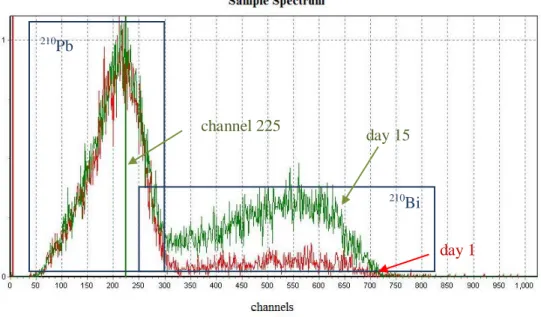
Figure 2 shows a spectrum corresponding to 210Pb+210Bi one day after precipitation (in red) and fifteen days after precipitation (in green), when secular equilibrium is achieved.
Figure 2: 210Pb spectrum (channel x cpm).
The first peak was from 210Pb contributions and the second from the 210Bi, where the growing-up can be shown. Because both are beta emitters, they present broad pulse height that produces an overlap between their pulse spectra. Based on spectrum observation it was decided to work with the range of channels from 5 to 225 aiming to minimize the contributions of 210Bi, since the beta spectrum is continuous. The lower limit for the channel range was set at channel 5 to avoid the counts caused by chemiluminescence in cocktail, while the upper limit was set to channel 225, near half of the 210Pb spectrum, minimizing contributions of decay product in the region. Figure 3 shows
210 Pb 210 Bi day 1 day 15 channel 225
the detection efficiency and its uncertainty as a function of days after precipitation for the channel range.
Figure 3: Scintillation cocktail efficiency curve up to 15 days after precipitation.
The average detection efficiency of ε = 53.9 % was found to be independent of time by ANOVA test (p = 0.05), with a correlation of R2 = 0.33. Such result relies on the fact that decay contributions are minimized when considering only 210Pb spectrum. There were no statistically significant differences between efficiency values found during time for the three standards and the average value after evaluated by t-student test (p = 0.005).
3.2. Accuracy assessment
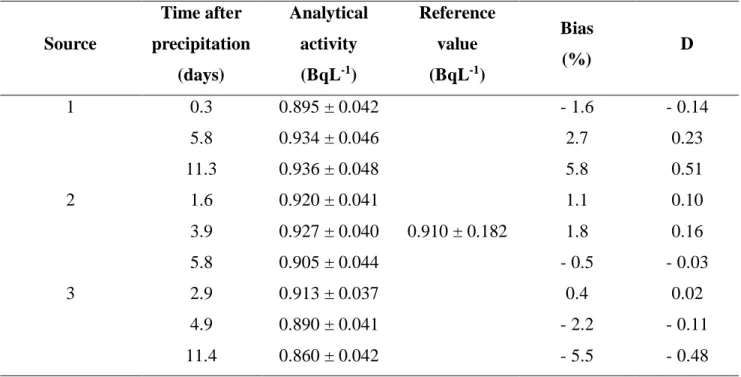
Three aliquots of the sample from the Brazilian National Intercomparison Program were analyzed to assess the calibration. The vials prepared from each aliquot were measured at different times after the precipitation of lead. Table 1 presents the activities results using the proposed
methodology for 210Pb in water, the different time after precipitation, reference value, normalized deviation (D) and relative bias. Activity uncertainties were calculated according to ISO11929 [9].
Table 1: Activity concentration of 210Pb obtained for different aliquots of the water reference sample 6116-EK27/0418.
Source Time after precipitation (days) Analytical activity (BqL-1) Reference value (BqL-1) Bias (%) D 1 0.3 0.895 ± 0.042 0.910 ± 0.182 - 1.6 - 0.14 5.8 0.934 ± 0.046 2.7 0.23 11.3 0.936 ± 0.048 5.8 0.51 2 1.6 0.920 ± 0.041 1.1 0.10 3.9 0.927 ± 0.040 1.8 0.16 5.8 0.905 ± 0.044 - 0.5 - 0.03 3 2.9 0.913 ± 0.037 0.4 0.02 4.9 0.890 ± 0.041 - 2.2 - 0.11 11.4 0.860 ± 0.042 - 5.5 - 0.48
Regardless of the period after precipitation, the results are within the acceptable reference value of 210Pb activity indicating that the proposed methodology is valid. This means that it is not necessary to wait 15 days for the secular equilibrium to be established between 210Pb and 210Bi. All samples are under the acceptable limit (D < 2).
Detection limit was calculated according to ISO11929 [9] and ranged from 0.051 to 0.063 Bq/L. This value can be lowered by setting higher counting times since efficiency is independent of time.
4. CONCLUSION
In summary, according to the results of the Brazilian Intercomparison program, this technique is reliable when 210Pb is determined before secular equilibrium is established.
It should be highlighted that it is a fast technique, considering the possibility of counting the sample since the first day after precipitation and can be used when there is a need for a rapid response for the determination of 210Pb activity levels.
REFERENCES
[1] LAURIA, D. C.; CARVALHO, L. L.; CONTI, C. C. Comparison of different methods for 210Pb determination in environmental samples. Advances in Liquid Scintillation Spectrometry LSC
2005, p. 211-216, 2006.
[2] SAN MIGUEL, E. G.; PÉREZ-MORENO, J. P.; BOLÍVAR, J. P.; GARCÍA-TENORIO, R.; MARTIN, J. E. 210Pb determination by gamma spectrometry in voluminal samples (cylindrical geometry). Nuclear Instruments and Methods in Physics Research Section A, v. 493 (1-2), p. 111-120, 2002.
[3] GARCÍA-ORELLANA, I.; GARCÍA-LEÓN, M. An easy method to determine 210Po and 210Pb by alpha spectrometry in marine environmental samples. Applied Radiation and Isotopes, v. 56 (4), p; 633-636, 2002.
[4] GODOY, J. M.; MOREIRA, I.; WANDERLEY, C.; SIMÕES FILHO, F. F., MOZETO, A. A. An alternative method for the determination of excess 210Pb in sediments. Radiation Protection
Dosimetry, v. 75 (1-4), p. 111-115, 1998.
[5] BLANCO, P.; LOZANO, J. C.; GÓMEZ ESCOBAR, V.; VERA TOMÉ, F. A simple method for 210Pb determination in geological samples by liquid scintillation counting. Applied
Radiation and Isotopes, v. 60, p. 83-88, 2004.
[6] KIM, Y. -J.; KIM, C. -K.; LEE, J. -I. Simultaneous determination of 226Ra and 210Pb in groundwater and soil samples by using liquid scintillation counter – suspension gel method.
Applied Radiation and Isotopes, v. 54, p. 275-281, 2001.
[7] GODOY, J. M.; LAURIA, D. C.; GODOY, Mª. L. D. P.; CUNHA, R. P. Development of a sequential method for the determination of 238U, 243U, 232Th, 228Th, 228Ra, 226Ra and 210Pb in
environmental samples. Journal of Radioanalytical and Nuclear Chemistry, v. 182, p. 165-169, 1994.
[8] VILLA, M.; HURTADO, S.; MANJÓN, G.; GARCÍA-TENORIO, R. Calibration and measurement of 210Pb using two independent techniques. Radiation Measurements, v. 42, p. 1552-1560, 2007.
[9] ISO – International Organization for Standardization. Determination of the characteristic
limits (decision threshold, detection limit and limits of the confidence interval) for measurements of ionizing radiation – Fundamentals and application. ISO 11929:2010,
Geneva, 2010. 60p.
[10] NATRELA, M. G. Experimental Statistics. NBS Handbook n. 91, U.S. Department of Commerce, p. 3 – 8, NBS, 1963.
[11] JARVIS, N. A.; SIU, L. Environmental Radioactivity – Laboratory Intercomparison Studies Program. EPA-600/ 4-81-004, U.S. EPA, 1981.