INTRODUCTION
1. Centro de Controle de Zoonoses, Coordenação de Vigilância em Saúde, Prefeitura da Cidade de São Paulo, São Paulo, SP.
Address to: Dra. Marilene Fernandes de Almeida. CCZ/COVISA/Prefeitura de São Paulo. Rua Santa Eulália 86, Santana, 02031-020 São Paulo, SP, Brasil.
Phone: 55 11 2251-2666; Fax 55 11 2251-2249
e-mail: [email protected]; [email protected] Received in 14/06/2010
Accepted in 04/11/2010
Rabies diagnosis and serology in bats from the State of São Paulo,
Brazil
Diagnóstico e sorologia de raiva em morcegos do Estado de São Paulo, Brasil
Marilene Fernandes de Almeida¹, Luzia Fátima Alves Martorelli¹, Miriam Martos Sodré¹, Ana Paula Arruda
Geraldes Kataoka¹, Adriana Ruckert da Rosa¹, Maria Lucia de Oliveira¹ and Elizabeth Amatuzzi¹
ABSTACT
Introduction: Bats are one of the most important reservoirs and vectors of the rabies virus in the world. Methods: From 1988 to 2003, the Zoonosis Control Center in São Paulo City performed rabies diagnosis on 5,670 bats by direct immunoluorescent test and mouse inoculation test. Blood samples were collected from 1,618 bats and the sera were analyzed using the rapid luorescent focus inhibition test to conirm rabies antibodies. Results: Forty-four (0.8%) bats were positive for rabies. he prevalence of rabies antibodies was 5.9% using 0.5IU/ml as a cutof. Insectivorous bats (69.8%) and bats of the species Molossus molossus
(51.8%) constituted the majority of the sample; however, the highest prevalence of antibodies were observed in Glossophaga soricina (14/133), Histiotus velatus (16/60), Desmodus rotundus
(8/66), Artibeus lituratus (5/54), Nyctinomops macrotis (3/23), Tadarida brasiliensis (3/48),
Carollia perspicillata (3/9), Eumops auripendulus (2/30), Nyctinomops laticaudatus (2/16),
Sturnira lilium (2/17) and Eumops perotis (1/13). he prevalence of rabies antibodies was analyzed by species, food preference and sex. Conclusions: he expressive levels of antibodies associated with the low virus positivity veriied in these bats indicate that rabies virus circulates actively among them.
Keywords: Rabies. Chiropteran. Diagnostic. Seroprevalence. Brazil.
RESUMO
Introdução: Morcegos são um dos mais importantes reservatórios e vetores do vírus da raiva no mundo. Métodos: No período entre 1998 e 2003, o Centro de Controle de Zoonoses da Cidade de São Paulo realizou o diagnóstico de raiva em 5.670 morcegos utilizando as técnicas de imunoluorescência direta e inoculação intracerebral em camundongos. Sangue foi coletado de 1.618 espécimes para pesquisa de anticorpos pela técnica de inibição de foco de luorescência rápida. Resultados: Quarenta e quatro (0,8%) morcegos foram positivos para raiva. A prevalência de anticorpos foi de 5,9% usando 0,5UI/ml como ponto de corte. Os morcegos de hábito alimentar insetívoro (69,8%) e os morcegos da espécie Molossus molossus (51,8%) representaram a maioria da amostra. Entretanto, as mais altas prevalências de anticorpos foram observadas nos morcegos Glossophaga soricina (14/133), Histiotus velatus (16/60), Desmodus rotundus (8/66), Artibeus lituratus (5/54), Nyctinomops macrotis
(3/23), Tadarida brasiliensis (3/48), Carollia perspicillata (3/9), Eumops auripendulus (2/30),
Nyctinomops laticaudatus (2/16), Sturnira lilium (2/17) e Eumops perotis (1/13). A prevalência de anticorpos foi analisada por espécie, hábito alimentar e sexo. Conclusões: O expressivo nível de anticorpos associado à baixa positividade para o vírus da raiva entre os morcegos estudados indica que o vírus circula ativamente entre morcegos.
Palavras-chaves: Raiva. Quiróptero. Diagnóstico. Soroprevalência. Brasil.
In recent decades, there have been frequent case reports of rabies in bats, which are one of the main virus reservoirs in many countries around the world1.
Several reports have conirmed the rabies virus in both hematophagous and nonhematophagous bats; the former are responsible for rabies outbreaks in Latin America2 and the later for sporadic rabies
transmission to humans3,4.
Data from the Pan-American Health Organization (PAHO)5 revealed 678 reported cases of
bat-transmited human rabies in Latin America from 1990 to 2010. Considering only the 240 human cases transmited by bats during the period 1996-2010, 74% were transmitted by hematophagous bats, 6.7% by nonhematophagous bats and in 19.6%, identiication of the species was not registered2,5.
In Brazil, between 2001 and 2010, 1,305 cases of rabies in bats were notiied, 815 (62.5%) involving nonhematophagous bats, 303 (23.2%) in hematophagous bats and in 187 (14.3%) bats, identiication of the species was not conirmed5. he
rabies virus has already been isolated in 41 of the 172 species that live in Brazil6.
The purpose of this work was to report the diagnosis of rabies in bats conducted from 1988 to 2003 on samples collected in the State of São Paulo, Brazil and serology for rabies antibodies performed from 1992 to 2003.
METHODS
From 1988 to 2003, the rabies laboratory of the São Paulo Zoonosis Control Center (CCZ-SP) received 5,834 bats for rabies diagnosis from citizens and other zoonosis centers in the State of São Paulo. Among these, 164 bats were unsuitable for diagnosis (autolysis, alcohol, etc). Diagnosis was performed on the brain of 5,670 bats by luorescent antibody test (FAT)7 and mouse inoculation test (MIT)8.
RESULTS
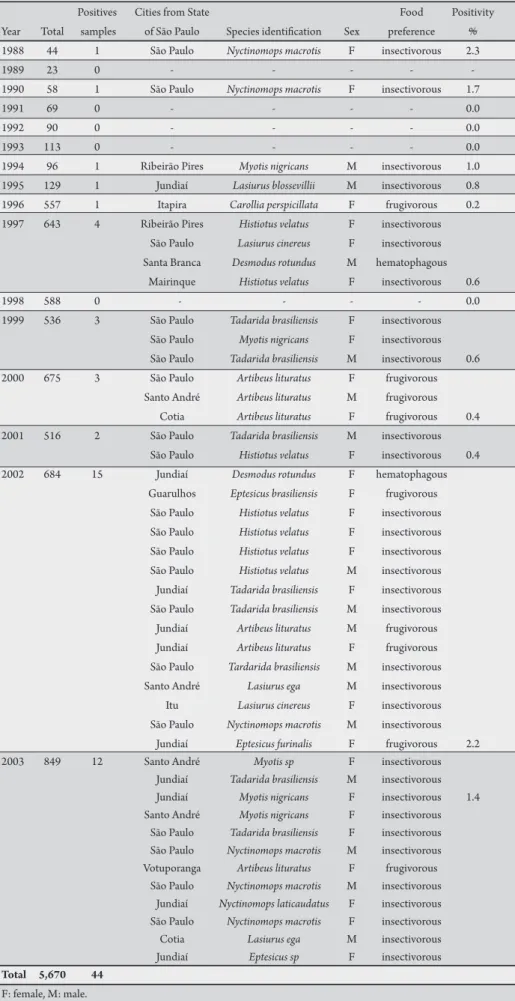
TABLE 1 - Rabies diagnosis in bats, according to species, year, sex and food preference, State of São Paulo, Brazil, 1988 to 2003.
Positives Cities from State Food Positivity
Year Total samples of São Paulo Species identiication Sex preference % 1988 44 1 São Paulo Nyctinomops macrotis F insectivorous 2.3
1989 23 0 - - - -
-1990 58 1 São Paulo Nyctinomops macrotis F insectivorous 1.7
1991 69 0 - - - - 0.0
1992 90 0 - - - - 0.0
1993 113 0 - - - - 0.0
1994 96 1 Ribeirão Pires Myotis nigricans M insectivorous 1.0 1995 129 1 Jundiaí Lasiurus blossevillii M insectivorous 0.8 1996 557 1 Itapira Carollia perspicillata F frugivorous 0.2 1997 643 4 Ribeirão Pires Histiotus velatus F insectivorous
São Paulo Lasiurus cinereus F insectivorous Santa Branca Desmodus rotundus M hematophagous
Mairinque Histiotus velatus F insectivorous 0.6
1998 588 0 - - - - 0.0
1999 536 3 São Paulo Tadarida brasiliensis F insectivorous São Paulo Myotis nigricans F insectivorous São Paulo Tadarida brasiliensis M insectivorous 0.6 2000 675 3 São Paulo Artibeus lituratus F frugivorous
Santo André Artibeus lituratus M frugivorous
Cotia Artibeus lituratus F frugivorous 0.4
2001 516 2 São Paulo Tadarida brasiliensis M insectivorous
São Paulo Histiotus velatus F insectivorous 0.4
2002 684 15 Jundiaí Desmodus rotundus F hematophagous Guarulhos Eptesicus brasiliensis F frugivorous
São Paulo Histiotus velatus F insectivorous São Paulo Histiotus velatus F insectivorous São Paulo Histiotus velatus F insectivorous São Paulo Histiotus velatus M insectivorous Jundiaí Tadarida brasiliensis F insectivorous São Paulo Tadarida brasiliensis M insectivorous Jundiaí Artibeus lituratus M frugivorous Jundiaí Artibeus lituratus F frugivorous São Paulo Tardarida brasiliensis M insectivorous Santo André Lasiurus ega M insectivorous Itu Lasiurus cinereus F insectivorous São Paulo Nyctinomops macrotis M insectivorous
Jundiaí Eptesicus furinalis F frugivorous 2.2
2003 849 12 Santo André Myotis sp F insectivorous
Jundiaí Tadarida brasiliensis M insectivorous Jundiaí Myotis nigricans F insectivorous 1.4 Santo André Myotis nigricans F insectivorous
São Paulo Tadarida brasiliensis F insectivorous São Paulo Nyctinomops macrotis M insectivorous Votuporanga Artibeus lituratus F frugivorous
São Paulo Nyctinomops macrotis M insectivorous Jundiaí Nyctinomops laticaudatus F insectivorous São Paulo Nyctinomops macrotis F insectivorous Cotia Lasiurus ega M insectivorous Jundiaí Eptesicus sp F insectivorous Total 5,670 44
F: female, M: male.
Of the total number of received bats, 1,618 were alive. After weighting, the bats were anesthetized with ketamine
hydrochloride (Ketamina), which
was injected into the pectoral muscle, considering weight and volume. Blood was collected by cardiac punction of the bats and the sera were analyzed for rabies virus neutralizing antibody (VNA) using the rapid luorescent focus inhibition test (RFFIT)9. he cutof point was 0.5IU/ML.
Euthanasia of the bats was performed in a CO2 chamber following blood collection.
Statistical analysis was performed using the uncorrected Chi square test, contained in the sotware Epi-Info 6.0 (CDC, Atlanta, GA, USA).
Ethical considerations
The Scientific Committee of the CCZ-SP authorized all the proceedings performed in this work. he capture of bats was authorized by a Brazilian institution responsible for wild animal care (Instituto Brasileiro do Meio Ambiente, IBAMA).
Rabies diagnosis
Forty-four (0.8%) bats were positive for rabies by FAT and MIT tests among the 5,670 samples analyzed, 45.5% of these were from City of São Paulo and 54.5% from another seven cities in the State of São Paulo. he incubation period for MIT ranged from 6 to 29 days (Table 1).
Regarding the circumstances of the location of the 44 positive bats, 24 were captured inside houses or commercial buildings, ten were collected on the ground, three specimens were capture in fruit trees, three bats were captured by mist nets on farms (two Desmodus rotundus and one
Carollia perspicillata) and one specimen was captured by children during light. In three cases, this data was not available.
The rabies-positive bats belonged to three families and 14 species: Vespertilionidae family (19 bats from six species), Molossidae family (16 bats from four species) and Phyllostomidae family (nine bats from four species). Sixteen were males and 28 were females. Rabies positivity year-by-year is presented in Table 1.
Rabies serology
DISCUSSION
TABLE 2 - Rabies antibodies prevalence in bats according to year and food preference, City of São Paulo, Brazil, 1992-2003.
Food prevalence
Year insectivorous phytophagous hematophagous not identiied total Prevalence (%)
1992-1995 83 28 0 0 111 9.9
1996 218 25 0 5 248 2.8
1997 259 21 6 8 294 3.7
1998 124 64 5 13 206 3.9
1999 100 39 17 59 215 2.8
2000 62 32 11 23 128 2.3
2001 54 13 6 2 75 10.7
2002 128 24 9 12 173 23.1
2003 102 45 14 7 168 1.8
Total 1,130 291 68 129 1,618 6.7
TABLE 3 - Rabies antibodies prevalence in bats according to species identiication, City of São Paulo, Brazil, 1992-2003.
Reagents Prevalence
Family Species identiication Total number %
Molossidae Cynomops planirostris 1 0 0.0
Eumops auripendulus 30 2 6.7
Eumops glaucinus 6 0 0.0
Eumops perotis 13 1 7.7
Eumops sp. 1 0 0.0
Molossops neglectus 2 0 0.0
Molossus molossus 839 27 3.2
Molossus rufus 42 1 2.4
Molossus sp. 6 1 16.7
Nyctinomops aurispinosus 1 0 0.0
Nyctinomops laticaudatus 16 2 12.5
Nyctinomops macrotis 23 3 13.0
Promops nasutus 5 0 0.0
Tadarida brasiliensis 48 3 6.3
Eptesicus brasiliensis 13 0 0.0
Vesperstilionidae Eptesicus furinalis 1 0 0.0
Histiotus velatus 60 16 26.7
Lasiurus cinereus 2 0 0.0
Lasiurus ega 2 0 0.0
Lasiurus sp. 2 0 0.0
Myotis albescens 1 0 0.0
Myotis nigricans 16 0 0.0
Total insectivorous 1,130 56 4.9
Phyllostomidae Artibeus imbriatus 4 0 0.0
Artibeus lituratus 54 5 9.3
Artibeus obscurus 1 0 0.0
Carollia perspicillata 9 3 33.3
Platyrrhinus lineatus 66 2 3.0
Sturnira lilium 17 2 11.8
Total frugivorous 151 12 7.9
Anoura caudifer 6 0 0.0
Anoura geofroyi 1 0 0.0
Glossophaga soricina 133 14 10.5
Total nectarivorous 140 14 10.0
Desmodus rotundus 66 8 12.1
Diphylla ecaudata 2 0 0.0
Total hematophagous 68 8 11.
Without identiication 129 6 4.6
Total 1,618 96 5.9
samples). Prevalence according year and food preference of bats is presented in Table 2. Among the 96 reagent sera, only three bats were positive for FAT and MIT techniques (three bats of the species
H. velatus in 2002).
Among the 1,618 bats submited to rabies serology, 65.8% of them were captured in the City of São Paulo and 34.2% in other cities in the State of São Paulo.
Predominance of insectivorous bats (69.8%) was observed every year throughout the period. Phytophagous (nectarivorous and frugivorous) represented 18% and hematophagous bats represented 4.2%. hirty species of bats were identiied and the insectivorous bat Molossus molossus (51.8%) was predominant. Rabies antibody prevalence according species is presented in Table 3.
Distribution according sex confirmed 62 out of 896 females and 34 out of 559 males with rabies antibody titers. For 163 specimens this information was not available. hroughout the entire period, the number of females was higher than males; however, this difference was not significant (x² = 0.39; p = 0.05). Seroprevalence was 6.9% among females and 6.1% among males.
he conditions of big cities seem appropriate for the permanence of bats, given the lack of predators, large quantities of food and adequate shelters. These factors are common in urban ecosystems. In this work, insectivorous bats from Molossidae and Vespertilionidae families represented the majority of the sample. his was expected, because urban ecosystems, like the City of São Paulo, are especially favorable to insectivorous bats due to the large population of insects atracted to this type of environment by street lamp illumination10.
In disagreement with Hester et al12, who reported that rabies
prevalence in solitary species submited for rabies diagnosis in the USA and Canada is consistently greater than in colonial species, even though the largest number of rabies cases were determined in the colonial bat Eptesicus fuscus,in this work, only six of the rabies-positive bats were from solitary species. In our sample, prevalence seems be more directly related to species habit in urban areas, which use cramped locals as shelter with intense body contact among individuals, than solitary or colonial species.
It is likely that some of the bats detected as rabies-positive were sent for rabies diagnosis and species identiication because the people who found them had some knowledge concerning the potential risk involving bats and rabies transmission. Bats collected by the public are oten sick or injured and therefore represent a biased subpopulation of bats more likely to be infected with rabies, such that rabies prevalence tends to be higher11,13,14. In studies where presumed
healthy bats captured during light were screened for the rabies virus, prevalence is consistently reported as less than 2%12.
Every day the CCZ-SP receives complaints from citizens in relation to bats, citing the noise, the smell of urine and excrement they produce or simply their presence. he population has been oriented continually not to handle these animals and to communicate with the health authorities when a bat is found in an atypical situation, such as lying during the day, paralyzed or moribund, incapable of lying or exposed to sunlight. At the CCZ-SP, information regarding rabies and bats has been publicized for more than 20 years, but to the public, the ecological role of these animals remains largely unknown and public opinion concerning them is generally based on prejudice, fear and erroneous concepts.
he prevalence of the rabies virus observed in this study (0.8%) may not be representative of the reality of the bat population in urban areas, because the majority of the bats were received due to citizens’ complaints (passive surveillance). However, other reports in the State of São Paulo showed similar prevalence in bats: 1.2% in the northwestern region from 1993 to 200715, 1.3% in the northern
and northwestern areas from 1997 to 200216 and 1.6 in the western
region from 1996 to 200317.
While in other regions of the State of São Paulo, the most common species conirmed with rabies were the frugivorous bat
A. lituratus and the insectivorous bats M. nigricans15,16, in this work,
four species predominated: T. brasilienses (19.2%) H. velatus (15.9%),
N. macrotis (13.6%) and A. lituratus (13.6%), while M. nigricans
represented 9.1%. Regarding H. velatus, ive of the six positive cases were found in one colony in 2001/200218.
An increase in the number of bats forwarded for diagnosis in this laboratory has been observed since 1989 and this could be the outcome of an increase in the bat population in urban areas due to the degradation of their natural areas, as well as the publicizing and divulgation of positive rabies cases. he increase in the number of cases of rabies-positive bats registered mostly relects the increasing interest concerning the disease than any real increase in disease incidence19.
Rabies infections of bats can occur during interspecies interaction, possibly by sharing shelters. In nature, bites among bats, the main mechanism of rabies transmission, are frequently observed; although rabies virus in bats involves a variety of transmission and maintenance mechanisms in addition to biting: aerosols20, drinking
milk infected with rabies virus21, transplacental transfer and prenatal
infection13,22.
Low rabies virus prevalence in bats associated with higher rabies antibody prevalence has been reported in the literature. Few studies exist concerning rabies seroprevalence in bats and in these studies the prevalence has shown extensive diferences in the results, between 2.2% and 80%. he presence of rabies antibodies has been detected by diferent serological techniques in numerous bats species, collected in their habitats or in urban shelters23-27.
Price & Everard23 observed seroprevalence of 8.6% in 439 sera
samples. he highest prevalence (29.4%) was observed in Artibeus planirostris (formerly A. jamaicensis). Steece & Altenbach13 reported
antibodies in 514 of 750 sera of Tadarida brasiliensis. Aghomo et al24
veriied rabies antibodies in ive out of 50 frugivorous bats Eidolon helvum (10%) from Nigeria, Africa. Jiang et al26 tested for rabies
antibodies in sera from 685 bats of eight species from China and the total seroprevalence was 2.2%, 2.3% for frugivorous bats and 1.8% for insectivorous bats.
Shankar et al28 detected VNA in five (14.3%) out of 35
insectivorous bats Eptesicus fuscus and Salas-Rojas et al25 examined
151 sera from nonhematophagous bats of 16 species and the seroprevalence determined was 37%. VNA were determined in 12 nonhematophagous bat species. he three species with the largest sample size and prevalence were Artibeus planirostris (formerly named
A. jamaicensis) (14/34), Sturnira lilium (14/37) and Glossophaga soricina (8/20).
he high prevalence of rabies antibodies observed in this study in insectivorous bats Histiotus velatus is related to one colony of 42 bats, in which ive rabies-positive cases were detected (12%). hirty-eight sera were collected and 16 presented antibody titers above 0.5IU/ ml. Elevated seropositivity with high titers, like that observed in this colony, demonstrates a recent outbreak18.
Regarding C. perspicillata and G. soricina, the presence of rabies antibodies could be related to the fact that these species share shelters with D. rotundus, a species frequently involved in rabies cases in Brazil; however, each species has their own niche inside the shelter with no interspecies relation. A. lituratus are colonial frugivorous bats that show aggressive behavior. At the CCZ-SP, these bats are frequently observed with visible scars on the wings compatible with bites, the main mechanism for rabies virus transmission. Bats Nyctinomops laticaudatus,Nyctinomops macrotis and Tadarida brasiliensis are colonial species that use cramped locations as shelters in urban areas, with intense body contact among individuals; this fact could also be associated with rabies virus transmission and the presence of antibodies.
he high prevalence of rabies antibodies in bats and other wild animals associated with low prevalence of rabies virus has been explained in diferent ways: exposure to rabies virus shortly ater birth13;
subclinical or asymptomatic infections13,29,30; sublethal infection31-33;
carrier state34; and latent virus activated by stress30-31,35,36.
Turmelle et al27 investigated whether roost type (natural or
he authors declare that there is no conlict of interest. CONFLICT OF INTEREST
REFERENCES
Regarding the inluence of stress, as measured by the maintenance of the rabies virus in bat colonies of Desmodus rotundus, Dimitrov et al37
investigated its efects by analysing its inluence on population densities and immunological proile of the colonies. he conclusion was that an accidental stressful event can be easily overcome by the population, while a persistent vertical immunodepression due to stress factors can have a devastating impact on the colony, even if it occurs at relatively low rates, and that seasonal stress factors afect population dynamics, but do not signiicantly alter the immunological proile of the colony.
Shankar et al28 observed seroconversion in four bats during the
period of captivity and concluded that fatal rabies virus infections may not be common among bats despite establishedstable infection cycles via bites, while immunity may be acquiredthrough recurrent exposure to rabies virus during close contact betweenindividuals. Intraspecies spread of rabies may cause acute diseasein some bats, while in others an abortive infection may resultin seroconversion.
he predominance of females over males observed in this study was also reported by Burnet38 and Childs et al39. However, this
diference regarding sex was not observed by others authors12,15,16.
In some species, females live in maternity colonies segregated from the males. his fact suggests that females are more easily captured in relation to males, who live in small groups or in various shelters and locations or are segregated from the colony by dominant males. Moreover, due to pregnancy and pups, females become heavier and, consequently, are easier to capture in the shelter. On the other hand, males ight viciously for access to the top of hierarchy in the colony or for preferred roosting females40, which would provide the
opportunity for rabies transmission.
he expressive levels of antibodies veriied in these bats indicate that rabies virus circulates actively among them, causing continuous viral challenge and, as a consequence, many of them are protected from the disease and rabies virus prevalence is low. he existence of rabid bats in areas where rabies has not been notiied represents a potential risk of rabies infection for humans and domestic animals, especially when these bats are found inside houses or commercial buildings, as reported in this paper. However, biologists and health authorities need to ensure that this risk does not endanger conservation eforts for these mammals.
1. Velasco-Villa A, Orciari LA, Juárez-Islas V, Gómez-Sierra M, Padilla-Medina I, Flisser A, et al. Molecular diversity of rabies viruses associated with bats in Mexico and other countries of the Americas.J Clin Microbiol2006; 44:1697-1710. 2. Schneider MC, Romijn PC, Uieda W, Tamayo H, da Silva DF, Beloto A, et al.
Rabies transmited by vampire bats to humans: An emerging zoonotic disease in Latin America? Rev Panam Salud Publica 2009; 25:260-269.
3. Messenger SL, Smith JS, Rupprecht CE. Emerging epidemiology of bat-associated cryptic cases of rabies in humans in the United States. Clin Infect Dis 2002; 35:738-747.
4. Favi M, Matos CA, Yung V, Chala E, López LR, Matos CC. First Case of Human Rabies in Chile Caused by an Insectivorous Bat Virus Variant. Emerg Infect Dis 2002; 8:79-81.
5. Pan-American Health Organization. World Health Organization [Internet]. Database 2009. [cited 2010 oct 13] Available from htp://siepi.panatosa.org. br/anuais.aspx and htp://sirvera.panatosa.org.br.
6. Sodré MM, Gama AR, Almeida MF. Updated List of bat species positive for rabies in Brazil. Rev Inst Med Trop Sao Paulo 2010;52:75-81.
7. Dean DJ, Abelseth MK, Atanasiu P. he luorescent antibody test. In: Meslin FX, Kaplan MM, Koprowisk H, editors. Geneva: Laboratory techniques in rabies; 1996. p. 80-87.
8. Koprowisk H. he mouse inoculation test. In: Meslin FX, Kaplan MM, Koprowisk H, editors. Geneva: Laboratory techniques in rabies; 1996. p. 88-96.
9. Smith JS, Yager PA, Baer GM. A Rapid Reproducible test for determining rabies neutralizing antibody. Bull WHO 1973; 48:535-541.
10. Rydell J, Racey PA. Street lamps and the feeding ecology of insectivorous bats. Symp Zool Soc London 1995; 67:291-307.
11. Parker EK, Dowda H, Redden SE, Tolson MW, Turner N, Kemick W. Bat rabies in South Carolina, 1970-90. J Wildl Dis 1999; 35:557-563.
12. Hester LC, Best TL, Hudson MK. Rabies in Bats from Alabama. J Wildl Dis 2007; 43:291-299.
13. Steece RS, Altenbach JS. Prevalence of rabies speciic antibodies in the Mexican free-tailed bat (Tadarida brasiliensis mexicana) at Lava cave, New Mexico. J Wildl Dis1989; 25:490-496.
14. Liesener AL, Smith KE, Davis RD, Bender JB, Danila RN, Neitzel DF, et al. Circumstances of bat encounters and knowledge of rabies among Minnesota residents submiting bats for rabies testing. Vector Borne Zoonotic Dis2006; 6:208-215.
15. Queiroz LH, Carvalho C, Buso DS, Ferrari CIL, Pedro WA. Peril epidemiológico da raiva na região Noroeste do Estado de São Paulo no período de 1993 a 2007. Rev Soc Bras Med Trop2009; 42:9-14.
16. Cunha ESM, Silva LHQ, Lara MCCSH, Nassas AFCN, Albas A, Sodré MM, et al. Bat rabies in the north-northwestern regions of the State of São Paulo, Brazil: 1997-2002. Rev Saude Publica2006; 40:1082-1086.
17. Albas A, Zoccolaro PT, Rosa TZ, Cunha ESM. Laboratory diagnosis of rabies in the west region of São Paulo state. Rev Soc Bras Med Trop 2005; 38:493-495. 18. Martorelli LFA, Almeida MF, Durigon EL. Rabies in a bat colony of Histiotus
velatus, São Paulo City, Brazil. XIII International Meeting on Research Advances and Rabies Control in the Americas. Mexico; 2002. p. 60-61.
19. Steece RS, Erickson TJ, Siem A. Chiropteran rabies in Minnesota: 1976-1980. J Wildl Dis 1982; 18:487-489.
20. Constantine DG. Rabies transmission by air in bat caves. Public Health Rep 1967; 82:867-888.
21. Constantine DG, Tierkel ES, Kleckner MD, Hawkine DM. Rabies in New Mexico caverns bats. Public Health Rep 1968; 83:303-316.
22. Steece RS, Calisher CH. Evidence for prenatal transfer of rabies virus in the Mexican free-tailed bat (Tadarida brasiliensis mexicana). J Wildl Dis 1989; 25:329-334.
23. Price JL, Everard COR. Rabies virus and antibody in bats in Grenada and Trinidad. J Wildl Dis 1977; 13:131-134.
24. Aghomo HO, Ako-Nai AK, Oduye OO, Tomori O, Rupprecht CE. Detection of rabies virus antibodies in fruit bats (Eidolon helvum) from Nigeria. J Wildl Dis 1990; 26:258-261.
25. Salas-Rojas M, Sanchez-Hernandez C, Romero-Almara ML, Schnellc GD, Schmida RK, Aguilar-Setien A. Prevalence of rabies and LPM paramyxovirus antibody in non-hematophagous bats captured in the Central Paciic coast of Mexico. Trans R Soc Trop Med Hyg 2004; 98:577-584.
26. Jiang Y, Wang L, Lu Z, Xuan Z, Han X, Xia X, et al. Seroprevalence of Rabies Virus Antibodies in Bats from Southern China. Vector Borne Zoonotic Dis 2009; Published online: 3 June 2009; doi: 10.1089=vbz.2008.0212.
27. Turmelle AS, Allen LC, Jackson FR, Kunz TH, Rupprecht CE. Ecology of Rabies Virus Exposure in Colonies of Brazilian Free-Tailed Bats (Tadarida brasiliensis) at Natural and Man-Made Roosts in Texas. Vector Borne Zoonotic Dis March 2010, 10:165-175.
28. Shankar V, Bowen A, Davis AD, Rupprecht CE, Shea T. Rabies in a Captive Colony of Big Brown Bats (Eptesicus fuscus). J Wildl Dis 2004; 40:403-413 29. Hill RE, Beran GW, Clark WR. Demonstration of rabies virus-speciic antibody in the
sera of free-ranging Iowa raccoons (Procyon lotor). J Wildl Dis 1992; 28:377-385. 30. Greenwood RJ, Newton WE, Pearson GL, Schamber GJ. Population and
31. Mclean RG. Raccoon rabies. In: Baer GM, editor. he natural history of rabies. New York: Academic Press; 1975. p. 53-77.
32. Everard COR, Baer GM, Alls ME, Moore SA. Rabies serum neutralizing antibody in mongooses from Grenada. Trans R Soc Trop Med Hyg1981; 75:654-666. 33. Gascoyne SC, Laurenson MK, Lelo S, Bomer M. Rabies in African Wild
Dogs (Lycaon pictus) in the Serengeti Region, Tanzania. J Wildl Dis 1993; 29:396-402.
34. East ML, Hofer H, Cox JH, Wulle U, Wiik H, Pitra C. Regular exposure to rabies virus and lack of symptomatic disease in Serengeti spoted hyenas. Proc Natl Acad Sci USA, 2001; 98:15026-15031.
35. Zumpt IF. Factors inluencing rabies outbreaks: the age and breeding cycle of the yellow mongoose, Cynictis penicillata. J S Afr Vet Assoc 1969;40:319-322. 36. Ballard WB, Krausman PR. Occurrence of rabies in wolves of Alaska. J Wildl Dis
1997; 33:242-245.
37. Dimitrov DT, Hallam TG, McCracken GF, editors. Modeling the efects of stresses on dynamics of bat rabies. Proceeding of the second IASTED International Conference Environmental Modeling and Simulation. St. homas: US Virgin Islands; 2006. p.117-112.
38. Burnet CD. Bat Rabies in Illinois: 1965 to 1986. J Wildl Dis 1989; 25:10-19. 39. Childs JE, Trimarchi CV, Krebs JW. he epidemiology of bat rabies in New York
State, 1988-92. Epidemiol. Infect1994; 113:51-511.