254
Revista da Sociedade Brasileira de Medicina Tropical 44(2):254-256, mar-abr, 2011
Case report/Relato de Caso
1. Laboratório de Vigilância em Leishmanioses, Instituto de Pesquisa Clínica Evandro Chagas, Fundação Oswaldo Cruz, Rio de Janeiro, RJ.
Address to: Dra. Maria Inês Fernandes Pimentel. Lab. Vigilância em Leishmanioses/ IPEC/FIOCRUZ. Av. Brasil 4365, Manguinhos, 21040-900 Rio de Janeiro, RJ, Brasil.
Phone-Fax: 55 21 3865-9609 e-mail: [email protected] Received in 05/08/2010
Accepted in 16/11/2010
INTRODUCTION
American cutaneous leishmaniasis caused by
Leishmania (Viannia)
braziliensis
resistant to meglumine antimoniate, but with good response
to pentamidine: a case report
Leishmaniose cutânea americana causada pela
Leishmania (Viannia) braziliensis
resistente ao
antimoniato de meglumina e com boa resposta terapêutica à pentamidina: relato de um caso
Maria Inês Fernandes Pimentel
1, Cibele Baptista
1, Évelyn Figueiredo Rubin, Érica de Camargo Ferreira
e Vasconcellos
1, Marcelo Rosandiski Lyra
1, Mariza de Matos Salgueiro
1, Maurício Naoto Saheki
1,
Cláudia Maria Valete Rosalino
1, Maria de Fátima Madeira
1, Aline Fagundes da Silva
1, Eliame Mouta Confort
1and Armando de Oliveira Schubach
1RESUMO
Relatamos um caso de um militar brasileiro com leishmaniose cutânea, cuja lesão reativou após dois tratamentos sistêmicos com antimoniato de meglumina. Foi tratado com anfotericina B, mas precisou interromper por intolerância à medicação. Após isolamento de Leishmania sp, seis iniltrações intralesionais de antimoniato de meglumina foram realizadas, sem resposta. Promastigotas de Leishmania sp. foram novamente isoladas. Foi submetido a tratamento intramuscular com pentamidina (4mg/kg). Parasitas da primeira e segunda biópsias foram identiicados como Leishmania (Viannia) braziliensis; os da primeira biópsia eram mais sensíveis ao antimoniato de meglumina in vitro do que os da segunda biópsia. A lesão não reativou.
Palavras-chaves: Leishmaniose cutânea. Terapêutica. Resistência medicamentosa.
ABSTACT
his is a case report of a Brazilian soldier with cutaneous leishmaniasis. he lesion relapsed following two systemic treatments with meglumine antimoniate. The patient was treated with amphotericin B, which was interrupted due to poor tolerance. Following isolation of Leishmania sp., six intralesional iniltrations of meglumine antimoniate resulted in no response.
Leishmania sp promastigotes were again isolated. he patient was submited to intramuscular 4mg/kg pentamidine. Parasites from the irst and second biopsies were identiied as Leishmania (Viannia) braziliensis; those isolated from the irst biopsy were more sensitive to meglumine antimoniate in vitro than those isolated from the second biopsy. No relapse was observed.
Keywords: Cutaneous leishmaniasis. herapeutics. Drug resistance.
American tegumentary leishmaniasis (ATL) is a disease caused by protozoan parasites of the genus Leishmania. Several wild and domestic animals serve as reservoirs of the parasite and humans are the secondary host. Transmission occurs through the bite of
diferent species of phlebotomine sand lies, which vary according to geographical region. he incubation period ranges from a few days to several months. he disease oten manifests as a papule that evolves into a nodule and frequently ulcerates with a distinctive iniltrated border. A primary lesion is usually solitary, but more than one lesion might be observed1.
Leishmania (Viannia) braziliensis is widely distributed in Brazil and is mainly responsible for cutaneous leishmaniasis (CL) and for occasional mucosal or mucocutaneous presentations. he last two forms are associated with signiicant morbidity1.
Pentavalent antimonials (Sb5+) are considered to be the
irst choice drug. In Brazil, a daily dose of 10 to 20mg/kg Sb5+
administered for 20 days is recommended for CL. If no remission is observed, a second treatment is administered for 30 days. In the absence of a therapeutic response, the second drug of choice (amphotericin B) is used. he third drug of choice is pentamidine1.
All of these medications are parenterally administered and may result in mild to severe side efects. Pentavalent antimonials can cause hyperamylasemia, ECG abnormalities, bone marrow suppression and hepatotoxicity, as well as constitutional symptoms, such as myalgia, arthralgia, headache, fever, nausea, vomiting, and pain at the site of drug application, when administered intramuscularly1,2.
Amphotericin B may result in anemia, cardiac and nephrotoxic efects, hypokalemia, and constitutional side efects, such as nausea, vomiting, phlebitis, shivering and fever1, which sometimes require
the interruption of treatment. Pentamidine is known for its cardiac toxicity, nephrotoxicity, hypotension, hypoglycemia, but the major concern is the possibility of development of diabetes mellitus1.
A case of CL caused by Leishmania (Viannia) braziliensis is reported in a Brazilian soldier, who probably acquired the disease in Ecuador during a military mission. he lesion was unresponsive to two complete courses of pentavalent antimonials and to six intralesional applications of the drug. he patient did not tolerate two diferent forms of amphotericin B (deoxycholate and liposomal), which caused constitutional symptoms. he lesion inally receded ater treatment with 2.4g of pentamidine with minimal side efects.
255
Pimentel MIF et al - Cutaneous leishmaniasis responsive to pentamidine
CASE REPORT
A 35 year-old white male military oicer, weighing 77kg and living in Rio de Janeiro, Brazil, had been in Ecuador between May 2005 and June 2006 on a military mission. In March 2006, a furunculoid lesion developed on his right arm, which was treated with antibiotics. he lesion increased in diameter and ulcerated and a diagnosis of CL was made (imprint positive for the parasite). he patient was treated with pentavalent antimonial (meglumine antimoniate 10mL/day for 30 days, approximately 10mg/kg Sb5+
per day), which resulted in apparent resolution of the lesion. Twenty days later, the lesion ulcerated again. Back in Brazil, the patient was submited to a second treatment with meglumine antimoniate at the same dose for 30 days, with apparent healing of the lesion. Twenty days later, the lesion ulcerated again.
Next, the patient received 25mg of amphotericin B deoxycholate, but he did not tolerate the drug, due to high fever, malaise, headache and chills. New treatment with liposomal amphotericin B was initiated, but as the cumulative dose increased, the patient did not tolerate this drug either, again due to moderate fever, chills, myalgia, tachypnea, tachycardia, nausea and hypotension during infusion. In an atempt to minimize the adverse efects, the duration of infusion was increased to 4h and 100mg of hydrocortisone was administered during infusion and oral dipyrone was used every 6h; however, with the increasing cumulative dose, the adverse efects became more frequent and more severe, leading to suspension of the drug. A total dose of 0.775g of amphotericin B was administered over a 16-day period.
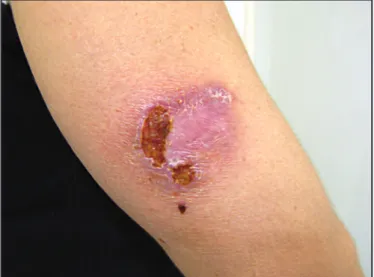
In August 2006, the patient still presented an ulcerated lesion on his right arm (Figure 1), but was otherwise in general good health. An immunoenzymatic assay for Leishmania was positive and the cutaneous Montenegro reaction was 12mm. A new skin biopsy was obtained and Leishmaniasp. promastigotes were isolated by culture in NNN medium. Six atempts at intralesional injections of meglumine antimoniate at 2-week intervals were then performed, but the patient developed contact eczema throughout the lesion and the surrounding
FIGURE 1 - Clinical aspect when the irst biopsy was performed, 2006 August. Ulcerated lesion on the right arm, with purulent crusts.
skin area following the inal application. he lesion was still ulcerated and crusted (Figure 2). A new biopsy was obtained and Leishmania sp.
promastigotes were again isolated. In March 2007, the patient was treated with intramuscular pentamidine isethionate at a daily dose of 4mg/kg on alternate days, receiving a cumulative dose of 2.4g over a 23-day treatment, with a brief interruption of one week due to pain and hemorrhaging at the site of injection.
Both isolates obtained during treatment with pentavalent antimonials were characterized as Leishmania (V.) braziliensis by isoenzyme electrophoresis3. In parallel, promastigote forms in the late
log phase of growth were tested in vitro for sensitivity to meglumine antimoniate (Aventis-Pharma, São Paulo)4. he results showed a
relevant diference between isolates, with the irst isolate presenting an inhibitory concentration for 50% (IC50) of 0.26 + 0mg/mL and the second presenting an IC50 of 2.10 + 0.16mg/mL.
No laboratory alterations were detected during and after treatment with pentamidine isethionate. he patient was negative for HIV 1 and 2 and HTLV-1. he lesion remained healed ater a 34-month follow-up (Figure 3).
FIGURE 2 - Clinical aspect when the second biopsy was performed, 2007 February. Ulcerated lesion and purulent crusts in the periphery of the atrophic scar on the right arm.
256
Rev Soc Bras Med Trop 44(2):254-256, mar-abr, 2011
DISCUSSION
REFERÊNCIAS Cutaneous leishmaniasis is a common condition among soldiers
involved in military campaigns in endemic areas. Military excursions to the Amazon region play a relevant role in the local incidence of the disease5.
Success rates reported in the literature for the recommended doses of pentavalent antimonials vary widely. Many factors may inluence the outcome of treatment, including drug subdoses and irregular treatment6, and the immune status of the host, with more
common failures in HIV-positive patients7.
Several mechanisms have been suggested to be involved in the drug resistance of parasites. It is known that species causing leishmaniasis respond differently to treatment with pentavalent antimonials. Furthermore, some Leishmania populations may develop resistance to these drugs, probably as a result of natural cloneselection8. In vitro
sensitivity testing of the parasites isolated ater the two intramuscular treatments and ater the six intralesional injections of antimonials revealed diferences between the isolates. According to Azeredo-Coutinho et al9, L. (V.) braziliensis strains presented IC
50 values varying
from 0.8 to 9.5mg/mL and the strains isolated from patients poorly responsive to therapy showed signiicantly higher IC50 values than those isolated from patients who were cured ater completion of the irst antimonial treatment9. In the present study, the parasites isolated from
the irst biopsy were more sensitive to antimonials (0.26mg/mL) than those isolated ater intralesional treatment (2.10mg/mL), a inding suggesting the development of resistance to the drug ater successive cycles of treatment. his resistance was conirmed both in vitro and
in vivo. hese results suggest that even the appropriatetherapeutic regimen can induce parasite resistance.
Amphotericin B has been recognized as an efective drug for the treatment of leishmaniasis, but is sometimes poorly tolerated. In Brazil, amphotericin B is the second drug of choice for the treatment of CL in the case of failure or contraindication to pentavalent antimonials1. Liposomal amphotericin B is associated with a lower
frequency of side efects, but its high cost and the need for intravenous administration limit its use. he present patient did not tolerate either of the two forms of amphotericin B due to constitutional symptoms, although the total dose of the drug applied was 0.775g, approximately half the dose indicated for the treatment of CL1.
Pentamidine has been gradually accepted in several Latin American countries as an excellent alternative to pentavalent antimonials and has been recommended as the drug of choice for the treatment of CL in some countries10. he drug is highly efective
and side efects are generally well tolerated, with pain at the site of drug injection, nausea, fever and biter taste being the most frequent symptoms10. Hypotension and hypoglycemia have been reported, as
well as the induction of diabetes mellitus1. herefore, monthly serum
glucose monitoring for 6 months has been recommended following the administration of a pentamidine cumulative dose higher than 1.0g1. Several studies have compared the eicacy of pentavalent
antimonials and pentamidine and some of them demonstrated a beter performance of the later10.
he administration of pentamidine was well tolerated by the patient and the outcome was satisfactory. he patient presented no laboratory alterations during post-treatment follow-up and was lesion-free 34 months ater the end of treatment.
FINANCIAL SUPPORT
his study was supported by the Secretaria Municipal de Saúde do Rio de Janeiro (convênio RJ/FIOCRUZ), FIOCRUZ, FAPERJ, CNPq, and PAPES4/FIOCRUZ.
1. Ministério da Saúde. Manual de Vigilância da Leishmaniose Tegumentar Americana. 2ª ed. atualizada. Brasília: Ministério da Saúde; 2010.
2. Aronson NE, Wortmann GW, Johnson SC, Jackson JE, Gasser Jr A, Magill AJ, et al. Safety and efficacy of intravenous sodium stibogluconate in the treatment of leishmaniasis: recent U. S. military experience. Clin Infect Dis 1998; 27:1457-1464.
3. Cupolillo E, Grimaldi Jr G, Momen H. A general classiication of New World Leishmania using numerical zymotaxonomy. Am J Trop Med Hyg 1994; 50:296-311.
4. Machado GM, Leon LL, De Castro SL. Activity of Brazilian and Bulgarian propolis against different species of Leishmania. Mem Inst Oswaldo Cruz 2007; 102:73-77.
5. Guerra JAO, Talhari S, Paes MG, Garrido M, Talhari JM. Aspectos clínicos e diagnósticos da leishmaniose tegumentar Americana em militares simultaneamente expostos à infecção na Amazônia. Rev Soc Bras Med Trop 2003; 36:587-590.
6. Rodrigues AM, Hueb M, Santos TARR, Fontes CJF. Fatores associados ao insucesso do tratamento da leishmaniose cutânea com antimoniato de meglumina. Rev Soc Bras Med Trop 2006; 39:139-145.
7. Barratt G, Legrand P. Comparison of the efficacy and pharmacology of formulations of amphotericin B used in treatment of leishmaniasis. Curr Op Infect Dis 2005; 18:527-530.
8. Croft SL, Sundar S, Fairlamb AH. Drug resistance in leishmaniasis. Clin Microbiol Rev 2006; 19:111-126.
9. Azeredo-Coutinho RB, Mendonça SC, Callahan H, Portal AC, Max G. Sensitivity of Leishmania braziliensis promastigotes to meglumine antimoniate (glucantime) is higher than that of other Leishmania species and correlates with response to therapy in American tegumentary leishmaniasis. J Parasitol 2007; 93:688-693. 10. Lai A Fat EJSK, Vrede MA, Soetosenojo RM, Lai A Fat RFM. Pentamidine,