J. Serb. Chem. Soc. 76 (4) 539–555 (2011) UDC 544.112:517.544.4:621.376.2
JSCS–4141 Original scientific paper
On the relationship between molecular spectroscopy and
statistical mechanics: calculation of partition functions
for triatomic molecules undergoing large-amplitude
bending vibrations
MILAN V. SENĆANSKI1#, JELENA RADIĆ-PERIĆ2 and MILJENKO PERIĆ2*#
1Innovation Centre of the Faculty of Chemistry, University of Belgrade, Studentski Trg 12–16,
11158 Belgrade and 2Faculty of Physical Chemistry, University of Belgrade,
Studentski Trg 12–16, P.O. Box 47, 11158 Belgrade, Serbia
(Received 26 November 2010)
Abstract: The evaluation of partition functions for triatomic molecules under-going large-amplitude bending vibrations is discussed. It was supposed that the needed molecular structure data were obtained by means of ab initio calcula-tions. Special attention is paid to the coupling between the bending and stretch-ing modes and the interplay between bendstretch-ing motions and rotations. An appro-priate scheme for variational computation of the energy levels is developed. Keywords: partition functions; triatomic molecules; large-amplitude bending.
INTRODUCTION
The present study was motivated by the need for partition functions of the molecule BC2, which plays an important role, e.g., in plasma processes that should lead to the synthesis of boron carbide, B4C. Since it was not possible to find either numerical data for the partition functions or spectroscopically derived molecular structure parameters needed to calculate partition functions by the machinery of statistical mechanics, ab initio quantum mechanical calculations on this species were performed.1 The results of these investigations showed that BC2 has a very interesting structure. It is characterized by the ground electronic state having C2v (X2A1) or slightly distorted C2v (X2A’) symmetry, separated by a barrier of about 2000 cm–1 from a local minimum on the potential energy sur-face, corresponding to the linear molecular geometry (2Σ+). The transition from the one to the other structure occurs in the course of large-amplitude bending vibrations, being strongly coupled to the stretching vibrational modes. Therefore,
* Corresponding author. E-mail: [email protected]
if one wishes to compute reliable partition functions for this molecule, one has to solve a number of specific problems that are normally ignored in textbooks on statistical mechanics. In the present paper, the theoretical background of the problem is dealt with. In the following paper,2 the results of the calculation of the vibrational–rotational energy levels in the ground electronic state and the corresponding partition functions are given.
The paper is organized as follows. In the second section, an evaluation of the energy levels and partition functions of triatomic molecules with linear and bent equilibrium geometries in the harmonic approximation is reviewed. In the third section, a method for ab initio handling of the same problem is presented. An approach for the solution of the Schrödinger equation for large-amplitude bend-ing vibrations is briefly described. The last section presents a short conclusion.
HARMONIC APPROXIMATION
At the beginning, it was found sensible to estimate the relationship between characteristic molecular-energy values and the quantity kT, where k is the Boltz-mann constant and T the temperature. In the present study, instead of energy, the wave number, ν= E/hc, expressed in cm–1 (1 J is equivalent to 5.0364×1022 cm–1) is often used; in this case, the Boltzmann constant becomes k = 0.695 cm–1 K–1. In the temperature interval of interest, i.e., 1000–6000 K, the value of kT will be in the range 700–4000 cm–1. The contribution of excited electronic states to the total partition function is neglected. The stretching vibrational wave num-bers for molecules such as BC2, being the subject of our next paper, are around 103 cm–1, whereas the bending wave numbers have values of a few hundred cm–1.1 The rotational constants are of a few cm–1.
First, the partition functions in the harmonic approximation are handled. Triatomic molecules are considered separately in spatially and spin non-dege-nerate electronic states with linear and non-linear equilibrium geometry. In both cases, the molecular Hamiltonian can be written in the form:
tr e v r
ˆ ˆ ˆ ˆ ˆ
H =H +H +H +H (1)
where Hˆ tr, , Hˆe Hˆ v and Hˆr represent the translational, electronic, vibrational and rotational parts, respectively. In the following, the translational part of the Hamiltonian, Eq. (1), is ignored and assume the eigenvalues of the electronic part to be included in Hˆ v as the “potential energy surface”, calculated within the framework of the Born–Oppenheimer approximation. Writing Eq. (1), it is impli-citly assumed that coupling between vibrational and rotational motions is ne-glected.
Linear equilibrium geometry
According to such a scheme, the vibrational and rotational parts of the Hamil-tonian (1) are written in the forms:
v
s b,
= + z
ˆ ˆ ˆ
H H H (2)
r r
, = x y
ˆ ˆ
H H (3)
The z-axis is chosen to coincide with the molecular axis at linear nuclear arrangements. The vibrational Hamiltonian is separated into a stretching (Hˆs) and a bending (Hˆb,z) part. This can be performed because the stretching and bending coordinates are (in the case of linear molecules) not coupled with one another in the harmonic approximation. r
x,y ˆ
H is the Hamiltonian for end-over-end rotations.
The stretching part of the vibrational Hamiltonian is in the harmonic appro-ximation represented by:
2 2 2 2 2 2
2 2
s 2 2
1 1
2µ 2µ µ 2 2
∂ ∂ ∂
= − − − + + +
∂ ∂ ∂ ∂
rr RR rR
r R rR
ˆ
H k r k R k rR
r R r R (4)
where
r
andR
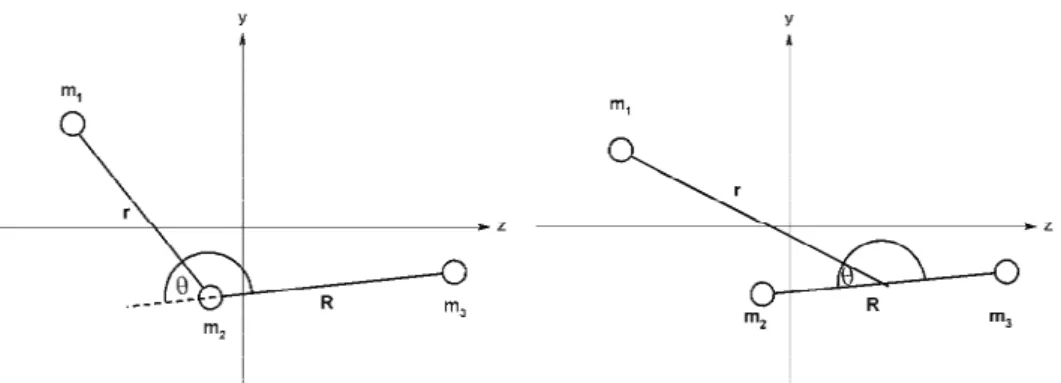
are two stretching vibrational coordinates. In the case of linear molecules, ABC, the usual choice is r = A–B and R = B–C, i.e., the stretching coordinates represent the bond lengths (or their changes with respect to the equilibrium values) – Fig. 1. R and r are the corresponding “reduced masses”.krr, kRR and krR are the quadratic force constants representing the electronic
energy as a function of the stretching coordinates. The eigenvalues of the Hamil-tonian (4) are:
s s1 1 s1 s2 1 s2 s1 1 s1 s2 1 s2
2 ω 2 ω 2 ν 2 ν
= + + + = + + +
E v v v hc v hc (5)
where ω is the vibrational frequency (in units s–1) and ν the wave number. The energy spectrum is non-degenerated.
In the harmonic approximation, the bending part of the vibrational Hamil-tonian has the form:
2 2 2
2
b,z 2 2 2 θ
b
1 1 1
2 2
ˆ
H k θ
µ θ θ θ θ ϕ
∂ ∂ ∂
= − + + +
∂ ∂ ∂
(6) if the volume element dV = θdθdφ is assumed. For molecules with linear
equi-librium geometry, the bending coordinate is usually chosen to be the supplement of the bond angle, i.e., θ= − ∠π A–B–C, expressed in length units. Equation (6) represents the Hamiltonian of an isotropic two-dimensional harmonic oscillator, the eigenvalues of which are:
(
)
(
)
b,z = b+1 ωb= b+1 νb
Each energy level is b + 1 degenerated, because for every b = 0,1,2,… there are sublevels of the same energy corresponding to the value of the vib-rational angular quantum number l = –vb,–vb+2,…,vb. Beyond the harmonic approximation, this degeneracy is lifted and the energy depends on both b and the absolute value of l – for this reason, l is usually considered as an unsigned quantity. Each Ev , lb level is in the case of anharmonicity twofold degenerate for
0 ≠
l .
The rotational Hamiltonian is usually written as: 2
2 2
r ,
B B B
2 2 2
= x + y =
x y
ˆ
ˆ J ˆ
J J
ˆ H
I I I (8)
since the z-component of the nuclear angular momentum equals zero and thus:
2 2 2 2
2≡ + + 2 = +
x y z x y
ˆ ˆ ˆ ˆ ˆ ˆ
J J J J J J (9)
where IB is the moment of inertia along the axes perpendicular to the molecular axis. The energy levels corresponding to the Hamiltonian (8) are:
(
)
(
)
2 r
,
B 1
1 2
+
= ≡ +
x y
J J
E BhcJ J
I , (10)
where
2
B B
8π 4π
≡ h =
B
cI cI (11)
is the rotational constant, usually expressed in cm–1. Each J-level is
(
2J +1)
- -degenerated because the wave functions for a given J are also characterized by the quantum number M (M = –J,–J+1,…,J), denoting the projection of the an-gular momentum along a space-fixed (Z) coordinate axis.If the above scheme is assumed, the total molecular partition function for the degrees of freedom considered is such as given in the majority of textbooks:3
r s1 s2 b,z x y,
Z =Z Z Z Z (12)
with:
s1 1 s2 1
s1 1 e kT s2 1 e kT
Z , Z
ω − ω −
− −
= − = −
(13)
b 2
b,z 1 e kT
Z
ω −
−
= −
(14)
r ,
2π
x y
kT kT
Z
hcB cB
σ σ
= =
In all formulae (13–15), the Boltzmann constant is assumed to have its “nor-mal” value, k=1 380 10. × −23 J K–1. The “symmetry number” in the present case (asymmetric ABC molecules) is σ = 1. In the following formulae, it will be omitted. It is assumed that the zeroth vibrational–rotational level is taken to be zero on the energy scale. The rotational partition function is derived in the “high- -temperature approximation” by replacing the sum with the corresponding in-tegral:
(
)
( )(
)
( )1 1
r
0 0
2 1 e 2 1 e d
BhcJ J BhcJ J
kT kT
x,y
J J
kT
Z J J J
hcB
+ ∞ +
∞ − −
= =
= + ≅ + = (16)
However, when Eq. (9) is written, the fact is ignored that triatomic mole-cules have a non-vanishing component of the total angular momentum along the molecular axis. This arises from the vibrational angular momentum, and relation (9) has to be replaced by the correct one:
2 2
2 2
x y ˆ
ˆ ˆ ˆ
J ≡J +J +l (17)
The origin of the vibrational angular momentum becomes clear when the rotational Hamiltonian is formally written in the general form of a prolate sym-metric top:
2
2 2
r ,
B B A
2 2 2
y
x z
x y
ˆ
ˆ J ˆ
J J
ˆ H
I I I
= + + (18)
where IA is the moment of inertia along the z-axis. Since IA = 0 for linear geometry, one prefers to incorporate the last term on the right-hand side in the bending Hamiltonian – it appears in it (Eq. (6)) in the form of:
2
2 2 2
2 2
A A b
2 2 2
z
i ˆJ
I I
ϕ
µ θ ϕ
∂ −
∂ ∂
= = −
∂
(19) The singularity caused by the term ˆJ /z2
(
2IA)
is then exactly cancelled bythe singularities caused by the remaining two terms in the Hamiltonian (6). The eigenvalues of the operator 2 2 2 2
z
ˆJ = − ∂ /∂ϕ are ˆl2 2 . Consequently, Eqs. (8) and (10) are replaced, respectively, by:
2
2 2 2
r ,
B B B
2 2 2
y
x z
x y
ˆ
ˆ J ˆ ˆ
J J J
ˆ H
I I I
−
= + = (20)
and
(
)
(
)
2 2
r 2
,
B 1
1 2
x y
J J l
E Bhc J J l
I
+ −
The quantum numbers J and l are connected with each other by the relation J ≥ l. We write now the energy values corresponding to the operator r
b,z x,y
ˆ ˆ
H +H as:
(
)
(
)
(
)
(
)
2
b, b b b
2
1 1 2 1
1
z
E v Bhc J J l n l
Bhc J J l
ω ω
= + + + − = + + +
+ + −
(22) where the integer n takes the values 0,1,2,... Taking into account that the degeneracy of each J-level is (2J + 1) and that l = 0 levels are non-degenerated, whereas for l ≠ 0, there are two sublevels corresponding to l= ±l , one obtains for the corresponding partition function:4
(
)
(
)
(
)
(
)
(
)
2 b
2
b b
b
b b
2 1
b,r
0 0
1 2
0 0
2
2 1 e
e e 2 1 d
1 e
1 e 1 e
n l Bhc J J l kT
l l n J l
BhcJ J
l l Bhc n
kT kT kT
l
l n J l
Bhc kT
Bhc
kT kT
Z g J
g J e J
kT Bhc
ω
ω ω
ω
ω ω
+ + + −
∞ ∞ ∞ −
= = =
+
− ∞
∞ − ∞ − −
= = =
+ −
+
− −
= + ≅
≅ + =
+
=
− −
(23)
Since ωb>>Bhc, it follows from Eq. (23):
b
b,r
2 1 1 e kT
kT Z
Bhc ω
− ≅
−
(24)
In this approximation, the same result is obtained as the product of Zb,z , Eq.
(14) and Zx,yr , Eq. (15). Therefore, in spite of the fact that the neglect of the relationship between the quantum numbers J and l, representing the heart of the approximation/misconception, Eq. (9), leads to an unreliable energy level sche-me, it does not causes serious errors in the partition function.
Nonlinear equilibrium geometry
bending vibrational motions. When dealing with large-amplitude bending vib-rations and particularly when one atom migrates around a more or less compact skeleton of the other two (as e.g., the H-atom around the N–C moiety in course of the HNC→HCN isomerisation process,5,6 or the B-atom around the C–C diato-mic rest in the BC2 molecule), it is more convenient to use the “Jacobi coordi-nates”, R, r and θ, where R is the distance between the nuclei building the diatomic part, r the distance between the migrating atom and the midpoint of the diatomic part, and θ is defined as the angle between the vectors r and R (Fig. 1). An advantage of these coordinates is that there is no coupling between the three vibrational modes through the kinetic energy part of the vibrational Hamil-tonian, and the coupling terms in the potential energy part are generally dimi-nished.
Fig. 1. Vibrational coordinates employed in the present study. Left-hand side: valence coordinates; right-hand side: Jacobi coordinates.
Although the stretching and bending vibrations are mutually coupled in triatomic molecules with nonlinear equilibrium geometry, this coupling is neg-lected in this subsection, because here the primarily interest lies in bookkeeping concerning the evaluation of the partition functions. The emphasis lies on the consequences of the gradual transformation of the twofold degenerate bending vibration in linear molecules to the one-dimensional bending plus the rotation around the z-axis in bent nuclear arrangements. Thus, the vibrational Hamiltonian in the form:
v
s b
ˆ ˆ ˆ
H =H +H (25)
is assumed, where the stretching part has the form given by Eq. (4), and the bending part is:
(
)
2 2 2
b 2 θ e
b
1
2 2
ˆ
H k θ θ
µ θ
∂
= − + −
∂
The equilibrium value of the coordinate θ is denoted by θe. When handling one-dimensional bending vibrations, it is sensible to assume the volume (in-tegration) element dV = dθ. The bending energy corresponding to the operator (26) is:
b b b
1 2 E =v + ω
(27)
and the spectrum is non-degenerated.
Triatomics with bent equilibrium geometry are asymmetric top molecules and thus the corresponding rotational Schrödinger equation cannot be solved analytically. In this subsection, they are handled as if they were symmetric tops, because the primary interest lies in the qualitative features of the partition func-tions. The rotational Hamiltonian of a symmetric top is given by:
2
2 y 2 2 2 2 2 2
x z z z z
r
B B A B A B A B
1 1
2 2 2 2 2 2 2
ˆ
ˆ J ˆ ˆ ˆ ˆ ˆ ˆ
J J J J J J J
ˆ H
I I I I I I I I
−
= + + = + = + −
(28)
and the corresponding energy is:
(
)
(
) (
)
r 1 2 2 1 2
E =Bhc J J + −K +AhcK =BhcJ J + + A−B hcK (29) 2
A 4 A≡ / πcI
For a given J, the quantum numbers K and M (not appearing in the energy expression, Eq. (29)) take the values K,M = –J,–J+1,…,J; since the energy does not depend on the sign of K, the energy levels for a particular combination of J and K are gK(2J+1)-degenerated, with gK = 1 for K = 0, and gK = 2 at K ≠ 0. The quantum number K, determining the projection of the angular momentum on the z-axis of the coordinate system fixed at the molecule, is fully equivalent to the quantum number l defined for linear molecules and, in order to emphasize this equivalence, the symbol l will be used instead of K in this subsection.
The complete vibrational–rotational molecular partition function of a triato-mic molecule with non-linear equilibrium geometry is given by:
r s1 s2 b
Z =Z Z Z Z (30)
where the stretching partition functions are of the same forms as those for linear molecules (Eq. (13)). The remaining part of the partition functions can be hand-led in several different ways:
Case a. The partition function for the (one-dimensional) bending vibrations is:
b b b
b
1
b 0
1 e
v
kT kT
v
Z e
ω ω −
∞ − −
=
= = −
The partition function corresponding to the rotational energy expression, Eq. (29), is:
(
)
(
1) (
)
2 3 2r
0
π 2 1 e
BhcJ J A B hcl /
J
kT l
J l J
kT
Z g J
hc AB
+ + −
∞ −
= =−
= + ≅
(32)
The final expression is derived in the high-temperature approximation, taking into account the fact that the term Bl can be neglected in the expression exp [–(Al2 + Bl)hc / kT] and that:
2 2
0
e e
Ahcl Ahcl
kT kT
l
l l
g
∞ − ∞ −
= =−∞
=
(33)
If B is replaced in Eq. (32) by BC, the expression for the rotational par-tition function of molecules with three unequal moments of inertia (asymmetric tops), as quoted in textbooks, (e.g., Ref. 3), is obtained.
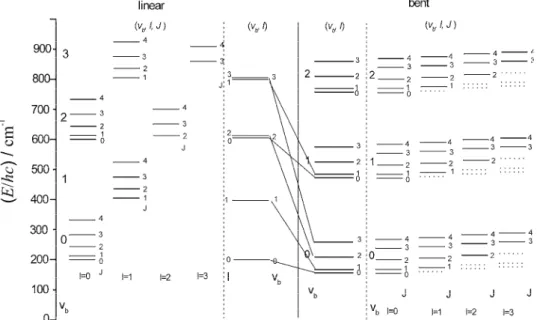
The correlation of the energy levels for bending vibrations plus rotations in a linear and a bent molecule are shown in Fig. 2.
Fig. 2. Correlation between bending vibrational and rotational energy levels of a linear (left-hand side) and a bent (right-hand side) molecule. The levels with the inscription (vb, l)
do not involve a contribution of end-over-end (x,y) rotations. They are computed by means of Eq. (7) for a linear molecule and Eq. (41) for a bent molecule. The levels with the inscription (vb, l, J) also involve a contribution of x, y rotations (Eqs. (21) and (43)).
The values of νb=200cm-1, B = 5 cm-1 for linear molecule and
b 300
ν = cm-1,
Case b. In order to enable direct comparison of the results for partition functions obtained in the harmonic approximation with their counterparts eva-luated beyond that approximation, the rotational partition function is now com-puted in another way. It will be shown that the partition function of a symmetric top can be replaced in a good approximation by the product of the partition func-tions of a one-dimensional and a two-dimensional rotator with the quantum num-bers being independent of one another.4 It is thus assumed the rotational Hamil-tonian in the form:
r r r
r r
x,y
1 2 z
ˆ ˆ ˆ ˆ ˆ
H =H +H =H +H (34)
with
2 2
2
x y
z
r r
1 2
A B
2 2
ˆ ˆ
ˆ J J
J
ˆ ˆ
H , H
I I
+
= = (35)
The corresponding energy levels are:
(
) (
)
r 2
l
1 , 0,1,2,..., , 1 0 ;2 0
E =Ahcl l= g = l= l≠ (36)
(
)
r
j
2 1 0 1 2 2 1
E =Bhc j j⋅ + , j= , , ,..., g = j+ (37) Note that the quantum number j appearing in Eq. (37) does not have the
same sense as the quantum number J for the magnitude of the total angular momentum. The partition functions are now
2 2
r
K 1
0
e e d
Ahcl Ahcl
kT kT
l
kT
Z g l
Ahc
π ∞
∞ − −
= −∞
= ≅ = (38)
(
)
(
)
(
)
(
)
1 1
r 2
0 0
2 1 e 2 1 e d
BhcJ J Bhcj j
kT kT
j
kT
Z j j j
Bhc
+ ∞ +
∞ − −
=
= + ≅ + = (39)
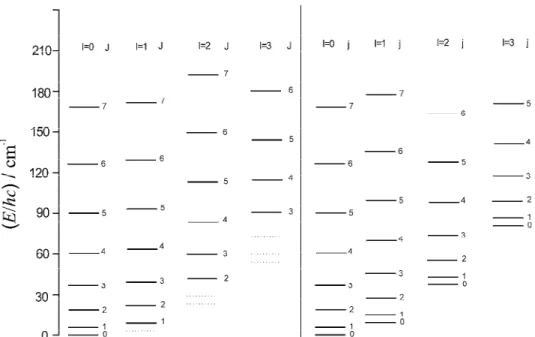
Multiplying Eq. (38) with Eq. (39), the result of Eq. (32) is indeed obtained. Comparison of the rotational-energy levels of the symmetric top and the sum of the corresponding one-dimensional and two-dimensional rotators is presented in Fig. 3.
Case c. According to the last statement above, when evaluating the partition functions, the term ˆJ /z2
(
2IA)
from the last but one expression for the rotational Hamiltonian, Eq. (28), can be extracted and put together with the bending Ha-miltonian, Eq. (26), into the operator Hˆb,z:(
)
(
)
2
2 2 2
z
b,z 2 θ 0
b a
2 2 2 2 2
θ 0
2
b a
1
2 2 2
1
2 2 2
ˆJ ˆ
H k
I l
k I
θ θ
µ θ
θ θ
µ θ
∂
= − + − + =
∂ ∂
= − + + −
∂
Fig. 3. Correlation between the rotational states of a symmetric top (left-hand side), and the sum of a one-dimensional and a two-dimensional rotator (right-hand side).
The values of A = 3 cm-1 and B = 1 cm-1 are used.
Such a partitioning of the Hamiltonian is performed in order to enable a cor-relation of the results obtained in the harmonic approximation with those gene-rated by employing the ab initio approach described below. The eigenvalues of the Hamiltonian, Eq. (40), are:
2
b, b 1 b
2
z
E =v + ω +Ahcl
(41)
and the partition function is:
2 2
b b b b
b b
b
b,
0 0 0
1
e e e d
π 1 e
v Ahcl v Ahcl
kT kT kT
z l
v l v
kT
Z g l
kT Ahc
ω ω
ω
+ ∞
∞ ∞ − ∞ − −
= = = −∞
− −
= ≅ =
= −
(42)
The eigenvalues of the remaining part of the rotational Hamiltonian,
(
2 2)
(
)
z 2 B
ˆ ˆ
J −J / I , are:
(
1)
2r x,y
where l ≤ J. However, when the partition function corresponding to this part of the Hamiltonian is independently evaluated, one has to put l = 0 and to sum over all J-values (from 0 to ∞), as was done in Eq. (19). The total bending–rotational partition function is then the product of Eqs. (42) and (19).
The complete bending–rotational energy is the sum of Eqs. (41) and (43):
(
)
2 2
b,r b b
1
1 2
E =v + ω +Ahcl +Bhc J J + −l
(44)
and equals, of course, the sum of Eb (Eq. (27)) and Eb (Eq. (29)) (l = K). The par-tition function corresponding to the energy expression, Eq. (44), equals the pro-duct of the partition functions, Eqs. (31) and (32) (case a), as well as the propro-duct of Eqs. (31), (38) and (39) (case b). However, recall that the energy spectra are different for the cases a and c on the one hand, and b on the other. In the first case, the energy levels are given by Eq. (44) with the condition l ≤ J; for a given combination of J and l the energy level is gl(2J+1)-fold degenerated (gl = 1 for
0 =
l and gl = 2 for l ≠ 0). In case b, the energy is:
(
)
2
b, b b
1
1 2
z
E =v + ω +Ahcl +Bhcj j+
(45)
where the quantum numbers l = 0,1,2,… and j = 0,1,2… are independent from each other. The energy level for a given combination of j and l is gl(2j
+1)-dege-nerated (Fig. 3).
In this subsection, the triatomic molecules were handled as symmetric tops. In a treatment beyond this approximation, the gl = 2 degeneracy of the rotation
levels with l ≠ 0 would be lifted.
AN AB INITIO APPROACH TO TRIATOMIC MOLECULES UNDERGOING LARGE-AMPLITUDE BENDING VIBRATIONS
The complete vibration–rotation Hamiltonian for a triatomic molecule, ex-pressed in terms of the Jacobi coordinates r, R, and θ (Fig. 1) and the Euler angles α, β and φ, which determine the orientation of the instantaneous molecular principal axes of inertia (ipia) with respect to a space-fixed coordinate system, was derived in a previous study.5 Its kinetic energy part can be written as the sum of the vibrational, rotational and vibration–rotational (coupling) terms:
v vr r
ˆ ˆ ˆ ˆ
T =T +T +T (46)
(
)
(
)
2 2 2 2 2 2
v 2 2 2 2 2
2 2
vr 2
2 2
2 2 2
r 2
1 1 1 1
cot
2 2 2
2 sin
( cos cos
sin cos )
1 1
2 2
2
r R r R
R r
xx
R r x
xx
x y z
yy zz
yy zz
ˆ T
r R r R
ˆ
T rR r R
r R
I
ˆ
R r iJ
ˆI
ˆ ˆ ˆ ˆ
T J J J
I I
I I
θ
µ µ µ µ θ θ
θ
µ θ µ θ
µ µ θ θ
θ ∂ ∂ ∂ ∂ = − − − + + ∂ ∂ ∂ ∂ ∂ ∂ = − − + + ∂ ∂ ∂ + − + ∂ = + + − (47)
where r and R are the “reduced masses”:
(
)
3 1 2 1 2
1 2
,
r R
m m m m m
M m m
µ = + µ =
+ (48)
and
(
)
( )
(
)
( )
2 2
2 2
2 2 4 4 2 2
2 2
2 2 4 4 2 2
1
2 cos 2
2 1
2 cos 2
2
xx r R yy zz
yy r R r R r R
zz r R r R r R
I r R I I
I r R r R r R
I r R r R r R
µ µ
µ µ µ µ µ µ θ
µ µ µ µ µ µ θ
= + = + = + + + + = + − + + (49)
are the instantaneous principal moments of inertia. ˆJx, ˆJy and ˆJz are the
com-ponents of the molecular angular momentum along the axes of the coordinate system bound to the molecule (
ipia
-system):7cos
sin cot cos sin
sin
cos cot sin sin x y z ˆJ i ˆJ i ˆJ i ϕ
ϕ β ϕ
β α β ϕ
ϕ
ϕ β ϕ
β α β ϕ
ϕ ∂ ∂ ∂ = − − + + ∂ ∂ ∂ ∂ ∂ ∂ = − + − ∂ ∂ ∂ ∂ = − ∂ (50)
The integration element is assumed in the form dV =sin sinβ θ∏dqi (qi
re-present the vibrational and rotational coordinates). The potential energy corres-ponding to the kinetic energy operator, Eq. (47), represents the electronic energy computed within the framework of the Born–Oppenheimer approximation for a set of relevant values of the coordinates r, R and θ.
the other nuclear degrees of freedom (in the case of BC2, the bending wave number is as small as νb ≈200 cm–1), the stretching Schrödinger equation was first solved with the Hamiltonian:
( )
( )
( )
2 2 2 2
2
s 2 2
2
1
2 2 2
1 2
rr
r R
RR rR
ˆ
H k r
r R
k R k rR ...
θ
µ µ
θ θ
∂ ∂
= − − + +
∂ ∂
+ + +
(51)
The force constants krr
( )
θ
,kRR( )
θ
,krR( ),...
θ
represent the stretchingpoten-tial surface. One calculates them separately for a number of values of the bending coordinate, handled as a parameter in the same sense as the nuclear coordinates when the electronic Schrödinger equation is solved in the usual Born–Oppen-heimer approximation. Since the stretching vibrations are normally small-ampli-tude ones, the calculations are restricted to the quadratic field only. The solutions of Eq. (51) are then:
( )
( )
( )
s s1 s1 s2 s2
1 1
2 2
E θ =v + ω θ +v + ω θ
(52)
From the above kinetic energy operator are now extracted the terms of central importance when dealing with large-amplitude bending vibrations, namely those describing the bending vibrations and rotations around the z-axis, coinciding for linear geometries with the molecular axis:
2 2
2
b, 2 2 2
1 1 1
cot
2 2
z z
r R zz
ˆ ˆ
T J
r R θ I
µ µ θ θ
∂ ∂
= − + + +
∂ ∂
(53) Were the coupling between the bending and stretching vibrations negligible, the stretching coordinates r and R could be replaced in Eq. (53) by their equilibrium values, re and Re, respectively. Since this is not the case, it is assumed the stretching coordinates are certain functions of θ, re(θ) ≡ r(θ), Re(θ) ≡ R(θ). How-ever, r and R cannot be directly replaced by r(θ) and R(θ) in Eq. (53), as written in Eq. (17) of Ref. 5, because such a Hamiltonian would not be hermitian. In-stead, the symmetrised form thereof must be used:
( ) ( )
( ) ( )
( )
2 2
b, 2 2 2
2 2 2
2 2 2 2
1 1
{( )( ctg )+
4
1 1
+( ctg )( )}
2
z
r R
zz
r R
ˆ T
r R
I
r R
θ θ
θ θ
θ
θ θ
µ µ
θ
θ θ µ µ θ ϕ
∂ ∂
= − + +
∂ ∂
∂ ∂ ∂
+ + −
∂ ∂ ∂
(54)
( )
( )
( )
( )
2 2
2
1 2 2 3 4
2
T T θ T θ l T θ T θ
θ θ ∂ ∂ = − + − + ∂ ∂ (55) where
( )
( ) ( )( )
( ) ( ) ( ) ( ) ( ) ( )( )
( )
( )
( ) ( ) ( ) ( ) ( ) ( ) ( ) ( ) ( ) ( )1 2 2
r R
2 2 2 3 3
r R r R
3
zz
4 3 3
r R 2 2 4 4 r R 2 3 r 1 1 d d
1 1 1 1
cot 2 d d 1 d d 1 1 cot d d d d 1 1 3 d d d 1 θ θ θ θ
θ θ θ θ
θ θ θ θ θ θ θ θ θ θ T θ r R r R
T θ θ
θ θ
r R r R
T θ
I θ
r R
T θ θ
θ θ r R r R θ θ r R r r = + = + − + = = − + + + + − − ( ) ( ) 2
2 3 2
R d 1 d d θ θ R
θ − R θ
(56)
The operator 2 2
(
2 2)
zˆJ = − ∂ /∂ϕ was replaced by l2 2 , because we assume the bending functions in the form:
(
,)
1( )
2π
il
e ϕ
ψ θ ϕ = Θ θ (57)
The potential energy part of the bending–z-rotation Hamiltonian
H
ˆ
b,z is assumed in the form:( )
,( )
s( )
( )
s1 s1( )
s2 s2( )
1 1
2 2
r R
V θ =V θ +E θ =V θ +v + ω θ +v + ω θ
(58)
where Vr,R(θ) is the bending potential corresponding to the bond lengths
opti-mized at each particular value of the coordinate θ. In the language of reaction kinetics, Vr,R(θ) represents the “minimum-energy path” along the “reaction
and ωs2 on θ. In Eq. (58), the stretching energy contribution is written in the harmonic approximation. A generalization involving anharmonicity of the stretch-ing vibrations is straightforward.
Finally, the contribution of the x,y-rotations to the total energy can be cal-culated at different levels of sophistication – the choice depends on the concrete numerical values of the parameters in question. In the case of a HBC molecule, when the hydrogen atom migrates around the relatively heavy BC fragment,
xx yy zz
I ≅I >>I (Eq. (49)), and Ixx and Iyy do not dramatically vary with a
chan-ge of θ. This was the situation in previous works on HNC→HCN isomeri-sation.5,6 The x,y-rotational contribution to the total energy can then be calcu-lated by means of Formula (21). If the above conditions are not fulfilled, the average values of the rotational constants can first be calculated over the bending wave functions and after that the rotational spectrum. When the molecular shape if far from a symmetric top, it might be better not to include the z-rotational part in the bending Hamiltonian and calculate the energy levels of the asymmetric top separately, using the averaged rotational constants. Of course, the computation of the partition functions must be performed numerically when the energy levels are calculated beyond the harmonic approximation.
In the next study of this series,2 the molecular Schrödinger equation is solv-ed employing the variational approach introducsolv-ed in Ref. 5. The key points there-of are repeated here.
The Hamiltonian of Eqs. (55) and (58) has two features that distinguish it from the usual forms of the vibrational Hamiltonian. It is periodical in
θ
with the period π and has singularities at θ = 0,π. The periodicity is taken into account if all terms in the kinetic and potential energy operator are expanded into Fourier series in θ. The singularities are caused by the presence of the terms T2 and T3 with the asymptotic behaviour 10π 2
limθ→ , T ∝sin−θ, and limθ→0,πT3∝sin−2θ. Since the volume element dV = sinθdθdφ is used, the first singularity disappears in computations of the matrix elements. The second singularity also vanishes when l = 0, but remains for l ≠ 0. In the first case, one employs for representation of the Hamiltonian, the basis functions:
( )
cosn n
ϕ = θ (59)
For l ≠ 0, the basis consists of the functions:
( )
sin cosn n
ϕ = θ θ (60)
(
)[
]
(
)
( )
(
)[
]
( )
π
i 0
π
2 i
0
π
i 0
cos / sin cos/ sin d
cos / sin sin/ cos d
cos / sin cos sin/ cos d
m T V n
m T V n
m T V n
θ θ θ θ
θ θ θ θ
θ θ θ θ θ
(61)
They can be easily calculated when the functions in the square brackets are fitted by sin(kθ) or cos(kθ) series.
CONCLUSIONS
In the present study, an evaluation of partition functions for linear and bent triatomic molecules in the harmonic approximation was reviewed and a scheme was presented for ab initio variational calculation of the vibration–rotational energy levels in triatomics undergoing large-amplitude bending vibrations. The harmonic formulae and the variational approach will be employed in the second paper of this series to obtain the energy levels and the partition functions in the ground electronic state of the BC2 molecule.
Acknowledgement. We acknowledge the financial support of the Ministry of Science and Technological Development of the Republic of Serbia (Contract Nos. 142074 and 142055).
Ђ :
. 1, - 2 2
1Inovacioni centar Hemijskog fakulteta u Beogradu i2Fakultet za fizi~ku hemiju
Univerziteta u Beogradu
ђ
.
ab initio .
-, .
.
( 26. 2011)
REFERENCES
1. S. V. Jerosimić, M. V. Senćanski, J. Radić-Perić, J. Mol. Struct: Theochem. 944(2010) 53 2. M. V. Senćanski, Lj. Stojanović, S. Jerosimić, J. Radić-Perić, M. Perić, J. Serb. Chem.
Soc. 76 (2011) 557
3. P. W. Atkins, Physical Chemistry, 5th ed., Oxford University Press, Oxford, UK, 1994 4. J. Radić-Perić, M. Perić, Z. Naturforsch. 42a (1987) 103