article
Influence of environmental quality of the tributaries of the Monjolinho River on the
relative condition factor (Kn) of the local ichthyofauna
Germano Henrique Costa Barrilli1,4, Odete Rocha2, Natalia Felix Negreiros1& Jose´ Roberto Verani3
1Programa de Po´s-graduac¸a˜o em Ecologia e Recursos Naturais, Universidade Federal de Sa˜o Carlos,
Rodovia Washington Luis, km 235, CEP 12565-905, Sa˜o Carlos, SP, Brazil. 2
Departamento de Ecologia e Biologia Evolutiva, Universidade Federal de Sa˜o Carlos, Rodovia Washington Luis, km 235, CEP 13565-905, Sa˜o Carlos, SP, Brazil.
3
Departamento de Hidrobiologia, Universidade Federal de Sa˜o Carlos, Rodovia Washington Luis, km 235, CEP 13565-905, Sa˜o Carlos, SP, Brazil.
4
Corresponding author: Germano Henrique Costa Barrilli, e-mail:[email protected]
BARRILLI, G.H.C, ROCHA, O., NEGREIROS, N.F., VERANI, J.R. Influence of environmental quality of the tributaries of the Monjolinho River on the relative condition factor (Kn) of the local ichthyofauna. http://dx.doi.org/10.1590/1676-06032015010714
Abstract:The relative condition factors (Kn) of the fishesAstyanax paranae,Phalloceros harpagosand Poecilia reticulata were used as a means of assessing the influence of environmental conditions on the well-being of sub - populations of these species, with the eventual aim of using them as bioindicators of disturbance in tributary streams of the Monjolinho River, in Sa˜o Carlos - SP. The power-law curve generated by the length-weight relationship indicated a positive allometric growth for the three species studied. Overall, the canonical correspondence analysis (CCA) positively correlated average Kn of A. paranaewith well oxygenated and oligotrophic environments, typical of conserved areas or near the natural state. For the average value of Kn obtained for Phalloceros harpagos species, there was no significant difference between natural and disturbed areas. However, the CCA positively correlated the mean Kn of the speciesP. reticulatafrom similar environments with higher trophic level, suggesting that this species is indicative of disturbance.
Keywords:Biomonitoring, condition factor, length-weight relationship, degradation, bioindicators.
BARRILLI, G.H.C, ROCHA, O., NEGREIROS, N.F., VERANI, J.R. Influeˆncia da integridade ambiental dos afluentes do Rio Monjolinho sobre o fator de condic¸a˜o relativo (Kn) da ictiofauna local.Biota
http://dx.doi.org/10.1590/1676-06032015010714
Resumo: Os fatores de condic¸a˜o relativo (Kn) de Astyanax paranae, Phalloceros harpagos e Poecilia reticulata foram utilizados como ferramenta para avaliar a influeˆncia da qualidade ambiental sobre o bem estar de sub-populac¸o˜es destas espe´cies, visando utiliza´-las como bioindicadoras de distu´rbios em co´rregos afluentes do rio Monjolinho, no municı´pio de Sa˜o Carlos –– SP. A curva potencial gerada pela relac¸a˜o peso-comprimento indicou um crescimento do tipo alome´trico positivo para as treˆs espe´cies estudadas. No geral, a ana´lise de correspondeˆncia canoˆnica (CCA) correlacionou positivamente o Kn me´dio da espe´cie A. paranae com ambientes bem oxigenados e oligotro´ficos, caracterı´sticos de a´reas preservadas ou pro´ximas do estado natural. Para o valor me´dio do Kn obtido para a espe´ciePhalloceros harpagos,na˜o ocorreram diferenc¸as significativas entre a´reas naturais e perturbadas. Entretanto, a CCA correlacionou positivamente o Kn me´dio da espe´cie Poecilia reticulata a ambientes impactados, com maior grau de trofia, o que sugere que o fator de condic¸a˜o relativo desta espe´cie pode ser utilizado como indicador de distu´rbios, neste caso, ocasionado pela poluic¸a˜o orgaˆnica.
Palavras-chave: Biomonitoramento, Fator de condic¸a˜o, relac¸a˜o peso-comprimento, degradac¸a˜o, bioindicadores.
Introduction
Natural ecosystems have suffered heavily over the last years from the impact of the combined effects of urbanization and other anthropogenic activities resulting from population growth. Many aquatic environments, such as rivers, lakes and reservoirs, which provide essential services to humanity, have
undergone a number of changes due to human interference (Ko¨nig et al., 2008). In this context, aquatic communities are constantly exposed to pollution by the large number of compounds released into water bodies from various emission sources, including industrial effluent discharge, domestic sewage, agricultural waste and others (Rashed, 2001). Thereby, the environmental quality or degradation level of
Biota Neotropica. 15(1): e20140107.
these ecosystems may be reflected by their biological commu-nities, which respond differently to the effects of the disturbing agents, providing an indicator to assess the effects of these disorders (Barbour et al., 1999).
The organisms most fequently used in the assessment of the impacts on aquatic ecosystems are the benthic macroinverte-brates, fish and periphyton (Goulart & Callisto, 2003). In ichthyofauna studies, for instance, the parameters usually analyzed in the study of populations are the size and weight of the organisms. The length-weight relationship of fish is an important tool to distinguish aspects of their biology, physiology and ecology, and combined with other quantitative features, such as growth, recruitment and mortality, it provides valuable information about the species structure in an environment (Lizama & Ambro´sio, 1999).
Using the relationship between body weight and length, it is possible to derive a parameter that is a measure of wellness, providing information about how the animal takes advantage of the available resources. This parameter, known as the relative condition factor (Kn), is an important and powerful tool to demonstrate changes in the condition of fish over a certain period of time and can be used to indicate nutritional status, environmental changes, the reproductive period, the dietary changes period, the fat accumulation (Le Cren, 1951; Gomiero & Braga, 2003) and parasite infections (Lemos et al., 2007), making it possible to compare populations that are subjected to different climate conditions, water temperature, salinity and density, food availability and other conditions (Lizama & Ambro´sio, 2002; Rocha et al., 2005; Reˆgo et al., 2008). Under normal conditions, the theoretically expected value of Kn is 1, whereas any event that interferes with the health or welfare of the fish can produce variations in this value.
The improper use of land and natural resources, resulting from urban development without proper planning and agri-cultural activities in the catchment area of the Monjolinho River have caused large disturbances in the basin, especially in the area of headwaters in the city of Sa˜o Carlos during the last few decades (Se´, 1992). The accelerated development occurring in areas where these headwaters are located interferes directly with the stability of aquatic ecosystems and, therefore, affects the water quality and aquatic biota across the whole river basin. The aim of this study was to assess the conditions in the tributary streams of the upper portion of the Monjolinho River system, through chemical, physical and biological analysis, as well as to test the relative condition factor as an indicator of environmental influence on the physiological state of the fish species present in these streams, with a view to using them as indicators of disturbance.
Material and Methods
The Monjolinho River basin covers an area of approxi-mately 275 km2, at an elevation between 700 and 800 meters above sea level. The greater part of this basin is located in the district of Sa˜o Carlos city, in the state of Sa˜o Paulo. The city is located in an area of accelerating urban development and, therefore, of considerable anthropogenic impact. The length of the river is 43.25 km (Se´, 1992).
The stretches used as sampling sites were chosen to include a variety of environmental and anthropogenic influences (natural, rural and urban areas) in several tributaries belonging
to the upper portion of the Monjolinho River catchment area. The study area is mapped in Figure 1, with stream names and sampling sites.
A brief description of each site follows:
N
Espraiado 1 (21658917.50S; 476529180 W): Stream stretch in an area of dense and structured native vegetation, closed canopy, legally defined as a preserved area; a reference site for this study.N
Espraiado 2 (216589520S; 476529260W). Stream stretch in an area with preserved riparian vegetation near a canalized portion. Both stretches (Espraiado 1 and 2) are located on Federal University of Sa˜o Carlos land, enclosed in an area covered by cerrado sensu stricto and replanted Eucalyptus sp. forest.N
Belvedere (21659954.30S; 47652913.90W): stretch located in an area with a small fragment of riparian vegetation, but with signs of burning and household waste, as well as earthworks that indicate the expansion of the Belvedere Park neighborhood. The stream is located in an urban development.N
Ponte de Ta´bua 1 (22600932.10S; 47651938.80W): stretch located in an urban area, near the Sabara Park condo-minium, with fragments of riparian vegetation and domestic waste collected along the stretch.N
Ponte de Ta´bua 2 (21659935.10 S; 47651943.20W): stretch located in an urban area; Jardim Veneza and Jardim Munique neighborhoods close to it, without riparian vegetation, with pipe for sewage discharge and grazing animals nearby.N
Canchim stream (21659921.40S; 47651914.20W): stretchlocated inside Coqueiros Farm, with riparian vegetation and without evidence of household wastes.
N
Sa˜o Rafael (226009520S; 4765199.40W): stretch located close to Jardim Tangara´ and Sa˜o Rafael residential neighbor-hoods and with evidence of disturbance.N
Douradinho (226009370S; 47650928.30W): stretch located inside Santa Joana Farm, characterized by a large forest fragment.To analyze the sampling stretches, we used the Habitat Diversity Rapid Assessment Protocol described by Callisto et al. (2002), which assesses a set of variables and indicates the degree of conservation of the habitat as: natural (up 60 points), altered (41-60 points) or impacted (0-40 points).
Sampling was conducted in the months of July and August 2013: a metal wire sieve mesh (diameter = 0.75 m, mesh = 3 mm) and a net (0.50 m in diameter) were used to catch the fish fauna, with a sampling effort of one hour in each stretch (approximately 50 meters long). The specimens were fixed in 10% formalin and preserved in 70% alcohol for later identification and biometrics analysis. For taxonomic identifi-cation, the specialized bibliography, keys and descriptions available in the literature were used (Britski, 1972 Britski et al., 1999, modified by Casatti et al., 2001; Castro et al., 2004; Oliveira, 2006; Grace & Pavanelli, 2007; Lucinda, 2008), as well as the help of ichthyologists. Species with greater occurrence constancy were selected, according to the criteria of Dajoz (1983), as well as those with higher relative abundance at the collection sites, and the species that were present in the habitats of lowest and highest degradation were taken as references.
For each selected taxon, measurements of standard length (Ls) and fresh weight (Wo) were taken with digital calipers (King Tools) and a precision balance (Marte AS 2000c). These
2 Biota Neotrop
Barrilli, G.H.C. et al.
data were used to fit an overall weight-length curve for each species, by adjusting a and b, the equation W = a.Lsb(Le Cren, 1951). With the estimated values of coefficients0a0and0b0, the theoretical expected weights (We) for the respective values of standard length (Ls) were calculated. The values of the relative condition factor (Kn) calculated by the equation Kn = Wo/We for individuals sampled in each environment, and the Kn data sets for each species and their habitats were compared by the nonparametric Kruskal-Wallis test (complemented by Dunn’s test) at a significance level of 5%. Finally, each mean Kn was compared with the hypothetical average (Kn = 1) by student’s t-test (Zar , 2010).
The physical and chemical data: pH, electrical conductivity, dissolved oxygen concentration and water temperature, were measured "in situ" with a HORIBA U-10 multiprobe, alongside the water sampling. The inorganic nutrients analyzed were: total phosphorus and nitrogen (Valderrama, 1981), nitrite (Bendchreider & Robinson, 1952, cited by Golterman et al., 1978), nitrate (Mackereth et al. 1978), ammonium (Koroleff 1976, cited by Mackereth et al. 1978) and dissolved total phosphate, organic phosphate and inorganic phosphate (Strickland & Parsons, 1960). Once the nutrient concentrations were established, the trophic state index (TSI) of Carlson (1977) modified by Lamparelli (2004) was calculated, using the total phosphorus concentration.
Canonical correspondence analysis (CCA), followed by a Monte Carlo test, with 999 random permutations, was used to
test the existence of significant associations between environ-mental variables and the relative condition factor of each species, using the program CANOCO 3:12 (Sˇmilauer & Ter Braak, 2002).
Results
Fishes belonging to eight species, totaling 616 specimens, were collected in the sampled streams, of which Astyanax paranae (Eigenmann, 1914), Phalloceros harpagos (Lucinda, 2008) and Poecilia reticulata (Peters, 1859) were more numerous, both in occurrence (O) and relative abundance (A), than others: Hypostomus ancistroides (Ihering, 1911), Geophagus brasiliensis (Quoy & Gaimard, 1824), Rhamdia quelen(Quoy & Gaimard, 1824), Gymnotus carapo(Linnaeus, 1758) andHyphessobrycon anisitsi(Eigenmann, 1907) Table 1. Therefore, the first three were selected for the length-weight relationship and relative condition factor.
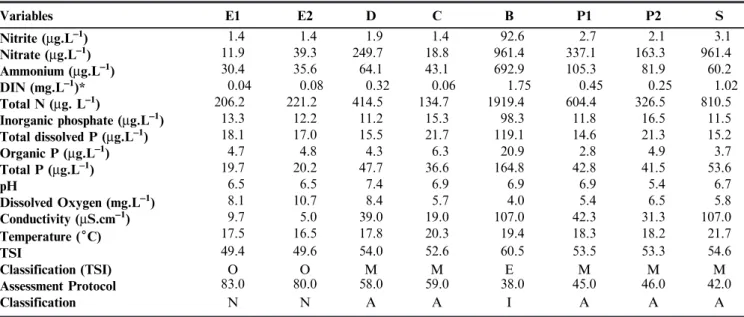
The score obtained for the Rapid Assessment Protocol, trophic state index (TSI) and physical and chemical variables are presented in table 2. The highest values for the physical and chemical variables, with the exception of dissolved oxygen, pH and temperature, were recorded in Belvedere stream. The lowest dissolved oxygen concentration was found in this stream too.
The Habitat Diversity Rapid Assessment Protocol classified as natural habitats (N) the Espraiado stream (E1 and E2), as altered streams (A) the Douradinho (D), Canchim (C), Ponte
de Ta´bua (P1 and P2) and Sa˜o Rafael (S), and as impacted stream (I) the Belvedere (B). The value of TSI characterized the Espraiado stream (E1 and E2) as oligotrophic (O), the Douradinho, Canchim, Ponte de Ta´bua (P1 and P2) and Sa˜o Rafael streams as mesotrophic (M), and Belvedere stream as eutrophic (E) (Table 2).
The equations obtained for the length-weight relationship for Astyanax paranae, Phalloceros harpagos and Poecilia reticulata in the streams under study were, respectively, W = 0.00001399 Ls3.180, W = 0.000003791 Ls3.558 and W = 0.000007636 Ls3.4142. The values of the exponents of LS (b.3) characterize the growth of the species as positive allometric; therefore, there is a greater than expected increase in weight as the standard length grows (Figure 2).
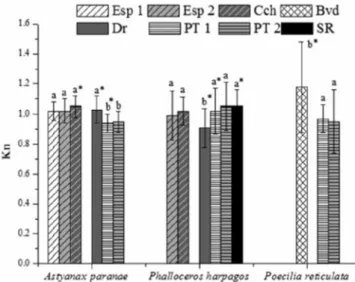
The data shown in Figure 3 indicate thatAstyanax paranae showed significantly lower values of the mean the relative condition factor (Kn) in the Ponte de Ta´bua stream (PT1 and PT2) than in other streams where the species occurred; both in PT1 and PT2, Kn was smaller than 1 (0.94 and 0.95, respectively). The Kn values for the species in Canchim (Kn = 1.05) and Douradinho streams (Kn = 1.03) were significantly
higher than 1, suggesting significantly more suitable environ-mental conditions for this fish than those in sites PT1 and PT2. In contrast, Phalloceros harpagos individuals collected in Douradinho stream were in poor body condition, shown by the low average value of Kn (p,0.05) relative to the other streams and the standard Kn (Kn = 1).
The specimens of Poecilia reticulata showed a higher Kn value in Belvedere stream than in all the other streams where this species was recorded. Besides being the highest value among all the streams, the average Kn of this species in this stream was significantly higher thant the standard value (Kn = 1) (Figure 3).
In the canonical correspondence analysis (CCA), the first two axes explained 98.5% of the total variability of the data (Figure 4). In general terms, the Belvedere stream (Bvd) was associated with higher nutrient concentrations, environmental disturbance, lower dissolved oxygen and higher abundance of Poecilia reticulata individuals. The species Astyanax paranae was correlated with natural habitat streams, with low nutrient concentrations and higher dissolved oxygen concentrations. In turn, Phalloceros harpagosindividuals were associated with altered conditions, as in:
Table 1. Composition, occurrence (O) and relative abundance (A) of the species collected in tributary streams of the Monjolinho River in the district of Sa˜o Carlos –– SP. Streams: Espraiado (E1 and E2), Douradinho (D), Canchim (C), Belvedere (B), Ponte de Ta´bua (P) and Sa˜o Rafael (S).
Streams
Species E1 E2 D C B P1 P2 S O (%) A (%)
Astyanax paranae 34 34 53 10 - 31 19 - 75 29.4
Poecilia reticulata - - - - 47 62 32 - 37.5 22.9
Phalloceros harpagos - 52 40 15 - 61 19 34 75 36.0
Hypostomus ancistroides - - - 1 - 13 21 - 37.5 5.7
Geophagus brasiliensis - - 3 - - - 5 - 25 1.3
Rhamdia quelen - - - 4 - 12,5 0.6
Gymnotus carapo - - - 1 5 - 25 1.0
Hyphessobrycon anisitsi - - - 10 - - 10 - 3.2
Table 2. Values related to chemical, physical, habitat diversity rapid assessment protocol and trophic state index (TSI) in tributary streams of Monjolinho River, in district of Sa˜o Carlos –– SP. Streams: Espraiado (E1 and E2), Douradinho (D), Canchim (C), Belvedere (B), Ponte de Ta´bua (P) and Sa˜o Rafael (S). O –– Oligotrophic, M –– Mesotrophic, E –– Eutrophic, N –– Natural, A –– Altered and I –– Impacted.
Variables E1 E2 D C B P1 P2 S
Nitrite (mg.L–1) 1.4 1.4 1.9 1.4 92.6 2.7 2.1 3.1
Nitrate (mg.L–1) 11.9 39.3 249.7 18.8 961.4 337.1 163.3 961.4
Ammonium (mg.L–1) 30.4 35.6 64.1 43.1 692.9 105.3 81.9 60.2
DIN (mg.L–1)* 0.04 0.08 0.32 0.06 1.75 0.45 0.25 1.02
Total N (mg. L–1) 206.2 221.2 414.5 134.7 1919.4 604.4 326.5 810.5 Inorganic phosphate (mg.L–1) 13.3 12.2 11.2 15.3 98.3 11.8 16.5 11.5
Total dissolved P (mg.L–1) 18.1 17.0 15.5 21.7 119.1 14.6 21.3 15.2
Organic P (mg.L–1) 4.7 4.8 4.3 6.3 20.9 2.8 4.9 3.7
Total P (mg.L–1) 19.7 20.2 47.7 36.6 164.8 42.8 41.5 53.6
pH 6.5 6.5 7.4 6.9 6.9 6.9 5.4 6.7
Dissolved Oxygen (mg.L–1) 8.1 10.7 8.4 5.7 4.0 5.4 6.5 5.8
Conductivity (mS.cm–1) 9.7 5.0 39.0 19.0 107.0 42.3 31.3 107.0
Temperature (6C) 17.5 16.5 17.8 20.3 19.4 18.3 18.2 21.7
TSI 49.4 49.6 54.0 52.6 60.5 53.5 53.3 54.6
Classification (TSI) O O M M E M M M
Assessment Protocol 83.0 80.0 58.0 59.0 38.0 45.0 46.0 42.0
Classification N N A A I A A A
* DIN –– Dissolved inorganic Nitrogen
4 Biota Neotrop
Barrilli, G.H.C. et al.
Canchim (Cch), Ponte de Ta´bua (PT1 and PT2) and Sa˜o Rafael (SR), but not Douradinho stream. The Monte Carlo test showed that the differences in dissolved oxygen, nitrite and total phosphorus concentrations were significant (p,0.05).
Discussion
The physical and chemical analysis, the Habitat Rapid Assessment Protocol of habitats and the trophic state index indicated a range of sites, from very clean to very impacted.
Being located in conservation areas, with well structured vegetation and far from pollutant emission sources, Espraiado stream, 1 and 2, have a good environmental quality, with nutrient concentrations below the regional limits for natural systems, according to those described by Tundisi & Matsumura-Tundisi (2008). The Habitat Rapid Assessment Protocol and trophic state index corroborated the improved environmental quality of these stretches, classifying them as natural and oligotrophic environments, respectively. However, these instruments characterized the Canchim, Douradinho, Ponte de Ta´bua1 and 2 and Sa˜o Rafael streams as mesotrophic and altered. In all streams except for Espraiado and Canchim streams, the dissolved inorganic nitrogen concentrations (ammonium, nitrite and nitrate) were higher than those found in natural habitats with low human intervention (around 0.12 mg.L-1), according to Allan & Castillo (2007).
In Belvedere stream, high nutrient concentrations and electrical conductivity were recorded compared to the other streams. The trophic state index and the Habitat Rapid Assessment Protocol characterized the Belvedere stream as eutrophic and impacted, respectively. Furthermore, evidence of fires was found in the riparian vegetation. These results corroborate those of Souza (2011), who reported, at the same site, a stream that proved to be negatively impacted.
The values of exponent b values for the species studied were within the limits indicated by Vazzoler (1996), ranging from 2.4 to 4.0 for most fish species. According to Verani (1980),
Figure 3.Relative Condition Factor (Kn) of each species in selected tributaries of Monjolinho River (Sa˜o Carlos –– SP) during the dry season: Espraiado (Esp1 and Esp2), Canchim (Cch), Belvedere (Bvd), Douradinho (Dr), Ponte de Ta´bua (PT1 and PT2) and Sa˜o Rafael (SR). Different letters represent statistically significant differences between individuals of the same species caught in distinct streams (Kruskal-Wallis test, p#0.05, followed by the Dunn multiple comparison test). Same letters correspond to the absence of statistical significance (Kruskal-Wallis, p.0.05). * Statistically different from 1 (Studentt
test, p#0.05) in the stream indicated.
Figure 4. Canonical correspondence analysis (CCA) relating the environmental variables, the relative condition factor of the speciesAstyanax paranae, Phalloceros harpagosandPoecilia reticulataand scores in rapid assessment of habitats of tributaries of Monjolinho river (Sa˜o Carlos –– SP), during dry season. Streams: Espraiado (Esp1 and Esp2), Canchim (Cch), Belvedere (Bvd), Douradinho (Dr), Ponte de Ta´bua (PT1 and PT2) and Sa˜o Rafael (SR).
6 Biota Neotrop
Barrilli, G.H.C. et al.
variations in this allometric coefficient can be related to environmental conditions and inherent biogenetic features of each species. Thus, the fact that this exponent exceeded 3 indicates that all three species,Astyanax paranae, Phalloceros harpagosand Poecilia reticulata at the study sites, showed a greater weight gain than predicted during growth, featuring positive allometric growth (Wooton, 1991).
In the CCA the relative condition factor (Kn) showed that Astyanax paranaewas in good condition in the well-oxygenated and less nutrient environments in Espraiado stream, as noted in stretches 1 and 2. However, there were no significant differences in the Kn values between the stretches classified as natural and oligotrophic and those classified as altered and mesotrophic, except for the Ponte de Ta´bua stream, stretches 1 and 2, where below average values of Kn were found for this species.
The results found by Lima-Junior (2004) and Orsi (2004) for the speciesAstyanax altiparanaedemonstrated a fall in the condition factor at most degraded sites. In contrast, Junior-Martins & Schulz (2001) and Albert et al. (2005) found an increase in Kn for another species of lambari, Astyanax fasciatus, in polluted sites. One possible explanation for the higher values of Kn for Astyanax paranae found in the subpopulations in Canchim and Douradinho streams, classified as mesotrophic and altered in this study could be that, within certain limits, eutrophication can increase the productivity of an ecosystem (Toledo et al., 1983), in the short term, be beneficial to the species. However, an excessive level of productivity can be harmful because it adversely alters the water quality, causes profound changes in the biogeochemical cycles of aquatic ecosystems and also leads to changes in community structure, destroying the natural balance of the food web (Toledo et al.,1983).
The low Kn values found for the subpopulation in the Ponte de Ta´bua stream (stretch 1 and 2) may be related to exposure of Astyanax paranae to the high nitrite concentrations recorded when compared to those reported in other streams where this species occurred. According to Baldisseroto (2002), nitrite can be toxic to fish, even at low concentrations, because it combines with the blood’s hemoglobin, hindering the transport of oxygen and resulting in tissue hypoxia (Jensen & Knudsen, 1997). Even at non-lethal levels, it can cause a weakening of the immune system of some species, leading to reduced growth and lower weight gain (Hanson & Grizzle, 1985).
For Phalloceros harpagos, the canonical correspondence analysis (CCA) related the species to environments with moderate levels of pollution, which suggests that it is tolerant to environments with moderate disturbance. The relative condition factor did not differ statistically between environ-ments of different degrees of disturbances except for the subpopulation from Douradinho stream. A similar result was obtained by Arau´jo et al. (2009) for the population of Phalloceros caudimaculatus in the Paraiba do Sul River. The low condition factor obtained for the subpopulation of P. harpagos in Douradinho stream was possibly a result of competition withA. paranae, which occurs in the same stream and in greater numerical density, and the fact that these species have similar trophic niches and a degree of flexibility that allows them to occupy a range of environments, from moderately impacted areas to nearly natural ones (Orsi, 2004). Thus, according to this author, the fish of this genus (Astyanaxspp.) can use available resources efficiently and can also compete well in moderately disturbed habitats, which can
be seen from the higher Kn value of this species in Douradinho stream compared, toPhalloceros harpagos.
Poecilia reticulata was highly correlated with negatively impacted environments, characterized by higher contents of nutrients and low oxygenation of the water. This has already been observed for this species by Lemes & Garutti (2002), Dyer (2003) and Cunico et al. (2006) who reported a high density of this species in impacted streams. According to Oliveira & Bennemann (2005),Poecilia reticulatais an exotic species that shows resilience in environments disturbed by human activity, owing to its opportunistic habits and diversified diets. In the present study, the relative condition factor ofP. reticulatawas highest in Belvedere stream, where the most severe conditions of eutrophication were observed, confirming that this species is not affected by poor environmental quality. In general, the species of the order Cyprinodontiformes are more tolerant of environmental degradation and can remain in such sites long after all the other fish disappear (Arau´jo, 1998; Chapman & Chapman, 1992). According to the authors cited here, the flexibility in the diet and the ability to survive and reproduce in waters with low oxygen facilitate the exploration of the habitat by this fish.
In the streams of the Monjolinho river basin, the varying degrees of environmental quality influenced differently the relative condition factor of the species.Astyanax paranaewas more sensitive to environments with higher nutrient and oxygen concentrations, while Phalloceros harpagos seems to be tolerant, since its condition factor did not differ between environments, with the exception of Douradinho stream, where the Kn value probably reflected the competition for food with A. paranae. On the other hand,P. reticulatahad the highest Kn value in the environment with lowest oxygen and highest nutrient concentrations, suggesting that this species is resistant to disturbed environments. The relative condition factor of fishes, combined with the analysis of environmental conditions, can be a useful tool for studies assessing the environmental quality of streams.
Acknowledgments
We thank CAPES (Coordination for the Improvement of Higher Education Personnel) for the grant to the first author, the technicians, Jose´ Valdecir de Lucca e Alcı´dio Culo´sio Filho, for their assistance in sampling, and ichthyologists Dr. Alexandre Kannebley de Oliveira and Dr. Evelise Nunes Fragoso de Moura for their contributions.
References
ALBERTO, A., CAMARGO, F.M., VERANI, J.R & COSTA, O.F.T. 2005. Health variables and gill morphology in the tropical fish
Astyanax fasciatus from a sewage-contaminated river. Ecotoxicology and Environmental Safety 6: p. 247-255.
ALLAN, J.D. & CASTILLO, M.M. 2007. Stream Ecology Structure and Function of Running Waters. Springer, 2nd. Dordrecht, The Netherlands, 436p.
ARAU´ JO, F.G. 1998. Adaptac¸a˜o do ı´ndice de integridade bio´tica usando a comunidade de peixes para o rio Paraı´ba do Sul. Revista Brasileira de Biologia v.58, n.4, p. 547-558.
BALDISSEROTTO, B. 2002 Fisiologia de peixes aplicada a` piscicul-tura. Santa Maria: UFSM. 212p.
BARBOUR, M.T., GERRITSEN, J., SNYDER, B.D. & STRIBLING, J.B. 1999. Rapid Bioassessment Protocols for Use in Streams and Wadeable Rivers: Periphyton, Benthic Macroinvertebrates and Fish, 2a ed. EPA 841-B-99-002. U.S. Environmental Protection Agency; Office of Water; Washington, D.C.
BRITSKI, H.A. 1972. Peixes de a´gua doce do Estado de Sa˜o Paulo: sistema´tica. In: Comissa˜o Interestadual da Bacia Parana´-Uruguay. Poluic¸a˜o e piscicultura: notas sobre ictiologia, poluic¸a˜o e piscicul-tura. Sa˜o Paulo: Faculdade de Sau´de Pu´blica da USP; Instituto de Pesca. p. 79-108.
CALLISTO, M., FERREIRA, W., MORENO, P., GOULART, M., PETRUCIO, M. 2002. Aplicac¸a˜o de um Protocolo de Avaliac¸a˜o Ra´pida da Diversidade de Habitats em Atividades de Ensino e Pesquisa (MG-RJ). Acta Limnologica Brasiliensia, v. 14, p. 91-98. CASATTI, L., LANGEANI, F. & CASTRO, R.M.C. 2001. Peixes de riacho do Parque Estadual Morro do Diabo, bacia do alto rio Parana´, SP. Biota Neotropica 1(1). Disponı´vel em: http://www.biotaneotropica. org.br/v1n12/pt/abstract?inventory++BN00201122001: Acesso em 04/ Jan/2013).
CASTRO, R.M.C., CASTRO, R.M.C., CASATTI, L., SANTOS, H.F., FERREIRA, K.M., RIBEIRO, A.C., BENINE, R.C., DARDIS, G.Z.P., MELO, A.L.A., STOPIGLIA, R., ABREU, T.X., BOCKMANN, F.A., CARVALHO, M., GIBRAN, F.Z.G. & LIMA, F.C.T. 2004. Estrutura e composic¸a˜o da ictiofauna de riachos da bacia do Rio Grande no estado de Sa˜o Paulo, sudeste do Brasil. Biota Neotrop., Campinas, v. 4, n. 1, 2. Disponı´vel em:
, http://www.scielo.br/scielo.php?script=sci_arttext&pid=S1676-06032004000100006&lng=en&nrm=iso.. Accesso em: 14 Jan. 2014.
CHAPMAN, L.J. & CHAPMAN, C.A. 1992. Variation in the structure ofPoecilia gilliipopulations. Copeia, p. 908-913.
CUNICO, A.M., AGOSTINHO, A.A., & LATINI, J.D. 2006. Influeˆncia da urbanizac¸a˜o sobre as assemble´ias de peixes em treˆs co´rregos de Maringa´, Parana´. Revista Brasileira de Zoologia 23(4): 1101-1110.
DAJOZ, R. 1983. Ecologia Geral. 4 ed. Vozes, Sa˜o Paulo.
DYER, S.D., PENG, C., MCAVOY, D.C, FENDINGER, N.J., MASSCHELEYN, P., CASTILHO, L.V. & LIM, J.M. 2003.The influence of untreated wastewater to aquatic communities in the Balatuin River, the Philippines. Chemosphere, Kidlington, 52: 43-53.
GOLTERMAN, H.L, CLYM, R.S. & OHNSTAD, M.A.M. 1978. Methods for Physical and Chemical Analysis of Fresh Waters. 2nd. ed. Oxford: Blackwell Scientific Publications, 215 p.
GOMIERO, L.M. & BRAGA, F.M.S. 2003. Relac¸a˜o peso-comprimento e fator de condic¸a˜o para Cichla cf. ocellarise Cichla monoculus
(Perciformes, Cichlidae) no reservato´rio de Volta Grande, rio Grande - MG/SP. Acta Scientiarum: Biological Sciences. Maringa´, v. 25, n. 1, p. 79-86.
GOULART, M.D. & CALLISTO, M. 2003. Bioindicadores de qualidade de a´gua como ferramenta em estudos de impacto ambiental. Revista FAPAM ano 2, n.1.
GRAC¸ A, W.J. & PAVANELLI, C.S. 2007. Peixes da planı´cie de inundac¸a˜o do alto rio Parana´ e a´reas adjacentes. Ed. Universidade Estadual de Maringa´, 240p.
HANSON, L.& GRIZZLE. 1985. Nitrite-induced predisposition of channel catfish to bacterial diseases Fish Culture, 47, p. 98-101. KNUDSEN, P.K. & JENSEN, F.B, 1997. Recovery from
nitrite-induced methaemoglobinaemia and potassium balance distur-bances in carp. Fish Physiology and Biochemistry. 16: 1-10. KONIG, R., SUZIN, C.R.H., RESTELLO, R.M. & HEPP, L.U. 2008.
Qualidade das a´guas de riachos da regia˜o norte do Rio Grande do Sul (Brasil) avaliada atrave´s de varia´veis fı´sicas, quı´micas e biolo´gicas. Panamjas: Pan-American Journal of Aquatic Sciences 3(1): 84-93.
LAMPARELLI, M.C. 2004. Grau de trofia em corpos d’a´gua do Estado de Sa˜o Paulo: avaliac¸a˜o dos me´todos de monitoramento. 2004. Sa˜o Paulo: Tese de Doutorado em Ecologia Aplicada. Universidade de Sa˜o Paulo.
LE-CREN, E.D. 1951. The length-weight relationship and seasonal cycle in gonad weight and condition in the perch (Perca fluviatilis). Journal of Animal. Ecology. 20(2):201-219.
LEMES, E.M. & V, GARUTTI. 2002. Ecologia da ictiofauna de um co´rrego de cabeceira da bacia do alto rio Parana´, Brasil. Iheringia, Se´rie Zoolo´gica, Porto Alegre, 92 (3):69-78.
LEMOS, J.R.G., TAVARES-DIAS, M., SALES, R.S.A., NOBRE FILHO, G.R. & FIM, J.D.I. 2007. Parasitos nas braˆnquias de
Brycon amazonicus(Characidae, Bryconinae) cultivados em canais de igarape´ do Turuma˜-Mirim, estado do Amazonas, Brasil. Acta Scientiarum: Biological Sciences, Maringa´, v. 29, n. 2, p. 217-222. LIMA-JUNIOR, S.E. 2004. A ictiofauna e a qualidade da a´gua em trechos do rio Corumbataı´ –– SP. Instituto de Biocieˆncias da Universidade Estadual Paulista Ju´lio de Mesquita Filho. 2004. 232 p. Tese (Doutorado) Rio Claro, SP.
LIZAMA, M.A.P. & AMBRO´ SIO, A.M. 1999. Relac¸a˜o peso-comprimento e estrutura da populac¸a˜o de nove espe´cies da famı´lia Characidae na planı´cie de inundac¸a˜o do alto rio Parana´, Brasil. Revista Brasileira de Zoologia, 16(3): p. 779-788.
LIZAMA, M.A.P & AMBRO´ SIO, A.M. 2002. Condition factor in nine species of fish of the Characidae family in the upper Parana´ river floodplain, Brazilian Journal of Biology, v.62, Maringa´(PR), n.1, p. 113-124.
LUCINDA, P.H.F. 2008. Systematics and biogeography of the genus
Phalloceros Eigenmann, 1907 (Cyprinodontiformes: Poeciliidae: Poeciliinae), with the description of twenty-one new species. Neotropical Ichthyology Porto Alegre, v.6, n.2, 2008. Disponı´vel em: http://www.scielo.br/scielo.php?script=sci_arttext&pid= S167962252008000200001&lng=en&nrm=iso Acesso: Outubro de 2013.
MACKERETH, F.J.H., HERON, J. & TALLING, J.F. 1978. Water Analysis: Some Revised Methods for Limnologists. Fresh Water Biological Association. Scientific Publication. N.36. Titus Wilson & Son ltd., Kendall. 117p.
OLIVEIRA, A.K. 2006. Composic¸a˜o e distribuic¸a˜o da ictiofauna de tributa´rios do Rio Mogi Guac¸u e do Rio Corumbataı´, Estado de Sa˜o Paulo. 2006. Tese de Doutorado, Universidade Federal de Sa˜o Carlos, Sa˜o Carlos–– SP.
OLIVEIRA, D.C. & BENNEMANN, S.T. 2005. Ictiofauna, recursos alimentares e relac¸o˜es com as interfereˆncias antro´picas em um riacho urbano no sul do Brasil. Biota Neotrop [online]. 2005, v.5, n.1, p. 95-107. Disponı´vel em: ,http://www.scielo.br/scielo. php?script=sci_arttext&pid=S1676-06032005000100011&lng= en&nrm=iso.. ISSN 1676-0603.
ORSI, M.L., CARVALHO, E.D. & FORESTI, F. 2004. Biologia populacional deAstyanax altiparanaeGarutti & Britski (Teleostei, Characidae) do Me´dio Rio Paranapanema, Parana´, Brasil. Revista Brasileira de Zoologia, v. 21, n. 2, p. 207-218.
POMPEU, P.S., ALVES. C.B.M & CALLISTO, M. 2005. In Press. The effects of urbanization on biodiversity and water quality in the Rio das Velhas basin, Brazil. In Brown, L.R. Gray, R.H. Hughes, R.M. and Meadow, M.R., editors. Effects of urbanization on stream ecosystems. American Fisheries Society, Symposium 47, Bethesda Maryland.
RASHED, M.N. 2001. Monitoring of environmental heavy metals in fish from Nasser Lake. Environ Int. 27(1):27-33.
REˆ GO, A.C.L., PINESE, O.P., MAGALHA˜ES, P.A. & PINESE, J.F. 2008. Relac¸a˜o peso-comprimento para Prochilodus lineatus
(Valenciennes, 1836) e Leporinus friderici (Bloch, 1794) (Characiformes) no reservato´rio de Nova Ponte –– EPDA de Galheiro, rio Araguari, MG. Revista Brasileira de Zoocieˆncias, v. 10, n. 1, p. 13-21.
ROCHA, M.A., RIBEIRO, E.L., MIZUBUTI, I.Y., SILVA, L.D.F., BOROSKY, J.C. & RUBIN, K.C.P. 2005. Uso do fator de
8 Biota Neotrop
Barrilli, G.H.C. et al.
condic¸a˜o alome´trico e de fulton na comparac¸a˜o de carpa(Cyprinus carpio), considerando os sexos e idade. Semina: Cieˆncias Agra´rias, Londrina, v.26, n.3, p. 429-434. Sciences 29: 217-222.
SCHULZ, U.H. & MARTINS-JUNIOR, H. 2001.Astyanax fasciatus
as bioindicator of water pollution of rio dos Sinos, RS, Brazil. Brazilian Journal of Biology. 61(4): p. 615-622.
SE´ , J.A.S. 1992. O Rio Monjolinho e sua Bacia Hidrogra´fica como Integradores de Sistemas Ecolo´gicos. 381 p. Dissertac¸a˜o (Mestrado). Escola de Engenharia de Sa˜o Carlos, Universidade de Sa˜o Paulo, Sa˜o Carlos, SP.
SOUZA, A.B. 2011. Avaliac¸a˜o da qualidade ambiental nas nascentes do rio Monjolinho na porc¸a˜o a` montante da estac¸a˜o de captac¸a˜o de a´gua do Esparaiado, Sa˜o Carlos-SP. 182f. Dissertac¸a˜o (Mestrado em Ecologia e Recursos Naturais, Universidade Federal de Sa˜o Carlos).
STRICKLAND, J.D. & PARSONS, T.R. 1960. A manual of sea water analysis. Bulletin Fisheries. Research Board of Canada., v. 125, 1-185p.
TER BRAAK, C.J.F. & SˇMILAUER, P. 2002. CANOCO reference manual CanoDraw for Windows user’s guide: software for canonical community ordination (version 4.5). –– Microcomputer Power IthacaNY, US. 500 pp.
TOLEDO, J.A.P., TALARICO, M., CHINEZ, S.J., AGUDO, E.G. 1983. A aplicac¸a˜o de modelos simplificados para a avaliac¸a˜o do processo da eutrofizac¸a˜o em lagos e reservato´rios tropicais. Congresso Brasileiro de Engenharia Sanita´ria e Ambiental. Balnea´rio Camboriu´, Santa Catarina.
TUNDISI, J.G., MATSUMURA TUNDISI, J.M, T.M. 2008. Limnologia 1a. Ed. Oficina de Textos, Sa˜o Paulo, 632p.
VALDERRAMA, J.C. 1981. The simultaneous analysis of total nitrogen and phosphorus in natural water. Mar. Chem., v.10, p. 109-122.
VAZZOLER, A.E.A.M. 1996. Biologia da reproduc¸a˜o de peixes teleo´steos: teoria e pra´tica. Maringa´: Eduem. 169p.
VERANI, J.R. 1980. Controle populacional em cultivo intensivo comparado entre a tila´pia do Nilo, Sarotherodon niloticus
(Linnaeus, 1757) e o tucunare´ comum, Cichla ocellaris
Schneider,1801. Aspectos quantitativos. 1980. Dissertac¸a˜o (Mestrado)––Departamento de Cieˆncias Biolo´gicas, Universidade Federal de Sa˜o Carlos, Sa˜o Carlos.
WOOTTON, R.J. 1991. Ecology of teleost fishes. Fish and Fisheries Series#1. Chapman & Hall. London 404 p.
ZAR, J.H. 2010. Biostatistical analysis. Prentice-Hall, New Jersey 5ed. 944 p.