ABSTRACT
Cor r osion b eh av ior of zir con ia in acid u lat ed
SKRVSKDWHÀXRULGH
$QLH 7+20$61 6DWK\DQDUD\DQDQ 65,'+$51 6KDQW$*+<$5,$11 3LODQGD :$7.,16&855<2 -XOLD< &+$12,
Alessandro POZZI3'DQLHOL&52'5,*8(61
1- University of Texas at Dallas, Department of Biomedical Engineering, Richardson, USA. 2- University of Texas at Dallas, Department of Chemistry, Richardson, USA.
3- Polytechnic University of Marche, Department of Oral Surgery-Implant Dentistry, Ancona, Italy.
&RUUHVSRQGLQJDGGUHVV Danieli C. Rodrigues - 800 W. Campbell Road - Richardson - Texas - 75080 - USA - Phone: 972 883 4703 - e-mail: [email protected]
6XEPLWWHG6HSWHPEHU0RGL¿FDWLRQ1RYHPEHU$FFHSWHG'HFHPEHU
O
EMHFWLYH7KHFRUURVLRQEHKDYLRURI]LUFRQLDLQDFLGXODWHGSKRVSKDWHÀXRULGH$3)UHSUHVHQWLQJDFLGLFHQYLURQPHQWVDQGÀXRULGHWUHDWPHQWVZDVVWXGLHG0DWHULDODQG Met hods: Zirconia rods were im m ersed in 1.23% and 0.123% APF solut ions and m aint ained at 37°C for det er m ined per iods of t im e. Sur faces of all specim ens w er e im aged using digit al m icr oscopy and scanning elect r on m icr oscopy ( SEM) . Sam ple m ass and dim ensions w er e m easur ed for m ass loss det er m inat ion. Sam ples w er e charact er ized by pow der X- ray diffract ion ( XRD) t o det ect changes in cr yst allinit y. A biosensor based on elect r ochem ical im pedance spect r oscopy ( EI S) was used t o det ect ion dissolut ion of m at er ial int o t he im m er sion m edia. Result s: Digit al m icr oscopy r evealed dim inishing lust er of t he m at er ials DQG 6(0 VKRZHG LQFUHDVHG VXSHU¿FLDO FRUURVLRQ RI ]LUFRQLD VXEPHUJHG LQ $3) Alt hough no st r uct ural change was found, t he absor pt ion of salt s ( sodium phosphat e) RQWRWKHVXUIDFHRIWKHPDWHULDOVEDWKHGLQ$3)ZDVVLJQL¿FDQW(,6LQGLFDWHGD gr eat er change of im pedance for t he im m er sion solut ions w it h incr easing bat hing t im e. Conclusion: I m m er sion of zir conia in APF solut ions show ed det er iorat ion lim it ed t o t he sur face, not ext ending t o t he bulk of t he m at er ial. I nfer ences on zir conia per for m ance in acidic oral envir onm ent can be elucidat ed fr om t he st udy.Ke y w or ds: Dent al abut m ent s. Dent al im plant s. Dent al cr ow ns. Acidulat ed phosphat e ÀXRULGH&RUURVLRQ&HUDPLFV
I N TROD UCTI ON
Zir conia and it s alloys ar e gaining pr evalence in t h e d en t al im p lan t sect or b ecau se of t h eir a e s t h e t i c p r o p e r t i e s , b i o c o m p a t i b i l i t y, l o w
SODTXH VXUIDFH DGKHVLRQ KLJK ÀH[XUDO VWUHQJWK
desirable osseoint egrat ion10, absence of m ucosal
d i sco l o r at i o n1 2 an d co r r o si o n r esi st an ce4. Th e
ongoing r esear ch for aest het ic, funct ionally st able and biocom pat ible m at er ials has favor ed t he use of all- cer am ic r econ st r u ct ion s f or f ix ed d en t al pr ost heses ( FDPs) as alt er nat ives t o convent ional porcelain- fused- t o- m et al ( PFM) prost heses11.
High-st rengt h m et al- oxide ceram ics have been developed t o over com e t he m echanical draw backs and high fract ur e rat es of pr ev ious all- ceram ic sy st em s23.
Cer am ics ar e ef f ect iv ely r eplacin g t h e m et allic com ponent s of pr ost het ic r est orat ions16. Alum ina
ZDV WKH ¿UVW ELRFHUDPLF IDEULFDWHG WR VHUYH DV
par t of dent al pr ost het ics; how ever, it s inher ent low b en d in g st r en g t h an d f r act u r e t ou g h n ess lead t o failur e due t o t he fract ur es. Wit h higher fract ur e r esist ance and elast ic m odulus, zir conia becam e t he m at er ial of choice succeeding alum ina. Yt t r ia- st abilized zir conium dioxide ( Y-TZP) is m or e biocom pat ible t han it s m et al alt ernat ives, prevent ing
VRIWWLVVXHLQÀDPPDWLRQDQGGLVFRORUDWLRQ1,12. Whit e
and shaded zir conia fram ew or k s pr ev ent bluish discolorat ion of per i- im plant soft t issues and m ay
EHEHQH¿FLDOLIVRIWWLVVXHUHFHVVLRQRFFXUVLQWKH
long t er m . Thus, Y-TZP cont r ibut es t o achiev ing healt hy soft t issue int egrat ion of im plant- support ed r est orat ions, t hus im pr oving long- t er m st abilit y of t he m ar ginal bone19. Zir conia- based all- ceram ics
on bot h nat ural t eet h and im plant s, in bot h ant erior and post er ior oral cavit y ar eas13,17,19- 21. The success
rat es of t hese fram ew or k s ar e com parable w it h convent ional PFM FDPs, but it is im por t ant t o not e
WKDWWKHVHVWDWLVWLFVDUHUHSRUWVIURPWKUHHWR¿YH
year s of clinical use15.
I n spit e of t he r epor t ed success, clinical r epor t s of zir con ia’s cat ast r oph ic f ailu r es do ex ist w it h
VLJQL¿FDQWELRORJLFDODQGWHFKQLFDOFRVW3. Generally,
f ailu r es of cer am ics ar e h igh ly associat ed w it h f r act u r e du e t o t h e in h er en t br it t len ess of t h e m at er ial1 2. Desp it e t h is, zir con ia con st it u t es a
su p er i or f r act u r e t ou g h n ess st ab i l i zed b y t h e t ransform at ion in t he cryst alline st ruct ure. However, t here are cert ain environm ent al condit ions t hat can lead t o degradat ion of t he m at erial. One of t he m ost im por t ant envir onm ent al degradat ion m echanism s associat ed w it h zir conia is know n as Ageing ( or ) Low Tem perat ure Degradat ion ( LTD)14. The process
of ageing t akes place in t w o differ ent scenar ios: ( i) st r ess cor r osion: slow t ransfor m at ion of sur face par t icles t o t he m onoclinic phase over t im e; ( ii) chem ical degradat ion: a chem isor pt ion of OH- fr om
w at er at t he sur face of zir conia grains t o for m Y( OH)3 and deplet ion of Yt t r ium . Transfor m at ion occur s in bot h scenar ios and is oft en ensued by a nucleat ion and gr ow t h pr ocess. This phenom ena can lead t o a cascade of ev ent s such as crack gr ow t h on t he sur face w hich is t er m ed Subcr it ical Crack Gr ow t h ( SCG) or st at ic fat igue6,14,29. These
pr ocesses can t r igger in vivo r elease of ceram ic part icles. Generally, ceram ic part icles are very inert and do not t rigger adverse react ions, however t here have been st udies point ing t o t he abilit y of zir conia
SRZGHUWRFDXVHLQÀDPPDWRU\UHDFWLRQVGXHWRWKH
for m at ion of zir conium hydr oxide16. Fur t her m or e,
invest igat ion of t he presence of ceram ic part icles in
DVSLUDWHGV\QRYLDOÀXLGLVFRQVLGHUHGDVDSRVVLEOH
diagnost ic t ool for ear ly det ect ion of fract ur e in ceram ic- on- ceram ic ( COC) hip im plant s25.
How ever, t he for m at ion of zir conium hydr oxide h a s n o w b e e n o v e r co m e w i t h t h e si n t e r i n g pr ocess16. Never t heless, t he m ain clinical concer n
r epor t ed in t he lit erat ur e r egar ding Y-TZP used as a fram ew or k m at er ial is a higher incidence of v en eer in g p or celain ch ip - of f f r act u r e r at es1 0 , 1 1,
which has been report ed t o range from 15% t o 54% over a 3- t o 5- year period11,12, versus 2.9% t o 8.8%
ceram ic fract ur e rat es obser ved in convent ional t o o t h - a n d i m p l a n t - su p p o r t e d m e t a l - ce r a m i c rest orat ions over 5 years18. Despit e t his m echanical
com plicat ion, pat ient sat isfact ion, favorable soft t i ssu e r e sp o n se a n d h i g h a e st h e t i c o u t co m e w er e not ed18. Several hypot heses concer ning t he
causes of porcelain veneer chipping highlight ed t he im por t ance of fact or s such as fram ew or k design, laborat ory handling, baking procedures and ceram ic m echanical pr oper t ies15.
He n ce , i t i s i m p o r t a n t t o i n v e st i g a t e a n d underst and t he effect of unfavorable acidic aqueous envir onm ent on t he sur face of new ly incor porat ed m a t er i a l s su ch a s zi r co n i a . I t h a s b een a l so suggest ed t hat an aqueous environm ent wit h acidic condit ions can accelerat e t he process of ageing wit h crack gr ow t h decr easing 20% - 30% t he pr ost hesis’ lif et im e4. Th e or al en v ir on m en t is an aq u eou s
elect r ochem ical m edium w it h high chances of pH
ÀXFWXDWLRQVWULJJHUHGE\WKHSUHVHQFHRIEDFWHULD LQJHVWLRQRIIRRGVRUSUHVHQFHRIDQLQÀDPPDWRU\
condit ion26. I n addit ion t o t his, t opical oral hygiene
m out hwashes pr escr ibed t o pat ient s cont ain highly
DFLGLFPHGLDGXHWRVRGLXPÀXRULGHDQGK\GURFKORULF
acid30. Acidulat ed Phosphat e Fluor ide ( APF) is one
such com m on t opical m out hwash used t o com bat dent al car ies. The effect of cor r osive envir onm ent s has been assessed for differ ent dent al ceram ics w her e t he low pH of t he m edium at t ack ed t he sur face leading t o coar ser sur faces24. Alt hough t he
LQÀXHQFHVRIGLIIHUHQWS+YDOXHVRQ]LUFRQLDKDYH
been evaluat ed, effect s of clinical solut ions, such as APF, on t he sur face of zir conia have not been invest igat ed28.
Henceforth, this study focuses on the investigation of t he sur face charact er ist ics of zir conia sam ples
H[SRVHGWRDFLGXODWHGSKRVSKDWHÀXRULGHVROXWLRQV
( 0.123% and 1.23% ) for an ext ended t im e per iod of 11 d. This st udy is based on t he hy pot hesis t h a t a n a ci d i c a q u e o u s m e d i u m i n t h e o r a l envir onm ent can accelerat e t he pr ocess of ceram ic ag ein g . Th is p r ocess can g en er at e n u cleat ion an d p r op ag at ion of cr ack s, in w h ich f r act u r es w ill r esu lt in dissolu t ion of ceram ic par t icles in t h e or al en v ir on m en t . Micr oscop ic t ech n iq u es w er e per for m ed t o under st and t he m or phological feat ur es of t he sur face. X- ray diffract ion ( XRD) w as em ploy ed t o evaluat e t he cr y st al st r uct ur e of t he ceram ic m at er ial because t he change in t he cr yst al st r uct ur e is consider ed an indicat or of m at er ial degradat ion. An elect r ochem ical sensor was used t o det ect t he presence of ceram ic part icles dissolut ion in t he APF m edium in which t he sam ples w er e im m er sed. The overall goal of t his st udy is t o pr ovide infor m at ion on t he per for m ance of zir conia m at er ials under sim ulat ed acidic oral envir onm ent .
M ATERI AL AN D M ETH OD S
M a t e r ia l
A non- porous zirconia ceram ic rod was obt ained fr om a vendor ( McMast er- Car r ; At lant a, Geor gia, USA; 97% Zr O2, 3% t race elem ent s) w it h diam et er of appr ox im at ely 0.15 cm and 30 cm in lengt h.
$FLGXODWHGSKRVSKDWHÀXRULGH3HGLDJHO
Pr e pa r a t ion of t h e z ir con ia r ods
Te n zi r co n i a r o d se ct i o n s w e r e cu t t o a n appr oxim at e lengt h of 2.54 cm each and t he ends sm oot h ed t o t ou ch an d v isu ally u sin g 5 0 0 - gr it silica paper ( Pace Technologies, 500- gr it , Tucson, Ar izona, USA) . Befor e im m er sion, all t he sam ples w ere im m ersed in acet one and sonicat ed for 5 m in.
I m m e r sion se t u p a n d t e st in g
The cleaned zir conia r ods w er e divided int o four gr oups involving differ ent im m er sion condit ions as follow s:
Gr oup 1: a zir conia r od not subj ect ed t o any im m er sion was used as a cont r ol.
Gr oup 2: a zir conia r od im m er sed in deionized ( DI ) wat er.
Gr oup 3: four zir conia r ods im m er sed in 1.23% APF m edium w it h each r od im m er sed in an isolat ed m edium cont ained in separat e glass vials.
Group 4: four zirconia rods im m ersed in 0.123% APF m ed iu m in a sim ilar m an n er t o g r ou p 3 . 0.123% APF was pr epar ed by 1: 10 dilut ion of t he com m er cial t opical agent .
The sam ple bat hed in DI w at er r epr esent ed a neut ral pH oral env ir onm ent for t he m at er ial. Different concent rat ions of APF solut ions represent ed different acidic oral environm ent condit ions. The t est sam ples were st ored in a 37°C room t o sim ulat e oral t em perat ur e. I t has been m ent ioned in a pr evious st udy t hat 24 h of im m ersion would represent 1 year of exposur e t o APF solut ion for 4 m in ever y day13.
Hence, t he im m er sion t est was per for m ed for 11 d t o r epr esent exposur e of r est orat ion m at er ials t o APF for 10- 11 year s.
Sur face m or phology of zir conia r ods fr om all
WKHJURXSVZHUHDQDO\]HGDWVSHFL¿FWLPHLQWHUYDOV
( “ t ” ) ( t = 24 h, 120 h, 192 h, 264 h) . I n addit ion, aliquot s of im m er sion m edia fr om gr oups 2- 4 w er e collect ed dur ing t he sam e t im e int er val t o ver ify t he dissolut ion of zir conia par t icles r elease over prolonged exposure t o acidic aqueous environm ent .
M a ss loss e x pe r im e n t s
Mass loss and change in dim ension were recorded t o verify if dissolut ion of zirconia ions/ part icles could occur under t he exper im ent al condit ions. Weight and dim ensions ( lengt h and w idt h) w er e r ecor ded per iodically for 11 d ( 264 h) for all specim ens using a m icrobalance and caliper, respect ively. Weight loss percent age was calculat ed using Equat ion 1. Where
¨:r epr esent s t he per cent age of w eight loss; t he init ial weight of each specim en, before im m ersion, is denot ed by Wo; and t he weight of im m ersed zirconia r ods ever y 24 h is indicat ed by WT.
( 1)
Su r fa ce m or ph ology
Th e ef f ect of APF solu t ion s on t h e m at er ial sur face was analyzed using differ ent m icr oscopy t echniques. Sur faces of all specim ens w er e im aged using digit al m icr oscopy ( Keyence VHX – 2000, I t asca, I llinois, USA) , and analyzed by Scanning Elect r on Micr oscopy ( SEM) ( SEM, JEOL, JSM- 6010, Peabody, Massachuset t s, USA) , befor e and aft er im m er sion.
X - r a y diffr a ct ion ( X RD )
Zir conia sam ples w er e gr ound using an alum ina m ort ar and pest le. Powder X- ray diffract ion ( Bruker D 8 Ad v an ce Po w d er D i f f r act o m et er, Mad i so n , W i sco n si n , USA) w a s u se d t o d e t e r m i n e t h e st ruct ure of t he m at erial pre- and post - im m ersion. D i f f r a ct i o n d a t a w er e co l l ect ed f o r a 2 - t h et a range fr om 10 t o 80 at 0.1 st ep size on a pow der diffract om et er equipped w it h a LYNXEYE det ect or w it h a pow er of 40 kV and 40 m A.
Zir con ia r e le a se st u dy
The r elease of zir conia par t icles due t o sur face degradat ion in t he im m ersion solut ion was analyzed wit h an elect rochem ical biosensor chip plat form t hat
TXDQWL¿HVSDUWLFOHGLVVROXWLRQXVLQJ(OHFWURFKHPLFDO
I m pedance Spect r oscopy ( EI S) . Aliquot s of t est ing solu t ion s w er e collect ed b ef or e an d af t er t h e im m er sion of zir conia r ods. Aft er t he im m er sion of r ods, sam ple aliquot s w er e collect ed fr om t he t est ing m edia at differ ent t im e int er vals “ t ” hour s ( h) ( t = 0, 24 h, 120 h, 192 h, 264 h) .
The EI S t est was per for m ed at a const ant peak-t o- peak volpeak-t age of 10 m V and a fr equency of 250 Hz. The im pedance of t he sam ple of int er est var ies accor ding t o t he conduct ivit y of it , w hich depends on t he concent rat ion of ceram ic par t icles in t he elect r olyt e ( i.e., a decr ease in im pedance indicat es a m or e conduct ive m edium ) . Deionized ( DI ) wat er w hich was not subj ect ed t o any im m er sion was used as t he cont r ol baseline. The rat io of change in im pedance of t he sam ple m edium analyt e fr om baseline was calculat ed t o generat e a per cent age
FKDQJH LQ LPSHGDQFH Ʃ= 3HUFHQW FKDQJH IRU
im pedance w as det er m ined using Equat ion ( 2) . This allow ed t he dat a set t o be averaged and t he st andar d dev iat ion t o be det er m ined over t hr ee r uns on t hr ee separat e EI S chips for t he 0.123% APF solut ion. Only one EI S m easur em ent ( one r un
per chip) was t aken for t he 1.23% APF gel due
t o t he high viscosit y of t he m edium . Wher e ¨Z
represent s t he percent change in im pedance; Zc and
ZI r epr esent t he im pedance value of t he im m er sion solut ion befor e and aft er im m er sion of specim ens, r espect ively.
( 2)
¨:
( )
*100Wo-WT
Wo ¨Z=
(
)
*100RESULTS
M a ss loss a n a ly sis
We i g h t a n d d i m e n s i o n m e a s u r e m e n t s o f im m er sed zir conia sam ples show ed only negligible ch an g e in b ot h t est in g solu t ion s. Th e av er ag e per cent age of w eight loss for sam ples im m er sed in 1.23% APF was about - 0.01% , w hile sam ples im m er sed in 0.123% APF show ed a w eight loss of 0.01% . The dim ensions of t he specim ens show ed sim ilar charact er ist ics, w her e t her e was no change com par ed t o pr e- im m er sion values.
Su r fa ce m or ph ology
Digit al m icr oscopy im ages show ed discolorat ion and loss of lust er on t he sur face for t he specim ens im m er sed in APF solut ions, as illust rat ed in Figur e 1 and 2, w hen com par ed t o t he cont r ols ( Figur e 1: 1A and Figur e 2: 10A) . Zir conia im m er sed in DI wat er show ed sim ilar lust er t o t hat of t he cont r ol. Manufact ur ing m ar ks w er e visible on all sur faces of t he zir conia r ods w het her t hey w er e im m er sed or dry as seen in Figure 1: 1A- 5A and Figure 2: 6A- 10A.
SEM sh ow ed a sm oot h u n d isr u p t ed su r f ace for t he cont r ol specim en ( Figur e 1: 1B) . The grain boundar ies w er e visible and indicat ed a unifor m
t op layer. Wit h im m er sion in APF solut ions, t he
VSHFLPHQVVKRZHGLPSHUIHFWLRQVRQWKHVXSHU¿FLDO
layers. The disrupt ion of surface grain and form at ion of m icr o por es in cr eased w it h im m er sion t im e in b ot h 1 . 2 3 % an d 0 . 1 2 3 % APF solu t ion s, as illust rat ed in Figur e 1: 2B- 5B and Figur e 2: 6B- 9B. Zir conia bat hed in DI w at er w as com parable t o t he cont r ol w her e an int act t op layer was evident ( Figur e 2: 10B) .
X - r a y diffr a ct ion ( X RD )
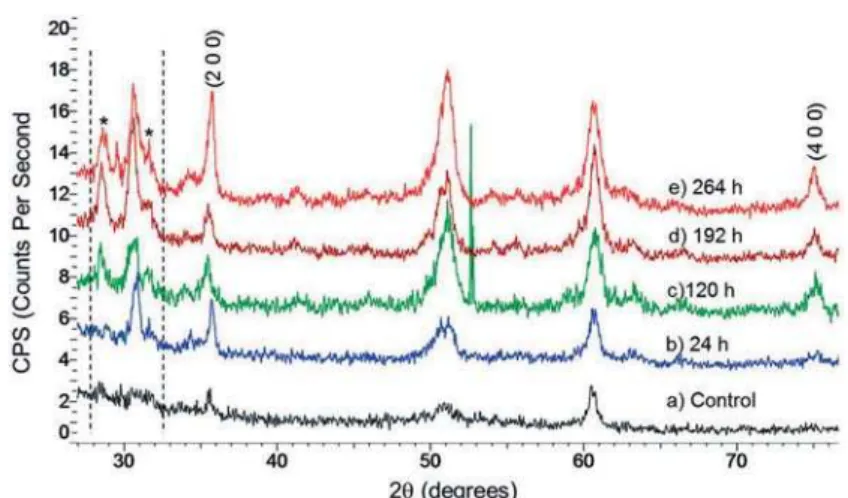
XRD pat t er ns for t he cont r ol befor e im m er sion in DI wat er or APF solut ions show ed t hat zir conia was of t he t et ragonal phase as indicat ed in Figur es
3a and 4a. This XRD pat t ern was used as a baseline for com par ison t o all t h e ot h er specim en s. For
]LUFRQLD LPPHUVHG LQ $3) VROXWLRQV UHÀHFWLRQV
cor r esponding t o sodium phosphat e ( Na3PO4) ar e evident and indicat ed by an ast er isk ( * ) . As t he im m er sion t im e incr eased, so did t he int ensit ies indicat ing t he pr esence of higher concent rat ion of sodium phosphat e. Addit ionally, t hese peaks ar e m or e int ense for t he sam ples bat hed in 0.123% APF solut ion ( Figur e 4) t han in 1.23% APF solut ion ( Figur e 3) . XRD pat t er ns for t he zir conia specim en in DI wat er show ed peaks for sodium phosphat e dehydrat e ( Na2HPO4.2H2O) ( Figur e 4f ) .
Figure 3- Powder diffraction patterns as a function of increasing immersion times in 1.23% Acidulat ed Phosphat e
Fluor ide ( APF) solution at oral temperature. (a) control (b) 24 h (c) 120 h (d) 192 h (e) 264 h, * indicates NaPO3
Figure 4- Powder diffraction patterns as a function of increasing soaking times in 0.123% Acidulat ed Phosphat e Fluor ide
( APF) solution and deionized (DI) water at oral temperature. (a) control (b) 24 h (c) 120 h (d) 192 h (e) 264 h (f) DI water 264 h, * indicates NaPO3
Figure 5- Electrochemical Impedance Spectroscopy- (A) Percent change in impedance for 1.23% Acidulat ed Phosphat e
Ele ct r och e m ica l I m pe da n ce Spe ct r oscopy ( EI S) - ba se d biose n sor
Sam p l e al i q u o t s o f i m m er si o n m ed i a su ch as DI w at er, 1 . 2 3 % an d 0 . 1 2 3 % APF ov er t h e
VSHFL¿HGLQWHUYDOVRIWLPHKKK
h, 264 h) w er e analyzed using a biosensor chip plat f or m . I m pedan ce valu es obt ain ed f r om t h e biosensor show ed a decr ease in im pedance, w it h incr easing im m er sion t im e of sam ples in APF, as show n in Figur e 5A- B. This t r end was consist ent in t he analysis of sam ple aliquot s fr om 0.123% and 1.23% APF solut ion. This r epr esent s an incr ease in solut ion conduct ivit y, w hich was evident w it h t he incr ease in t he per cent age change in im pedance
Ʃ=,WVDYHUDJHLQFUHDVHGE\LQ$3)
and 65% in 0.123% APF m edia collect ed at t = 264 h in com par ison t o t h e con t r ol solu t ion bef or e im m er sion . EI S m easu r em en t s w er e acq u ir ed w it h t hr ee differ ent chips for 0.123% APF solut ion and av eraged ( Figur e 5 B) . Measur em ent s w er e conduct ed only once for t he 1.23% APF gel ( Figur e 5A) .
D I SCUSSI ON
The im m er sion st udy of zir conia r ods in APF was per for m ed t o invest igat e t he effect of an acidic elect r och em ical env ir on m en t on t h e su r f ace of zir conia. I t was hypot hesized t hat acidic aqueous env ir onm ent pr ov ided by t he t opical agent can degrade t he zir conia sur face and accelerat e t he process of ageing, leading t o m icro- crack nucleat ion and pr opagat ion.
Exam inat ion of sur face m or phology of sam ples exposed t o APF cont aining m edia show ed visible discolor at ion u n der digit al m icr oscope ( Figu r es 1 and 2 ) . This obser vat ion w as at t r ibut ed t o a
JUDLQ VWUXFWXUDO FKDQJH LQ WKH VXSHU¿FLDO OD\HU ZKLFK PD\ KDYH DIIHFWHG OLJKW UHÀHFWLRQ RQ WKH
su r f ace of t h e m at er ial. Man u f act u r in g m ar k s ev ident on all specim ens w er e consider ed t o be m anufact ur ing defect s, since t hey w er e visible on t he non- im m ersed cont rol as well as shown in Figure 1: 1A- 5A; Figur e 2: 6A- 10A. Som e of t hese deposit s were et ched out by APF from t he specim ens, leaving spot s of black st r eaks ( Figur e 1: 3A, Figur e 2: 6A
DQG$7KHVHVXSHU¿FLDOGHIHFWVZHUHHYLGHQWLQ
t he SEM im ages, w her e t he t op layer seem ed t o be et ched w it h appar ent m icr o- por e for m at ion ( Figur e 1: 2B- 5B; Figure 2: 6B- 9B) . Sim ilar disrupt ion of t he
VXSHU¿FLDOOD\HUDQGIRUPDWLRQRIPLFURSRUHVKDYH
been show n in st udies w her e hot acidic sur face t r eat m en t w as ap p l i ed o n zi r co n i a5. Pr ev i o u s
lit erat ur e st udies suggest cr eat ion of m icr ocracks in cer am ic m at er ials w h en ex p osed t o ag ein g solu t ion s1 4. Th is w ou ld f u r t h er lead t o sev er al
com p licat ion s su ch as: ( i) in cr ease in su r f ace roughness, which could increase plaque adhesion22,
( ii) abrasion of ant agonist ic t eet h2, and ( iii) color
change leading t o im pr oper aest het ic qualit ies of r est orat ions12. APF at differ ent concent rat ions has
been report ed t o et ch dent al com posit es, porcelain, am algam and dent al cem ent s in vit r o7,9. Ageing is
charact er ized by t he pr opagat ion of defor m at ion fr om t he sur face t o t he bulk. I t was essent ial t o invest igat e t he bulk cr y st al st r uct ur e of zir conia sam ples t o ver ify t he ext ent of acidic at t ack.
XRD w a s p e r f o r m e d t o v e r i f y t h e cr y st a l st r uct ur e t ransfor m at ion. But , changes in lat t ice st r u ct u r e w er e n ot d et ect ed b y XRD w it h t h e sam ples invest igat ed. Furt her XRD analysis showed t h e ab sor p t ion of sod iu m p h osp h at e on t o t h e sur face of zir conia, but w eight change w as not evident as m ent ioned in t he m ass loss analysis. The disr upt ion of t he t op layer and t he absor pt ion of sodium phosphat e is a dynam ic process in solut ion; t her efor e, change in m ass was not m easurable.
7KHFRUURVLRQHIIHFWZDVOLPLWHGWRWKHVXSHU¿FLDO
lay er s of t h e m at er ial an d can b e con sid er ed t o be of n an o- t h ick n ess. Sam ples im m er sed in 0.123% APF had a higher concent rat ion of sodium phosphat e w it h incr easing t im e, as dem onst rat ed by t he incr eased int ensit ies of Na3PO4UHÀHFWLRQV in t he XRD diffract ion pat t er n ( Figur e 4A- E) . This is because t he dilut ed APF solut ion allow ed t he diffusion of ions t o occur m or e fr eely unlike t he 1.23% APF gel, w hose high viscosit y im posed a diffusion bar r ier for t he m ovem ent of ions. Peaks of sodiu m ph osph at e hy dr at e seen for zir con ia im m er sed in DI wat er ( Figur e 4F) w er e possibly a r esult of cr oss cont am inat ion of t he APF im m er sion m edia caused by inst r um ent s used t o ext ract t he sam ples fr om t he solut ions.
Ev e n t h o u g h t h e r e w a s n o ch a n g e i n t h e cr yst al lat t ice st r uct ur e, bot h m icr oscopic evidence an d XRD r esu lt s illu st r at ed su p er f icial su r f ace d e g r a d a t i o n . Th e r e f o r e , i t w a s n e ce ssa r y t o
FRQ¿UPWKHGLVVROXWLRQRI]LUFRQLDSDUWLFOHVLQWKH
im m er sion m edia. Sam ple aliquot s of im m er sion
PHGLD FROOHFWHG RYHU VSHFL¿F LQWHUYDO RI WLPHV
w er e analy zed by an elect r ochem ical biosensor chip plat for m . Elect r ochem ical biosensor r esult s show ed m or e conduct iv it y of t he solut ion w it h incr easing t im e, as illust rat ed in Figur e 5( A- B) . Cor r elat ions bet w een EI S and XRD r esult s show ed t he absor pt ion of sodium phosphat e ont o zir conia f or b ot h con cen t r at ion s of APF solu t ion s. Th is ph en om en on can be at t r ibu t ed t o select iv e ion exchange of sodium phosphat e fr om APF at t aching
WRWKHVXUIDFHRI]LUFRQLDOHDYLQJÀXRULGHLRQVLQWKH VROXWLRQWRDOORZIRUWKHIRUPDWLRQRIK\GURÀXRULF
acid ( HF)4&RPPHUFLDO$3)KDVDÀXRULGH
cont ent of 12, 300 par t s per m illion ( ppm ) w it h 0. 34% of HF, w her e it s dilut ion t o 0. 123% APF
ZLOOSURYLGHDÀXRULGHFRQWHQWRISSP8,30. I n
t o t he for m at ion of HF can fur t her exacer bat e t he m edium . HF pr esent in t he APF solut ion has been associat ed wit h t he dissolut ion of silica in t he dent al bioglass ceram ics. How ever, t he lack of silica phase in zir conia has been at t r ibut ed t o it s im pr ov ed r esist an ce t o acid et ch in g. Bu t , a r ecen t st u dy suggest ed t he possibilit y of et ching of zir conia due t o HF w it h an incr eased exposur e t im e24. Ear lier
st udies have dispr oved t he t heor y of dissolut ion of zir con ia or y t t r ia in t o w at er an d , sim ilar ly, show ed no w eight change in aged specim ens14,27.
Considering t hat our ageing solut ion was acidic, and
WKDW6(0LPDJHVUHYHDOHGGLVUXSWLRQRIDVXSHU¿FLDO
layer, dissolut ion of t his nano- layer is assum ed t o have occur r ed, w hich r esult ed in an incr ease in t he conduct ivit y of t he APF solut ions. This dissolut ion of ions was m or e pr evalent for t he 0.123% APF m edium , which was at t ribut ed t o t he viscosit y of t he solut ion. The 1.23% APF gel was viscous, slow ing t he m ov em ent of ions and int eract ion bet w een t he gel and sur face of m at er ial, w hile t he dilut ed APF allow ed for chem ical exchanges bet w een t he sur face and solut ion t o occur m or e fr eely.
The r esult s of t his st udy clear ly show ed t hat t he aqueous acidic envir onm ent was able t o t r igger
VXSHU¿FLDOVXUIDFHGHJUDGDWLRQZLWKWKHGLVVROXWLRQ
of ceram ic par t icles lim it ed t o t he sur face and did
QRWDIIHFWWKHEXONFU\VWDOVWUXFWXUHDVFRQ¿UPHG
by XRD, w hich was consider ed as an indicat or for ageing ( or ) slow m icr o- crack pr opagat ion.
The degradat at ion lim it ed t o t he surface wit hout affect ing t he bulk cryst al st ruct ure could explain t he
FOLQLFDO¿QGLQJRIQR]LUFRQLDIUDPHZRUNIUDFWXUHV
ex per ien ced in w ell con du ct ed clin ical st u dies, result ing in overall prost het ic survival rat es of 100% up t o 5 years13,17,18. Thus, t he ongoing developm ent
of new clinical and laborat or y pr ocedur es hav e yielded successful r esult s of t he PFZ as a viable r est orat ive alt er nat ive t o PFM, r esult ing in high pat ient sat isfact ion19.
+RZHYHUVXSHU¿FLDOVXUIDFHGHJUDGDWLRQVKRXOG
not be neglect ed. Due t o t he r oughness induced
E\ÀXRULGHDQGDFLGLFHQYLURQPHQWVWKHWRSOD\HU
could pr om ot e plaque r et ent ion cr eat ing a st age for per i- im plant diseases t o ar ise22. I n Dent ist r y,
zir conia is gaining im por t ance as t he m at er ial of choice for m aking abut m ent s and cr ow ns. Pozzi, et al.19 ( 2015) , r epor t ed on zir conium oxide’s high
biocom pat ibilit y and low plaque sur face adhesion cont r ibut ing t o successful soft t issue int egrat ion, assessing a ext r em ely low cum ulat ive plaque scor e w it h 93% of pat ient s w it hout gingivit is t hr oughout follow - up, and t he r em aining 2 % and 5 % w it h r espect iv e m ild and m oderat e gingiv it is19.
Vice-ver sa, non- hygienic inaccessible r est orat ions and r ou gh ed or n ot pr oper ly polish ed su r f aces ar e
VLJQL¿FDQWO\DVVRFLDWHGZLWKLPSODQWORVVDQGDKLJK
rat e of per i- im plant it is22.
I t has also been suggest ed t hat for m at ion of
VXUIDFHFRUURVLRQOD\HUVPD\LQÀXHQFHWKHGHJUHHRI
degradat ion in addit ion t o t he effect of m icrost ruct ure and env ir onm ent al condit ions4. Mor eover, it has
EHHQUHSRUWHGWKDW]LUFRQLD¶VVWUHQJWKLVLQÀXHQFHG
b y d i f f er en t su r f ace t r eat m en t s t h at p r o d u ce differ ent degr ees and t ypes of sur face dam age5.
Cer t ain lim it at ions exist w it hin t his st udy. This m et hodology provides an overview on t he corrosive behavior of APF on zir conia in oral t em perat ur e. Never t heless, in- vivo oral envir onm ent can have
ÀXFWXDWLRQV LQ S+ PDVWLFDWLRQ IRUFHV DQG RWKHU IDFWRUVWKDWPD\IXUWKHULQÀXHQFHWKHPDWHULDOV
pr oper t ies and per for m ance.
CON CLUSI ON
Th is st u d y in v est ig at ed t h e ef f ect of acid ic aqu eou s elect r och em ical env ir on m en t du e t o a t opical solut ion. How ev er, t he oral env ir onm ent is com pr ised of com plex elect r ochem ical fact or s such as saliva, enzym es, a w ide var iet y of bact er ial
VSHFLHV DORQJ ZLWK ÀXFWXDWLRQV LQ WKH S+ DQG
t em perat ur e condit ions due t o food par t icles and beverages. I n addit ion, dent al rest orat ion m at erials
in vivo ar e also exposed t o m echanical fact or s such
as occlusal for ces due t o m ast icat ion. I t has been clear ly st at ed t hat t he m echanical pr oper t ies of zirconia are affect ed under prolonged exposure in an aqueous m edium . I n t he lim it ed clinical evidences obt ained so far, failure of zirconia has been prim arily associat ed w it h fract ur e. Hence, fut ur e st udies w ill include m echanical loading of zir conia in sim ulat ed oral env ir onm ent t o under st and t he int er play of m echanical and elect r ochem ical fact or s t hat can accelerat e degradat ion and fract ure of t he m at erial.
I m m e r s e d s a m p l e s d i d n o t s h o w a n y t ransform at ion of cryst alline phase from m onoclinic t o t et ragonal. Hence, it was concluded t hat t he acidic m edium was not able t o t r igger t he ageing p h e n o m e n o n . H o w e v e r, m i cr o sco p i c i m a g e s
GHWHFWHGVXSHU¿FLDOVXUIDFHGHJUDGDWLRQ,QWKHRUDO HQYLURQPHQW VXSHU¿FLDO VXUIDFH GDPDJH GXH WR
acidic m edium , can be fur t her invigorat ed by cyclic occlusal forces which can have a direct effect on t he bulk pr oper t ies of t he m at er ial. Fut ur e st udies w ill focus on t he syner gist ic effect of m echanical for ces and acidic elect rochem ical environm ent , which m ay accelerat e crack pr opagat ion r esult ing in fract ur e and failur e of t he zir conia cor e or chipping of t he por celain veneer ing layer.
ACKN OW LED GM EN TS
an d Nan ot ech n ology Labor at or y f or con du ct in g t he elect r ochem ical sensor t est ing. The aut hor s w ould like t o acknow ledge Dr. Thom as G. Wilson Jr., a pr ivat e pract it ioner for pr oviding us w it h t he clinical t opical agent .
REFEREN CES
1- Abraham sson I , Ber glundh T, Glant z PO, Lindhe J. The m ucosal at t achm ent at different abut m ent s. An experim ent al st udy in dogs. J Clin Per iodont ol. 1998; 25: 721- 7.
2- Al- Hiyasat AS, Saunder s WP, Shar key SW, Sm it h GM, Gilm our WH. I nvest igat ion of hum an enam el w ear against four dent al ceram ics and gold. J Dent . 1998; 26: 487- 95.
3- Aram ouni P, Zebouni E, Tashkandi E, Dib S, Salam eh Z, Alm as K. Fract ure resist ance and failure locat ion of zirconium and m et allic im plant abut m ent s. J Cont em p Dent Pract . 2008; 9: 41- 8. 4- Ber gm ann CP, St um pf A. Dent al ceram ics: m icr ost r uct ur e, pr oper t ies and degradat ion, I n: Ber gm ann CP, eds. Topics in m ining, m et allur gy and m at er ials engineer ing. Ber lin: Spr inger ; 2013. p. 67- 84.
5- Casucci A, Mazzit elli C, Mont icelli F, Toledano M, Osorio R, Osorio E, et al. Morphological analysis of t hree zirconium oxide ceram ics: effect of sur face t r eat m ent s. Dent Mat er. 2010; 26: 751- 60. 6 - Ch ev alier J. Wh at f u t u r e f or zir con ia as a b iom at er ial? Biom at er ials. 2006; 27: 535- 43.
'DUYHOO%:7KHHIIHFWRIWRSLFDOÀXRULGHRQDPDOJDP%U'HQW
J. 1977; 142: 47- 51.
8- Dent al product s [ I nt ernet ] . New York: Fluoride Act ion Net work.;
F>FLWHG$XJ@$YDLODEOHIURPKWWSÀXRULGHDOHUW
or g/ issues/ dent al- pr oduct s/ t oot hpast es/
9- El- Badraw y WA, McCom b D, Wood RE. Effect of hom e- use
ÀXRULGHJHOVRQJODVVLRQRPHUDQGFRPSRVLWHUHVWRUDWLRQV'HQW
Mat er. 1993; 9: 63- 7.
1 0 - Gu ess PC, At t W, St r u b JR. Z i r co n i a i n f i x ed i m p l a n t pr ost hodont ics. Clin I m plant Dent Relat Res. 2012; 14: 633- 45. 1 1 - Heint ze SD, Rousson V. Sur v ival of zir conia- and m et
alVXSSRUWHG ¿[HG GHQWDO SURVWKHVHV D V\VWHPDWLF UHYLHZ ,QW
-Pr ost hodont . 2010; 23: 493- 502.
12- Kout ayas S, Vagkopoulou T, Pelekanos S, Koidis P, St r ub JR. Zirconia in dent ist ry: part 2. Evidence- base clinical breakt hrough. Eur J Est het Dent . 2009; 4: 348- 80.
13- Lar sson C, Vult von St eyer n P, Nilner K. A pr ospect ive st udy of im plant - support ed full- arch yt t ria- st abilized t et ragonal zirconia
SRO\FU\VWDOPDQGLEXODU¿[HGGHQWDOSURVWKHVHVWKUHH\HDUUHVXOWV
I nt J Pr ost hodont . 2010; 23: 364- 9.
14- Law son S. Envir onm ent al degradat ion of zir conia ceram ics. J Eur Ceram Soc. 1995; 15: 485- 502.
15- Lim a JM, Souza AC, Anam i LC, Bot t ino MA, Melo RM, Souza RO. Effect s of t hickness, pr ocessing t echnique, and cooling rat e
SURWRFRORQWKHÀH[XUDOVWUHQJWKRIDELOD\HUFHUDPLFV\VWHP'HQW
Mat er. 2013; 29: 1063- 72.
16- Manicone PF, Rossi I om m et t i P, Raffaelli L. An over view of zir conia ceram ics: basic pr oper t ies and clinical applicat ions. J Dent . 2007; 35: 819- 26.
1 7 - Pa p a sp y r i d a k o s P, La l K. Co m p u t e r - a ssi st e d d e si g n /
FRPSXWHUDVVLVWHGPDQXIDFWXULQJ]LUFRQLDLPSODQW¿[HGFRPSOHWH
pr ost heses: clinical r esult s and t echnical com plicat ions up t o 4 year s of funct ion. Clin Oral I m plant Res. 2013; 24: 659- 65. 18- Pj et ur sson BE, Br ägger U, Lang NP, Zwahlen M. Com par ison
RIVXUYLYDODQGFRPSOLFDWLRQUDWHVRIWRRWKVXSSRUWHG¿[HGGHQWDO
prost heses ( FDPs) and im plant - support ed FDPs and single crow ns ( SCs) . Clin Oral I m plant s Res. 2007; 18: 97- 113.
19- Pozzi A, Holst S, Fabbr i G, Tallar ico M. Clinical r eliabilit y of CAD/ CAM cr oss- ar ch zir con ia br idges on im m ediat ely loaded im plant s placed wit h com put er- assist ed/ t em plat e- guided surgery: a ret rospect ive st udy w it h a follow- up bet w een 3 and 5 years. Clin I m plant Dent Relat Res. 2015; 17: e86- e96.
20- Pozzi A, Tallar ico M, Bar lat t ani A. Monolit hic lit hium disilicat e full- cont our cr ow ns bonded on CAD/ CAM zir conia com plet e- ar ch im plant br idges w it h 3 t o 5 year s of follow- up. J Oral I m plant ol. 2015; 41: 450- 8.
21- Pozzi A, Tallar ico M, Moy PK. The im plant biologic pont ic designed int er face: descr ipt ion of t he t echnique and cone- beam com put ed t om ography evaluat ion. Clin I m plant Dent Relat Res. 2015; 17( Suppl 2) : e711- 20.
22- Quir ynen M, De Soet e M, van St eenber ghe D. I nfect ious r isks for oral im plant s: a r eview of t he lit erat ur e. Clin Oral I m plant s Res. 2002; 13: 1- 19.
23- Sailer I , Feher A, Filser F, Gauckler LJ, Lut hy H, Ham m erle CH.
)LYH\HDUFOLQLFDOUHVXOWVRI]LUFRQLDIUDPHZRUNVIRUSRVWHULRU¿[HG
par t ial dent ur es. I nt J Pr ost hodont . 2007; 20: 151- 6.
24- Sr iam por n T, Tham r ongananskul N, Busabok C, Poolt hong
68R07DJDPL-'HQWDO]LUFRQLDFDQEHHWFKHGE\K\GURÀXRULF
acid. Dent Mat er J. 2014; 33: 79- 85.
25- St ea S, Traina F, Beraudi A, Mont esi M, Bor dini B, Squar zoni
6 HW DO 6\QRYLDO ÀXLG PLFURDQDO\VLV DOORZV HDUO\ GLDJQRVLV RI
ceram ic hip pr ost hesis dam age. J Or t hop Res. 2012; 30: 1312- 20. 26- Sur dacka A, St r zykaa K, Rydzew ska A. Changeabilit y of oral cavit y envir onm ent . Eur J Dent . 2007; 1: 14- 7.
27- Tinscher t J, Nat t G, Mohr bot t er N, Spieker m ann H, Schulze KA. Lifet im e of alum ina- and zir conia ceram ics used for cr ow n and br idge r est orat ions. J Biom ed Mat er Res B Appl Biom at er. 2007; 80: 317- 21.
28- Tur p V, Tuncelli B, Sen D, Goller G. Evaluat ion of har dness and fract ur e t oughness, coupled w it h m icr ost r uct ural analysis, of zirconia ceram ics st ored in environm ent s wit h different pH values. Dent Mat er J. 2012; 31: 891- 902.
29- Volpat o CM, Gar belot t o LG, Fr edel MC, Bondioli F. Applicat ion of zir con ia in d en t ist r y : b iolog ical, m ech an ical an d op t ical considerat ions. I n: Sikalidis C, ed. Advances in ceram ics - elect r ic and m agnet ic ceram ics, bioceram ics, ceram ics and envir onm ent . Rij eka: I nTech; 2011. p. 397- 420.
30- Whit for d GM, Adair SM, Hanes CM, Per due EC, Russell CM.
(QDPHOXSWDNHDQGSDWLHQWH[SRVXUHWRÀXRULGHFRPSDULVRQRI
![Figure 1- $0LFURVFRSLFLPDJHVDW[PDJQL¿FDWLRQRI]LUFRQLDVXUIDFHEHIRUHDQGDIWHULPPHUVLRQLQ Acidulat ed Phosphat e Fluor ide ( APF) at 37°C for 24 h, 120 h, 192 h, and 264 h; (B) Scanning electron microscopy images of all zirconia specimens at different immers](https://thumb-eu.123doks.com/thumbv2/123dok_br/14984243.511501/4.892.86.808.372.1101/lfurvfrslflpdjhvdw-fdwlrqri-lufrqldvxuidfhehiruhdqgdiwhulpphuvlrqlq-acidulat-phosphat-scanning-microscopy-specimens.webp)
![Figure 2- $ 0LFURVFRSLF LPDJHV DW [ PDJQL¿FDWLRQ RI ]LUFRQLD VXUIDFH DIWHU LPPHUVLRQ LQ Acidulat ed Phosphat e Fluor ide ( APF) and deionized (DI) water at 37°C for 24 h, 120 h, 192 h, and 264 h; (B) Scanning electron microscopy images of all zirconia](https://thumb-eu.123doks.com/thumbv2/123dok_br/14984243.511501/5.892.77.810.385.1097/lfurvfrslf-lufrqld-lpphuvlrq-acidulat-phosphat-deionized-scanning-microscopy.webp)