Submitted27 February 2014 Accepted 13 June 2014 Published8 July 2014
Corresponding author
Neng Chen,
Academic editor
Santosh Patnaik
Additional Information and Declarations can be found on page 12
DOI10.7717/peerj.468
Copyright
2014 Chen and Prada
Distributed under
Creative Commons CC-BY 4.0
OPEN ACCESS
Development of allele-specific multiplex
PCR to determine the length of poly-T in
intron 8 of
CFTR
Neng Chen1,2and Anne E. Prada1
1Department of Pathology and Laboratory Medicine, Beaumont Health System, Royal Oak,
MI, USA
2Department of Pathology and Laboratory Medicine, Oakland University William Beaumont
School of Medicine, Royal Oak, MI, USA
ABSTRACT
Cystic fibrosis transmembrane conductance regulator (CFTR) gene mutation anal-ysis has been implemented for Cystic Fibrosis (CF) carrier screening, and molecu-lar diagnosis of CF and congenital bilateral absence of the vas deferens (CBAVD). Although poly-T allele analysis in intron 8 ofCFTRis required when a patient is positive for R117H, it is not recommended for routine carrier screening. Therefore, commercial kits forCFTRmutation analysis were designed either to mask the poly-T allele results, unless a patient is R117H positive, or to have the poly-T analysis as a standalone reflex test using the same commercial platform. There are other stan-dalone assays developed to detect poly-T alleles, such as heteroduplex analysis, High Resolution Melting (HRM) curve analysis, allele-specific PCR (AS-PCR) and Sanger sequencing. In this report, we developed a simple and easy-to-implement multiplex AS-PCR assay using unlabeled standard length primers, which can be used as a reflex or standalone test forCFTRpoly-T track analysis. Out of 115 human gDNA samples tested, results from our new AS-PCR matched to the previous known poly-T results or results from Sanger sequencing.
Subjects Biotechnology, Genetics, Molecular Biology, Pathology, Medical Genetics
Keywords Poly-T analysis, CFTR, Multiplex allele-specific PCR
INTRODUCTION
Multiple commercial products have been developed forCFTRtesting (Johnson, Yoshit-omi & Richards, 2007). All include the 23 mutations recommended by American College of Medical Genetics and Genomics (ACMG) and American Congress of Obstetricians and Gynecologists (ACOG) (Grody et al., 2001;Watson et al., 2004) for carrier screening. One of the criteria to select the mutations for the recommendedCFTRmutation panel was that allele frequency of a mutation must be at least 0.1% in the general US population. Inevitably, the selected 23 mutations would have higher detection rate in non-Hispanic white and Ashkenazi Jewish population, who have the highest CF prevalence in general populations. The same recommended panel would lead to lower detection rate in other ethnic groups such as Hispanics, African Americans and Asians. For this reason, mutations with relatively high allele frequency in other minority ethnic groups (Macek et al., 1997; Rohlfs et al., 2011;Sugarman et al., 2004) were added in each panel to increase the detection rate. Therefore, each panel contained a varying number of mutations ranging from 30 to more than 100. Additional testing of the poly-Thymidine (poly-T) tract in intron 8 ofCFTRis indicated when a patient is positive for R117H, one of the 23 recommended mutations (Grody et al., 2001). Poly-T tract has three alleles, 5, 7, and 9 Thymidine (T) in general population, with allele frequency of about 5%, 85% and 10%, respectively (Chillon et al., 1995). However, only one of the poly-T alleles, 5T, has reduced splicing of exon 9 and decreased expression of the full-length gene products (Chu et al., 1993). 5T alone is not considered a disease-causing CF mutation, but it is related to CBAVD (Chillon et al., 1995). Presence of both R117H and 5T allele on the same chromosome (i.e., R117H and 5T incis-configuration) constitutes a disease-causing CF mutation (Bienvenu et al., 1993;Chmiel et al., 1999;Dean et al., 1990). As a result, poly-T tract testing was considered as a follow-up test (i.e., reflex test) and is included in almost all the commercial assays. Testing parents of patients is able to define whether R117H and 5T are from the one parent (i.e., incis-configuration) or different parent (i.e., intrans-configuration), if 5T is detected in R117H positive samples. Because R117H and poly-T alleles are about 18 kb apart, long-range PCR has also been developed to determine thecis- ortrans-relationship of R117H and 5T alleles to circumvent testing unaffected parents (Chen & Schrijver, 2011; Pont-Kingdon et al., 2004).
Alignment of the sequence reads in the poly-T region is extremely challenging as there are three common poly-T alleles and variable numbers of TG repeats at the 5′of the poly-T tract in each individual allele. Commonly available NGS commercial software cannot align the region properly. End users have to write their own script in order to have the correct alignment in the poly-T region (Trujillano et al., 2013). This would be an issue for laboratories who do not have this type of bioinformatics support. In this case, a standalone poly-T assay can be implemented as part ofCFTRmolecular testing when NGS is applied to detect other mutations in the gene.
There are standalone poly-T assays developed for clinical research or testing, such as heteroduplex (Chillon et al., 1995), High Resolution Melting (HRM) curve analysis (Millson et al., 2005), and Allele-Specific PCR (AS-PCR) (Costa et al., 2008;Friedman et al., 1997). In addition, direct Sanger sequencing was also used to identify the variable length of the poly-T track (Chen & Schrijver, 2011;Chiang et al., 2009). The heteroduplex analysis involves running the nested PCR products on non-denaturing polyacrylamide gel to visualize the different number of thymidine in the poly-T track. HRM analysis is much easier to set up. After PCR reaction, collection of the melt curve signals is performed directly using the same tube without any treatment. However, patterns of the HRM curves for each individual sample could be different and complex, depending on combination of the poly-T with the adjacent TG repeats. This complicates the interpretation of the HRM results.
In contrast, interpretation of AS-PCR results is simpler. Presence or absence of the AS-PCR products would indicate the specific variant that is intended to be detected by the allele specific primer. Non-fluorescent AS-PCR was developed byFriedman et al. (1997) to detect 5T, 7T and 9T in the poly-T track. Three individual AS-PCR reactions, 5T, 7T and 9T were set up in three separate tubes for a sample. Following PCR, the presence and absence of the AS-PCR products were visualized on agarose gels, which are commonly used in molecular laboratories.
to synthesize. It results in much reduced yield and is therefore more expensive. Another matter of consideration is that the product is no longer available for the US market.
In this report, we developed a simple and easy-to-implement standalone qualitative multiplex AS-PCR assay using standard length primers (less than 50 nucleotides). Our assay can be utilized as a reflex or standalone test forCFTRpoly-T track analysis.
MATERIALS & METHODS
DNA samples
Genomic DNA (gDNA) samples from 115 individuals were included in this study. Of these samples, 60 (Table 1) were purchased from Coriell (Coriell Cell Repositories, Camden, New Jersey), including 23 samples from MUTCF-2 Cystic Fibrosis Mutation Panel. The remaining 55 samples (Table S1) were leftover human gDNA from routine clinical tests conducted in Molecular Pathology Laboratory at Beaumont Health System. Of all the samples, only MUTCF-2 Cystic Fibrosis panel had been poly-T track tested previously (Coriell Institute, 2009a;Coriell Institute, 2009b;Sebastian et al., 2004). All the Beaumont samples were de-identified and the study was approved by Human Investigational Committee (HIC 2014-010) at Beaumont Health System.
In-house gDNA from sample ID number S43 to S66, S89 and S90 (Table S1) were extracted from peripheral blood using the Gentra Puregene Blood Kit (Gentra Systems, Minneapolis, MN) following the manufacturer’s instructions. The gDNA concentration was measured using a NanoDrop spectrophotometer (Thermo Fisher Scientific, Wilming-ton, MA). NucliSens easyMAG (bioMerieux, Durham, NC), an automated system for total nucleic acid extraction, was used to isolate the remainder of the in-house gDNA (sample ID number S114 to S142,Table S1). Briefly, red blood cells from 200µL of EDTA whole blood were lysed by adding 600µL of RBC Lysis Solution (Qiagen, Germantown, MD). After centrifugation of the lysate, the pellets were resuspended in 1 mL of easyMAG Lysis Buffer (bioMerieux) and transferred to the extraction cassettes for on-board easyMAG extraction, using default Specific A protocol. Then 70µL of easyMAG elution buffer was added to elute gDNA from the magnetic silica.
Cloning of 5T alleles
Table 1 Poly-T analysis of Coriell gDNA.
Sample ID Poly-T alleles Reference method Coriell IDa Sample ID Poly-T alleles Reference method Coriell IDa
S1 7/7 Sanger sequencing CD00003 S31 7/7 Sanger sequencing NA20737
S2 7/9 Sanger sequencing CD00009 S32 7/7 Sanger sequencing NA20741
S3 7/7 Sanger sequencing NA00059 S33 7/7 Sanger sequencing NA20745
S4 7/7 Sanger sequencing NA00112 S34 7/7 Sanger sequencing NA20836
S5 7/7 Sanger sequencing NA00852 S35 7/7 Sanger sequencing NA20925
S6 7/9 Sanger sequencing NA01031 S36 7/9 Sanger sequencing NA21551
S7 7/7 Sanger sequencing NA01607 S37 7/9 Sanger sequencing GM22063b
S8 7/7 Sanger sequencing NA02528 S38 9/9 Other methodsc NA01531
S9 7/7 Sanger sequencing NA02533 S39 7/9 Other methodsc NA07441
S10 7/9 Sanger sequencing NA02828 S40 7/7 Other methodsc NA11277
S11 7/7 Sanger sequencing NA03252 S41 5/7 Other methodsc NA11723
S12 7/7 Sanger sequencing NA03403 S42 5/9 Other methodsc NA13591
S13 7/7 Sanger sequencing NA03441 S96 7/9 Other methodsc NA07552
S14 7/7 Sanger sequencing NA03461 S97 7/9 Other methodsc NA08338
S15 7/7 Sanger sequencing NA04268 S98 7/9 Other methodsc NA11275
S16 7/7 Sanger sequencing NA04394 S99 7/9 Other methodsc NA11280
S17 7/7 Sanger sequencing NA04863 S100 9/9 Other methodsc NA11281
S18 7/7 Sanger sequencing NA07854 S101 7/9 Other methodsc NA11282
S19 7/7 Sanger sequencing NA07857 S102 9/9 Other methodsc NA11283
S20 7/7 Sanger sequencing NA08752 S103 7/9 Other methodsc NA11284
S21 7/9 Sanger sequencing NA09787 S104 7/9 Other methodsc NA11472
S22 7/9 Sanger sequencing NA11285 S105 9/9 Other methodsc NA11496
S23 7/7 Sanger sequencing NA12794 S106 7/7 Other methodsc NA11859
S24 7/7 Sanger sequencing NA13033 S107 7/7 Other methodsc NA11860
S25 7/7 Sanger sequencing NA13205 S108 7/7 Other methodsc NA12444
S26 7/7 Sanger sequencing NA16193 S109 7/7 Other methodsc NA12585
S27 7/7 Sanger sequencing NA17821 S110 7/7 Other methodsc NA12785
S28 7/7 Sanger sequencing NA18802 S111 7/7 Other methodsc NA12960
S29 7/9 Sanger sequencing NA18803 S112 7/9 Other methodsd NA18799
S30 7/7 Sanger sequencing NA18929 S113 7/9 Other methodse NA18800
Notes.
aAll the gDNA purchased from Coriell were purified by Qiagen Autopure LS instrument, except GM22063. bGM22063 was purchased as a frozen cell line. gDNA was purified manually by Gentra kit.
cDifferent methods by different laboratories for poly-T testing were described bySebastian et al. (2004). dPoly-T testing was described byCoriell Institute (2009a).
ePoly-T testing was described byCoriell Institute (2009b).
and would generate the same size AS-PCR products. A 5T plasmid clone from NA13591 was used in the study.
Primer design and multiplex AS-PCR
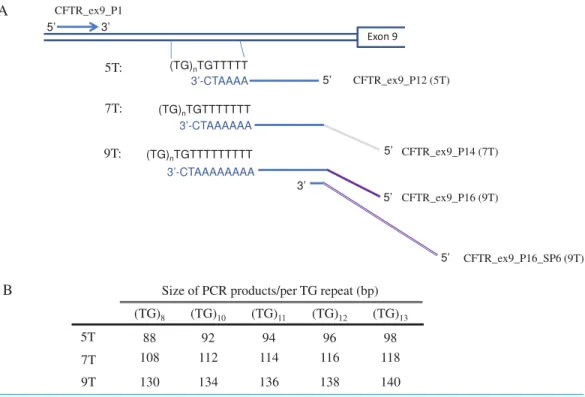
Figure 1 Primer design forCFTRpoly-T analysis.(A) Diagram of the AS-PCR primers. The multi-plex AS-PCR has a common upstream primer, CFTR ex9 P1, and allele specific downstream primers, CFTR ex9 P12 , CFTR ex9 P14, and CFTR ex9 P16 for 5T, 7T and 9T alleles, respectively. In order to dis-tinguish the 5T, 7T and 9T by the size of the final AS-PCR products, a third primer, CFTR ex9 P16 SP6, was used in the multiplex PCR reaction for 9T alleles. (B) Size of the AS-PCR products for 5T, 7T, and 9T alleles. Considering TG repeats could range from 8 to 13, PCR products for 5T, 7T and 9T could be from 88 to 98bp, 108 to 118bp, and 130 to 140bp, respectively.
(5′-CGTTGTAAAACGACGGCCAGCCCCAAATCCCTGTTAAAAAATC-3′) for 7T, and CFTR ex9 P16 (5′-ACCTAAATAGCTAAGCCCAAATCCCTGTTAAAAAAA ATC-3′) and CFTR ex9 P16 SP6 (5′-GCATAGCTTGAGTATTCTATAGTGTCACCTAAATAGCTAAGC CCAAATC-3′) for 9T. PCR product size for each allele is different, 88 to 98 bp for 5T, 108 to 118 bp for 7T and 130 to 140 bp for 9T, considering TG repeats at 5′of the poly-T track range from 8 to 13.
Evaluation of run-to-run and within-run reproducibility of the multiplex AS-PCR
After optimization of the multiplex AS-PCR, run-to-run and within-run reproducibility were evaluated using five gDNAs from MUTCF-2 panel, NA01531 (9/9T), NA07441 (7/9T), NA11277 (7/7T), NA11723 (5/7T) and NA13591 (5/9T), and a 5T plasmid clone as homozygous 5/5T. The final call of the poly-T alleles of each sample was compared to determine the reproducibility of the method. For 5T plasmid, 170 pg of plasmid were added to the multiplex AS-PCR.
Poly-T analysis using multiplex AS-PCR and confirmed with sanger sequencing
110 samples were tested to determine the length of the poly-T alleles using the newly developed multiplex AS-PCR. Among these samples, eighteen (sample ID S96 to S113) from MUTCF-2 of Coriell Cell Repositories were tested previously (Coriell Institute, 2009a; Coriell Institute, 2009b;Sebastian et al., 2004). Poly-T track of the remaining 92 samples (sample ID S1 to S37, S43 to S66, S89, S90 and S114 to S142) were unknown. Multiplex AS-PCR was set up the same way as in “Primer Design and Multiplex AS-PCR”.
Sequences flanking the poly-T region of all the 92 samples of unknown poly-T alleles were amplified using primers CFTR ex9 P1 and CFTR ex9 P2 as in “Cloning of 5T Alleles”. Each PCR reaction contained 1X Melt Doctor HRM master mix, 250 nmol/ul of each of the primers and 50 ng of Coriell or in-house manually extracted or 2µL of the easyMAG extracted gDNA. PCR products were run on Qiaxel to determine the proper amplification of a single 267 bp fragment. Then PCR products were treated with Exonuclease and Shrimp Alkaline Phosphatase based on manufacturer’s instruction (Affymetrix, Santa Clara, CA). CFTR ex9 P2 were used for Sanger sequencing (Elim Biopharmaceutical). Poly-T status of each sample was determined from directly reading the sequencing chromatogram.
RESULTS
Primer design and optimization of the multiplex AS-PCR reactions Each PCR primer set was designed to uniquely amplify 5T, 7T or 9T in intron 8 ofCFTR (Fig. 1A). The downstream primers are complementary to the corresponding length of poly-T sequences, which confers the specificity for each poly-T allele. The primers end with a 3′-C that is complimentary to the G in the last TG repeat of the template sequence. To increase the specificity of the allele-specific primer binding, an additional deliberate mismatch (i.e., from A to T) at the next to the last base of the allele-specific primers was introduced (Little, 2001;Wangkumhang et al., 2007).
Diagnostics, 2004). For this reason, the overhang DNA sequences were added to the 5′ end of the AS-PCR primers to generate PCR products with at least 10 bp difference in size among all three poly-T alleles (Figs. 1Aand1B). These PCR products are then easily distinguishable on Qiaxcel DNA High Resolution cartridge.
AS-PCR products for the same poly-T allele, such as 5T, can vary up to 10 bp in size because each poly-T allele may contain 8 to 13 TG repeats at the 5′end of the poly-T tract (Fig. 1B). Primer CFTR ex9 P12 for 5T consists of onlyCFTRsequences to generate the shortest PCR amplicon (88 bp to 98 bp). CFTR ex9 P14, a 43-base primer for 7T includes 20 bases of M13 sequences added to the 5′of the primer, generating fragment size of 108 to 118 bp. A 61-base or longer AS-PCR primer would be designed to generate the shortest 9T allele (i.e., a minimum 128 bp PCR product with 8 TG repeats), that is at least 10-bp longer than the largest 7T allele (7T with 13 TG repeats, which is 118 bp). Technically, synthesis of such long primers is possible. The longest primer for Elucigene’s AS-PCR is 90 bases to detect 9T alleles (Iain et al., 2001). However, there are challenges in quality and consistency, as well as in purification of the complete primers from truncated premature products (Kozlov et al., 2005). To prevent synthesizing a long oligo for the 9T allele, we have used two-downstream-primer approach for 9T amplification. CFTR ex9 P16, a 39-base primer, contains 24 bases of CFTR complementary sequence and a 15-base 5′overhang of SP6 promoter. CFTR ex9 P16 SP6, a 49-base primer, has a 23-base overlap with 5′of CFTR ex9 P16 and 26-base of additional SP6 promoter sequence at its 5′end. The total length of the PCR products for 9T is between 130 and 140 bp. It allows detection of each poly-T allele using High Resolution Qiaxcel cartridge, without labeling of the downstream primers.
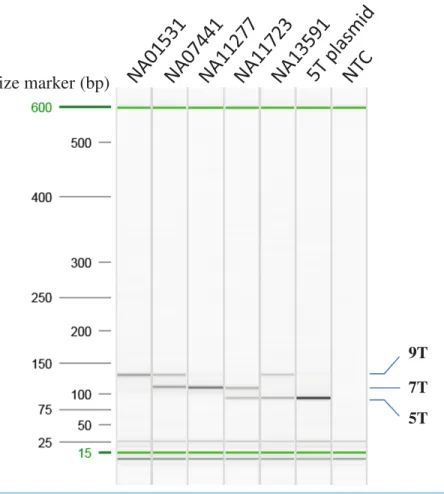
Different combinations of the primer concentration and annealing temperature were tested to optimize the multiplex AS-PCR.Figure 2indicated that the optimized multiplex AS-PCR is able to detect all six combinations of the poly-T alleles in samples of known poly-T length from the MUCF-2 panel: NA01531 (9/9T), NA07441 (7/9T), NA11277 (7/7T), NA11723 (5/7T) and NA13591 (5/9T), and a cloned 5T allele as 5/5T. Furthermore, we also tested the remaining 18 samples from MUTCF-2 panel; all matched to the published data for the poly-T status (Table 1).
Run-to-run and within-run reproducibility
The same five samples and 5T plasmid used for optimization of the multiplex AS-PCR reaction were tested for within-run reproducibility (run in triplicate on the same PCR plate) and for run-to-run reproducibility (three different runs on the same PCR instrument). All indicated that the multiplex AS-PCR was able to determine the poly-T alleles for all six poly-T allele combinations in the same run or different runs (data not shown).
Poly-T analysis of unknown samples
Figure 2 Optimization of AS-PCR for poly-T analysis.All the samples used for optimization of the multiplex AS-PCR have known poly-T allele information: NA01531 (9/9T), NA07441 (7/9T), NA11277 (7/7T), NA11723 (5/7T) and NA13591 (5/9T). 5T plasmid was cloned from NA11723 and NA13591. After Sanger sequencing of the plasmid clones, the 5T allele has 12 TG repeats, the 7T allele from NA11723 has 10 TG repeats, and the 9T allele from NA13591 has 10 TG repeats. All the AS-PCR products were run on the High Resolution cartridge of Qiaxcel Advanced System. NTC: No template control.
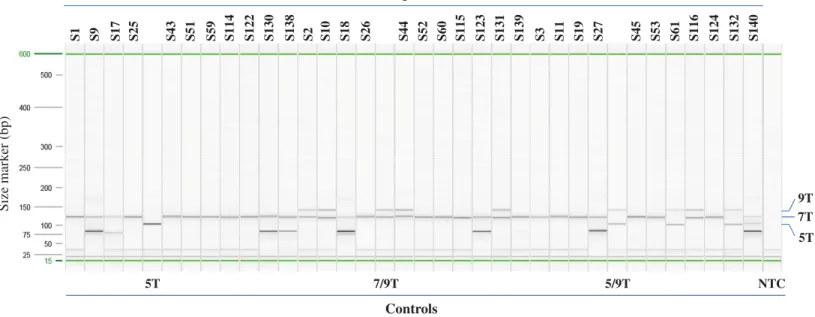
Results for poly-T allele status from multiplex AS-PCR matched results from Sanger sequencing for all samples.
DISCUSSION
We developed a multiplex AS-PCR to simultaneously detect 5T, 7T and 9T in the poly-T region of intron 8 ofCFTR. Our assay was able to detect all the combinations of the poly-T alleles, 5/5T, 7/7T, 9/9T, 5/7T, 5/9T, and 7/9T (Fig. 2). Out of the 115 human gDNA samples tested, only the MUTCF-23 panel had known poly-T results. The rest of the samples were Sanger sequenced to determine the poly-T length. All the results from multiplex AS-PCR matched to the published or Sanger sequencing results, indicating that our assay had 100% sensitivity in detecting all types of poly-T alleles and 100% specificity to correctly detect poly-T alleles in patient samples. Thus, it is a reliable method for poly-T analysis.
Figure 3 Example of Poly-T analysis using multiplex AS-PCR.Results of AS-PCR were listed inTable 1andTable S1and confirmed by published data or Sanger sequencing. Sample ID from S1 to S27 are from Coriell. Sample ID from S43 to S61 and S114 to S140 are from Beaumont Health System. Control 5T, 7/9T and 5/9T are cloned plasmid DNA, NA07441 and NA13591, respectively. NTC: no template control.
single tube multiplex AS-PCR is to split the longest AS-PCR primer to two shorter oligos that can be synthesized without special care and purification overhead required with longer oligos.
However, there are a few considerations to establish the assay in a laboratory. First, annealing temperature is critical as allele-specific amplification is based on the difference of the annealing temperature of each allele-specific primer to generate the corresponding PCR products among the alleles, thus annealing temperature must be tested on each instrument used for this assay. It is especially sensitive in this assay because the 5T, 7T and 9T alleles differ in two or four bases of the thymidine repeats. We have found that programming the same annealing temperature on a different PCR instrument didn’t work as well as the initial one used for optimization. Once we slightly adjusted annealing temperature (i.e., higher or lower than the optimized annealing temperature on our first testing instrument) on that instrument, we were able to obtain consistent results for poly-T testing. The main objective is to calibrate the annealing temperature on each instrument so that the specific target products are maximally amplified, whereas the non-specific by-products are minimized.
Second, using a PCR instrument with good uniformity across all the wells would produce better reproducibility and more robust results. Most of PCR instruments are block-based and temperatures are known to vary among different wells of the same block (Logan & Edwards, 2009;Saunders et al., 2001). Such variations would lead to inconsistency since the actual annealing temperature of the AS-PCR in each individual well may not be identical. We observed that when the variation of the temperature exceeds the optimal annealing temperature to generate allele-specific PCR products, the reaction would fail, i.e., no products or non-specific PCR products were generated. Testing a group of samples with known poly-T status, such as MUTCF-2 panel, would verify whether the uniformity of the PCR block is sufficient to produce robust and correct results. Third, we used an automated high resolution gel cartridge of Qiaxcel Advanced System to detect the size of the AS-PCR products. However, with at least 10 bp difference in each of AS-PCR products, running the multiplex AS-PCR products on high concentration agarose gel worked equally well (Fig. S1).
fact that the most common TG repeats are 11, 12 and 13 (Moskowitz et al., 2008). Therefore the most common scenario would be the same allele with at most 6 bp difference in length (i.e., 3 TG repeats from 11 to 13), and different alleles with at least 16 bp difference in length, such as 5T plus 13 TG repeat vs 7T with 11TG repeat (Fig. 1B). It would be relatively easy to distinguish the same two poly-T from different two poly-T alleles .
Although the assay performed well in our hands, each lab would need to establish the protocol on its own instrument to implement the test. The first step would be to choose the PCR instrument with the best temperature uniformity in a laboratory. Instruments with multiple temperature sensors usually have better uniformity than a single sensor. Secondly, five of the 23 samples from MUTCF-23 panel with different poly-T alleles (Fig. 2) would be used to adjust the annealing temperature on the instrument. Subsequently, additional samples with known poly-T alleles, such as the MUTCF-23 panel, could be tested to determine whether the multiplex AS-PCR generates correct results. Optimal uniformity of the thermal block is indicated by 100% concordance with the known results; any discordance of results indicates uneven temperature of the thermal block, if everything else is done correctly. The lab may need to seek advice from the instrument vendor to evaluate the temperature variability of the instrument. With moderate volume of poly-T test in a lab, the thermal block can be virtually partitioned; that is, only a portion of the block with good temperature uniformity will be used to validate and perform the assay. Then, run-to-run and within-run reproducibility can be performed to assess the robustness of the assay. The last step would be to perform a blind test of more samples to establish the analytical specificity of the assay. If samples are tested with unknown poly-T allele status, Sanger sequencing, a gold standard for variant detection, can be implemented to confirm the AS-PCR results (Fig. 4).
Overall, we developed a simple, easy to implement standalone multiplex AS-PCR method to detect all three poly-T alleles in intron 8 of CFTR. Our assay can be implemented as a reflex test in patients with positive R117H, if another method for CFTRmutation analysis didn’t include poly-T analysis. The assay can also be combined with any routineCFTRtests as a standalone method for molecular diagnosis of CBAVD. Furthermore, our AS-PCR design improves robustness and consistency for poly-T allele detection inCFTR.
ACKNOWLEDGEMENTS
The authors wish to thank Dr. Bryan Thibodeau for critically reading and commenting the manuscript.
ADDITIONAL INFORMATION AND DECLARATIONS
Funding
Grant Disclosures
The following grant information was disclosed by the authors:
Department of Pathology and Laboratory Medicine at Beaumont Health System.
Competing Interests
Anne E. Prada and Neng Chen are employees of the Beaumont Health System.
Author Contributions
• Neng Chen conceived and designed the experiments, performed the experiments,
analyzed the data, contributed reagents/materials/analysis tools, wrote the paper, prepared figures and/or tables, reviewed drafts of the paper.
• Anne E. Prada performed the experiments, analyzed the data, contributed
reagents/materials/analysis tools, wrote the paper, reviewed drafts of the paper.
Ethics
The following information was supplied relating to ethical approvals (i.e., approving body and any reference numbers):
Beaumont Human Investigational Committee: Approval number: 2014-10.
Patent Disclosures
The following patent dependencies were disclosed by the authors:
Bayliffe AI, Coctter E, Kelly SU, and Robertson NG./WO2001021833 A2/2001. Supplemental Information
Supplemental information for this article can be found online athttp://dx.doi.org/ 10.7717/peerj.468.
REFERENCES
Bayliffe AI, Docter E, Kelly SJ, Robertson NH. 2001.Assay for detection of human CFTR allele variants using specific diagnostic primers. WIPO Patent WO/2001/021833A2.
Bienvenu T, Beldjord C, Adjiman M, Kaplan JC. 1993.Male infertility as the only presenting sign of cystic fibrosis when homozygous for the mild mutation R117H.Journal of Medical Genetics
30:797DOI 10.1136/jmg.30.9.797.
Chen N, Schrijver I. 2011.Allelic discrimination of cis-trans relationships by digital polymerase chain reaction: GJB2 (p.V27I/p.E114G) and CFTR (p.R117H/5T).Genetics in Medicine
13:1025–1031DOI 10.1097/GIM.0b013e3182272e0b.
Chiang HS, Lu JF, Liu CH, Wu YN, Wu CC. 2009.CFTR (TG)m(T)n polymorphism in patients with CBAVD in a population expressing low incidence of cystic fibrosis.Clinical Genetics
76:282–286DOI 10.1111/j.1399-0004.2009.01258.x.
Chillon M, Casals T, Mercier B, Bassas L, Lissens W, Silber S, Romey M-C, Ruiz-Romero J, Verlingue C, Claustres M, Nunes V, F´erec C, Estivill X. 1995.Mutations in the cystic fibrosis gene in patients with congenital absence of the vas deferens.New England Journal of Medicine
Chmiel JF, Drumm ML, Konstan MW, Ferkol TW, Kercsmar CM. 1999.Pitfall in the use of genotype analysis as the sole diagnostic criterion for cystic fibrosis.Pediatrics103:823–826
DOI 10.1542/peds.103.4.823.
Chu CS, Trapnell BC, Curristin S, Cutting GR, Crystal RG. 1993.Genetic basis of variable exon 9 skipping in cystic fibrosis transmembrane conductance regulator mRNA.Nature Genetics
3:151–156DOI 10.1038/ng0293-151.
Coriell Institute. 2009a.Catalog ID: GM18799.Available athttp://ccr.coriell.org/Sections/Search/ Sample Detail.aspx?Ref=GM18799&PgId=166(accessed 05 February 2014).
Coriell Institute. 2009b.Catalog ID: GM18800.Available athttp://ccr.coriell.org/Sections/Search/ Sample Detail.aspx?Ref=GM18800&PgId=166(accessed 05 February 2014).
Costa C, Costa JM, Martin J, Boissier B, Goossens M, Girodon E. 2008.Multiplex allele-specific fluorescent PCR for haplotyping the IVS8 (TG)m(T)n locus in the CFTR gene.Clinical
Chemistry54:1564–1567DOI 10.1373/clinchem.2008.103259.
Dean M, White MB, Amos J, Gerrard B, Stewart C, Khaw KT, Leppert M. 1990.Multiple mutations in highly conserved residues are found in mildly affected cystic fibrosis patients. Cell61:863–870DOI 10.1016/0092-8674(90)90196-L.
Elucigene Diagnostics. 2004.Product Insert for CF Poly T (Catalogue Code: PT003B2).Available athttp://www.elucigene.com/docs/cf/lit/PolyT.pdf(accessed 3 June 2014).
Friedman KJ, Heim RA, Knowles MR, Silverman LM. 1997.Rapid characterization of the variable length polythymidine tract in the cystic fibrosis (CFTR) gene: association of the 5T allele with selected CFTR mutations and its incidence in atypical sinopulmonary disease.Human Mutation
10:108–115DOI 10.1002/(SICI)1098-1004(1997)10:2<108::AID-HUMU3>3.0.CO;2-G. Grody WW, Cutting GR, Klinger KW, Richards CS, Watson MS, Desnick RJ, Subcommittee
on Cystic Fibrosis Screening, Accreditation of Genetic Services Committee, ACMG. 2001.
Laboratory standards and guidelines for population-based cystic fibrosis carrier screening.
Genetics in Medicine3:149–154DOI 10.1097/00125817-200103000-00010.
Iain BA, Eelco D, James KS, Hastings RN. 2001.Assay for detection of human cftr allele variants using specific diagnostic primers. Publication number WO2001021833 A3.
Johnson MA, Yoshitomi MJ, Richards CS. 2007.A comparative study of five technologically diverse CFTR testing platforms. The Journal of Molecular Diagnostics 9:401–407
DOI 10.2353/jmoldx.2007.060163.
Kozlov IA, Dang M, Sikes K, Kotseroglou T, Barker DL, Zhao C. 2005.Significant improvement of quality for long oligonucleotides by using controlled pore glass with large pores.Nucleosides,
Nucleotides and Nucleic Acids24:1037–1041DOI 10.1081/NCN-200059761.
Little S. 2001.Amplification-refractory mutation system (ARMS) analysis of point mutations.
Current Protocols in Human GeneticsChapter 9:Unit 9.8DOI 10.1002/0471142905.hg0908s07.
Logan J, Edwards K. 2009.Real-time PCR: current technology and applications. In: Logan J, Edwards K, Saunders N, eds.An overview of PCR platforms. Norfolk: Caister Academic, 20–21.
Macek Jr M, Mackova A, Hamosh A, Hilman BC, Selden RF, Lucotte G, Friedman KJ, Knowles MR, Rosenstein BJ, Cutting GR. 1997.Identification of common cystic fibrosis mutations in African–Americans with cystic fibrosis increases the detection rate to 75%.
American Journal of Human Genetics60:1122–1127.
Mak V, Zielenski J, Tsui LC, Durie P, Zini A, Martin S, Longley TB, Jarvi KA. 1999.Proportion of cystic fibrosis gene mutations not detected by routine testing in men with obstructive azoospermia.Journal of the American Medical Association281:2217–2224
Millson A, Pont-Kingdon G, Page S, Lyon E. 2005.Direct molecular haplotyping of the IVS-8 poly(TG) and polyT repeat tracts in the cystic fibrosis gene by melting curve analysis of hybridization probes.Clinical Chemistry51:1619–1623DOI 10.1373/clinchem.2005.052159.
Moskowitz SM, Chmiel JF, Sternen DL, Cheng E, Cutting GR. 2008.CFTR-related disorders. In: Pagon R, Adam M, Bird T, Pagon RA, Adam MP, Ardinger HH, Bird TD, Dolan CR, Fong C-T, Smith RJH, Stephens K, eds. GeneReviewsTM[Internet]. Seattle, WA: University of Washington, Seattle.Available athttp://www.ncbi.nlm.nih.gov/books/NBK1250/.
Pont-Kingdon G, Jama M, Miller C, Millson A, Lyon E. 2004.Long-range (17.7 kb) allele-specific polymerase chain reaction method for direct haplotyping of R117H and IVS-8 mutations of the cystic fibrosis transmembrane regulator gene.The Journal of Molecular Diagnostics6:264–270
DOI 10.1016/S1525-1578(10)60520-X.
Rohlfs EM, Zhou Z, Heim RA, Nagan N, Rosenblum LS, Flynn K, Scholl T, Akmaev VR, Sirko-Osadsa DA, Allitto BA, Sugarman EA. 2011.Cystic fibrosis carrier testing in an ethnically diverse US population.Clinical Chemistry57:841–848DOI 10.1373/clinchem.2010.159285.
Saunders GC, Dukes J, Parkes HC, Cornett JH. 2001.Interlaboratory study on thermal cycler performance in controlled PCR and random amplified polymorphic DNA analyses.Clinical
Chemistry47:47–55.
Sebastian S, Spitzer SG, Grosso LE, Amos J, Schaefer FV, Lyon E, WolffDJ, Hajianpour A, Taylor AK, Millson A, Stenzel TT. 2004.Multicenter characterization and validation of the intron-8 poly(T) tract (IVS8-T) status in 25 Coriell cell repository cystic fibrosis reference cell lines for cystic fibrosis transmembrane conductance regulator (CFTR) gene mutation assays.
Clinical Chemistry50:251–254DOI 10.1373/clinchem.2003.028068.
Sugarman EA, Rohlfs EM, Silverman LM, Allitto BA. 2004.CFTR mutation distribution among U.S. Hispanic and African American individuals: evaluation in cystic fibrosis patient and carrier screening populations.Genetics in Medicine6:392–399
DOI 10.1097/01.GIM.0000139503.22088.66.
Trujillano D, Ramos MD, Gonzalez J, Tornador C, Sotillo F, Escaramis G, Ossowski S, Armengol L, Casals T, Estivill X. 2013.Next generation diagnostics of cystic fibrosis and CFTR-related disorders by targeted multiplex high-coverage resequencing of CFTR.Journal
of Medical Genetics50:455–462DOI 10.1136/jmedgenet-2013-101602.
Wangkumhang P, Chaichoompu K, Ngamphiw C, Ruangrit U, Chanprasert J, Assawamakin A, Tongsima S. 2007.WASP: a Web-based Allele-Specific PCR assay designing tool for detecting SNPs and mutations.BMC Genomics8:275DOI 10.1186/1471-2164-8-275.
Watson MS, Cutting GR, Desnick RJ, Driscoll DA, Klinger K, Mennuti M, Palomaki GE, Popovich BW, Pratt VM, Rohlfs EM, Strom CM, Richards CS, Witt DR, Grody WW. 2004.
Cystic fibrosis population carrier screening: 2004 revision of American College of Medical Genetics mutation panel.Genetics in Medicine6:387–391