INTRODUCTION
In recent years, polymer nanocomposites have received considerable attention in the academia and industry due to a signiicant improvement in the properties of these materials, when compared to the properties of pure polymers or conventional composites [1]. These improvements include increase in some properties, such as: mechanical and thermal properties, reduced permeability to gases, etc. [2].
Polymer nanocomposites comprise a class of materials formed by adding a small quantity by weight of inorganic iller (< 5%), mainly clays, which are inely dispersed in a polymeric matrix in nanometer scale [3, 4]. This class of materials began to be studied in the 80s by Toyota Research Laboratory with the development of nanocomposites of polyamide and clay [5].
Natural layered silicates such as montmorillonite (MMT), which is the main constituent of the mineral bentonite clays,
Characterization of bentonite clays from Cubati,
Paraíba (Northeast of Brazil)
(Caracterização de argilas bentoníticas de Cubati,
Paraíba - nordeste do Brasil)
C. I. R. de Oliveira1, M. C. G. Rocha1, A. L. N. da Silva2, L. C. Bertolino3,*
1Instituto Politécnico, Universidade do Estado do Rio de Janeiro, R. Bonim 25, Bloco 1, RJ, Brazil 28625-570
2Instituto de Macromoléculas Professora Eloisa Mano, Universidade Federal do Rio de Janeiro,
Centro de Tecnologia, Bloco J, Rio de Janeiro, RJ, Brazil 21945-970
3Centro de Tecnologia Mineral, Ministério da Ciência, Tecnologia e Inovação, Av. Pedro Calmon, 900,
Rio de Janeiro, RJ, Brazil 21941-908 *[email protected]
Abstract
Clays of different composition have been used in the development of polymer nanocomposites. The utilization of bentonite clays of the State of Paraíba, Brazil, has been emphasized mainly due to their availability. However, these bentonite deposits are becoming exhausted after several years of exploitation. Thus, the aim of this work was to characterize bentonite clays recently discovered in the
municipality of Cubati, Paraíba. The samples underwent a particle size classiication step and were characterized by granulometric analysis by laser diffraction, X-ray luorescence, X-ray diffraction, infrared spectroscopy, thermogravimetric analysis and cation
exchange capacity. The results of particle size distribution showed that the clay samples have similar physical characteristics to bentonite clays of Boa Vista, Paraíba. Results of X-ray diffraction indicated that the mineralogical composition of the samples
consisted of montmorillonite, kaolinite and quartz. The characterization of the samples by FTIR conirmed these results. Results of
chemical analysis showed that the samples are polycationic bentonite clays and have predominantly different exchangeable cations similar to those seen in South American bentonites.
Keywords: clay, bentonite, Cubati, characterization, polymer nanocomposites.
Resumo
Argilas de diferentes composições têm sido usadas no desenvolvimento de nanocompósitos poliméricos. Argilas bentoníticas do estado da Paraíba, Brasil, vêm sendo muito utilizadas devido, principalmente, a sua disponibilidade. No entanto, os depósitos dessas argilas têm mostrado uma exaustão após diversos anos de intensa exploração. Logo, o principal objetivo do presente trabalho foi caracterizar argilas bentoníticas recentemente descobertas no município de Cubati, Paraíba. As amostras passaram
por uma etapa de classiicação de tamanho de partícula e foram caracterizadas por análise granulométrica por difração a laser, luorescência de raios X, difração de raios X, espectroscopia de absorção no infravermelho, análise termogravimétrica e
capacidade de troca catiônica. Os resultados da distribuição de tamanho de partícula mostraram que as amostras das argilas têm características físicas similares às argilas bentoníticas de Boa Vista, Paraíba. Resultados de difração de raios X indicaram que a composição mineralógica das amostras é constituída por montmorilonita, caulinita e quartzo. A caracterização das amostras
por espectroscopia de absorção no infravermelho conirmou esses resultados. Resultados da análise química mostraram que as amostras são argilas bentoníticas policatiônicas e que apresentam, predominantemente, diferentes cátions trocáveis similares aos
encontrados em bentonitas sul-americanas.
are inorganic illers commonly used for preparing polymeric nanocomposites [6]. Bentonite rocks are composed essentially of one or more of the group of smectite clay minerals (montmorillonite itself, beidelite, nontronite, saponite, sauconite, volconscoite and hectorite), formed by devitriication and subsequent chemical alteration of a glassy material of igneous origin, usually a tuff or volcanic ash, acid preferably [7]. Technologically, there is a consensus that if smectite clays present similar characteristics or industrial applications to those presented by natural bentonites, they can be called bentonites regardless of their geological origin [7]. The properties of bentonite clays depend on the structure and chemical composition, exchangeable ion type and small particle size of smectites. These properties include large speciic surface area, high cation exchange capacity and others physical-chemical properties, such as: swelling, plasticity, cohesion, compressibility, strength, particle size, adsorptive properties, pore structure, surface acidity, and catalytic activity [8, 9].
Bentonite is an aluminosilicate 2:1 which in its natural form has the exchangeable cations Na+, Mg2+, Ca2+, Al3+ and Fe3+. In Brazil, the most common form of its occurrence is as polycationic bentonite [10]. Most Brazilian bentonite reserves, about 62% are located in the state of Paraíba, northeast of Brazil, mainly in the municipality of Boa Vista. Discovered in the early 60’s, these deposits have been intensively studied. These studies resulted in their use in a wide range of technological applications. However, the random exploration of these deposits for many years is causing the depletion of these clays, which may cause a serious problem to the national industry. In order to circumvent this problem, studies have been performed in order to improve the properties of other clays from Paraíba, which have not been often used due to their poor properties. With the same purpose, research activities have been carried out aiming to discover new occurrences with similar or superior properties to those presented by the already exploited clays.
There are many published studies on the application of clays from the municipality of Boa Vista, especially in the ield of nanocomposites [11-15]. However, there is a lack of studies on clays from other regions of Paraíba. Most of characterization studies of bentonite clays from these regions intend to develop materials for using in water based drilling luids [16-21]. In a recent work, Menezes et al. [21] performed the physical and mineralogical characterization of bentonite clays from the municipality of Cubati, Paraíba. In this case, the study was developed with the objective of inding applications of these materials in different industrial sectors [21]. The aim of this work was to study the characterization of new occurrences of bentonite clays in the municipality of Cubati, Paraíba, in order to assess the possibility of their application in polymer nanocomposites.
MATERIALS AND METHODS
Materials: in this study, clay samples were collected in
the mines fronts in the region of Cubati, Paraíba, Brazil. The clay samples were identiied according to its source as JG and RF clays. The RF clay was collected in the geographical coordinates 24M 0799742 9244916 while the JG clay in the geographical coordinates 24M 0799950 9245922. The methylene blue and sodium chloride were provided by Proquimios (Rio de Janeiro, RJ). Sulfuric acid was provided by Vetec Química Fina Ltda. (Rio de Janeiro, RJ).
Clays preparation: the particle size separation of the clay was performed by the wet sieving method. Samples were dispersed in distilled water and then passed through sieves (Granutest) of 0.053, 0.044 and 0.022 mm. The clay fraction with size less than 0.022 mm was separated, dried in an oven at 60 ºC and milled providing a homogeneous sample. This fraction was used in the characterization of clays.
Clays characterization: the clays were characterized using the following techniques: multiangle laser light scattering (MALLS), X-ray luorescence (XRF), X-ray diffraction (XRD), Fourier transform infrared spectroscopy (FTIR), thermogravimetric analysis (TGA), and cation exchange capacity (CEC).
Determination of particle size distribution of clays by MALLS: using a Mastersizer Hydro 2000SM equipment from Malvern Instruments. A small amount of sample was added to a beaker containing approximately 500 mL of deionized water with stirring at 1700 rpm. The dispersion was then homogenized by ultrasound application for 5 min. Subsequently the samples were submitted to the laser light scattering.
Mineralogical analyses of the clays by XRD: the test was conducted in powder samples using a Bruker-D4 Endeavor equipment, with the following operating conditions: Co-Kα, 40 kV voltage and 40 mA current, 0.02º step size, counting time/step of 0.5 s and a scanning angle 2θ from 4 to 80º. The qualitative interpretation of the XRD patterns were made by comparison with standards contained in the database PDF02 (ICDD, 2006), in BrukerDiffracPlus software.
Determination of the chemical composition of the clays by XRF: in a WDX luorescence spectrometer, AXIOS (Panalytical). The semi-quantitative results were calculated as oxides and normalized to 100%. The loss on ignition (LOI) was determined according to LOI = (Wd – Wf)/Wd x 100, where Wd is the weight of the dry sample at 110 ºC, and Wf is the weight of the calcined sample at 1000 ºC during 3 h.
Structural analyses of the clays by FTIR: performed using a Varian Spectrometer, Excalibur 3100. The spectra were obtained from 4000 to 400 cm-1 range, with samples pressed with KBr powder.
Evaluation of thermal stability of the clays by TGA: using a TA Instruments, Q500. The analyses were performed under nitrogen low and the samples were heated from 30 a 700 ºC, at a heating rate of 10 ºC/min.
RESULTS AND DISCUSSION
Particle size distribution of clays
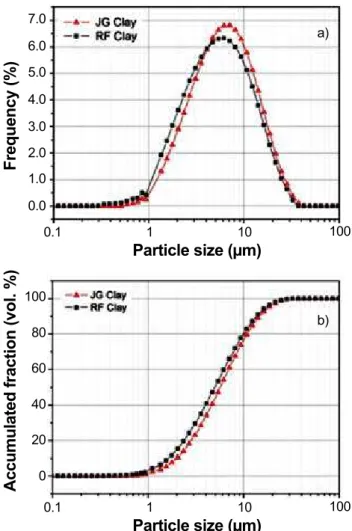
Fig. 1a shows that both clays present wide particle size distributions. JG clay presents an average particle size of about 6.08 μm, while the average particle size of RF clay is about 5.33 μm. Fig. 1a also shows that the distribution curve for both samples is monomodal. The curves show a concentration of particles with size between 4 and 8 μm for RF clay and between 5 and 9 μm for JG clay. The speciic surface area of the RF clay was about 1.63 m2/g while speciic surface area of the JG clay was about 1.36 m2/g. Fig. 1b shows that the content of clay fraction (diameter smaller than 2 μm) was about 10.13% for JG clay, whereas 14.81% for RF clay. In terms of accumulated volume of silt (particles with diameter between 2 and 20 μm), the samples showed high values of 86.22% and 82.44% for JG and RF clays, respectively. JG and RF clays present relatively low amounts of sand fraction, 3.65% and 2.75%, respectively. The sand fraction is associated with particles with diameters above 20 μm. The results of particle size analysis of the
clay samples are summarized in Table I. Costa et al. [18] evaluated two bentonites clays from Cubati, Paraíba. The results of particle size distribution observed by the authors are very similar to those obtained for JG and RF clays in this study, indicating that these clays have similar physical characteristics of the bentonite clays of Paraíba [18].
X-ray diffraction (XRD) of clays
The characterization of the clay samples by XRD aimed to verify the existence of associated minerals and clay minerals. Fig. 2 presents the X-ray diffraction results of the clay samples studied in the present work. The XRD patterns show the presence of montmorillonite (6.7, 23.21, 42.08 and 73.82º) and kaolinite (14.42, 29.05, 40.90, 44.07, 59.94 and 65.06º) as majority phases. Leite et al. [23] characterized bentonite clay from Campina Grande, Paraíba, through XRD. The patterns showed the presence of diffraction peaks corresponding to planes (001) and (020), conirming the presence of montmorillonite in the samples. The data also showed the presence of impurities such as kaolinite (11.73 and 23.45º) and quartz (20.87 and 26.67º) in bentonite clay evaluated [23]. In the XRD patterns of the clays obtained in
Figure 1: Particle size distribution curves of the studied clays: (a) histogram; (b) accumulated fraction.
[Figura 1: Curvas de distribuição de tamanho de partícula das argilas estudadas: (a) histograma; (b) fração acumulada.]
Figure 2: X-ray diffraction patterns of the studied clays [M - montmorillonite (pdf 00-013-0135), K - kaolinite (pdf 01-080-0886), Q - quartz (pdf 01-078-2315), m - muscovite (pdf 01-082-0576), c-mg - calcite-magnesite (pdf 01-086-2335)].
[Figura 2: Difratogramas de raios X das argilas estudadas [M - montmorilonita (pdf 00-013-0135), K - caulinita (pdf 01-080-0886), Q - quartzo (pdf 01-078-2315), m - muscovita (pdf 01-082-0576), c-mg - calcita-magnesita (pdf 01-086-2335)].]
7.0
a)
b) 4.0
1.0 6.0
100
80
60
40
20
0 3.0
0.0 5.0
2.0
0.1
0.1
Particle size (µm)
Particle size (µm)
F
re
q
u
e
n
c
y
(%
)
A
c
c
u
m
u
la
te
d
fr
a
c
ti
o
n
(v
o
l.
%
)
10
10
100
100 1
1
Sample
Clay (x<2 μm)
(%)
Silt (2 < x < 20 μm)
(%)
Sand (x > 20 μm)
(%)
Mean diameter
(μm)
JG clay 10.13 86.22 3.65 6.08
RF clay 14.81 82.44 2.75 5.33
Table I - Particle size distribution and average particle diameter of the clays from Cubati, PB.
[Tabela I - Distribuição de tamanho de partícula e diâmetro médio de partícula das argilas de Cubati, PB.]
5 18000
16000 14000
12000
10000
8000
4000
0 6000
2000
2q (grau)
In
te
n
s
ity
this study, the presence of quartz and muscovite was also observed. The JG clay shows traces of calcite-magnesite as indicated by the presence of a diffraction peak in 34.45º (Fig. 2). Similar XRD results were obtained by Silva et al. [19] when they performed the characterization of bentonite clays from the municipality of Pedra Lavada, Paraíba.
X-ray luorescence (XRF) of clays
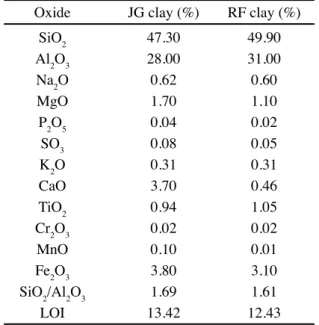
Table II presents the results of chemical analysis obtained by XRF of the clay samples evaluated after sieving with a 0.022 mm sieve. The analysis of the results in Table II indicates that SiO2 and Al2O3 are the main components present in the clay samples. The SiO2 and Al2O3 contents were 47.3% and 28% for the JG clay and 49.9% and 31% for the RF clay, respectively. Similar values of these oxides were observed in the characterization by chemical analysis of bentonite clays from the municipality of Pedra Lavada, PB [19]. In Table II, the SiO2/Al2O3 ratio is also shown. Both clays present high amount of SiO2 and low amount of Al2O3. The SiO2/Al2O3 ratio was equivalent to 1.69 for the JG clay and 1.61 for the RF clay.
The results indicate that the studied clays have high amount of clay minerals, mainly kaolinite and montmorillonite according to XRD results (Fig. 2). The JG and RF clays presented 3.8% and 3.1% of Fe2O3 content, respectively. Bentonite clays from the municipality of Boa Vista, PB, generally show Fe2O3 contents above 7%. Nevertheless, the chemical compositions of bentonite usually vary because of the many substitutions are isomorphic in smectite, and because of the associated impurities (accessory minerals) [24]. With regard to other components, the clays showed similar levels of Na2O, K2O, MgO and TiO2 (Table II). According to [21], the oxides contents found are similar to those seen in South
American bentonites. The CaO content observed for JG clay was about 3.7%, whereas only 0.46% was observed in the RF clay. This result is in agreement with the results observed with the X-ray diffraction. The XRD pattern of the JG clay (Fig. 2) shows the presence of a diffraction peak at 34.45º, which maybe attributed to the presence of calcite-magnesite. This diffraction peak is not observed in the XRD pattern of RF clay. The values of loss on ignition (LOI) of the clays are relatively high, and are very close. According to [25], the loss on ignition of the kaolinite is close to 13.95%. The JG and RF clays presented weight loss of 13.42 and 12.43%, respectively, which are probably related to coordinated water, presence of clay minerals, hydroxides and organic matter.
Fourier transform infrared spectroscopy (FTIR) of clays
The FTIR spectra for bentonite clays are shown in Fig. 3. The main absorption bands with their corresponding assignments are shown in Table III. It can be observed in the spectra for both evaluated clays (Fig. 3), the presence of absorption bands at 3622 and 3441 cm-1, which can be attributed
Oxide JG clay (%) RF clay (%)
SiO2 47.30 49.90
Al2O3 28.00 31.00
Na2O 0.62 0.60
MgO 1.70 1.10
P2O5 0.04 0.02
SO3 0.08 0.05
K2O 0.31 0.31
CaO 3.70 0.46
TiO2 0.94 1.05
Cr2O3 0.02 0.02
MnO 0.10 0.01
Fe2O3 3.80 3.10
SiO2/Al2O3 1.69 1.61
LOI 13.42 12.43
Table II - Chemical composition of the clays from Cubati, PB. [Tabela II - Composição química das argilas de Cubati, PB.]
LOI – weight loss-on-ignition. Wavenumber (cm
-1) Attribution
3698 O-H stretching
3622 O-H asymmetric stretching
3441 O-H symmetric stretching
1638 H-O-H bending
1113 Si-O stretching
1041 Si-O stretching
912 Octahedral sheet
794 Octahedral sheet
693 Si-O-Al bending
535 Si-O bending
472 Si-O-Si bending
Table III - Absorption bands on the FTIR spectrum. [Tabela III - Bandas de absorção no espectro de FTIR.] Figura 3: FTIR spectra of the studied clays.
[Figura 3: Espectros de FTIR das argilas estudadas.]
4000
Wavenumber (cm-1)
T
ra
n
s
m
ita
n
c
e
2000
3000 1000
to the asymmetric and symmetric stretching of structural hydroxyl groups, respectively. An absorption band at 1638 cm-1, attributed to the angular vibration of the OH group and related to the adsorbed water and the hydration water present in the clay, can also be seen in the spectra [26]. Characteristic absorption of montmorillonite clay can be observed in the region between 1113 and 1041 cm-1, characteristic of the Si-O bond, and between 912 and 794 cm-1, corresponding to the octahedral layers of the aluminosilicate. A high intensity band was observed at 472 cm-1 in the IR spectrum of the RF clay. This absorption band is also observed in the spectrum of the JG clay and can be attributed to Si-O-Si bending vibration [26]. Benites et al. [27] performed the characterization of latosols from the State of Minas Gerais by FTIR. Infrared spectra showed absorption bands characteristic of kaolinite in 3692, 3656, 3620, 1100, 1034, 1008 and 912 cm-1. The JG and RF clays showed similar absorption bands to those found in [27]. The results suggest that the clays are formed by kaolinite and montmorillonite [27]. The FTIR results are in agreement with results obtained by X-ray diffraction.
Thermogravimetric analysis (TGA) of clays
The thermogravimetric analysis is considered a simple and accurate method to evaluate the thermal stability and
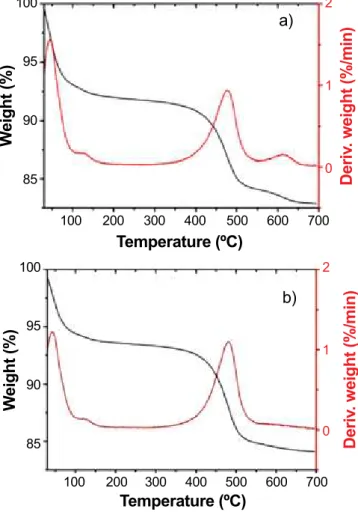
decomposition of different materials. The TG and DTG curves for JG and RF clays are shown in Figs. 4a and 4b, respectively. The TG and DTG curves for both clays (Fig. 4) show that the samples presented double endothermic peaks between 30 and 200 °C, related to the presence of free and absorbed water. The DTG curves show the presence of two endothermic peaks in this temperature range. The irst peak appears with a maximum at 45 ºC, while a slightly endothermic band can be seen with a maximum at 126 ºC. The presence of double or triple endothermic peaks up to 200 °C is related to the presence of coordinated water to Ca2+ and Mg2+ [7]. Nevertheless, the CaO content for JG clay (Table II) was much higher than the other oxides of alkali and alkaline earth metals. A signiicant weight loss is observed in the clays in the range between 400 and 550 °C, with maximum at 478 ºC, which can be attributed to the dehydroxylation of the clay minerals present in the clays. The JG clay shows a third mass loss between 550 and 650 °C, with a maximum at 624 ºC, which can also be related to the decomposition of clay minerals.
Cation exchange capacity (CEC) of clays
Table IV describes the CEC of the clays under study. The CEC of the JG clay was about 41.67 meq/100 g while CEC of the RF clay was about 35.33 meq/100 g. It is known that due to some limitations of methylene blue method, the values are almost always inferior to those obtained by other methods, such as ammonium acetate or barium chloride. However, the results allow a comparison of samples subjected to the same conditions [24]. Silva et al. [19] found CTC values between 56 and 64 meq/100 g in natural clays from the municipality of Pedra Lavada, PB.
CONCLUSIONS
From the studies of new occurrences of smectite clays in the municipality of Cubati, PB, it can be concluded that the samples presented a mineral composition of montmorillonite, kaolinite and quartz. The XRD results were conirmed by FTIR. The chemical analysis of the clays showed that the samples present oxides contents similar to those found in South American bentonites.
ACKNOWLEDGEMENTS
The authors thank the Conselho Nacional para o
Figure 4: TG and DTG curves for JG clay (a), and RF clay (b).
[Figura 4: Curvas de TG e DTG da argila JG (a) e argila RF (b).]
100 2
D
er
iv
. w
ei
gh
t (%
/m
in
)
1
0
W
e
ig
h
t
(%
) 95
90
85
100
Temperature (ºC)
200 300 400 500 600 700
a)
100 2
D
er
iv
. w
ei
gh
t (%
/m
in
)
1
0
W
e
ig
h
t
(%
) 95
90
85
100
Temperature (ºC)
200 300 400 500 600 700
b)
Table IV - Cation exchange capacity of studied clays. [Tabela IV - Capacidade de troca catiônica das argilas estudadas.]
Sample CEC (meq/100 g)
JG clay 41.67 ± 0.76
Desenvolvimento Cientíico e Tecnológico (CNPq) and Fundação de Amparo à Pesquisa do Estado do Rio de Janeiro (FAPERJ) for inancial support and the Centro de Tecnologia Mineral (CETEM) for supplying the clays. The authors also thank CAPES, for Senior Scholarship Process 3955-13-3.
REFERENCES
[1] K. Das, D. Ray, I. Banerjee, N.R. Bandyopadhyay, S. Sengupta, A.K. Mohanty, M. Misra, J. Appl. Polym. Sci. 118 (2010) 143.
[2] S.S. Ray, M. Okamoto, Prog. Polym. Sci. 28 (2003)
1539.
[3] C. Saujanya, S. Radhakrishnan, Polymer 42 (2001) 6723.
[4] D.R. Paul, L.M. Robeson, Polymer 49 (2008) 3187.
[5] M. Alexandre, P. Dubois, Mater. Sci. Eng. 28 (2000) 1. [6] S.M.L. Silva, P.E.R. Araújo, K.M. Ferreira, E.L. Canedo, L.H. Carvalho, C.M.O. Raposo, Polymer Eng. Sci. 49 (2009) 1696.
[7] P. Souza Santos, Ciência e Tecnologia de Argilas, 2nd Ed., Edgar Blücher, S. Paulo (1992).
[8] L.F. Cótica, V.F. Freitas, I.A. Santos, M. Barabach, F.J. Anaissi, R.Y. Miyahara, P.W.C. Sarvezuk, Appl. Clay Sci. 51 (2011) 187.
[9] E. Teixeira-Neto, A.A. Teixeira Neto, Quím. Nova 32 (2009) 809.
[10] E.V.D.G. Líbano, L.L.Y. Visconte, E.B.A.V. Pacheco, Polímeros: Ciência Tecn. 22 (2012) 430.
[11] E.M. Araújo, T.J.A. Melo, L.N.L. Santana, G.A. Neves, H.C. Ferreira, H.L. Lira, L.H. Carvalho, M.M. A’vila Jr, M.K.G. Pontes, I.S. Araújo, Mater. Sci. Eng. B 112 (2004) 175.
[12] E.M. Araújo, R. Barbosa, A.W.B. Rodrigues, T.J.A. Melo, E.N. Ito, Mater. Sci. Eng. A 445-446 (2007) 141. [13] R. Barbosa, E.M. Araújo, T.J.A. Melo, E.N. Ito, Mater.
Lett. 61 (2007) 2575.
[14] A.M.D. Leite, L.F. Maia, O.D. Pereira, E.M. Araújo, H.L. Lira, W.B. Castro, J. Alloy. Compoun. 495 (2010) 596. [15] D.D.S. Morais, R. Barbosa, K.M. Medeiros, E.M. Araújo, T.J.A. Melo, Mater. Sci. Forum 727-728 (2012) 867. [16] R.R. Menezes, L.R.L. Melo, F.A.S. Fonseca, H.S. Ferreira, A.B. Martins, G.A. Neves, Rev. Eletr. Mater. Proc. 3 (2008) 36.
[17] R.R. Menezes, L.F.A. Campos, H.S. Ferreira, L.N. Marques, G.A. Neves, H.C. Ferreira, Cerâmica 55 (2009) 349.
[18] J.M.R. Costa, C.D. da Silva, I.A. da Silva, H.S. Ferreira, G.A. Neves, H.C. Ferreira, Mater. Sci. Forum 727-728 (2012) 1444.
[19] I.A. Silva, J.M.R. Costa, R.R. Menezes, H.S. Ferreira, G.A. Neves, H.C. Ferreira, REM: Rev. Escola de Minas 66 (2013) 485.
[20] I.D.S. Pereira, I.A. Silva, J.M. Cartaxo, R.R. Menezes, L.N.L. Santana, G.A. Neves, H.C. Ferreira, Cerâmica 60 (2014) 223-230.
[21] R.R. Menezes, P.M. Souto, L.N.L. Santana, G.A. Neves, R.H.G.A. Kiminami, H.C. Ferreira, Cerâmica 55 (2009) 163.
[22] ASTM C 837, “Standard Test Method for Methylene Blue Index of Clay”, Annual Book of ASTM Standards, Philadelphia (2009).
[23] I.F. Leite, C.M.O. Raposo, S.M.L. Silva, Cerâmica 54 (2008) 303.
[24] S.P.A. Paz, R.S. Angélica, R.F. Neves, R. Neumann, G.M. da Costa, Cerâmica 57 (2011) 444.
[25] G.P. Souza, S.J.G. Souza, L.A.H. Terrones, J.N.F. Holanda, Cerâmica 51 (2005) 381.
[26] C. Bertagnolli, M.G.C. da Silva, Mater. Res. 15 (2012) 253.