From the Laboratory of Medical Investigation in Clinical Allergy and Immunology, Hospital das Clínicas, Faculty of Medicine, University of São Paulo - São Paulo/SP, Brazil.
E-mail: [email protected]
Received for publication on September 02, 2003.
REVIEW
INVOLVEMENT OF C4 ALLOTYPES IN THE
PATHOGENESIS OF HUMAN DISEASES
Eliana Sueco Tibana Samano, Lia de Melo Ribeiro, Rosa G. Gorescu, Katya Cristina Rocha and Anete S. Grumach
SAMANO EST et al. Involvement of C4 allotypes in the pathogenesis of human diseases. Rev. Hosp. Clín. Fac. Med. S. Paulo 59(3):138-144, 2004.
The complement system is an important humoral defense mechanism that plays a relevant role against microbial agents, inflammatory response control, and immunocomplex clearance. Classical complement pathway activation is antibody-dependent. The C4 component participates in the initial step of activation, and C4 expression is determined by 2 pairs of allotypes: C4A and C4B. Deficiencies in C4 allotypes have been associated with several diseases.
The aim of the present review is evaluate the reported data in the literature regarding specific C4A and C4B deficiencies and characterize their clinical relevance.
We searched the MEDLINE and LILACS databases. Papers referring to total C4 deficiency without allotype evaluation and case reports of primary C4 deficiency were not included.
Deficiencies in C4 allotypes have been associated with Mycobacterium leprae infection, erythema nodosum, systemic
sclerosis with anti-topoisomerase I antibodies, intermediate congenital adrenal hyperplasia with DR5 genotype, diabetes mellitus type 1 with DR3,4 genotype, and diabetes mellitus with antibodies against islet cells. C4 allotype deficiency is also related to C4B deficiency and autoimmune-associated diseases, such as systemic lupus erythematosus, or diseases with an autoimmune component, such as autism. Some reports associate C4A with thyroiditis after delivery as well as limited and systemic sclerosis without anti-topoisomerase I antibodies. However, the studies with C4A and C4B have been concentrated in isolated populations, and some of the studies could not be reproduced by other authors.
KEY WORDS: C4 allotypes. C4A. C4B. C4. Complement. Complement deficiency.
The complement system is com-prised of at least by 30 proteins,7
form-ing an important mechanism of hu-moral defense by the immune system. It activates in defense against micro-bial agents, in the control of the im-mune response, and in the clearance of immune complexes. It can be activated by 3 pathways: classic, alternative, and by lectins.
The classic pathway depends on the presence of antibody. Therefore, it is an effector system of high specificity. Viruses, DNA, C-reactive protein, and mitochondrial membranes can activate this pathway, independent
of the antibody. Furthermore, fungi, polysaccharides, viruses, and cells in-fected by viruses can activate the path-way directly. The lectin pathpath-way may be initiated by the linkage of mannan-binding lectin (MBL) to mannose and N-acetyl-glucosamine residues on sur-faces of microorganisms. When MBL binds to these sugars, they activate the
serine proteases of mannose (MASP-1 and MASP-2). After that, C4 is cleaved into C4a and C4b, and C2 into C2a and C2b. All the pathways converge to C3 activation, and consequently, the membrane attack complex (MAC)2 is
formed.
complement system is controlled by a group of plasma proteins, and cells use these regulator proteins, which are lo-cated on their membranes, to defend themselves from the MAC systems.
Most of the complement proteins are produced in the liver; nevertheless, some other cells, such as monocytes, T cells, macrophages, granulocytes, skin fibroblasts, and keratinocytes that produce C3, can also synthesize these components.2,3
The complement system is impor-tant to host biological defense, as is evident when patients with comple-ment component deficiencies show an increased predisposition for infections and diseases.
The C4 molecule (204 kDa) is pro-duced in the liver, and its concentra-tion in the plasma is about 75 mg/mL2.
This molecule is synthesized as a sin-gle chain and then is processed into 3 polypeptide chains (α, β, γ). The α
chain has an intramolecular thioester bond. C4 is cleaved by C1s, forming C4a and C4b. This reaction allows a covalent binding between the acti-vated protein and the cellular surface or the receptor molecule.2
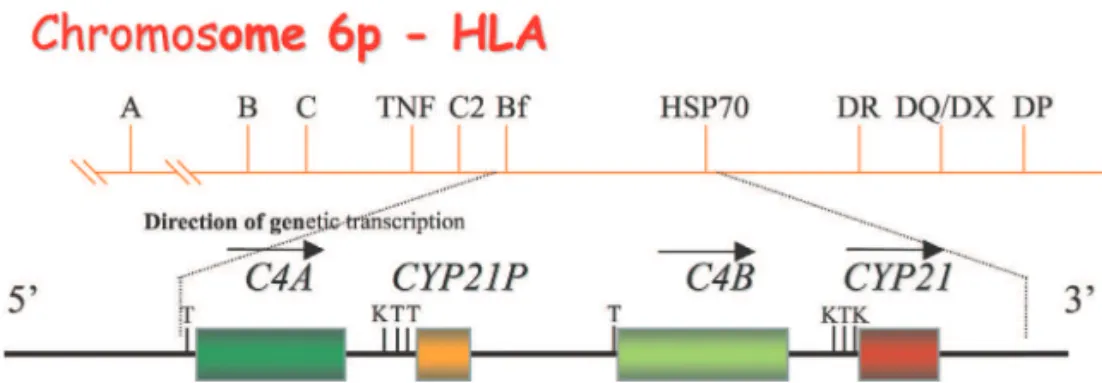
The expression of C4 is determined by 2 allotypes: C4A and C4B. They are coded by 2 adjacent genes that are located on the short arm of chromo-some 6. These genes are close to genes that code for the enzyme 21-hydroxy-lase (21-OH), the C2 component, and the B factor (Bf), all of which are com-ponents of the major histocompatibil-ity complex class III (MHC class III)2,4
(Figure 1).
The C4 fraction is one of the most polymorphic molecules of the MHC class III, with about 35 allotypes hav-ing been described.5 C4
polymor-phism is important for binding the large diversity of antigen-antibody complexes.
At the primary response, recogni-tion of the antigen by the antibody is amplified by the classic pathway of
complement activation, in which the cleavage of C4 into C4a and C4b by C1 are some of the first steps. The bind-ing efficiency depends on the C4 al-lotype and the nature of the antigen or antibody molecule. The C4b fraction from the C4A allotype preferentially binds amide groups to amino groups, while C4b from C4B makes ester bonds using carbohydrates or hy-droxyl groups from amino acids (ser-ine, threon(ser-ine, tyrosine). This selectiv-ity seems to be related to the electro-static and stereochemical interactions between the isotypic regions of the C4’s a chain and the receptor mol-ecule.5,2,6 This C4 polymorphism also
suggests an important involvement in the autoimmune diseases.6
The C4A and C4B allotypes have 90% homology. At the a chain region called C4d, there are 4 amino acids at positions 1101 to 1106 that are re-sponsible for the structural and func-tional differences of the 2 allotypes.5
The aim of the present study is to describe the clinical significance of a partial deficiency of C4 and to evalu-ate the papers that associevalu-ate human diseases with specific deficiencies of the C4 allotypes.
METHOD
We performed an extensive litera-ture review of the last 10 years using the MEDLINE and LILACS databases. Publications associated with C4
defi-ciency allotypes and human diseases were included. Furthermore, the key words C4 allotypes and diseases were used. We excluded papers concerning a primary deficiency with total ab-sence of C4 (C4 congenital defi-ciency), which are very rare in the medical literature. Studies about C4 deficiency without the allotype evalu-ation were also not considered.
RESULTS
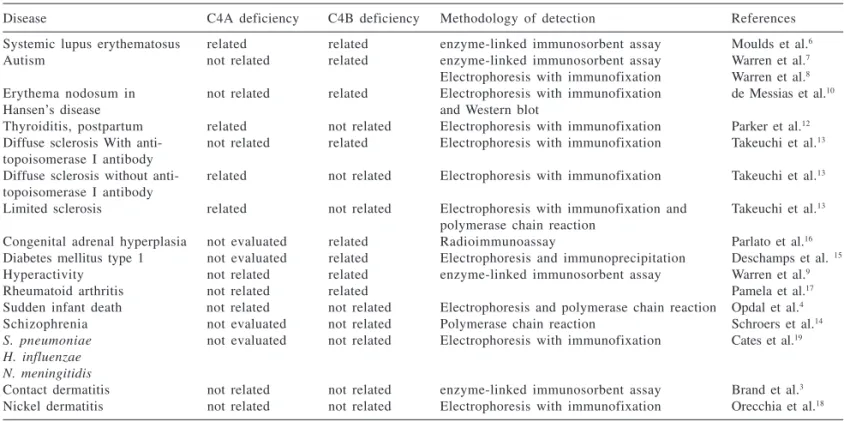
Deficiencies in C4 allotypes that are associated with human diseases and the methodology applied for de-termining the plasma levels comple-ment components or allotype genotyping are shown on Table 1.
Total deficiency of C4 and its allotypes
Complement deficiency, in particu-lar of the C4 fraction, has been the subject of studies of several human diseases. Deficiencies in C4 allotypes occur in 0.1% to 0.3% of the popula-tion as result of delepopula-tion, genetic con-version, or silent mutations.5 C4
defi-ciencies have been shown to be in-volved in the following diseases: sys-temic lupus erythematosus (SLE),6
au-tism,7,8 hyperactivity,9 erythema
nodosum in leprosy,10,11 postpartum
thyroiditis,12 diffuse and limited
sys-temic sclerosis,13 schizophrenia,14 type
1 diabetes mellitus,15 congenital
adre-Figure 1 - Schematic representation of human major histocompatibility
nal hyperplasia,16 rheumatoid
arthri-tis,17 contact dermatitis,3,18 infection
with encapsulated bacteria,19 and
sud-den infant death4 (Table 1).
C4 deficiencies have been associ-ated with an increased susceptibility to bacterial and viral infections, the pre-disposition to chronic active hepatitis
15 and vitiligo 8.
However, repeated infections were not always found in people with defi-ciencies of the components on the classic pathway, exemplifying the im-portance of the alternative pathway for eliminating the majority of the micro-organisms.2
A deficiency in the C4A allotype was found to be associated with SLE, postpartum thyroiditis, diffuse sclero-sis without the anti-topoisomerase I antibody (ATIA), and limited sclerosis. A deficiency in the C4B allotype was found to be associated with autism, erythema nodosum leprosum, diffuse sclerosis with ATIA, congenital adre-nal hyperplasia, type 1 diabetes mellitus, hyperactivity, and rheuma-toid arthritis (Table 1). Both C4A and C4B allotype deficiencies were not
as-sociated with sudden infant death, contact dermatitis and nickel dermati-tis. Schizophrenia and infections caused by encapsulated bacteria were not related to C4B allotype deficiency and it was not evaluated for C4A allo-type deficiency.
Autoimmune diseases and C4 allotypes
The presence of high levels of cir-culating immune complexes in SLE has been associated with C2 and C4 function in the process of removing of these complexes, which suggests that deficiencies of these proteins can oc-cur in autoimmune diseases.2 The
cor-relation of high levels of immune complexes and deficiencies of C2 and C4 is due to the fact of these proteins are fundamental to the formation of C3-convertase in the classic pathway and to immune complex dissociation.
Studies in different populations that have inheritable total C4 deficien-cies, such as white Western Europeans, Australians, Afro-Americans, Chinese, Japanese, and mixed-race Mexicans,
reveal an increased predisposition to SLE in these populations.6,8
Homozygous C4A deficiency is observed in from 13% to 15% of caucasian patients with SLE and in only 2% of the normal population, with a relative risk of 17.6 Partial or
to-tal C4B deficiency also contributes as a risk factor. Total C4 deficiency has been associated with SLE in more than 80% of the cases.10
Moulds et al. (1993)6 verified that
C4A and C4B levels in SLE change pro-portionally to the disease activity. In pa-tients with active disease, the levels of C4A and C4B increase, while the levels are reduced in the periods without activ-ity, when compared with normal indi-viduals. Additionally, the authors dem-onstrated that partial deficiencies of one C4 allotype do not modify the total level of serum C4 protein, which means that heterozygous individuals with C4A deficiencies have increased levels of C4B, while heterozygous individuals with C4B deficiencies have increased levels of C4A. The authors show in this study that in blacks with SLE, the total levels of C4, C4A, and C4B are higher
Table 1 - Literature data associating C4 allotype deficiency and other diseases (C4A and C4B).
Disease C4A deficiency C4B deficiency Methodology of detection References
Systemic lupus erythematosus related related enzyme-linked immunosorbent assay Moulds et al.6
Autism not related related enzyme-linked immunosorbent assay Warren et al.7
Electrophoresis with immunofixation Warren et al.8 Erythema nodosum in not related related Electrophoresis with immunofixation de Messias et al.10
Hansen’s disease and Western blot
Thyroiditis, postpartum related not related Electrophoresis with immunofixation Parker et al.12 Diffuse sclerosis With anti- not related related Electrophoresis with immunofixation Takeuchi et al.13 topoisomerase I antibody
Diffuse sclerosis without anti- related not related Electrophoresis with immunofixation Takeuchi et al.13 topoisomerase I antibody
Limited sclerosis related not related Electrophoresis with immunofixation and Takeuchi et al.13 polymerase chain reaction
Congenital adrenal hyperplasia not evaluated related Radioimmunoassay Parlato et al.16 Diabetes mellitus type 1 not evaluated related Electrophoresis and immunoprecipitation Deschamps et al. 15 Hyperactivity not related related enzyme-linked immunosorbent assay Warren et al.9
Rheumatoid arthritis not related related Pamela et al.17
Sudden infant death not related not related Electrophoresis and polymerase chain reaction Opdal et al.4 Schizophrenia not evaluated not related Polymerase chain reaction Schroers et al.14 S. pneumoniae not evaluated not related Electrophoresis with immunofixation Cates et al.19 H. influenzae
N. meningitidis
than in Caucasians, independent of dis-ease activity (total C4 level in Afro-Eu-ropean with active disease was close to 40 mg/dL while in whites was 28 mg/ dL). This racial difference is more impor-tant in SLE evaluation than is the con-tribution of homozygous or hetero-zygous C4 deficiency.
Lhotta et al. (1996)20 concluded
that in glomerulonephritis, the pre-dominance of glomerular C4A depo-sition is due to a higher affinity of C4A to the proteins of immune com-plexes. The same affinity is not ob-served with C4B.
Paimela et al. (1996)17 studied 73
cases of rheumatoid arthritis. They found a correlation between the prog-nostic factor of the disease and the alleles of complement: factor B (Bf) and C4. Patients with C4B null allele (and consequently C4B deficiency) had higher disease activity with more radiological progression than patients with C4A null allele or patients with-out null allele. C4B deficiency was also associated with a higher suscep-tibility to adverse effects of the antirheumatic therapy.17
Takeuchi et al. (1998)13 evaluated
the contribution of the C4A and C4B allele polymorphism in the pathogenesis of systemic sclerosis in Japanese patients. A significant in-crease of 44.4% in the frequency of C4BQO (null alleles of C4B) in sys-temic sclerosis with diffuse sclero-derma was observed.
In systemic sclerosis with anti-topoisomerase I antibodies (ATIA), a 50% increase of the incidence of C4BQO was also verified. In contrast, the presence of C4AQO was signifi-cantly increased in limited derma (53.8%) and in systemic sclero-sis not associated with the presence of ATIA. They concluded that C4BQO and C4AQO are independent genetic markers for each clinical subgroup of systemic sclerosis and for the positivity to ATIA.
Endocrine diseases and C4 allotypes
Based on the proximity of the C4 and 21-hydroxylase locci to the class III region of the MHC, Parlato et al. (1992)16 studied the relationship
be-tween C4 and enzyme deficiencies that are important in cortisol synthesis. Al-though there is a lack of evidence in humans, it had been demonstrated in mice that there is hormonal regulation in the production of Bf and C4. De-spite the few number of cases in the study, these authors suggest that C4B deficiency is associated with DR5+ in-dividuals and low levels of Bf, and C4B deficiency can be related to the congenital adrenal hyperplasia, one of the standard presentations of 21-hy-droxylase deficiency. Recently, Gil et al. (2002)21 observed C4 allotype
de-ficiencies associated with 21-hydroxy-lase deficiency. A duplication of C4A or C4B with increased serum levels and the deletion of one pair of allotypes, resulting in undetectable levels of them, was also observed.
The association in diabetic rela-tives between the risk for developing diabetes and C4 deficiency, especially C4B, was studied by Deschamps et al. (1992).15 In a 8-year prospective study,
the authors found a significant risk (relative risk of 112) for siblings of de-veloping type 1 diabetes when they had a DR3,4 genotype, antibodies to islet cells, and a C4B deficiency (C4BQO). In this study, 86% of indi-viduals with this genotype presented type 1 diabetes, while 25% without C4B deficiency developed the disease during the follow-up. Among the pa-tients without autoantibodies but with C4B deficiency, 4% developed the disease. When they compared the in-dividuals, 8.7% with C4B deficiency developed diabetes and only 2.4% of these individuals without this defi-ciency developed it, independently of the presence of the autoantibodies. In DR3,4+ and C4B deficient
individu-als, 36% developed the disease com-pared with only 8% of the DR3,4+ without C4B deficiency. Furthermore, the DR3,4+ individuals with C4B de-ficiency developed diabetes at a younger age than did the group with-out C4B deficiency (8.9 ± 1.42 years versus 25 ± 4.9 years, p < 0.01). In contrast, in individuals not DR3,4+ but deficient in C4B, 2% developed the disease. Therefore, it is reasonable to conclude that the C4B deficiency is a risk factor of low importance for type 1 diabetes mellitus when it is not associated with the DR3,4 genotype.
Parker et al. (1996)12 evaluated the
association between the MHC class III and DQ-MHC molecules in postpar-tum thyroiditis, and they determined the prevalence of Bf, C4A and C4B allotypes in this condition. The fol-lowing were evaluated: incidence, prevalence, and clinical consequences of postpartum thyroiditis in 2897 preg-nant women in South Wales (United Kingdom) between 1983 and 1989. They compared 265 pregnant women with high levels of circulating antithy-roid antibodies with other 316 preg-nant women having regular levels of the circulating antithyroid antibodies. They verified that postpartum thy-roiditis is frequently associated with C4A and Bf deficiencies and not to deficiencies in C4B.
Psychiatric disorders
Warren et al. (1994)7 tried to
found diminished, but it was not sig-nificantly lower. C4A concentrations were normal in both groups.
Later (1995),8 the same authors
evaluated the C4B levels in autistic patients, and they verified that the ac-tivation of T DR+ cells was not asso-ciated with the patient’s age, disprov-ing a notion that in autistic patients, the activation of T DR+ cells de-creases with the aging. However, in this study, it was also verified using DR markers that there were DR+ T cells, indicating T-cell activation, but there was no increase in IL-2 receptor expression in these cells, which is also associated with T-cell activation. These data indicate that T-cell activa-tion is related to the decrease of plasma C4B levels and, perhaps indirectly, to the decrease of MHC class III expres-sion. This conclusion was based on the fact that C4 allotypes are located on chromosome 6, near the MHC class III and class II regions, which determine the DR genotype of the T lymphocyte (Figure 1). Nevertheless, an association between C4A and T DR+ cells was not found. This study provides strong evi-dence that an autoimmune process, in-volving C4B especially, is involved in the genesis of autism, although this disease has an unknown etiology.
The association of decreased C4B levels was also observed in children with attention-deficit hyperactivity disorder 9.
One of the hypotheses regarding the development of schizophrenia is related to C4B deficiency. A study demonstrated an increased expression of HLA-B44 antigen in schizophrenic patients´ mothers 14 and this finding
was significant when compared with the control group. It was suggested that the increased expression of HLA-B44 in the mothers could induce an abnormal maternal-fetal immune re-sponse during the initial stages of preg-nancy, and maternal antibodies would challenge a neurological lesion which
results in schizophrenic children.6,14
Schroers et al. studied 176 patients with schizophrenia and verified that there were no significant differences between these patients and a control group regarding C4B deficiency (n=145). Previous studies7 had shown
evidence of a relationship between ho-mozygous C4B deficiency and schizo-phrenia. Nevertheless, these authors postulate the possibility that schizo-phrenia could be associated with a de-ficiency of a gene close to the C4 lo-cus, considering the association of schizophrenia with HLA-B44 and its location on the same chromosome.
Dermatological diseases and C4 allotypes
de Messias et al. (1993)10 associated
C4B deficiency with erythema nodosum leprosum (ENL). Erythema nodosum leprosum results from anti-body-mediated reactions and corre-sponds to the Gell and Coombs type III hypersensitivity. It is hypothesized that these reactions could be linked to ba-cillar destruction and antigen exposure, resulting in stimulus of antibody pro-duction and immune complex forma-tion. These immune complexes activate complement and neutrophil migration, resulting in tissue destruction and vas-culitis. The intensity of the ENL phe-nomenon is associated with the produc-tion of tumor necrosis factor (TNF) α. In the complete clinical phenotype of ENL, fever, malaise, painful lymphad-enitis, erythematous plaques and nod-ules, neuritis, arthritis, arthralgia, iritis, orchitis, and other findings are ob-served. The authors evaluated the asso-ciation between some MHC class III molecules, such as C2, Bf, C4A, C4B, with leprosy in a South Brazilian popu-lation. The results demonstrated that there was not an increased C4B expres-sion in leprosy patients with ENL com-pared with a control group. All the ho-mozygous C4B-deficient patients
pre-sented ENL, suggesting that C4B defi-ciency leads to an abnormal immune response to Mycobacterium leprae. The deficiency in the immune complex clearance results in ENL.
Brand et al. (1994)3 evaluated C4A,
C4B, and total C4 levels in the lymph of 2 healthy volunteers after triggering with a contact irritant for 7 days, and they verified that the complement frac-tions were not involved in the physi-opathological mechanism of contact dermatitis, but they were involved in the inflammatory process and in the in-teractions with the inflammatory cytokines and soluble mediators that arise in the regional lymph nodes. Con-sequently, they concluded that there is not a special involvement of comple-ment system in the initial pathologic mechanism of contact dermatitis.
Orecchia et al. (1992)18 studied the
polymorphism of the MHC class III genes in 55 patients of different ages having contact dermatitis. It was not possible to establish a relationship be-tween contact dermatitis stimulated with different allergens and the MHC class III molecules. However, from their findings, they suggested a genetic relationship between MHC and con-tact dermatitis caused by nickel.
Other diseases
Opdal et al. (1994)4 evaluated the
involvement of partial deletion of C4 genes in sudden death of infants. In this study, the authors could not prove a relationship between C4 deficiency and sudden infant death, but they ob-served that children with C4A and C4B deletion had a higher vulnerabil-ity to lethal infections (p= 0.035) when compared with normal children.
Cates et al. (1992)19 evaluated
with bacteremia, those with meningitis, those who developed Haemophilus influenzae type b (Hib) disease after Hib polysaccharide vaccination, and pa-tients less than 1 year old with menin-gitis. Healthy adults served as controls. Of the 257 patients, 2.3% were ho-mozygous for C4B deficiency com-pared with 3.7% in 349 controls. There-fore, an association between ho-mozygous C4B deficiency and menin-gitis or bacteremia caused by encapsu-lated bacteria was not observed.
CONCLUSION
The deficiency of C4 allotypes has
been associated with some diseases: erythema nodosum in leprosy, sys-temic sclerosis with ATIA, congenital adrenal hyperplasia with DR5 geno-type, type 1 diabetes mellitus with DR3,4 genotype, and diabetes mellitus with anti-islet cell antibodies. Some association has also been noted be-tween C4B and the activity in some autoimmune diseases, such as SLE, or in diseases with a supposed autoimmune component in their gen-esis, such as autism.
Regarding C4A, the studies demon-strated an association with postpartum thyroiditis and limited sclerosis and systemic sclerosis without ATIA; how-ever, with C4A as for C4B, the studies
are concentrated in isolated populations, and some studies could not be reproduced by other authors, such as those concerning schizophrenia. Thus, we conclude that additional studies using standardized methods for determining allotypes and genotypes are required to characterize the asso-ciation between C4 deficiencies and human diseases.
ACKNOWLEDGEMENTS
Dr. Maricilda Mello for the sche-matic representation of HLA and Dr. Registila Libania Beltrame for the sup-port of the development of this study.
RESUMO
SAMANO EST e col. O envolvimento dos alótipos de C4 na patogênese das doenças humanas. Rev. Hosp.
Clín. Fac. Med. S. Paulo 59(3):
138-144, 2004.
O sistema complemento constitui um importante sistema de defesa hu-moral, exercendo papel relevante na resposta contra agentes microbianos, no controle da resposta inflamatória e na depuração de imunocomplexos. A ativação da via clássica é dependente da formação do complexo antígeno-anticorpo. O componente C4 do complemento participa da etapa inicial de ativação desta via e a sua expressão é determinada por dois alótipos : C4A e C4B. A deficiência dos alótipos de C4 tem sido relacionada a várias doenças.
O objetivo do presente estudo foi avaliar os dados de literatura que des-crevem as deficiências específicas de C4A e C4B com a finalidade de carac-terizar seu significado clínico.
Foi realizada uma ampla revisão bibliográfica através do MEDLINE e LILACS, avaliando-se os dados de li-teratura. Excluiu-se estudos com a avaliação de C4 total sem a análise dos alótipos e relatos de caso isolados de deficiência total de C4.
Verificou-se que a deficiência dos alótipos de C4 está relacionada com algumas doenças: hanseníase, esclerose sistêmica com anticorpos anti-topoisomerase I, hiperplasia adrenal congênita intermediária com genótipo DR5, diabetes mellitus tipo 1 com genótipo DR3,4 e diabetes
mellitus tipo 1 com anticorpos anti-cé-lulas das ilhotas. Também foram obser-vadas algumas associações entre C4B e doenças auto-imunes como lupus eritematoso sistêmico, ou que se supõe terem um componente auto–imune como o autismo. Estudos demonstra-ram associações do C4A com tireoidite pós-parto, esclerose limitada e esclerose sistêmica sem anticorpos anti-topoisomerase I. Porém, os estu-dos estu-dos alótipos de C4 se concentra-ram em populações isoladas e alguns destes não conseguiram ser reproduzi-dos por outros autores.
UNITERMOS: C4A. C4B. C4. Complemento. Deficiência de com-plemento. Alótipos de C4.
REFERENCES
1. Kirschfink M, Grumach AS. Deficiências de Complemento. In:
GRUMACH AS. Alergia e Imunologia na Infância e na Adolescência. São Paulo, Atheneu, 2001, 497-514.
3. Brand CU, Späth PJ, Hunziker T, Limat A, Braathen LR. Complement profiles in human skin lymph during the course of irritant contact dermatitis. Arch Dermatol Res 1994, 286 (7): 359-363.
4. Opdal SH, Vege Å, Saugstad OD, Rognum TO. Is partial deletion of the complement C4 genes associated with sudden infant death? Eur J Pediatr, 1994; 153 (4): 287-290.
5. Finco O, Li S, Cuccia M, Rosen FS, Carroll MC. Structural differences between the two human complement C4 isotypes affect the humoral immune response. J. Exp. Med., 1992; 175 (2) 537-543.
6. Moulds JM, Warner NB, Arnett FC. Complement component C4A and C4B levels in systemic lupus erythematosus: quantitation in relation to C4 null status and disease activity. J Rheum, 1993; 20 (9) :3, 443-447.
7. Warren RP, Burger RA, Odell D, Torres AR, Warren NWL. Decreased plasma concentrations of the C4B complement protein in autism. Arch Pediatr Adolesc Med, 1994; 148 (2):180-183.
8. Warren RP, Yonk J, Burger RW, Odell D, Warren WL. DR-positive T cells in autism: association with decreased plasma levels of the complement C4B protein. Neuropsychobiology, 1995; 31(2):53-57.
9. Warren RP, Odell JD, Warren Wl, Burger RA, Maciulis A, Torres AR. Is decreased blood plasma concentration of the complement C4B protein associated with attention-deficit hyperactivity disorder? J Am Acad Child Adolesc Psychiatry, 1995; 34(8):1009-1014.
10. De Messias IJT, Santamaria J, Brenden M, Reis A, Mauff G. Association of C4B deficiency (C4B*Q0) with erythema nodosum in leprosy. Clin Exp Immunol, 1993; 92 (2):284-287.
11. Sampaio APS, Rivitti EA. Dermatologia. 2ª ed. São Paulo, Artes Médicas, 2000, p-479-480.
12. Parker AB, Darke C, Othman S, Thomas M, Young N, Richards CJ, et al. Major histocompatibility complex class II and complement polymorphisms in postpartum thyroiditis. Eur J Endocrinol, 1996; 134 (4):449-453.
13. Takeuchi F, Nabeta H, Hong GH, Matsuta K, Tokunaga K, Tanimoto K, et al. C4A and C4B null alleles are genetic markers of different types of systemic sclerosis in Japanese patients. Clin Exp Rheumatol, 1998; 16 (1):55-60.
14. Schroers R, Nöthen MM, Rietschel M, Albus M, Maier W, Scwab S, et al. Investigation of complement C4B deficiency in schizophrenia. Hum Hered, 1997; 47 (5):279-282.
15. Deschamps I, Boitard C, Hors J, Busson M, Marcelli-Barge A, Mogenet A, et al.. Life table analysis of the risk of type 1 (insulin-dependent) diabetes mellitus in siblings according to islet cell antibodies and HLA markers. Diabetologia, 1992; 35 (10):951-957.
16. Parlato F, Pisano G, Misiano G, Cosentini E, Cacciapuoti C, Cavalcanti Mr, et al. HLADR5 and C4BQO high frequency and antinuclear antibodies positivity in patients with 21 hydroxylase deficiency from Campania region. J. Endocrinol. Invest., 1992;15 (6):429-436.
17. Pamela L, Leirisalo-Repo M, Lokki ML, Koskimies S. Prognostic significance of complement alleles Bf and C4 in early rheumatoid arthritis. Clin Rheumatol, 1996; 15(6):594-598. 18. Orecchia G, Perfetti L, Finco O, Dondi E, Cuccia M.
Polymorphisms of HLA class III genes in allergic contact dermatitis. Dermatology, 1992; 184 (4):254-259.
19. Cates KL, Densen P, Lookman JC, Levine Rp. C4B deficiency is not associated with meningitis or bacteremia with encapsulated bacteria. J Infect Dis, 1992; 165 (5):942-944.
20. Lhotta K, Schlogi A, Kronenberg F, Joannidis M, Konig P. Glomerular deposition of the complement C4 isotypes C4A and C4B in glomerulonephritis. Nephrol Dial Transplant, 1996; 11(6):1024-1028.