O
RIGINALA
RTICLE Revista Brasileira de FisioterapiaUse of different electrical stimulations
for treating pain in women with
temporomandibular disorders
Utilização de diferentes estimulações elétricas para o tratamento da dor em
mulheres com disfunção temporomandibular
Rodrigues-Bigaton D1, Almeida AFN1, Berni KCS1, Pedroni CR2, Gonçalves RN1, Bérzin F2
Abstract
Objective: To analyze pain intensity in individuals with temporomandibular disorder (TMD) who were treated with ten sessions of transcutaneous electrical nerve stimulation (TENS) or high voltage electrical stimulation (HVES). Methods: Twenty-four women (22.98±1.86 years old) with a diagnosis of TMD in accordance with the Research Diagnostic Criteria for Temporomandibular Disorders (RDC/TMD) were selected. Sixty percent of the participants had a diagnosis of TMD classified as group Ia and 40% as Ia and IIa. They were divided into two groups named TENS group (TG) and high-voltage group (HVG). Each participant received ten applications of either TENS (10Hz, modulated at 50%, 200µs and motor threshold intensity) or HVES (10Hz, twin pulses of 20µs each at intervals of 100µs between the twin pulses, 100volts and positive pole) twice a week for 30 minutes. To measure the pain intensity, a visual analog scale (VAS) was used. Statistical analyses were performed using t test and simple linear regression. Results: Comparison of the pre- and post-TENS conditions showed diminished pain intensity (p<0.05) in most sessions except for sessions 6, 7 and 8. In contrast, HVES reduced the pain intensity in all sessions (p<0.05). Evaluation of the pre-application values showed that both treatments decreased the pain intensity uniformly over the ten sessions (p<0.05). Conclusions: TENS and HVES both promoted reductions in pain intensity in women with TMD. HVES is a therapeutic resource recommended for such patients.
Key words: temporomandibular joint dysfunction; transcutaneous electrical stimulation; pain assessment; Physical Therapy.
Resumo
Objetivo: Analisar a intensidade da dor em indivíduos com disfunção temporomandibular (DTM) tratados com dez sessões de estimulação elétrica nervosa transcutânea (TENS) ou estimulação elétrica de Alta Voltagem (EEAV). Métodos: Foram selecionadas 24 mulheres (22,98±1,86 anos) com diagnóstico de DTM, segundo o Research Diagnostic Criteria for Temporomandibular Disorders (RDC/TMD), sendo 60% com diagnóstico de DTM do grupo Ia e 40% Ia e IIa. As voluntárias foram divididas em dois grupos denominados grupo TENS (GT) e Grupo Alta Voltagem (GAV). Em ambos os grupos as voluntárias receberam dez aplicações da TENS (10Hz modulada em 50%, 200 µs e intensidade no limiar motor) ou da EEAV (10Hz, pulsos gêmeos com 20µs cada e intervalo 100µs interpulsos gêmeos, 100Volts e pólo positivo) duas vezes por semana por 30 minutos. Para mensurar a intensidade da dor, foi utilizada a escala visual analógica (VAS). Para análise estatística, utilizou-se teste t de Student e análise de regressão linear simples.
Resultados:Comparando-se as condições pré e pós TENS observa-se uma redução na intensidade da dor (p<0,05) na maioria das sessões, exceto na sexta, sétima e oitava, enquanto a EEAV reduziu a intensidade da dor (p<0,05) em todas as sessões. Avaliando-se os valores pré-aplicação, os dois recursos diminuíram a intensidade de dor de forma uniforme ao longo das dez sessões (p<0,05).
Conclusões: A TENS e a EEAV promoveram redução da intensidade da dor em mulheres com DTM, sendo a EEAV mais um recurso indicado para o tratamento desses pacientes.
Palavras-chave: disfunção da articulação temporomandibular; estimulação elétrica transcutênea; avaliação da dor; Fisioterapia.
Received: 21/12/2007 – Revised: 06/05/2008 – Accepted: 18/08/2008
1 Universidade Metodista de Piracicaba (Unimep), Piracicaba (SP), Brazil 2 Faculdade de Odontologia de Piracicaba (FOP/Unicamp), Piracicaba (SP), Brazil
Introduction
Temporomandibular disorder (TMD) is characterized by functional and pathological changes that afect the temporo-mandibular joint (TMJ), the masticatory muscles and, on occa-sion, other parts of the stomatognacthic system1. According to Magnusson, Egemark and Carlsson2 the state of the mandibu-lar, cervical and masticatory muscles present in the TMD is the greatest cause of non-dental pain in the orofacial region, and this has a major impact on the quality of life of the individual3. In this sense, the treatment of such an illness consists in coun-seling, drug therapy and physical therapy. Among the physical therapy treatments indicated for TMD are: exercise4, massage5, transcutaneous electrical nerve stimulation (TENS)6-8, ultra-sound9, and laser6.
TENS has been extensively used in physical therapy to treat pain in patients with TMD. Rodrigues, Oliveira and Bérzin8 evaluated, among other variables, the efects of conventional TENS application (150Hz modulated at 50%, 20µs, sensorial threshold for 45 minutes) on the intensity of pain in women with TMD and found that this resource promoted signii-cant pain reduction in the participants. he same result was obtained by Gonçalves, Ordenes and Rodrigues-Bigaton10, al-though these authors applied TENS with diferent simulation parameters (10Hz modulated at 50%, 200µs and intensity at motor threshold for 30 minutes).
Kato et al.6 assessed the efect of ten low-frequency TENS and laser applications (40 minutes) on nine TMD patients and found that both resources were efective in reducing pain in TMD patients.
Alvarez-Arenal et al.7 demonstrated that 15 low-frequency TENS applications, in 45 to 60-minute sessions, and the use of the occlusal splints in patients with bruxism distributed into two treatment groups were not enough to signiicantly reduce the signs and symptoms of the TMD, including pain. he same results were found by Linde, Isacsson and Jonsson11 who evalu-ated the efect of high-frequency TENS on 31 individuals with TMD.
As observed in the aforementioned studies, it can be stated that, although TENS is widely used in clinical practice, there is no consensus in the literature regarding its eicacy against pain in patients with TMD.
Another resource used in physical therapy is high-voltage electrical stimulation (HVES), indicated as an analgesic and tissue repairer. HVES is a therapeutic modal-ity originally developed in the United States. It has a twin pulse, with an almost instantaneous rise and exponential falls; 0.1 millisecond pulses; usually fixed form and dura-tion and variable double-pulse frequency, generally from 2 to 100Hz12.
Unlike TENS, HEVS use in the treatment of pain in indi-viduals with TMD has not been described in well-controlled studies. his fact justiies the undertaking of the present study. It is also worth noting that, although both electrical currents are indicated as analgesics, the choice of type, electrical pa-rameters and number of sessions has not been scientiically established.
Given that TENS and HEVS are indicated to promote anal-gesia, it can be assumed that both treatments would promote analgesia in patients with TMD and that HEVS could be used as a possible physical therapy resource in the treatment of these patients.
hus, the aim of this study was to analyze the intensity of pain in TMD patients treated with ten TENS or HEVS sessions.
Methods
Participants
he sample calculation was carried out by means of the software GraphPad StatMate version 1.01i 1998, with a 95% conidence interval and 80% power, the number of participants being set at ten.
hirty-eight patients were evaluated, 29 of which were se-lected. hree women were excluded from the sample due to the use of pain medication and two gave up the treatment. hus, 24 women took part in the study, with ages ranging from 18 to 29 (mean age 22.98±1.86 years) and body mass index (BMI) below 25. In group Ia (myofascial pain), 60% of the participants had TMD, and in groups Ia and IIa (disc displacement with re-duction), 40% had TMD, according to the Research Diagnostic Criteria for Temporomandibular Disorders (RDC/TMD). All participants signed consent form, and the research was ap-proved by the Research Ethics Committee of Unimep (protocol 03/04 and 25/06).
he inclusion criteria for all patients were: presence of pain in the masticatory muscles during the functional activities for a period of one to ive years; occlusive parafunction such as grinding or clenching for at least one year; muscle pain and/or soreness in the morning; and jaw popping.
he exclusion criteria were: systemic musculoskeletal dis-eases, history of facial and TMJ trauma; joint dislocation and limited ATM range of motion diagnosed by the RDC/TMD; use of braces and use of analgesic and/or anti-inlammatory medication.
for the treatment, and the irst treatment ofered was TENS, followed by HVES. Although group allocation was not random, the groups were considered homogeneous in relation to age, BMI, and symptom duration.
In both groups, the participants received ten applications of TENS or HVES for 30 minutes, twice a week, according to the group to which they belonged. For the treatment with both resources, the participants remained in the dorsal de-cubitus position with a cushion under the knees during the applications.
For the application of the TENS, the following equipment was used: Dualpex 961, Transcutaneous Electrical Stimulator (Quark Medical Products), two channels with four 3x5cm sili-con-carbon transcutaneous electrodes. hese electrodes were placed bilaterally on the preauricular area and on the masseter muscle, one channel on the right-hand side and the other on the left-hand side. he parameter adopted was 10Hz frequency modulated at 50%, i.e. the frequency variation was 10 to 5Hz, the pulse width was 200 microseconds (µs) and the intensity was at motor threshold, which was identiied through visible muscle contraction.
he instrument used for the application of the HVES was the microcontrolled Neurodyn High Volt(Ibramed) with two channels and four 3x5cm active silicon-carbon electrodes and a 10x18cm dispersive electrode made of aluminum cov-ered by wet felt. he electrodes were placed bilaterally on the anterior portion of the temporal muscle (channel 1) and on the masseter muscle (channel 2). he dispersive electrode was attached to the participants’ cervical area because, ac-cording to Holcomb13, it has to be signiicantly larger than the active one to reduce the current density, hence the need to place it in large areas. Furthermore, the bigger the distance between the active and dispersive electrodes is, the deeper the current14.
he parameters used in the HVES were: 10Hz frequency, pulse width determined by the equipment with two 20µs twin pulses, each with a 100µs interval, intensity above 100v reach-ing motor threshold (visible muscle contraction) and positive polarity (anodic HVES) in both channels. he anodic stimula-tion was based on Alon15, who claimed that the choice of one of the poles is made according to the patient’s comfort and to the desired contraction intensity. According to Holcomb13, both poles are indicated for analgesia. It is worth noting that in the present study motor stimulation was prioritized and, based on pilot studies, we found that the positive pole produced a more vigorous contraction of the masticatory muscles, therefore be-ing chosen for the treatment.
Both equipments were tested with an oscilloscope (Tek-tronix TDS 210) according to the physical current parameters speciied in the equipment. he equipment timers were also
tested with three Technos stopwatches. his variable followed equipment speciications. In both equipments, gel was used under the silicon-carbon electrodes to allow the current to be conducted to the tissue. he electrodes had not been previ-ously used.
To measure pain intensity, a Visual Analog Scale (VAS) was used. It consisted of a 10cm horizontal line with the words “no pain” on the left end and “worst pain” on the right end. he par-ticipants were advised to draw a vertical line across the hori-zontal line to indicate at what point the pain was. his stage was carried out before and immediately after each of the ten TENS and HVES applications. he participants did not have access to any of their previous notes so as not to be inluenced by them.
he VAS data were analyzed by means of a centimeter (cm) ruler. Pain intensity was measured from the left end, which co-incided with the ruler’s 0 value, to the line drawn by the patient. It is worth noting that the examiner who analyzed the VAS data did not know to which group each participant belonged, whether the scales were from the pre- or post-application of the resources, nor whether the data were from the beginning or end of the ten applications.
Statistical analysis
he statistical analysis was initially based on the Shapiro-Wilk normality test (JMPversion 3.1.6.2). As the data indi-cated normal distribution, we used the t test for the analysis of
the independent samples, in order to compare the mean values of pain intensity recorded in the VAS before and immediately after each TENS and HVES session.
For the analysis and efect of both treatments, we used a simple linear regression analysis. It is worth noting that this analysis included only the mean values of pain intensity re-corded in the VAS obtained before the application of each one of the resources. he post-treatment values were not analyzed due to the current’s immediate efect.
For all calculations, a critical level of 5% (p<0.05) was set.
Results
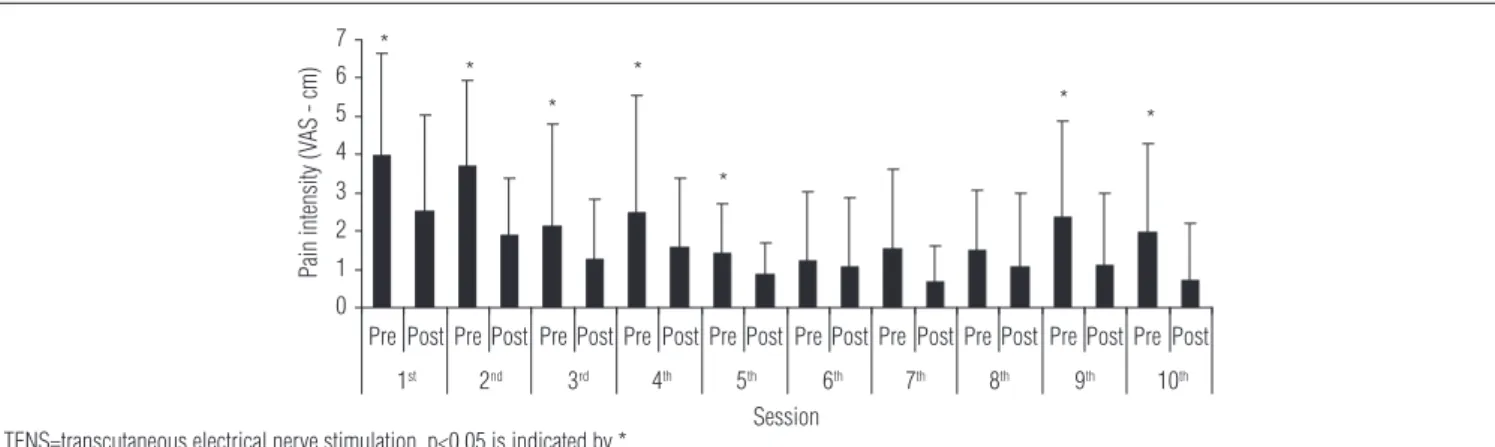
Figures 1 and 2 display the results of the comparison for the mean values of pain intensity recorded in the VAS before and after TENS and HVES.
0 1 2 3 4 5 6 7
Pre Post Pre Post Pre Post Pre Post Pre Post Pre Post Pre Post Pre Post Pre Post Pre Post
1st 2nd 3rd 4th 5th 6th 7th 8th 9th 10th Session
* * * * *
* *
Pain intensity (V
AS - cm)
TENS=transcutaneous electrical nerve stimulation. p<0.05 is indicated by *.
Figure 1. Comparison of the mean values of pain intensity registered in the VAS (cm), before (pre) and after (post) each TENS session (n=12).
0 2 4 6 8 10
Pre Post Pre Post Pre Post Pre Post Pre Post Pre Post Pre Post Pre Post Pre Post Pre Post
1st 2nd 3rd 4th 5th 6th 7th 8th 9th 10th
Session
* *
* *
* *
* *
* *
Pain intensity (V
AS - cm)
HVES=high-voltage electrical stimulation. p<0.05 is indicated by *.
Figure 2. Comparison of the mean values of pain intensity recorded in the VAS (cm), before (pre) and after (post) each HVES session (n=12).
Pain=-0.1423 x Sessão + 2.6136
0 1 2 3 4 5 6
0 1 2 3 4 5 6 7 8 9 10 11
Session
Pain intensity (V
AS - cm)
R*2 5.21%:
R**2 29.82%:
(HV) (TENS)
Pain=-0.451 x Sessão + 5.6794
TENS=transcutaneous electrical nerve stimulation. HVES=high-voltage electrical stimulation.
Figure 3. The mean values of pain intensity recorded in the VAS (cm), before (pre) and after (post) each session of TENS and HVES (n=24).
According to Figure 3, the mean values of pain intensity recorded in the VAS before the TENS and HVES applications decreased steadily over the course of the ten sessions carried out twice a week.
Discussion
he results of this study indicate that both the TENS and HVES reduced pain intensity, and that this reduction was sta-tistically signiicant in all HVES group sessions and in most of the TENS group sessions, except for the sixth, seventh, and eighth sessions.
he data from the TENS group obtained in the present study conirm the indings of Rodrigues, Oliveira and Bérzin8, Gonçalves, Ordenes and Rodrigues-Bigaton10 and Kato et al.6, who observed a signiicant pain reduction immediately after the application of the high8 and low-frequency10 TENS.
In contrast, the results of this research contradict Alvarez-Arenal et al.7 and Linde, Isacsson and Jonsson11, who showed that TENS at low-frequency7 and high-frequency11 did not signiicantly reduce pain of patients with bruxism and TMD,
given only once a week for six weeks and pain was recorded in the VAS only at the beginning and at the end of treatment, not being considered individually at each session.
With regard to the efect of the treatment on pain intensity, a simple linear regression analysis shows that the variables “pain” and “sessions” are inversely proportional, i.e. as the number of sessions increased, the intensity of pain was attenuated in both groups. Such a result agrees with the conclusions drawn by Ido, Rothenbühler and Janz16, who studied ibromyalgia patients and demonstrated that the intensity of pain is steadily reduced with the increase in the number of low-frequency TENS ses-sions applied three times a week. he same result was recorded by Kato et al.,6 who examined the efect of ten low-frequency TENS applications, and found a decrease in the pain intensity values, measured by the VAS after the period of intervention.
As previously stated, localized muscle pain is one of the most common symptoms of TMD and, according to Larsson et al.17, this presence of pain results from the local muscle is-chemia. Tullberg et al.18 in turn report that the reduction in microcirculation may lead to the release of chemical mediators which make the peripheral nerves more sensitive, thus caus-ing pain. Based on these claims and those of Okada et al.19, treatments that improve blood low are efective for relieving muscle pain in TMD patients.
In this context, it is believed that the reduction in pain inten-sity in both groups can be attributed to two main therapeutic efects of the currents: analgesia and circulation enhancement, which may have been achieved because of the low frequency and the high intensity of the electrical stimulation.
As for the increase in blood low, it is known that high-intensity, motor-threshold electrical stimulation by means of TENS and HVES, as put forward in this study, generates a pumping efect (due to the rhythmic muscle contraction and relaxation) that increases localized blood low and reduces in-terstitial edema and the accumulation of metabolic residue20.
Cramp et al.21 compared the efects of low- and high-frequency electrical stimulation on skin blood low and temperature in 30 healthy individuals. hey concluded that low-frequency stimulation increases local blood low when compared to high-frequency application, but none of these stimulations afected skin temperature at the site of appli-cation. he authors claim that low-frequency TENS causes cutaneous vasodilation, perhaps due to the inhibition of the sympathetic nervous system.
Goldman et al.22 report that HVES promotes a slow increase in blood low, reaching near normal standards depending on
the number of applications. he increased blood low pro-moted by HVES was also observed by Goldman et al.23, but under the experimental conditions of the present study, it is not possible to assert that the anodic HVES promoted a circulatory increment in the masticatory muscles of women with TMD.
In regard to analgesia, when electrical stimulation elicits a strong, rhythmic (high-intensity) and non-tetanic (low-fre-quency) muscle contraction, such as those used in the present study for both groups, and increases arterial blood low to the stimulated area, there is a greater generation of analgesia and activation of mechanisms that release endogenous opiates. herefore, stimulation at motor level is eicient in the modula-tion of clinical, experimentally induced pain24.
After comparing the analgesic efect of TENS and HEVS, it can be stated that HVES is more efective when it comes to pain control in patients with TMD. Figure 1 shows that TENS reduced pain signiicantly in seven out of ten ses-sions, whereas the signiicant analgesic efect of HVES was observed in all of the ten sessions. Figure 3 suggests that pain reduction seems to have been greater among the women who received HVES. Although plausible, these claims cannot be made based on the results of the present study because the intensity of pain in the HVES group was greater than that of the TENS group. Due to this diference, we chose not to do a comparative analysis between the groups, but to analyze them separately.
he diference in pain intensity found in both groups may have occurred because of the non-random distribution of the participants, as the criteria for sample selection and pain eval-uation were the same for both groups. herefore, the limitation of the present study (non-random selection of participants) must be taken into account in future experiments as well as the inclusion of a placebo group, especially for the application of HVES, given the lack of studies on the clinical eicacy of this resource for analgesia.
Conclusions
1. Tvrdy P. Methods of imaging in the diagnosis of temporomandibular joint disorders. Biomed Pap Med Fac Univ Palacky Olomouc Czech Repub. 2007;151(1):133-6.
2. Magnusson T, Egermark I, Carlsson GE. A longitudinal epidemiologic study of signs and symptoms of temporomandibular disorders from 15 to 35 years of age. J Orofac Pain. 2000;14(4):310-9.
3. Oliveira AS, Bermudez CC, Souza RA, Souza CMF, Dias EM, Castro CES et al. Impacto da dor na vida de portadores de disfunção temporomandibular. J Appl Oral Sci. 2003;11(2):138-43.
4. Furto ES, Cleland JA, Whitman JM, Olson KA. Manual physical therapy interventions and exercise for patients with temporomandibular disorders. Cranio. 2006;24(4):283-91.
5. Cappelini VK, Souza GS, Faria CRS. Massage therapy in the management of myogenic TMD: a pilot study. J Apllied Oral Sci. 2006;14(1):21-6.
6. Kato MT, Kogawa EM, Santos CN, Conti PCR. Tens and low-level laser therapy in the Management of temporomandibular Disorders. J Appl Oral Sci. 2006;14(2):130-5.
7. Alvarez-Arenal A, Junquera LM, Fernandez JP, Gonzalez I, Olay S. Effect of occlusal splint and transcutaneous electric nerve stimulation on the signs and symptoms of temporomandibular disorders in patients with bruxism. J Oral Rehabil. 2002;29(9):858-63.
8. Rodrigues D, Siriani AO, Bérzin F. Effect of conventional TENS on pain and eletromyographic activity of masticatory muscles in TMD patients. Braz Oral Res. 2004;18(4):290-5.
9. Windt DA, Heijden GJ, Berg SG, Riet G, Winter AF, Bouter LM. Ultrasound therapy for musculoskeletal disorders: a systematic review. Pain. 1999;81(3):257-71.
10. Gonçalves RN, Ordenes IEU, Rodrigues-Bigaton D. Efeito indireto da TENS sobre os músculos cervicais em portadores de DTM. Fisioter Mov. 2007;20(2):83-90.
11. Linde C, Isacsson G, Jonsson BG. Outcome of 6-week treatment with
transcutaneous electric nerve stimulation compared with splint on symptomatic temporomandibular joint disk displacement without reduction. Acta Odontol Scand. 1995;53(2):92-8.
12. Stralka SW, Jackson JA, Lewis AR. Treatment of hand and wrist pain: A randomized clinical trial of high voltage pulsed, direct current built into a wrist splint. AAOHN Journal. 1998;46(5):233-6.
13. Holcomb WR. A practical Guide to Electrical Therapy. J Sport Rehabil. 1997;6:272-82.
14. Nelson RM, Hayes KW, Currier DP. Eletroterapia Clínica. 3ª ed. Barueri: Manole; 2003.
15. Alon G. Os princípios da estimulação elétrica. In. Nelson RM, Hayes KW, Currier DP. Eletroterapia Clínica. 3ª ed. Barueri: Manole; 2003. p.55-139.
16. Ido C, Rothenbuhler R, Janz L. Eletroestimulação nervosa trancutânea de baixa freqüência nos “tender points” dos pacientes fibromioálgicos juvenis. Rev Fisioter Univ São Paulo. 2003;10(1):1-6.
17. Larsson SE, Bodegard L, Henriksson KG, Oberg PA. Chronic trapezius myalgia. Morphology and blood flow studied in 17 patients. Acta Orthop Scand. 1990;61(5):394-8.
18. Tullberg M, Alstergren PJ, Ernberg MM. Effects of low-power laser exposure on masseter muscle pain and microcirculation. Pain. 2003;105(1-2):89-96.
19. Okada K, Yamaguchi T, Minowa K, Inoue N. The influence of hot pack therapy on the blood flow in masseter muscles. J Oral Rehabil. 2005;32(7):480-6.
20. Wieselmann-Penkner K, Janda M, Lorenzoni M, Polansky R. A comparison of the muscular relaxation effects of TENS and EMG-biofeedback in patients with bruxism. J Oral Rehabil. 2001;28(9):849-53.
21. Cramp AFL, Gilsenan C, Lowe AS, Walsh DM. The effect of high- and low-frequency transcutaneous electrical nerve stimulation upon cutaneous blood flow and skin temperature in healthy subjects. Clin Physiol. 2000;20(2):150-7.
22. Goldman R, Brewley B, Zhou L, Golden M. Electrotherapy reverses inframalleolar ischemia: A retrospective, observational study. Advances in Skin & Wound care. 2003;16(2):79-89.
23. Goldman R, Rosen M, Brewley B, Golden M. Electrotherapy promotes healing and microcirculation of infrapopliteal ischemic wounds: a prospective pilot study. Adv Skin Wound Care. 2004;17(6):284-94.
24. Robinson AJ, Snyder ML. Eletrofisiologia Clínica: eletroterapia e teste eletrofisiológico. 2ª ed. Porto Alegre: Artmed; 2001.