Article
Printed in Brazil - ©2016 Sociedade Brasileira de Química 0103 - 5053 $6.00+0.00
*e-mail: [email protected]
Emissions of Criteria and Non-Criteria Pollutants by a Flex-Fuel Motorcycle
Luiz C. Daemme,a Renato Penteado,a Sergio M. Corrêa,*,b Fátima Zotinc and Marcelo R. Errerad
aLACTEC, Instituto de Tecnologia para o Desenvolvimento, 80210-170 Curitiba-PR, Brazil
bFaculdade de Tecnologia, Universidade do Estado do Rio de Janeiro, 27537-000 Resende-RJ, Brazil
cInstituto de Química, Universidade do Estado do Rio de Janeiro, 20550-900 Rio de Janeiro-RJ, Brazil
dCentro Politécnico, Universidade Federal do Paraná, 81531-970 Curitiba-PR, Brazil
While criteria pollutants have established emission limits for motorcycles in Brazil, aldehydes limits have not been established and conclusive studies have not been found in the existing literature, despite the growing number of motorcycles using lex fuel in Brazil. This work presents results for the emissions of criteria pollutants, such as carbon monoxide, hydrocarbons and nitrogen oxides, acetaldehyde and formaldehyde. The motorcycle was tested with 22, 61, and 100% of ethanol in gasoline blends. Fourier transform infrared (FTIR) and high performance liquid chromatography (HPLC) were used to determine the pre- and post-catalytic converter emissions. Aldehyde emissions directly increased with the ethanol content in the fuel blend. The tailpipe aldehyde emissions for 22, 61, and 100% of ethanol in gasoline were 3.9, 8.5, and 38.8 mg km-1, respectively. These results demonstrated that aldehyde emissions in motorcycles are not negligible, and higher emissions are observed during the cold phase of the engine.
Keywords: vehicular, emission, aldehyde, motorcycle, lex fuel
Introduction
The internal combustion engines will remain, in the coming years, the main propulsion system for vehicles. Thus, the impact on the environment by emissions from mobile sources assumes great importance, mainly in urban centers.1-3
In Brazil, concern over vehicular emissions is not new. In 1986, the Control Program of Air Pollution from Motor Vehicles (PROCONVE) was created, and PROCONVE imposed a schedule to gradually reduce pollutant emissions for light and heavy vehicles.4,5 With
regard to motorcycles, legislation for emission control is newer, and in 2002, the Control Program of the Air Pollution by Motorcycles and Similar Vehicles (PROMOT) was created in Brazil. In countries with a tradition in the control of vehicle emissions such as the United States and European countries, legislation was established in the early 1960s and 1970s, respectively,6,7 and the establishment of
limits for motorcycle emissions has been established since 1990,8 with a marked restriction from 1999.9 However,
the Brazilian legislation basically considered compounds legislated by the European Union.
The emission of aldehydes is relevant to the Brazilian context,10,11 being legislated for vehicles in terms of total
emissions since 1992.12 The basis for this control was due to
the Brazilian automotive energy matrix, where fuel differs from other countries by the addition of ethanol to gasoline and its use in the hydrated form. The use of ethanol has many advantages such as a renewable fuel, generation of less carbon monoxide, hydrocarbons and particulates, and higher octane numbers compared to gasoline, which leads to an increase in the engine compression ratio, promoting greater eficiency and engine power. Disadvantages stand out because of its lower caloriic value and the increased emissions of carbonyl compounds, especially aldehydes.13,14
Because of the relationship between aldehyde emissions and the use of ethanol as a fuel,10,15-17 emission limits have
been implemented for these pollutants, as aldehydes are the result of partial oxidation of alcohols during the combustion process.18-20
These compounds cause damage and irritation to the respiratory tract and eyes and are classiied as carcinogenic (formaldehyde) and potentially carcinogenic (acetaldehyde).21-23 Due to their chemical reactivity,
ozone, which, besides being a photochemical oxidant, is a greenhouse gas.21,22-24
Another aspect that has been discussed in the literature refers to the criteria and non-criteria emissions according to the ethanol content and, more recently, the concern about the cold phase emissions.25,26 In the initial minutes,
the emissions of most pollutants are known to be greater because the beginning of engine operation is associated with less eficient burning.27,28 In addition, the catalyst is cold and
therefore less effective. In this period, it is also common to observe signiicant emissions of ethanol and unconverted hydrocarbons, in addition to criteria pollutants.29 Overall,
this scenario commonly occurs in short paths and becomes worrisome in the context of the medium and large cities.
In Brazil, with the implementation of the Euro III limits in 2009, motorcycles need to be equipped with a three-way catalytic converter (TWC). In the same year, the irst lex-fuel motorcycle was created. In 2010, Brazil occupied the fifth position in motorcycle production globally, trailing only the Asian countries. In 2009/2010, motorcycles constituted 25% of Brazil’s total leet.30 The
attractive price, inancing facilities, and an ineficient public transport system in a favorable economic environment have boosted the market. According to ABRACICLO,30 in
2011, more than two million units were sold. Compared to the automobile market, one motorcycle is sold for every 1.3 cars sold. In the following years, 1.5 and 2.0 million motorcycles were sold per year, conirming the importance of the motorcycle leet in Brazil.
Some articles about aldehyde emissions are found in the literature,31-35 but virtually there are no articles about
carbonyl emissions during the cold phase or about the action of the catalyst under these conditions.
This work determines the emissions of criteria pollutants (carbon monoxide, carbon dioxide, total hydrocarbons and nitrogen oxides) and non-criteria pollutants (aldehydes) from a lex fuel motorcycle in the cold phase and the steady state by evaluating the role of the catalyst in both periods. The NBR 1202636 regulation was followed, based on the
CARB procedures.37,38 For the determination of aldehydes,
high performance liquid chromatography (HPLC) with UV detection and Fourier transform infrared (FTIR) spectroscopy were used to follow the aldehyde emission behavior and the inluence of the catalyst. The tests were conducted on a chassis dynamometer in accordance with the European rules.
Experimental
A motorcycle with a 150 cm3 engine, representative of
the Brazilian leet (manufactured in 2011, standard Euro III,
with three-way catalyst (TWC), electronic fuel injection, lex fuel and 135 kg of inertia), was used.
Gasoline (78%) and anhydrous ethanol (22%) were used on a volume basis, called emission standard gasoline (E22), hydrous ethanol fuel (E100) and an intermediate mixture, called E61, containing both standard gasoline (E22) and E100 in the proportion of 50% by volume of the two fuels.
Brazil adopted the standard chassis dynamometer bench testing with the driving cycle from European legislation 97/24/EC,9 which allows simulation of load changes during
emission testing. The predetermined path can be divided into one or two stages, according to the motor volumetric capacity. Motorcycles up to 150 cm3 perform just one phase,
called the urban cycle.
The test includes approximately 6.05 km in the urban cycle. The resistive power applied to the motorcycle by the dynamometer (AVL Zöllner AN 40770, 648 mm, 100 kW) along the way was determined by reference to the mass, adding up to 75 kg standard weight for the driver. The cooling of the motorcycle engine was performed by a fan positioned in front of the vehicle (AVL Zollner AN 40770, 52,000 m3 h-1) at a speed directly proportional to
the motorcycle velocity. The temperature of the testing room remained between 20 and 30 °C, and the average temperature value for the tests was 24 ºC. The temperature of the lubricating oil was maintained at ± 2 °C to room temperature before beginning the test.9
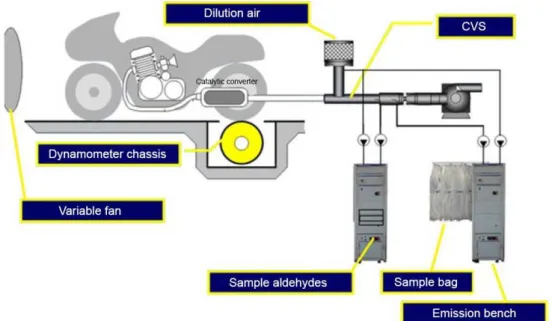
During the test, the emissions were diluted with ambient air and collected in 90 L Tedlar bags by a constant volume sampler (CVS Horiba 7200S) (Figure 1).
The unburned hydrocarbons were determined by a lame ionization detector (FID) analyzer (model FIA-720, 0-1000 ppmC), FID for CH4 (model GFA720, 0-50 ppm),
CO and CO2 by non-dispersive infrared (NDIR) analyzers
(model AIA-721A, 0-5000 ppm, and AIA-722, 0-5 vol%, respectively) and NOx by a chemiluminescence analyzer
(model CLA-720A, 0-300 ppm), all from the Horiba MEXA 7200 bench.
Aldehydes were determined following ABNT
NBR 12026 methodology,36 by the reaction with
2,4-dinitrophenylhydrazine (DNPH) in 25-mL impingers at a constant low of 2.0 mL min-1 of the diluted exhaust
gas during the entire test (1200 s). Samples were analyzed immediately after the tests. For chemical analysis, an Agilent 1200 HPLC was used with a reverse phase column Agilent ZORBAX ODS C18 column (4.6 × 250 mm × 5 µm) operating with 70% acetonitrile in water and UV detection at 365 nm.
Supelco 47651-U standard solution was used at 0.210 to 5.250 mg L-1 for formaldehyde and at 0.153 to 3.828 mg L-1
deviations below 3% and a determination coeficient better than 0.99.
Additional tests were performed using FTIR (AVL SESAM4), a technique that allows an on-line evaluation of compounds dificult to detect with a wide application for non-criteria compounds. The device has adjustments (methods) that optimize its operation in accordance with the tested fuel and was operated according to the methods for gasoline (E22 and E61) and ethanol (E100). The exhaust system of the motorcycle was instrumented for the collection of raw emissions before the catalytic converter (pre-cat) and after (tailpipe) at a frequency of 1 Hz.
To provide a statistical analysis and data assessment, three tests were conducted in each condition.
Results and Discussion
Vehicle emissions are known to depend on parameters such as ethanol content, the air/fuel ratio, engine operating conditions, and type of vehicle, among others.39 In addition,
most studies have been devoted to vehicular emission from ethanol-gasoline blends.40 There are few studies
related to the emissions from lex-fuel motorcycles,15,18,32
and among these studies, there is little discussion of cold phase emissions.
Criteria pollutants emissions
Figures 2 and 3 depict the trend of criteria emissions (CO, NOx, and THC-total hydrocarbons), measured using
the FTIR technique, before and after the catalyst, allowing for the identiication of emissions in the cold phase (transient
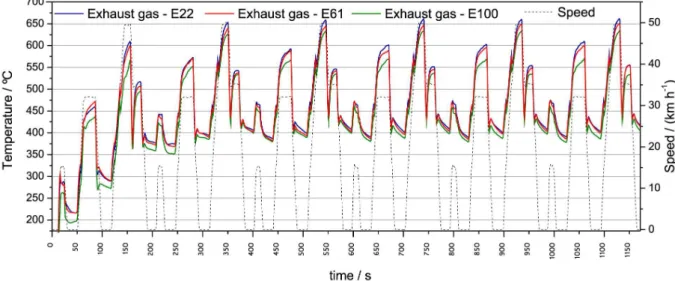
region). To support the data, the temperature proile over time is present in Figure 4 because it contributes to a better understanding of the transient region. Note that the steady state is reached after 200 s. Furthermore, increasing the ethanol content reduces the operating temperature of the system.
Figure 2 shows that the CO and THC emissions are highest before the catalyst during the irst 200 s (cold phase), justiied by the incomplete combustion. In this stage, NOx emissions are also observed to be lower in that
same time frame because the lowest engine temperatures reduce the NOx thermal pathway.
After the catalyst, the CO and THC emissions are also higher in the initial 200 s, explained by the low eficiency of the catalyst, which needs a minimum temperature to start the conversion reactions. For NOx, few changes
in emissions are observed, compared to the emissions during the steady state (after the initial 200 s) because at the beginning of the operation, emissions arriving in the catalyst are lower, and the catalyst is cold with a lower conversion rate.
To understand the effect of the ethanol content on the emissions, the results are presented before (Figure 5a) and after (Figure 5b) the catalyst during the two periods of analysis (before and after 200 s).
Regarding the results before the catalyst in the steady state (Figure 5a after 200 s), the criteria emissions follow the expected trend, namely, a reduction with increased ethanol content, in a less extent for CO using E100. The results for the steady state after the catalyst (Figure 5b after 200 s) are lower than the Euro III emissions limits (2.0; 0.8 and 0.15 g km-1 for CO, THC and NO
x,
Figure 2. CO, THC (total hydrocarbons) and NOx emissions over time before the three-way catalytic converter (TWC).
Figure 3. CO, THC (total hydrocarbons) and NOx emissions over time after the three-way catalytic converter (TWC).
respectively), regardless of the fuel used. Figure 5b clearly indicate the eficiency of the catalyst after the cold phase.
are at ambient temperature. This period may also be deined as the time required for the engine to operate without suffering performance variations.
However, it is worth mentioning the issue of NOx for
E100. According to the literature,41 when hydrated ethanol
is used (E100), such as in Brazil, NOx emissions decrease
because water absorbs heat during vaporization, reducing the temperature peaks and hence the NOx emissions.
A global analysis of these results after the catalyst for NOx also indicates some differences that are mainly related
to E61. This behavior can be attributed to the mapping criteria adopted by the fuel injection system manufacturer and the lower air/fuel ratio control for motorcycles.42 The
lower THC and CO emissions for E61 and the highest NOx value after the catalyst can be explained by the
unforeseen change in the air/fuel ratio during the tests with E61. An analysis of the mean lambda value indicates values of 1.052, 1.104 and 1.065 for tests using E22, E61 and E100, respectively, and shows E61 tests with a more oxidizing medium, favoring oxidation reactions (increasing the conversion of CO and THC) instead of the reduction (decreasing NOx conversion).
The catalyst conversions during the cold phase are very low (Figures 2 and 3), and they present null values for THC and values as low as 17% for CO and 51% for NOx. The
catalyst performance after 200 s shows good eficiency in most cases. With the use of E22, an average conversion of 85, 88 and 81% was observed for THC, CO and NOx,
respectively. With the use of E100, the average values are close to the above values: 87, 92, and 71% for THC, CO Figure 4. Temperature proile during the experiment.
and NOx,respectively. Finally, for E61, 86, 92 and 54% are
obtained for THC, CO and NOx, respectively. Again, there
is a low conversion of NOx for E61, assigned to a higher
air/fuel ratio, as discussed above.
As discussed in the literature, the catalytic eficiency values for motorcycles in most cases are lower than the catalytic eficiency value for automobiles that have required eficiency values above 90% for the criteria pollutants43
and are assigned to the lower air/fuel ratio control for motorcycles.42 Table 1 shows the average values of the
criteria emissions by CVS analysis. With the exception of methane using A22 and E61, the hypothesis of no signiicant differences among the compounds is set aside. THC emissions are signiicantly different between the fuels; they are higher for E100 because the FID detector also measures the unburned ethanol as THC.
Non-criteria pollutants emissions
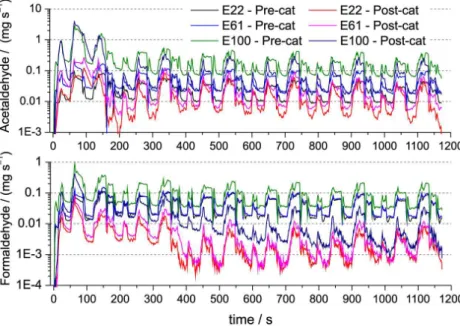
For the non-criteria emissions, emphasis is given to the aldehydes, speciically acetaldehyde and formaldehyde, as
shown in Figure 6, before and after the catalyst for each of the fuels used. In the cold phase, higher formaldehyde and acetaldehyde emissions, especially with E100, are observed. The emission stabilization occurs approximately 3 and 6 min for acetaldehyde and formaldehyde, respectively.
During the cold phase, the unconverted hydrocarbons are partially oxidized, generating OHCs (oxygenated hydrocarbons), and intermediate species, such as aldehydes (formaldehyde and acetaldehyde), form during low temperature reactions. Speciically, formaldehyde is generated by the decomposition of alkyl peroxides formed at low temperatures and thus occurs primarily in the early stages of combustion, reaching a maximum value at approximately 1100 K when high temperature combustion starts, and formaldehyde tends to be consumed thereafter.44
The formaldehyde formation process on motorcycles using ethanol shows a lack of information, with reports presenting discordant values about mixtures with a low percentage of ethanol in gasoline.45 Research on vehicles
using blends up to 85% ethanol disclose increased
Table 1. Results for the criteria pollutant emissions
Fuel Result THC / (g km-1) CO / (g km-1) NO
x / (g km-1) CO2 / (g km-1) CH4 / (g km-1) NMHC / (g km-1)
E22 average 0.182 0.978 0.068 50.969 0.010 0.172
SD 0.006 0.093 0.003 0.218 0.001 0.005
E61 average 0.126 0.596 0.107 50.364 0.009 0.117
SD 0.008 0.042 0.004 0.226 0.001 0.008
E100 average 0.246 1.198 0.050 49.262 0.020 0.227
SD 0.006 0.073 0.004 0.252 0.002 0.006
THC: total hydrocarbons; SD: standard deviation; NMHC: non-methane hydrocarbons.
emissions of formaldehyde.46-48 However, in the literature,
there are no reports of formaldehyde formation mechanisms with the use of hydrated ethanol (E100). In the case of acetaldehyde, all articles regarding the use of ethanol conirm its formation from the oxidation reaction during the combustion of ethanol.49
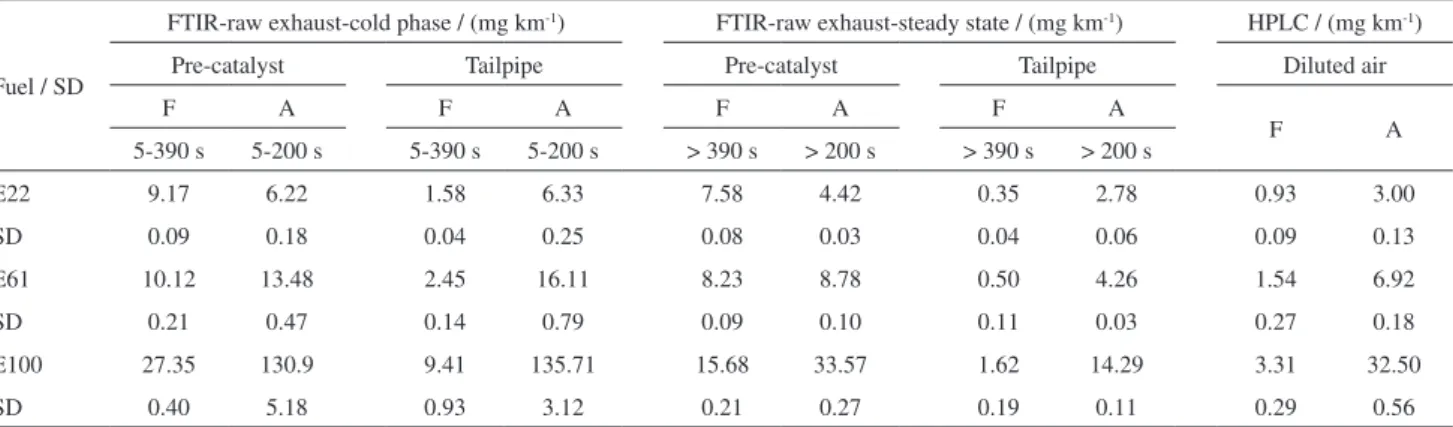
Table 2 shows the emission of aldehydes measured by the FTIR technique before and after the catalyst. The emissions before the catalyst during the cold phase for E22 present more formaldehyde than acetaldehyde. With an increase in the content ethanol (E61), the acetaldehyde emissions exceed formaldehyde, and using E100, acetaldehyde emissions are ive times greater than formaldehyde emissions. This behavior can be explained by the fact that the engine is still cold, and combustion can be incomplete, releasing larger amounts of unburned alcohol from the combustion chamber. Figure 7 shows the emission of unburned ethanol at low temperatures.
According to Table 2, during the cold phase, the catalyst level of performance is lower. Formaldehyde conversions achieved values between 66% using E100 and 83% using E22. However, in the case of acetaldehyde for the same conditions, there was no conversion but an increase of this compound after the catalyst was observed. The formation of acetaldehyde in the catalyst is explained by the operating conditions. At the beginning of engine operation, combustion is ineficient due to low temperatures.50 Thus,
unburned ethanol can be oxidized and also dehydrogenated
to acetaldehyde in CeO2, a major component of the
automotive catalyst, which is favored in the presence of platinum or palladium, the noble metals also traditionally used in these catalysts.51-54 Thus, there is a clear correlation
between acetaldehyde after the catalyst and the presence of unburned ethanol in the emissions (Figure 7).
In a steady state and after the catalyst, emissions are lower for formaldehyde and acetaldehyde. Formaldehyde
Table 2. Aldehyde emissions (in mg km-1) measured before and after the catalyst by FTIR, during the cold phase and steady state and in the diluted
emissions by HPLC
Fuel / SD
FTIR-raw exhaust-cold phase / (mg km-1) FTIR-raw exhaust-steady state / (mg km-1) HPLC / (mg km-1)
Pre-catalyst Tailpipe Pre-catalyst Tailpipe Diluted air
F A F A F A F A
F A
5-390 s 5-200 s 5-390 s 5-200 s > 390 s > 200 s > 390 s > 200 s
E22 9.17 6.22 1.58 6.33 7.58 4.42 0.35 2.78 0.93 3.00
SD 0.09 0.18 0.04 0.25 0.08 0.03 0.04 0.06 0.09 0.13
E61 10.12 13.48 2.45 16.11 8.23 8.78 0.50 4.26 1.54 6.92
SD 0.21 0.47 0.14 0.79 0.09 0.10 0.11 0.03 0.27 0.18
E100 27.35 130.9 9.41 135.71 15.68 33.57 1.62 14.29 3.31 32.50
SD 0.40 5.18 0.93 3.12 0.21 0.27 0.19 0.11 0.29 0.56
SD: standard deviation; FTIR: Fourier transform infrared; HPLC: high performance liquid chromatography; F: HCHO; A: CH3CHO.
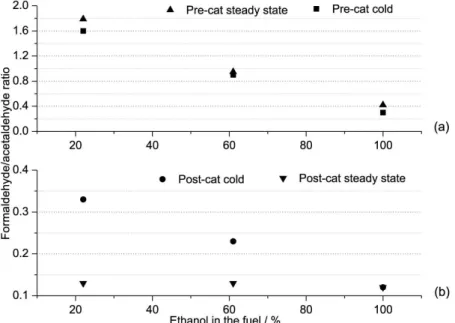
Figure 8. Formaldehyde/acetaldehyde ratio (a) before and (b) after the TWC, measured by FTIR.
Figure 9. Emissions of formaldehyde, methanol, CH4, C2H4 and unburned alcohol emissions (UAE).
conversion values are 90% for E100 and 95% for E22 and for acetaldehyde conversions are much lower, between 37% for E22 and 57% for E100, indicating the possibility of acetaldehyde being produced in the catalyst. Total aldehyde conversions in the cold phase are between 25% for E100 and 57% for E22, and steady state results are 68% for E22 and 75% for E100.
As previously mentioned, there is no consensus in the literature about formaldehyde emissions, but an increase in ethanol content promoted the formation of not only acetaldehyde, as expected, but also formaldehyde. In addition, before the catalyst, a linear decrease in the formaldehyde/acetaldehyde ratio with ethanol content is observed, either during the cold phase or steady state, as indicated by Figure 8. The differences observed
between the proiles before the catalyst emphasize that a higher temperature during the fuel combustion favors formaldehyde formation. After the catalyst, the behavior changes. The formaldehyde/acetaldehyde ratio also shows a linearly decreasing trend with the increase of the ethanol content. However, after the cold phase, this ratio is approximately 0.13 and is virtually independent of the ethanol content, indicating an equilibrium behavior.
In an attempt to achieve a better understanding of the formaldehyde formation, Figure 9 presents the emissions for the initial 195 s of the test before the catalyst, making it possible to observe the relationship of unburned ethanol with emissions of methane (CH4), ethylene (C2H4),
Some reports in the literature44,55 state that formaldehyde
is formed from reactions involving methane and compounds with two carbons. There are also studies indicating that formaldehyde occurs as an intermediate species in hydrocarbon combustion, being formed early in the combustion at low temperatures.56
Considering the formation of formaldehyde via CH4,
once the necessary energy to activate the CH4 molecule
during the fuel combustion has been achieved, a series of reactions involving CH3• radical with itself and with other
radicals, such as oxygen species, may occur. Reaction of the CH3• radical with an oxygen species promotes the
formation of methanol, which can be partially oxidized to formaldehyde.55 Thus, the aldehydes present in the
exhaust gases may form as intermediate species by the post-combustion oxidation of methanol.
Finally, it is equally important to evaluate the raw emission values after the catalyst. In the cold phase, formaldehyde emissions were 1.6, 2.5 and 9.4 mg km-1
using E22, E61 and E100, respectively, while for the same range, emissions of acetaldehyde were 6.3, 16.1 and 135.7 mg km-1. In the steady state, the formaldehyde
values were at 0.4, 0.5 and 1.6 mg km-1, and acetaldehyde
values were 2.8, 4.3 and 14.3 mg km-1. Currently, for light
vehicles, the legislation states that the total aldehydes
(RCHO) should be below 20 mg km-1 (L6 phase of
PROCONVE). Comparing this value with the values obtained, we conclude that the motorcycle would meet the limits of total aldehyde emissions for the steady state phase. However, in the cold phase, the emission from E100 exceeds the threshold value.
The average values obtained with the FTIR technique were compared with those obtained by HPLC using the analysis of variance (Figure 10). The post-catalyst formaldehyde emissions were found to be statistically equivalent. Acetaldehyde emissions show significant differences for E61 and E100. The average emission value by FTIR for the total aldehydes was 14% lower than with the use of HPLC for the E61 because the FTIR samples raw emissions in the exhaust, and the HPLC methodology collects the sample after the dilution process. The total aldehyde emissions for E100, measured by HPLC, presented values 8% lower than the values obtained by FTIR, and the effect is constant for both test cases (pre- and post-catalyst). Different values between FTIR and HPLC techniques can be attributed to corrections made in sampling/dilution procedures between the two techniques.
Conclusions
The methodology used for collecting and analyzing aldehydes in motorcycle emissions is technically feasible, and the collection process is effective and shows good repeatability between tests.
The use of FTIR to identify and quantify formaldehyde and acetaldehyde provided additional information for understanding the formation and emission processes. The results demonstrate the usefulness of this technique in the investigation of vehicular non-criteria emissions and provided a comparison with the traditional HPLC methodology, where the results obtained for the use of gasoline and ethanol were considered statistically equivalent.
Regarding criteria pollutants, the catalyst performance showed lower values than the values obtained in automobiles, which have eficiency values greater than 90% for these compounds, because there is less control of the air/fuel ratio on motorcycles. The question of cold phase emissions should also be assessed because the conversions were too low and lower than 10% in some cases.
With regard to non-criteria pollutants, an increase in ethanol content in the fuel promoted an increase in aldehyde emissions. The formaldehyde/acetaldehyde ratio linearly decreased with the ethanol content in the fuel when measured before the catalyst in both the cold phase and the steady state and in the cold phase when measured after the catalyst. The same analysis after a catalyst in the steady state showed that the ratio remained stable and did not vary with ethanol content, suggesting an equilibrium behavior.
Under steady state conditions, the catalyst was found to be eficient for formaldehyde conversion, regardless of the fuel used. However, for the acetaldehyde under the same conditions, the catalyst performance was lower, probably because of a signiicant increase in acetaldehyde emissions and the presence of unconverted ethanol in the exhaust gases, which can be related to the formation of acetaldehyde in the catalyst.
In the cold phase, the combustion process proved to be incomplete, with the presence of unconverted ethanol at signiicant levels and methane, ethylene, methanol, and aldehydes, among others, in the exhaust gases analyzed before the catalyst. Under these conditions, the catalyst is cold, hindering the conversion of the pollutants. However, at low temperatures, the catalyst can promote reactions such as the ethanol dehydrogenation, and at 200 °C and above, it can form acetaldehyde, as found in the emissions before and after the catalyst up to 350 s.
The results obtained accent the need to reduce the time needed to reach the steady state. The approximate value obtained in this study is approximately 6 min, and this amount of time is very high, considering that the paths in a small or medium city can be short, and the catalyst is underutilized, resulting in high emissions of aldehydes and other pollutants. One possible solution would be to place the catalyst near the engine, as in systems with close-coupled technology and as used in light vehicles to reduce the time to start the catalytic reactions. This option should be accompanied by a study of the thermal stability of the catalyst components.
Another important aspect to emphasize is the composition of the catalyst, which must be optimized for motorcycles to avoid undesirable reactions or the generation of non-criteria pollutants.
Acknowledgments
The authors acknowledge the Brazilian Ministry of Science and Technology (MCT), the Brazilian National Council for Technological and Scientiic Development (CNPq), law 8010, FAPERJ, and the staff members of the LACTEC Automotive Laboratory (LEME) for providing support for this work.
References
1. Rangel, M. C.; Carvalho, M. F.; Quim. Nova 2003, 26, 265.
2. Shah, A. N.; Yun-Shan, G.; Hong, Z.; J. Mechan. Ind. Eng.
2010, 4, 340.
3. Abrantes, R.; Assunção, J.; Pesquero, C. R.; Bruns, R. E.; Nóbrega, R. P.; Atmos. Environ.2009, 43, 648.
4. Szwarciter, L.; Mendes, F. E.; la Rovere, E. L.; Transp. Res. Part D: Transp. Environ.2005, 10, 153.
5. Conselho Nacional do Meio Ambiente (CONAMA); Resolução No. 18, 6 de Maio de 1986, Dispõe sobre a Criação do Programa de Controle de Poluição do Ar por Veículos Automotores-PROCONVE, Publicada no Diário Oicial da União, 17 de Junho de 1986, Seção 1, p. 8792.
6. US Environmental Protection Agency (US EPA); Control of Emissions from Highway Motorcycles,40 CFR Parts 9, 86, 90 and 1051; Federal Register, No. 10, 2004.
7. Faiz, A.; Weaver, C. S.; Walsh, M. P.; Standards and Technologies for Controlling Emissions; The World Bank: Washington DC, USA, 1996.
8. Greening, P.; Top. Catal.2001, 16-17, 5.
9. Commission Implementing Regulation (EU); On Certain Components and Characteristics of Two or Three-Wheel Motor Vehicles, 97/24/EC, 17/07/1997; Oficial Journal of the European Communities, 1997, 1.
10. Amaral, R. A.; Sodre, J. R.; Combust. Sci. Technol.2002, 174, 153.
11. Grosjean, D.; Miguel, A. H.; Tavares, T.; Atmos. Environ.1990,
24, 101.
12. Conselho Nacional do Meio Ambiente (CONAMA); Resolução No. 3, 15 de Junho de 1989, Dispõe sobre Níveis de Emissão de Aldeídos no Gás e Escapamento de Veículos Automotores; Publicada no Diário Oicial da União, de 25 de Agosto de 1989, Seção 1, p. 14.713.
13. Anderson, L. G.; Renewable Sustainable Energy Rev. 2015, 47, 162.
14. Bayraktar, H.; Renewable Energy2005, 30, 1733.
15. de Andrade, J. B.; Andrade, M. V.; Pinheiro, H. L. C.; J. Braz. Chem. Soc.1998, 9, 219.
17. Poulopoulos, S. G.; Samaras, D. P.; Philippopoulos, C.; Atmos. Environ.2001, 35, 4399.
18. Yao, Y.; Tsai, J.; Chiang, H.; Sci. Total Environ.2009, 19, 5257. 19. Wagner, T.; Wyszyński, M. L.; J. Autom. Eng.1996, 210, 109. 20. Zervas, E.; Montagne, X.; Lahaye, J.; Environ. Sci. Technol.
2002, 36, 2414.
21. Kumar, S.; Nayek, M.; Kumar, A.; Tandon, A.; Mondal, P.; Vijay, A.; Bhangale, U. D.; Tyagi, D.; Am. Chem. Sci. J.2011,
1, 1.
22. Abrantes, R.; Assunção, J. V.; Hirai, E. Y.; Rev. Saúde Pública
2005, 39, 479.
23. Sandström-Dahl, C.; International Energy Agency-Advanced Motor Fuels, 2009, AVL MTC 9711.
24. Carter, W. P. L.; Pierce, J. A.; Luo, D.; Malkina, I. L.; Atmos. Environ.1995, 29, 2499.
25. Clairotte, M.; Adam, T. W.; Zardini, A. A.; Manfredi, U.; Martini, G.; Krasenbrink, A.; Vicet, A.; Tournié, E.; Astorga, C.; Appl. Energy2013, 102, 44.
26. Suarez-Bertoa, R.; Zardini, A. A.; Keuken, H.; Astorga, C.; Fuel
2015, 143, 173.
27. Iodice, P.; Senatore, A.; Energy Procedia2014, 45, 809. 28. Yao, Y. C.; Tsai, J. H.; Chiang, H. L.; Sci. Total Environ. 2009,
407, 5257.
29. Hsieh, W. D.; Chen, R. H.; Wu, T. L.; Lin, T.; Atmos. Environ.
2002, 36, 403.
30. www.abraciclo.com.br, accessed in April 2016.
31. Yang, H. H.; Liu, T. C.; Chang, C. F.; Lee, E.; Appl. Energy
2011, 89, 281.
32. Lan, L.; Yunshan, G.; Mingda, W.; Zihang, P.; Yanan, S.; Liwei, Z.; Wanli, Y.; Sci. Total Environ.2015, 502, 627.
33. Horng, R.; Chou, H.; Hsu, T.; Energy Convers. Manage.2004,
45, 2113.
34. Corrêa, S. M.; Arbilla, G.; Atmos. Environ.2008, 42, 769. 35. Garcia, L. F. A.; Corrêa, S. M.; Penteado, R.; Daemme, L. C.;
Gatti, L. V.; Alvim, D. S.; J. Braz. Chem. Soc.2013, 24, 375. 36. ABNT NBR 12026: Veículos Rodoviários Automotores Leves,
Determinação de Aldeídos e Cetonas Contidos no Gás de Escapamento, por Cromatografia Líquida, Método DNPH, ABNT: Rio de Janeiro, 2009.
37. California Air Resources Board (CARB); Standard Operating Procedure for the Determination of Aldehyde and Ketone
Compounds in Automotive Source Samples by High Performance Liquid Chromatography, SOP MLD 104, California, USA, 2001.
38. California Air Resources Board (CARB); California Non-Methane Organic Gas Test Procedures,California, USA, 2002. 39. Zervas, E.; Montagne, X.; Lahaye, J.; Environ. Sci. Technol.
2003, 37, 3232.
40. Costa, R. C.; Sodré, J. R.; Fuel2010, 89, 287.
41. Masum, B. M.; Masjuki, H. H.; Kalam, M. A.; Rizwanul, I. M.; Palash, S. M.; Abedin, M. J.; Renewable Sustainable Energy Rev.2013, 24, 209.
42. Chan, C.; Nien, C.; Tsai, C.; Her, G.; J. Air Waste Manage. Assoc.1995, 45, 116.
43. Kaspar, J.; Fornasiero, P.; Hickey, N.; Catal. Today2003, 77, 419.
44. Lemel, M.; Hultqvist, A.; Vressner, A.; Nordgren, H.; Persson, H.; Johansson, B.; SAE2005, 1, 3724.
45. Yao, Y. C.; Tsai, J. H.; Chiang, H. L.; Environ. Eng. Sci.2010,
28, 147.
46. Graham, L. A.; Belisle, S. L.; Bass, C.; Atmos. Environ.2008,
42, 4498.
47. Niven, R. K.; Renewable Sustainable Energy Rev. 2005, 9, 535. 48. Bielaczyc, P.; Woodburn, J.; Klimkiewicz, D.; Pajdowski, P.;
Szczotka, A.; Fuel Process. Technol.2013, 107, 50.
49. Magnusson, R.; Nilsson, C.; Andersson, B.; Environ. Sci. Technol.2002, 36, 1656.
50. Gaffney, J. S.; Marley, N. A.; Atmos. Environ.2009, 43, 23. 51. Stepanek, J.; Koci, P.; Marek, M.; Maunula, T.; Kinnunen, T.;
SAE Int. J. Fuels Lubr.2010, 3, 523. 52. Idriss, H.; Platinum Met. Rev.2004, 48, 105.
53. Sheng, P. Y.; Yee, A.; Bowmaker, G. A.; Idriss, H.; J. Catal.
2002, 208, 393.
54. Mello, L. F.; Noronha, F. B.; Schmal, M.; J. Catal.2003, 220, 358.
55. Brown, M. J.; Parkyns, N. D.; Catal. Today1991, 8, 305. 56. Särner, G.; Richter, M.; Aldén, M.; Hildingason, L.; Hultqvist,
A.; Johansson, B.; SAE 2005, 1, 3869.