Article
Printed in Brazil - ©2016 Sociedade Brasileira de Química0103 - 5053 $6.00+0.00
*e-mail: [email protected]
#Present address: Embrapa Agroindústria Tropical, CP 3761, 60511-110 Fortaleza-CE, Brazil.
§Pesquisador Emérito-FAPERJ
New Epimeric Spirostanol and Furostanol-Type Steroidal Saponins from
Cestrum
laevigatum
L.
Paulo R. V. Ribeiro,#,a Raimundo Braz-Filho,§,b,c Ana J. Araújo,d Letícia V. Costa-Lotufo,e
Luciana G. S. Souza,a Hélio V. Nobre Junior,f Cecília R. da Silva,f João B. de Andrade
Neto,f Edilberto R. Silveiraa and Mary Anne S. Lima*,a
aDepartamento de Química Orgânica e Inorgânica, Centro de Ciências, Universidade Federal do
Ceará, CP 12200, 60021-940 Fortaleza-CE, Brazil
bLaboratório de Ciências Químicas-CCT, Universidade Estadual do Norte Fluminense Darcy
Ribeiro, 28013-600 Campos dos Goytacazes-RJ, Brazil
cDepartamento de Química-ICE, Universidade Federal Rural do Rio de Janeiro,
CP 74541, 23894-374, Seropédica-RJ, Brazil
dFaculdade de Medicina, Universidade Federal do Piauí, 64200-500 Parnaíba-PI, Brazil
eInstituto de Ciências Biomédicas, Universidade de São Paulo, 05508-900 São Paulo-SP, Brazil
fDepartamento de Farmácia, Universidade Federal do Ceará, CP 12200,
60430-170 Fortaleza-CE, Brazil
Four new epimeric spirostanol and furostanol-type steroidal saponins, (25R,S)-5α -spirostan-2α,3β-diol 3-O-β-D-glucopyranosyl-(1→4)-β-D-galactopyranosyl-(1→4)-β-D-galactopyranoside, (25R,S)-5α-spirostan-2α,3β-diol 3-O-β-D-glucopyranosyl-(1→2)-α-L-rhamnopyranosyl-(1→ 4)-β-D-galactopyranoside, 26-O-β-D-glucopyranosyl-(25R,S)-5α-furost-20-ene,2α,3β-diol 3-O-β -D-galactopyranoside and 26-O-β-D-glucopyranosyl-(25R,S)-5α-furost-20-ene,2α,3β-diol 3-O-β -D-galactopyranosyl-(1→4)-β-D-galactopyranoside, in addition to the known (25R,S)-5α -spirostan-2α,3β-diol 3-O-β-D-galactopyranoside, were isolated from Cestrum laevigatum. Compounds were submitted to cytotoxic activity assays using colorectal adenocarcinoma (HCT-116), human promyelocytic leukemia (HL-60), ovarian carcinoma (OVCAR-8), glioma (SF-295) human cancer cell lines, and the antimicrobial activity was evaluated against Candida parapsilosis, C. albicans, C. krusei, Pseudomonas aeruginosa, Staphylococcus aureus and Bacillus subtilis.
Keywords: Cestrum laevigatum, saponins, spirostanol, furostanol, cytotoxic, antimicrobial
Introduction
Steroidal saponins are constituted mainly by spirostanol and furostanol-type glycosides. Spirostanol glycosides are the largest group and comprises aglycones with the spirostan skeleton containing a sugar chain generally at C-3 position and a spiro-bicyclic acetal at C-22, while furostanol derivatives usually present a hemiacetal with a hydroxy or methoxy moiety at C-22 or yet a ∆(20,22)-unsaturation, besides a glycosidic linkage
at C-26. In both skeletons, C-25 is naturally found with either R or S configuration, or as inseparable epimeric mixtures.1,2 Furostanol are recognized as biogenetic
precursors of spirostanol, since the 26-O glucoside unit can be enzymatically cleaved and a ring closure to 26-OH takes place with dehydration of 22-26-OH.3 So, the
co-occurrence of spirostanol saponins with the correspondent furostanols, in innumerous plants, is the consequence of this ready conversion.
The isolation of bioactive steroidal saponins has been reported to several species of reputed poisonous plants belonging to the Solanaceae.1,4,5 Based on these findings,
among the group of common invasive species that cause liver damage.6,7
In this study, we have isolated epimeric mixtures of the new (25R,S)-5α-spirostan-2α,3β-diol 3-O-β -D-glucopyranosyl-(1→4)-β-D-galactopyranosyl-(1→
4)-β-D-galactopyranoside (1/2), (25R,S)-5α -spirostan-2α, 3β- d i o l 3 -O-β- D - g l u c o py r a n o s y l - ( 1→2 ) -α -L-rhamnopyranosyl-(1→4)-β-D-galactopyranoside (3/4), 26-O-β-D-glucopyranosyl-(25R,S)-5α -furost-20-ene,2α,3β-diol 3-O-β-D-galactopyranoside (5/6) 26-O-β -D-glucopyranosyl-(25R,S)-5α-furost-20-ene,2α,3β-diol 3-O-β-D-galactopyranosyl-(1→4)-β-D-galactopyranoside (7/8), in addition to the known (25R,S)-5α -spirostan-2α,3β-diol 3-O-β-D-galactopyranoside (9/10) (Figure 1). The cytotoxicity of all compounds was evaluated against four human tumor cell lines: colorectal adenocarcinoma (HCT-116), human promyelocytic leukemia (HL-60), ovarian carcinoma (OVCAR-8) and glioma (SF-295). The screening for antifungal activities was performed against
Candida parapsilosis ATCC 22019, Candida albicans
ATCC 10231 and Candida krusei ATCC 14243, while the antimicrobial activity was assayed against Pseudomonas aeruginosa ATCC 9027, Staphylococcus aureus ATCC 6538 and Bacillus subtilis ATCC 6633.
Experimental
General experimental procedures
Melting points were obtained on a Mettler Toledo FP82HT apparatus (Columbus, OH, USA) and were uncorrected. Infrared (IR) spectra were recorded as KBr pellets on a PerkinElmer FT-IR Spectrum 1000 (Waltham, MA, USA). The nuclear magnetic resonance (NMR) spectra were performed on an Agilent VNMR-600 (Santa Clara, CA, USA) or Bruker Avance DRX 500 (Billerica, MA, USA) spectrometers. The proton (1H) and carbon 13
(13C) chemical shifts are expressed in the dscale and were
referenced to tetramethylsilane (TMS) through the residual solvent. High resolution mass spectra were recorded on a Waters Acquity UPLC system (Milford, MA, USA) coupled with a quadrupole/time-of-flight (TOF) system (UPLC/Qtof MSE spectrometer) in the positive mode. TOF conditions were as follow: source temperature 120 °C; desolvation temperature 350 °C; desolvation gas flow of 500 L h−1;
capillary voltage 3.2 kV; collision energy ramp 20 eV. Data were recorded from m/z 110 to 1200 Da. High performance liquid chromatography (HPLC) analyses were performed on a Shimadzu chromatograph equipped with a ternary
pump (Shimadzu LC-20AT) and UV detector (Shimadzu SPD-M20A; Tokyo, Japan), using Phenomenex RP-18 column (analytical: 250 × 4.6 mm, 5 µm; semi-preparative: 250 × 10 mm, 10 µm; Torrance, CA, USA). HPLC grade solvents were purchased from Tedia Co (Brasil, São Paulo) and the HPLC grade water was obtained by a Milli-Q purification system (Millipore, Bedford, MA, USA). Gas chromatography (GC) analyses were performed on an Agilent 7890B/5977A GC/MSD (Santa Clara, CA, USA) using a CP-ChiraSil-L-Val (30 m × 0.25 mm × 0.25 mm) column. Column chromatography was performed over Sephadex LH-20 (Pharmacia, Uppsala, Sweden) and solid phase extraction (SPE) C18 cartridge (Strata, 5 g × 20 mL; Phenomex, Torrance, CA, USA). Thin layer chromatography (TLC) was performed on precoated silica gel aluminum sheets (Kieselgel 60 F254, 0.20 mm; Merck, Darmstadt,
Germany). Compounds were visualized by ultraviolet (UV) detection and by spraying with vanillin/perchloric acid/ ethanol (EtOH) solution, followed by heating.
Plant material
Cestrum laevigatum L. was collected at Guaramiranga Mountain, Pacoti, Ceará State, Northeast of Brazil (August 2012). Voucher specimens (#38643) were deposited at the Herbário Prisco Bezerra (EAC) and identified by MSc Edson de Paula Nunes, Departamento de Biologia, Universidade Federal do Ceará, Ceará State, Brazil.
Extraction and isolation
Stems of C. laevigatum (3.03 kg) were pulverized and extracted with hexane (3 × 5 L) at room temperature. The solvent was removed under reduced pressure to yield the hexane extract (0.3 g). The plant residue was then extracted with EtOH (3 × 6 L) to yield the corresponding EtOH extract (30.1 g), after evaporation of the solvent.
An aliquot of the EtOH extract (2.8 g) was chromatographed over Sephadex LH-20 (2.0 × 10 cm) by elution with methanol (MeOH, 250 mL) to afford forty fractions that were pooled together into three main fractions after TLC analysis: F-1 (50 mL, 400 mg), F-2 (120 mL, 830 mg), and F-3 (80 mL, 600 mg). Fraction F-2 was chromatographed on flash silica gel column (2.5 × 28 cm) using CH2Cl2 100% (100 mL), CH2Cl2/MeOH
2:1 (50 mL), CH2Cl2/MeOH 1:1 (120 mL), CH2Cl2/MeOH
1:3 (130 mL) and MeOH 100% (50 mL) to give ninety sub-fractions (5 mL), which were combined into eight main sub-fractions according to TLC analysis: F-1 (180.0 mg), F-2 (80.0 mg), F-3 (65.0 mg), F-4 (72.7 mg), F-5 (78.3 mg), F-6 (73.4 mg), F-7 (50.0 mg), and F-8 (140.0 mg).
Fractions F-2 (80.0 mg) and F-3 (65.0 mg) yielded the pure compounds 9/10 (7.2 mg) and 1/2 (6.0 mg), respectively, after recrystallization with MeOH.
Roots (4.43 kg) were pulverized and extracted with hexane (3 × 7 L) at room temperature. The solvent was removed under reduced pressure to yield the hexane extract (0.45 g). The residue was extracted with EtOH (3 × 7 L) to yield the corresponding extract (22.5 g).
An aliquot of the EtOH extract (600 mg) was chromatographed on a SPE C18 cartridge by elution with MeOH/H2O 1:1 (40 mL), MeOH/H2O 7:3 (50 mL),
MeOH/H2O 8:2 (50 mL), MeOH/H2O 9:1 (30 mL) and
MeOH (40 mL), to yield five fractions: F-1 (92.0 mg), F-2 (140.0 mg), F-3 (130.0 mg), F-4 (102.2 mg), and F-5 (90.6 mg). Recrystallization of the fraction F-4 (102.2 mg) with MeOH yielded the compounds 3/4 (9 mg). Fraction F-3 (130 mg) was submitted to semi-preparative RP-18 HPLC chromatography, using a UV detector (210-400 nm), flow 4.5 mL min−1 and isocratic elution with MeOH/H
2O (8:2)
to afford 5/6 (7 mg) and 7/8 (9 mg).
Acid hydrolysis, sililation and sugar analysis
The epimeric mixtures (ca. 5.0 mg) were dissolved in 2 mol L−1 HCl (dioxane/H
2O 1:1, 2 mL) and stirred
at 90 °C for 2 h. After cooling, the reaction mixture was neutralized with solution of 1 mol L−1 NaOH, extracted
with CH2Cl2, and the aqueous layer was evaporated to give
a mixture of monosaccharides. The residue was dissolved in hexadimethyldisilazane/trimethylchlorosilan/pyridine (3:1:9), excess, and stirred at 70 °C for 60 min. The supernatants (3 µL) were analyzed by GC Agilent model 7890B/5977A GC/MSD (quadrupole), under the following conditions: CP-ChiraSil-L-Val column, 0.25 mm × 25 m; temperatures for detector and injector 150 and 200 °C, respectively; temperature of gradient system for the oven, 100 °C for 1 min and then raised to 180 °C, rate 5 °C min−1 kept for 5 min. The configurations of sugars were
determined by comparison of the retentions times of the corresponding derivatives with those of standards treated simultaneously with same silylating reagents (L-rhamnose Rt:11.15, D-galactose Rt:16.02, and D-glucose Rt:16.57). Peaks of the hydrolysates were detected at Rt:11.20 (L-rhamnose), Rt:16.01 (D-galactose) and Rt:16.57 (D-glucose). Co-injection of each hydrolysate with the respective standard gave single peaks.
Cytotoxic activity
promyelocytic leukemia HL-60 and glioma SF-295) were kindly donated by the National Cancer Institute (Bethesda, MD, USA). Cells were maintained in Roswell Park Memorial Institute (RPMI) 1640 medium supplemented with 10% fetal bovine serum, 2 mmol L−1 glutamine,
100 U mL−1 penicillin, and 100 ug mL−1 streptomycin
at 37 °C with 5% CO2. The cytotoxicity of the isolated
compounds was tested the against tumor cell lines using the 3-(4,5-dimethyl-2-thiazolyl-2,5-diphenyl-2H -tetrazolium bromide (MTT; Sigma-Aldrich, St. Louis, MO, USA) reduction assay. Cells were plated in 96-well plates (105 cells per well for adherent cells or 3 × 10⁵ cells per well for suspended cells in 100 µL of medium) and compounds (0.05-25 µg mL−1) were dissolved in dimethyl
sulfoxide (DMSO; Sigma-Aldrich, St. Louis, MO, USA), added to each well using the high-throughput screening (HTS) Biomek 3000 (Beckman Coulter, Brea, CA, USA), and incubated for 72 h. Doxorubicin was used as the positive control. Control groups received the same amount of DMSO. After 69 h of incubation, the supernatant was replaced by fresh medium containing tetrazolium dye (MTT, 0.5 mg mL−1). Three hours later, MTT formazan
product was dissolved in 150 µL of DMSO, and the absorbance was measured at 595 nm (DTX 880 Multimode Detector, Beckman Coulter, Brea, CA, USA).
Antimicrobial activity
In vitro antibacterial activity
Tests were performed according to the M02-A11 (CLSI, 2012) protocol with modifications.8 Wells with
6 mm diameter were made in the agar overlay of the Petri dish. To those wells, a volume of 20 µL (1000 µg mL−1)
of the obtained compounds was applied. The plates were incubated for 20 h at 35 °C. The solvents and diluents used in the compounds dissolution were used as negative control. The assayed microorganisms used in this study were
Pseudomonas aeruginosa ATCC 9027, Staphylococcus
aureus ATCC 6538, and Bacillus subtilis ATCC 6633.
The antibiotic disk used in antimicrobial sensitivity test was Cefepime (CPM) 30 µg (Specialized Diagnostics Microbiology, DME, São Paulo, SP, Brazil).
In vitro antifungal activity
The broth microdilution (BMD) antifungal susceptibility test was performed according to M27-A3 protocol using RPMI broth (pH 7.0) buffered with 0.165 mol L−1
3-(N-morpholino)propanesulfonic acid (MOPS; Sigma-Aldrich, St Louis, MO, USA).9 Compounds were dissolved
in DMSO and tested at concentrations ranging from 1.95 to 1000 µg mL−1. Fluconazole was used as positive
control. The yeasts and compounds were incubated in 96-well culture plates at 35 °C for 24 h and the results were examined visually. The minimum inhibitory concentration (MIC) of each compound was determined as the concentration that inhibited 50% of fungal growth. The assayed microorganisms used in this study were Candida parapsilosis ATCC 22019, Candida krusei ATCC 14243 and Candida albicans ATCC 10231.
(25-R,S)-5α-Spirostan-2α,3β-diol 3-O-β -D-glucopyranosyl-(1→4)-β-D-galactopyranosyl -(1→4)-β-D-galactopyranoside (1/2)
White solid; m.p. 190-192 °C; R.f. 0.24 (CH2Cl2/H2O
15%); IR (KBr) ν / cm−1 3350, 2927, 1638, 1450,
1377, 1241, 1156, 1085, 982, 920, 897; 1H NMR
(500 MHz, C5D5N) and 13C NMR (125 MHz, C5D5N), see
Tables 1 and 2; HRESIMS m/z calc. for C45H75O19 [M + H]+
919.4931; found: 919.4902.
(25-R,S)-5α-Spirostan-2α,3β-diol 3-O-β -D-glucopyranosyl-(1→2)-α-L-rhamnopyranosyl-(1→4)-β-D-galactopyranoside (3/4)
White solid; m.p. 194-196 °C; R.f. 0.25 (CH2Cl2/H2O
15%); IR (KBr) ν / cm−1 3432, 2915, 1650, 1446, 1365,
1041, 906; 1H NMR (500 MHz, C
5D5N) and 13C NMR
(125 MHz, C5D5N), see Tables 1 and 2; HRESIMS m/z calc. for C45H75O18 [M + H]+ 903.4979; found:
903.4953.
26-O-β-D-Glucopyranosyl-(25-R,S)-5α -furost-20-ene,2α,3β-diol 3-O-β-D-galactopyranoside (5/6)
White solid; m.p. 126-128 °C; R.f. 0.40 (CH2Cl2/H2O
15%); IR (KBr) ν / cm−1 3367, 2934, 1643, 1397, 1036, 906; 1H NMR (600 MHz, CD
3OD) and 13C NMR (125 MHz,
CD3OH), see Tables 1 and 2; HRESIMS m/z calc. for
C39H65O14 [M + H]+ 757.4372; found: 757.4374.
26-O-β-D-Glucopyranosyl-(25-R,S)-5α -furost-20-ene,2α,3β-diol 3-O-β-D-galactopyranosyl-(1→4)-β -D-galactopyranoside (7/8)
White solid; m.p. 184-186 °C; R.f. 0.25 (CH2Cl2/H2O
10%); IR (KBr) ν / cm−1 3369, 2926, 1635, 1439, 1374,
1033, 902; 1H NMR (600 MHz, CD
3OD) and 13C NMR
(125 MHz, CD3OD), see Tables 1 and 2; HRESIMS m/z calc. for C45H75O19 [M + H]+ 919.4902; found:
919.4902.
Results and Discussion
reverse-phase (RP) HPLC and could not be separated by a variety of column chromatographies. This was evident from the observation of several signals of closely similar chemical shifts in the 13C NMR spectra. The HRESI/MS spectrum
showed the protonated molecular ion peak at m/z 919.4931 [M + H]+, suggesting the molecular formula C
45H74O19. The
sequential loss of the three hexose moieties was observed by the fragment ion peaks at m/z 757.4390, 595.3856 and 433.3330, respectively.
The most shielded region of the 1H NMR spectrum
showed three methyl singlets at dH 0.72 (s, H-19), 0.79
(s, H-18), 0.80 (s, H-18), and four doublets at dH 0.70
(J 5.3 Hz, H-27), 1.06 (J 5.3 Hz, H-27), 1.12 (J 3.6 Hz, H-21) and 1.13 (d, J 3.6 Hz, H-21). Furthermore, several signals were observed in the range of dH 3.30-4.70, in
addition to three doublets at dH4.89 (d, J 7.7 Hz, H-1’),
5.19 (d, J 7.7 Hz, H-1’’’) and 5.60 (d, J 7.9 Hz, H-1’’). These data suggested for 1 a steroidal core structure containing three sugar units.
The 13C NMR and distortionless enhancement by
polarization transfer (DEPT) spectra displayed sixty-three signals, several of which related to oxygenated carbons with a high degree of overlapping. The presence of typical signals of spiroacetal carbons at dC 109.5 and
110.1 (C-22), and secondary methyl groups at dC 30.9
and 27.8 (C-25), suggested for 1/2 the structure of one mixture of steroidal saponins containing a spirostane skeleton as aglycone. The methyl groups at dC 16.9 and 17.6
(C-27) in axial and equatorial positions, respectively, besides the steric compression of the methyl group in axial position protecting the carbon at dC 26.7 (C-23)
indicated the R/S epimeric pair at C-25. The aglycones were characterized as gitogenin and neogitogenin after comparison with literature data.10-12 The relative
configuration of the hydroxyl and sugar portion at C-2 and C-3 was established by comparison with the 13C NMR
spectral data described to the gitogenin and its 2β,3α
-dihydroxy isomer, through the characteristic chemical shifts relative to C-1 to C-5. The chemical shifts at dC 46.0 (C-1),
70.7 (C-2), 85.0 (C-3), 34.3 (C-4) and 44.9 (C-5) observed in 1/2 were in accordance with the 2α, 3β-orientation.13
All proton and carbon signals were fully assigned through heteronuclear single-quantum correlation spectroscopy (HSQC) and heteronuclear multiple-bond correlation spectroscopy (HMBC) spectra analyses (Tables 1 and 2). The three sugar units were characterized by the HSQC correlations of the acetal carbon at dC 103.7
(C-1’) with the anomeric proton at dH 4.89 (d, J 7.7 Hz,
H-1’); the carbon at dC 105.3 (C-1’’) with the proton at dΗ
5.60 (d, J 7.9 Hz, H-1’’), and the carbon at dC 107.4 (C-1’’’) with the proton at dH 5.19 (d, J 7.7 Hz, H-1’’’).
The monosaccharides were identified as one glucose and two galactose units through NMR analyses followed by comparison with the literature data.12,14 The absolute
configurations were determined as D, on the basis of the acid hydrolysis followed by sililation of the sugars and GC analysis. The β-anomeric configurations of the glucopyranosyl and galactopyranosyl moieties were supported by the relatively large vicinal coupling constant values (ca. 8.0 Hz) observed for the anomeric protons.
The HMBC spectrum analysis allowed to establish the sequence of all sugar units by long-range correlations between the proton signal at dH 5.19 (H-1’’’) of the
glucopyranose unit with the carbon at dC80.4 (C-4’’) of
the galactopyranose, which anomeric proton at dH 5.60
(H-1’’) showed correlation with the carbon at dC 80.4
(C-4’) of the second galactopyranose unit. The anomeric proton of the second galactopyranose at dH 4.89 (H-1’)
in turn showed correlation with the C-3 carbon of the aglycone portion at dC85.3 (C-3). These findings confirmed
the attachment sequence of the sugar chain at C-3 to be 3-O-β-D-glucopyranosyl-(1→4)-β -D-galactopyranosyl-(1→4)-β-D-galactopyranoside.
Thus, the structure of 1/2 was elucidated as the epimeric mixture of the new (25-R,S)-5α-spirostan-2α,3β-diol 3-O-β-D-glucopyranosyl-(1→4)-β -D-galactopyranosyl-(1→4)-β-D-galactopyranoside.
Compounds 3/4 was isolated as a yellow resin and showed only a single peak in RP HPLC. The support for an epimeric mixture with a spirostanol steroid skeleton came from the comparative analysis of its NMR data with those observed for compounds 1/2.
The 1H NMR spectrum of 3/4 showed resonances quite
similar to those of 1/2, except the presence of an additional methyl doublet at dH 1.77 (d, J 6.0 Hz, H-6’’). As seen for
compound 1/2, the presence of several signals in the range of
dH 3.30-5.00 besides the deshielded signals corresponding
to the anomeric protons at dH 4.92 (d, J 7.8 Hz, H-1’), 5.53
(d, J 7.3 Hz, H-1’’’) and 6.28/6.38 (s, H-1’’), revealed the presence of the monosaccharide moieties.
Comparison of the 13C NMR data of 3/4 with those of 1/2 supported the assignment of the aglycones as gitogenin/ neogitogenin. As to the glycosidic portions, a difference was the presence of an additional methyl carbon at dC19.1
(C-6’’). In addition, the sugar anomeric carbons at dC 105.4
(C-1’), 102.3/102.4 (C-1’’) and 104.1 (C-1’’’) showed HSQC correlations with corresponding protons signals at dH 4.92 (H-1’), 6.28/6.38 (H-1’’) and 5.53 (H-1’’’),
respectively (Tables 1 and 2).
β-orientations of glucose and galactose and the α-orientation of rhamnose were ascertained by the coupling constant values of the anomeric protons. A further coupling constant corresponding to a proton signal at dH 4.27 (t, J 9.5 Hz, H-4’’)
confirms the galactose unit. The absolute configuration of the glucose and galactose units was determined as D and that of rhamnose as L, through acid hydrolysis, followed by sililation and GC analysis. In addition, the quasimolecular ion peak at m/z 903.4979 (calcd. for 903.4953) in the HRESIMS, and the subsequent fragmentations signals at
m/z 741.4476, 595.3871 and 433.3298 relative to the loss of the three sugar moieties, confirmed the proposed structure.
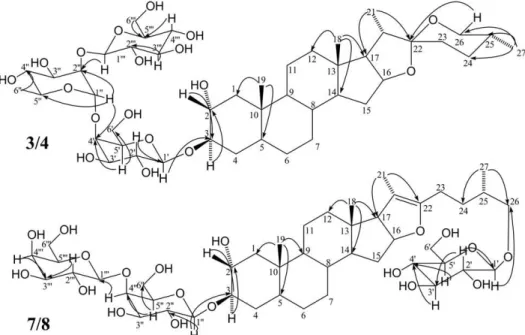
The attachment of the sugar moieties to C-3 of the aglycone was deduced by long-range correlations between the anomeric proton of the galactopyranosyl unit at dH 4.92
(H-1’) and the carbons at dC 85.6/85.2 (C-3) in the HMBC
spectrum. Moreover, the correlations between the anomeric proton of the glucopyranosyl unit at dΗ 5.53 (H-1’’’) with the carbon at dC 76.5 (C-2’’) of the rhamnopyranosyl, whose
anomeric proton at dΗ 6.38/6.28 (H-1’’) correlated with the carbons at dC 78.4/78.0 (C-4’) of the galactopyranosyl,
established the sugar sequence (Figure 2).
The nuclear overhauser effect spectroscopy (NOESY) spectrum provided certain information for the stereostructure assignments. This spectrum showed NOE correlations between the signals at dH 0.70 (H-19) and 3.91 (H-2), and
between dH 1.05 (H-5) and 3.82 (H-3), and the junction
of rings A/B was confirmed to be trans. Figure 3 shows all diagnostic dipolar-dipolar interactions observed for compounds 3/4.
Thus, the structure of 3/4 was elucidated as the new (25-R,S)-5α-spirostan-2α,3β-diol-3-O-β -D-glucopyranosyl-(1→2)-α-L-rhamnopyranosyl-(1→4)-β -D-galactopyranoside.
Compounds 5/6, white solid, were isolated as one single peak by RP HPLC. The existence of several signals with closely similar chemical shifts in the NMR spectra led to the conclusion that this compound, as the other previously described, was also an epimeric mixture.
Inspection of the 1H NMR spectrum also suggested a
steroidal saponin for compounds 5/6, by the signals relative to methyl groups at dH 0.70 (s, H-18), 0.90 (s, H-19), 1.60
(s, H-21) and 0.95 (d, J 6.0 Hz, H-27), and the protons of the sugar units in the range of dH 3.2-3.9, besides the
Figure 2.1H,13C heteronuclear multiple-bond correlation spectroscopy (HMBC) of compounds 3/4 and 7/8.
two anomerics at dH 4.22 (d, J 7.8 Hz, H-1’) and 4.32 (d, J 7.4 Hz, H-1’’).
A typical ∆20,22-furostanol skeleton was deduced after
comparative analysis of the 13C NMR data with those of
compounds 1/2 and 3/4, that revealed the absence of the carbons relative to a spiroketal, and the presence of typical signals of unsaturated carbons at dC 105.2/105.3 (C-20) and
153.0/153.1 (C-22), besides one oxymethylene at dC75.9
(C-26).16,17 The presence of the 2α,3β-dioxy-decalin moiety
was supported by the oxymethine carbons at dC 71.7 (C-2)
and 85.1 (C-3).
The sugar units were confirmed as glucose and galactose by comparison of their chemical shifts with those reported for sugar moieties.10-15 Their β-orientations were
as ascertained by the relatively large coupling constants of the anomeric protons. This was further confirmed by the precursor ion peak at m/z 757.4372 (calcd. for 757.4374) in the HRESIMS, and the subsequent loss of the two sugar units at m/z 595.3828 and 433.3308.
The attachment of the sugar moieties was deduced through the HMBC analysis by the correlation peaks observed for the anomeric proton of the glucose unit at
dΗ4.22 (H-1’) with the oxymethylene carbon at dC75.9/75.8
(C-26), and for the anomeric proton of the galactopyranosyl unit at dΗ4.22 (H-1’’) with the carbon at dC85.1 (C-3) of
the aglycone. In addition, long range correlations were also detected for the proton at dΗ 0.95 (H-27) with the carbons at dC75.9 (C-26) and 32.2 (C-24), and for the
proton at dΗ 4.70 (H-16), 2.48 (H-17) and 1.71 (H-24) with the unsaturated carbons at dC 153.1/153.0 (C-22).
The C-25 configuration was assigned as 25R and 25S
based on the observed difference of the 1H NMR chemical
shifts related to the H-26 geminal protons (∆ab = da − db).
The values of ∆ab= 0.34 and 0.46 were in agreement with
those reported for 25R and 25S furostane-type steroidal saponins (∆ab < 0.35 for 25R; ∆ab> 0.45 for 25S).17 From
the above mentioned data compound 5/6 was assigned as the new 26-O-β-D-glucopyranosyl-(25R,S)-5α -furost-20-ene,2α,3β-diol-3-O-β-D-galactopyranoside.
Compounds 7/8 were isolated as white solid. As observed previously, the several signals with closely similar chemical shifts in the NMR spectra revealed it to be an epimeric mixture.
Comparison of the NMR data of 7/8 with those correspondents of 5/6 revealed that these compounds were quite similar, except for the presence of an additional hexose monosaccharide. Three anomeric protons at dH4.22
(d, J 7.2 Hz, H-1’), 4.33 (d, J 7.2 Hz, H-1’’) and 4.82 (m, H-1’’’) were observed in the 1H NMR spectrum. In
addition, the resonances of the aglycone moiety containing one glucose unit linked to C-26 appeared almost identical
in the 13C NMR, while some slight differences were
detected among the resonances of the galactose that was linked to C-3 (Tables 1 and 2). In particular, the signals for C-4’’ (dC 70.5) and for H-4’’ (dH3.82) of 5/6 were a lot
more shielded than the corresponding C-4’’ (dC 79.4) and
H-4’’(dH 4.02) on 7/8. These data suggested the additional
sugar moiety to be linked at C-4’’. It was identified as
β-D-galactopyranosyl by comparison of its 13C NMR
chemical shifts with those reported for sugar moieties and by GC analysis.14 The quasimolecular ion peak at m/z
919.4902 (calcd. for 919.4902) in the HRESIMS, and the subsequent fragmentations at m/z 757.4390, 595.3831 and 433.3283, corroborated the above data.
The HMBC long range correlations of the anomeric proton at dΗ 4.82 (H-1’’’) with the carbon at dC 79.4 (C-4’’)
confirmed the attachment of the additional galactose unit at C-4’’. Similarly, the anomeric proton at dH 4.33 (H-1’’)
showed correlation with the carbon at dC 85.3 (C-3) of the
aglycone (Figure 2). Thus, compounds 7/8 was elucidated as the new 26-O-β-D-glucopyranosyl-(25R,S)-5α -furost-20-ene,2α,3β-diol-3-O-β-D-galactopyranosyl-(1→4)-β -D-galactopyranoside.
The genus Cestrum is a known as an abundant source of saponins. The natural role of these compounds in plants is to protect them against potential pathogens, that would be related with their antimicrobial activity.18-20 Compounds 1/2
exhibited antimicrobial activity against Candida albicans
and Candida parapsilosis with MIC50 3.9 and 7.0 µg mL−1,
while compounds 9/10 showed moderated activity with IC50 7.0 µg mL−1 (Table 3). Compounds 3/4 showed
moderated activity against C. krusei and C. albicans with IC50 7.8 µg mL−1, and compounds 5/6 and 7/8 were inactive
to all microorganisms. In addition, the cytotoxic activity of all compounds was evaluated against HCT-116, OVCAR-8, HL-60, and SF-295 cell lines (Table 4). Compounds 1/2 exhibited high cytotoxic activity to HL-60, with IC50
value of 2.22 µg mL−1, and moderate activity against
the others with IC50 ranging from 6.88 to 10.8 µg mL−1.
Compounds 3/4 showed only moderate activity to all cell lines with IC50 ranging from 7.28 to 15.30 µg mL−1.
Compounds 9/10 showed moderate activity against HL-60, OVCAR-8 and HCT-116 with IC50 ranging from 11.3 to
16.7 µg mL−1, and were inactive against SF-295 cell lines.
In contrast, compounds 5/6 and 7/8 were inactive to all cell lines.
Conclusions
Table 1.1H nuclear magnetic resonance (NMR) chemical shifts of compounds 1/2, 3/4, 5/6 and 7/8 (J in Hz)
H
1/2a,c 3/4a,c 5/6b,d 7/8b,d
dH / ppm dH/ ppm dH / ppm dH / ppm
25R 25S 25R 25S 25R 25S 25R 25S
1 2.21 (d, 12.0) 1.07 (m)
e 2.16 (m)
1.15 (m)
e 1.98 (m)
0.90 (m)
e 1.98 (m)
0.93 (m)
e
2 3.92 (m) e 3.91 (m) e 3.68 (m) e 3.61 (m) e
3 3.82 (m) e 3.82 (m) e 3.48 (m) e 3.46 (m) e
4 1.81 (m)
1.42 (m)
e 1.80 (m)
1.42 (m)
e 1.73 (m)
1.42 (m)
e 1.60 (m)
1.25 (m)
e
5 1.00 (m) e 1.05 (m) e 1.05 (m) e 1.20 (t, 12.6) e
6 1.15 (m)
1.04 (m)
e 1.15 (m)
1.03 (m)
e 1.41 (m)
1.23 (m)
e 1.35 (m)
1.24 (m)
e
7 1.53 (m)
0.78 (m)
e 1.51 (m)
0.78 (m)
e 1.71 (m)
0.96 (sl)
e 1.70 (m) e
8 1.40 (m) e 1.39 (m) e 1.52 (m) e 1.53 (m) e
9 0.60 (t, 9.6) e 0.57 (m) e 0.78 (m) e 0.70 (m) e
10 − e − e - e − e
11 1.48 (m) 1.22 (m)
e 1.44 (m)
1.19 (m)
e 1.57 (m)
1.40 (m)
e 1.58 (m)
1.39 (m)
e
12 1.62 (m) 1.04 (m)
e 1.62 (m)
1.03 (m)
e 1.80 (m)
1.22 (m)
e 1.79 (m)
1.25 (m)
e
13 − e − − - e − e
14 1.03 (m) e 1.05 (m) e 1.05 (m) e 1.04 (m) e
15 2.00 (m) 1.40 (m)
e 2.00 (m)
1.38 (m)
e 2.10 (m)
1.39 (m)
e 2.15 (m)
1.38 (m)
e
16 4.51 (m) 4.51 (m) 4.54 (m) e 4.70 (dd, 15.6, 7.8) e 4.70 (dd, 15.7, 7.8) e
17 1.78 (m) e 1.78 (m) e 2.48 (d, 10.0) e 2.47 (d, 9.6) e
18 0.80 (s) 0.79 (s) 0.78 (s) 0.79 (s) 0.70 (s) e 0.70 (s) e
19 0.72 (s) e 0.70 (s) e 0.90 (s) e 0.90 (s) e
20 1.93 (m) 1.89 1.88 (m) 1.92 (m) - − − −
21 1.13 (d, 3.6) 1.12 (d, 3.6) 1.13 (m) e 1.60 (s) e 1.60 (s) e
22 − − − − - − − −
23 1.66 (m) 1.38 (m) 1.67 (m) 1.34 (m) 2.14 e 2.12 (m) e
24 1.55 (m) 1.35 (m)
e 1.70 (m)
1.62 (m)
e 1.71 (m)
1.40 (m)
e 1.61 (m)
1.25 (m)
e
25 1.59 (m) e 1.56 (m) 1.59 (m) 1.53 (m) e 1.76 (m) e
26 3.49 (d, 9.6) 3.58 (m)
4.04 (m) 3.36 (d, 10.8)
3.58 (dd, 7.9, 2.5) 3.52 (t, 10.4)
4.09 (m) 3.38 (d, 11.0)
3.71 (m) 3.37 (m) 3.78 (m) 3.32 (m) 3.72 (m) 3.37 (m) 3.78 (m) 3.33 (m) 27 0.70 (d, 5.3) 1.06 (d, 5.3) 0.70 (d, 8.7) 1.06 (d, 7.0) 0.95 (d, 6.0) e 0.95 (d, 6.0) e
1’ 4.89 (d, 7.7) e 4.92 (m) e 4.22 (d, 7.8) e 4.22 (d, 7,2) e
2’ 4.42 (m) e 4.62 (m) e 3.19 (t, 7.6) e 3.17 (t, 9.0) e
3’ 4.22 (m) e 4.22 (m) e 3.32 (m) e 3.35 (m) e
4’ 4.65 (m) e 3.95 (d, 4.5) e 3.51 (m) e 3.25 (m) e
5’ 4.09 (m) e 4.10 (m) e 3.53 (m) e 3.29 (m) e
6’ 4.52 (m) 4.17 (m)
e 4.56 (m) 4.21(m) e 3.85 (m) e 3.85 (m)
3.67 (m)
e
1’’ 5.60 (d, 7.9) e 6.38 (s) 6.28 (s) 4.32 (d, 7.4) e 4.33 (d, 7.2) e
2’’ 4.04 (d, 4.5) e 4.76 (sl) e 3.52 (m) e 3.56 (m) e
3’’ 4.22 (m) e 4.76 (sl) e 3.51 (m) e 3.58 (m) e
4’’ 4.62 (m) e 4.27 (t, 9.5) 4.22 (m) 3.82 (m) e 4.02 (d, 7.8) e
5’’ 4.10 (m) e 4.92 (m) 4.89 (m) 3.27 (m) e 3.25 (m) e
6’’ 4.54 (m) 4.19 (m)
e 1.77 (d, 6.0) e 3.68 (m) e 3.85 (m)
3.66 (m)
e
1’’’ 5.19 (d, 7.7) e 5.53 (d, 7.3) − − − 4.82 (m) e
2’’’ 4.10 (m) e 4.25 (m) − − − 3.38 (m) e
3’’’ 4.19 (m) e 4.20 (m) − − − 3.58 (m) e
4’’’ 4.04 (m) e 4.15 (m) − − − 3.43 (m) e
5’’’ 3.98 (m) e 4.07 (m) − − − 3.72 (m) e
6’’’ 4.60 (m) 4.23 (m)
e 4.55 (m)
4.14 (m)
− − − 3.85 (m)
3.58 (m)
e
a1H NMR data recorded at 500 MHz; band at 600 MHz; csolvent C
Table 2.13C nuclear magnetic resonance (NMR) chemical shifts of compounds 1/2, 3/4, 5/6, 7/8 and 9/10
C
1/2a,c 3/4a,c 5/6a,d 7/8b,d 9/10a,c
dC/ ppm dC/ ppm dC/ ppm dC/ ppm dC/ ppm
25R 25S 25R 25S 25R 25S 25R 25S 25R 25S
1 46.0 e 45.8 e 46.0 46.1 45.9 46.0 46.1 e
2 70.7 e 70.9 70.5 71.7 e 71.6 e 71.0 e
3 85.0 e 85.6 85.2 85.1 e 85.3 e 85.5 e
4 34.3 e 34.2 34.0 34.3 e 34.3 e 34.6 e
5 44.9 e 45.0 e 46.0 e 45.9 e 45.0 e
6 28.4 e 28.4 e 29.2 e 29.2 e 28.5 e
7 32.4 e 32.5 e 33.6 e 33.6 e 32.6 e
8 34.9 e 34.9 e 35.8 e 35.8 e 35.0 e
9 54.7 e 54.7 e 55.9 e 55.8 e 54.8 e
10 37.2 e 37.2 e 38.1 e 38.0 e 37.2 e
11 21.7 e 21.7 e 22.6 e 22.6 e 21.8 e
12 40.4 e 40.3 e 41.0 e 41.0 e 40.4 e
13 41.1 e 41.1 41.0 44.8 e 44.8 e 41.1 e
14 56.6 e 56.6 e 56.1 e 56.1 e 56.7 e
15 32.5 e 32.4 e 35.2 e 35.2 e 32.5 e
16 81.4 81.5 81.4 81.5 85.8 e 85.8 e 81.5 81.6
17 63.3 63.4 63.1 63.2 65.4 e 65.7 e 63.2 63.4
18 16.9 e 16.9 e 14.9 15.0 15.0 15.9 16.9 e
19 13.7 e 13.7 e 13.9 e 13.9 e 13.8 e
20 42.3 42.8 42.2 42.3 105.2 105.3 105.3 104.8 42.4 42.8
21 15.2 15.3 15.1 15.3 12.0 e 12.0 e 15.2 15.4
22 109.5 110.1 109.5 110.0 153.0 153.1 153.0 e 109.6 110.0
23 32.1 26.7 32.1 26.6 24.2 e 24.3 e 32.2 26.8
24 29.6 26.5 29.5 e 32.2 e 32.2 e 29.6 26.6
25 30.9 27.8 30.9 27.9 34.3 e 35.1 e 31.0 27.9
26 67.2 65.4 67.2 65.4 76.0 75.9 75.9 75.8 67.2 65.5
27 17.6 16.9 17.6 16.6 17.5 e 17.5 17.4 17.7 16.7
1’ 103.7 e 105.4 e 104.6 e 104.6 e 104.5 e
2’ 73.3 e 72.9 e 75.3 e 75.3 e 72.7 e
3’ 75.2 e 72.3 e 78.3 e 78.3 e 75.7 e
4’ 80.4 e 78.0 78.4 71.8 e 71.8 e 70.6 e
5’ 76.2 e 75.7 e 77.0 e 78.0 e 77.6 e
6’ 63.6 e 61.3 e 62.9 e 62.9 e 62.7 e
1’’ 105.3 e 102.3 102.4 103.5 e 103.3 e − −
2’’ 73.6 e 76.5 e 72.6 e 75.8 e − −
3’’ 75.4 e 72.7 72.9 75.0 e 75.2 e − −
4’’ 80.4 e 74.7 74.3 70.5 e 79.4 e − −
5’’ 76.0 e 70.7 71.0 78.0 e 78.0 e − −
6’’ 63.6 e 19.1 e 62.7 e 61.6 e − −
1’’’ 107.4 e 104.1 e − − 104.0 e − −
2’’’ 76.2 e 73.1 e − − 73.3 e − −
3’’’ 79.0 e 77.7 e − − 75.3 e − −
4’’’ 69.8 e 71.0 e − − 69.4 e − −
5’’’ 78.8 e 78.4 e − − 76.0 e − −
6’’’ 61.2 e 63.5 e − − 63.6 e − −
a13C NMR data were recorded at 125 MHz; band at 150 MHz; csolvent C
skeleton 1/2, 3/4 and 5/6 exhibited antimicrobial activity against Candida albicans, Candida krusei and Candida parapsilosis and cytotoxic activity against HCT-116, OVCAR-8, HL-60 and SF-295 cancer cell lines, while the furostanols 5/6 and7/8 were inactive. These results indicate that the ring closure in C-22/C-26 typical of spirostanol skeleton appears to play an important role in the antimicrobial and cytotoxicity activities.
Supplementary Information
Supplementary data are available free of charge at http://jbcs.sbq.org.br as PDF file
Acknowledgments
The authors are grateful to Conselho Nacional de Desenvolvimento Científico e Tecnológico (CNPq), Coordenação de Aperfeiçoamento de Pessoal de Nível Superior (CAPES), Programa de Apoio aos Núcleos de Excelência (PRONEX) and Fundação Cearense de Apoio ao Desenvolvimento Científico e Tecnológico (FUNCAP) for the fellowships and financial support. We also thank
Centro Nordestino de Aplicação e Uso da Ressonância Magnética Nuclear (CENAUREMN) of the Universidade Federal do Ceará for the NMR data; and to Laboratório de Química de Produtos Naturais, Empresa Brasileira de Pesquisa Agropecuária (Embrapa) Agroindústria Tropical (CE) for GC analysis and for NMR and high-resolution mass spectra.
References
1. Mimaki, Y.; Watanabe, K.; Sakagami, H.; Sashida, Y.; J. Nat. Prod. 2002, 65, 1863.
2. Yan, W.; Ohtani, K.; Kasai, R.; Yamasaki, K.; Phytochemistry
1996, 42, 1417.
3. Pang, X.; Huan, H. Z.; Zhao, Y.; Xiong, C.; Yub, L. Y.; Ma, B.;
RSC Adv. 2015, 5, 4831.
4. Baqai, F. T.; Ali, A.; Ahmad, V. U.; Helv. Chim. Acta2001, 11, 3350.
5. Haraguchia, M.; Mimaki, Y.; Motidome, M.; Morita, H.; Takeya, K.; Itokawa, H.; Yokosuka, A.; Sashida, Y.; Phytochemistry
2000, 55, 715.
6. Dôbereiner, J.; Tokarnia, C. I.; Canella, C. F. C.; Pesq. Agropec. Bras. 1969, 4, 16.
Table 4. Cytotoxicity against four human cancer cell lines
Compound HL-60
IC50a / (µg mL–1)
OVCAR-8 IC50a / (µg mL–1)
HCT-116 IC50a / (µg mL–1)
SF-295 IC50a / (µg mL–1)
1/2 2.22 (1.55-3.17) 10.80 (9.51-12.27) 7.27 (5.93-8.90) 6.88 (4.49-10.56)
3/4 7.28 (6.68-7.95) 15.30 (11.91-19.64) 11.41 (9.63-13.51) 12.90 (10.78-15.43)
5/6 ND ND ND ND
7/8 ND ND ND ND
9/10 16.68 (11.85-23.49) 11.30 (9.21-13.87) 16.50 (14.3-19.1) > 25
Doxorubicinb 0.02 (0.01-0.02) 0.26 (0.17- 0.3) 0.12 (0.09-0.17) 0.24 (0.02-0.27)
a95% of confidence interval; bpositive control. Experiments were performed in triplicate. ND: Not determined. Table 3. Antimicrobial activity
Compound C. krusei
MIC50 / (µg mL−1)
C. parapsilosis
MIC50 / (µg mL−1)
C. albicans
MIC50 / (µg mL−1)
P. aeruginosa
haloa / mm
B. subitilis
haloa / mm
S. aureus
haloa / mm
1/2 125.0 7.0 3.9 NA NA NA
3/4 7.8 125.0 7.8 NA NA NA
5/6 > 500 > 500 > 250 NA NA NA
7/8 > 500 > 500 > 500 NA NA NA
9/10 31.2 > 500 7.0 NA NA NA
Fluconazole 16.0 0.125 4.0 − − −
Cefepime − − − 33 26 30
Controlb NA NA NA NA NA NA
7. Barbosa, J. D.; Oliveira, C. M. C.; Pinheiro, C.; Lopes, C. T.
A.; Marquiore, D.; Brito, M. F.; Yamasaki, E. M.; Tokarnia, C. H.; Pesq. Vet. Bras. 2010, 30, 12.
8. Clinical and Laboratory Standards Institute (CLSI); Performance Standards for Antimicrobial Susceptibility Testing; CLSI
Standard M100-S23: Wayne, PA, USA, 2013.
9. Clinical and Laboratory Standards Institute (CLSI); Reference Method for Broth Dilution Antifungal Susceptibility Testing of
Yeasts; CLSI Standard M27-A3: Wayne, PA, USA, 2008.
10. Plock, A.; Beyer, G.; Hiller, K.; Gründemann, E.; Krause, E.; Nimtz, M.; Wray, V.; Phytochemistry2001, 57, 489. 11. Sang, S.; Lao, A.; Wang, H.; Chen, Z.; J. Nat. Prod. 1999, 62,
1028.
12. Mimaki, Y.; Kuroda, M.; Kameyama, A.; Yokosuka, A.; Sashida, Y.; Phytochemistry1998, 48, 1361.
13. Agrawal, P. K.; Jain, D. C.; Gufta, R. K.; Thakur, R. S.;
Phytochemistry1985, 24, 2479.
14. Chen, S.; Snyder, J. K.; J. Org. Chem. 1989, 54, 3679.
15. Espejo, O.; Llavot, J. C.; Jung, H.; Giral, F.; Phytochemistry
1982, 21, 413.
16. Xu, J.; Feng, S.; Wang, Q.; Cao, Y.; Sun, M.; Zhang, C.;
Molecules 2014, 19, 20975.
17. Challinor, V. L.; Piacente, S.; De Voss, J. J.; Steroids 2012, 77, 602.
18. Bhattacharjee, I.; Ghosh, A.; Ghandra, G.; Afr. J. Biotechnol.
2005, 4, 371.
19. Khan, M. A.; Inayat, H.; Khan, H.; Saeed, M.; Khan, I.; Rahman, I. U.; Afr. J. Microbiol. Res.2011, 5, 612.
20. Sivaraj, B.; Vidya, C.; Nandini, S.; Sanil, R.; Int. J. Curr. Microbiol. Appl. Sci, 2015, 4, 830.
Submitted: November 19, 2015
Published online: April 8, 2016